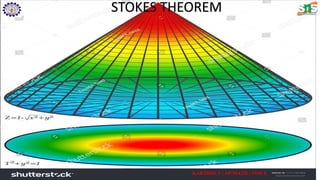
STOKES THEOREM
KARTHIK.V | AP/MATH | SNSCE
Introduction to Stokes'
Theorem
Stokes' Theorem is a fundamental theorem in vector calculus that relates
a surface integral of a vector field to a line integral of the field's curl. It
provides a powerful tool for evaluating flux across a surface in three-
dimensional space.
KARTHIK.V | AP/MATH | SNSCE
Overview of Vector Calculus
Scalar and Vector
Fields
Vector calculus deals
with the study of scalar
and vector fields in
three-dimensional
space.
Gradient,
Divergence, Curl
Topics include
gradients, divergence,
curl, and their
applications in physics
and engineering.
Line and Surface
Integrals
Line and surface
integrals play a key
role in defining and
understanding vector
calculus concepts.
KARTHIK.V | AP/MATH | SNSCE
Understanding Line Integrals
• Definition: Line integrals measure the total effect of a vector field along a curve.
• Direction: Positive and negative results indicate the direction of the flow along the curve.
• Applications: Widely used in physics, engineering, and computer graphics for various calculations.
KARTHIK.V | AP/MATH | SNSCE
Explanation of Surface Integrals
1 Definition
A surface integral involves the integration of a scalar or vector field over a
surface. It measures the flux of the field through the surface.
2 Surface Orientation
The orientation of the surface plays a crucial role in determining the direction
of the flux and is essential for correctly setting up the integral.
3 Applications
Surface integrals are used in physics, engineering, and fluid dynamics to
calculate quantities like flow rates, electric flux, and surface area.
KARTHIK.V | AP/MATH | SNSCE
The Concept of a Closed Surface
Definition
A closed surface is a
surface that completely
encloses a finite volume
within itself. It has no
boundaries or openings,
and it is often used in
vector calculus to
understand concepts of
flux and circulation.
Application
In physics, closed
surfaces are essential for
understanding the flow of
vector fields such as
electric and magnetic
fields. They allow for the
calculation of flux, which
measures the flow of a
vector field through the
surface.
Mathematical
Representation
A closed surface can be
mathematically
represented using
equations that describe
its boundaries and any
internal volumes. These
representations are
crucial for the application
of Stokes' Theorem and
other vector calculus
concepts.
KARTHIK.V | AP/MATH | SNSCE
Stokes' Theorem
In vector calculus, Stokes' Theorem relates a surface integral of the curl
of a vector field to a line integral of the vector field around the boundary of
the surface. It provides a fundamental connection between line integrals
and surface integrals.
KARTHIK.V | AP/MATH | SNSCE
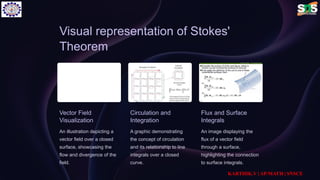
Visual representation of Stokes'
Theorem
Vector Field
Visualization
An illustration depicting a
vector field over a closed
surface, showcasing the
flow and divergence of the
field.
Circulation and
Integration
A graphic demonstrating
the concept of circulation
and its relationship to line
integrals over a closed
curve.
Flux and Surface
Integrals
An image displaying the
flux of a vector field
through a surface,
highlighting the connection
to surface integrals.
KARTHIK.V | AP/MATH | SNSCE
Application of Stokes' Theorem in
Physics
Stokes' Theorem finds widespread application in physics, particularly in the fields of fluid
dynamics, electromagnetism, and quantum mechanics. It allows for the conversion of
complex surface integrals into simpler line integrals, providing a powerful tool for analyzing
vector fields in three-dimensional space.
KARTHIK.V | AP/MATH | SNSCE
Examples of calculating line integrals
using Stokes' Theorem
Identify the vector field
Begin by identifying the vector field involved in the line integral.
Choose a closed curve
Select a closed curve that encompasses the surface of interest.
Apply Stokes' Theorem
Use the theorem to find the line integral by evaluating the curl of the vector
field over the surface.
KARTHIK.V | AP/MATH | SNSCE
Examples of calculating surface
integrals using Stokes' Theorem
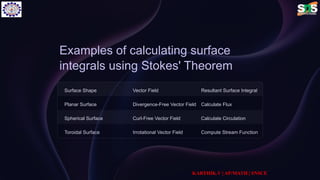
Surface Shape Vector Field Resultant Surface Integral
Planar Surface Divergence-Free Vector Field Calculate Flux
Spherical Surface Curl-Free Vector Field Calculate Circulation
Toroidal Surface Irrotational Vector Field Compute Stream Function
KARTHIK.V | AP/MATH | SNSCE

7 stokes theorem with explanation .pptx

  • 1.
  • 2.
    Introduction to Stokes' Theorem Stokes'Theorem is a fundamental theorem in vector calculus that relates a surface integral of a vector field to a line integral of the field's curl. It provides a powerful tool for evaluating flux across a surface in three- dimensional space. KARTHIK.V | AP/MATH | SNSCE
  • 3.
    Overview of VectorCalculus Scalar and Vector Fields Vector calculus deals with the study of scalar and vector fields in three-dimensional space. Gradient, Divergence, Curl Topics include gradients, divergence, curl, and their applications in physics and engineering. Line and Surface Integrals Line and surface integrals play a key role in defining and understanding vector calculus concepts. KARTHIK.V | AP/MATH | SNSCE
  • 4.
    Understanding Line Integrals •Definition: Line integrals measure the total effect of a vector field along a curve. • Direction: Positive and negative results indicate the direction of the flow along the curve. • Applications: Widely used in physics, engineering, and computer graphics for various calculations. KARTHIK.V | AP/MATH | SNSCE
  • 5.
    Explanation of SurfaceIntegrals 1 Definition A surface integral involves the integration of a scalar or vector field over a surface. It measures the flux of the field through the surface. 2 Surface Orientation The orientation of the surface plays a crucial role in determining the direction of the flux and is essential for correctly setting up the integral. 3 Applications Surface integrals are used in physics, engineering, and fluid dynamics to calculate quantities like flow rates, electric flux, and surface area. KARTHIK.V | AP/MATH | SNSCE
  • 6.
    The Concept ofa Closed Surface Definition A closed surface is a surface that completely encloses a finite volume within itself. It has no boundaries or openings, and it is often used in vector calculus to understand concepts of flux and circulation. Application In physics, closed surfaces are essential for understanding the flow of vector fields such as electric and magnetic fields. They allow for the calculation of flux, which measures the flow of a vector field through the surface. Mathematical Representation A closed surface can be mathematically represented using equations that describe its boundaries and any internal volumes. These representations are crucial for the application of Stokes' Theorem and other vector calculus concepts. KARTHIK.V | AP/MATH | SNSCE
  • 7.
    Stokes' Theorem In vectorcalculus, Stokes' Theorem relates a surface integral of the curl of a vector field to a line integral of the vector field around the boundary of the surface. It provides a fundamental connection between line integrals and surface integrals. KARTHIK.V | AP/MATH | SNSCE
  • 8.
    Visual representation ofStokes' Theorem Vector Field Visualization An illustration depicting a vector field over a closed surface, showcasing the flow and divergence of the field. Circulation and Integration A graphic demonstrating the concept of circulation and its relationship to line integrals over a closed curve. Flux and Surface Integrals An image displaying the flux of a vector field through a surface, highlighting the connection to surface integrals. KARTHIK.V | AP/MATH | SNSCE
  • 9.
    Application of Stokes'Theorem in Physics Stokes' Theorem finds widespread application in physics, particularly in the fields of fluid dynamics, electromagnetism, and quantum mechanics. It allows for the conversion of complex surface integrals into simpler line integrals, providing a powerful tool for analyzing vector fields in three-dimensional space. KARTHIK.V | AP/MATH | SNSCE
  • 10.
    Examples of calculatingline integrals using Stokes' Theorem Identify the vector field Begin by identifying the vector field involved in the line integral. Choose a closed curve Select a closed curve that encompasses the surface of interest. Apply Stokes' Theorem Use the theorem to find the line integral by evaluating the curl of the vector field over the surface. KARTHIK.V | AP/MATH | SNSCE
  • 11.
    Examples of calculatingsurface integrals using Stokes' Theorem Surface Shape Vector Field Resultant Surface Integral Planar Surface Divergence-Free Vector Field Calculate Flux Spherical Surface Curl-Free Vector Field Calculate Circulation Toroidal Surface Irrotational Vector Field Compute Stream Function KARTHIK.V | AP/MATH | SNSCE
  • 12.