• Vector integration, also known as line or path integration,
involves integrating a vector field along a curve or path. This
mathematical concept has various applications in physics,
engineering, and other scientific disciplines.
• The fundamental concept is similar to scalar integration, but
instead of dealing with scalar functions, vector integration
deals with vector-valued functions.
• The result is a vector quantity.
• A line integral is a mathematical
concept used in calculus to
calculate the total of a scalar or
vector field along a curve or path.
• Line integrals are used in physics,
engineering, and various other
fields to model and analyze
quantities that depend on the path
taken.
• There are two main types of line
integrals: scalar line integrals and
vector line integrals.

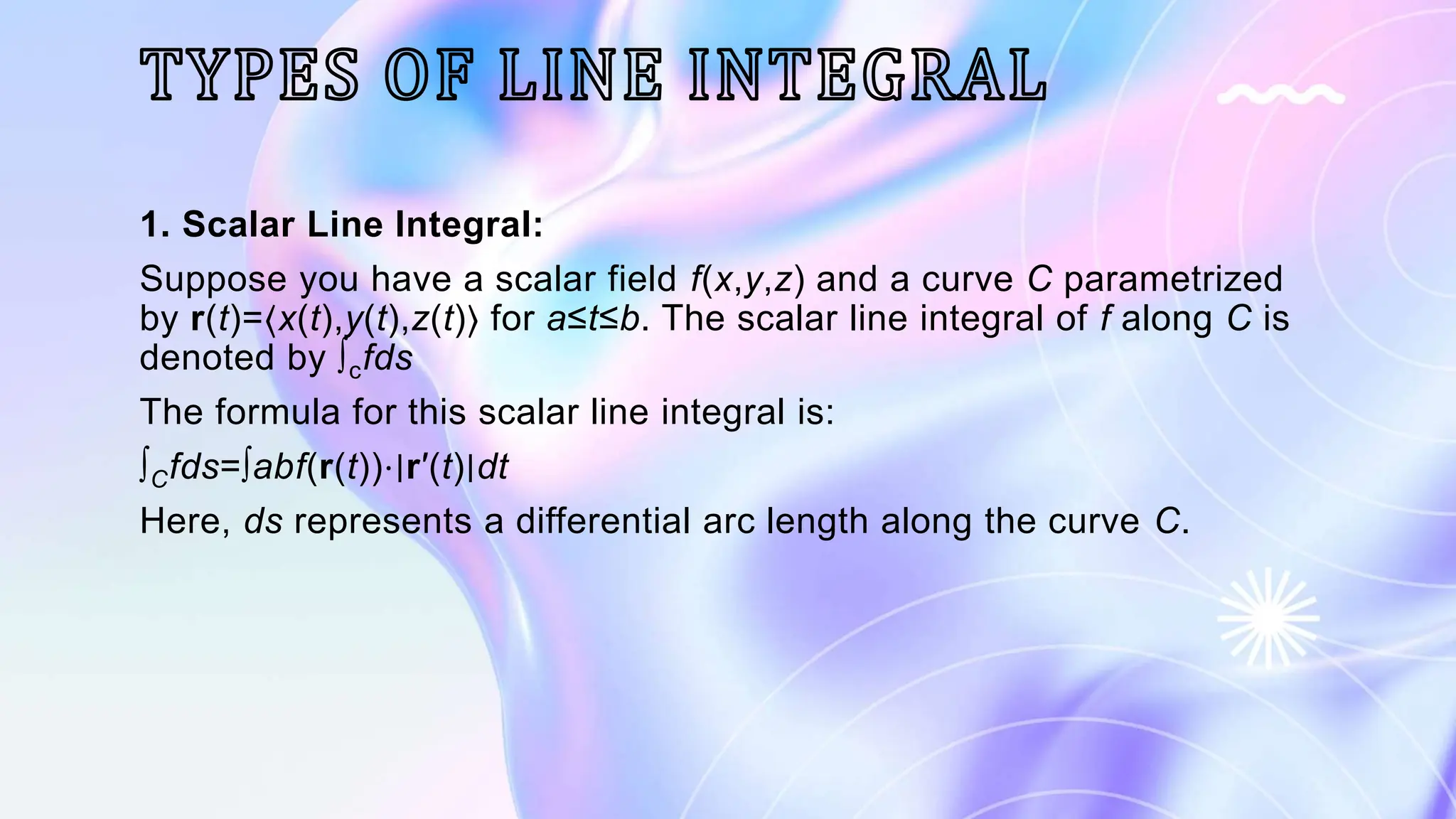
1. Scalar Line Integral:
Suppose you have a scalar field f(x,y,z) and a curve C parametrized
by r(t)=⟨x(t),y(t),z(t)⟩ for a≤t≤b. The scalar line integral of f along C is
denoted by ∫cfds
The formula for this scalar line integral is:
∫Cfds=∫abf(r(t))⋅∣r′(t)∣dt
Here, ds represents a differential arc length along the curve C.
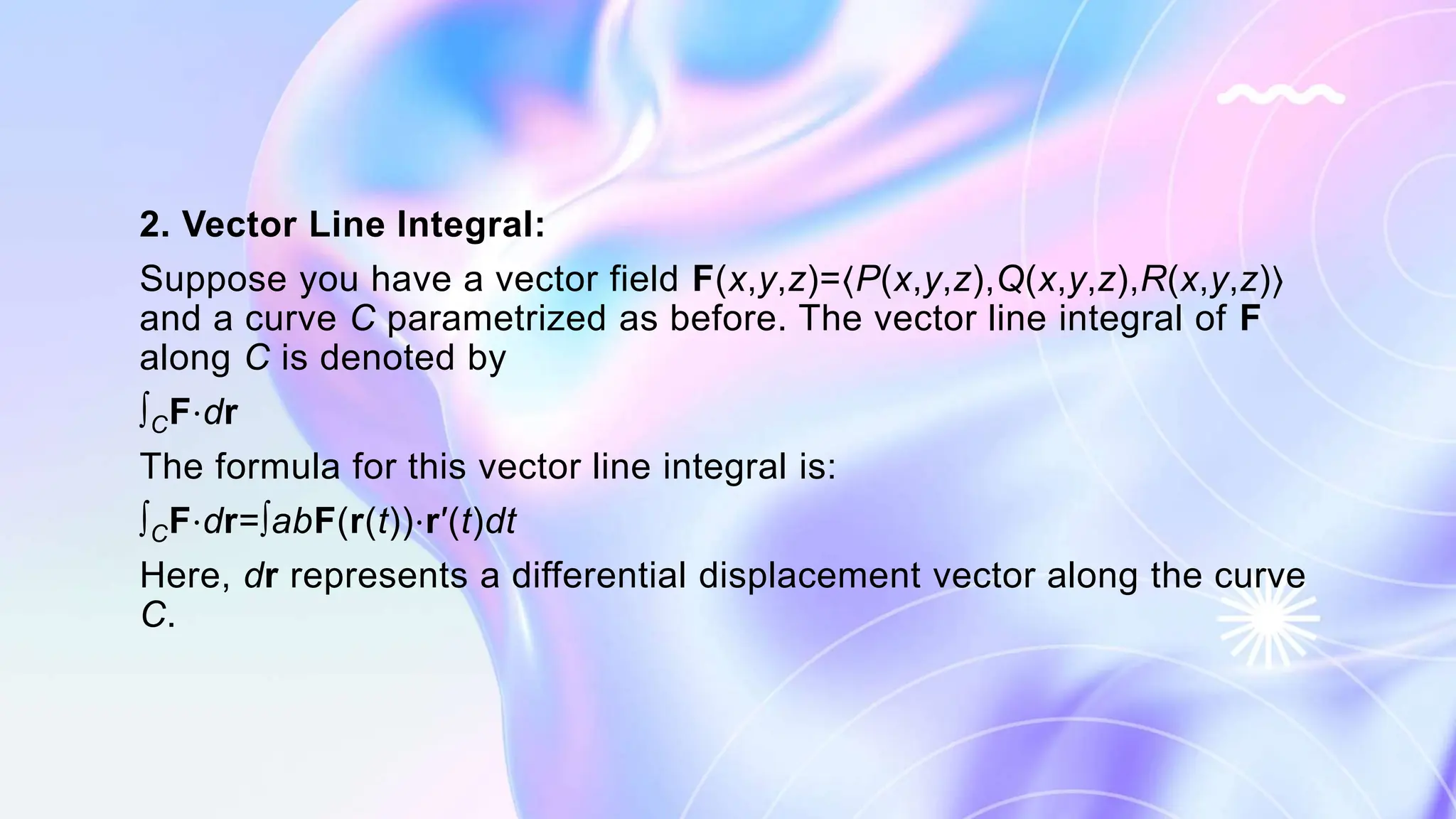
2. Vector Line Integral:
Suppose you have a vector field F(x,y,z)=⟨P(x,y,z),Q(x,y,z),R(x,y,z)⟩
and a curve C parametrized as before. The vector line integral of F
along C is denoted by
∫CF⋅dr
The formula for this vector line integral is:
∫CF⋅dr=∫abF(r(t))⋅r′(t)dt
Here, dr represents a differential displacement vector along the curve
C.
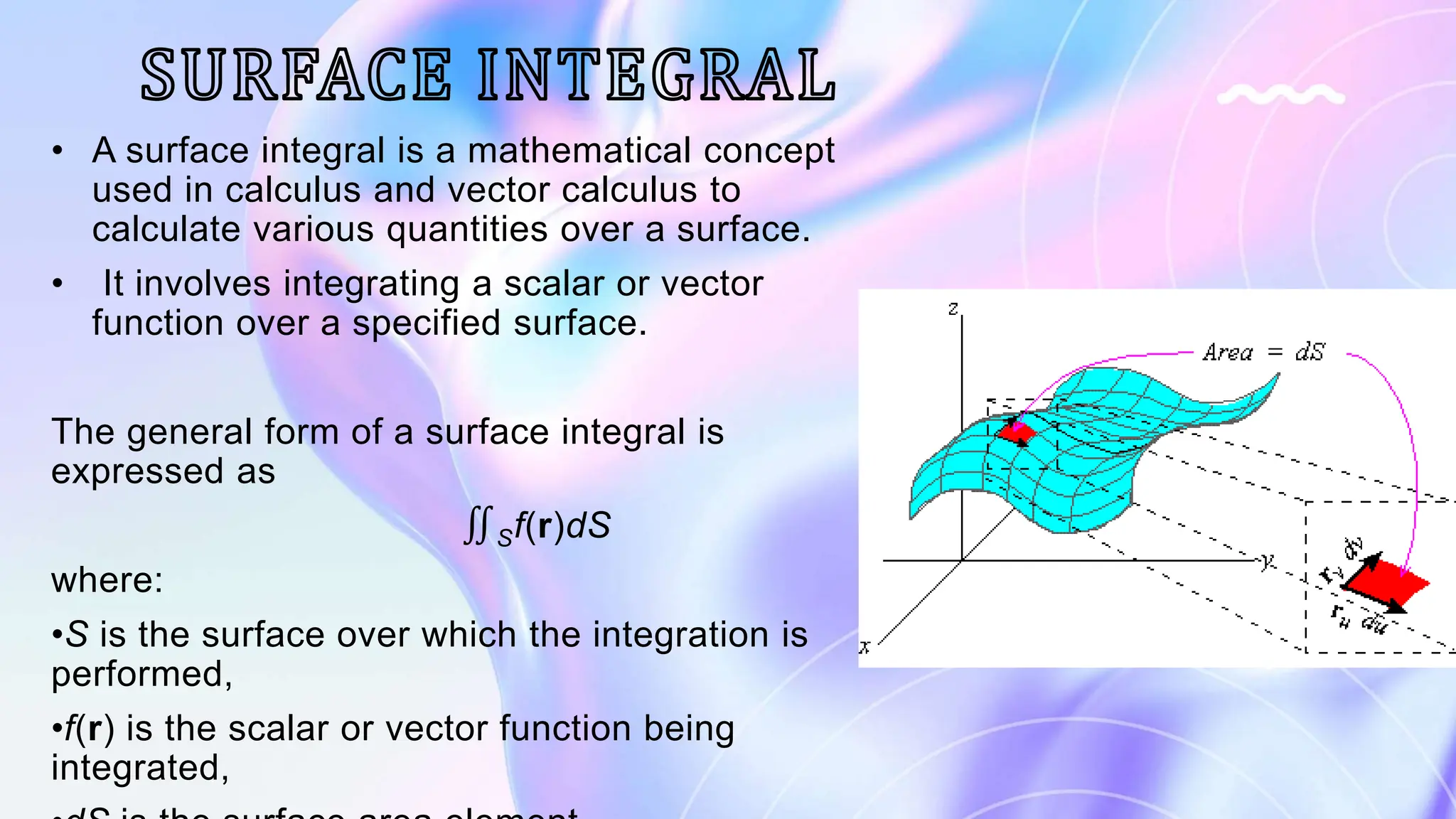
• A surface integral is a mathematical concept
used in calculus and vector calculus to
calculate various quantities over a surface.
• It involves integrating a scalar or vector
function over a specified surface.
The general form of a surface integral is
expressed as
∬Sf(r)dS
where:
•S is the surface over which the integration is
performed,
•f(r) is the scalar or vector function being
integrated,
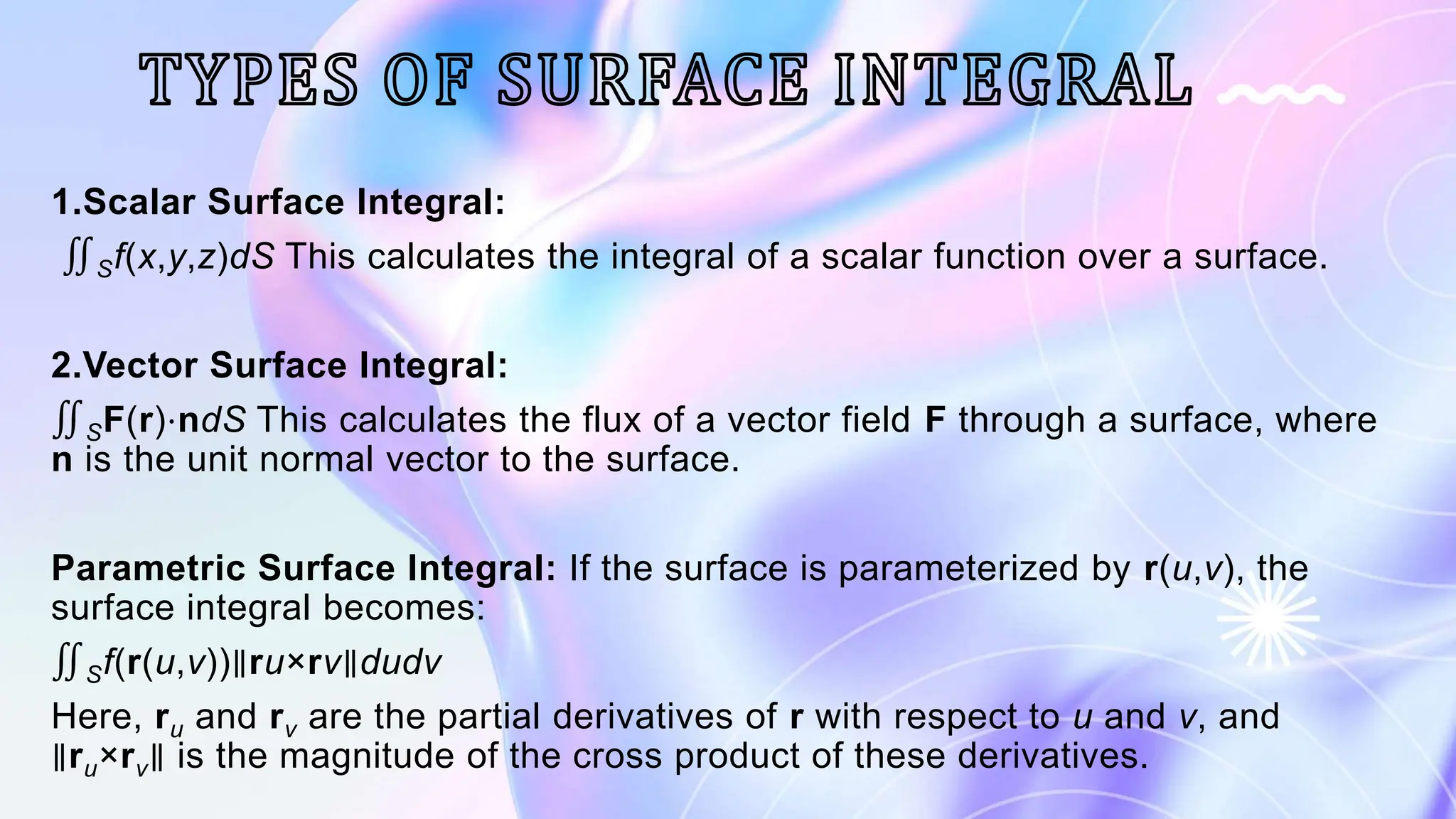
1.Scalar Surface Integral:
∬Sf(x,y,z)dS This calculates the integral of a scalar function over a surface.
2.Vector Surface Integral:
∬SF(r)⋅ndS This calculates the flux of a vector field F through a surface, where
n is the unit normal vector to the surface.
Parametric Surface Integral: If the surface is parameterized by r(u,v), the
surface integral becomes:
∬Sf(r(u,v))∥ru×rv∥dudv
Here, ru and rv are the partial derivatives of r with respect to u and v, and
∥ru×rv∥ is the magnitude of the cross product of these derivatives.
Suppose we have a force field F(x,y) = xi+yj and a curve C given by the
parametric equations x(t)=t and y(t)=t2 for 0≤t≤1.
We want to calculate the work done by the force field F along the curve C.
where dr = idx+jdy is the differential displacement vector along the curve.
The curve is parameterized by t, so dx=dt and dy=2tdt.
The work done (W) is given by the line integral:
W=∫CF⋅dr
W=∫C(xi+yj ).(idx,jdy )
W=∫Cxdx+ydy
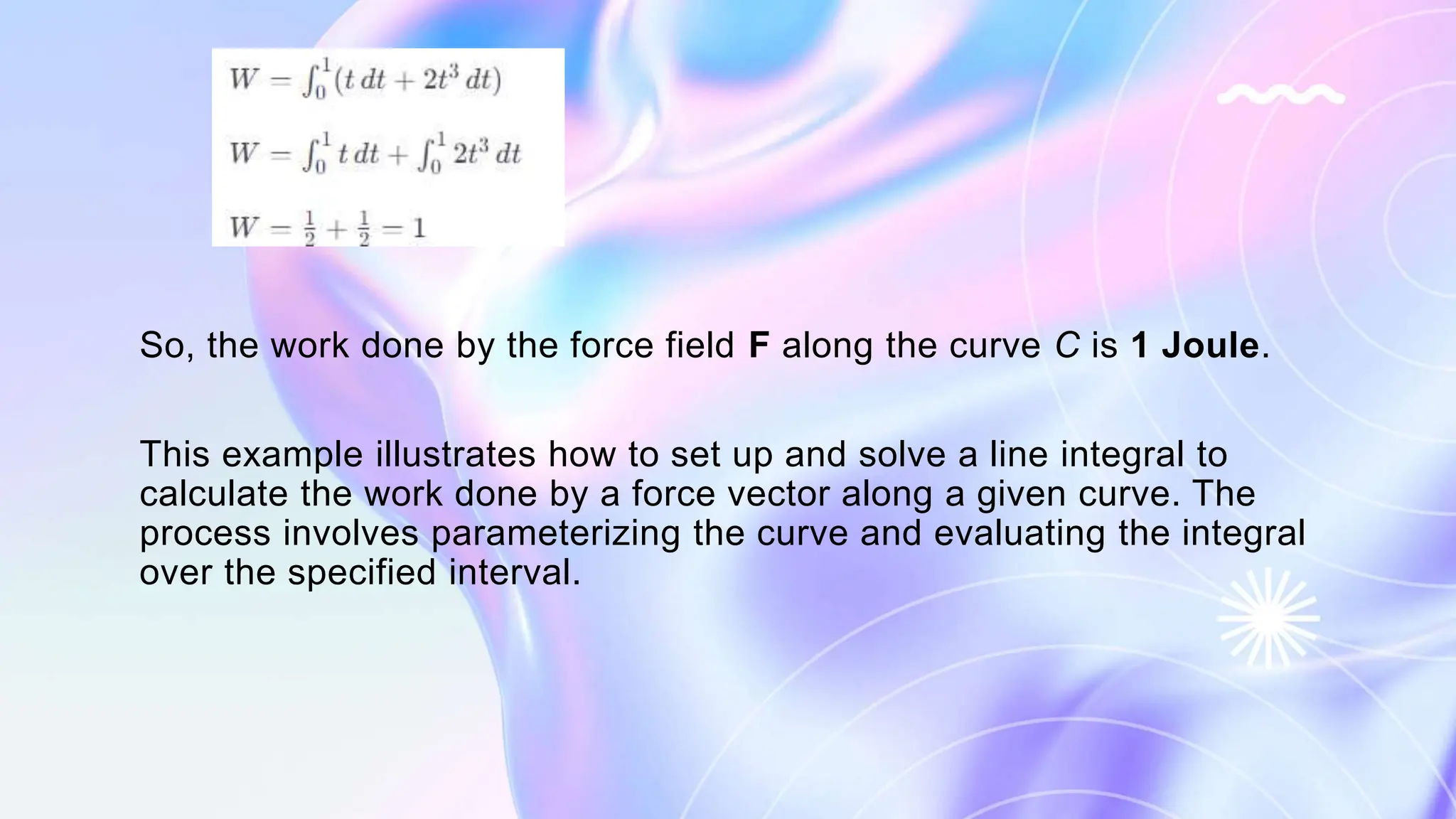
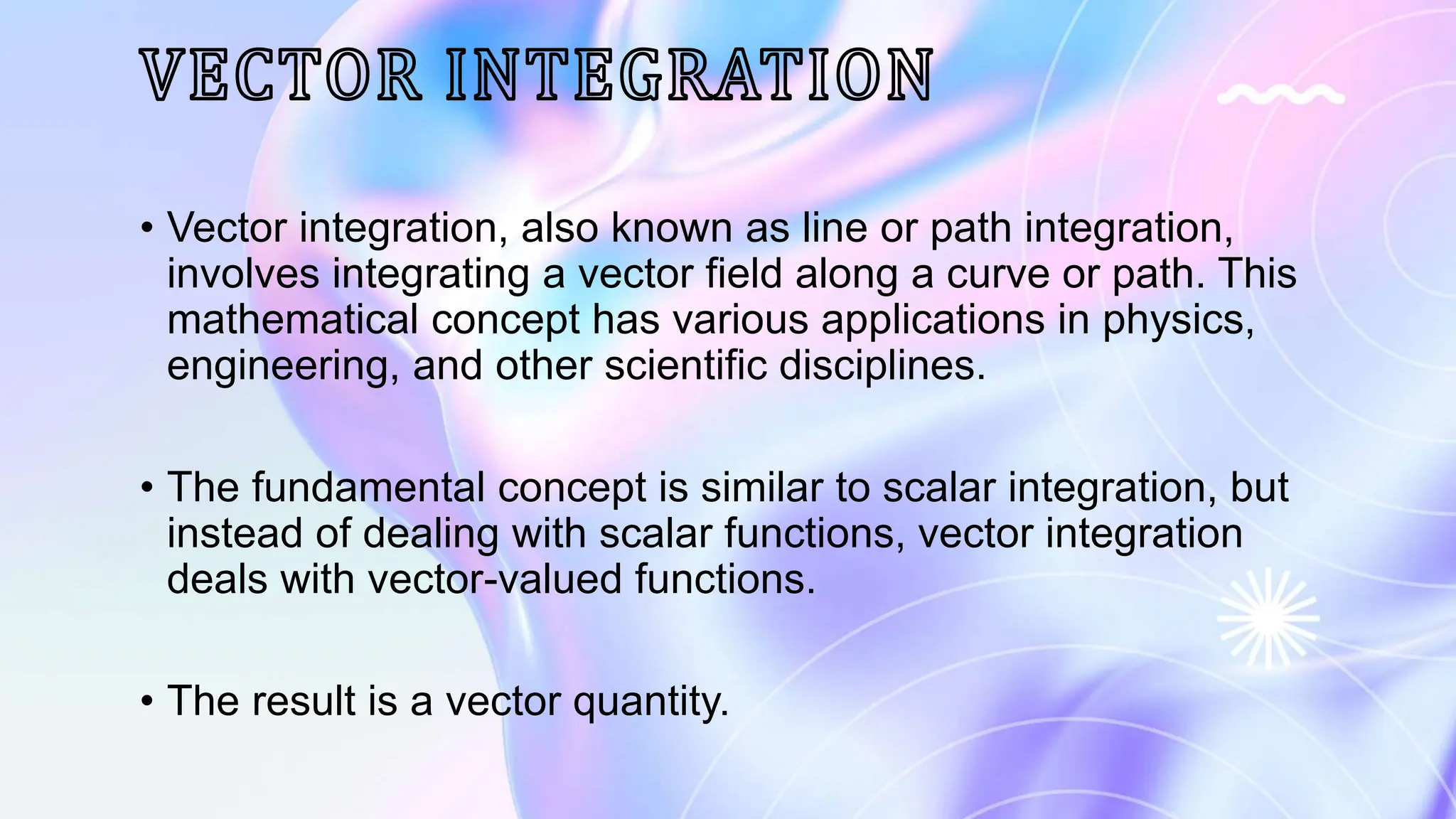
So, the work done by the force field F along the curve C is 1 Joule.
This example illustrates how to set up and solve a line integral to
calculate the work done by a force vector along a given curve. The
process involves parameterizing the curve and evaluating the integral
over the specified interval.
Suppose we have a vector field F(x,y)=yi + xj (in Newtons) and a curve C
represented by the parameterization r(t)= t+t2 for 0≤t≤1.
We want to calculate the flux of the vector field F across the curve C.
The flux (Φ) is given by the line integral:
Φ=∫CF⋅nds
where n is the unit normal vector to the curve C, and ds is the differential arc
length along the curve.
First, let's find the unit normal vector n. The tangent vector to the curve is
given by r′(t)=1i + 2tj, and the unit tangent vector is
T=r′/∥r′∥ ​=(1i+2tj)/√(12+(2t)2)
The unit normal vector is then n= −2ti+1j
The differential arc length ds is given by ds=∥r′∥dt=1+(2t)2​dt
Now, we can set up the line integral:
Φ=∫0
1F⋅nds
Φ=∫0
1(t2i,tj)⋅(−2ti,1j)√(1+(2t)2)dt
Φ=∫0
1​(−2t3+t) √(1+(2t)2)dt
This integral can be computed to find the flux across the curve C.
This example illustrates how to set up and solve a line integral to
calculate the flux of a vector field across a given curve. The process
involves finding the unit normal vector to the curve and evaluating the
integral over the specified interval.
The circulation of a vector field along a closed curve is a line integral
that describes the tendency of the vector field to circulate around the
curve. Mathematically, the circulation (C) is given by:
C=∮CF⋅dr
where:
•∮C denotes a closed curve integral,
•F is the vector field,
•dr is the differential displacement vector along the closed curve.
Suppose we have a 2D vector field F(x,y)=−yi+xj (in Newtons) and a
closed curve C in the counterclockwise direction defined by the
parameterization r(t)=acos(t)i+asin(t)j for 0≤t≤2π.
We want to calculate the circulation of the vector field F along the
closed curve C.
So, the circulation of the vector
field F along the closed curve C is
2πa2 Newton-meters.
Application Of vector Integration and all

Application Of vector Integration and all

  • 2.
    • Vector integration,also known as line or path integration, involves integrating a vector field along a curve or path. This mathematical concept has various applications in physics, engineering, and other scientific disciplines. • The fundamental concept is similar to scalar integration, but instead of dealing with scalar functions, vector integration deals with vector-valued functions. • The result is a vector quantity.
  • 3.
    • A lineintegral is a mathematical concept used in calculus to calculate the total of a scalar or vector field along a curve or path. • Line integrals are used in physics, engineering, and various other fields to model and analyze quantities that depend on the path taken. • There are two main types of line integrals: scalar line integrals and vector line integrals.
  • 4.
    1. Scalar LineIntegral: Suppose you have a scalar field f(x,y,z) and a curve C parametrized by r(t)=⟨x(t),y(t),z(t)⟩ for a≤t≤b. The scalar line integral of f along C is denoted by ∫cfds The formula for this scalar line integral is: ∫Cfds=∫abf(r(t))⋅∣r′(t)∣dt Here, ds represents a differential arc length along the curve C.
  • 5.
    2. Vector LineIntegral: Suppose you have a vector field F(x,y,z)=⟨P(x,y,z),Q(x,y,z),R(x,y,z)⟩ and a curve C parametrized as before. The vector line integral of F along C is denoted by ∫CF⋅dr The formula for this vector line integral is: ∫CF⋅dr=∫abF(r(t))⋅r′(t)dt Here, dr represents a differential displacement vector along the curve C.
  • 6.
    • A surfaceintegral is a mathematical concept used in calculus and vector calculus to calculate various quantities over a surface. • It involves integrating a scalar or vector function over a specified surface. The general form of a surface integral is expressed as ∬Sf(r)dS where: •S is the surface over which the integration is performed, •f(r) is the scalar or vector function being integrated,
  • 7.
    1.Scalar Surface Integral: ∬Sf(x,y,z)dSThis calculates the integral of a scalar function over a surface. 2.Vector Surface Integral: ∬SF(r)⋅ndS This calculates the flux of a vector field F through a surface, where n is the unit normal vector to the surface. Parametric Surface Integral: If the surface is parameterized by r(u,v), the surface integral becomes: ∬Sf(r(u,v))∥ru×rv∥dudv Here, ru and rv are the partial derivatives of r with respect to u and v, and ∥ru×rv∥ is the magnitude of the cross product of these derivatives.
  • 9.
    Suppose we havea force field F(x,y) = xi+yj and a curve C given by the parametric equations x(t)=t and y(t)=t2 for 0≤t≤1. We want to calculate the work done by the force field F along the curve C. where dr = idx+jdy is the differential displacement vector along the curve. The curve is parameterized by t, so dx=dt and dy=2tdt. The work done (W) is given by the line integral: W=∫CF⋅dr W=∫C(xi+yj ).(idx,jdy ) W=∫Cxdx+ydy
  • 10.
    So, the workdone by the force field F along the curve C is 1 Joule. This example illustrates how to set up and solve a line integral to calculate the work done by a force vector along a given curve. The process involves parameterizing the curve and evaluating the integral over the specified interval.
  • 11.
    Suppose we havea vector field F(x,y)=yi + xj (in Newtons) and a curve C represented by the parameterization r(t)= t+t2 for 0≤t≤1. We want to calculate the flux of the vector field F across the curve C. The flux (Φ) is given by the line integral: Φ=∫CF⋅nds where n is the unit normal vector to the curve C, and ds is the differential arc length along the curve. First, let's find the unit normal vector n. The tangent vector to the curve is given by r′(t)=1i + 2tj, and the unit tangent vector is T=r′/∥r′∥ ​=(1i+2tj)/√(12+(2t)2)
  • 12.
    The unit normalvector is then n= −2ti+1j The differential arc length ds is given by ds=∥r′∥dt=1+(2t)2​dt Now, we can set up the line integral: Φ=∫0 1F⋅nds Φ=∫0 1(t2i,tj)⋅(−2ti,1j)√(1+(2t)2)dt Φ=∫0 1​(−2t3+t) √(1+(2t)2)dt This integral can be computed to find the flux across the curve C. This example illustrates how to set up and solve a line integral to calculate the flux of a vector field across a given curve. The process involves finding the unit normal vector to the curve and evaluating the integral over the specified interval.
  • 13.
    The circulation ofa vector field along a closed curve is a line integral that describes the tendency of the vector field to circulate around the curve. Mathematically, the circulation (C) is given by: C=∮CF⋅dr where: •∮C denotes a closed curve integral, •F is the vector field, •dr is the differential displacement vector along the closed curve.
  • 14.
    Suppose we havea 2D vector field F(x,y)=−yi+xj (in Newtons) and a closed curve C in the counterclockwise direction defined by the parameterization r(t)=acos(t)i+asin(t)j for 0≤t≤2π. We want to calculate the circulation of the vector field F along the closed curve C. So, the circulation of the vector field F along the closed curve C is 2πa2 Newton-meters.