IS 2401 LINEAR ALGEBRA 
AND 
DIFFERENTIAL 
EQUATIONS 
ASSIGNMENT - 02
Contents 
GROUP MEMBERS .................................................................................................................................... 3 
INTRODUCTION ........................................................................................................................................ 4 
FUNDAMENTAL THEORIES OF VECTOR INTEGRATION ................................................................. 5 
del (∇) operator ......................................................................................................................................... 5 
The gradient .............................................................................................................................................. 5 
Curl ........................................................................................................................................................... 6 
Divergence ................................................................................................................................................ 6 
Basic Vector integration theories. ............................................................................................................. 6 
Theorem 1: ............................................................................................................................................ 6 
Theorem 2 : ........................................................................................................................................... 6 
Theorem 1.3: ......................................................................................................................................... 7 
Theorem 1.4: ......................................................................................................................................... 7 
Theorem 1.5: ......................................................................................................................................... 7 
Application of vector integration in fluid dynamics ................................................................................... 10 
To find the rate of change of the mass of a fluid flows. .......................................................................... 10 
Stock theorem ......................................................................................................................................... 11 
Calculate the circulation of the fluid about a closed curve. ................................................................ 11 
To analyze the vorticity of the fluid body ........................................................................................... 11 
Bjerknes Circulation Theorem ................................................................................................................ 13 
To analysis sea breeze ......................................................................................................................... 13 
Application of vector calculus in Electricity and Magnetism ..................................................................... 14 
Theorem: ............................................................................................................................................. 17
GROUP MEMBERS 
Name Registration number 
1) Fernando W.T.V.S EG/2013/2191 
2) Perera A.L.V.T.A EG/2013/2278 
3) Ismail T.A EG/2013/2209 
4) Kapuge A.K.V.S EG/2013/2224 
5) SurendraC.K.B.B EG/2013/2318
INTRODUCTION 
The objective of this report is to create a simple explanation on application of Vector 
Integration. To do this we have analyzed concepts of vector calculus, fluid dynamics, and the 
Navier-Stokes equation. Upon finding such useful and insightful information, this report 
evolved into a study of how the Navier-Stokes equation was derived. 
The Navier-Stokes equation is named after Claude-Louis Navier and George Gabriel Stokes. 
This equation provides a mathematical model of the motion of a fluid. It is an important 
equation in the study of fluid dynamics, and it uses many core aspects to vector calculus. 
Before explaining the Navier-Stokes equation it is important to cover several aspects of 
computational fluid dynamics. At the core of this is the notion of a vector field. A vector field 
is defined as a mapping from each point in 2- or 3-dimensional real space to a vector. Each 
such vector can be thought of as being composed of a directional unit vector and a scalar 
multiplier. In the context of fluid dynamics, the value of a vector field at a point can be used 
to indicate the velocity at that point. Vector fields are useful in the study of fluid dynamics, 
since they make it possible to discern the approximated path of a fluid at any given point.
FUNDAMENTAL THEORIES OF VECTOR INTEGRATION 
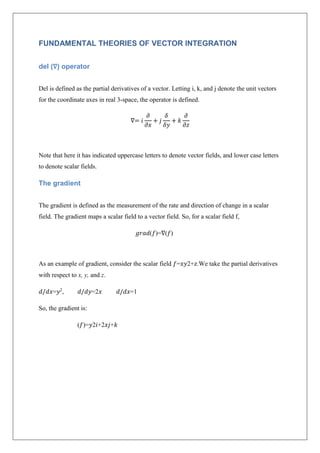
del (∇) operator 
Del is defined as the partial derivatives of a vector. Letting i, k, and j denote the unit vectors 
for the coordinate axes in real 3-space, the operator is defined. 
∇= 푖 
휕 
휕푥 
+ 푗 
훿 
훿푦 
+ 푘 
휕 
휕푧 
Note that here it has indicated uppercase letters to denote vector fields, and lower case letters 
to denote scalar fields. 
The gradient 
The gradient is defined as the measurement of the rate and direction of change in a scalar 
field. The gradient maps a scalar field to a vector field. So, for a scalar field f, 
푔푟푎푑(푓)=∇(푓) 
As an example of gradient, consider the scalar field 푓=푥푦2+푧.We take the partial derivatives 
with respect to x, y, and z. 
푑/푑푥=푦2, 푑/푑푦=2푥 푑/푑푥=1 
So, the gradient is: 
(푓)=푦2푖+2푥푗+푘
Curl 
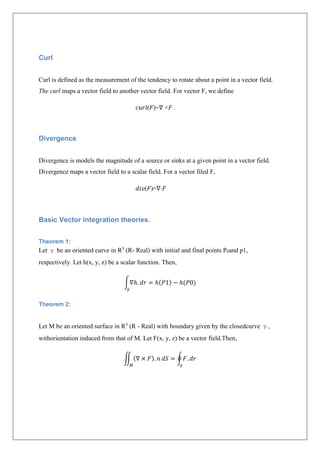
Curl is defined as the measurement of the tendency to rotate about a point in a vector field. 
The curl maps a vector field to another vector field. For vector F, we define 
푐푢푟푙(퐹)=∇ ×퐹 . 
Divergence 
Divergence is models the magnitude of a source or sinks at a given point in a vector field. 
Divergence maps a vector field to a scalar field. For a vector filed F, 
푑푖푣(퐹)=∇∙퐹 
Basic Vector integration theories. 
Theorem 1: 
Let γ be an oriented curve in R3 (R- Real) with initial and final points P0and p1, 
respectively. Let h(x, y, z) be a scalar function. Then, 
∫∇ℎ. 푑푟 = ℎ(푃1) − ℎ(푃0) 
훾 
Theorem 2: 
Let M be an oriented surface in R3 (R - Real) with boundary given by the closedcurve γ, 
withorientation induced from that of M. Let F(x, y, z) be a vector field.Then, 
∬ (∇ × 퐹). 푛 
푀 
푑푆 = ∮퐹. 푑푟 
훾
Theorem 1.3: 
Let E be a bounded solid region in R3(R- Real) with boundary given by theclosed surface M, 
with theoutward pointing orientation. Let F(x, y, z) be a vectorfield. Then, 
∭(∇. 퐹) 푑푉 = ∯ 퐹. 푛 푑푆 
퐸 푀 
Theorem 1.4: 
A vector field F in R3 is said to be conservative or irrational ifany of the following 
equivalent conditions hold: 
∇ × F = 0 At every point. 
∫ 퐹. 푑푟 
훾 
Is independent of the path joining the same two endpoints. 
∮ 퐹. 푑푟 = 0 
훾 
For any closed path γ. 
F = ∇h For some scalar potential h. 
In fact this theorem is true for vector fields defined in any region where all closedpaths can 
be shrunk to a point without leaving the region. 
Theorem 1.5: 
A vector field F in R3 is said to be solenoidal or incompressible ifany of the following 
equivalent conditions hold: 
∇.F = 0 At every point. 
∬ 퐹. 푛 푑푆 
푀 
Is independent of the surface M having the same boundary 
curve. 
∯ 퐹. 푛 푑푆 = 0 
푀 
For any closed surface M.
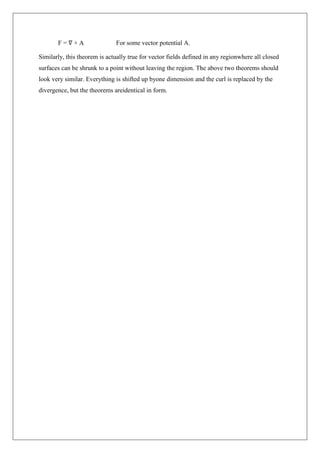
F = ∇ × A For some vector potential A. 
Similarly, this theorem is actually true for vector fields defined in any regionwhere all closed 
surfaces can be shrunk to a point without leaving the region. The above two theorems should 
look very similar. Everything is shifted up byone dimension and the curl is replaced by the 
divergence, but the theorems areidentical in form.
APPLICATION OF VECTOR INTEGRATION IN FLUID DYNAMICS 
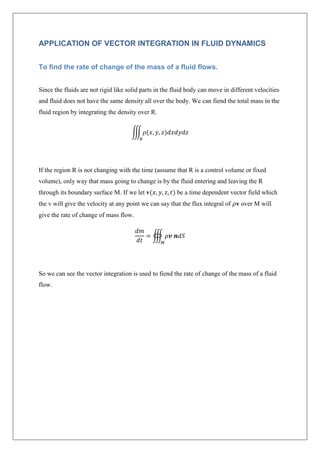
To find the rate of change of the mass of a fluid flows. 
Since the fluids are not rigid like solid parts in the fluid body can move in different velocities 
and fluid does not have the same density all over the body. We can fiend the total mass in the 
fluid region by integrating the density over R. 
∭휌(푥, 푦, 푧)푑푥푑푦푑푧 
푅 
If the region R is not changing with the time (assume that R is a control volume or fixed 
volume), only way that mass going to change is by the fluid entering and leaving the R 
through its boundary surface M. If we let v(푥, 푦, 푧, 푡) be a time dependent vector field which 
the v will give the velocity at any point we can say that the flux integral of 휌v over M will 
give the rate of change of mass flow. 
푑푚 
푑푡 
= ∰ 휌풗 풏푑푆 
푀 
So we can see the vector integration is used to fiend the rate of change of the mass of a fluid 
flow.
Stock theorem 
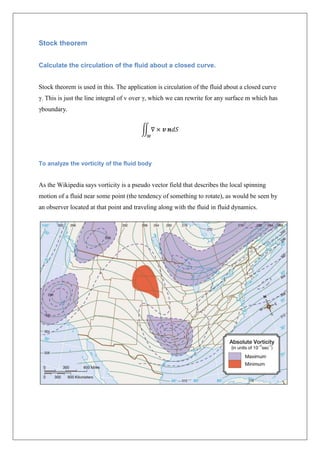
Calculate the circulation of the fluid about a closed curve. 
Stock theorem is used in this. The application is circulation of the fluid about a closed curve 
γ. This is just the line integral of v over γ, which we can rewrite for any surface m which has 
γboundary. 
∬ ∇ × 풗 
푀 
풏푑푆 
To analyze the vorticity of the fluid body 
As the Wikipedia says vorticity is a pseudo vector field that describes the local spinning 
motion of a fluid near some point (the tendency of something to rotate), as would be seen by 
an observer located at that point and traveling along with the fluid in fluid dynamics.
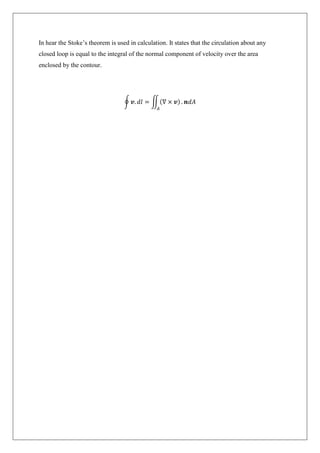
In hear the Stoke’s theorem is used in calculation. It states that the circulation about any 
closed loop is equal to the integral of the normal component of velocity over the area 
enclosed by the contour. 
∮ 풗. 푑푙 = ∬(∇ × 풗) 
퐴 
. 풏푑퐴
Bjerknes Circulation Theorem 
To analysis sea breeze 
In fluid dynamics, circulation is the line integral around a closed curve of the velocity field. It 
is obtain by taking the line integral of Newton’s second law for a closed chain of fluid partial. 
It is known as the Bjerknes Circulation Theorem. 
∫( 
푑푣 
푑푡 
= −2Ω × 풗 − 
1 
휌 
∇푝 × 품 × 푭)푑푙 
This theorem use vector integration. This theorem is used in analyzing the bartropic fluids. 
The definition of the baratropic fluids is that they are useful model for fluid behavior in a 
wide variety of scientific fields, from meteorology to astrophysics. Most liquids have a 
density which varies weakly with pressure or temperature, which is the density of a liquid, is 
nearly constant, so to first approximation liquids are barotropic. 
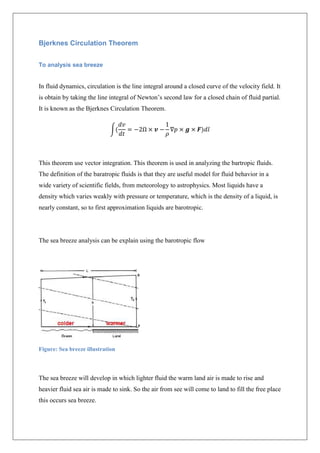
The sea breeze analysis can be explain using the barotropic flow 
Figure: Sea breeze illustration 
The sea breeze will develop in which lighter fluid the warm land air is made to rise and 
heavier fluid sea air is made to sink. So the air from see will come to land to fill the free place 
this occurs sea breeze.
APPLICATION OF VECTOR CALCULUS IN ELECTRICITY AND 
MAGNETISM 
In this discussion we will discuss the mathematical consequences of theorems.Let us take 
Electric and Magnetic field in space as E(x,y,z,t) and B(x,y,z,t) where (x,y,z) represents the 
position in space and t represents the time. Further let ρ(x,y,z,t) be charge density and 
J(x,y,z,t) the current density in space. Current density is a vector field since current is given 
by both magnitude and direction. 
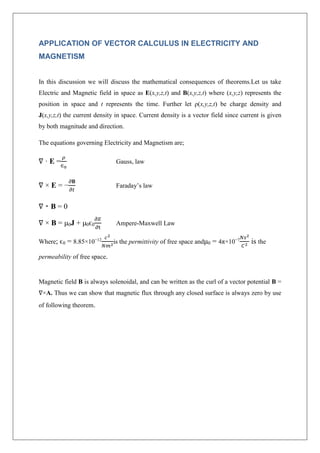
The equations governing Electricity and Magnetism are; 
휌 
∈0 
∇ · E = 
Gauss, law 
휕퐁 
휕푡 
∇ × E = − 
Faraday’s law 
∇・B = 0 
휕퐸 
∂t Ampere-Maxwell Law 
∇ × B = μ0J + μ0ϵ0 
Where; ϵ0 = 8.85×10⁻¹² 푐2 
푁푚2is the permittivity of free space andμ0 = 4π×10−7푁푠2 
퐶2 is the 
permeability of free space. 
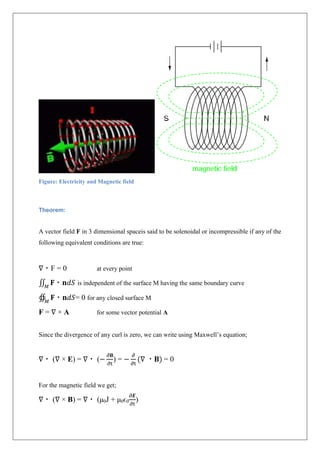
Magnetic field B is always solenoidal, and can be written as the curl of a vector potential B = 
∇×A. Thus we can show that magnetic flux through any closed surface is always zero by use 
of following theorem.
Figure: Electricity and Magnetic field 
Theorem: 
A vector field F in 3 dimensional spaceis said to be solenoidal or incompressible if any of the 
following equivalent conditions are true: 
∇・F = 0 at every point 
∬ 퐅・퐧푑푆 푀 
is independent of the surface M having the same boundary curve 
∯ 퐅・퐧푑푆 푀 
= 0 for any closed surface M 
F = ∇ × A for some vector potential A 
Since the divergence of any curl is zero, we can write using Maxwell’s equation; 
∇・ (∇ × E) = ∇・ (− 
∂퐁 
∂t 
) = − 
∂ 
∂t 
(∇ ・퐁) = 0 
For the magnetic field we get; 
∇・ (∇ × B) = ∇・ (μ0J + μ0ϵ0 
휕푬 
∂t 
)
휕 
∂t 
∇・ (∇ × B) = μ0∇・J + μ0ϵ0 
(∇・E) 
∂ρ 
∂t 
∇・ (∇ × B) = μ0 (∇・J+ 
) 
For the consistency of divergence of curl to be zero it is required that∇・J+ 
∂ρ 
∂t 
to be zero. 
This is ideally the conservation of charge. 
Now let us consider constant electric E and magnetic B fields. Then the two time derivatives 
get drop out of Maxwell’s equation. In this case the curl of electric field is zero. Thus we can 
write E = −∇ϕ. Where ϕ is some scalar potential function ϕ(x,y,z). The minus sign is used for 
the easiness thus; we can represent the flow of positive charge from higher potential point to 
lower potential. In this constant field, over a closed path the cyclic integral evaluates to zero. 
Now we have; 
ρ 
ϵ0 
∇・E = −∇・∇ ϕ = −∇2 ϕ = 
When the object is highly symmetric we can use Gauss’s Law and Ampere’s Law to calculate 
electric and magnetic fields. Consider a uniformly charged solid sphere of radius R. since 
there is no any preferred direction from symmetry we can say that electric charge outside the 
sphere is radially directed which only depend on the radius r from the origin. So E· n = E(r) 
because the electric field is parallel to the normal vector. Now we can integrate both side of 
Gauss’s Law over a solid sphere Br of some constant radius 
r > R and use the divergence theorem: 
∭ (∇ ∙ 퐄)푑푉 
퐵푟 
= ∭ 
휌 
퐵 ϵ0 푟 
푑푉 = 
푄 
ϵ0 
∯ 퐄 ∙ 퐧푑푆 = 
푀 
∯ 퐸(푟)푑푆 = 4휋푟2퐸(푟) 
푀 
Where, Q is the total charge of the sphere. 
E(r) is a constant on the sphere of radius r since ρ is constant in the charged sphere and zero 
outside it
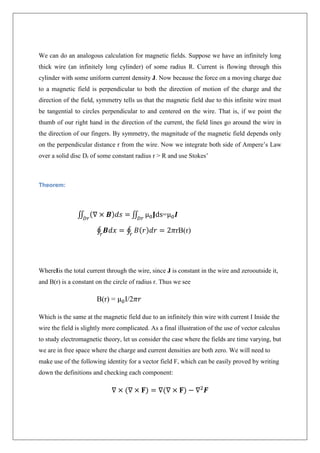
We can do an analogous calculation for magnetic fields. Suppose we have an infinitely long 
thick wire (an infinitely long cylinder) of some radius R. Current is flowing through this 
cylinder with some uniform current density J. Now because the force on a moving charge due 
to a magnetic field is perpendicular to both the direction of motion of the charge and the 
direction of the field, symmetry tells us that the magnetic field due to this infinite wire must 
be tangential to circles perpendicular to and centered on the wire. That is, if we point the 
thumb of our right hand in the direction of the current, the field lines go around the wire in 
the direction of our fingers. By symmetry, the magnitude of the magnetic field depends only 
on the perpendicular distance r from the wire. Now we integrate both side of Ampere’s Law 
over a solid disc Dr of some constant radius r > R and use Stokes’ 
Theorem: 
∬ (∇ × 푩)푑푠 = 퐷푟 ∬ μ0퐉ds 퐷푟 
=μ0푰 
∮ 푩푑푥 푟 = ∮ 퐵(푟)푑푟 = 2휋 푟 
rB(r) 
WhereIis the total current through the wire, since J is constant in the wire and zerooutside it, 
and B(r) is a constant on the circle of radius r. Thus we see 
B(r) = μ0I/2휋푟 
Which is the same at the magnetic field due to an infinitely thin wire with current I Inside the 
wire the field is slightly more complicated. As a final illustration of the use of vector calculus 
to study electromagnetic theory, let us consider the case where the fields are time varying, but 
we are in free space where the charge and current densities are both zero. We will need to 
make use of the following identity for a vector field F, which can be easily proved by writing 
down the definitions and checking each component: 
∇ × (∇ × 퐅) = ∇(∇ × 퐅) − ∇2푭
We apply this identity to both the electric and magnetic fields, and use all of Maxwell’s 
equations to simplify the results, remembering that both ρ and J are assumed to be zero: 
∇ × (∇ × 퐄) = ∇(∇. 퐄) − ∇2푬 = −∇2푬 
= ∇ (− 
휕푩 
휕푡 
) = − 
휕 
휕푡 
(∇ × 푩) = −휇° ∈° 
휕2푬 
휕푡2 
and similarly: 
∇ × (∇ × 퐁) = ∇(∇. 퐁) − ∇2푩 = −∇2푩 
= ∇ (휇° ∈° 
휕푬 
휕푡 
) = 휇° ∈° 
휕 
휕푡 
(∇ × 푬) = −휇° ∈° 
휕2푩 
휕푡2 
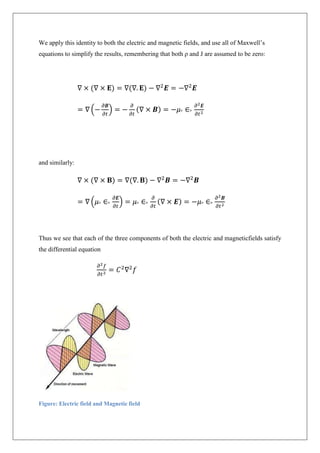
Thus we see that each of the three components of both the electric and magneticfields satisfy 
the differential equation 
휕2푓 
휕푡2 = 퐶2∇2푓 
Figure: Electric field and Magnetic field
Forc = 
1 
√(휇°∈°) 
This equation represents the motion of a wave with speed c. Hence we see that in free space 
the electric and magnetic fields propagate as waves with speed 
1 
√(휇°∈°) 
= 
1 
√(4휋×10−7푁82 )(8.85×10⁻¹² 푐2 
푁푚2) 
= 2.99863 × 10⁸ 푚 
푠 
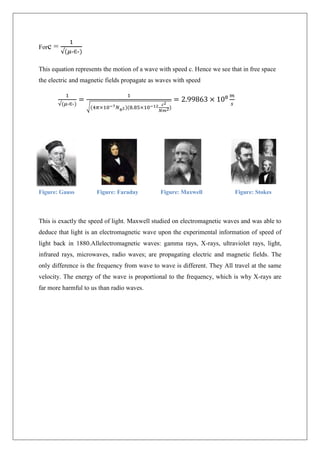
Figure: Gauss Figure: Faraday Figure: Maxwell Figure: Stokes 
This is exactly the speed of light. Maxwell studied on electromagnetic waves and was able to 
deduce that light is an electromagnetic wave upon the experimental information of speed of 
light back in 1880.Allelectromagnetic waves: gamma rays, X-rays, ultraviolet rays, light, 
infrared rays, microwaves, radio waves; are propagating electric and magnetic fields. The 
only difference is the frequency from wave to wave is different. They All travel at the same 
velocity. The energy of the wave is proportional to the frequency, which is why X-rays are 
far more harmful to us than radio waves.
REFERENCE 
http://en.wikipedia.org/wiki/Stokes'_theorem 
http://wxmaps.org/jianlu/Lecture_6.pdf 
http://www.math.ubc.ca/~cass/courses/m266-99a/ch8.pdf 
http://www.cs.umd.edu/~mount/Indep/Steven_Dobek/dobek-stable-fluid-final-2012.pdf

Application of vector integration

  • 1.
    IS 2401 LINEARALGEBRA AND DIFFERENTIAL EQUATIONS ASSIGNMENT - 02
  • 2.
    Contents GROUP MEMBERS.................................................................................................................................... 3 INTRODUCTION ........................................................................................................................................ 4 FUNDAMENTAL THEORIES OF VECTOR INTEGRATION ................................................................. 5 del (∇) operator ......................................................................................................................................... 5 The gradient .............................................................................................................................................. 5 Curl ........................................................................................................................................................... 6 Divergence ................................................................................................................................................ 6 Basic Vector integration theories. ............................................................................................................. 6 Theorem 1: ............................................................................................................................................ 6 Theorem 2 : ........................................................................................................................................... 6 Theorem 1.3: ......................................................................................................................................... 7 Theorem 1.4: ......................................................................................................................................... 7 Theorem 1.5: ......................................................................................................................................... 7 Application of vector integration in fluid dynamics ................................................................................... 10 To find the rate of change of the mass of a fluid flows. .......................................................................... 10 Stock theorem ......................................................................................................................................... 11 Calculate the circulation of the fluid about a closed curve. ................................................................ 11 To analyze the vorticity of the fluid body ........................................................................................... 11 Bjerknes Circulation Theorem ................................................................................................................ 13 To analysis sea breeze ......................................................................................................................... 13 Application of vector calculus in Electricity and Magnetism ..................................................................... 14 Theorem: ............................................................................................................................................. 17
  • 3.
    GROUP MEMBERS NameRegistration number 1) Fernando W.T.V.S EG/2013/2191 2) Perera A.L.V.T.A EG/2013/2278 3) Ismail T.A EG/2013/2209 4) Kapuge A.K.V.S EG/2013/2224 5) SurendraC.K.B.B EG/2013/2318
  • 4.
    INTRODUCTION The objectiveof this report is to create a simple explanation on application of Vector Integration. To do this we have analyzed concepts of vector calculus, fluid dynamics, and the Navier-Stokes equation. Upon finding such useful and insightful information, this report evolved into a study of how the Navier-Stokes equation was derived. The Navier-Stokes equation is named after Claude-Louis Navier and George Gabriel Stokes. This equation provides a mathematical model of the motion of a fluid. It is an important equation in the study of fluid dynamics, and it uses many core aspects to vector calculus. Before explaining the Navier-Stokes equation it is important to cover several aspects of computational fluid dynamics. At the core of this is the notion of a vector field. A vector field is defined as a mapping from each point in 2- or 3-dimensional real space to a vector. Each such vector can be thought of as being composed of a directional unit vector and a scalar multiplier. In the context of fluid dynamics, the value of a vector field at a point can be used to indicate the velocity at that point. Vector fields are useful in the study of fluid dynamics, since they make it possible to discern the approximated path of a fluid at any given point.
  • 5.
    FUNDAMENTAL THEORIES OFVECTOR INTEGRATION del (∇) operator Del is defined as the partial derivatives of a vector. Letting i, k, and j denote the unit vectors for the coordinate axes in real 3-space, the operator is defined. ∇= 푖 휕 휕푥 + 푗 훿 훿푦 + 푘 휕 휕푧 Note that here it has indicated uppercase letters to denote vector fields, and lower case letters to denote scalar fields. The gradient The gradient is defined as the measurement of the rate and direction of change in a scalar field. The gradient maps a scalar field to a vector field. So, for a scalar field f, 푔푟푎푑(푓)=∇(푓) As an example of gradient, consider the scalar field 푓=푥푦2+푧.We take the partial derivatives with respect to x, y, and z. 푑/푑푥=푦2, 푑/푑푦=2푥 푑/푑푥=1 So, the gradient is: (푓)=푦2푖+2푥푗+푘
  • 6.
    Curl Curl isdefined as the measurement of the tendency to rotate about a point in a vector field. The curl maps a vector field to another vector field. For vector F, we define 푐푢푟푙(퐹)=∇ ×퐹 . Divergence Divergence is models the magnitude of a source or sinks at a given point in a vector field. Divergence maps a vector field to a scalar field. For a vector filed F, 푑푖푣(퐹)=∇∙퐹 Basic Vector integration theories. Theorem 1: Let γ be an oriented curve in R3 (R- Real) with initial and final points P0and p1, respectively. Let h(x, y, z) be a scalar function. Then, ∫∇ℎ. 푑푟 = ℎ(푃1) − ℎ(푃0) 훾 Theorem 2: Let M be an oriented surface in R3 (R - Real) with boundary given by the closedcurve γ, withorientation induced from that of M. Let F(x, y, z) be a vector field.Then, ∬ (∇ × 퐹). 푛 푀 푑푆 = ∮퐹. 푑푟 훾
  • 7.
    Theorem 1.3: LetE be a bounded solid region in R3(R- Real) with boundary given by theclosed surface M, with theoutward pointing orientation. Let F(x, y, z) be a vectorfield. Then, ∭(∇. 퐹) 푑푉 = ∯ 퐹. 푛 푑푆 퐸 푀 Theorem 1.4: A vector field F in R3 is said to be conservative or irrational ifany of the following equivalent conditions hold: ∇ × F = 0 At every point. ∫ 퐹. 푑푟 훾 Is independent of the path joining the same two endpoints. ∮ 퐹. 푑푟 = 0 훾 For any closed path γ. F = ∇h For some scalar potential h. In fact this theorem is true for vector fields defined in any region where all closedpaths can be shrunk to a point without leaving the region. Theorem 1.5: A vector field F in R3 is said to be solenoidal or incompressible ifany of the following equivalent conditions hold: ∇.F = 0 At every point. ∬ 퐹. 푛 푑푆 푀 Is independent of the surface M having the same boundary curve. ∯ 퐹. 푛 푑푆 = 0 푀 For any closed surface M.
  • 8.
    F = ∇× A For some vector potential A. Similarly, this theorem is actually true for vector fields defined in any regionwhere all closed surfaces can be shrunk to a point without leaving the region. The above two theorems should look very similar. Everything is shifted up byone dimension and the curl is replaced by the divergence, but the theorems areidentical in form.
  • 10.
    APPLICATION OF VECTORINTEGRATION IN FLUID DYNAMICS To find the rate of change of the mass of a fluid flows. Since the fluids are not rigid like solid parts in the fluid body can move in different velocities and fluid does not have the same density all over the body. We can fiend the total mass in the fluid region by integrating the density over R. ∭휌(푥, 푦, 푧)푑푥푑푦푑푧 푅 If the region R is not changing with the time (assume that R is a control volume or fixed volume), only way that mass going to change is by the fluid entering and leaving the R through its boundary surface M. If we let v(푥, 푦, 푧, 푡) be a time dependent vector field which the v will give the velocity at any point we can say that the flux integral of 휌v over M will give the rate of change of mass flow. 푑푚 푑푡 = ∰ 휌풗 풏푑푆 푀 So we can see the vector integration is used to fiend the rate of change of the mass of a fluid flow.
  • 11.
    Stock theorem Calculatethe circulation of the fluid about a closed curve. Stock theorem is used in this. The application is circulation of the fluid about a closed curve γ. This is just the line integral of v over γ, which we can rewrite for any surface m which has γboundary. ∬ ∇ × 풗 푀 풏푑푆 To analyze the vorticity of the fluid body As the Wikipedia says vorticity is a pseudo vector field that describes the local spinning motion of a fluid near some point (the tendency of something to rotate), as would be seen by an observer located at that point and traveling along with the fluid in fluid dynamics.
  • 12.
    In hear theStoke’s theorem is used in calculation. It states that the circulation about any closed loop is equal to the integral of the normal component of velocity over the area enclosed by the contour. ∮ 풗. 푑푙 = ∬(∇ × 풗) 퐴 . 풏푑퐴
  • 13.
    Bjerknes Circulation Theorem To analysis sea breeze In fluid dynamics, circulation is the line integral around a closed curve of the velocity field. It is obtain by taking the line integral of Newton’s second law for a closed chain of fluid partial. It is known as the Bjerknes Circulation Theorem. ∫( 푑푣 푑푡 = −2Ω × 풗 − 1 휌 ∇푝 × 품 × 푭)푑푙 This theorem use vector integration. This theorem is used in analyzing the bartropic fluids. The definition of the baratropic fluids is that they are useful model for fluid behavior in a wide variety of scientific fields, from meteorology to astrophysics. Most liquids have a density which varies weakly with pressure or temperature, which is the density of a liquid, is nearly constant, so to first approximation liquids are barotropic. The sea breeze analysis can be explain using the barotropic flow Figure: Sea breeze illustration The sea breeze will develop in which lighter fluid the warm land air is made to rise and heavier fluid sea air is made to sink. So the air from see will come to land to fill the free place this occurs sea breeze.
  • 14.
    APPLICATION OF VECTORCALCULUS IN ELECTRICITY AND MAGNETISM In this discussion we will discuss the mathematical consequences of theorems.Let us take Electric and Magnetic field in space as E(x,y,z,t) and B(x,y,z,t) where (x,y,z) represents the position in space and t represents the time. Further let ρ(x,y,z,t) be charge density and J(x,y,z,t) the current density in space. Current density is a vector field since current is given by both magnitude and direction. The equations governing Electricity and Magnetism are; 휌 ∈0 ∇ · E = Gauss, law 휕퐁 휕푡 ∇ × E = − Faraday’s law ∇・B = 0 휕퐸 ∂t Ampere-Maxwell Law ∇ × B = μ0J + μ0ϵ0 Where; ϵ0 = 8.85×10⁻¹² 푐2 푁푚2is the permittivity of free space andμ0 = 4π×10−7푁푠2 퐶2 is the permeability of free space. Magnetic field B is always solenoidal, and can be written as the curl of a vector potential B = ∇×A. Thus we can show that magnetic flux through any closed surface is always zero by use of following theorem.
  • 15.
    Figure: Electricity andMagnetic field Theorem: A vector field F in 3 dimensional spaceis said to be solenoidal or incompressible if any of the following equivalent conditions are true: ∇・F = 0 at every point ∬ 퐅・퐧푑푆 푀 is independent of the surface M having the same boundary curve ∯ 퐅・퐧푑푆 푀 = 0 for any closed surface M F = ∇ × A for some vector potential A Since the divergence of any curl is zero, we can write using Maxwell’s equation; ∇・ (∇ × E) = ∇・ (− ∂퐁 ∂t ) = − ∂ ∂t (∇ ・퐁) = 0 For the magnetic field we get; ∇・ (∇ × B) = ∇・ (μ0J + μ0ϵ0 휕푬 ∂t )
  • 16.
    휕 ∂t ∇・(∇ × B) = μ0∇・J + μ0ϵ0 (∇・E) ∂ρ ∂t ∇・ (∇ × B) = μ0 (∇・J+ ) For the consistency of divergence of curl to be zero it is required that∇・J+ ∂ρ ∂t to be zero. This is ideally the conservation of charge. Now let us consider constant electric E and magnetic B fields. Then the two time derivatives get drop out of Maxwell’s equation. In this case the curl of electric field is zero. Thus we can write E = −∇ϕ. Where ϕ is some scalar potential function ϕ(x,y,z). The minus sign is used for the easiness thus; we can represent the flow of positive charge from higher potential point to lower potential. In this constant field, over a closed path the cyclic integral evaluates to zero. Now we have; ρ ϵ0 ∇・E = −∇・∇ ϕ = −∇2 ϕ = When the object is highly symmetric we can use Gauss’s Law and Ampere’s Law to calculate electric and magnetic fields. Consider a uniformly charged solid sphere of radius R. since there is no any preferred direction from symmetry we can say that electric charge outside the sphere is radially directed which only depend on the radius r from the origin. So E· n = E(r) because the electric field is parallel to the normal vector. Now we can integrate both side of Gauss’s Law over a solid sphere Br of some constant radius r > R and use the divergence theorem: ∭ (∇ ∙ 퐄)푑푉 퐵푟 = ∭ 휌 퐵 ϵ0 푟 푑푉 = 푄 ϵ0 ∯ 퐄 ∙ 퐧푑푆 = 푀 ∯ 퐸(푟)푑푆 = 4휋푟2퐸(푟) 푀 Where, Q is the total charge of the sphere. E(r) is a constant on the sphere of radius r since ρ is constant in the charged sphere and zero outside it
  • 17.
    We can doan analogous calculation for magnetic fields. Suppose we have an infinitely long thick wire (an infinitely long cylinder) of some radius R. Current is flowing through this cylinder with some uniform current density J. Now because the force on a moving charge due to a magnetic field is perpendicular to both the direction of motion of the charge and the direction of the field, symmetry tells us that the magnetic field due to this infinite wire must be tangential to circles perpendicular to and centered on the wire. That is, if we point the thumb of our right hand in the direction of the current, the field lines go around the wire in the direction of our fingers. By symmetry, the magnitude of the magnetic field depends only on the perpendicular distance r from the wire. Now we integrate both side of Ampere’s Law over a solid disc Dr of some constant radius r > R and use Stokes’ Theorem: ∬ (∇ × 푩)푑푠 = 퐷푟 ∬ μ0퐉ds 퐷푟 =μ0푰 ∮ 푩푑푥 푟 = ∮ 퐵(푟)푑푟 = 2휋 푟 rB(r) WhereIis the total current through the wire, since J is constant in the wire and zerooutside it, and B(r) is a constant on the circle of radius r. Thus we see B(r) = μ0I/2휋푟 Which is the same at the magnetic field due to an infinitely thin wire with current I Inside the wire the field is slightly more complicated. As a final illustration of the use of vector calculus to study electromagnetic theory, let us consider the case where the fields are time varying, but we are in free space where the charge and current densities are both zero. We will need to make use of the following identity for a vector field F, which can be easily proved by writing down the definitions and checking each component: ∇ × (∇ × 퐅) = ∇(∇ × 퐅) − ∇2푭
  • 18.
    We apply thisidentity to both the electric and magnetic fields, and use all of Maxwell’s equations to simplify the results, remembering that both ρ and J are assumed to be zero: ∇ × (∇ × 퐄) = ∇(∇. 퐄) − ∇2푬 = −∇2푬 = ∇ (− 휕푩 휕푡 ) = − 휕 휕푡 (∇ × 푩) = −휇° ∈° 휕2푬 휕푡2 and similarly: ∇ × (∇ × 퐁) = ∇(∇. 퐁) − ∇2푩 = −∇2푩 = ∇ (휇° ∈° 휕푬 휕푡 ) = 휇° ∈° 휕 휕푡 (∇ × 푬) = −휇° ∈° 휕2푩 휕푡2 Thus we see that each of the three components of both the electric and magneticfields satisfy the differential equation 휕2푓 휕푡2 = 퐶2∇2푓 Figure: Electric field and Magnetic field
  • 19.
    Forc = 1 √(휇°∈°) This equation represents the motion of a wave with speed c. Hence we see that in free space the electric and magnetic fields propagate as waves with speed 1 √(휇°∈°) = 1 √(4휋×10−7푁82 )(8.85×10⁻¹² 푐2 푁푚2) = 2.99863 × 10⁸ 푚 푠 Figure: Gauss Figure: Faraday Figure: Maxwell Figure: Stokes This is exactly the speed of light. Maxwell studied on electromagnetic waves and was able to deduce that light is an electromagnetic wave upon the experimental information of speed of light back in 1880.Allelectromagnetic waves: gamma rays, X-rays, ultraviolet rays, light, infrared rays, microwaves, radio waves; are propagating electric and magnetic fields. The only difference is the frequency from wave to wave is different. They All travel at the same velocity. The energy of the wave is proportional to the frequency, which is why X-rays are far more harmful to us than radio waves.
  • 20.
    REFERENCE http://en.wikipedia.org/wiki/Stokes'_theorem http://wxmaps.org/jianlu/Lecture_6.pdf http://www.math.ubc.ca/~cass/courses/m266-99a/ch8.pdf http://www.cs.umd.edu/~mount/Indep/Steven_Dobek/dobek-stable-fluid-final-2012.pdf