Vector Integral Calculus
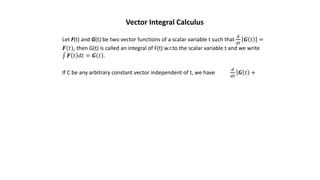
Let F(t) and G(t) be two vector functions of a scalar variable t such that
𝑑
𝑑𝑡
𝑮 𝑡 =
𝑭(𝑡), then G(t) is called an integral of F(t) w.r.to the scalar variable t and we write
𝑭 𝑡 𝑑𝑡 = 𝑮 𝑡 .
If C be any arbitrary constant vector independent of t, we have
𝑑
𝑑𝑡
𝑮 𝑡 +
Example1: If 𝑨 𝑡 = 3𝑡2 − 2𝑡 𝑖 + 6𝑡 − 4 𝑗 + 4𝑡𝑘, then evaluate
2
3
𝑨 𝑡 𝑑𝑡.
Soln:- 2
3
𝑨 𝑡 𝑑𝑡 = 2
3
3𝑡2
− 2𝑡 𝑖 + 6𝑡 − 4 𝑗 + 4𝑡𝑘] 𝑑𝑡
= 𝑖 2
3
(3𝑡2
− 2𝑡) 𝑑𝑡 + 𝑗 2
3
(6𝑡 − 4) 𝑑𝑡 + 𝑘 2
3
(4𝑡𝑘) 𝑑𝑡
=14𝑖 + 11𝑗 + 10𝑘.
Example2:
The acceleration of a particle at time t is given by 𝒂 = 18𝑐𝑜𝑠3𝑡 𝑖 −
8𝑠𝑖𝑛2𝑡 𝑗 + 6𝑡 𝑘. If the velocity v and displacement r be zero at t =0, find the
velocity and displacement at any point t.
Solution:
Here 𝒂 =
𝒅𝟐𝑟
𝑑𝑡2 = 18𝑐𝑜𝑠3𝑡 𝑖 − 8𝑠𝑖𝑛2𝑡 𝑗 + 6𝑡 𝑘. Integrating,
we have 𝒗 =
𝒅𝒓
𝒅𝒕
= 𝑖 18𝑐𝑜𝑠3𝑡 𝑑𝑡 + 𝑗 −8𝑠𝑖𝑛2𝑡 𝑑𝑡 + 𝑘 6𝑡 𝑑𝑡.
= 6𝑠𝑖𝑛3𝑡 𝑖 + 4𝑐𝑜𝑠2𝑡 𝑗 + 3𝑡2𝑘 + 𝒄.
At t = 0, v = 0⇒ 𝟎 = 4𝑗 + 𝒄 ⟹ 𝒄 = −4𝑗. Hence 𝒗 =
𝒅𝒓
𝒅𝒕
= 6𝑠𝑖𝑛3𝑡 𝑖 +
4(𝑐𝑜𝑠2𝑡 − 1) 𝑗 + 3𝑡2𝑘
Integrating again, we have𝒓 = −2𝑐𝑜𝑠3𝑡 𝑖 + 2𝑠𝑖𝑛2𝑡 − 4𝑡 𝑗 + 𝑡3𝑘 + 𝑐1.
Since r = 0 when t = 0, we have𝑐1 = 2 𝑖 ⇒ 𝒓 = 2(1 − 𝑐𝑜𝑠3𝑡 )𝑖 +
2𝑠𝑖𝑛2𝑡 − 4𝑡 𝑗 + 𝑡3
𝑘.
Line Integral
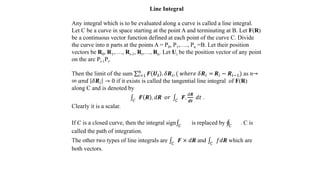
Any integral which is to be evaluated along a curve is called a line integral.
Let C be a curve in space starting at the point A and terminating at B. Let F(R)
be a continuous vector function defined at each point of the curve C. Divide
the curve into n parts at the points A = P0, P1,…., Pn =B. Let their position
vectors be R0, R1,…., Ri-1, Ri,…, Rn. Let Ui be the position vector of any point
on the arc Pi-1Pi.
Then the limit of the sum 𝑖=1
𝑛
𝑭 𝑼𝒊 . 𝛿𝑹𝑖, ( 𝑤ℎ𝑒𝑟𝑒 𝛿𝑹𝑖 = 𝑹𝑖 − 𝑹𝑖−1) as n→
∞ 𝑎𝑛𝑑 𝛿𝑹𝑖 → 0 if it exists is called the tangential line integral of F(R)
along C and is denoted by
𝐶
𝑭 𝑹 . 𝑑𝑹 𝑜𝑟 𝐶
𝑭.
𝑑𝑹
𝒅𝒕
𝑑𝑡 .
Clearly it is a scalar.
If C is a closed curve, then the integral sign 𝐶
is replaced by 𝐶
. C is
called the path of integration.
The other two types of line integrals are 𝐶
𝑭 × 𝑑𝑹 and 𝐶
𝑓𝑑𝑹 which are
both vectors.
Circulation
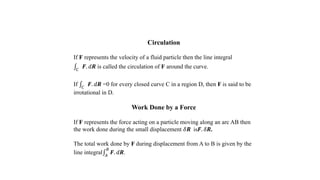
If F represents the velocity of a fluid particle then the line integral
𝐶
𝑭. 𝑑𝑹 is called the circulation of F around the curve.
If 𝐶
𝑭. 𝑑𝑹 =0 for every closed curve C in a region D, then F is said to be
irrotational in D.
Work Done by a Force
If F represents the force acting on a particle moving along an arc AB then
the work done during the small displacement 𝛿𝑹 is𝑭. 𝛿𝑹.
The total work done by F during displacement from A to B is given by the
line integral 𝐴
𝐵
𝑭. 𝑑𝑹.
Example: If 𝑭 = 3𝑥𝑦 𝑖 − 𝑦2
𝑗, evaluate 𝐶
𝑭. 𝑑𝑹 where C is the arc
of the parabola 𝑦 = 2𝑥2
from 0,0 𝑡𝑜 1,2 .
Solution: Since the particle moves in the xy-plane(z =0), we take
𝑹 = 𝑥 𝑖 + 𝑦 𝑗, then
𝐶
𝑭. 𝑑𝑹 = 𝐶
3𝑥𝑦 𝑖 − 𝑦2 𝑗 . 𝑑𝑥 𝑖 + 𝑑𝑦 𝑗 = 𝐶
3𝑥𝑦𝑑𝑥 − 𝑦2𝑑𝑦)
= 𝑥=0
1
3𝑥 2𝑥2 𝑑𝑥 − (2𝑥2)
2
𝑑(2𝑥2)]
= −7/6
Surface Integrals
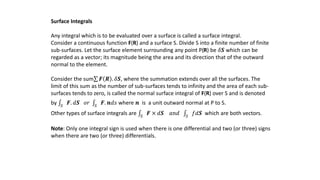
Any integral which is to be evaluated over a surface is called a surface integral.
Consider a continuous function F(R) and a surface S. Divide S into a finite number of finite
sub-surfaces. Let the surface element surrounding any point P(R) be 𝛿𝑺 which can be
regarded as a vector; its magnitude being the area and its direction that of the outward
normal to the element.
Consider the sum 𝑭 𝑹 . 𝛿𝑺, where the summation extends over all the surfaces. The
limit of this sum as the number of sub-surfaces tends to infinity and the area of each sub-
surfaces tends to zero, is called the normal surface integral of F(R) over S and is denoted
by 𝑆
𝑭. 𝑑𝑺 𝑜𝑟 𝑆
𝑭. 𝒏𝑑𝑠 where 𝒏 is a unit outward normal at P to S.
Other types of surface integrals are 𝑆
𝑭 × 𝑑𝑺 𝑎𝑛𝑑 𝑆
𝑓𝑑𝑺 which are both vectors.
Note: Only one integral sign is used when there is one differential and two (or three) signs
when there are two (or three) differentials.
Flux across a surface:
If F represents the velocity of a fluid particle then the surface integral
𝐶
𝑭. 𝑑𝑺 is called the total outward flux of F across a closed surface S.
Solenoidal vector point function:
When the flux of F across every closed surface S in a region E vanishes, F is
said to be a Solenoidal vector point function in E.
Example: Evaluate 𝑆
𝑭. 𝒏𝑑𝑠 where 𝑭 = 2𝑥2
𝑦 𝑖 − 𝑦2
𝑗 + 4𝑥𝑧2
𝑘 and S is the
closed surface of the region in the first octant bounded by the cylinder 𝑦2
+ 𝑧2
=
9 𝑎𝑛𝑑 𝑡ℎ𝑒 𝑝𝑙𝑎𝑛𝑒𝑠 𝑥 = 0, 𝑥 = 2, 𝑦 = 0 𝑎𝑛𝑑 𝑧 = 0.
Solution: The given closed surface S piecewise smooth and is comprised of S1-the
rectangular face OAEB in xy-plane; S2-the rectangular face OADC in the xz-plane;
S3-the circular quadrant ABC in yz-plane, S4-the circular quadrant AED and S5-the
curved surface BCDE of the cylinder in the first octant.
𝑆
𝑭. 𝒏𝑑𝑠 = 𝑆1
𝑭. 𝒏𝑑𝑠 + 𝑆2
𝑭. 𝒏𝑑𝑠 + 𝑆3
𝑭. 𝒏𝑑𝑠 + 𝑆4
𝑭. 𝒏𝑑𝑠 + 𝑆5
𝑭. 𝒏𝑑𝑠
Now 𝑆1
𝑭. 𝒏𝑑𝑠 = 𝑆1
2𝑥2𝑦 𝑖 − 𝑦2 𝑗 + 4𝑥𝑧2 𝑘 . −𝑘 𝑑𝑠 = 0
Similarly 𝑆2
𝑭. 𝒏𝑑𝑠 = 0 = 𝑆3
𝑭. 𝒏𝑑𝑠
𝑆4
𝑭. 𝒏𝑑𝑠 =
𝑆4
2𝑥2𝑦 𝑖 − 𝑦2 𝑗 + 4𝑥𝑧2 𝑘 . 𝑖 𝑑𝑠 =
𝑆4
2𝑥2𝑦 𝑑𝑠 =
0
3
0
9−𝑧2
8𝑦𝑑𝑦𝑑𝑧 = 72
To find n in S5, we have 𝛻 𝑦2
+ 𝑧2
= 2𝑦 𝑗 + 2𝑧 𝑘
𝑎𝑛𝑑 𝒏 = (2𝑦 𝑗 + 2𝑧 𝑘)/ 4𝑦2 + 4𝑧2 =
𝑦 𝑗 + 𝑧 𝑘
3
𝒏. 𝑘 =
𝑧
3
𝑠𝑜 𝑡ℎ𝑎𝑡 𝑑𝑠 = 𝑑𝑥𝑑𝑦/(
𝑧
3
)
𝑆5
𝑭. 𝒏𝑑𝑠 =
0
2
0
3
−
𝑦3
𝑧
+ 4𝑥𝑧2 𝑑𝑦𝑑𝑥 = 108 (𝑝𝑢𝑡 𝑦 = 3𝑠𝑖𝑛𝜃, 𝑧 = 3𝑐𝑜𝑠𝜃)
Hence 𝑆
𝑭. 𝒏𝑑𝑠 = 0 + 0 + 0 + 72 + 108=180
Example2 Evaluate 𝑆
𝑨. 𝒏𝑑𝑠 where 𝑨 = 𝒛 𝒊 + 𝒙 𝒋 − 𝟑𝒚𝟐
𝒛 𝒌 and S is the
surface of the cylinder 𝑥2
+ 𝑦2
= 16 included in the first octant
between 𝑧 = 0 𝑎𝑛𝑑 𝑧 = 5.
Solution:- Equation of the surface is 𝑥2 + 𝑦2 = 16.
Let 𝜙 = 𝑥2
+ 𝑦2
. A vector normal to the surface S is given by 𝛻𝜙 = 2𝑥 𝑖 +
2𝑦 𝑗.
Hence n = a unit vector normal to the surface S
=
2𝑥 𝑖+2𝑦 𝑗
2𝑥 2+ 2𝑦 2
=
𝑥 𝑖 + 𝑦 𝑗
4
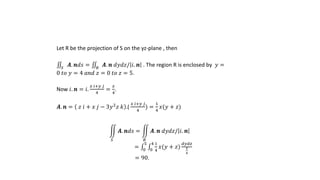
Let R be the projection of S on the yz-plane , then
𝑆
𝑨. 𝒏𝑑𝑠 = 𝑅
𝑨. 𝒏 𝑑𝑦𝑑𝑧/ 𝑖. 𝒏 . The region R is enclosed by 𝑦 =
0 𝑡𝑜 𝑦 = 4 𝑎𝑛𝑑 𝑧 = 0 𝑡𝑜 𝑧 = 5.
Now 𝑖. 𝒏 = 𝑖.
𝑥 𝑖+𝑦 𝑗
4
=
𝑥
4
.
𝑨. 𝒏 = 𝑧 𝑖 + 𝑥 𝑗 − 3𝑦2
𝑧 𝑘 .(
𝑥 𝑖+𝑦 𝑗
4
) =
1
4
𝑥(𝑦 + 𝑧)
𝑆
𝑨. 𝒏𝑑𝑠 =
𝑅
𝑨. 𝒏 𝑑𝑦𝑑𝑧/ 𝑖. 𝒏
= 0
5
0
4 1
4
𝑥(𝑦 + 𝑧)
𝑑𝑦𝑑𝑧
𝑥
4
= 90.

line and surface integral.pptx .

  • 1.
    Vector Integral Calculus LetF(t) and G(t) be two vector functions of a scalar variable t such that 𝑑 𝑑𝑡 𝑮 𝑡 = 𝑭(𝑡), then G(t) is called an integral of F(t) w.r.to the scalar variable t and we write 𝑭 𝑡 𝑑𝑡 = 𝑮 𝑡 . If C be any arbitrary constant vector independent of t, we have 𝑑 𝑑𝑡 𝑮 𝑡 +
  • 2.
    Example1: If 𝑨𝑡 = 3𝑡2 − 2𝑡 𝑖 + 6𝑡 − 4 𝑗 + 4𝑡𝑘, then evaluate 2 3 𝑨 𝑡 𝑑𝑡. Soln:- 2 3 𝑨 𝑡 𝑑𝑡 = 2 3 3𝑡2 − 2𝑡 𝑖 + 6𝑡 − 4 𝑗 + 4𝑡𝑘] 𝑑𝑡 = 𝑖 2 3 (3𝑡2 − 2𝑡) 𝑑𝑡 + 𝑗 2 3 (6𝑡 − 4) 𝑑𝑡 + 𝑘 2 3 (4𝑡𝑘) 𝑑𝑡 =14𝑖 + 11𝑗 + 10𝑘.
  • 3.
    Example2: The acceleration ofa particle at time t is given by 𝒂 = 18𝑐𝑜𝑠3𝑡 𝑖 − 8𝑠𝑖𝑛2𝑡 𝑗 + 6𝑡 𝑘. If the velocity v and displacement r be zero at t =0, find the velocity and displacement at any point t. Solution: Here 𝒂 = 𝒅𝟐𝑟 𝑑𝑡2 = 18𝑐𝑜𝑠3𝑡 𝑖 − 8𝑠𝑖𝑛2𝑡 𝑗 + 6𝑡 𝑘. Integrating, we have 𝒗 = 𝒅𝒓 𝒅𝒕 = 𝑖 18𝑐𝑜𝑠3𝑡 𝑑𝑡 + 𝑗 −8𝑠𝑖𝑛2𝑡 𝑑𝑡 + 𝑘 6𝑡 𝑑𝑡. = 6𝑠𝑖𝑛3𝑡 𝑖 + 4𝑐𝑜𝑠2𝑡 𝑗 + 3𝑡2𝑘 + 𝒄. At t = 0, v = 0⇒ 𝟎 = 4𝑗 + 𝒄 ⟹ 𝒄 = −4𝑗. Hence 𝒗 = 𝒅𝒓 𝒅𝒕 = 6𝑠𝑖𝑛3𝑡 𝑖 + 4(𝑐𝑜𝑠2𝑡 − 1) 𝑗 + 3𝑡2𝑘 Integrating again, we have𝒓 = −2𝑐𝑜𝑠3𝑡 𝑖 + 2𝑠𝑖𝑛2𝑡 − 4𝑡 𝑗 + 𝑡3𝑘 + 𝑐1. Since r = 0 when t = 0, we have𝑐1 = 2 𝑖 ⇒ 𝒓 = 2(1 − 𝑐𝑜𝑠3𝑡 )𝑖 + 2𝑠𝑖𝑛2𝑡 − 4𝑡 𝑗 + 𝑡3 𝑘.
  • 4.
    Line Integral Any integralwhich is to be evaluated along a curve is called a line integral. Let C be a curve in space starting at the point A and terminating at B. Let F(R) be a continuous vector function defined at each point of the curve C. Divide the curve into n parts at the points A = P0, P1,…., Pn =B. Let their position vectors be R0, R1,…., Ri-1, Ri,…, Rn. Let Ui be the position vector of any point on the arc Pi-1Pi. Then the limit of the sum 𝑖=1 𝑛 𝑭 𝑼𝒊 . 𝛿𝑹𝑖, ( 𝑤ℎ𝑒𝑟𝑒 𝛿𝑹𝑖 = 𝑹𝑖 − 𝑹𝑖−1) as n→ ∞ 𝑎𝑛𝑑 𝛿𝑹𝑖 → 0 if it exists is called the tangential line integral of F(R) along C and is denoted by 𝐶 𝑭 𝑹 . 𝑑𝑹 𝑜𝑟 𝐶 𝑭. 𝑑𝑹 𝒅𝒕 𝑑𝑡 . Clearly it is a scalar. If C is a closed curve, then the integral sign 𝐶 is replaced by 𝐶 . C is called the path of integration. The other two types of line integrals are 𝐶 𝑭 × 𝑑𝑹 and 𝐶 𝑓𝑑𝑹 which are both vectors.
  • 5.
    Circulation If F representsthe velocity of a fluid particle then the line integral 𝐶 𝑭. 𝑑𝑹 is called the circulation of F around the curve. If 𝐶 𝑭. 𝑑𝑹 =0 for every closed curve C in a region D, then F is said to be irrotational in D. Work Done by a Force If F represents the force acting on a particle moving along an arc AB then the work done during the small displacement 𝛿𝑹 is𝑭. 𝛿𝑹. The total work done by F during displacement from A to B is given by the line integral 𝐴 𝐵 𝑭. 𝑑𝑹.
  • 6.
    Example: If 𝑭= 3𝑥𝑦 𝑖 − 𝑦2 𝑗, evaluate 𝐶 𝑭. 𝑑𝑹 where C is the arc of the parabola 𝑦 = 2𝑥2 from 0,0 𝑡𝑜 1,2 . Solution: Since the particle moves in the xy-plane(z =0), we take 𝑹 = 𝑥 𝑖 + 𝑦 𝑗, then 𝐶 𝑭. 𝑑𝑹 = 𝐶 3𝑥𝑦 𝑖 − 𝑦2 𝑗 . 𝑑𝑥 𝑖 + 𝑑𝑦 𝑗 = 𝐶 3𝑥𝑦𝑑𝑥 − 𝑦2𝑑𝑦) = 𝑥=0 1 3𝑥 2𝑥2 𝑑𝑥 − (2𝑥2) 2 𝑑(2𝑥2)] = −7/6
  • 7.
    Surface Integrals Any integralwhich is to be evaluated over a surface is called a surface integral. Consider a continuous function F(R) and a surface S. Divide S into a finite number of finite sub-surfaces. Let the surface element surrounding any point P(R) be 𝛿𝑺 which can be regarded as a vector; its magnitude being the area and its direction that of the outward normal to the element. Consider the sum 𝑭 𝑹 . 𝛿𝑺, where the summation extends over all the surfaces. The limit of this sum as the number of sub-surfaces tends to infinity and the area of each sub- surfaces tends to zero, is called the normal surface integral of F(R) over S and is denoted by 𝑆 𝑭. 𝑑𝑺 𝑜𝑟 𝑆 𝑭. 𝒏𝑑𝑠 where 𝒏 is a unit outward normal at P to S. Other types of surface integrals are 𝑆 𝑭 × 𝑑𝑺 𝑎𝑛𝑑 𝑆 𝑓𝑑𝑺 which are both vectors. Note: Only one integral sign is used when there is one differential and two (or three) signs when there are two (or three) differentials.
  • 8.
    Flux across asurface: If F represents the velocity of a fluid particle then the surface integral 𝐶 𝑭. 𝑑𝑺 is called the total outward flux of F across a closed surface S. Solenoidal vector point function: When the flux of F across every closed surface S in a region E vanishes, F is said to be a Solenoidal vector point function in E.
  • 9.
    Example: Evaluate 𝑆 𝑭.𝒏𝑑𝑠 where 𝑭 = 2𝑥2 𝑦 𝑖 − 𝑦2 𝑗 + 4𝑥𝑧2 𝑘 and S is the closed surface of the region in the first octant bounded by the cylinder 𝑦2 + 𝑧2 = 9 𝑎𝑛𝑑 𝑡ℎ𝑒 𝑝𝑙𝑎𝑛𝑒𝑠 𝑥 = 0, 𝑥 = 2, 𝑦 = 0 𝑎𝑛𝑑 𝑧 = 0. Solution: The given closed surface S piecewise smooth and is comprised of S1-the rectangular face OAEB in xy-plane; S2-the rectangular face OADC in the xz-plane; S3-the circular quadrant ABC in yz-plane, S4-the circular quadrant AED and S5-the curved surface BCDE of the cylinder in the first octant.
  • 10.
    𝑆 𝑭. 𝒏𝑑𝑠 =𝑆1 𝑭. 𝒏𝑑𝑠 + 𝑆2 𝑭. 𝒏𝑑𝑠 + 𝑆3 𝑭. 𝒏𝑑𝑠 + 𝑆4 𝑭. 𝒏𝑑𝑠 + 𝑆5 𝑭. 𝒏𝑑𝑠 Now 𝑆1 𝑭. 𝒏𝑑𝑠 = 𝑆1 2𝑥2𝑦 𝑖 − 𝑦2 𝑗 + 4𝑥𝑧2 𝑘 . −𝑘 𝑑𝑠 = 0 Similarly 𝑆2 𝑭. 𝒏𝑑𝑠 = 0 = 𝑆3 𝑭. 𝒏𝑑𝑠 𝑆4 𝑭. 𝒏𝑑𝑠 = 𝑆4 2𝑥2𝑦 𝑖 − 𝑦2 𝑗 + 4𝑥𝑧2 𝑘 . 𝑖 𝑑𝑠 = 𝑆4 2𝑥2𝑦 𝑑𝑠 = 0 3 0 9−𝑧2 8𝑦𝑑𝑦𝑑𝑧 = 72 To find n in S5, we have 𝛻 𝑦2 + 𝑧2 = 2𝑦 𝑗 + 2𝑧 𝑘 𝑎𝑛𝑑 𝒏 = (2𝑦 𝑗 + 2𝑧 𝑘)/ 4𝑦2 + 4𝑧2 = 𝑦 𝑗 + 𝑧 𝑘 3 𝒏. 𝑘 = 𝑧 3 𝑠𝑜 𝑡ℎ𝑎𝑡 𝑑𝑠 = 𝑑𝑥𝑑𝑦/( 𝑧 3 ) 𝑆5 𝑭. 𝒏𝑑𝑠 = 0 2 0 3 − 𝑦3 𝑧 + 4𝑥𝑧2 𝑑𝑦𝑑𝑥 = 108 (𝑝𝑢𝑡 𝑦 = 3𝑠𝑖𝑛𝜃, 𝑧 = 3𝑐𝑜𝑠𝜃) Hence 𝑆 𝑭. 𝒏𝑑𝑠 = 0 + 0 + 0 + 72 + 108=180
  • 11.
    Example2 Evaluate 𝑆 𝑨.𝒏𝑑𝑠 where 𝑨 = 𝒛 𝒊 + 𝒙 𝒋 − 𝟑𝒚𝟐 𝒛 𝒌 and S is the surface of the cylinder 𝑥2 + 𝑦2 = 16 included in the first octant between 𝑧 = 0 𝑎𝑛𝑑 𝑧 = 5. Solution:- Equation of the surface is 𝑥2 + 𝑦2 = 16. Let 𝜙 = 𝑥2 + 𝑦2 . A vector normal to the surface S is given by 𝛻𝜙 = 2𝑥 𝑖 + 2𝑦 𝑗. Hence n = a unit vector normal to the surface S = 2𝑥 𝑖+2𝑦 𝑗 2𝑥 2+ 2𝑦 2 = 𝑥 𝑖 + 𝑦 𝑗 4
  • 12.
    Let R bethe projection of S on the yz-plane , then 𝑆 𝑨. 𝒏𝑑𝑠 = 𝑅 𝑨. 𝒏 𝑑𝑦𝑑𝑧/ 𝑖. 𝒏 . The region R is enclosed by 𝑦 = 0 𝑡𝑜 𝑦 = 4 𝑎𝑛𝑑 𝑧 = 0 𝑡𝑜 𝑧 = 5. Now 𝑖. 𝒏 = 𝑖. 𝑥 𝑖+𝑦 𝑗 4 = 𝑥 4 . 𝑨. 𝒏 = 𝑧 𝑖 + 𝑥 𝑗 − 3𝑦2 𝑧 𝑘 .( 𝑥 𝑖+𝑦 𝑗 4 ) = 1 4 𝑥(𝑦 + 𝑧) 𝑆 𝑨. 𝒏𝑑𝑠 = 𝑅 𝑨. 𝒏 𝑑𝑦𝑑𝑧/ 𝑖. 𝒏 = 0 5 0 4 1 4 𝑥(𝑦 + 𝑧) 𝑑𝑦𝑑𝑧 𝑥 4 = 90.