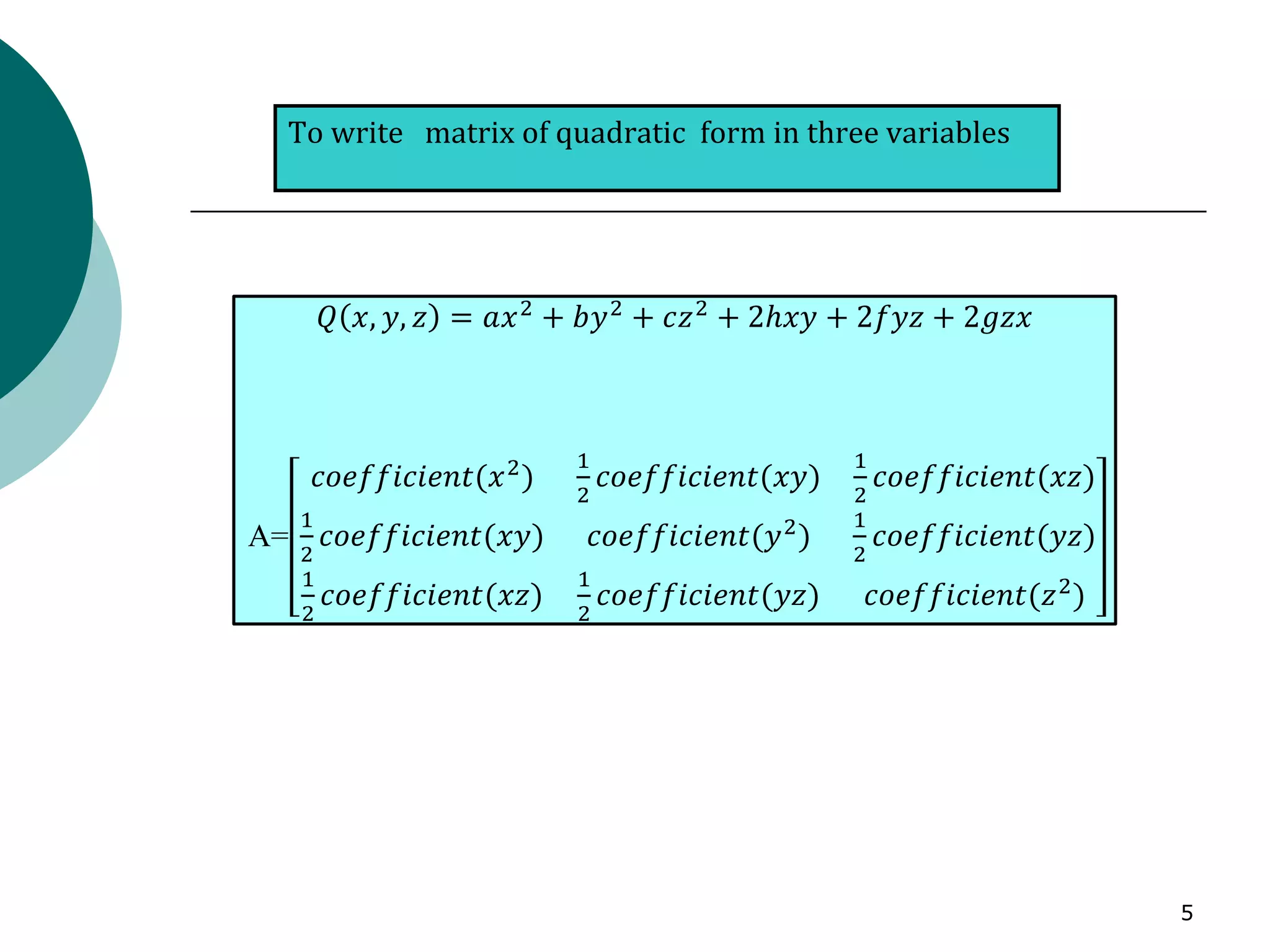
The document discusses reducing a quadratic form to canonical form using an orthogonal transformation. It begins by defining quadratic forms and representing them using matrices. It then provides examples of writing the matrix and quadratic form for functions of 2 and 3 variables. The document explains finding the eigenvectors and eigenvalues of the coefficient matrix to form an orthogonal transformation matrix B. Premultiplying the coefficient matrix A by the inverse of B results in the diagonal canonical form matrix D, where the diagonal elements are the eigenvalues of A. The quadratic form is then in canonical (sum of squares) form. An example problem demonstrates reducing a 3D quadratic form to canonical form using this process.
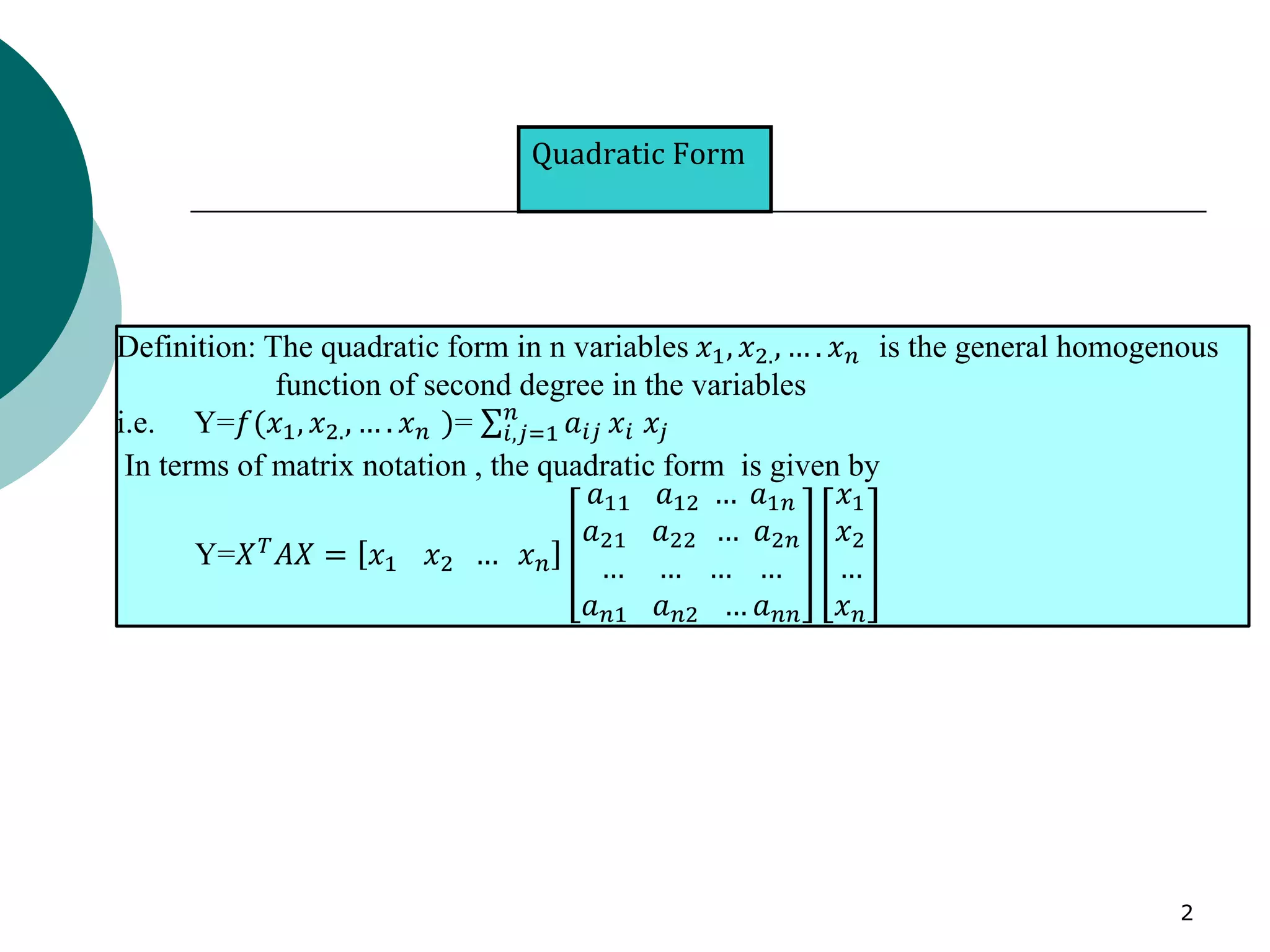
Quadratic Form
2
Definition: Thequadratic form in n variables 𝑥1, 𝑥2., … . 𝑥𝑛 is the general homogenous
function of second degree in the variables
i.e. Y=𝑓(𝑥1, 𝑥2., … . 𝑥𝑛 )= σ𝑖,𝑗=1
𝑛
𝑎𝑖𝑗 𝑥𝑖 𝑥𝑗
In terms of matrix notation , the quadratic form is given by
Y=𝑋𝑇
𝐴𝑋 = 𝑥1 𝑥2 … 𝑥𝑛
𝑎11 𝑎12 … 𝑎1𝑛
𝑎21 𝑎22 … 𝑎2𝑛
… … … …
𝑎𝑛1 𝑎𝑛2 … 𝑎𝑛𝑛
𝑥1
𝑥2
…
𝑥𝑛
3.
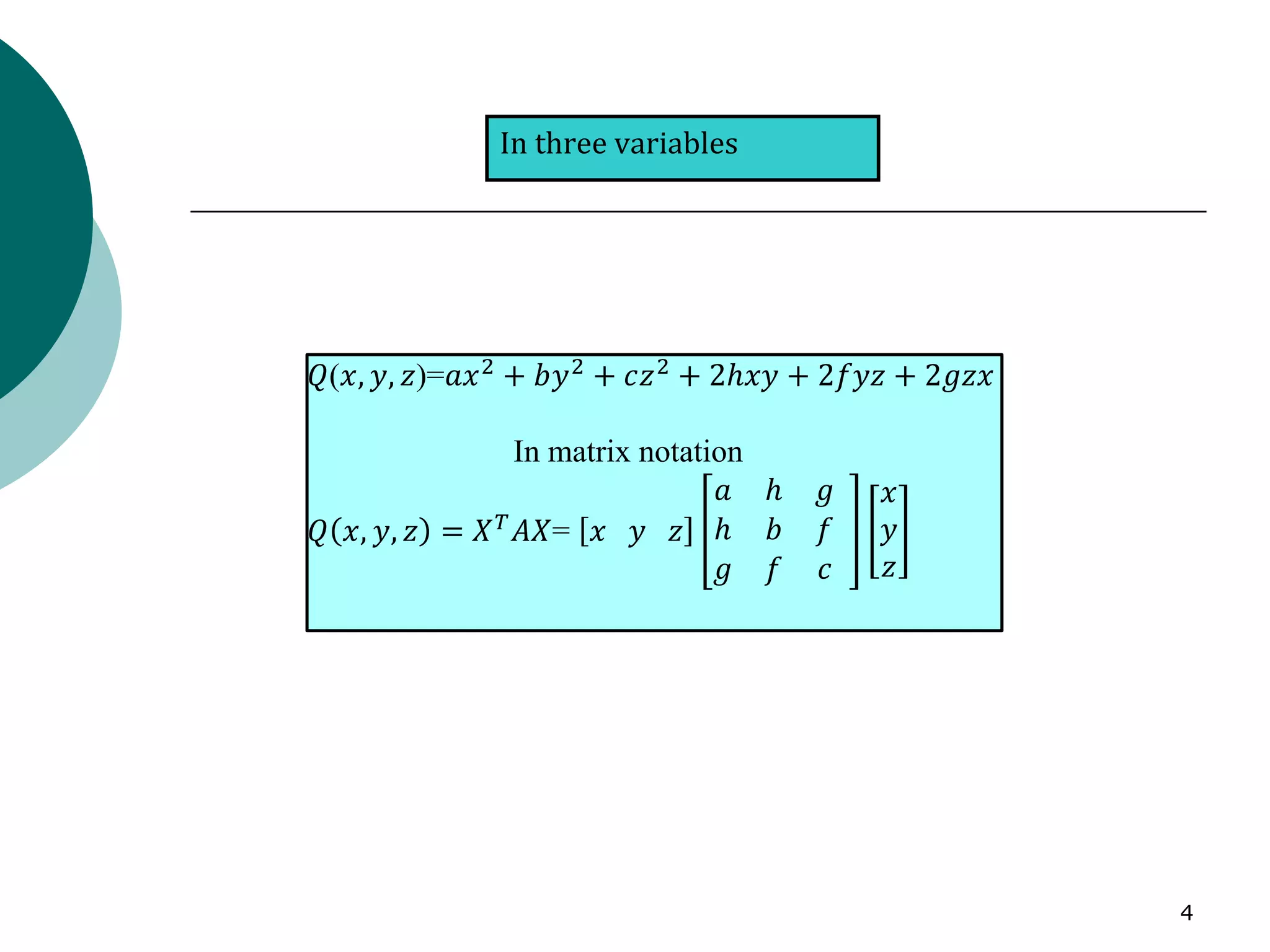
In Matrix Notation
3
Intwo variables (𝑥,𝑦): 𝑎𝑥2+2ℎ𝑥𝑦 + 𝑏𝑦2
𝑄 𝑥, 𝑦, 𝑧 = 𝑋𝑇𝐴𝑋 = 𝑥 𝑦
𝑎 ℎ
ℎ 𝑏
𝑥
𝑦
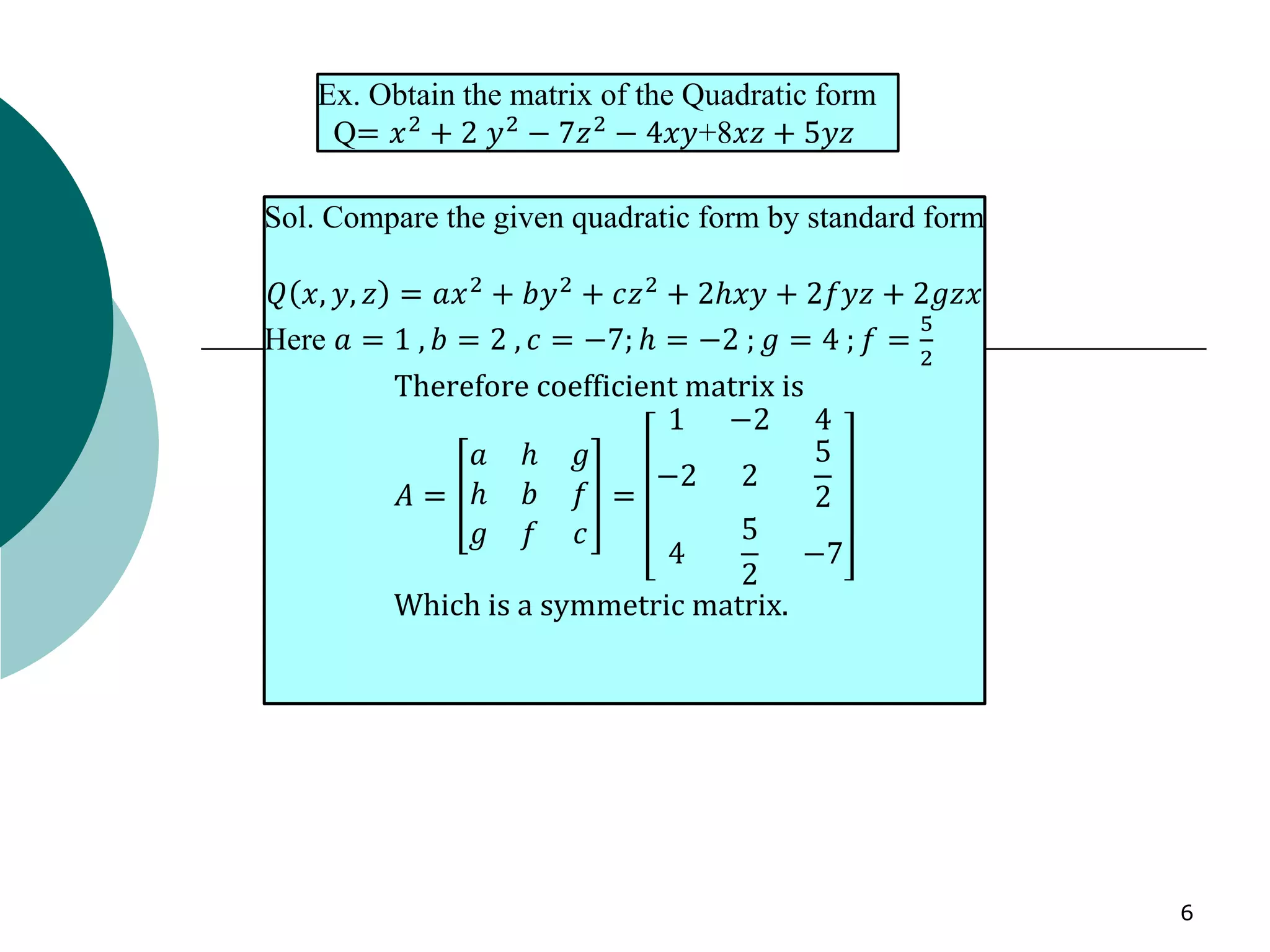
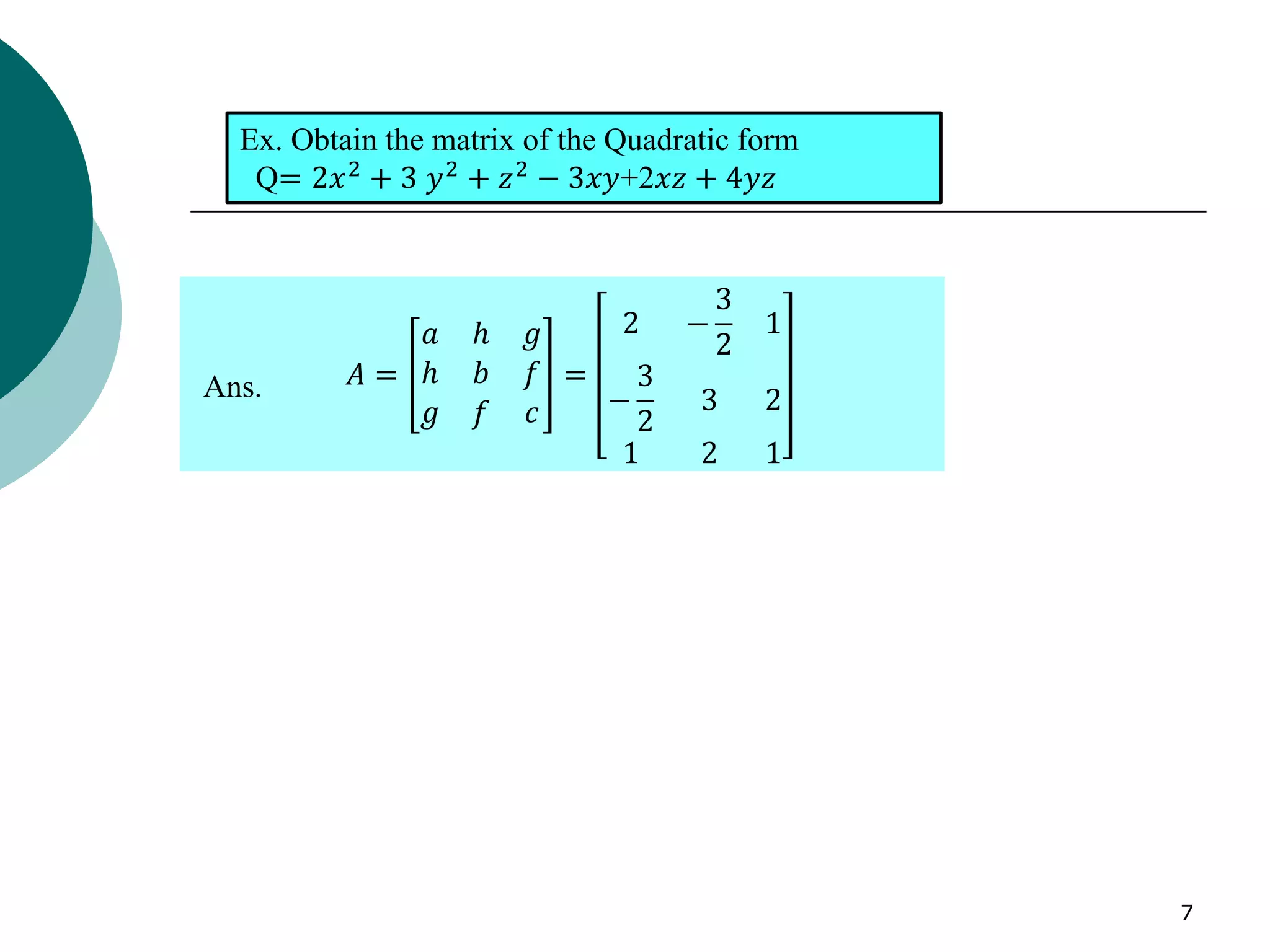
Here A is known as matrix of quadratic form
.
𝐴 =
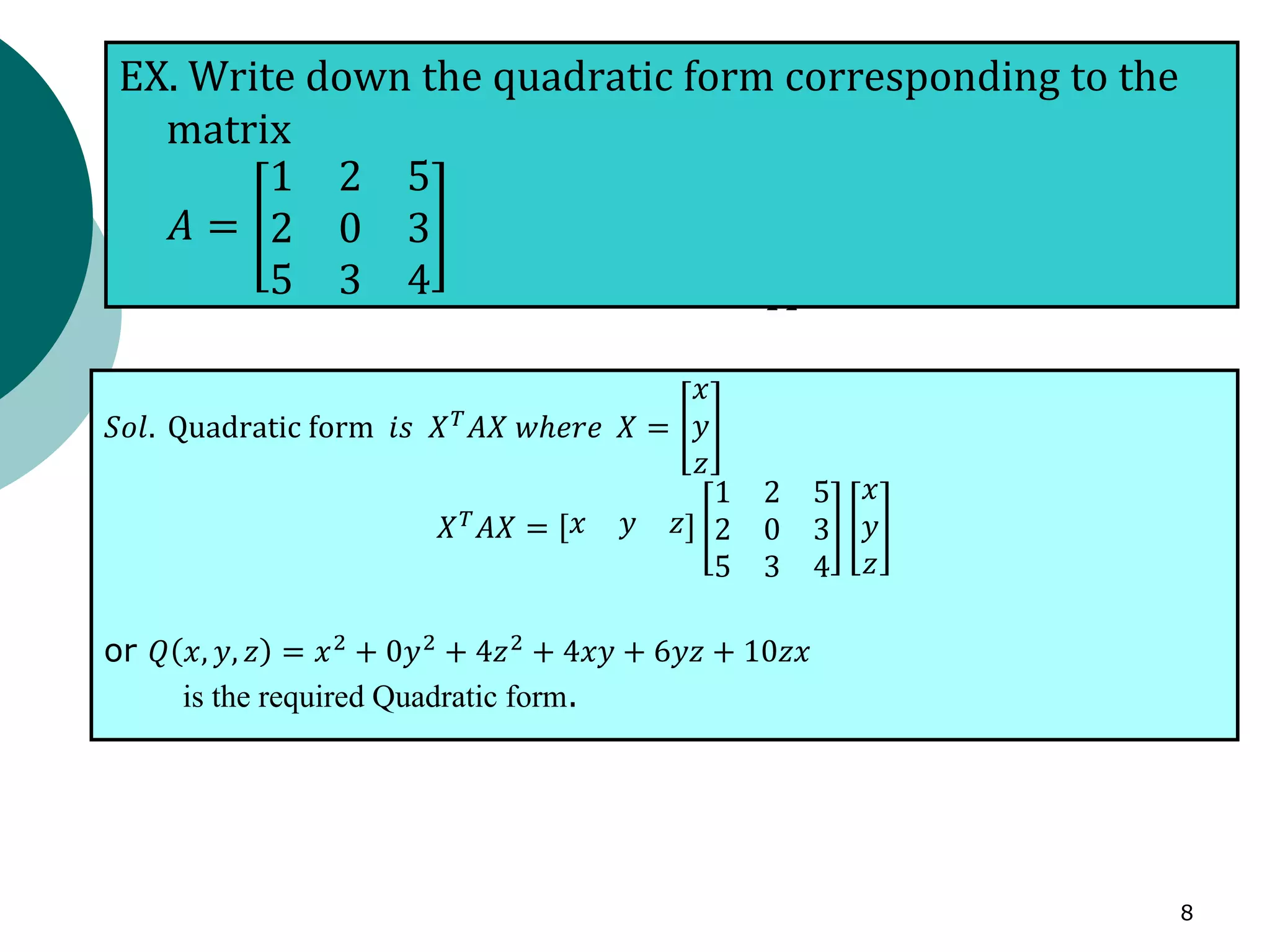
EX. Writedown the quadratic form corresponding to the
matrix
𝐴 =
1 2 5
2 0 3
5 3 4
𝑆𝑜𝑙. Quadratic form 𝑖𝑠 𝑋𝑇
𝐴𝑋 𝑤ℎ𝑒𝑟𝑒 𝑋 =
𝑥
𝑦
𝑧
𝑋𝑇
𝐴𝑋 = 𝑥 𝑦 𝑧
1 2 5
2 0 3
5 3 4
𝑥
𝑦
𝑧
or 𝑄 𝑥, 𝑦, 𝑧 = 𝑥2 + 0𝑦2 + 4𝑧2 + 4𝑥𝑦 + 6𝑦𝑧 + 10𝑧𝑥
is the required Quadratic form.
8
9.
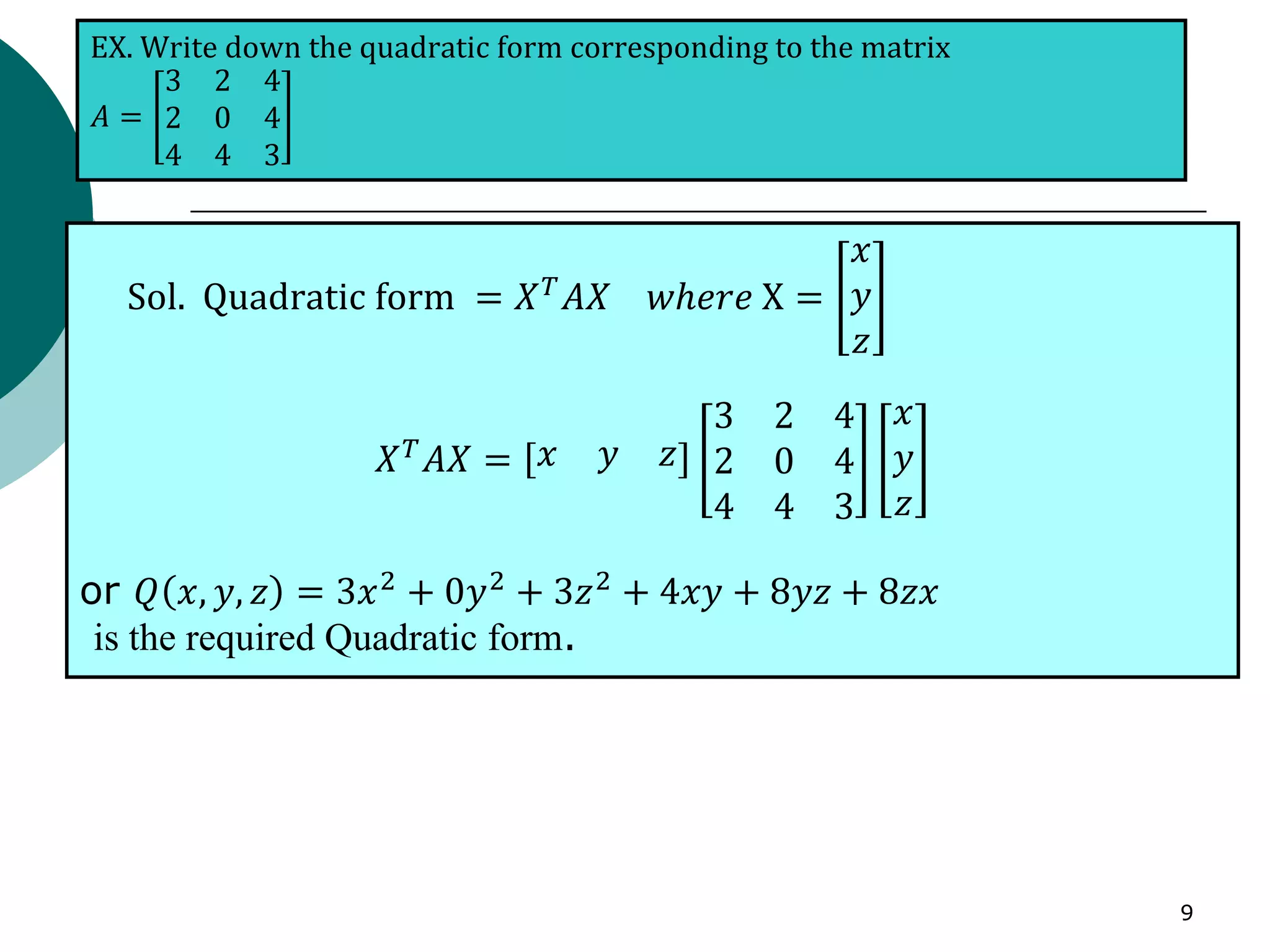
Sol. Quadratic form= 𝑋𝑇
𝐴𝑋 𝑤ℎ𝑒𝑟𝑒 X =
𝑥
𝑦
𝑧
𝑋𝑇
𝐴𝑋 = 𝑥 𝑦 𝑧
3 2 4
2 0 4
4 4 3
𝑥
𝑦
𝑧
or 𝑄 𝑥, 𝑦, 𝑧 = 3𝑥2
+ 0𝑦2
+ 3𝑧2
+ 4𝑥𝑦 + 8𝑦𝑧 + 8𝑧𝑥
is the required Quadratic form.
EX. Write down the quadratic form corresponding to the matrix
𝐴 =
3 2 4
2 0 4
4 4 3
9
10.
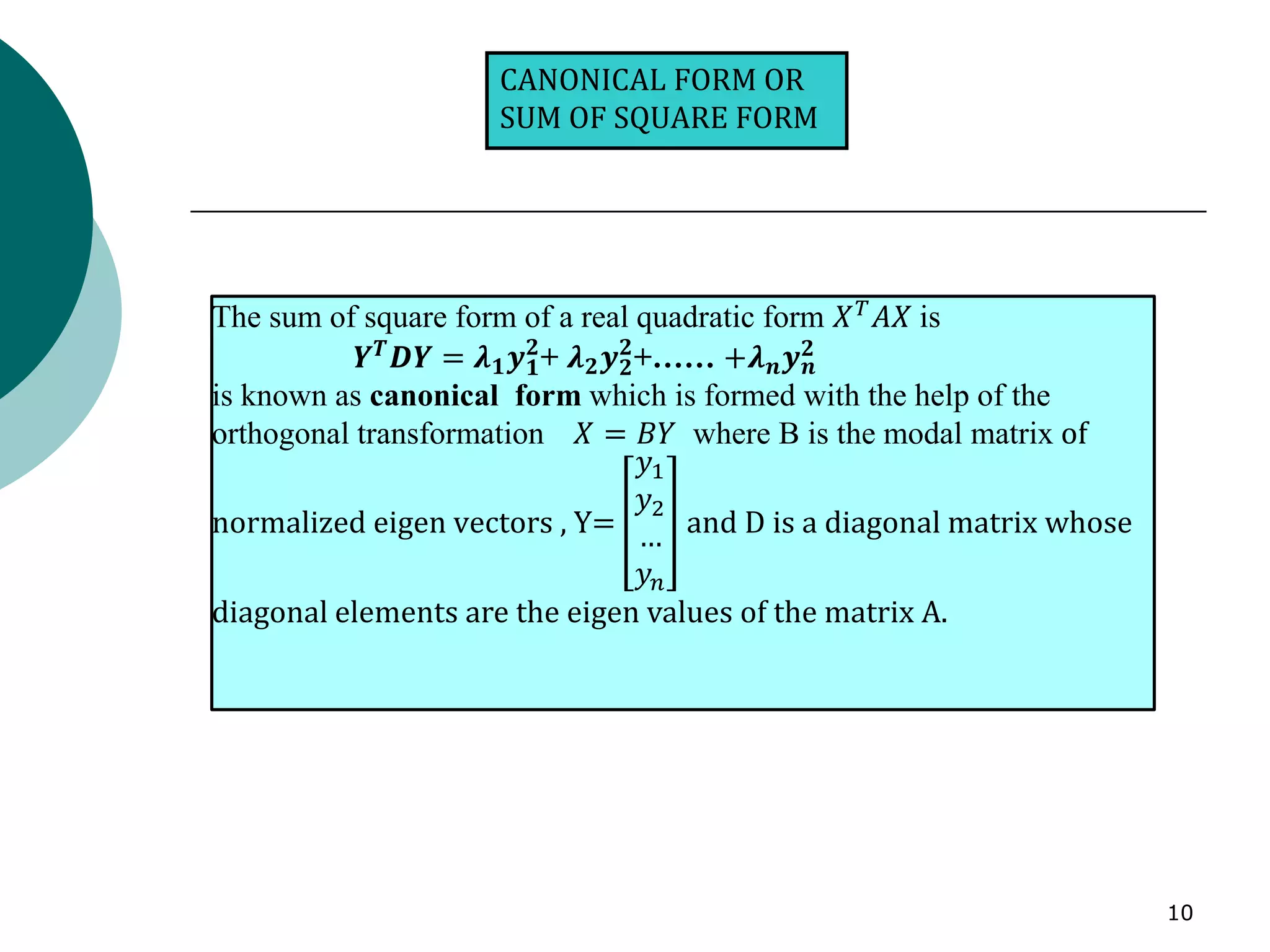
CANONICAL FORM OR
SUMOF SQUARE FORM
10
The sum of square form of a real quadratic form 𝑋𝑇
𝐴𝑋 is
𝒀𝑻𝑫𝒀 = 𝝀𝟏𝒚𝟏
𝟐
+ 𝝀𝟐𝒚𝟐
𝟐
+…… +𝝀𝒏𝒚𝒏
𝟐
is known as canonical form which is formed with the help of the
orthogonal transformation 𝑋 = 𝐵𝑌 where B is the modal matrix of
normalized eigen vectors , Y=
𝑦1
𝑦2
…
𝑦𝑛
and D is a diagonal matrix whose
diagonal elements are the eigen values of the matrix A.
11.
11
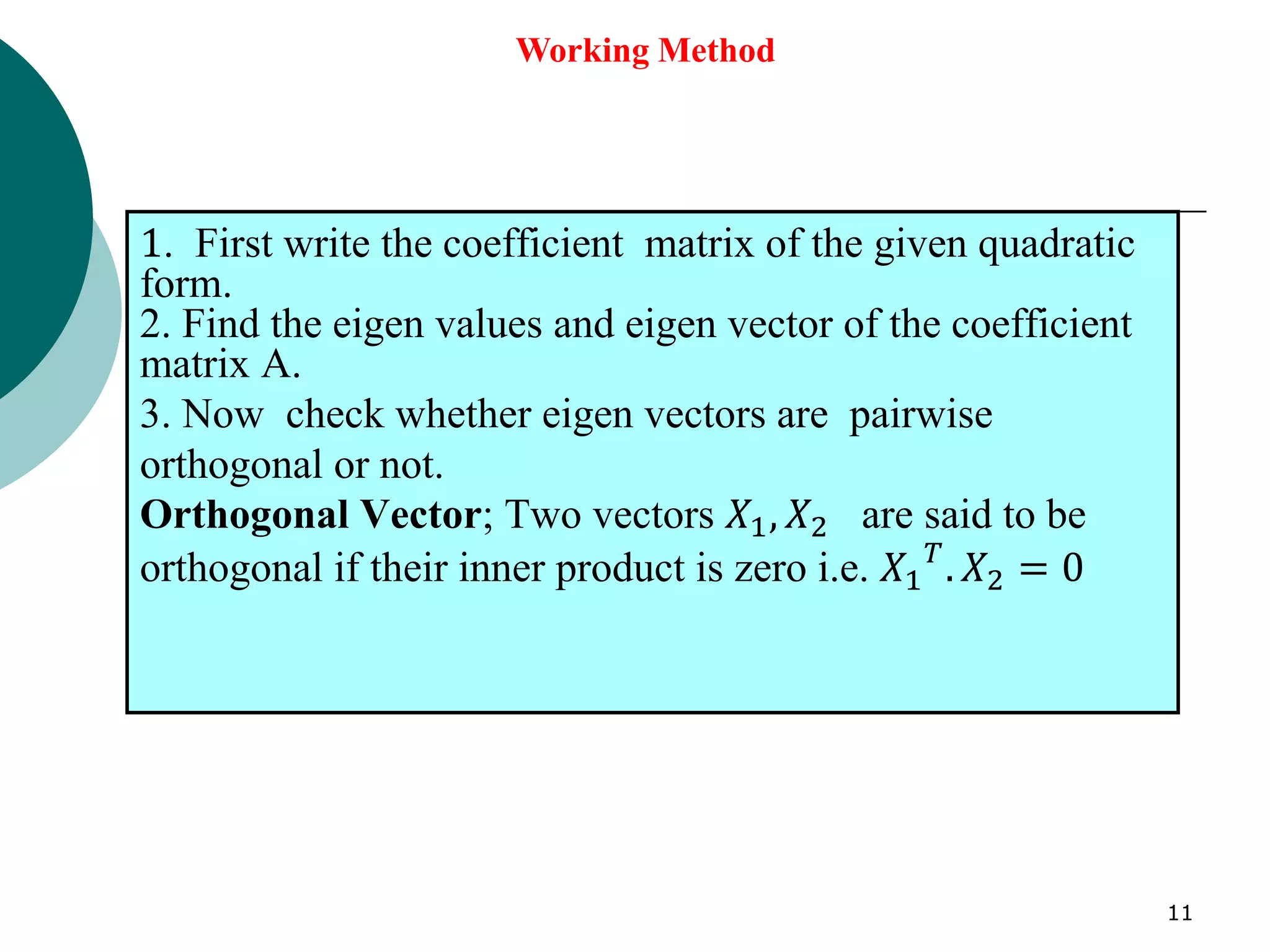
1. First writethe coefficient matrix of the given quadratic
form.
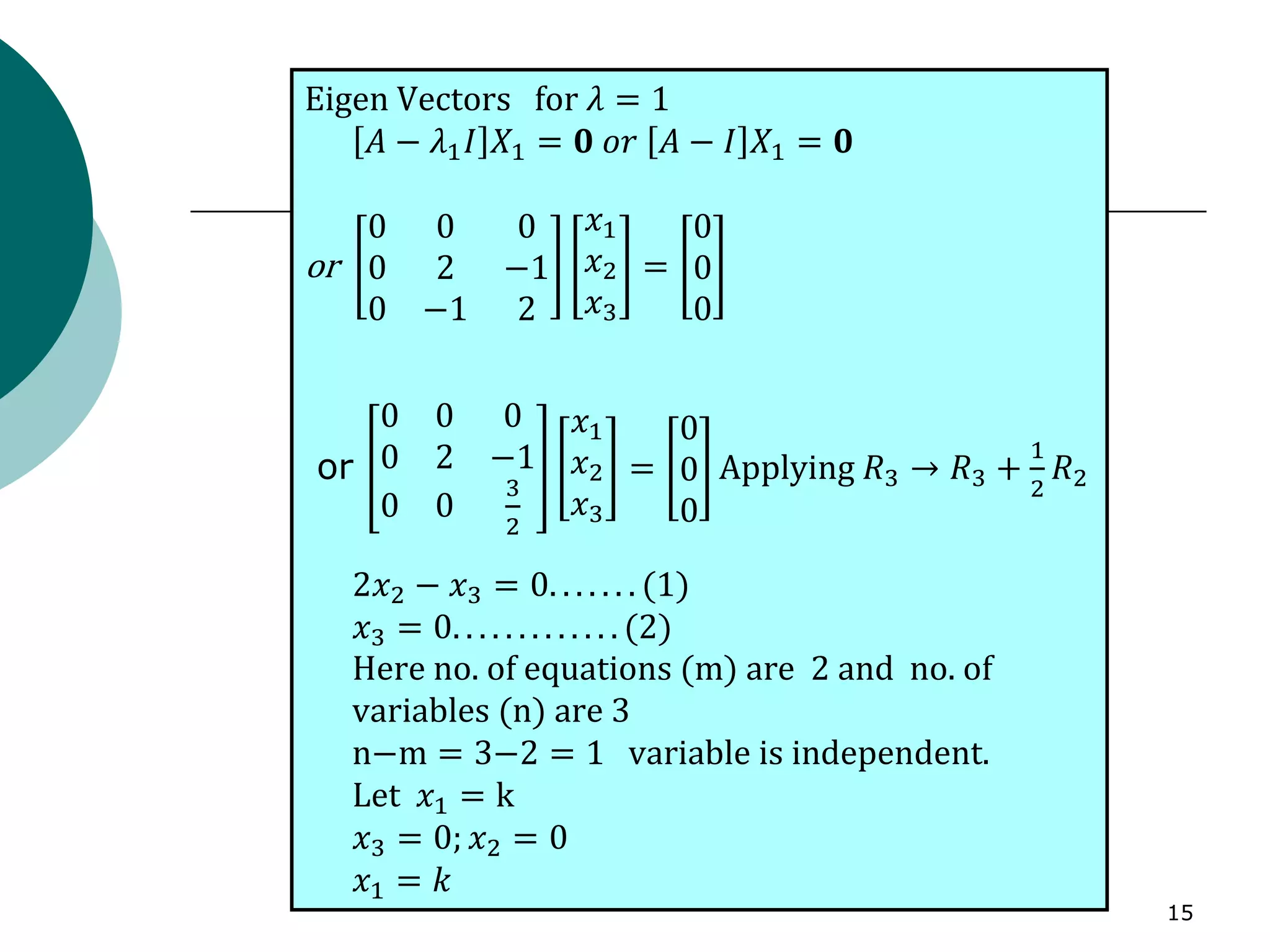
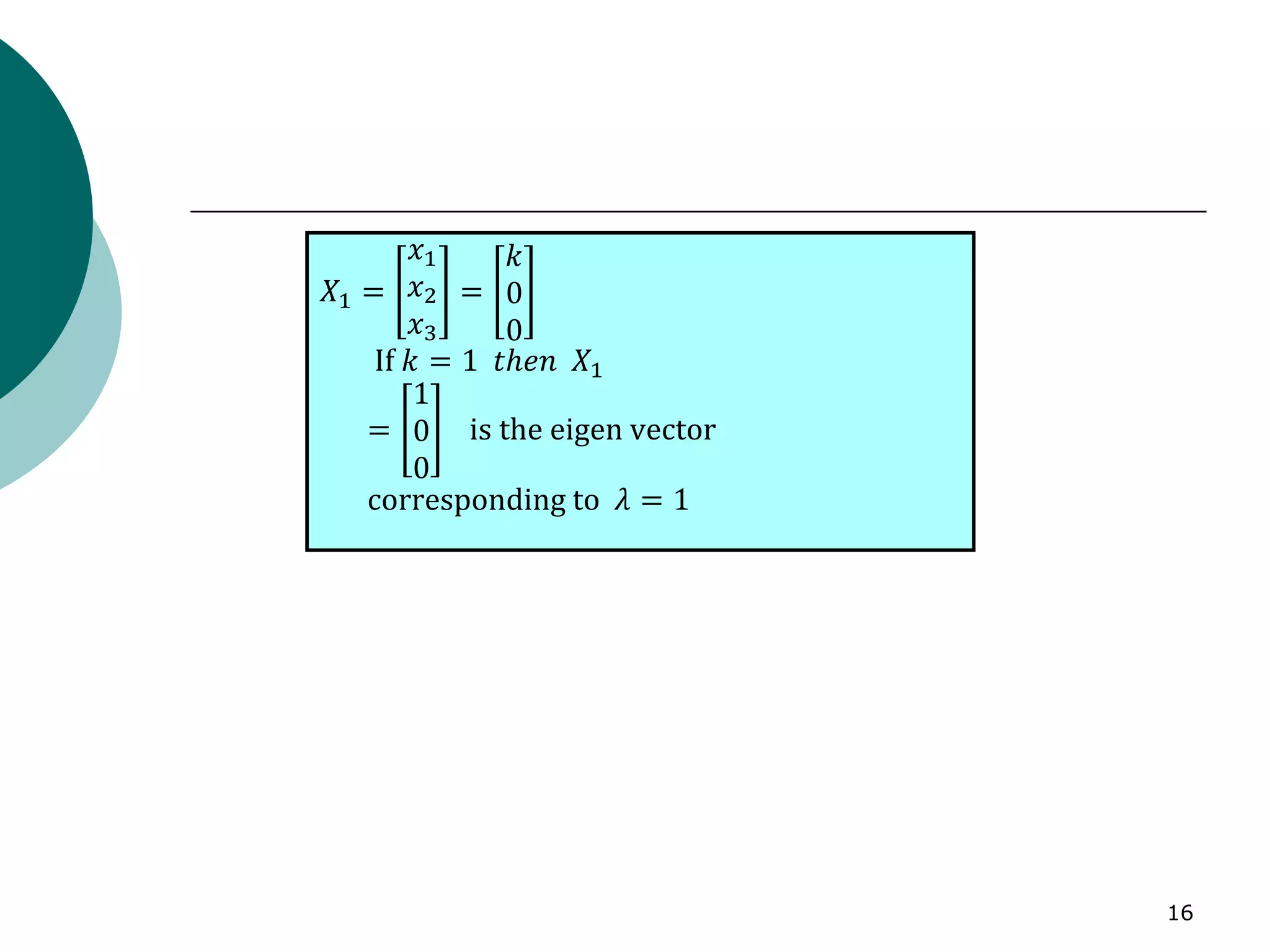
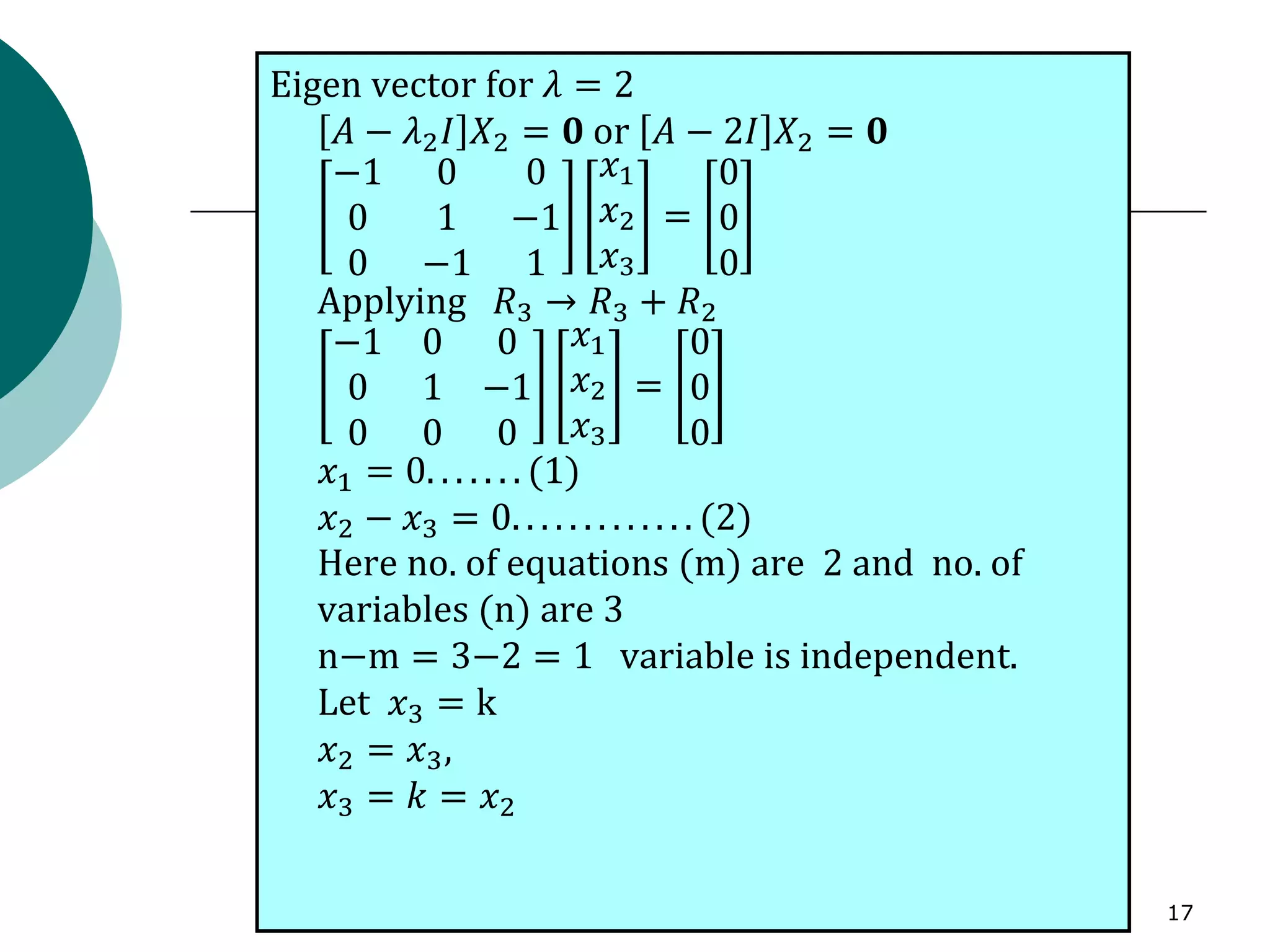
2. Find the eigen values and eigen vector of the coefficient
matrix A.
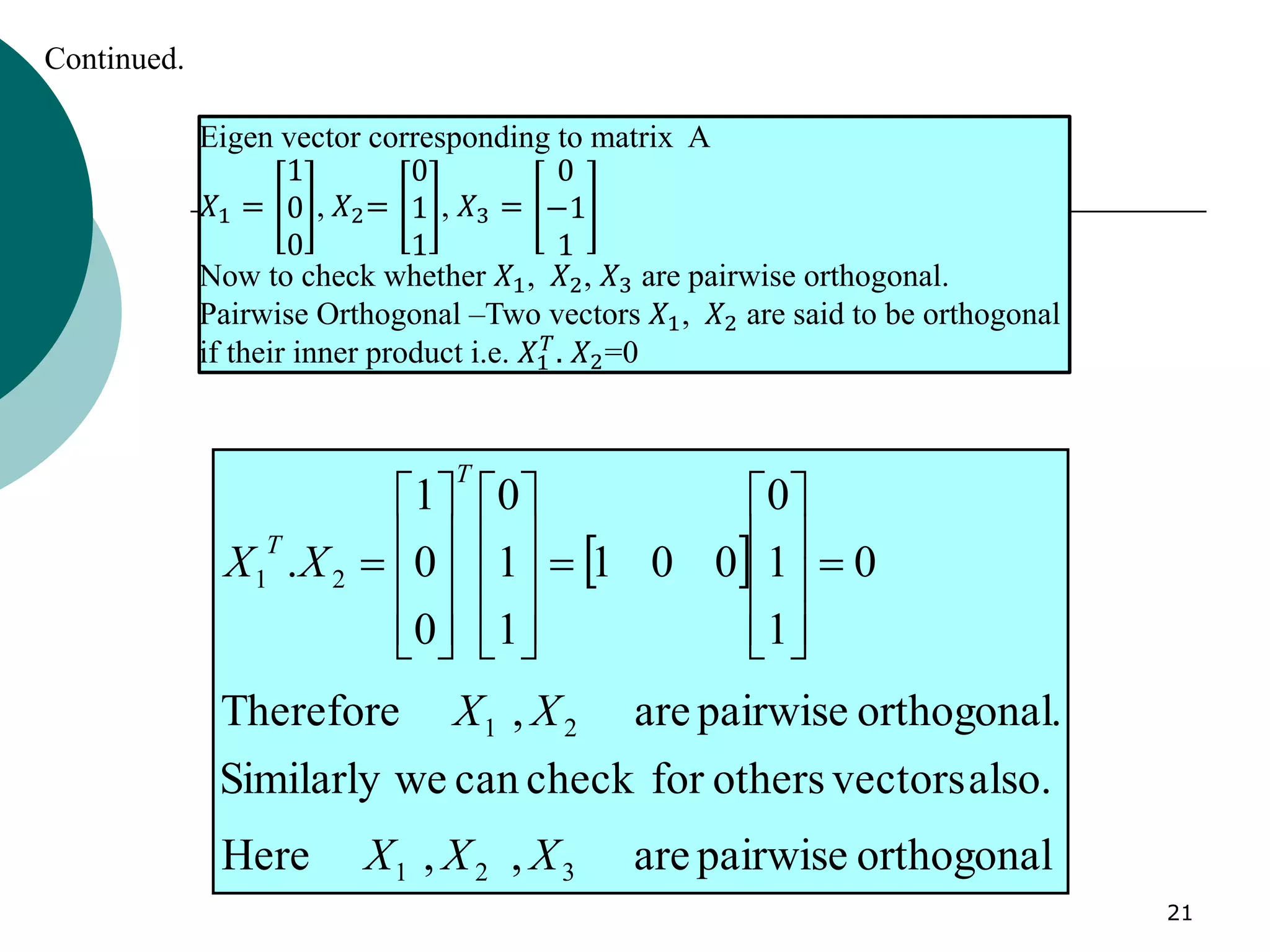
3. Now check whether eigen vectors are pairwise
orthogonal or not.
Orthogonal Vector; Two vectors 𝑋1, 𝑋2 are said to be
orthogonal if their inner product is zero i.e. 𝑋1
𝑇
. 𝑋2 = 0
Working Method
12.
12
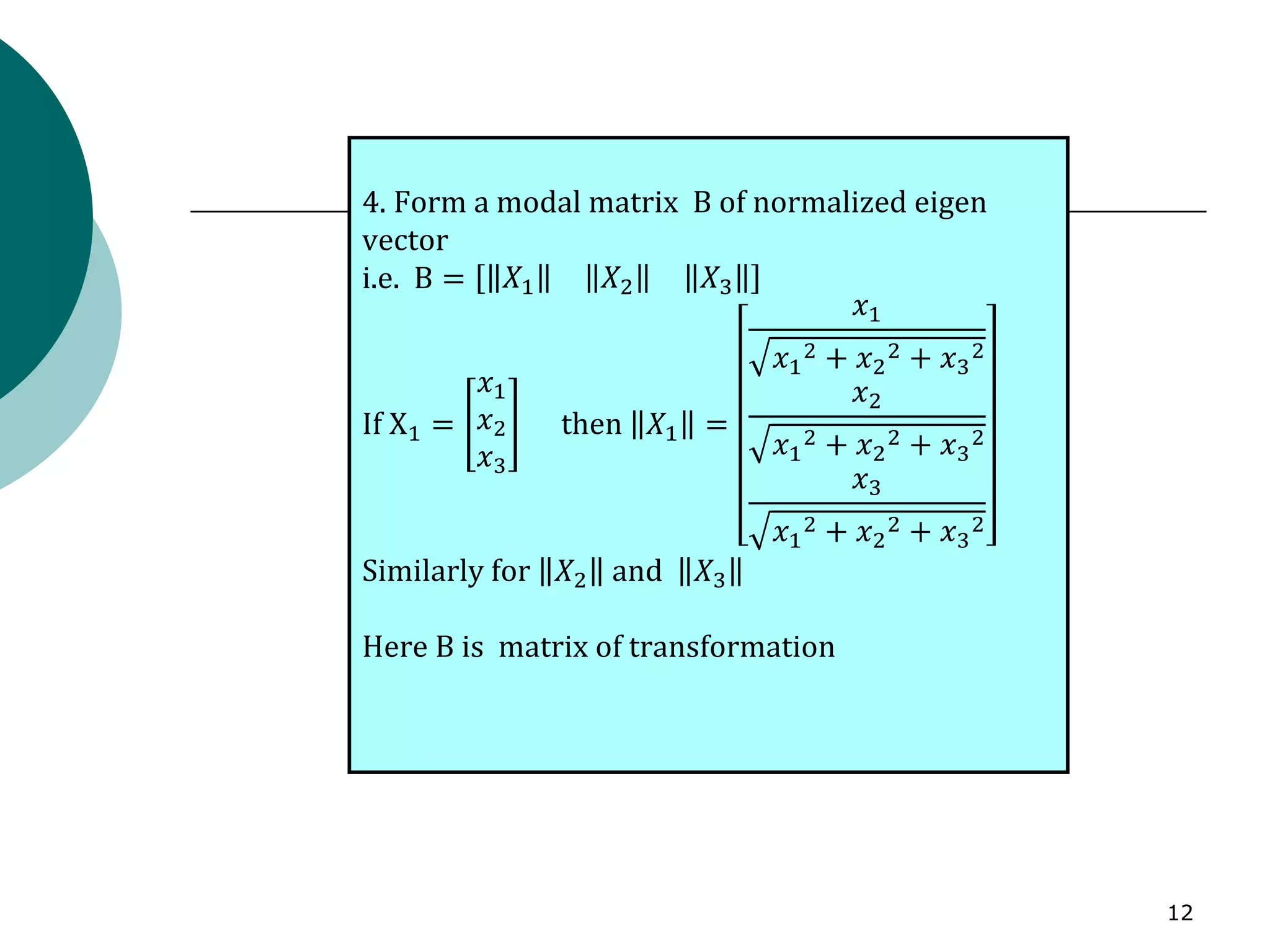
4. Form amodal matrix B of normalized eigen
vector
i.e. B = 𝑋1 𝑋2 𝑋3
If X1 =
𝑥1
𝑥2
𝑥3
then 𝑋1 =
𝑥1
𝑥1
2 + 𝑥2
2 + 𝑥3
2
𝑥2
𝑥1
2 + 𝑥2
2 + 𝑥3
2
𝑥3
𝑥1
2 + 𝑥2
2 + 𝑥3
2
Similarly for 𝑋2 and 𝑋3
Here B is matrix of transformation
13.
13
𝑋
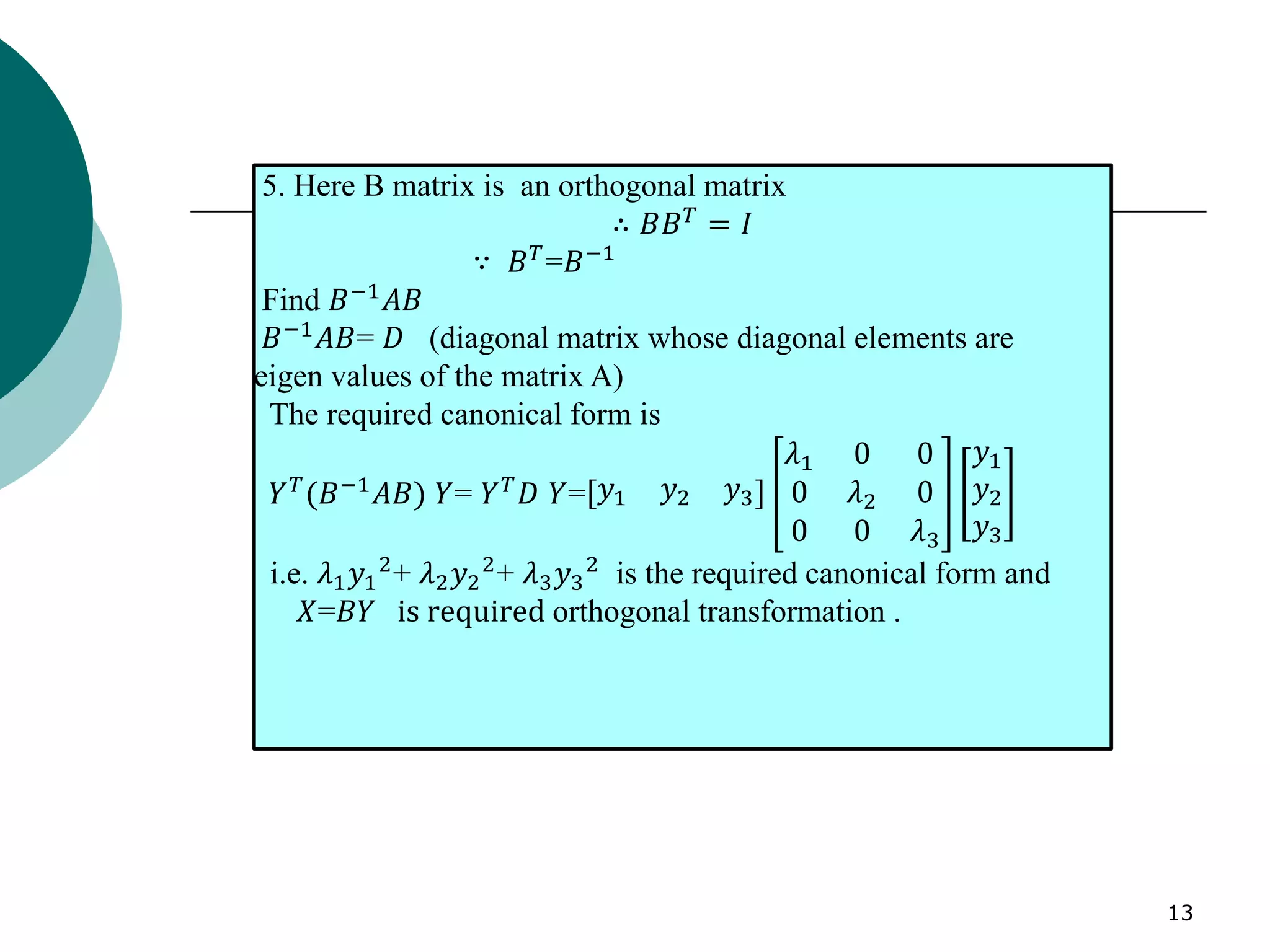
5. Here Bmatrix is an orthogonal matrix
∴ 𝐵𝐵𝑇
= 𝐼
∵ 𝐵𝑇=𝐵−1
Find 𝐵−1
𝐴𝐵
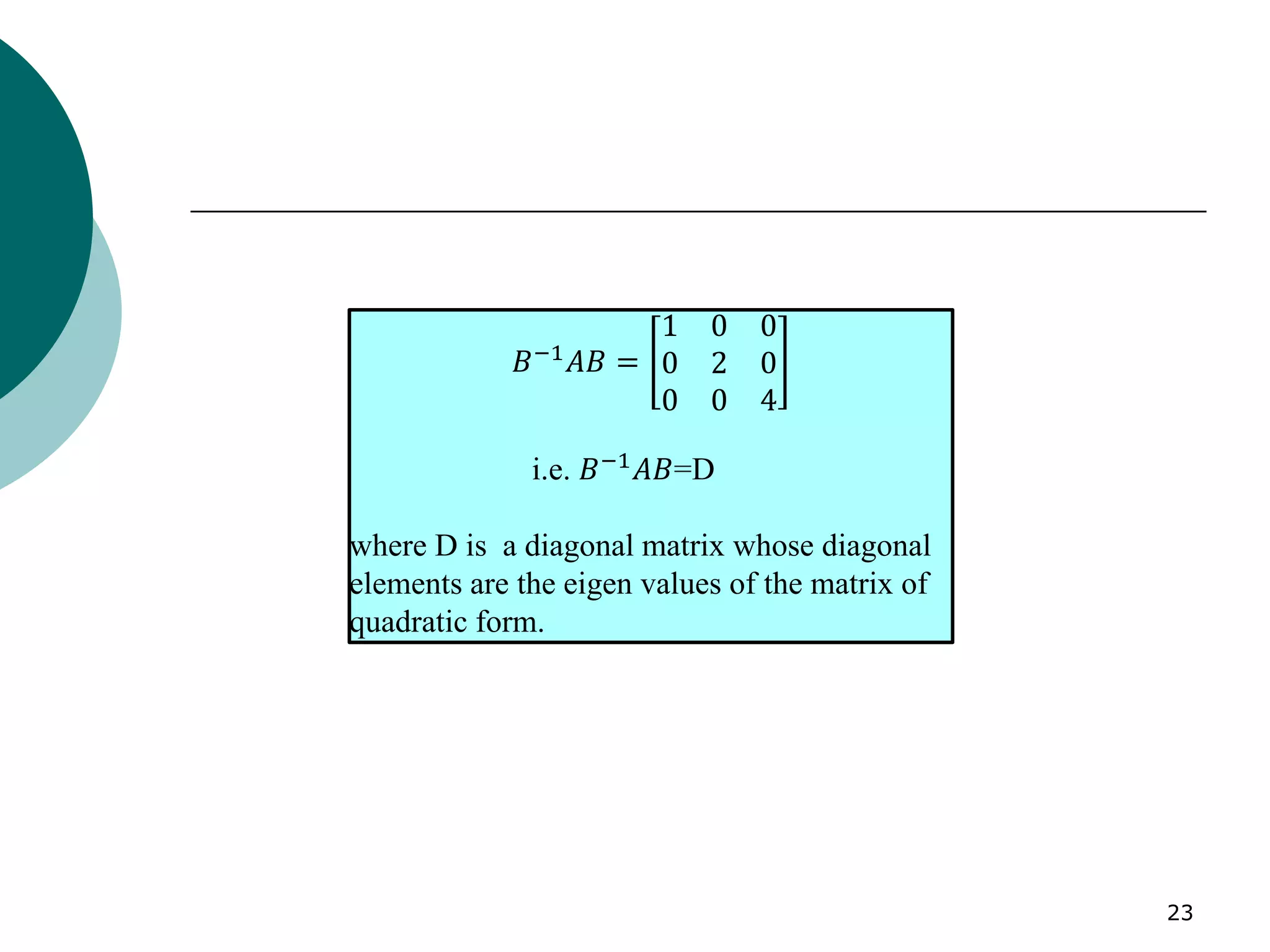
𝐵−1𝐴𝐵= 𝐷 (diagonal matrix whose diagonal elements are
eigen values of the matrix A)
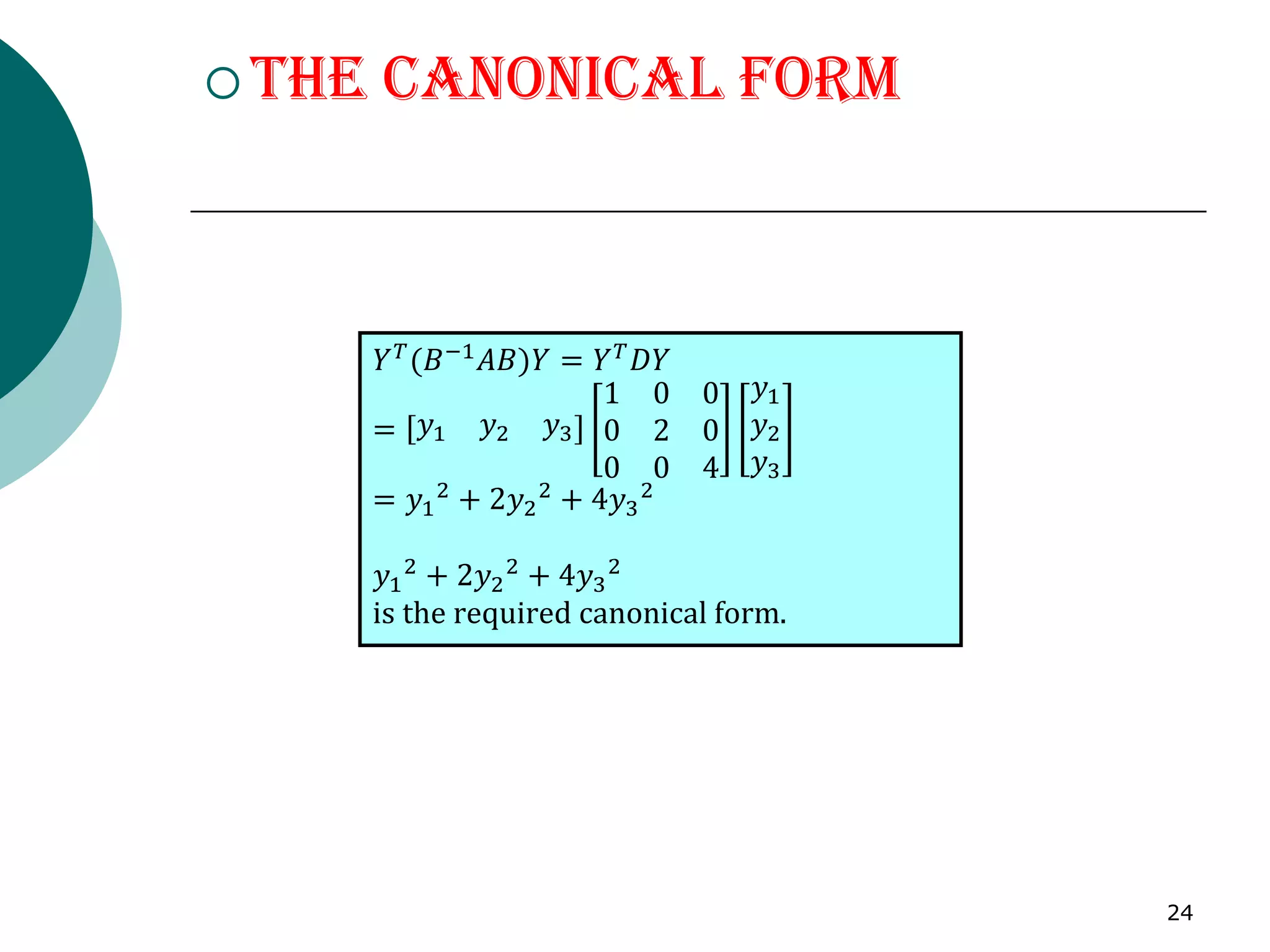
The required canonical form is
𝑌𝑇(𝐵−1𝐴𝐵) 𝑌= 𝑌𝑇𝐷 𝑌= 𝑦1 𝑦2 𝑦3
𝜆1 0 0
0 𝜆2 0
0 0 𝜆3
𝑦1
𝑦2
𝑦3
i.e. 𝜆1𝑦1
2
+ 𝜆2𝑦2
2
+ 𝜆3𝑦3
2
is the required canonical form and
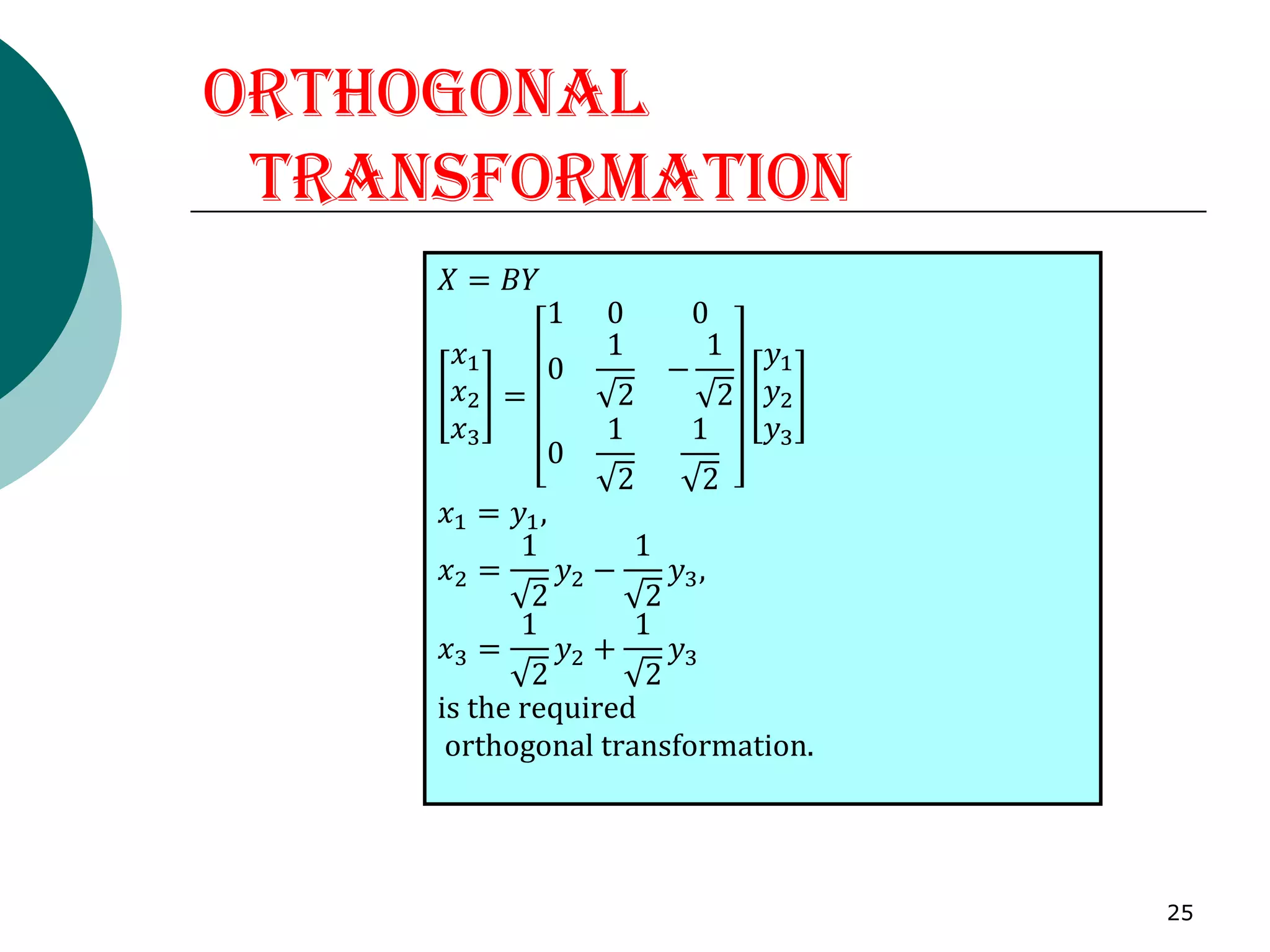
𝑋=𝐵𝑌 is required orthogonal transformation .
14.
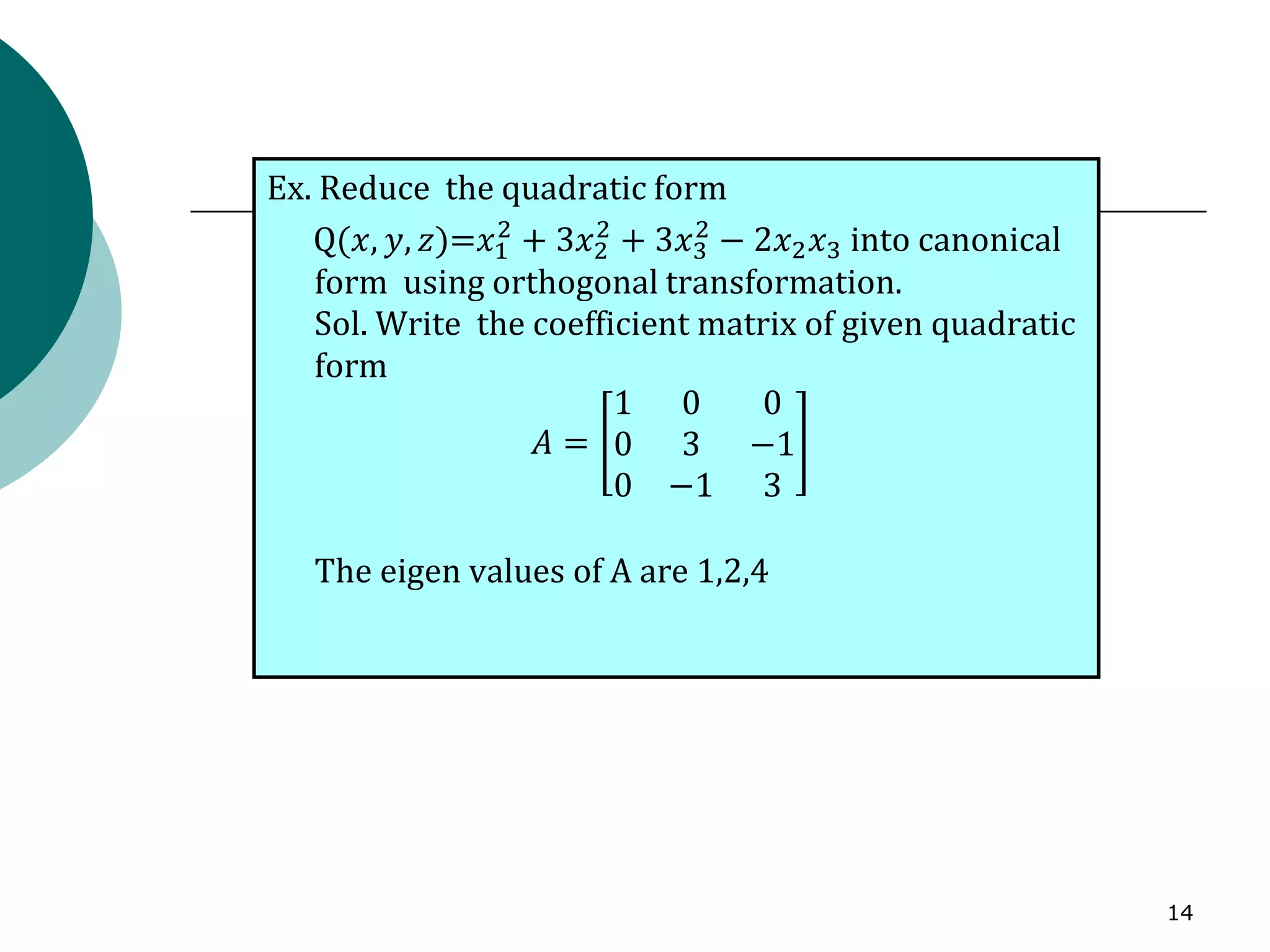
Ex. Reduce thequadratic form
Q(𝑥, 𝑦, 𝑧)=𝑥1
2
+ 3𝑥2
2
+ 3𝑥3
2
− 2𝑥2𝑥3 into canonical
form using orthogonal transformation.
Sol. Write the coefficient matrix of given quadratic
form
𝐴 =
1 0 0
0 3 −1
0 −1 3
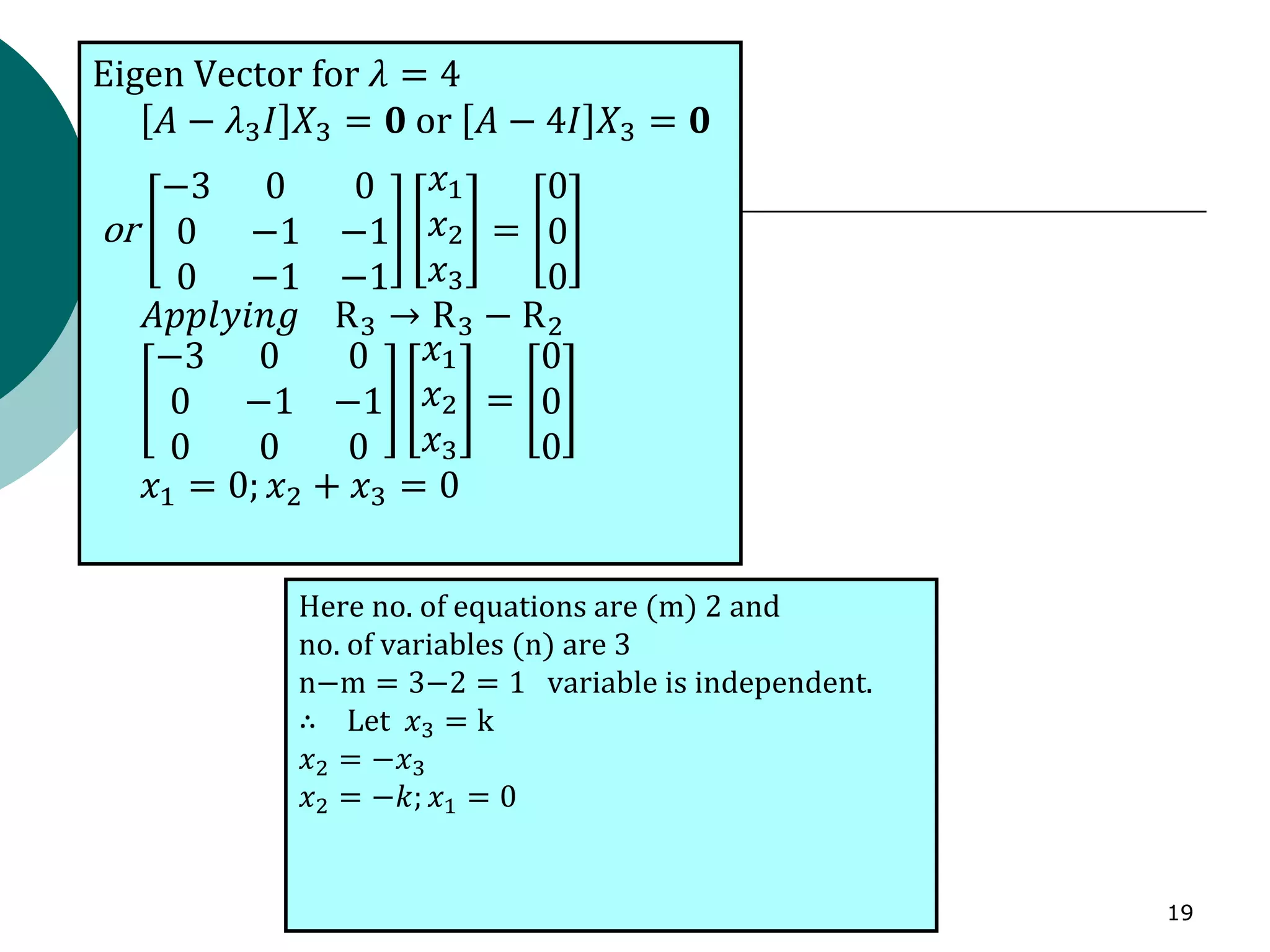
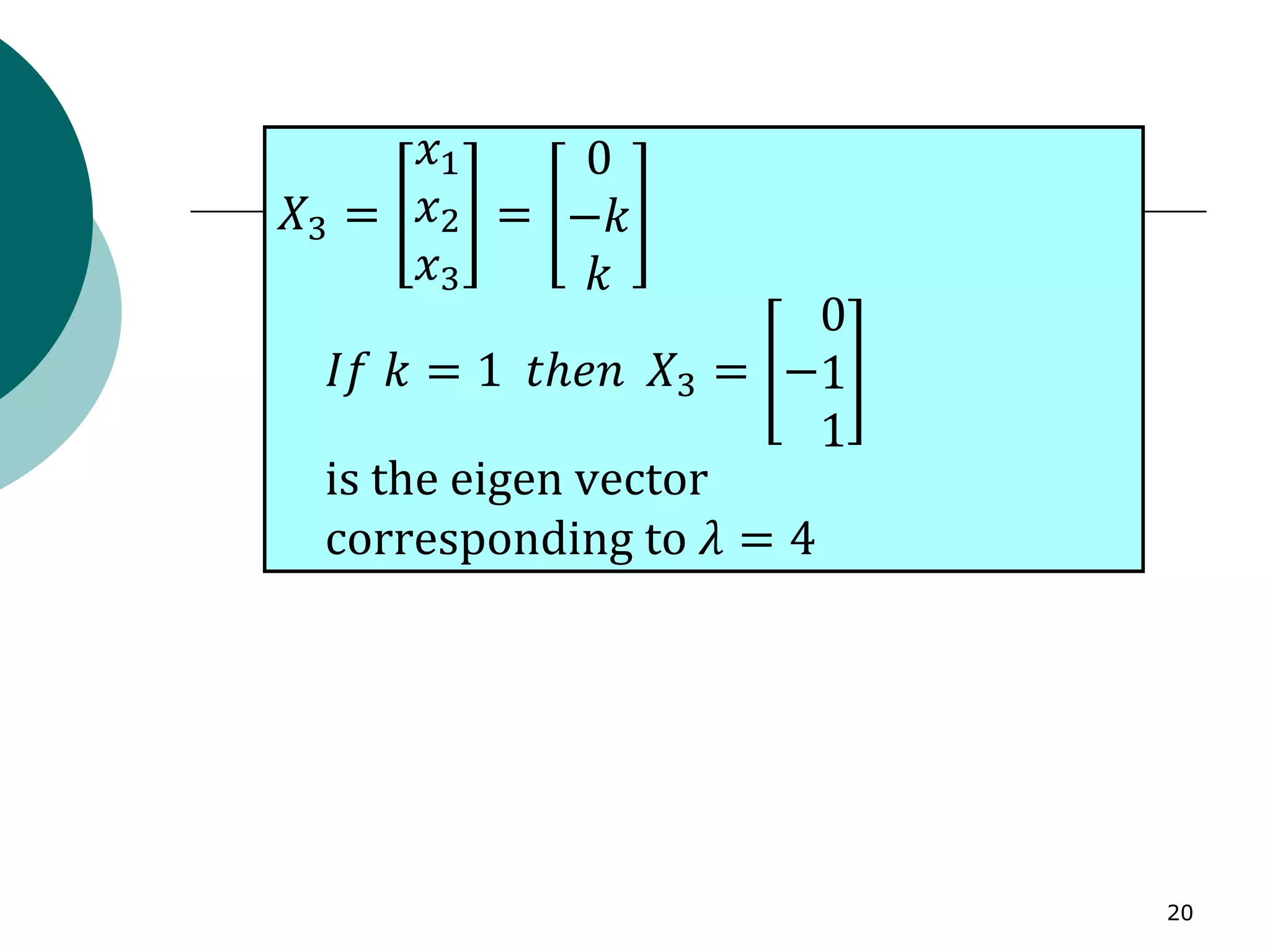
The eigen values of A are 1,2,4
14
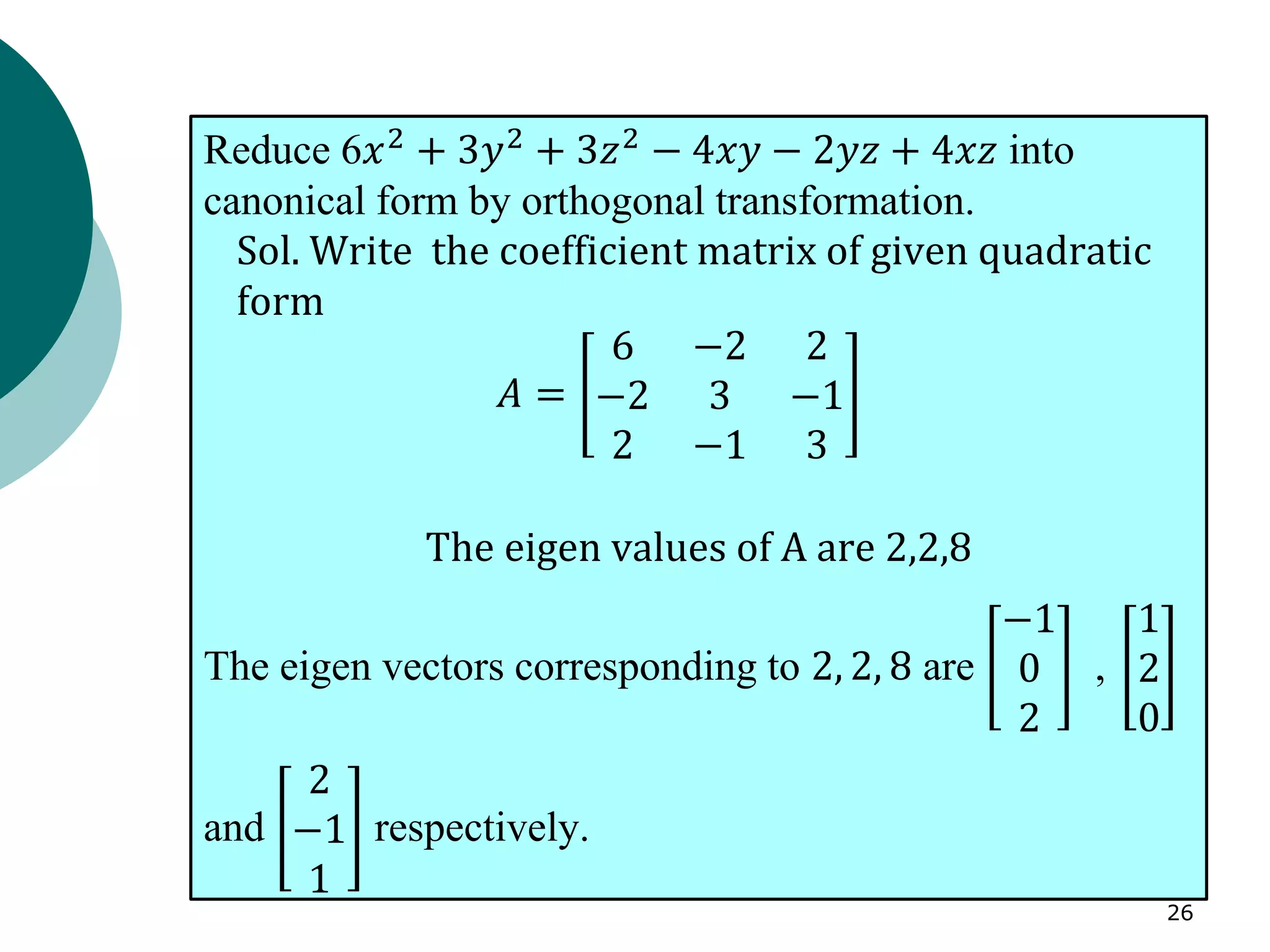
Reduce 6𝑥2 +3𝑦2 + 3𝑧2 − 4𝑥𝑦 − 2𝑦𝑧 + 4𝑥𝑧 into
canonical form by orthogonal transformation.
Sol. Write the coefficient matrix of given quadratic
form
𝐴 =
6 −2 2
−2 3 −1
2 −1 3
The eigen values of A are 2,2,8
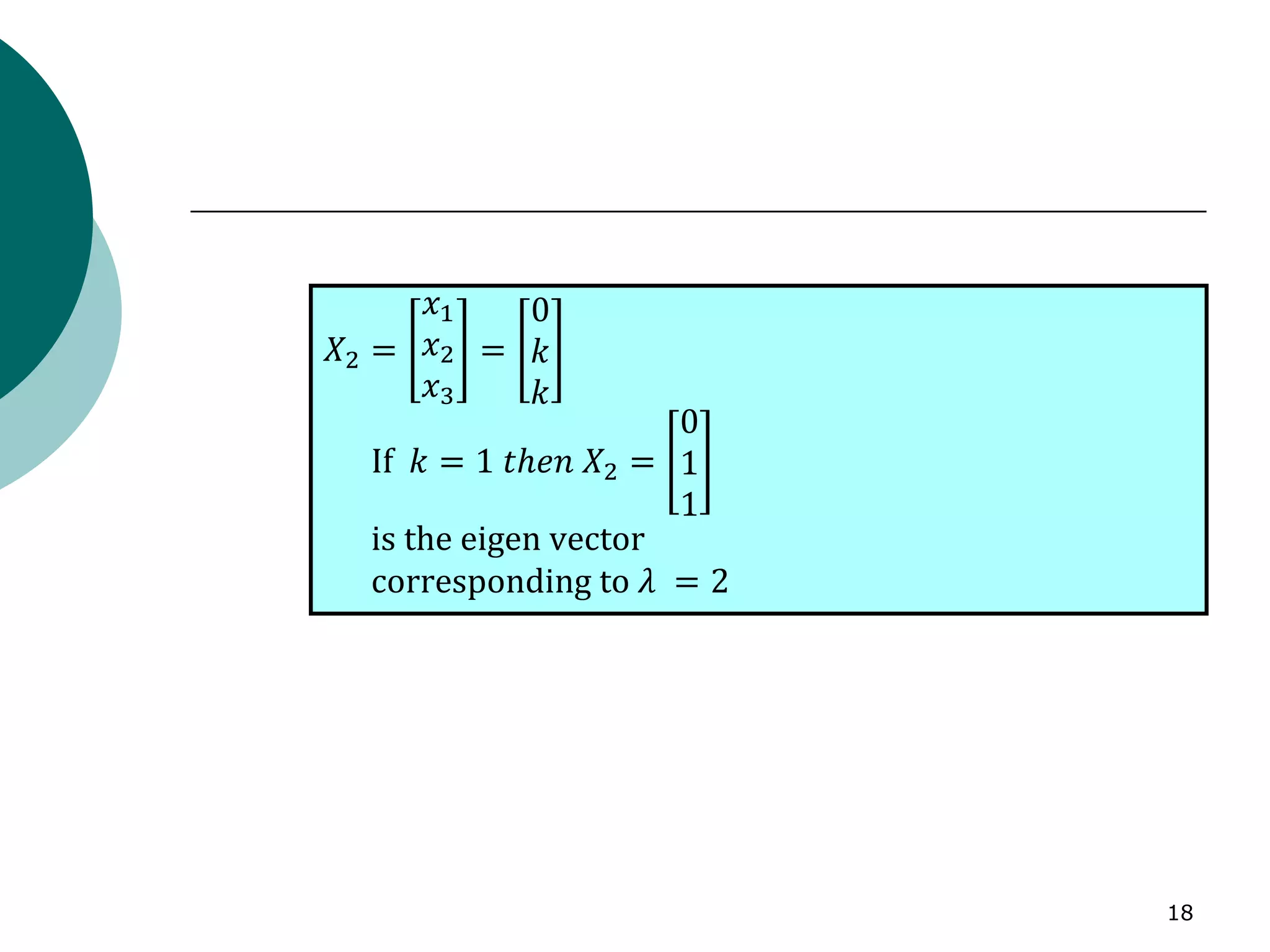
The eigen vectors corresponding to 2, 2, 8 are
−1
0
2
,
1
2
0
and
2
−1
1
respectively.
26
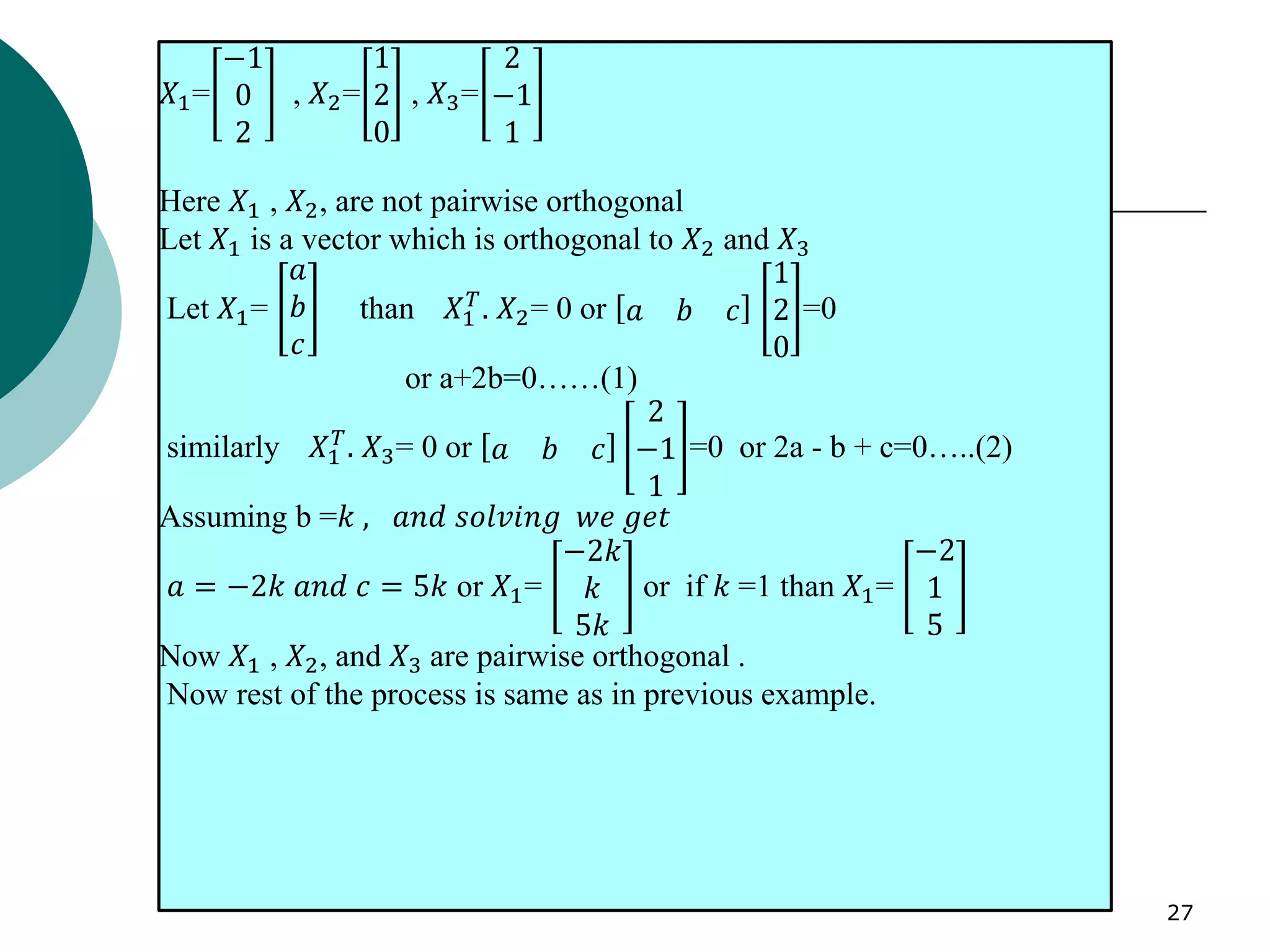
27.
27
𝑋1=
−1
0
2
, 𝑋2=
1
2
0
, 𝑋3=
2
−1
1
Here𝑋1 , 𝑋2, are not pairwise orthogonal
Let 𝑋1 is a vector which is orthogonal to 𝑋2 and 𝑋3
Let 𝑋1=
𝑎
𝑏
𝑐
than 𝑋1
𝑇
. 𝑋2= 0 or 𝑎 𝑏 𝑐
1
2
0
=0
or a+2b=0……(1)
similarly 𝑋1
𝑇
. 𝑋3= 0 or 𝑎 𝑏 𝑐
2
−1
1
=0 or 2a - b + c=0…..(2)
Assuming b =𝑘 , 𝑎𝑛𝑑 𝑠𝑜𝑙𝑣𝑖𝑛𝑔 𝑤𝑒 𝑔𝑒𝑡
𝑎 = −2𝑘 𝑎𝑛𝑑 𝑐 = 5𝑘 or 𝑋1=
−2𝑘
𝑘
5𝑘
or if 𝑘 =1 than 𝑋1=
−2
1
5
Now 𝑋1 , 𝑋2, and 𝑋3 are pairwise orthogonal .
Now rest of the process is same as in previous example.
28.
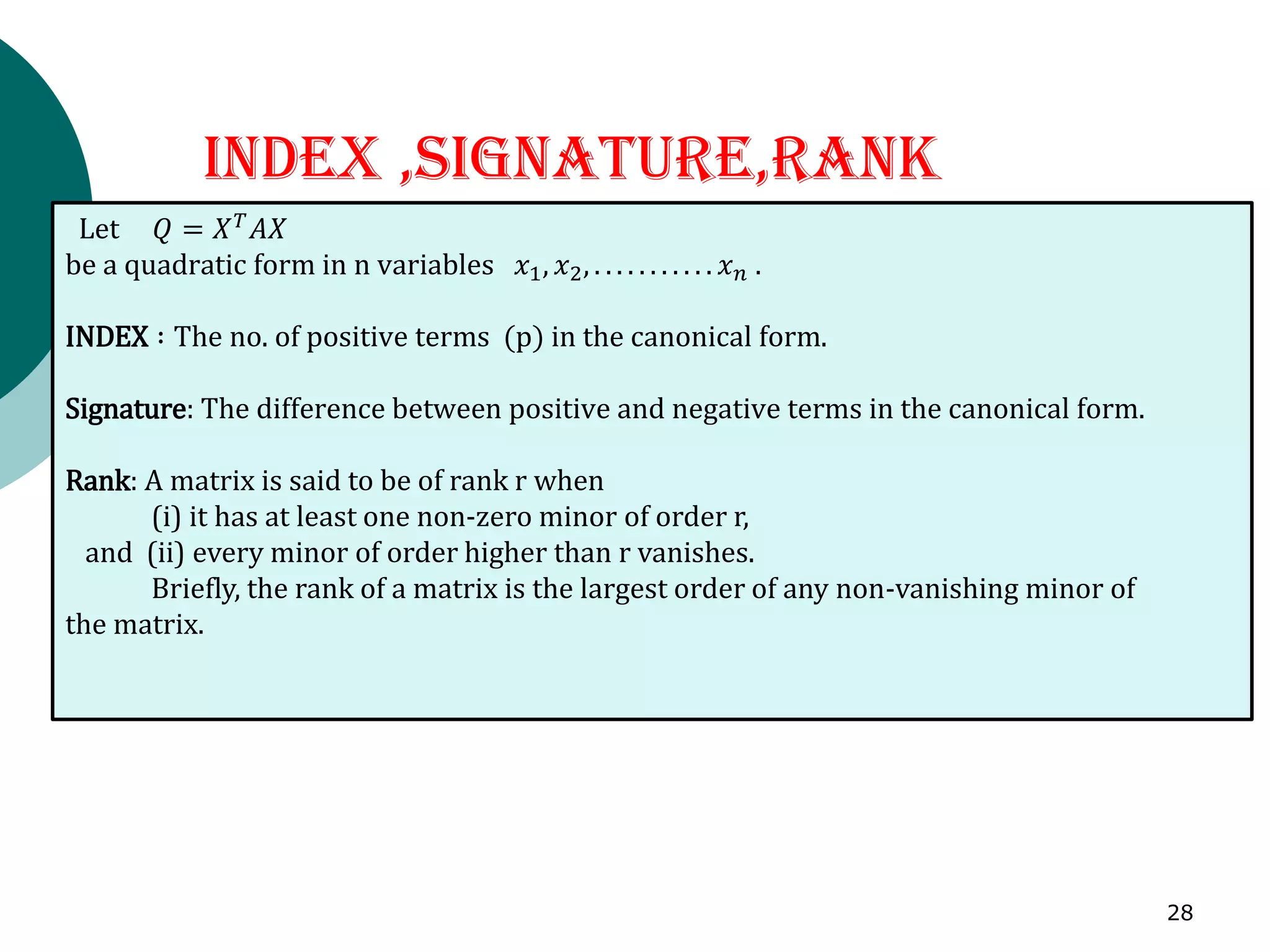
INDEX ,SIGNATURE,RANK
Let 𝑄= 𝑋𝑇
𝐴𝑋
be a quadratic form in n variables 𝑥1, 𝑥2, . . . . . . . . . . . 𝑥𝑛 .
INDEX ∶ The no. of positive terms (p) in the canonical form.
Signature: The difference between positive and negative terms in the canonical form.
Rank: A matrix is said to be of rank r when
(i) it has at least one non-zero minor of order r,
and (ii) every minor of order higher than r vanishes.
Briefly, the rank of a matrix is the largest order of any non-vanishing minor of
the matrix.
28
29.
29
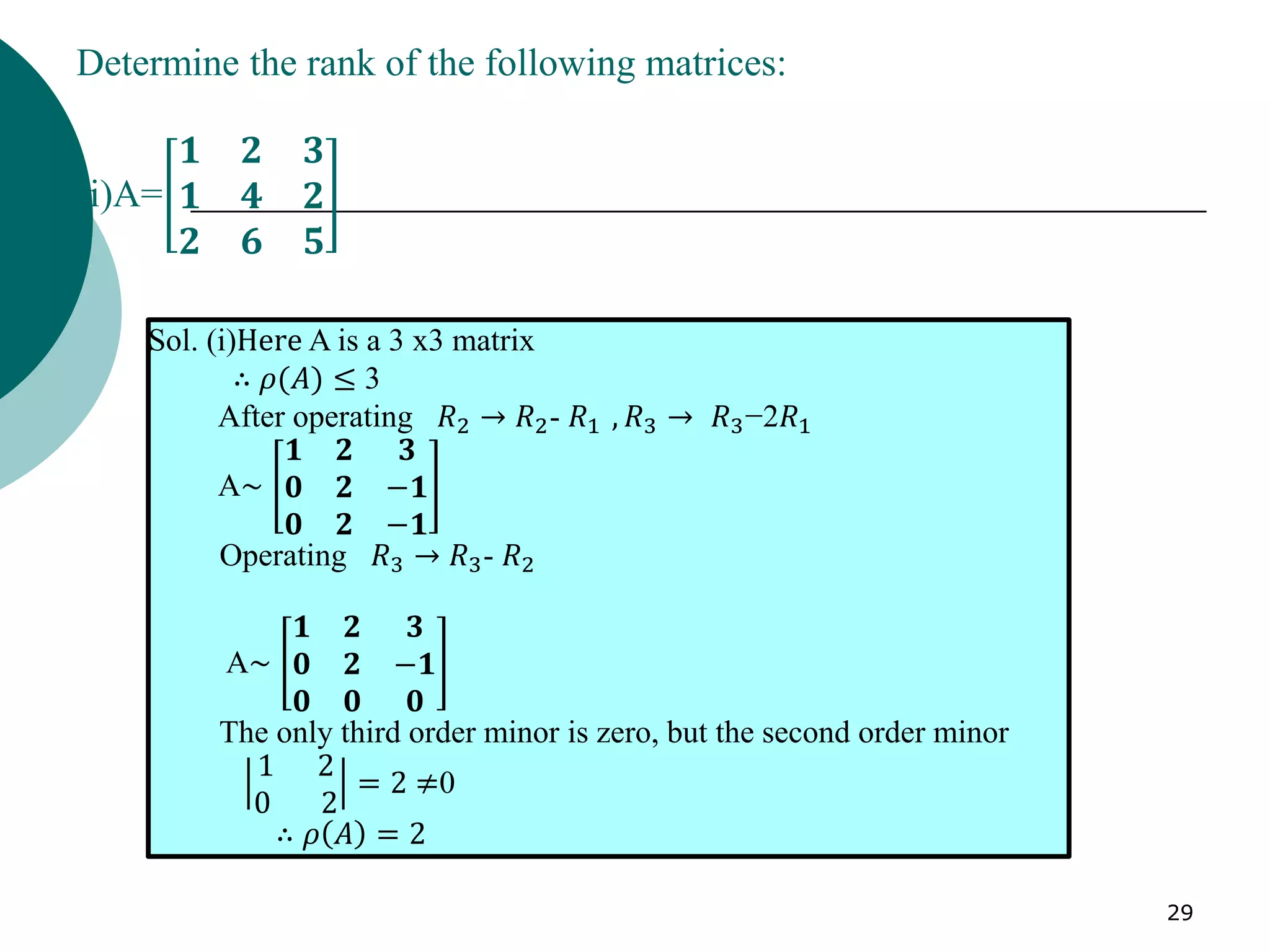
Determine the rankof the following matrices:
(i)A=
𝟏 𝟐 𝟑
𝟏 𝟒 𝟐
𝟐 𝟔 𝟓
Sol. (i)Here A is a 3 x3 matrix
∴ 𝜌(𝐴) ≤ 3
After operating 𝑅2 → 𝑅2- 𝑅1 , 𝑅3 → 𝑅3−2𝑅1
A~
𝟏 𝟐 𝟑
𝟎 𝟐 −𝟏
𝟎 𝟐 −𝟏
Operating 𝑅3 → 𝑅3- 𝑅2
A~
𝟏 𝟐 𝟑
𝟎 𝟐 −𝟏
𝟎 𝟎 𝟎
The only third order minor is zero, but the second order minor
1 2
0 2
= 2 ≠0
∴ 𝜌 𝐴 = 2
30.
30
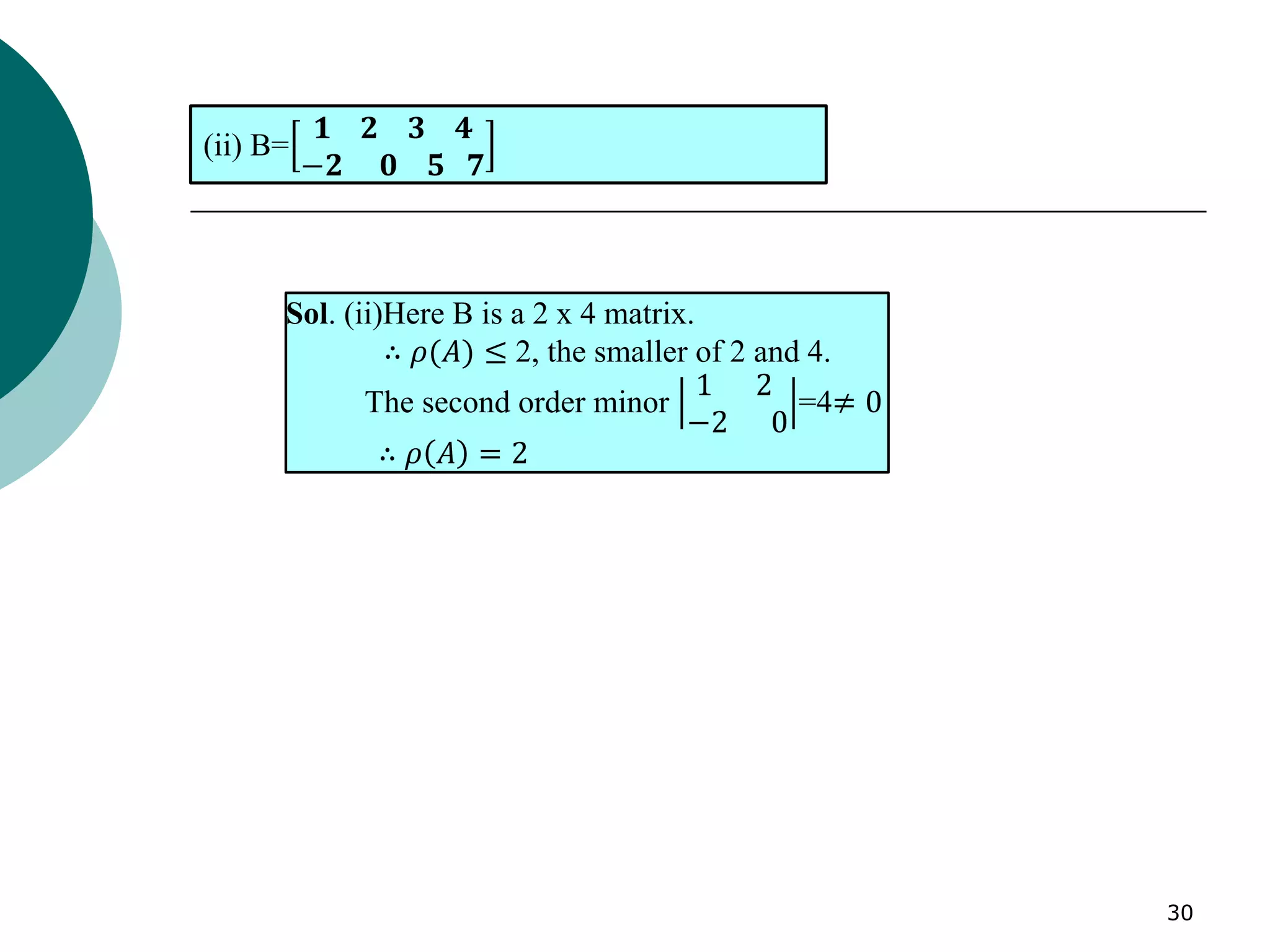
Sol. (ii)Here Bis a 2 x 4 matrix.
∴ 𝜌(𝐴) ≤ 2, the smaller of 2 and 4.
The second order minor
1 2
−2 0
=4≠ 0
∴ 𝜌 𝐴 = 2
(ii) B=
𝟏 𝟐 𝟑 𝟒
−𝟐 𝟎 𝟓 𝟕
31.
Let 𝑋𝑇
𝐴𝑋be a real quadratic form in n
variables 𝑥1,𝑥2, …. 𝑥𝑛 with rank r and signature s.
Then we say that the quadratic form is
(i) positive definite if r = n, s = n
(ii) negative definite if r = n, s = 0
(iii) positive semidefinite if r<n and s = r
(iv) negative semidefinite if r<n, s = 0
(v) indefinite in all other cases.
31
NATURE OF QUADRATIC FORM
( using rank, signature)
32.
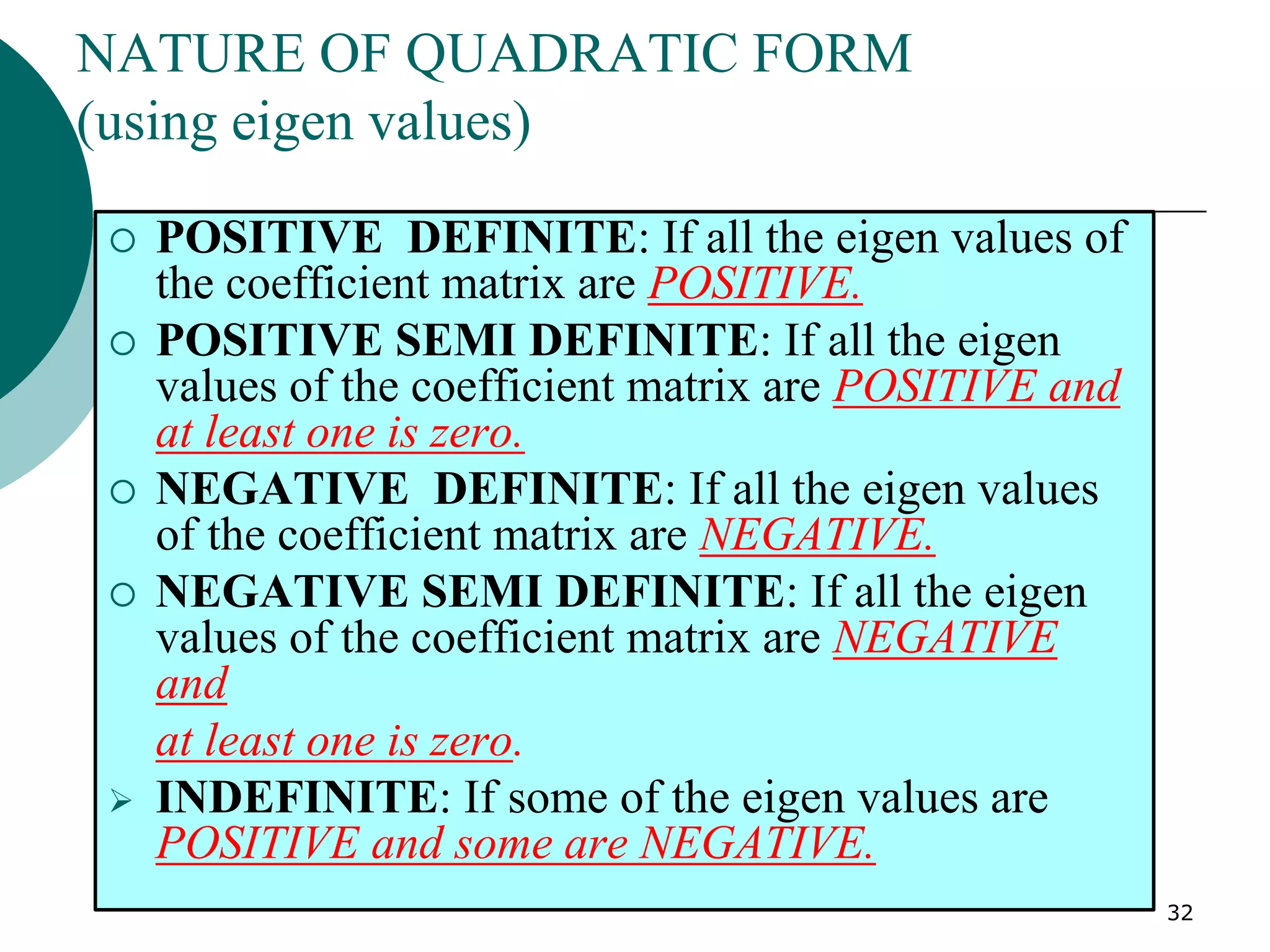
NATURE OF QUADRATICFORM
(using eigen values)
POSITIVE DEFINITE: If all the eigen values of
the coefficient matrix are POSITIVE.
POSITIVE SEMI DEFINITE: If all the eigen
values of the coefficient matrix are POSITIVE and
at least one is zero.
NEGATIVE DEFINITE: If all the eigen values
of the coefficient matrix are NEGATIVE.
NEGATIVE SEMI DEFINITE: If all the eigen
values of the coefficient matrix are NEGATIVE
and
at least one is zero.
➢ INDEFINITE: If some of the eigen values are
POSITIVE and some are NEGATIVE.
32
33.
EX. Determine thenature ,index and signature of the quadratic form
𝑄(𝑥) = 2𝑥1𝑥2 + 2𝑥1𝑥3 + 2𝑥3𝑥2
Solution. Here
𝐴 =
0 1 1
1 0 1
1 1 0
Now the characteristic equation for A is
𝜆3 − 3𝜆 − 2 = 0
or 𝜆 = 2, −1, −1
Some of the eigen values are positive and
some are negative.
Hence 𝐐(𝐱) is indefinite.
Here the canonical form is 2𝑥1
2
− 𝑥2
2
− 𝑥3
2
.
Index =1 No. of positive term in canonical form
Signature=-1
(difference of positive and negative term in canonical form )
33





![[Steven h. weintraub]_jordan_canonical_form_appli(book_fi.org)](https://cdn.slidesharecdn.com/ss_thumbnails/stevenh-150418132059-conversion-gate02-thumbnail.jpg?width=640&height=640&fit=bounds)


