Engineering Mathematics Material 2012
Prepared by C.Ganesan, M.Sc., M.Phil., (Ph: 9841168917) Page 1
SUBJECT NAME : Engineering Mathematics – II
SUBJECT CODE : MA 2161
MATERIAL NAME : Formula Material
MATERIAL CODE : JM08AM1003
Name of the Student: Branch:
Unit – I (Ordinary Differential Equation)
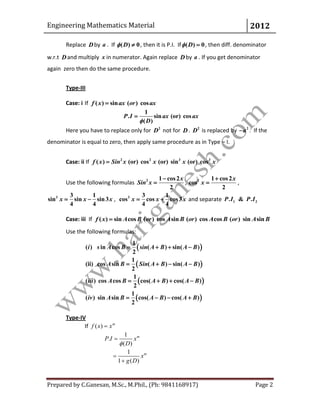
1. ODE with constant coefficients: Solution C.F + P.Iy 
Complementary functions:
Sl.No. Nature of Roots C.F
1. 1 2m m ( ) mx
Ax B e
2. 1 2 3m m m   2 mx
Ax Bx c e 
3. 1 2m m 1 2m x m x
Ae Be
4. 1 2 3m m m  31 2 m xm x m x
Ae Be Ce 
5. 1 2 3,m m m 3
( ) m xmx
Ax B e Ce 
6. m i   ( cos sin )x
e A x B x
 
7. m i  cos sinA x B x 
Particular Integral:
Type-I
If ( ) 0f x 
then . 0P I 
Type-II
If ( ) ax
f x e
1
.
( )
ax
P I e
D

Engineering Mathematics Material 2012
Prepared by C.Ganesan, M.Sc., M.Phil., (Ph: 9841168917) Page 2
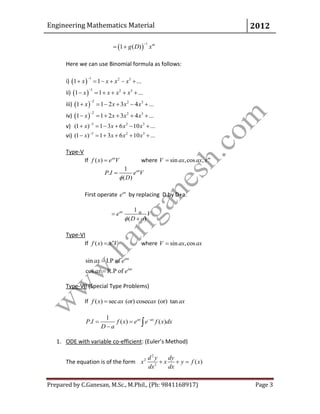
Replace Dby a . If ( ) 0D  , then it is P.I. If ( ) 0D  , then diff. denominator
w.r.t Dand multiply x in numerator. Again replace Dby a . If you get denominator
again zero then do the same procedure.
Type-III
Case: i If ( ) sin ( ) cosf x ax or ax
1
. sin (or) cos
( )
P I ax ax
D

Here you have to replace only for 2
D not for D. 2
D is replaced by 2
a . If the
denominator is equal to zero, then apply same procedure as in Type – I.
Case: ii If 2 2 3 3
( ) (or) cos (or) sin (or) cosf x Sin x x x x
Use the following formulas 2 1 cos2
2
x
Sin x

 , 2 1 cos2
cos
2
x
x

 ,
x x x 3 3 1
sin sin sin3
4 4
, x x x 3 3 1
cos cos cos3
4 4
and separate 1 2. & .P I P I
Case: iii If ( ) sin cos ( ) cos sin ( ) cos cos ( ) sin sinf x A B or A B or A B or A B
Use the following formulas:
 
 
 
 
1
( ) in cos ( ) sin( )
2
1
(ii) cos sin ( ) sin( )
2
1
( ) cos cos cos( ) cos( )
2
1
( ) sin sin cos( ) cos( )
2
i s A B sin A B A B
A B Sin A B A B
iii A B A B A B
iv A B A B A B
   
   
   
   
Type-IV
If ( ) m
f x x
1
.
( )
m
P I x
D

1
1 ( )
m
x
g D


Engineering Mathematics Material 2012
Prepared by C.Ganesan, M.Sc., M.Phil., (Ph: 9841168917) Page 3
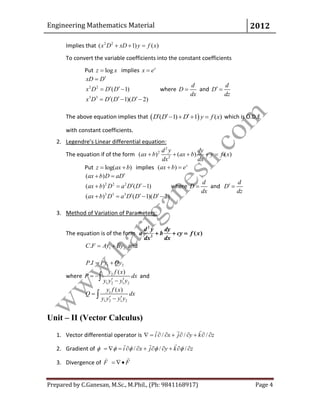
 
1
1 ( ) m
g D x

 
Here we can use Binomial formula as follows:
i)  
1 2 3
1 1 ...x x x x

     
ii)  
1 2 3
1 1 ...x x x x

     
iii)  
2 2 3
1 1 2 3 4 ...x x x x

     
iv)  
2 2 3
1 1 2 3 4 ...x x x x

     
v) 3 2 3
(1 ) 1 3 6 10 ...x x x x
     
vi) 3 2 3
(1 ) 1 3 6 10 ...x x x x
     
Type-V
If ( ) ax
f x e V where sin ,cos , m
V ax ax x
1
.
( )
ax
P I e V
D

First operate ax
e by replacing D by D+a.
1
( )
ax
e V
D a


Type-VI
If ( ) n
f x x V where sin ,cosV ax ax
sin I.P of
cos R.P of
iax
iax
ax e
ax e


Type-VII (Special Type Problems)
If ( ) sec (or) cosec (or) tanf x ax ax ax
1
. ( ) ( )ax ax
P I f x e e f x dx
D a

 
 
1. ODE with variable co-efficient: (Euler’s Method)
The equation is of the form
2
2
2
( )
d y dy
x x y f x
dx dx
  
Engineering Mathematics Material 2012
Prepared by C.Ganesan, M.Sc., M.Phil., (Ph: 9841168917) Page 4
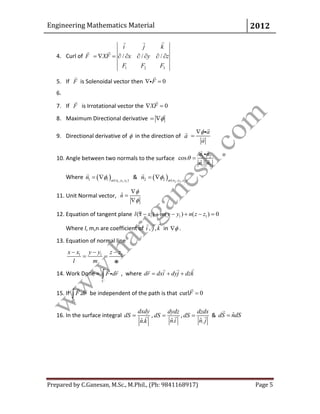
Implies that 2 2
( 1) ( )x D xD y f x  
To convert the variable coefficients into the constant coefficients
Put logz x implies z
x e
2 2
3 3
( 1)
( 1)( 2)
xD D
x D D D
x D D D D

  
    
where
d
D
dx
 and
d
D
dz
 
The above equation implies that  ( 1) 1 ( )D D D y f x      which is O.D.E
with constant coefficients.
2. Legendre’s Linear differential equation:
The equation if of the form
2
2
2
( ) ( ) ( )
d y dy
ax b ax b y f x
dx dx
    
Put log( )z ax b  implies ( ) z
ax b e 
2 2 2
3 3 3
( )
( ) ( 1)
( ) ( 1)( 2)
ax b D aD
ax b D a D D
ax b D a D D D
 
   
     
where
d
D
dx
 and
d
D
dz
 
3. Method of Variation of Parameters:
The equation is of the form
d y dy
a b cy f x
dx dx
  
2
2
( )
1 2.C F Ay By  and
1 2.P I Py Qy 
where 2
1 2 1 2
( )y f x
P dx
y y y y
 
  and
1
1 2 1 2
( )y f x
Q dx
y y y y

 
Unit – II (Vector Calculus)
1. Vector differential operator is / / /i x j y k z         
2. Gradient of  / / /i x j y k z             
3. Divergence of F F 
Engineering Mathematics Material 2012
Prepared by C.Ganesan, M.Sc., M.Phil., (Ph: 9841168917) Page 5
4. Curl of F
1 2 3
/ / /
i j k
XF x y z
F F F
        
5. If F is Solenoidal vector then 0F 
6.
7. If F is Irrotational vector the 0XF 
8. Maximum Directional derivative  
9. Directional derivative of  in the direction of a
a
a


10. Angle between two normals to the surface 1 2
1 2
cos
n n
n n
 
Where   1 1 1
1 1 ( , , )at x y z
n   &   2 2 2
2 2 ( , , )at x y z
n  
11. Unit Normal vector, ˆn





12. Equation of tangent plane 1 1 1( ) ( ) ( ) 0l x x m y y n z z     
Where l, m,n are coefficient of , ,i j k in  .
13. Equation of normal line
1 1 1x x y y z z
l m n
  
 
14. Work Done =
C
F dr , where dr dxi dyj dzk  
15. If .
C
F dr be independent of the path is that curl 0F 
16. In the surface integral
ˆ.
dxdy
dS
n k
 ,
ˆ.
dydz
dS
n i
 ,
ˆ.
dzdx
dS
n j
 & ˆdS ndS
Engineering Mathematics Material 2012
Prepared by C.Ganesan, M.Sc., M.Phil., (Ph: 9841168917) Page 6
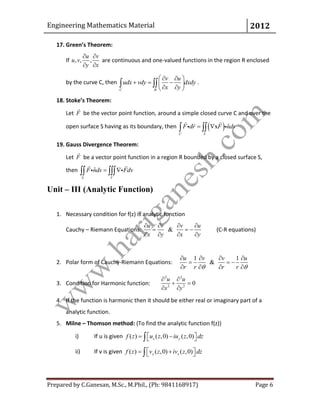
17. Green’s Theorem:
If , , ,
u v
u v
y x
 
 
are continuous and one-valued functions in the region R enclosed
by the curve C, then
C R
v u
udx vdy dxdy
x y
  
   
  
  .
18. Stoke’s Theorem:
Let F be the vector point function, around a simple closed curve C and over the
open surface S having as its boundary, then   ˆx
C S
F dr F nds  
19. Gauss Divergence Theorem:
Let F be a vector point function in a region R bounded by a closed surface S,
then ˆ
S V
F nds Fdv  
Unit – III (Analytic Function)
1. Necessary condition for f(z) is analytic function
Cauchy – Riemann Equations: &
u v v u
x y x y
   
  
   
(C-R equations)
2. Polar form of Cauchy-Riemann Equations:
1 1
&
u v v u
r r r r 
   
  
   
3. Condition for Harmonic function:
2 2
2 2
0
u u
x y
 
 
 
4. If the function is harmonic then it should be either real or imaginary part of a
analytic function.
5. Milne – Thomson method: (To find the analytic function f(z))
i) If u is given ( ) ( ,0) ( ,0)x yf z u z iu z dz   
ii) If v is given ( ) ( ,0) ( ,0)y xf z v z iv z dz   
Engineering Mathematics Material 2012
Prepared by C.Ganesan, M.Sc., M.Phil., (Ph: 9841168917) Page 7
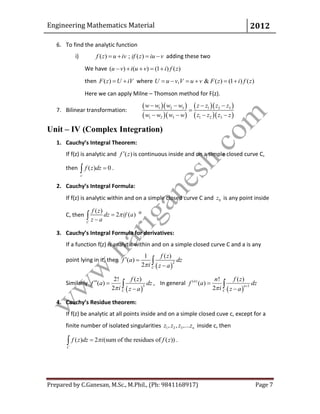
6. To find the analytic function
i) ( ) ; ( )f z u iv if z iu v    adding these two
We have ( ) ( ) (1 ) ( )u v i u v i f z    
then ( )F z U iV  where , & ( ) (1 ) ( )U u v V u v F z i f z     
Here we can apply Milne – Thomson method for F(z).
7. Bilinear transformation:
  
  
  
  
1 2 3 1 2 3
1 2 3 1 2 3
w w w w z z z z
w w w w z z z z
   

   
Unit – IV (Complex Integration)
1. Cauchy’s Integral Theorem:
If f(z) is analytic and ( )f z is continuous inside and on a simple closed curve C,
then ( ) 0
c
f z dz  .
2. Cauchy’s Integral Formula:
If f(z) is analytic within and on a simple closed curve C and 0z is any point inside
C, then
( )
2 ( )
C
f z
dz if a
z a


3. Cauchy’s Integral Formula for derivatives:
If a function f(z) is analytic within and on a simple closed curve C and a is any
point lying in it, then
 
2
1 ( )
( )
2 C
f z
f a dz
i z a
 


Similarly
 
3
2! ( )
( )
2 C
f z
f a dz
i z a
 

 , In general
 
( )
1
! ( )
( )
2
n
n
C
n f z
f a dz
i z a 



4. Cauchy’s Residue theorem:
If f(z) be analytic at all points inside and on a simple closed cuve c, except for a
finite number of isolated singularities 1 2 3, , ,... nz z z z inside c, then
( ) 2 (sum of the residues of ( ))
C
f z dz i f z .
Engineering Mathematics Material 2012
Prepared by C.Ganesan, M.Sc., M.Phil., (Ph: 9841168917) Page 8
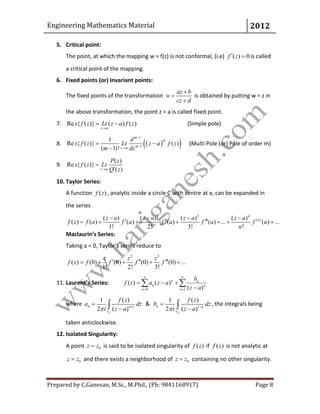
5. Critical point:
The point, at which the mapping w = f(z) is not conformal, (i.e) ( ) 0f z  is called
a critical point of the mapping.
6. Fixed points (or) Invariant points:
The fixed points of the transformation
az b
w
cz d



is obtained by putting w = z in
the above transformation, the point z = a is called fixed point.
7. Re { ( )} ( ) ( )
z a
s f z Lt z a f z

  (Simple pole)
8.   
1
1
1
Re { ( )} ( )
( 1)!
m
m
mz a
d
s f z Lt z a f z
m dz


 

(Multi Pole (or) Pole of order m)
9.
( )
Re { ( )}
( )z a
P z
s f z Lt
Q z


10. Taylor Series:
A function ( )f z , analytic inside a circle C with centre at a, can be expanded in
the series
2 3
( )( ) ( ) ( ) ( )
( ) ( ) ( ) ( ) ( ) ... ( ) ...
1! 2! 3! !
n
nz a z a z a z a
f z f a f a f a f a f a
n
   
        
Maclaurin’s Series:
Taking a = 0, Taylor’s series reduce to
2 3
( ) (0) (0) (0) (0) ...
1! 2! 3!
z z z
f z f f f f      
11. Laurent’s Series:
0 1
( ) ( )
( )
n n
n n
n n
b
f z a z a
z a
 
 
  

 
where
1
1
1 ( )
2 ( )
n n
C
f z
a dz
i z a 

 &
2
1
1 ( )
2 ( )
n n
C
f z
b dz
i z a 

 , the integrals being
taken anticlockwise.
12. Isolated Singularity:
A point 0z z is said to be isolated singularity of ( )f z if ( )f z is not analytic at
0z z and there exists a neighborhood of 0z z containing no other singularity.
Engineering Mathematics Material 2012
Prepared by C.Ganesan, M.Sc., M.Phil., (Ph: 9841168917) Page 9
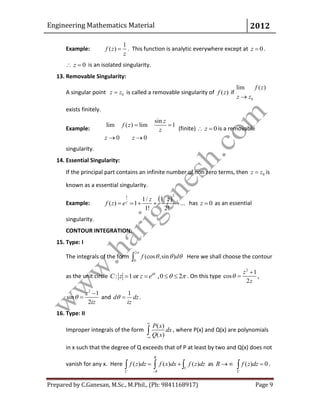
Example:
1
( )f z
z
 . This function is analytic everywhere except at 0z  .
0z  is an isolated singularity.
13. Removable Singularity:
A singular point 0z z is called a removable singularity of ( )f z if
0
lim ( )f z
z z
exists finitely.
Example:
sin
lim ( ) lim 1
0 0
z
f z
z
z z
 
 
(finite) 0z  is a removable
singularity.
14. Essential Singularity:
If the principal part contains an infinite number of non zero terms, then 0z z is
known as a essential singularity.
Example:
 
21
1/1/
( ) 1 ...
1! 2!
z
zz
f z e     has 0z  as an essential
singularity.
CONTOUR INTEGRATION:
15. Type: I
The integrals of the form
2
0
(cos ,sin )f d

   Here we shall choose the contour
as the unit circle : 1 or ,0 2i
C z z e
     . On this type
2
1
cos
2
z
z


 ,
2
1
sin
2
z
iz


 and
1
d dz
iz
  .
16. Type: II
Improper integrals of the form
( )
( )
P x
dx
Q x


 , where P(x) and Q(x) are polynomials
in x such that the degree of Q exceeds that of P at least by two and Q(x) does not
vanish for any x. Here ( ) ( ) ( )
R
C R
f z dz f x dx f z dz


    as ( ) 0R f z dz

   .
Engineering Mathematics Material 2012
Prepared by C.Ganesan, M.Sc., M.Phil., (Ph: 9841168917) Page 10
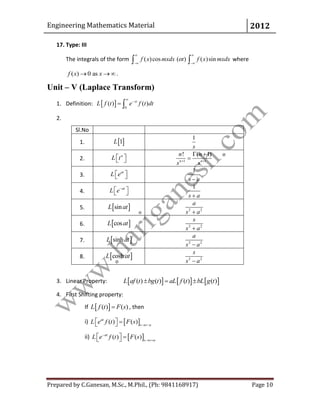
17. Type: III
The integrals of the form ( )cos (or) ( )sinf x mxdx f x mxdx
 
   where
( ) 0 asf x x   .
Unit – V (Laplace Transform)
1. Definition:   0
( ) ( )st
L f t e f t dt


 
2.
Sl.No
1.  1L
1
s
2.
n
L t   1 1
! ( 1)
n n
n n
s s 
 

3.
at
L e  
1
s a
4.
at
L e
  
1
s a
5.  sinL at 2 2
a
s a
6.  cosL at 2 2
s
s a
7.  sinhL at 2 2
a
s a
8.  coshL at 2 2
s
s a
3. Linear Property:      ( ) ( ) ( ) ( )L af t bg t aL f t bL g t  
4. First Shifting property:
If  ( ) ( )L f t F s , then
i)  ( ) ( )at
s s a
L e f t F s  
   
ii)  ( ) ( )at
s s a
L e f t F s
 
   
Engineering Mathematics Material 2012
Prepared by C.Ganesan, M.Sc., M.Phil., (Ph: 9841168917) Page 11
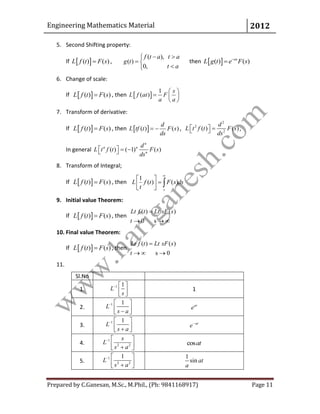
5. Second Shifting property:
If  ( ) ( )L f t F s ,
( ),
( )
0,
f t a t a
g t
t a
 
 

then  ( ) ( )as
L g t e F s

6. Change of scale:
If  ( ) ( )L f t F s , then  
1
( )
s
L f at F
a a
 
  
 
7. Transform of derivative:
If  ( ) ( )L f t F s , then  ( ) ( )
d
L tf t F s
ds
  ,
2
2
2
( ) ( )
d
L t f t F s
ds
    ,
In general ( ) ( 1) ( )
n
n n
n
d
L t f t F s
ds
    
8. Transform of Integral;
If  ( ) ( )L f t F s , then
1
( ) ( )
s
L f t F s ds
t

 
  

9. Initial value Theorem:
If  ( ) ( )L f t F s , then
( ) ( )
0 s
Lt f t Lt sF s
t

  
10. Final value Theorem:
If  ( ) ( )L f t F s , then
( ) ( )
s 0
Lt f t Lt sF s
t

  
11.
Sl.No
1.
1 1
L
s
  
  
1
2.
1 1
L
s a
  
  
at
e
3.
1 1
L
s a
  
  
at
e
4.
1
2 2
s
L
s a
  
  
cosat
5.
1
2 2
1
L
s a
  
  
1
sin at
a
Engineering Mathematics Material 2012
Prepared by C.Ganesan, M.Sc., M.Phil., (Ph: 9841168917) Page 12
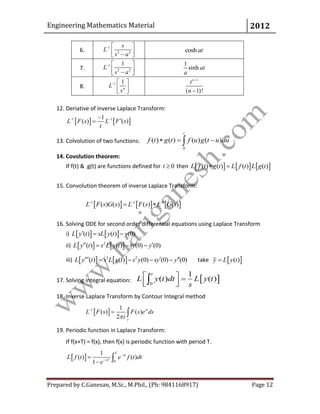
6.
1
2 2
s
L
s a
  
  
coshat
7.
1
2 2
1
L
s a
  
  
1
sinh at
a
8.
1 1
n
L
s
  
  
1
( 1)!
n
t
n


12. Deriative of inverse Laplace Transform:
   1 11
( ) ( )L F s L F s
t
 

13. Colvolution of two functions:
0
( ) ( ) ( ) ( )
t
f t g t f u g t u du  
14. Covolution theorem:
If f(t) & g(t) are functions defined for 0t  then      ( ) ( ) ( ) ( )L f t g t L f t L g t 
15. Convolution theorem of inverse Laplace Transform:
     1 1 1
( ) ( ) ( ) ( )L F s G s L F s L G s  
 
16. Solving ODE for second order differential equations using Laplace Transform
i)    ( ) ( ) (0)L y t sL y t y  
ii)    2
( ) ( ) (0) (0)L y t s L y t sy y   
iii)    3 2
( ) ( ) (0) (0) (0)L y t s L y t s y sy y      take  ( )y L y t
17. Solving integral equation:  0
1
( ) ( )
t
L y t dt L y t
s
  
  
18. Inverse Laplace Transform by Contour Integral method
 1 1
( ) ( )
2
st
c
L F s F s e ds
i

 
19. Periodic function in Laplace Transform:
If f(x+T) = f(x), then f(x) is periodic function with period T.
  0
1
( ) ( )
1
T
st
sT
L f t e f t dt
e



 

Formula m2

  • 1.
    Engineering Mathematics Material2012 Prepared by C.Ganesan, M.Sc., M.Phil., (Ph: 9841168917) Page 1 SUBJECT NAME : Engineering Mathematics – II SUBJECT CODE : MA 2161 MATERIAL NAME : Formula Material MATERIAL CODE : JM08AM1003 Name of the Student: Branch: Unit – I (Ordinary Differential Equation) 1. ODE with constant coefficients: Solution C.F + P.Iy  Complementary functions: Sl.No. Nature of Roots C.F 1. 1 2m m ( ) mx Ax B e 2. 1 2 3m m m   2 mx Ax Bx c e  3. 1 2m m 1 2m x m x Ae Be 4. 1 2 3m m m  31 2 m xm x m x Ae Be Ce  5. 1 2 3,m m m 3 ( ) m xmx Ax B e Ce  6. m i   ( cos sin )x e A x B x   7. m i  cos sinA x B x  Particular Integral: Type-I If ( ) 0f x  then . 0P I  Type-II If ( ) ax f x e 1 . ( ) ax P I e D 
  • 2.
    Engineering Mathematics Material2012 Prepared by C.Ganesan, M.Sc., M.Phil., (Ph: 9841168917) Page 2 Replace Dby a . If ( ) 0D  , then it is P.I. If ( ) 0D  , then diff. denominator w.r.t Dand multiply x in numerator. Again replace Dby a . If you get denominator again zero then do the same procedure. Type-III Case: i If ( ) sin ( ) cosf x ax or ax 1 . sin (or) cos ( ) P I ax ax D  Here you have to replace only for 2 D not for D. 2 D is replaced by 2 a . If the denominator is equal to zero, then apply same procedure as in Type – I. Case: ii If 2 2 3 3 ( ) (or) cos (or) sin (or) cosf x Sin x x x x Use the following formulas 2 1 cos2 2 x Sin x   , 2 1 cos2 cos 2 x x   , x x x 3 3 1 sin sin sin3 4 4 , x x x 3 3 1 cos cos cos3 4 4 and separate 1 2. & .P I P I Case: iii If ( ) sin cos ( ) cos sin ( ) cos cos ( ) sin sinf x A B or A B or A B or A B Use the following formulas:         1 ( ) in cos ( ) sin( ) 2 1 (ii) cos sin ( ) sin( ) 2 1 ( ) cos cos cos( ) cos( ) 2 1 ( ) sin sin cos( ) cos( ) 2 i s A B sin A B A B A B Sin A B A B iii A B A B A B iv A B A B A B                 Type-IV If ( ) m f x x 1 . ( ) m P I x D  1 1 ( ) m x g D  
  • 3.
    Engineering Mathematics Material2012 Prepared by C.Ganesan, M.Sc., M.Phil., (Ph: 9841168917) Page 3   1 1 ( ) m g D x    Here we can use Binomial formula as follows: i)   1 2 3 1 1 ...x x x x        ii)   1 2 3 1 1 ...x x x x        iii)   2 2 3 1 1 2 3 4 ...x x x x        iv)   2 2 3 1 1 2 3 4 ...x x x x        v) 3 2 3 (1 ) 1 3 6 10 ...x x x x       vi) 3 2 3 (1 ) 1 3 6 10 ...x x x x       Type-V If ( ) ax f x e V where sin ,cos , m V ax ax x 1 . ( ) ax P I e V D  First operate ax e by replacing D by D+a. 1 ( ) ax e V D a   Type-VI If ( ) n f x x V where sin ,cosV ax ax sin I.P of cos R.P of iax iax ax e ax e   Type-VII (Special Type Problems) If ( ) sec (or) cosec (or) tanf x ax ax ax 1 . ( ) ( )ax ax P I f x e e f x dx D a      1. ODE with variable co-efficient: (Euler’s Method) The equation is of the form 2 2 2 ( ) d y dy x x y f x dx dx   
  • 4.
    Engineering Mathematics Material2012 Prepared by C.Ganesan, M.Sc., M.Phil., (Ph: 9841168917) Page 4 Implies that 2 2 ( 1) ( )x D xD y f x   To convert the variable coefficients into the constant coefficients Put logz x implies z x e 2 2 3 3 ( 1) ( 1)( 2) xD D x D D D x D D D D          where d D dx  and d D dz   The above equation implies that  ( 1) 1 ( )D D D y f x      which is O.D.E with constant coefficients. 2. Legendre’s Linear differential equation: The equation if of the form 2 2 2 ( ) ( ) ( ) d y dy ax b ax b y f x dx dx      Put log( )z ax b  implies ( ) z ax b e  2 2 2 3 3 3 ( ) ( ) ( 1) ( ) ( 1)( 2) ax b D aD ax b D a D D ax b D a D D D             where d D dx  and d D dz   3. Method of Variation of Parameters: The equation is of the form d y dy a b cy f x dx dx    2 2 ( ) 1 2.C F Ay By  and 1 2.P I Py Qy  where 2 1 2 1 2 ( )y f x P dx y y y y     and 1 1 2 1 2 ( )y f x Q dx y y y y    Unit – II (Vector Calculus) 1. Vector differential operator is / / /i x j y k z          2. Gradient of  / / /i x j y k z              3. Divergence of F F 
  • 5.
    Engineering Mathematics Material2012 Prepared by C.Ganesan, M.Sc., M.Phil., (Ph: 9841168917) Page 5 4. Curl of F 1 2 3 / / / i j k XF x y z F F F          5. If F is Solenoidal vector then 0F  6. 7. If F is Irrotational vector the 0XF  8. Maximum Directional derivative   9. Directional derivative of  in the direction of a a a   10. Angle between two normals to the surface 1 2 1 2 cos n n n n   Where   1 1 1 1 1 ( , , )at x y z n   &   2 2 2 2 2 ( , , )at x y z n   11. Unit Normal vector, ˆn      12. Equation of tangent plane 1 1 1( ) ( ) ( ) 0l x x m y y n z z      Where l, m,n are coefficient of , ,i j k in  . 13. Equation of normal line 1 1 1x x y y z z l m n      14. Work Done = C F dr , where dr dxi dyj dzk   15. If . C F dr be independent of the path is that curl 0F  16. In the surface integral ˆ. dxdy dS n k  , ˆ. dydz dS n i  , ˆ. dzdx dS n j  & ˆdS ndS
  • 6.
    Engineering Mathematics Material2012 Prepared by C.Ganesan, M.Sc., M.Phil., (Ph: 9841168917) Page 6 17. Green’s Theorem: If , , , u v u v y x     are continuous and one-valued functions in the region R enclosed by the curve C, then C R v u udx vdy dxdy x y             . 18. Stoke’s Theorem: Let F be the vector point function, around a simple closed curve C and over the open surface S having as its boundary, then   ˆx C S F dr F nds   19. Gauss Divergence Theorem: Let F be a vector point function in a region R bounded by a closed surface S, then ˆ S V F nds Fdv   Unit – III (Analytic Function) 1. Necessary condition for f(z) is analytic function Cauchy – Riemann Equations: & u v v u x y x y            (C-R equations) 2. Polar form of Cauchy-Riemann Equations: 1 1 & u v v u r r r r             3. Condition for Harmonic function: 2 2 2 2 0 u u x y       4. If the function is harmonic then it should be either real or imaginary part of a analytic function. 5. Milne – Thomson method: (To find the analytic function f(z)) i) If u is given ( ) ( ,0) ( ,0)x yf z u z iu z dz    ii) If v is given ( ) ( ,0) ( ,0)y xf z v z iv z dz   
  • 7.
    Engineering Mathematics Material2012 Prepared by C.Ganesan, M.Sc., M.Phil., (Ph: 9841168917) Page 7 6. To find the analytic function i) ( ) ; ( )f z u iv if z iu v    adding these two We have ( ) ( ) (1 ) ( )u v i u v i f z     then ( )F z U iV  where , & ( ) (1 ) ( )U u v V u v F z i f z      Here we can apply Milne – Thomson method for F(z). 7. Bilinear transformation:             1 2 3 1 2 3 1 2 3 1 2 3 w w w w z z z z w w w w z z z z          Unit – IV (Complex Integration) 1. Cauchy’s Integral Theorem: If f(z) is analytic and ( )f z is continuous inside and on a simple closed curve C, then ( ) 0 c f z dz  . 2. Cauchy’s Integral Formula: If f(z) is analytic within and on a simple closed curve C and 0z is any point inside C, then ( ) 2 ( ) C f z dz if a z a   3. Cauchy’s Integral Formula for derivatives: If a function f(z) is analytic within and on a simple closed curve C and a is any point lying in it, then   2 1 ( ) ( ) 2 C f z f a dz i z a     Similarly   3 2! ( ) ( ) 2 C f z f a dz i z a     , In general   ( ) 1 ! ( ) ( ) 2 n n C n f z f a dz i z a     4. Cauchy’s Residue theorem: If f(z) be analytic at all points inside and on a simple closed cuve c, except for a finite number of isolated singularities 1 2 3, , ,... nz z z z inside c, then ( ) 2 (sum of the residues of ( )) C f z dz i f z .
  • 8.
    Engineering Mathematics Material2012 Prepared by C.Ganesan, M.Sc., M.Phil., (Ph: 9841168917) Page 8 5. Critical point: The point, at which the mapping w = f(z) is not conformal, (i.e) ( ) 0f z  is called a critical point of the mapping. 6. Fixed points (or) Invariant points: The fixed points of the transformation az b w cz d    is obtained by putting w = z in the above transformation, the point z = a is called fixed point. 7. Re { ( )} ( ) ( ) z a s f z Lt z a f z    (Simple pole) 8.    1 1 1 Re { ( )} ( ) ( 1)! m m mz a d s f z Lt z a f z m dz      (Multi Pole (or) Pole of order m) 9. ( ) Re { ( )} ( )z a P z s f z Lt Q z   10. Taylor Series: A function ( )f z , analytic inside a circle C with centre at a, can be expanded in the series 2 3 ( )( ) ( ) ( ) ( ) ( ) ( ) ( ) ( ) ( ) ... ( ) ... 1! 2! 3! ! n nz a z a z a z a f z f a f a f a f a f a n              Maclaurin’s Series: Taking a = 0, Taylor’s series reduce to 2 3 ( ) (0) (0) (0) (0) ... 1! 2! 3! z z z f z f f f f       11. Laurent’s Series: 0 1 ( ) ( ) ( ) n n n n n n b f z a z a z a           where 1 1 1 ( ) 2 ( ) n n C f z a dz i z a    & 2 1 1 ( ) 2 ( ) n n C f z b dz i z a    , the integrals being taken anticlockwise. 12. Isolated Singularity: A point 0z z is said to be isolated singularity of ( )f z if ( )f z is not analytic at 0z z and there exists a neighborhood of 0z z containing no other singularity.
  • 9.
    Engineering Mathematics Material2012 Prepared by C.Ganesan, M.Sc., M.Phil., (Ph: 9841168917) Page 9 Example: 1 ( )f z z  . This function is analytic everywhere except at 0z  . 0z  is an isolated singularity. 13. Removable Singularity: A singular point 0z z is called a removable singularity of ( )f z if 0 lim ( )f z z z exists finitely. Example: sin lim ( ) lim 1 0 0 z f z z z z     (finite) 0z  is a removable singularity. 14. Essential Singularity: If the principal part contains an infinite number of non zero terms, then 0z z is known as a essential singularity. Example:   21 1/1/ ( ) 1 ... 1! 2! z zz f z e     has 0z  as an essential singularity. CONTOUR INTEGRATION: 15. Type: I The integrals of the form 2 0 (cos ,sin )f d     Here we shall choose the contour as the unit circle : 1 or ,0 2i C z z e      . On this type 2 1 cos 2 z z    , 2 1 sin 2 z iz    and 1 d dz iz   . 16. Type: II Improper integrals of the form ( ) ( ) P x dx Q x    , where P(x) and Q(x) are polynomials in x such that the degree of Q exceeds that of P at least by two and Q(x) does not vanish for any x. Here ( ) ( ) ( ) R C R f z dz f x dx f z dz       as ( ) 0R f z dz     .
  • 10.
    Engineering Mathematics Material2012 Prepared by C.Ganesan, M.Sc., M.Phil., (Ph: 9841168917) Page 10 17. Type: III The integrals of the form ( )cos (or) ( )sinf x mxdx f x mxdx      where ( ) 0 asf x x   . Unit – V (Laplace Transform) 1. Definition:   0 ( ) ( )st L f t e f t dt     2. Sl.No 1.  1L 1 s 2. n L t   1 1 ! ( 1) n n n n s s     3. at L e   1 s a 4. at L e    1 s a 5.  sinL at 2 2 a s a 6.  cosL at 2 2 s s a 7.  sinhL at 2 2 a s a 8.  coshL at 2 2 s s a 3. Linear Property:      ( ) ( ) ( ) ( )L af t bg t aL f t bL g t   4. First Shifting property: If  ( ) ( )L f t F s , then i)  ( ) ( )at s s a L e f t F s       ii)  ( ) ( )at s s a L e f t F s      
  • 11.
    Engineering Mathematics Material2012 Prepared by C.Ganesan, M.Sc., M.Phil., (Ph: 9841168917) Page 11 5. Second Shifting property: If  ( ) ( )L f t F s , ( ), ( ) 0, f t a t a g t t a      then  ( ) ( )as L g t e F s  6. Change of scale: If  ( ) ( )L f t F s , then   1 ( ) s L f at F a a        7. Transform of derivative: If  ( ) ( )L f t F s , then  ( ) ( ) d L tf t F s ds   , 2 2 2 ( ) ( ) d L t f t F s ds     , In general ( ) ( 1) ( ) n n n n d L t f t F s ds      8. Transform of Integral; If  ( ) ( )L f t F s , then 1 ( ) ( ) s L f t F s ds t        9. Initial value Theorem: If  ( ) ( )L f t F s , then ( ) ( ) 0 s Lt f t Lt sF s t     10. Final value Theorem: If  ( ) ( )L f t F s , then ( ) ( ) s 0 Lt f t Lt sF s t     11. Sl.No 1. 1 1 L s       1 2. 1 1 L s a       at e 3. 1 1 L s a       at e 4. 1 2 2 s L s a       cosat 5. 1 2 2 1 L s a       1 sin at a
  • 12.
    Engineering Mathematics Material2012 Prepared by C.Ganesan, M.Sc., M.Phil., (Ph: 9841168917) Page 12 6. 1 2 2 s L s a       coshat 7. 1 2 2 1 L s a       1 sinh at a 8. 1 1 n L s       1 ( 1)! n t n   12. Deriative of inverse Laplace Transform:    1 11 ( ) ( )L F s L F s t    13. Colvolution of two functions: 0 ( ) ( ) ( ) ( ) t f t g t f u g t u du   14. Covolution theorem: If f(t) & g(t) are functions defined for 0t  then      ( ) ( ) ( ) ( )L f t g t L f t L g t  15. Convolution theorem of inverse Laplace Transform:      1 1 1 ( ) ( ) ( ) ( )L F s G s L F s L G s     16. Solving ODE for second order differential equations using Laplace Transform i)    ( ) ( ) (0)L y t sL y t y   ii)    2 ( ) ( ) (0) (0)L y t s L y t sy y    iii)    3 2 ( ) ( ) (0) (0) (0)L y t s L y t s y sy y      take  ( )y L y t 17. Solving integral equation:  0 1 ( ) ( ) t L y t dt L y t s       18. Inverse Laplace Transform by Contour Integral method  1 1 ( ) ( ) 2 st c L F s F s e ds i    19. Periodic function in Laplace Transform: If f(x+T) = f(x), then f(x) is periodic function with period T.   0 1 ( ) ( ) 1 T st sT L f t e f t dt e     