MATHEMATICS-I
CONTENTS
   Ordinary Differential Equations of First Order and First Degree
   Linear Differential Equations of Second and Higher Order
   Mean Value Theorems
   Functions of Several Variables
   Curvature, Evolutes and Envelopes
   Curve Tracing
   Applications of Integration
   Multiple Integrals
   Series and Sequences
   Vector Differentiation and Vector Operators
   Vector Integration
   Vector Integral Theorems
   Laplace transforms
TEXT BOOKS
   A text book of Engineering Mathematics, Vol-I
    T.K.V.Iyengar, B.Krishna Gandhi and Others,
    S.Chand & Company
   A text book of Engineering Mathematics,
    C.Sankaraiah, V.G.S.Book Links
   A text book of Engineering Mathematics, Shahnaz A
    Bathul, Right Publishers
   A text book of Engineering Mathematics,
    P.Nageshwara Rao, Y.Narasimhulu & N.Prabhakar
    Rao, Deepthi Publications
REFERENCES
 A text book of Engineering Mathematics,
  B.V.Raman, Tata Mc Graw Hill
 Advanced Engineering Mathematics, Irvin
  Kreyszig, Wiley India Pvt. Ltd.
 A text Book of Engineering Mathematics,
  Thamson Book collection
UNIT-VII

CHAPTER-I:VECTOR DIFFERENTIATION
     AND VECTOR OPERATORS
 CHAPTER-II:VECTOR INTEGRATION
  CHAPTER-III:VECTOR INTEGRAL
            THEOREMS
UNIT HEADER
  Name of the Course: B.Tech
      Code No:07A1BS02
      Year/Branch: I Year
CSE,IT,ECE,EEE,ME,CIVIL,AERO
         Unit No: VII
        No. of slides:23
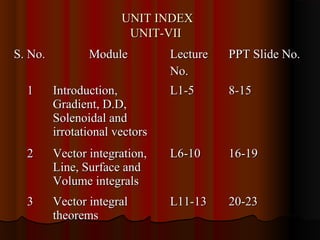
UNIT INDEX
                        UNIT-VII
S. No.          Module          Lecture   PPT Slide No.
                                No.
  1      Introduction,          L1-5      8-15
         Gradient, D.D,
         Solenoidal and
         irrotational vectors
  2      Vector integration,    L6-10     16-19
         Line, Surface and
         Volume integrals
  3      Vector integral        L11-13    20-23
         theorems
Lecture-1
              INTRODUCTION
 In this chapter, vector differential calculus is
  considered, which extends the basic concepts
  of differential calculus, such as, continuity and
  differentiability to vector functions in a simple
  and natural way. Also, the new concepts of
  gradient, divergence and curl are introducted.
 Example: i,j,k are unit vectors.
VECTOR DIFFERENTIAL
             OPERATOR
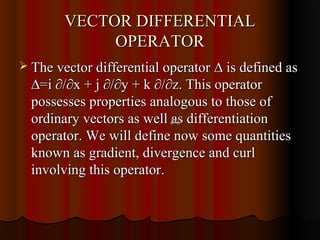
 The vector differential operator ∆ is defined as
  ∆=i ∂/∂x + j ∂/∂y + k ∂/∂z. This operator
  possesses properties analogous to those of
  ordinary vectors as well ∂/∂ differentiation
                           as
  operator. We will define now some quantities
  known as gradient, divergence and curl
  involving this operator.
Lecture-2
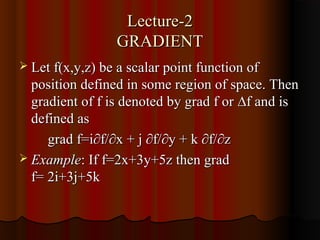
                 GRADIENT
 Let f(x,y,z) be a scalar point function of
  position defined in some region of space. Then
  gradient of f is denoted by grad f or ∆f and is
  defined as
     grad f=i∂f/∂x + j ∂f/∂y + k ∂f/∂z
 Example: If f=2x+3y+5z then grad
  f= 2i+3j+5k
Lecture-3
     DIRECTIONAL DERIVATIVE
 The directional derivative of a scalar point
  function f at a point P(x,y,z) in the direction of
  g at P and is defined as grad g/|grad g|.grad f
 Example: The directional derivative of
  f=xy+yz+zx in the direction of the vector
  i+2j+2k at the point (1,2,0) is 10/3
Lecture-4
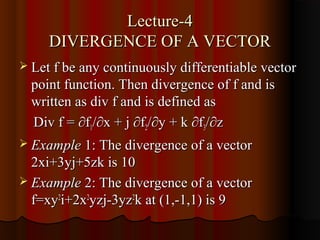
     DIVERGENCE OF A VECTOR
 Let f be any continuously differentiable vector
  point function. Then divergence of f and is
  written as div f and is defined as
  Div f = ∂f1/∂x + j ∂f2/∂y + k ∂f3/∂z
 Example 1: The divergence of a vector
  2xi+3yj+5zk is 10
 Example 2: The divergence of a vector
  f=xy2i+2x2yzj-3yz2k at (1,-1,1) is 9
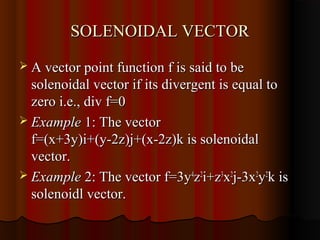
SOLENOIDAL VECTOR
 A vector point function f is said to be
  solenoidal vector if its divergent is equal to
  zero i.e., div f=0
 Example 1: The vector
  f=(x+3y)i+(y-2z)j+(x-2z)k is solenoidal
  vector.
 Example 2: The vector f=3y4z2i+z3x2j-3x2y2k is
  solenoidl vector.
Lecture-5
          CURL OF A VECTOR
 Let f be any continuously differentiable vector
  point function. Then the vector function curl of
  f is denoted by curl f and is defined as
  curl f= ix∂f/∂x + jx∂f/∂y + kx∂f/∂z
 Example 1: If f=xy2i +2x2yzj-3yz2k then curl f
  at (1,-1,1) is –i-2k
 Example 2: If r=xi+yj+zk then curl r is 0
Lecture-6
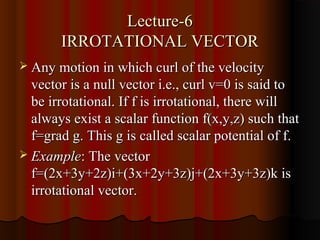
       IRROTATIONAL VECTOR
 Any motion in which curl of the velocity
  vector is a null vector i.e., curl v=0 is said to
  be irrotational. If f is irrotational, there will
  always exist a scalar function f(x,y,z) such that
  f=grad g. This g is called scalar potential of f.
 Example: The vector
  f=(2x+3y+2z)i+(3x+2y+3z)j+(2x+3y+3z)k is
  irrotational vector.
Lecture-7
       VECTOR INTEGRATION
 INTRODUCTION: In this chapter we shall
 define line, surface and volume integrals
 which occur frequently in connection with
 physical and engineering problems. The
 concept of a line integral is a natural
 generalization of the concept of a definite
 integral of f(x) exists for all x in the interval
 [a,b]
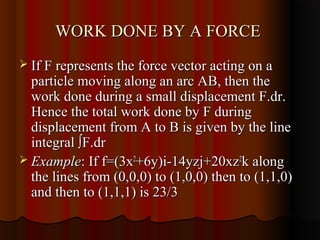
WORK DONE BY A FORCE
 If F represents the force vector acting on a
  particle moving along an arc AB, then the
  work done during a small displacement F.dr.
  Hence the total work done by F during
  displacement from A to B is given by the line
  integral ∫F.dr
 Example: If f=(3x2+6y)i-14yzj+20xz2k along
  the lines from (0,0,0) to (1,0,0) then to (1,1,0)
  and then to (1,1,1) is 23/3
Lecture-8
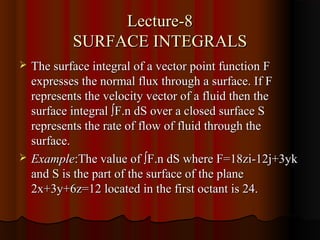
           SURFACE INTEGRALS
   The surface integral of a vector point function F
    expresses the normal flux through a surface. If F
    represents the velocity vector of a fluid then the
    surface integral ∫F.n dS over a closed surface S
    represents the rate of flow of fluid through the
    surface.
   Example:The value of ∫F.n dS where F=18zi-12j+3yk
    and S is the part of the surface of the plane
    2x+3y+6z=12 located in the first octant is 24.
Lecture-9
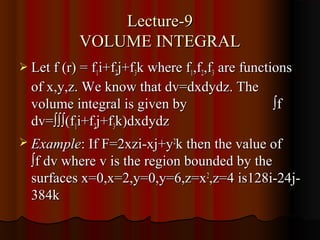
           VOLUME INTEGRAL
 Let f (r) = f1i+f2j+f3k where f1,f2,f3 are functions
  of x,y,z. We know that dv=dxdydz. The
  volume integral is given by           ∫f
  dv=∫∫∫(f1i+f2j+f3k)dxdydz
 Example: If F=2xzi-xj+y2k then the value of
  ∫f dv where v is the region bounded by the
  surfaces x=0,x=2,y=0,y=6,z=x2,z=4 is128i-24j-
  384k
Lecture-10
  VECTOR INTEGRAL THEOREMS
 In this chapter we discuss three important
  vector integral theorems.
 1)Gauss divergence theorem
 2)Green’s theorem
 3)Stokes theorem
Lecture-11
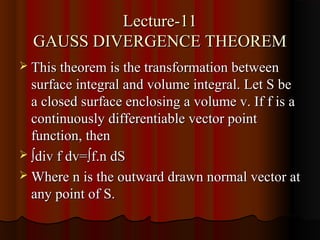
  GAUSS DIVERGENCE THEOREM
 This theorem is the transformation between
  surface integral and volume integral. Let S be
  a closed surface enclosing a volume v. If f is a
  continuously differentiable vector point
  function, then
 ∫div f dv=∫f.n dS
 Where n is the outward drawn normal vector at
  any point of S.
Lecture-12
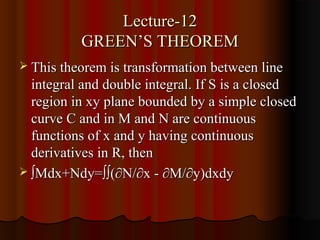
          GREEN’S THEOREM
 This theorem is transformation between line
  integral and double integral. If S is a closed
  region in xy plane bounded by a simple closed
  curve C and in M and N are continuous
  functions of x and y having continuous
  derivatives in R, then
 ∫Mdx+Ndy=∫∫(∂N/∂x - ∂M/∂y)dxdy
Lecture-13
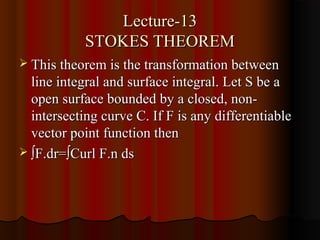
            STOKES THEOREM
 This theorem is the transformation between
  line integral and surface integral. Let S be a
  open surface bounded by a closed, non-
  intersecting curve C. If F is any differentiable
  vector point function then
 ∫F.dr=∫Curl F.n ds

M1 unit vii-jntuworld

  • 1.
  • 2.
    CONTENTS  Ordinary Differential Equations of First Order and First Degree  Linear Differential Equations of Second and Higher Order  Mean Value Theorems  Functions of Several Variables  Curvature, Evolutes and Envelopes  Curve Tracing  Applications of Integration  Multiple Integrals  Series and Sequences  Vector Differentiation and Vector Operators  Vector Integration  Vector Integral Theorems  Laplace transforms
  • 3.
    TEXT BOOKS  A text book of Engineering Mathematics, Vol-I T.K.V.Iyengar, B.Krishna Gandhi and Others, S.Chand & Company  A text book of Engineering Mathematics, C.Sankaraiah, V.G.S.Book Links  A text book of Engineering Mathematics, Shahnaz A Bathul, Right Publishers  A text book of Engineering Mathematics, P.Nageshwara Rao, Y.Narasimhulu & N.Prabhakar Rao, Deepthi Publications
  • 4.
    REFERENCES  A textbook of Engineering Mathematics, B.V.Raman, Tata Mc Graw Hill  Advanced Engineering Mathematics, Irvin Kreyszig, Wiley India Pvt. Ltd.  A text Book of Engineering Mathematics, Thamson Book collection
  • 5.
    UNIT-VII CHAPTER-I:VECTOR DIFFERENTIATION AND VECTOR OPERATORS CHAPTER-II:VECTOR INTEGRATION CHAPTER-III:VECTOR INTEGRAL THEOREMS
  • 6.
    UNIT HEADER Name of the Course: B.Tech Code No:07A1BS02 Year/Branch: I Year CSE,IT,ECE,EEE,ME,CIVIL,AERO Unit No: VII No. of slides:23
  • 7.
    UNIT INDEX UNIT-VII S. No. Module Lecture PPT Slide No. No. 1 Introduction, L1-5 8-15 Gradient, D.D, Solenoidal and irrotational vectors 2 Vector integration, L6-10 16-19 Line, Surface and Volume integrals 3 Vector integral L11-13 20-23 theorems
  • 8.
    Lecture-1 INTRODUCTION  In this chapter, vector differential calculus is considered, which extends the basic concepts of differential calculus, such as, continuity and differentiability to vector functions in a simple and natural way. Also, the new concepts of gradient, divergence and curl are introducted.  Example: i,j,k are unit vectors.
  • 9.
    VECTOR DIFFERENTIAL OPERATOR  The vector differential operator ∆ is defined as ∆=i ∂/∂x + j ∂/∂y + k ∂/∂z. This operator possesses properties analogous to those of ordinary vectors as well ∂/∂ differentiation as operator. We will define now some quantities known as gradient, divergence and curl involving this operator.
  • 10.
    Lecture-2 GRADIENT  Let f(x,y,z) be a scalar point function of position defined in some region of space. Then gradient of f is denoted by grad f or ∆f and is defined as grad f=i∂f/∂x + j ∂f/∂y + k ∂f/∂z  Example: If f=2x+3y+5z then grad f= 2i+3j+5k
  • 11.
    Lecture-3 DIRECTIONAL DERIVATIVE  The directional derivative of a scalar point function f at a point P(x,y,z) in the direction of g at P and is defined as grad g/|grad g|.grad f  Example: The directional derivative of f=xy+yz+zx in the direction of the vector i+2j+2k at the point (1,2,0) is 10/3
  • 12.
    Lecture-4 DIVERGENCE OF A VECTOR  Let f be any continuously differentiable vector point function. Then divergence of f and is written as div f and is defined as Div f = ∂f1/∂x + j ∂f2/∂y + k ∂f3/∂z  Example 1: The divergence of a vector 2xi+3yj+5zk is 10  Example 2: The divergence of a vector f=xy2i+2x2yzj-3yz2k at (1,-1,1) is 9
  • 13.
    SOLENOIDAL VECTOR  Avector point function f is said to be solenoidal vector if its divergent is equal to zero i.e., div f=0  Example 1: The vector f=(x+3y)i+(y-2z)j+(x-2z)k is solenoidal vector.  Example 2: The vector f=3y4z2i+z3x2j-3x2y2k is solenoidl vector.
  • 14.
    Lecture-5 CURL OF A VECTOR  Let f be any continuously differentiable vector point function. Then the vector function curl of f is denoted by curl f and is defined as curl f= ix∂f/∂x + jx∂f/∂y + kx∂f/∂z  Example 1: If f=xy2i +2x2yzj-3yz2k then curl f at (1,-1,1) is –i-2k  Example 2: If r=xi+yj+zk then curl r is 0
  • 15.
    Lecture-6 IRROTATIONAL VECTOR  Any motion in which curl of the velocity vector is a null vector i.e., curl v=0 is said to be irrotational. If f is irrotational, there will always exist a scalar function f(x,y,z) such that f=grad g. This g is called scalar potential of f.  Example: The vector f=(2x+3y+2z)i+(3x+2y+3z)j+(2x+3y+3z)k is irrotational vector.
  • 16.
    Lecture-7 VECTOR INTEGRATION  INTRODUCTION: In this chapter we shall define line, surface and volume integrals which occur frequently in connection with physical and engineering problems. The concept of a line integral is a natural generalization of the concept of a definite integral of f(x) exists for all x in the interval [a,b]
  • 17.
    WORK DONE BYA FORCE  If F represents the force vector acting on a particle moving along an arc AB, then the work done during a small displacement F.dr. Hence the total work done by F during displacement from A to B is given by the line integral ∫F.dr  Example: If f=(3x2+6y)i-14yzj+20xz2k along the lines from (0,0,0) to (1,0,0) then to (1,1,0) and then to (1,1,1) is 23/3
  • 18.
    Lecture-8 SURFACE INTEGRALS  The surface integral of a vector point function F expresses the normal flux through a surface. If F represents the velocity vector of a fluid then the surface integral ∫F.n dS over a closed surface S represents the rate of flow of fluid through the surface.  Example:The value of ∫F.n dS where F=18zi-12j+3yk and S is the part of the surface of the plane 2x+3y+6z=12 located in the first octant is 24.
  • 19.
    Lecture-9 VOLUME INTEGRAL  Let f (r) = f1i+f2j+f3k where f1,f2,f3 are functions of x,y,z. We know that dv=dxdydz. The volume integral is given by ∫f dv=∫∫∫(f1i+f2j+f3k)dxdydz  Example: If F=2xzi-xj+y2k then the value of ∫f dv where v is the region bounded by the surfaces x=0,x=2,y=0,y=6,z=x2,z=4 is128i-24j- 384k
  • 20.
    Lecture-10 VECTORINTEGRAL THEOREMS  In this chapter we discuss three important vector integral theorems.  1)Gauss divergence theorem  2)Green’s theorem  3)Stokes theorem
  • 21.
    Lecture-11 GAUSSDIVERGENCE THEOREM  This theorem is the transformation between surface integral and volume integral. Let S be a closed surface enclosing a volume v. If f is a continuously differentiable vector point function, then  ∫div f dv=∫f.n dS  Where n is the outward drawn normal vector at any point of S.
  • 22.
    Lecture-12 GREEN’S THEOREM  This theorem is transformation between line integral and double integral. If S is a closed region in xy plane bounded by a simple closed curve C and in M and N are continuous functions of x and y having continuous derivatives in R, then  ∫Mdx+Ndy=∫∫(∂N/∂x - ∂M/∂y)dxdy
  • 23.
    Lecture-13 STOKES THEOREM  This theorem is the transformation between line integral and surface integral. Let S be a open surface bounded by a closed, non- intersecting curve C. If F is any differentiable vector point function then  ∫F.dr=∫Curl F.n ds