VECTOR CALCULUS AND
FOURIER SERIES
BY,
J. MANJULA
ASSISTANT PROFESSOR OF MATHEMATICS
BON SECOURS COLLEGE FOR WOMEN
GREEN’S THEOREM
INTRODUCTION:-
In mathematics, Green’s theorem gives
the relationship between the line integral around a
simple closed curve C and a double integral over
the plane region D bounded by C. It is named after
George Green, though its first proof is due to
Bernard Reimann.
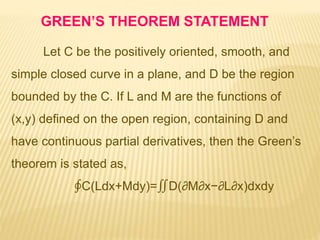
Let C be the positively oriented, smooth, and
simple closed curve in a plane, and D be the region
bounded by the C. If L and M are the functions of
(x,y) defined on the open region, containing D and
have continuous partial derivatives, then the Green’s
theorem is stated as,
∮C(Ldx+Mdy)=∬D(∂M∂x−∂L∂x)dxdy
GREEN’S THEOREM STATEMENT
STROKE’S THEOREM:-
INTRODUCTION:-
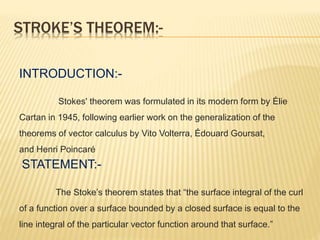
Stokes' theorem was formulated in its modern form by Élie
Cartan in 1945, following earlier work on the generalization of the
theorems of vector calculus by Vito Volterra, Édouard Goursat,
and Henri Poincaré
STATEMENT:-
The Stoke’s theorem states that “the surface integral of the curl
of a function over a surface bounded by a closed surface is equal to the
line integral of the particular vector function around that surface.”
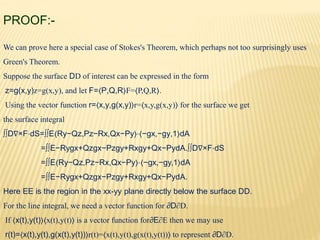
We can prove here a special case of Stokes's Theorem, which perhaps not too surprisingly uses
Green's Theorem.
Suppose the surface DD of interest can be expressed in the form
z=g(x,y)z=g(x,y), and let F=⟨P,Q,R⟩F=⟨P,Q,R⟩.
Using the vector function r=⟨x,y,g(x,y)⟩r=⟨x,y,g(x,y)⟩ for the surface we get
the surface integral
∫∫D∇×F⋅dS=∫∫E⟨Ry−Qz,Pz−Rx,Qx−Py⟩⋅⟨−gx,−gy,1⟩dA
=∫∫E−Rygx+Qzgx−Pzgy+Rxgy+Qx−PydA.∫∫D∇×F⋅dS
=∫∫E⟨Ry−Qz,Pz−Rx,Qx−Py⟩⋅⟨−gx,−gy,1⟩dA
=∫∫E−Rygx+Qzgx−Pzgy+Rxgy+Qx−PydA.
Here EE is the region in the xx-yy plane directly below the surface DD.
For the line integral, we need a vector function for ∂D∂D.
If ⟨x(t),y(t)⟩⟨x(t),y(t)⟩ is a vector function for∂E∂E then we may use
r(t)=⟨x(t),y(t),g(x(t),y(t))⟩r(t)=⟨x(t),y(t),g(x(t),y(t))⟩ to represent ∂D∂D.
PROOF:-
Then∫∂DF⋅dr=∫baPdxdt+Qdydt+Rdzdtdt
=∫baPdxdt+Qdydt+R(∂z∂xdxdt+∂z∂ydydt)dt.∫∂DF⋅dr
=∫abPdxdt+Qdydt+Rdzdtdt
=∫abPdxdt+Qdydt+R(∂z∂xdxdt+∂z∂ydydt)dt.
using the chain rule for dz/dtdz/dt. Now we continue to manipulate
this:
∫baPdxdt+Qdydt+R(∂z∂xdxdt+∂z∂ydydt)dt
=∫ba[(P+R∂z∂x)dxdt+(Q+R∂z∂y)dydt]dt
=∫∂E(P+R∂z∂x)dx+(Q+R∂z∂y)dy,
∫abPdxdt+Qdydt+R(∂z∂xdxdt+∂z∂ydydt)dt
=∫ab[(P+R∂z∂x)dxdt+(Q+R∂z∂y)dydt]dt
=∫∂E(P+R∂z∂x)dx+(Q+R∂z∂y)dy,
which now looks just like the line integral of Green's Theorem, except
that the functions PPand QQ of Green's Theorem have been
replaced by the more
complicated P+R(∂z/∂x)P+R(∂z/∂x) and Q+R(∂z/∂y)Q+R(∂z/∂y). We
can apply Green's Theorem to get
∫∂E(P+R∂z∂x)dx+(Q+R∂z∂y)dy=∫∫E∂∂x(Q+R∂z∂y)−∂∂y(P+R∂z∂x)dA.∫∂
E(P+R∂z∂x)dx+(Q+R∂z∂y)dy=∫∫E∂∂x(Q+R∂z∂y)−∂∂y(P+R∂z∂x)dA.
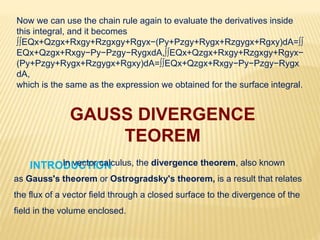
Now we can use the chain rule again to evaluate the derivatives inside
this integral, and it becomes
∫∫EQx+Qzgx+Rxgy+Rzgxgy+Rgyx−(Py+Pzgy+Rygx+Rzgygx+Rgxy)dA=∫∫
EQx+Qzgx+Rxgy−Py−Pzgy−RygxdA,∫∫EQx+Qzgx+Rxgy+Rzgxgy+Rgyx−
(Py+Pzgy+Rygx+Rzgygx+Rgxy)dA=∫∫EQx+Qzgx+Rxgy−Py−Pzgy−Rygx
dA,
which is the same as the expression we obtained for the surface integral.
GAUSS DIVERGENCE
TEOREM
INTRODUCTION:-In vector calculus, the divergence theorem, also known
as Gauss's theorem or Ostrogradsky's theorem, is a result that relates
the flux of a vector field through a closed surface to the divergence of the
field in the volume enclosed.
.
The divergence theorem is an important result for the mathematics
of physics and engineering, in particular in electrostatics and fluid dynamics.
The divergence theorem states that the surface integral of a
vector field over a closed surface, which is called the flux through the
surface, is equal to the volume integral of the divergence over the region
inside the surface. Intuitively, it states that the sum of all sources of the
field in a region (with sinks regarded as negative sources) gives the net
flux out of the region.
STATEMENT:-
PROOF:-
Gauss’ Theorem or The divergence theorem. states that if W
is a volume bounded by a surface S with outward unit normal n and F =
F1i + F2j + F3k is a continuously differentiable vector field in W then
∫∫ S F · n dS = ∫∫∫W div F dV,
where div F = ∂F1 ∂x + ∂F2 ∂y + ∂F3 ∂z .
Let us however first look at a one dimensional and a two dimensional
analogue. A one dimensional analogue if the First Fundamental
Theorem of Calculus:
f(b) − f(a) = ∫ b a f 0 (x) dx.
A two dimensional analogue says that if D is a region in the plane with
boundary curve C and n = (n1, n2) is the outward unit normal to C,
then ∫ C F1n1 + F2n2 ds = ∫∫ D ³∂F1 ∂x + ∂F2 ∂y ´ dA where ds is the
arclength. (This is in fact equivalent to Green’s Theorem.)
Example:
Find flux of F = 2x i + y 2 j + z 2 k out of the unit sphere S.
Solution:
By the divergence theorem we have with B the unit ball
∫∫S F · n dS = ∫∫∫B div F dV
= ∫∫∫B (2 + 2y + 2z) dV
= ∫∫∫B 2dV + ∫∫∫B 2ydV + ∫∫∫B 2zdV
= 2 Vol(B) + 0 + 0
= 24π/ 3
since the last two integrals vanishes because the region is symmetric under
replacing y by −y (respectively z by −z) but the integrand changes sign.

VECTOR CALCULUS

  • 1.
    VECTOR CALCULUS AND FOURIERSERIES BY, J. MANJULA ASSISTANT PROFESSOR OF MATHEMATICS BON SECOURS COLLEGE FOR WOMEN
  • 2.
    GREEN’S THEOREM INTRODUCTION:- In mathematics,Green’s theorem gives the relationship between the line integral around a simple closed curve C and a double integral over the plane region D bounded by C. It is named after George Green, though its first proof is due to Bernard Reimann.
  • 3.
    Let C bethe positively oriented, smooth, and simple closed curve in a plane, and D be the region bounded by the C. If L and M are the functions of (x,y) defined on the open region, containing D and have continuous partial derivatives, then the Green’s theorem is stated as, ∮C(Ldx+Mdy)=∬D(∂M∂x−∂L∂x)dxdy GREEN’S THEOREM STATEMENT
  • 4.
    STROKE’S THEOREM:- INTRODUCTION:- Stokes' theoremwas formulated in its modern form by Élie Cartan in 1945, following earlier work on the generalization of the theorems of vector calculus by Vito Volterra, Édouard Goursat, and Henri Poincaré STATEMENT:- The Stoke’s theorem states that “the surface integral of the curl of a function over a surface bounded by a closed surface is equal to the line integral of the particular vector function around that surface.”
  • 5.
    We can provehere a special case of Stokes's Theorem, which perhaps not too surprisingly uses Green's Theorem. Suppose the surface DD of interest can be expressed in the form z=g(x,y)z=g(x,y), and let F=⟨P,Q,R⟩F=⟨P,Q,R⟩. Using the vector function r=⟨x,y,g(x,y)⟩r=⟨x,y,g(x,y)⟩ for the surface we get the surface integral ∫∫D∇×F⋅dS=∫∫E⟨Ry−Qz,Pz−Rx,Qx−Py⟩⋅⟨−gx,−gy,1⟩dA =∫∫E−Rygx+Qzgx−Pzgy+Rxgy+Qx−PydA.∫∫D∇×F⋅dS =∫∫E⟨Ry−Qz,Pz−Rx,Qx−Py⟩⋅⟨−gx,−gy,1⟩dA =∫∫E−Rygx+Qzgx−Pzgy+Rxgy+Qx−PydA. Here EE is the region in the xx-yy plane directly below the surface DD. For the line integral, we need a vector function for ∂D∂D. If ⟨x(t),y(t)⟩⟨x(t),y(t)⟩ is a vector function for∂E∂E then we may use r(t)=⟨x(t),y(t),g(x(t),y(t))⟩r(t)=⟨x(t),y(t),g(x(t),y(t))⟩ to represent ∂D∂D. PROOF:-
  • 6.
    Then∫∂DF⋅dr=∫baPdxdt+Qdydt+Rdzdtdt =∫baPdxdt+Qdydt+R(∂z∂xdxdt+∂z∂ydydt)dt.∫∂DF⋅dr =∫abPdxdt+Qdydt+Rdzdtdt =∫abPdxdt+Qdydt+R(∂z∂xdxdt+∂z∂ydydt)dt. using the chainrule for dz/dtdz/dt. Now we continue to manipulate this: ∫baPdxdt+Qdydt+R(∂z∂xdxdt+∂z∂ydydt)dt =∫ba[(P+R∂z∂x)dxdt+(Q+R∂z∂y)dydt]dt =∫∂E(P+R∂z∂x)dx+(Q+R∂z∂y)dy, ∫abPdxdt+Qdydt+R(∂z∂xdxdt+∂z∂ydydt)dt =∫ab[(P+R∂z∂x)dxdt+(Q+R∂z∂y)dydt]dt =∫∂E(P+R∂z∂x)dx+(Q+R∂z∂y)dy, which now looks just like the line integral of Green's Theorem, except that the functions PPand QQ of Green's Theorem have been replaced by the more complicated P+R(∂z/∂x)P+R(∂z/∂x) and Q+R(∂z/∂y)Q+R(∂z/∂y). We can apply Green's Theorem to get ∫∂E(P+R∂z∂x)dx+(Q+R∂z∂y)dy=∫∫E∂∂x(Q+R∂z∂y)−∂∂y(P+R∂z∂x)dA.∫∂ E(P+R∂z∂x)dx+(Q+R∂z∂y)dy=∫∫E∂∂x(Q+R∂z∂y)−∂∂y(P+R∂z∂x)dA.
  • 7.
    Now we canuse the chain rule again to evaluate the derivatives inside this integral, and it becomes ∫∫EQx+Qzgx+Rxgy+Rzgxgy+Rgyx−(Py+Pzgy+Rygx+Rzgygx+Rgxy)dA=∫∫ EQx+Qzgx+Rxgy−Py−Pzgy−RygxdA,∫∫EQx+Qzgx+Rxgy+Rzgxgy+Rgyx− (Py+Pzgy+Rygx+Rzgygx+Rgxy)dA=∫∫EQx+Qzgx+Rxgy−Py−Pzgy−Rygx dA, which is the same as the expression we obtained for the surface integral. GAUSS DIVERGENCE TEOREM INTRODUCTION:-In vector calculus, the divergence theorem, also known as Gauss's theorem or Ostrogradsky's theorem, is a result that relates the flux of a vector field through a closed surface to the divergence of the field in the volume enclosed.
  • 8.
    . The divergence theoremis an important result for the mathematics of physics and engineering, in particular in electrostatics and fluid dynamics. The divergence theorem states that the surface integral of a vector field over a closed surface, which is called the flux through the surface, is equal to the volume integral of the divergence over the region inside the surface. Intuitively, it states that the sum of all sources of the field in a region (with sinks regarded as negative sources) gives the net flux out of the region. STATEMENT:- PROOF:- Gauss’ Theorem or The divergence theorem. states that if W is a volume bounded by a surface S with outward unit normal n and F = F1i + F2j + F3k is a continuously differentiable vector field in W then
  • 9.
    ∫∫ S F· n dS = ∫∫∫W div F dV, where div F = ∂F1 ∂x + ∂F2 ∂y + ∂F3 ∂z . Let us however first look at a one dimensional and a two dimensional analogue. A one dimensional analogue if the First Fundamental Theorem of Calculus: f(b) − f(a) = ∫ b a f 0 (x) dx. A two dimensional analogue says that if D is a region in the plane with boundary curve C and n = (n1, n2) is the outward unit normal to C, then ∫ C F1n1 + F2n2 ds = ∫∫ D ³∂F1 ∂x + ∂F2 ∂y ´ dA where ds is the arclength. (This is in fact equivalent to Green’s Theorem.)
  • 10.
    Example: Find flux ofF = 2x i + y 2 j + z 2 k out of the unit sphere S. Solution: By the divergence theorem we have with B the unit ball ∫∫S F · n dS = ∫∫∫B div F dV = ∫∫∫B (2 + 2y + 2z) dV = ∫∫∫B 2dV + ∫∫∫B 2ydV + ∫∫∫B 2zdV = 2 Vol(B) + 0 + 0 = 24π/ 3 since the last two integrals vanishes because the region is symmetric under replacing y by −y (respectively z by −z) but the integrand changes sign.