Introduction to Ordinary Differential
Equations
Presented by
Dnyaneshwar Pardeshi [182070006]
M.Tech (Control System)
Under The Guidance
Of
Dr. Surendra Bhosale
Introduction
 Differential equations are introduce in different fields and
its importance appears not only in mathematics but also in
Engineering , Natural science ,Chemical science , Medicine,
Ecology and Economy.
 In mathematics, an ordinary differential equation is a
differential equation containing one or more functions of
one independent variable and its derivatives. The term
ordinary is used in contrast with the term partial differential
equation which may be with respect to more than one
independent variable.
Notation and Definitions
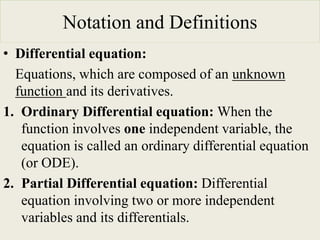
• Differential equation:
Equations, which are composed of an unknown
function and its derivatives.
1. Ordinary Differential equation: When the
function involves one independent variable, the
equation is called an ordinary differential equation
(or ODE).
2. Partial Differential equation: Differential
equation involving two or more independent
variables and its differentials.
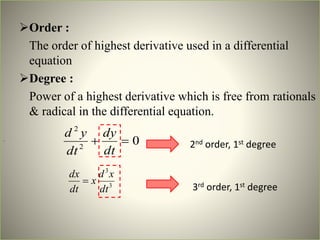
Order :
The order of highest derivative used in a differential
equation
Degree :
Power of a highest derivative which is free from rationals
& radical in the differential equation.
02
2

dt
dy
dt
yd.
2nd order, 1st degree
3
3
dt
xd
x
dt
dx

3rd order, 1st degree
Solutions of First Order Differential Equations
1. Variable Separable Equations
2. Homogeneous & Non homogeneous Equation
3. Exact & Non-Exact Equations
4. Linear Equations
5. Bernoulli’s Equations
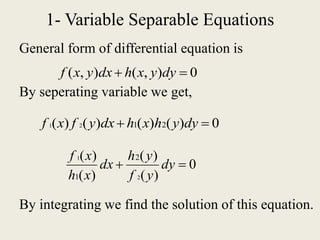
1- Variable Separable Equations
General form of differential equation is
By seperating variable we get,
By integrating we find the solution of this equation.
0),(),(  dyyxhdxyxf
0)()()()( 2121  dyyhxhdxyfxf
0
)(
)(
)(
)(
2
1 2
1
 dy
yf
yh
dx
xh
xf
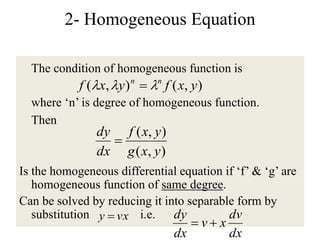
2- Homogeneous Equation
The condition of homogeneous function is
where ‘n’ is degree of homogeneous function.
Then
Is the homogeneous differential equation if ‘f’ & ‘g’ are
homogeneous function of same degree.
Can be solved by reducing it into separable form by
substitution i.e.
),(),( yxfyxf nn
 
),(
),(
yxg
yxf
dx
dy

vxy 
dx
dv
xv
dx
dy

3- Exact Equations
The required condition for equation to be exact
is
and its general solution is
[ is constant] [Terms free from ]
0),(),(  dyyxNdxyxM
x
N
y
M





cdyyxNdxyxM   ),(),(
y x
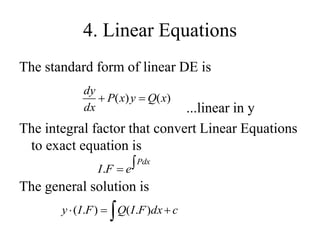
4. Linear Equations
The standard form of linear DE is
...linear in y
The integral factor that convert Linear Equations
to exact equation is
The general solution is
)()( xQyxP
dx
dy


Pdx
eFI.
cdxFIQFIy   ).().(
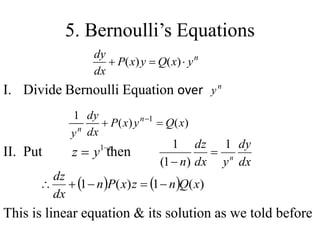
5. Bernoulli’s Equations
I. Divide Bernoulli Equation over
II. Put then
This is linear equation & its solution as we told before
n
yxQyxP
dx
dy
 )()(
n
y
n
yz 
 1
)()(
1 1
xQyxP
dx
dy
y
n
n
 
dx
dy
ydx
dz
n n
1
)1(
1


    )(1)(1 xQnzxPn
dx
dz

THANK YOU

Ordinary differential equation

  • 1.
    Introduction to OrdinaryDifferential Equations Presented by Dnyaneshwar Pardeshi [182070006] M.Tech (Control System) Under The Guidance Of Dr. Surendra Bhosale
  • 2.
    Introduction  Differential equationsare introduce in different fields and its importance appears not only in mathematics but also in Engineering , Natural science ,Chemical science , Medicine, Ecology and Economy.  In mathematics, an ordinary differential equation is a differential equation containing one or more functions of one independent variable and its derivatives. The term ordinary is used in contrast with the term partial differential equation which may be with respect to more than one independent variable.
  • 3.
    Notation and Definitions •Differential equation: Equations, which are composed of an unknown function and its derivatives. 1. Ordinary Differential equation: When the function involves one independent variable, the equation is called an ordinary differential equation (or ODE). 2. Partial Differential equation: Differential equation involving two or more independent variables and its differentials.
  • 4.
    Order : The orderof highest derivative used in a differential equation Degree : Power of a highest derivative which is free from rationals & radical in the differential equation. 02 2  dt dy dt yd. 2nd order, 1st degree 3 3 dt xd x dt dx  3rd order, 1st degree
  • 5.
    Solutions of FirstOrder Differential Equations 1. Variable Separable Equations 2. Homogeneous & Non homogeneous Equation 3. Exact & Non-Exact Equations 4. Linear Equations 5. Bernoulli’s Equations
  • 6.
    1- Variable SeparableEquations General form of differential equation is By seperating variable we get, By integrating we find the solution of this equation. 0),(),(  dyyxhdxyxf 0)()()()( 2121  dyyhxhdxyfxf 0 )( )( )( )( 2 1 2 1  dy yf yh dx xh xf
  • 7.
    2- Homogeneous Equation Thecondition of homogeneous function is where ‘n’ is degree of homogeneous function. Then Is the homogeneous differential equation if ‘f’ & ‘g’ are homogeneous function of same degree. Can be solved by reducing it into separable form by substitution i.e. ),(),( yxfyxf nn   ),( ),( yxg yxf dx dy  vxy  dx dv xv dx dy 
  • 8.
    3- Exact Equations Therequired condition for equation to be exact is and its general solution is [ is constant] [Terms free from ] 0),(),(  dyyxNdxyxM x N y M      cdyyxNdxyxM   ),(),( y x
  • 9.
    4. Linear Equations Thestandard form of linear DE is ...linear in y The integral factor that convert Linear Equations to exact equation is The general solution is )()( xQyxP dx dy   Pdx eFI. cdxFIQFIy   ).().(
  • 10.
    5. Bernoulli’s Equations I.Divide Bernoulli Equation over II. Put then This is linear equation & its solution as we told before n yxQyxP dx dy  )()( n y n yz   1 )()( 1 1 xQyxP dx dy y n n   dx dy ydx dz n n 1 )1( 1       )(1)(1 xQnzxPn dx dz 
  • 11.

Editor's Notes

  • #4 Partial differential equation that involves two or more independent variables.
  • #5 These definations are same for both ode n pde