DIFFRACTION OF X-RAYS
BY CRYSTALS
Presented By:-
ATEEQ SINDHU
Ist YEAR
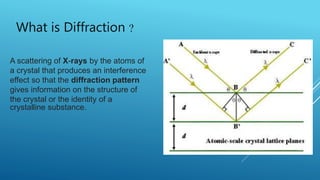
What is Diffraction ?
A scattering of X-rays by the atoms of
a crystal that produces an interference
effect so that the diffraction pattern
gives information on the structure of
the crystal or the identity of a
crystalline substance.
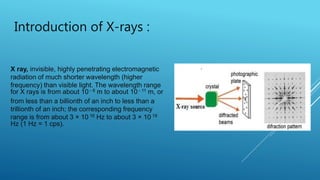
Introduction of X-rays :
X ray, invisible, highly penetrating electromagnetic
radiation of much shorter wavelength (higher
frequency) than visible light. The wavelength range
for X rays is from about 10 - 8 m to about 10 - 11 m, or
from less than a billionth of an inch to less than a
trillionth of an inch; the corresponding frequency
range is from about 3 × 10 16 Hz to about 3 × 10 19
Hz (1 Hz = 1 cps).
History of X-Rays crystallography
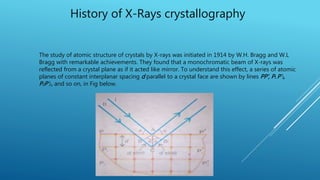
The study of atomic structure of crystals by X-rays was initiated in 1914 by W.H. Bragg and W.L
Bragg with remarkable achievements. They found that a monochromatic beam of X-rays was
reflected from a crystal plane as if it acted like mirror. To understand this effect, a series of atomic
planes of constant interplanar spacing d parallel to a crystal face are shown by lines PP’, P1 P’1,
P2P’2 , and so on, in Fig below.
Diffraction of x-rays by crystals :
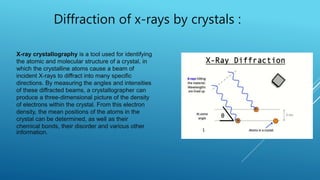
X-ray crystallography is a tool used for identifying
the atomic and molecular structure of a crystal, in
which the crystalline atoms cause a beam of
incident X-rays to diffract into many specific
directions. By measuring the angles and intensities
of these diffracted beams, a crystallographer can
produce a three-dimensional picture of the density
of electrons within the crystal. From this electron
density, the mean positions of the atoms in the
crystal can be determined, as well as their
chemical bonds, their disorder and various other
information.
Suppose that a single monochromatic wave (of any type) is incident on aligned plane of lattice points, with separation d, at angle
θ. Points A and C are on one plane, and B is on the plane below. Points ABCC’ form a quadrilateral.
(AB + BC) – (AC’)
The tow separate waves will arrive at a point with the same phase, and hence undergo constructive interference, if and only if this path
difference is equal to any integer value of the wavelength, i.e.
(AB + BC) – (AC’) = nλ ,
Where the same definition of n and λ apply as above.
Therefore,
AB = BC =
𝑑
𝑆𝑖𝑛 θ
and AC =
2𝑑
tan 𝜃
,
From which it follows that
AC’ = AC . cos θ =
2𝑑
tan 𝜃
cosθ = (
2𝑑
sin 𝜃
cos θ) cos θ =
2𝑑
sin 𝜃
cos 2 θ.
Putting everything together,
nλ =
2𝑑
sin 𝜃
(1-cos 2 θ) =
2𝑑
sin 𝜃
sin2 θ ,
Which simplify to
nλ = 2d sin θ ,
Which is Bragg’s Law.
Heuristic derivation
Diffraction of X-rays by crystals

Diffraction of X-rays by crystals

  • 1.
    DIFFRACTION OF X-RAYS BYCRYSTALS Presented By:- ATEEQ SINDHU Ist YEAR
  • 2.
    What is Diffraction? A scattering of X-rays by the atoms of a crystal that produces an interference effect so that the diffraction pattern gives information on the structure of the crystal or the identity of a crystalline substance.
  • 3.
    Introduction of X-rays: X ray, invisible, highly penetrating electromagnetic radiation of much shorter wavelength (higher frequency) than visible light. The wavelength range for X rays is from about 10 - 8 m to about 10 - 11 m, or from less than a billionth of an inch to less than a trillionth of an inch; the corresponding frequency range is from about 3 × 10 16 Hz to about 3 × 10 19 Hz (1 Hz = 1 cps).
  • 4.
    History of X-Rayscrystallography The study of atomic structure of crystals by X-rays was initiated in 1914 by W.H. Bragg and W.L Bragg with remarkable achievements. They found that a monochromatic beam of X-rays was reflected from a crystal plane as if it acted like mirror. To understand this effect, a series of atomic planes of constant interplanar spacing d parallel to a crystal face are shown by lines PP’, P1 P’1, P2P’2 , and so on, in Fig below.
  • 5.
    Diffraction of x-raysby crystals : X-ray crystallography is a tool used for identifying the atomic and molecular structure of a crystal, in which the crystalline atoms cause a beam of incident X-rays to diffract into many specific directions. By measuring the angles and intensities of these diffracted beams, a crystallographer can produce a three-dimensional picture of the density of electrons within the crystal. From this electron density, the mean positions of the atoms in the crystal can be determined, as well as their chemical bonds, their disorder and various other information.
  • 6.
    Suppose that asingle monochromatic wave (of any type) is incident on aligned plane of lattice points, with separation d, at angle θ. Points A and C are on one plane, and B is on the plane below. Points ABCC’ form a quadrilateral. (AB + BC) – (AC’) The tow separate waves will arrive at a point with the same phase, and hence undergo constructive interference, if and only if this path difference is equal to any integer value of the wavelength, i.e. (AB + BC) – (AC’) = nλ , Where the same definition of n and λ apply as above. Therefore, AB = BC = 𝑑 𝑆𝑖𝑛 θ and AC = 2𝑑 tan 𝜃 , From which it follows that AC’ = AC . cos θ = 2𝑑 tan 𝜃 cosθ = ( 2𝑑 sin 𝜃 cos θ) cos θ = 2𝑑 sin 𝜃 cos 2 θ. Putting everything together, nλ = 2𝑑 sin 𝜃 (1-cos 2 θ) = 2𝑑 sin 𝜃 sin2 θ , Which simplify to nλ = 2d sin θ , Which is Bragg’s Law. Heuristic derivation