X-Ray Diffraction
Colin McElroy
11/09/2012
OUTLINE
Historical account (partial)
Wilhelm Röntgen: X-Rays (1895)
Max von Laue: X-Ray diffraction (1912)
Paul Peter Ewald: Ewald Sphere (1969)
William Lawrence Bragg: Bragg condition (1912)
X-Ray Overview
Photons
Generators
Subtle Characteristics (Cuκα, Cuκβ, filters)
Diffraction
2-slit experiment
Reflection planes
Equipment/Method
Powder Diffraction
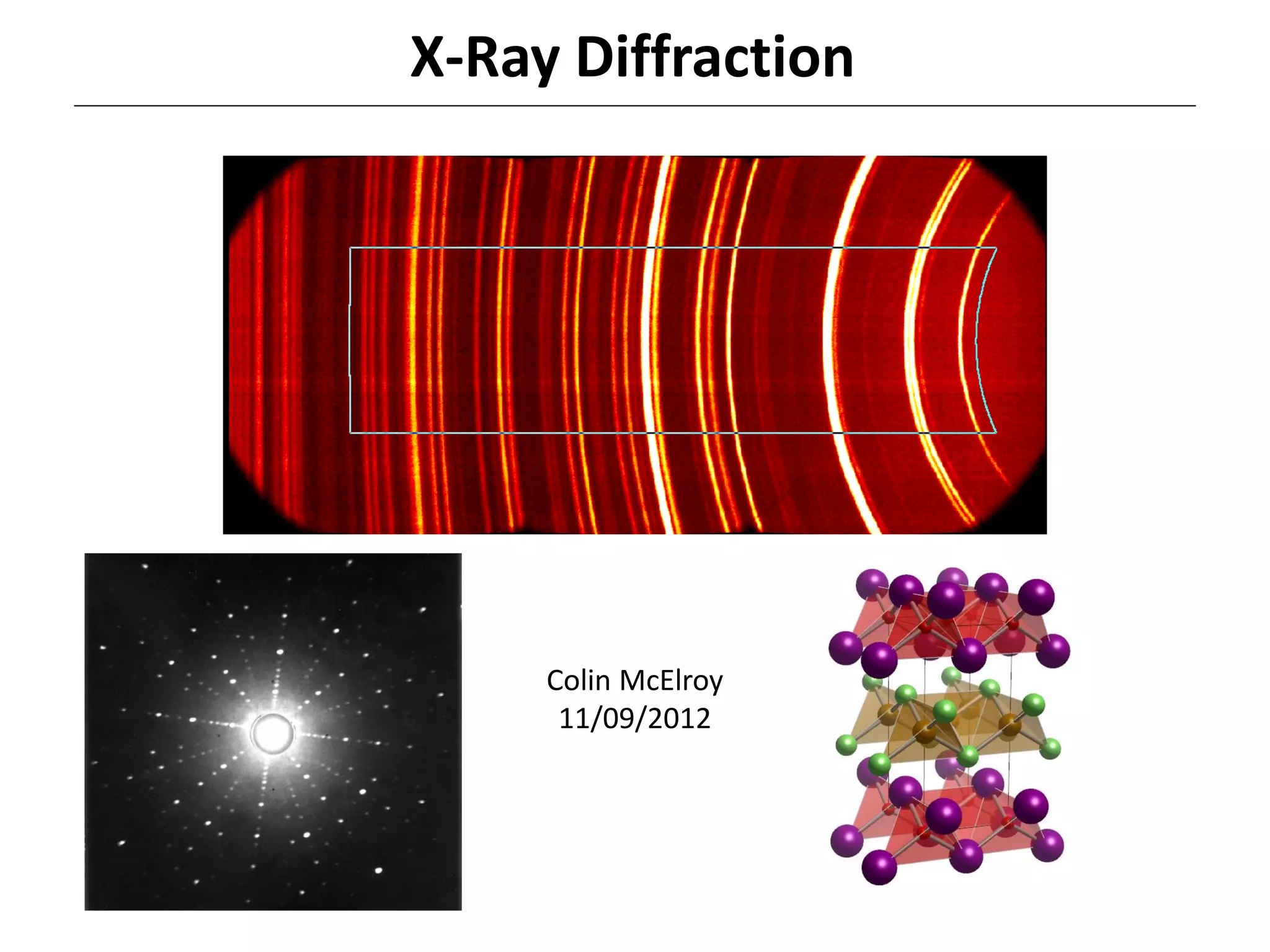
Laue
Laue Method
Powder Diffraction Method
Analysis/Tools
HISTORY (brief)
Wilhelm Röntgen
(1845-1923)
William Lawrence Bragg
(1890-1971)
Peter Debye (1884-1966)
Paul Scherrer (1890-1969)
Max von Laue (1879-1960)
Paul Peter Ewald (1888-1985)
Wilhelm Röntgen studies X-Rays
Crookes Tubes
Max von Laue establishes crystal diffraction
Paul Peter Ewald’s thesis
William Lawrence Bragg: Bragg’s Law
Peter Debye & Paul Scherrer
Debye Scherrer camera (technique)
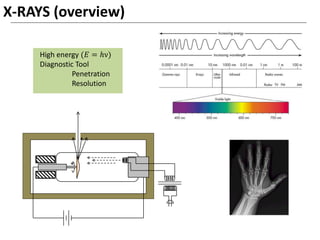
X-RAYS (overview)
High energy (𝐸 = ℎν)
Diagnostic Tool
Penetration
Resolution
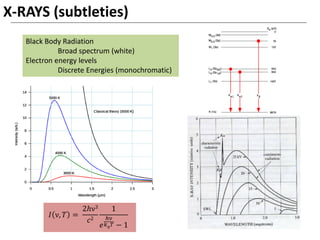
X-RAYS (subtleties)
Black Body Radiation
Broad spectrum (white)
Electron energy levels
Discrete Energies (monochromatic)
𝐼 ν, 𝑇 =
2ℎν3
𝑐2
1
𝑒
ℎν
𝑘 𝐵
𝑇 − 1
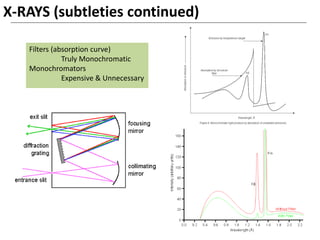
X-RAYS (subtleties continued)
Filters (absorption curve)
Truly Monochromatic
Monochromators
Expensive & Unnecessary
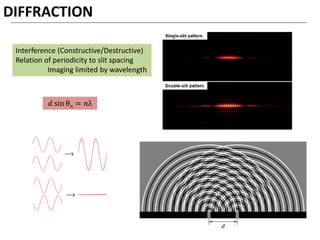
DIFFRACTION
Interference (Constructive/Destructive)
Relation of periodicity to slit spacing
Imaging limited by wavelength
𝑑 sin θ 𝑛 = 𝑛λ
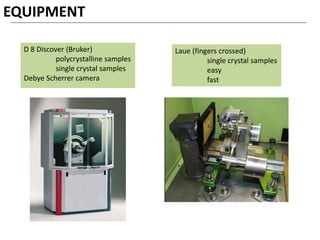
EQUIPMENT
Laue (fingers crossed)
single crystal samples
easy
fast
D 8 Discover (Bruker)
polycrystalline samples
single crystal samples
Debye Scherrer camera
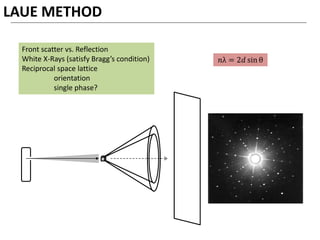
LAUE METHOD
Front scatter vs. Reflection
White X-Rays (satisfy Bragg’s condition)
Reciprocal space lattice
orientation
single phase?
𝑛λ = 2𝑑 sin θ
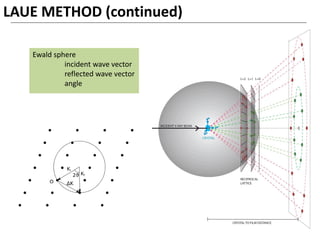
LAUE METHOD (continued)
Ewald sphere
incident wave vector
reflected wave vector
angle
θ
2θ
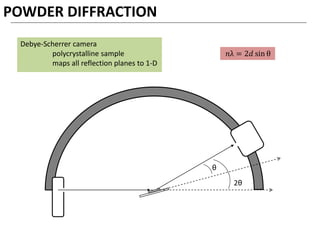
POWDER DIFFRACTION
Debye-Scherrer camera
polycrystalline sample
maps all reflection planes to 1-D
𝑛λ = 2𝑑 sin θ
θ θ
2θ
POWDER DIFFRACTION (continued)
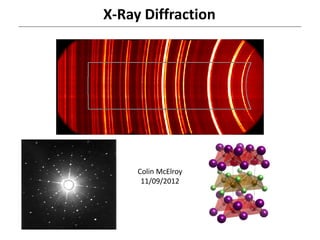
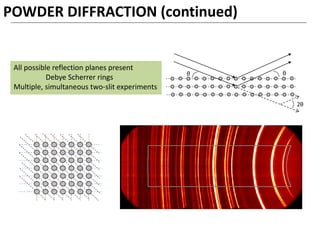
All possible reflection planes present
Debye Scherrer rings
Multiple, simultaneous two-slit experiments
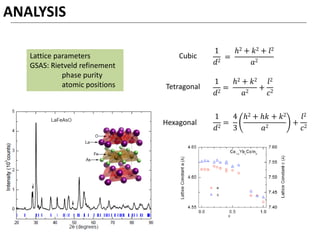
Lattice parameters
GSAS: Rietveld refinement
phase purity
atomic positions
ANALYSIS
1
𝑑2
=
ℎ2 + 𝑘2 + 𝑙2
𝑎2
Cubic
1
𝑑2
=
ℎ2 + 𝑘2
𝑎2
+
𝑙2
𝑐2
Tetragonal
1
𝑑2
=
4
3
ℎ2 + ℎ𝑘 + 𝑘2
𝑎2
+
𝑙2
𝑐2
Hexagonal
END
Thank you

XRD_presentation_McElroy