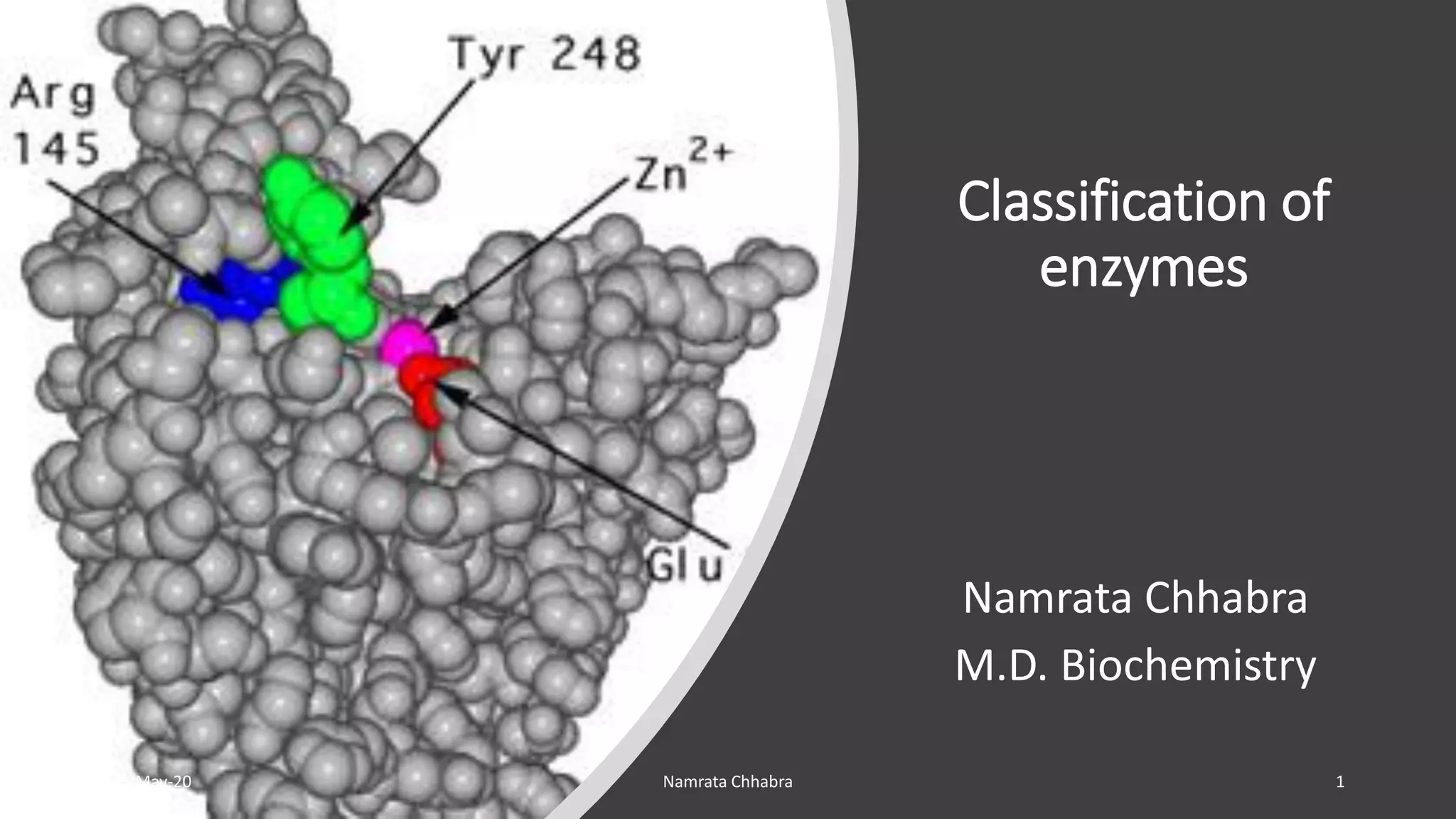

Classification of
enzymes
Namrata Chhabra
M.D. Biochemistry
15-May-20 Namrata Chhabra 1
• Biologic polymers that catalyze the chemical reactions
• Enzymes are neither consumed nor permanently altered because of
their participation in a reaction
• Except for catalytic RNA molecules, or ribozymes, enzymes are
proteins in nature.
• In addition to being highly efficient, enzymes are also extremely
selective catalysts.
Enzymes- Introduction
15-May-20 Namrata Chhabra 2
Nomenclature of enzymes
a) Based on the type of reaction catalyzed (followed by the suffix –ase)
b) Based on the nature of substrate
c) Based on the source of enzyme
d) Based on its regulation
e) Trival names
15-May-20 Namrata Chhabra 3
Nomenclature of enzymes
Based on the type of reaction catalyzed (followed by the suffix –ase)
• Dehydrogenase
• Protease
• Isomerase
• Reductase
• Transferase
15-May-20 Namrata Chhabra 4
Nomenclature of enzymes
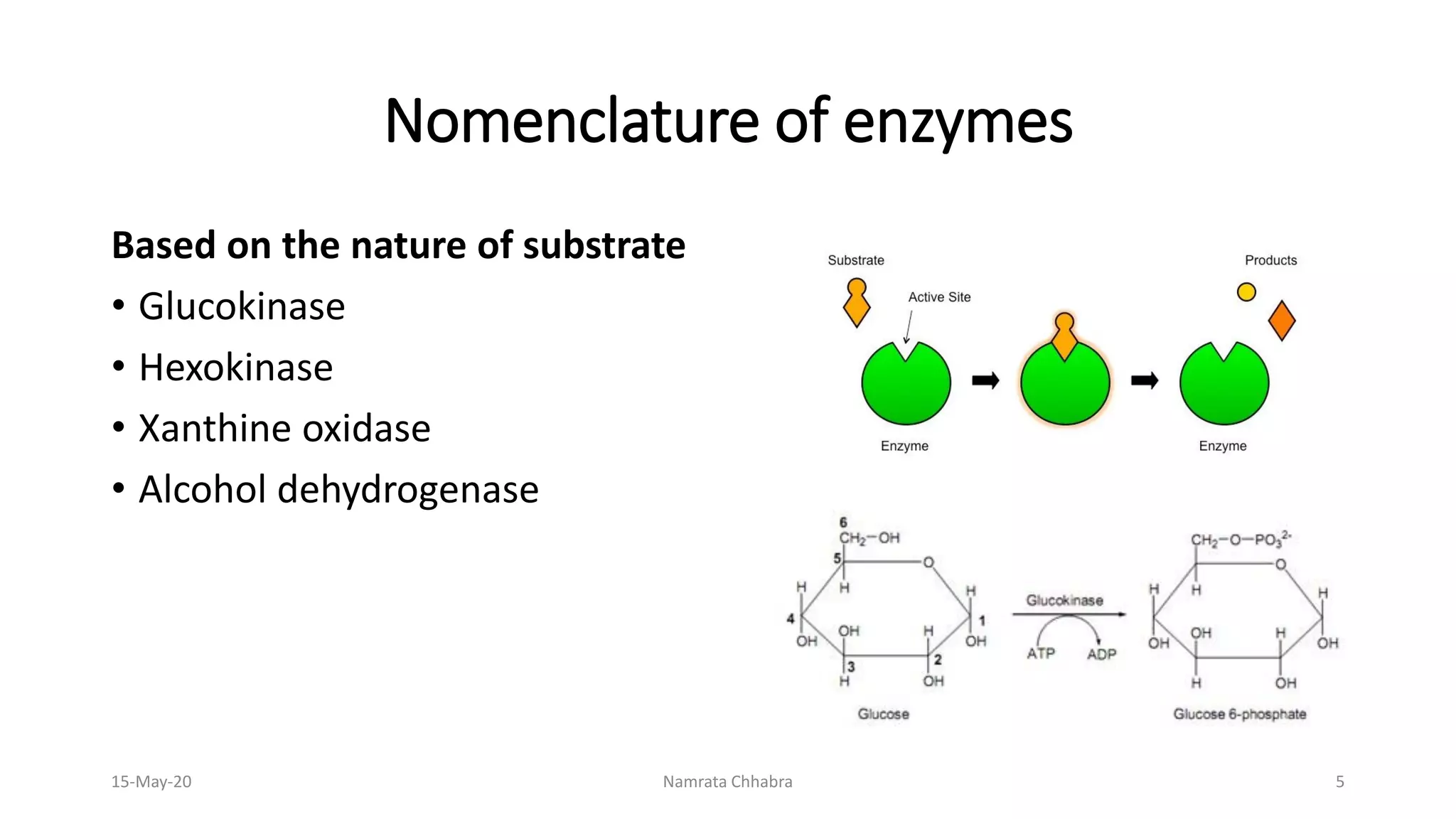
Based on the nature of substrate
• Glucokinase
• Hexokinase
• Xanthine oxidase
• Alcohol dehydrogenase
15-May-20 Namrata Chhabra 5
Nomenclature of
enzymes
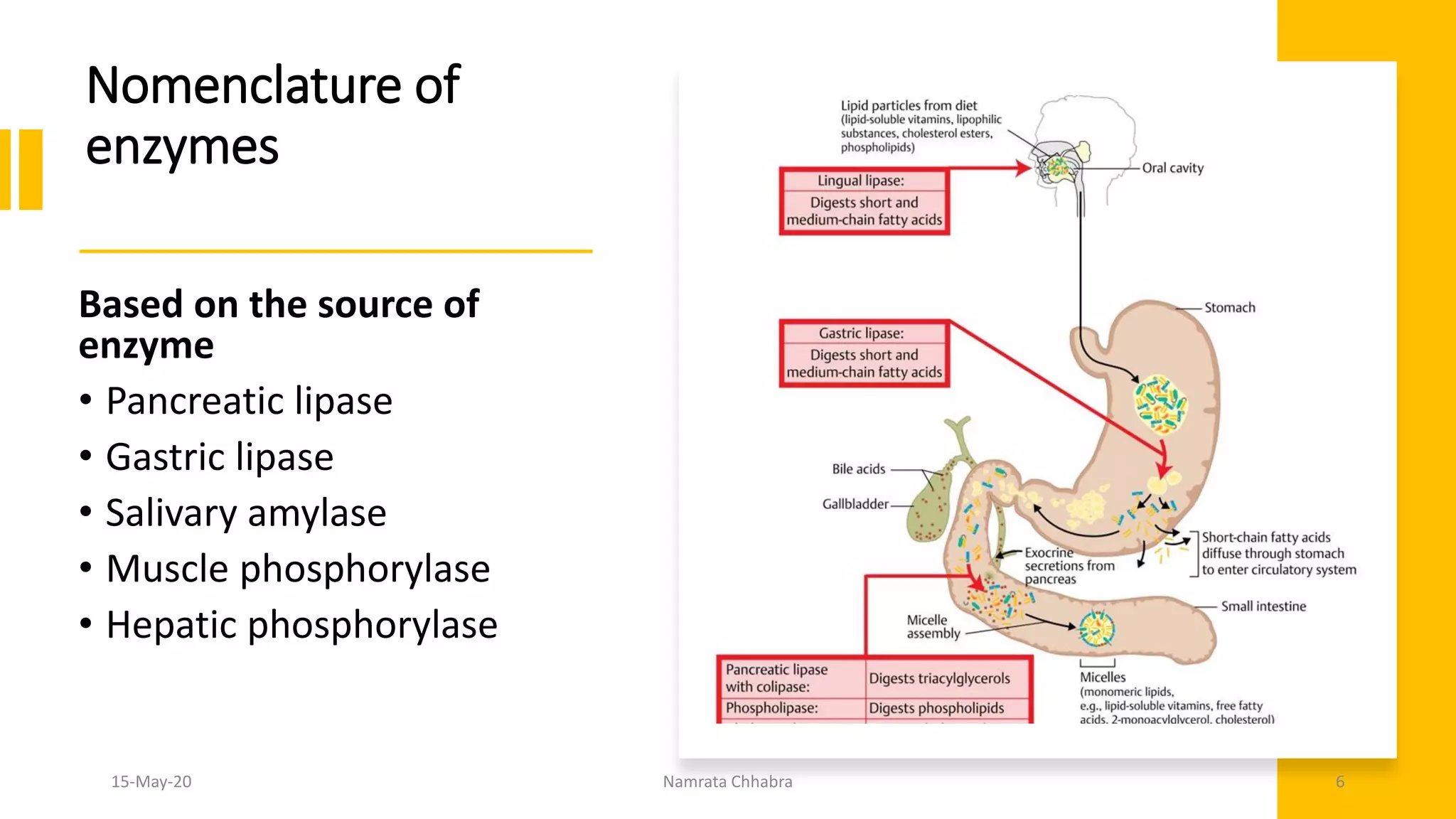
Based on the source of
enzyme
• Pancreatic lipase
• Gastric lipase
• Salivary amylase
• Muscle phosphorylase
• Hepatic phosphorylase
15-May-20 Namrata Chhabra 6
Nomenclature of enzymes
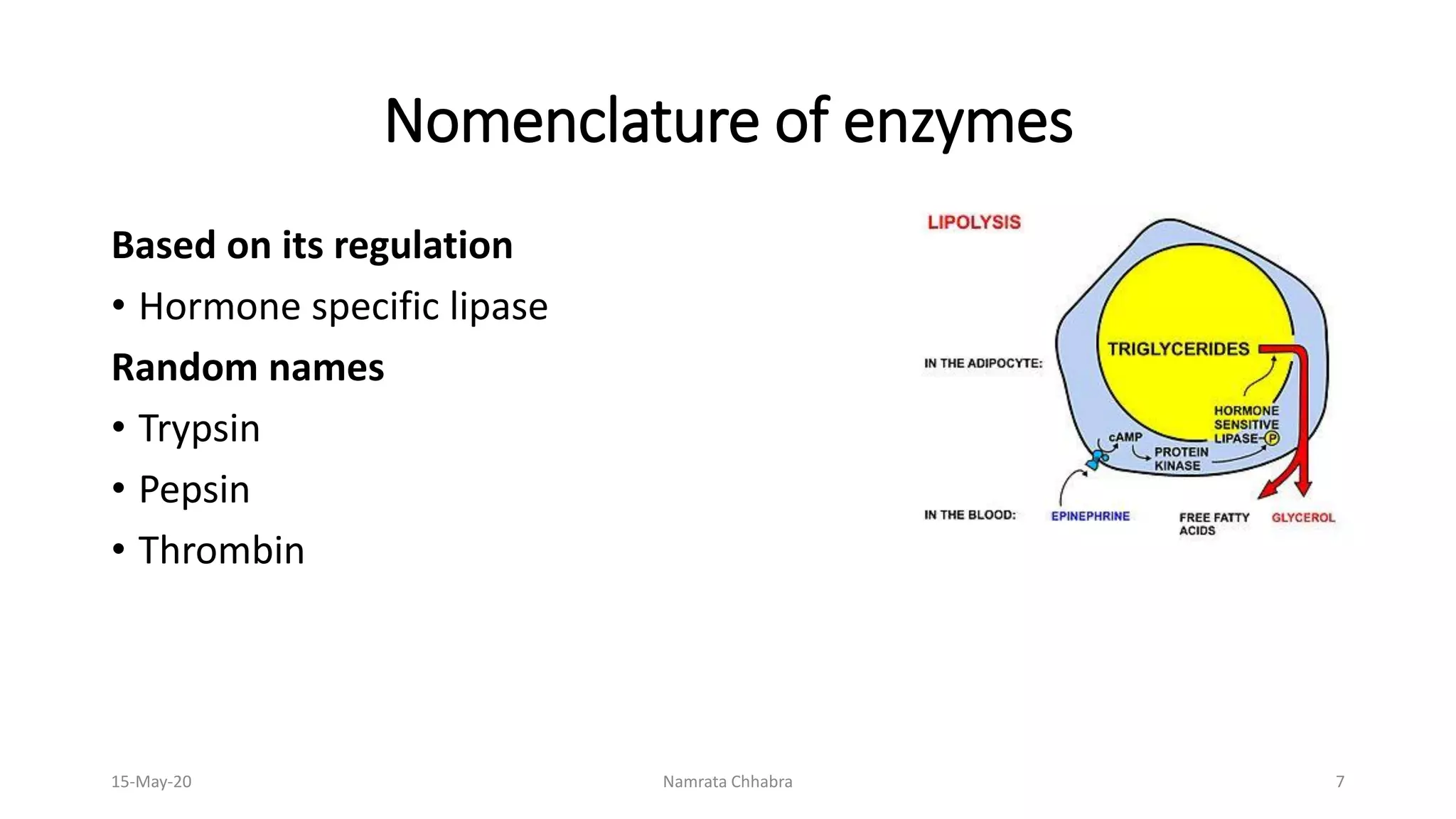
Based on its regulation
• Hormone specific lipase
Random names
• Trypsin
• Pepsin
• Thrombin
15-May-20 Namrata Chhabra 7
Systematic Names of enzymes
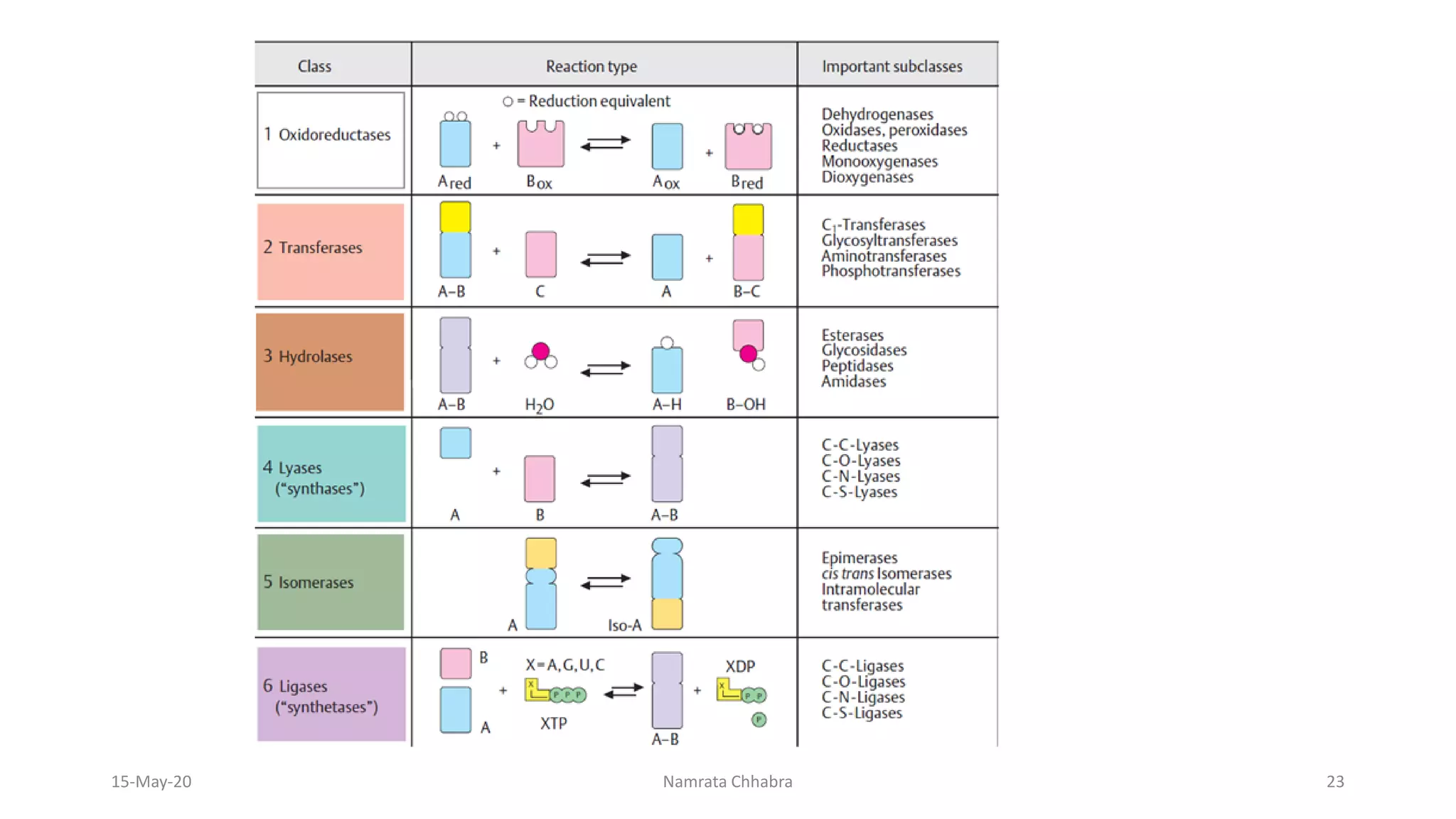
• The International Union of Biochemists (IUB) classification
• Each enzyme has a unique name and code number that identifies the
type of reaction catalyzed, and the substrates involved.
• Enzymes are grouped into six classes.
15-May-20 Namrata Chhabra 8
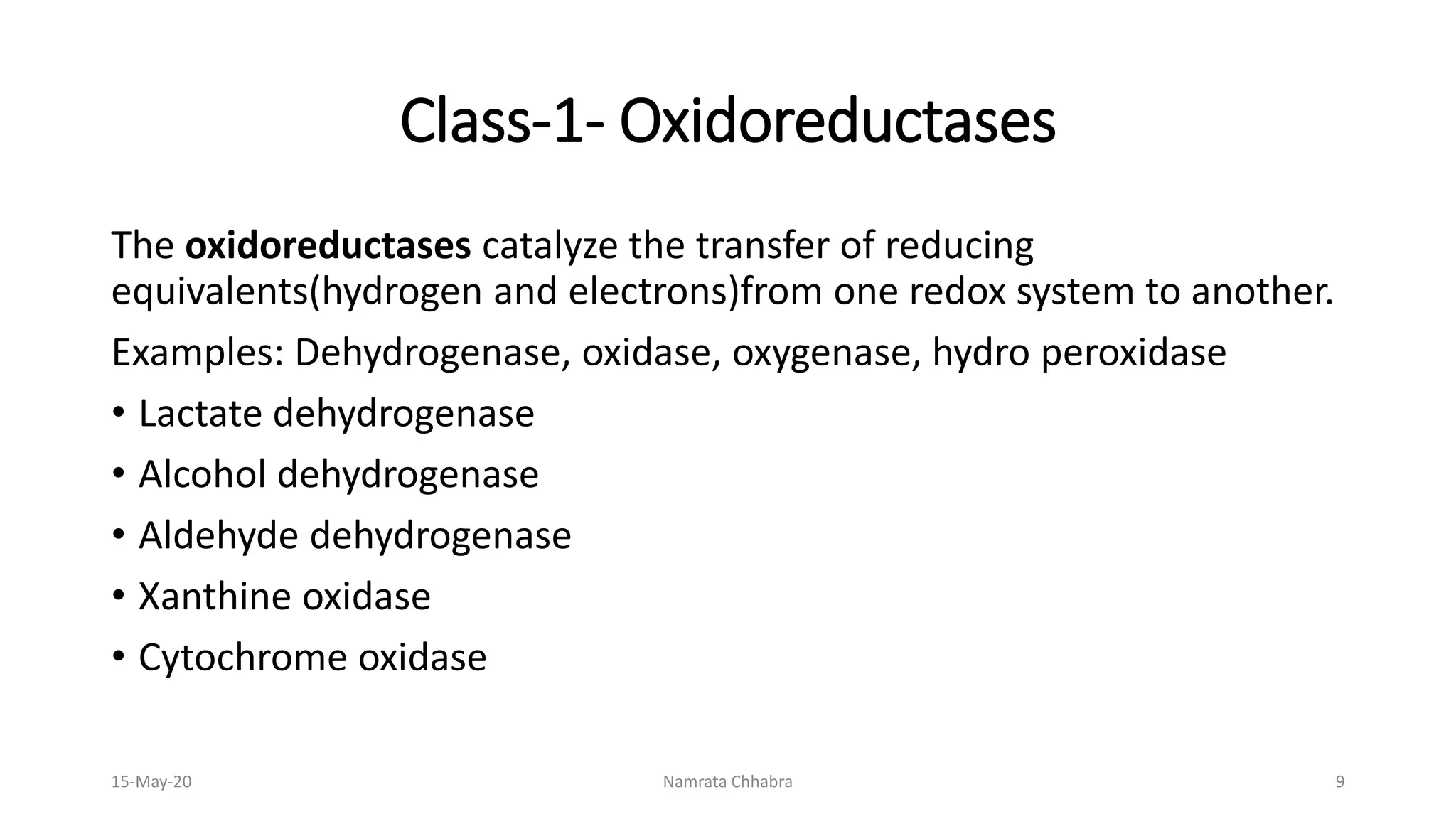
Class-1- Oxidoreductases
The oxidoreductases catalyze the transfer of reducing
equivalents(hydrogen and electrons)from one redox system to another.
Examples: Dehydrogenase, oxidase, oxygenase, hydro peroxidase
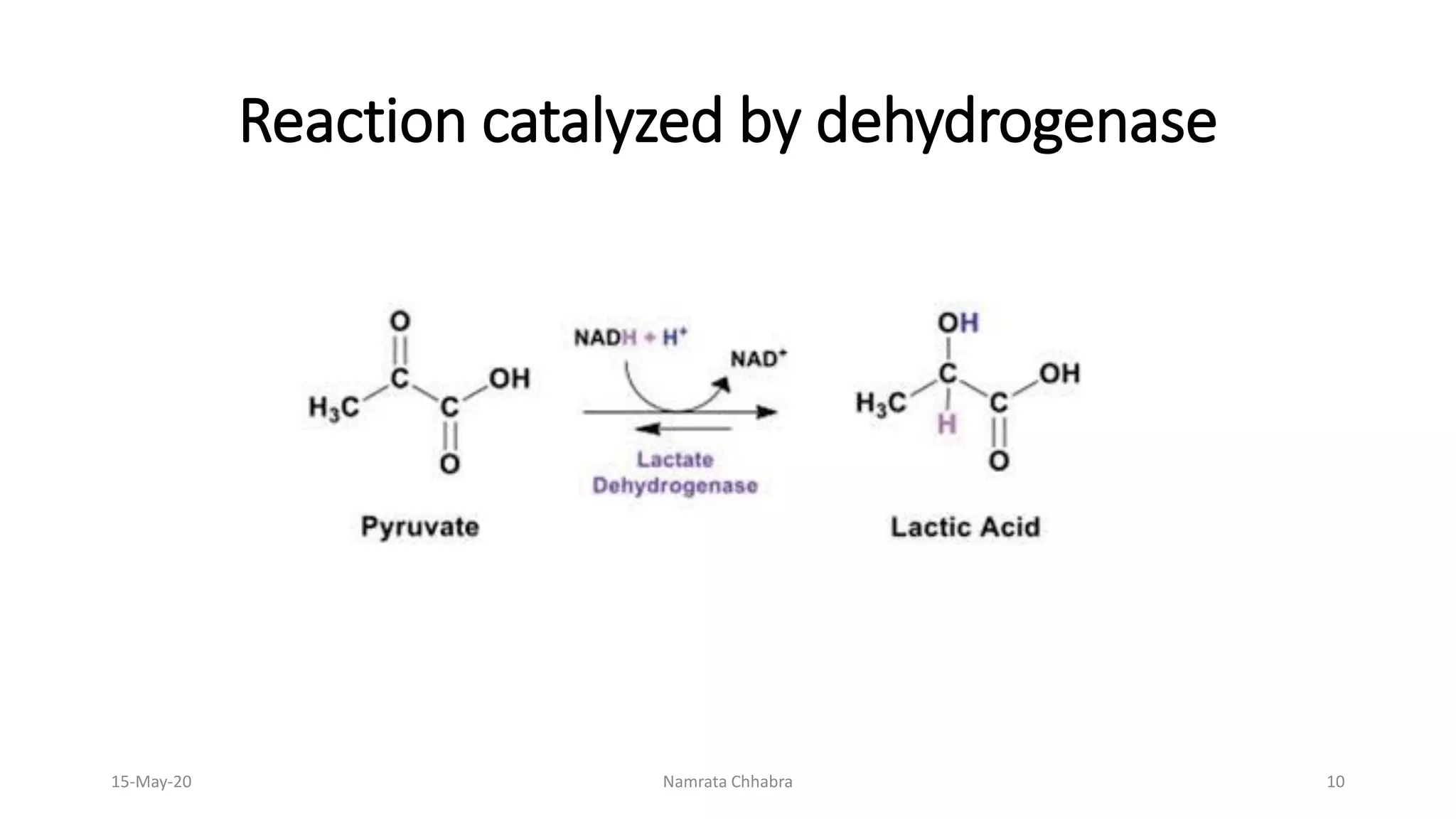
• Lactate dehydrogenase
• Alcohol dehydrogenase
• Aldehyde dehydrogenase
• Xanthine oxidase
• Cytochrome oxidase
15-May-20 Namrata Chhabra 9
Reaction catalyzed by dehydrogenase
15-May-20 Namrata Chhabra 10
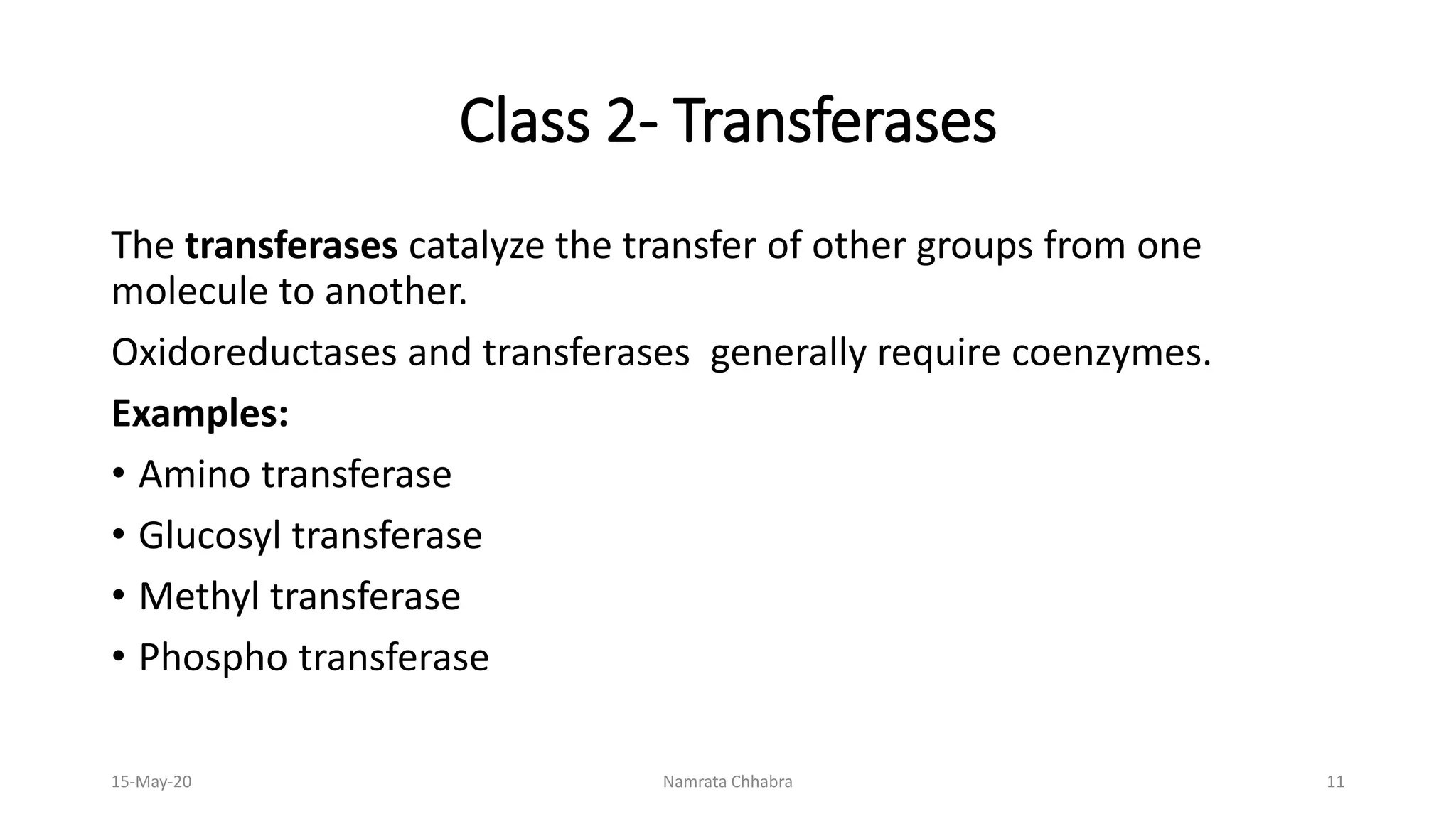
Class 2- Transferases
The transferases catalyze the transfer of other groups from one
molecule to another.
Oxidoreductases and transferases generally require coenzymes.
Examples:
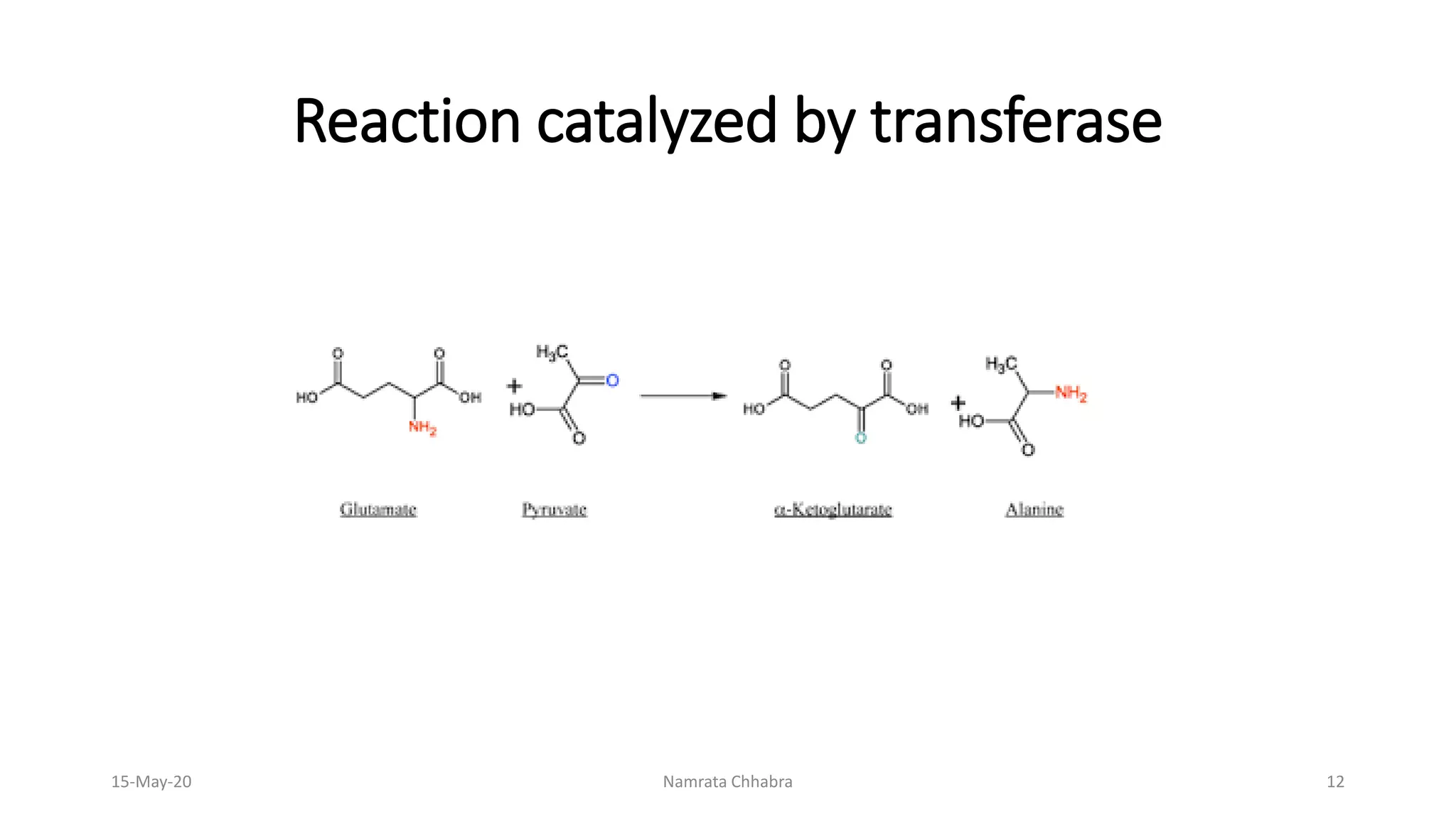
• Amino transferase
• Glucosyl transferase
• Methyl transferase
• Phospho transferase
15-May-20 Namrata Chhabra 11
Reaction catalyzed by transferase
15-May-20 Namrata Chhabra 12
Class 3- Hydrolases
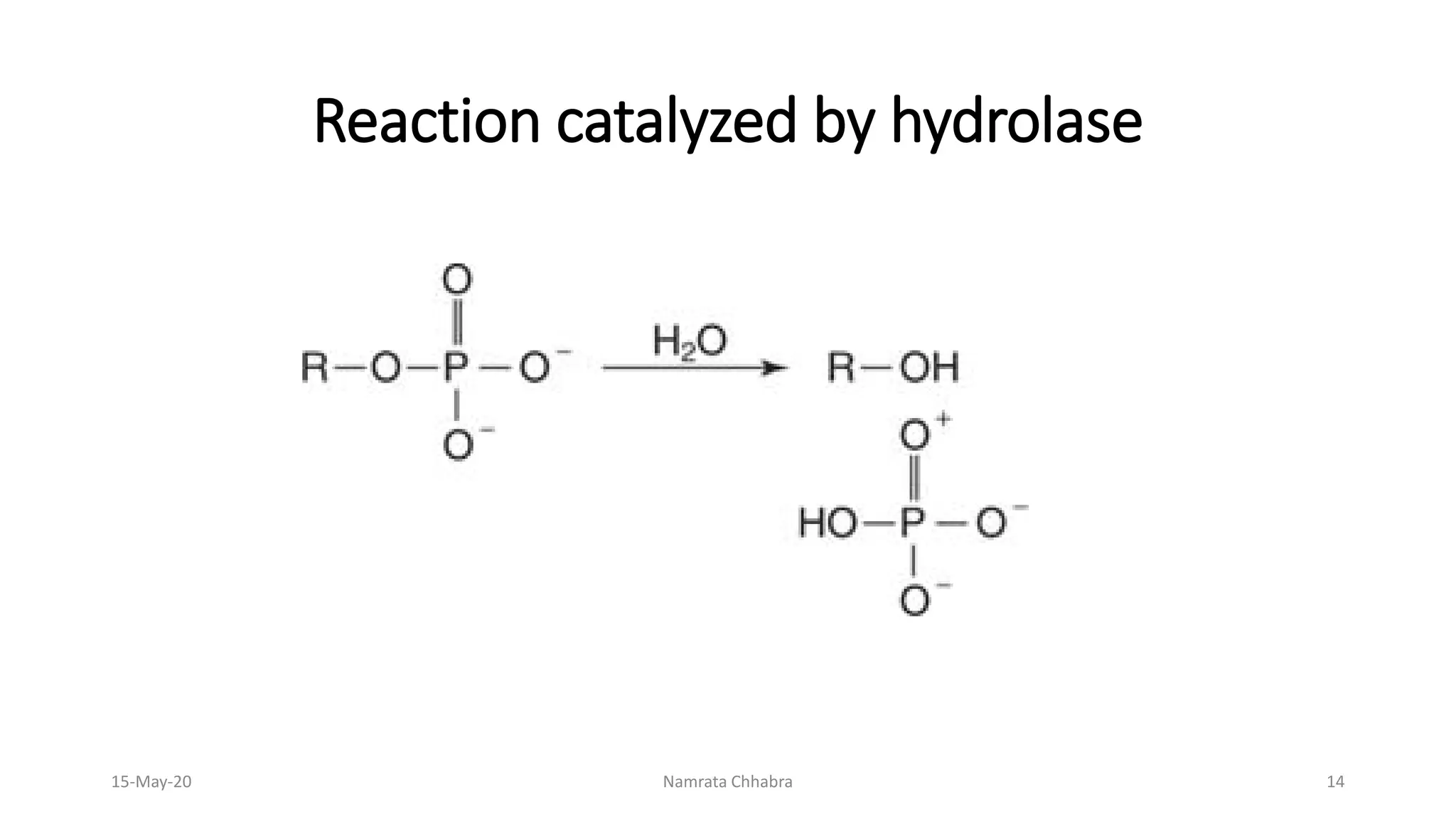
The hydrolases cause cleavage of bond using water.
Examples:
• Protease
• Peptidase
• Glycosidase
• Phosphatase
15-May-20 Namrata Chhabra 13
Reaction catalyzed by hydrolase
15-May-20 Namrata Chhabra 14
Class 4 Lyases
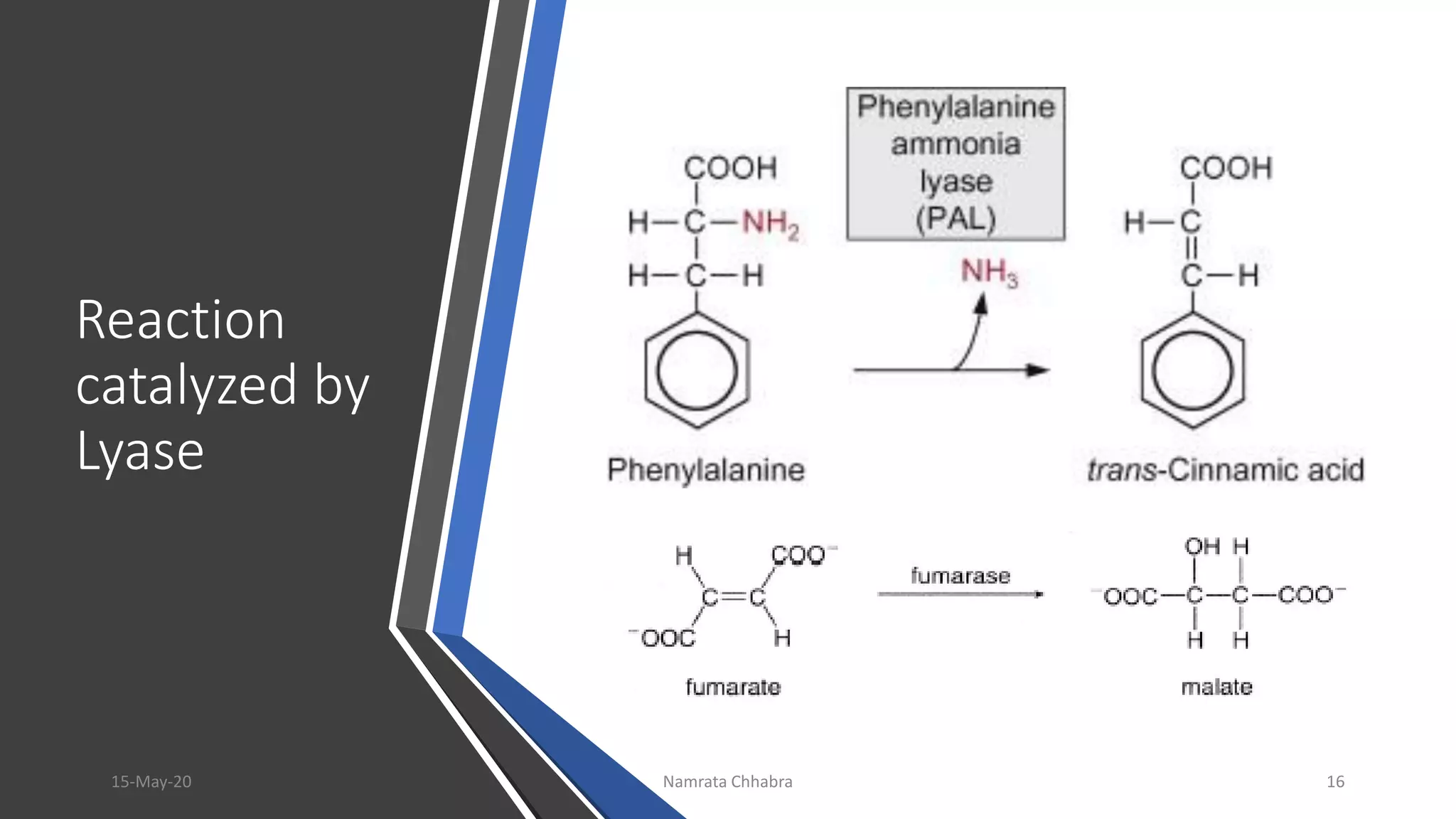
• The Lyases catalyze reactions involving either the cleavage or
formation of chemical bonds (also known as synthases)
• with double bonds either arising or disappearing
• Cleavage of bond does not require water.
• Lyases usually break C-C, C-O, C-N, or C-S linkages.
Examples:
Fumarase, Arginosuccinase, glutamate decarboxylase
15-May-20 Namrata Chhabra 15
Reaction
catalyzed by
Lyase
15-May-20 Namrata Chhabra 16
Class 5- Isomerases
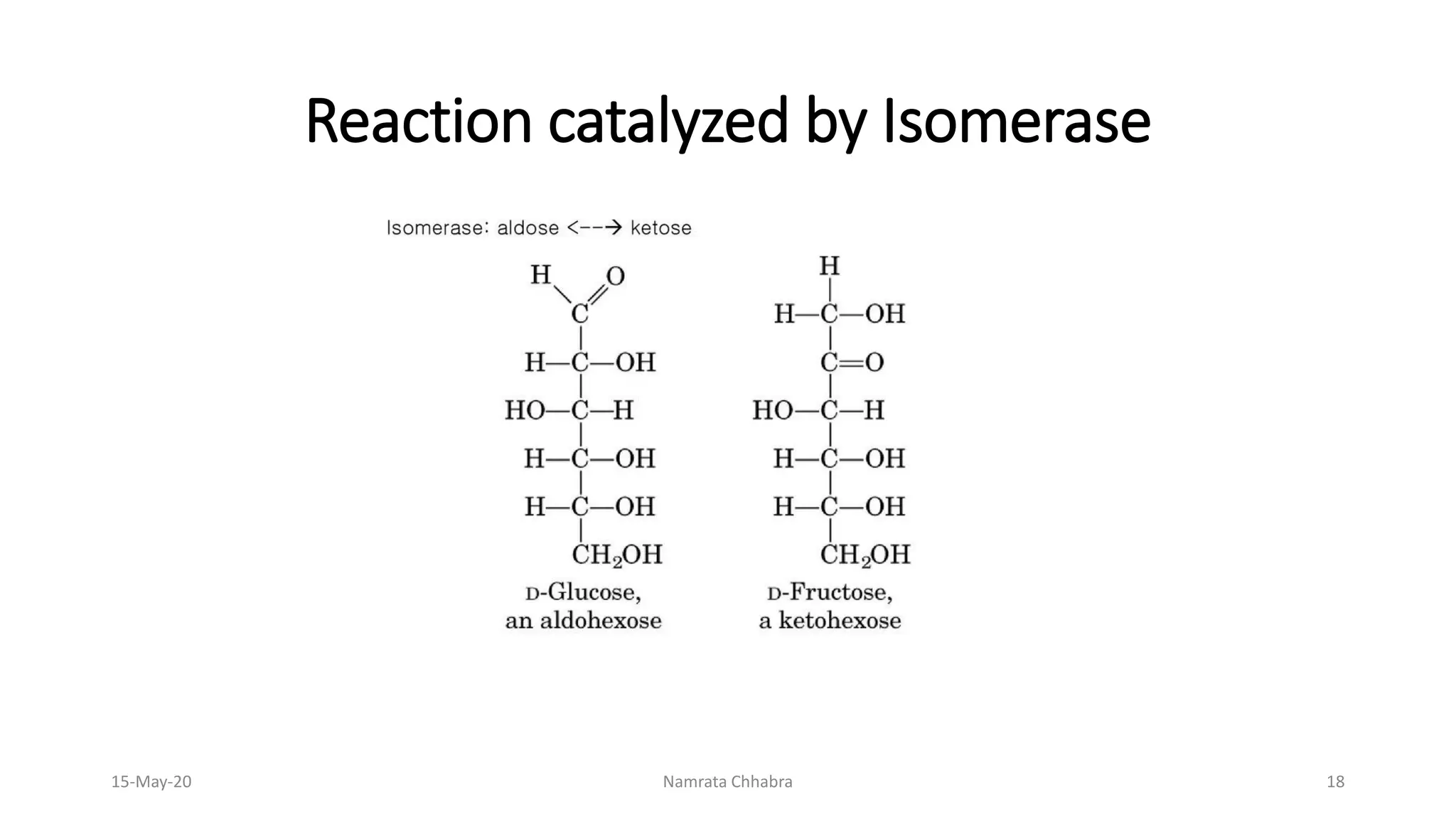
• The isomerases move groups within a molecule, without changing
the gross composition of the substrate.
Examples:
• Epimerase
• Aldose ketose isomerase
• Mutase
15-May-20 Namrata Chhabra 17
Reaction catalyzed by Isomerase
15-May-20 Namrata Chhabra 18
Class 6- Ligases
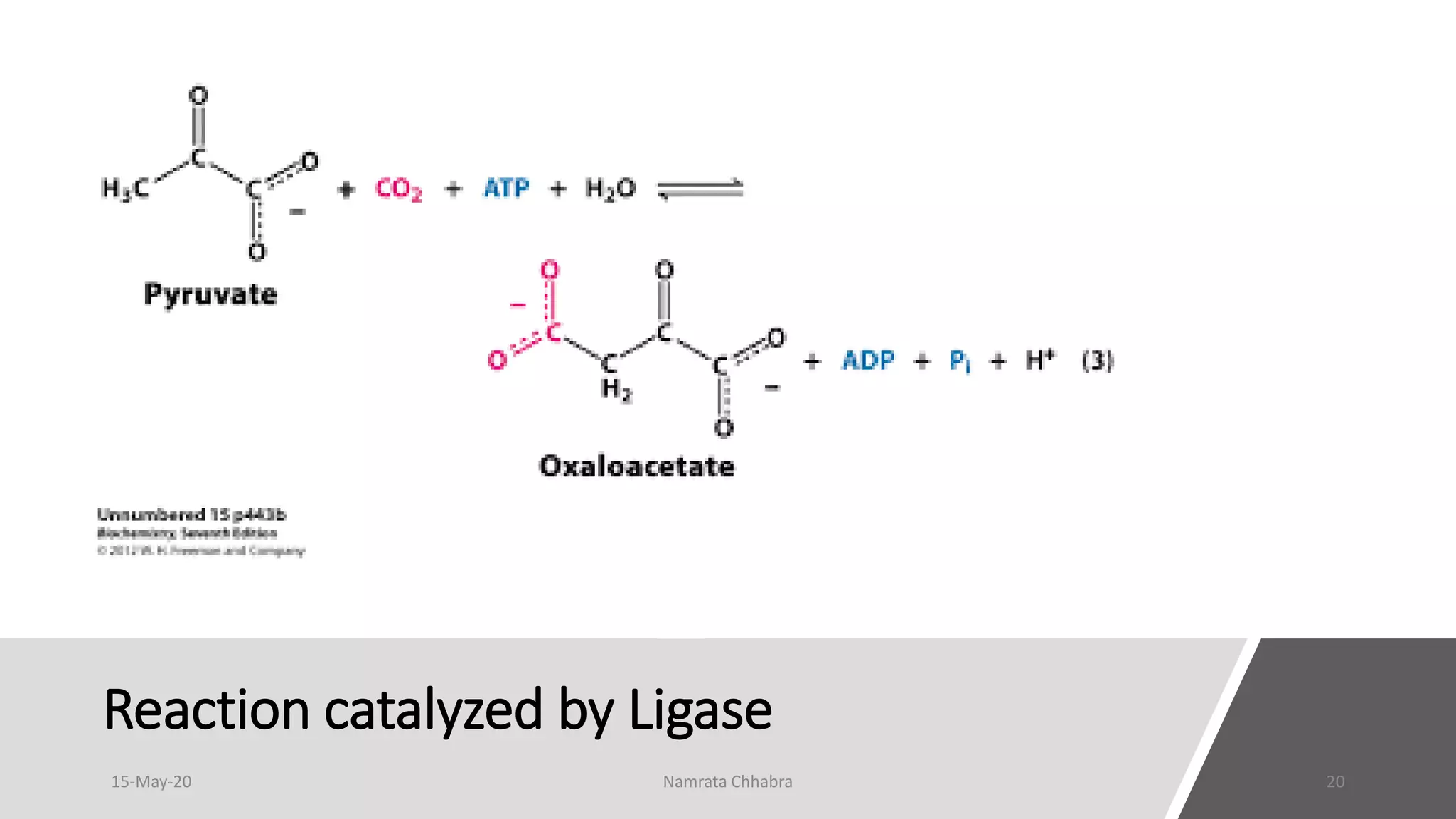
• The ligation reactions catalyzed by ligases (“synthetases,” class 6) are
energy-dependent and are therefore always coupled to the hydrolysis
of nucleoside triphosphates.
Examples:
• DNA Ligase
• Pyruvate carboxylase
• Acetyl Co A carboxylase
15-May-20 Namrata Chhabra 19
Reaction catalyzed by Ligase
15-May-20 Namrata Chhabra 20
Enzyme Commission number (EC number)
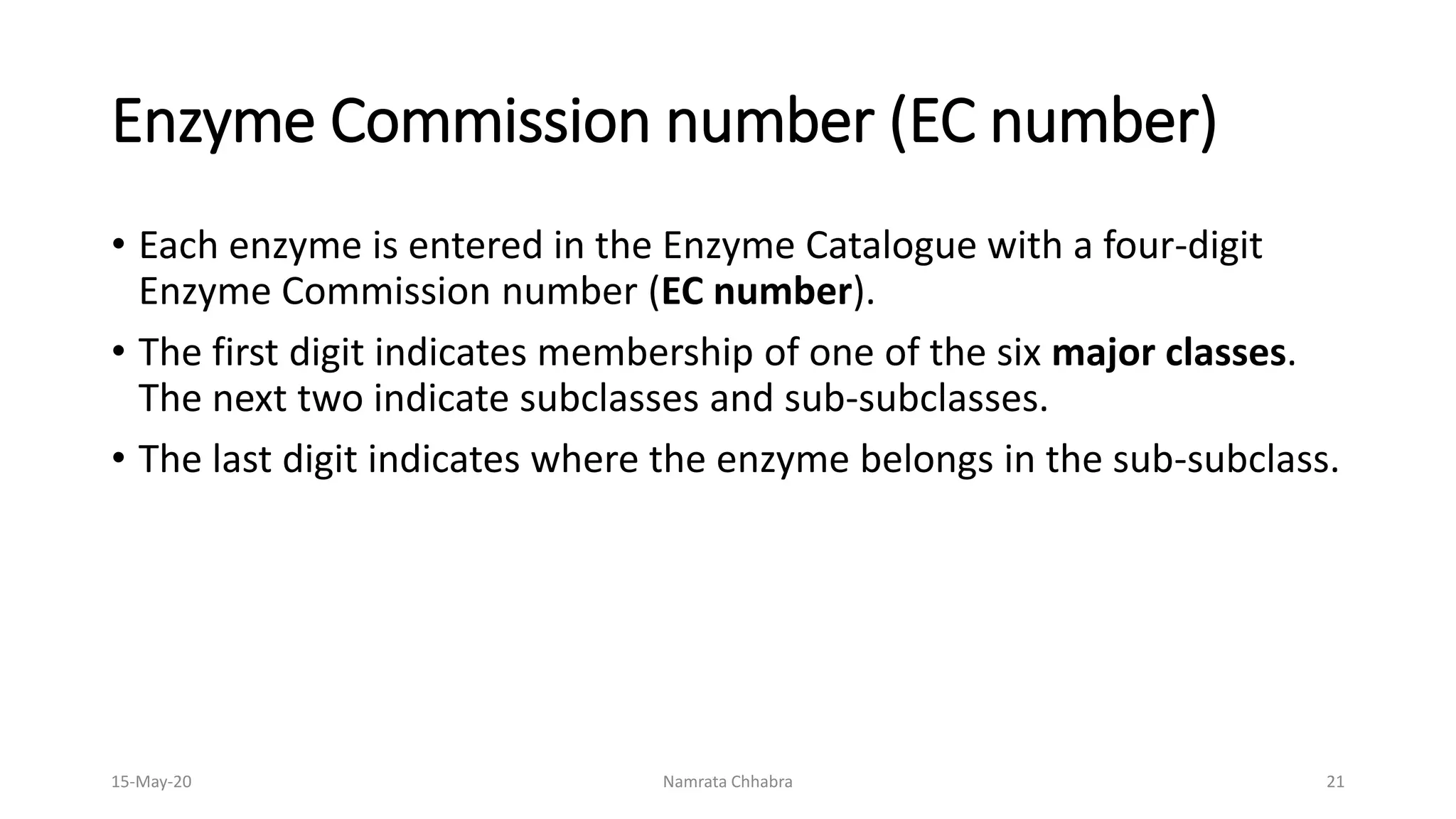
• Each enzyme is entered in the Enzyme Catalogue with a four-digit
Enzyme Commission number (EC number).
• The first digit indicates membership of one of the six major classes.
The next two indicate subclasses and sub-subclasses.
• The last digit indicates where the enzyme belongs in the sub-subclass.
15-May-20 Namrata Chhabra 21
Enzyme Commission number (EC number)
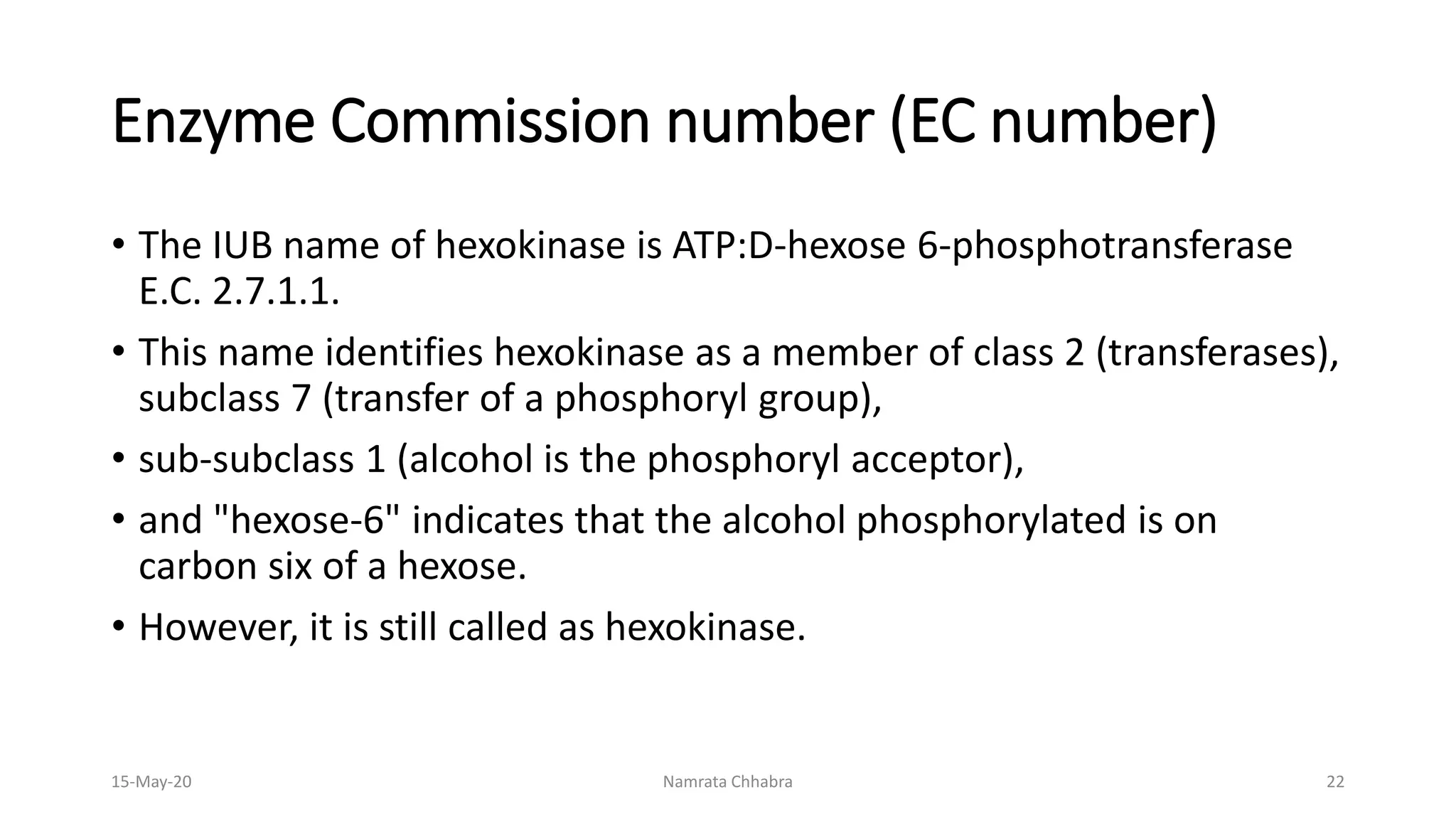
• The IUB name of hexokinase is ATP:D-hexose 6-phosphotransferase
E.C. 2.7.1.1.
• This name identifies hexokinase as a member of class 2 (transferases),
subclass 7 (transfer of a phosphoryl group),
• sub-subclass 1 (alcohol is the phosphoryl acceptor),
• and "hexose-6" indicates that the alcohol phosphorylated is on
carbon six of a hexose.
• However, it is still called as hexokinase.
15-May-20 Namrata Chhabra 22
15-May-20 Namrata Chhabra 23
Thank you
15-May-20 Namrata Chhabra 24

Enzyme classification

  • 1.
    Classification of enzymes Namrata Chhabra M.D.Biochemistry 15-May-20 Namrata Chhabra 1
  • 2.
    • Biologic polymersthat catalyze the chemical reactions • Enzymes are neither consumed nor permanently altered because of their participation in a reaction • Except for catalytic RNA molecules, or ribozymes, enzymes are proteins in nature. • In addition to being highly efficient, enzymes are also extremely selective catalysts. Enzymes- Introduction 15-May-20 Namrata Chhabra 2
  • 3.
    Nomenclature of enzymes a)Based on the type of reaction catalyzed (followed by the suffix –ase) b) Based on the nature of substrate c) Based on the source of enzyme d) Based on its regulation e) Trival names 15-May-20 Namrata Chhabra 3
  • 4.
    Nomenclature of enzymes Basedon the type of reaction catalyzed (followed by the suffix –ase) • Dehydrogenase • Protease • Isomerase • Reductase • Transferase 15-May-20 Namrata Chhabra 4
  • 5.
    Nomenclature of enzymes Basedon the nature of substrate • Glucokinase • Hexokinase • Xanthine oxidase • Alcohol dehydrogenase 15-May-20 Namrata Chhabra 5
  • 6.
    Nomenclature of enzymes Based onthe source of enzyme • Pancreatic lipase • Gastric lipase • Salivary amylase • Muscle phosphorylase • Hepatic phosphorylase 15-May-20 Namrata Chhabra 6
  • 7.
    Nomenclature of enzymes Basedon its regulation • Hormone specific lipase Random names • Trypsin • Pepsin • Thrombin 15-May-20 Namrata Chhabra 7
  • 8.
    Systematic Names ofenzymes • The International Union of Biochemists (IUB) classification • Each enzyme has a unique name and code number that identifies the type of reaction catalyzed, and the substrates involved. • Enzymes are grouped into six classes. 15-May-20 Namrata Chhabra 8
  • 9.
    Class-1- Oxidoreductases The oxidoreductasescatalyze the transfer of reducing equivalents(hydrogen and electrons)from one redox system to another. Examples: Dehydrogenase, oxidase, oxygenase, hydro peroxidase • Lactate dehydrogenase • Alcohol dehydrogenase • Aldehyde dehydrogenase • Xanthine oxidase • Cytochrome oxidase 15-May-20 Namrata Chhabra 9
  • 10.
    Reaction catalyzed bydehydrogenase 15-May-20 Namrata Chhabra 10
  • 11.
    Class 2- Transferases Thetransferases catalyze the transfer of other groups from one molecule to another. Oxidoreductases and transferases generally require coenzymes. Examples: • Amino transferase • Glucosyl transferase • Methyl transferase • Phospho transferase 15-May-20 Namrata Chhabra 11
  • 12.
    Reaction catalyzed bytransferase 15-May-20 Namrata Chhabra 12
  • 13.
    Class 3- Hydrolases Thehydrolases cause cleavage of bond using water. Examples: • Protease • Peptidase • Glycosidase • Phosphatase 15-May-20 Namrata Chhabra 13
  • 14.
    Reaction catalyzed byhydrolase 15-May-20 Namrata Chhabra 14
  • 15.
    Class 4 Lyases •The Lyases catalyze reactions involving either the cleavage or formation of chemical bonds (also known as synthases) • with double bonds either arising or disappearing • Cleavage of bond does not require water. • Lyases usually break C-C, C-O, C-N, or C-S linkages. Examples: Fumarase, Arginosuccinase, glutamate decarboxylase 15-May-20 Namrata Chhabra 15
  • 16.
  • 17.
    Class 5- Isomerases •The isomerases move groups within a molecule, without changing the gross composition of the substrate. Examples: • Epimerase • Aldose ketose isomerase • Mutase 15-May-20 Namrata Chhabra 17
  • 18.
    Reaction catalyzed byIsomerase 15-May-20 Namrata Chhabra 18
  • 19.
    Class 6- Ligases •The ligation reactions catalyzed by ligases (“synthetases,” class 6) are energy-dependent and are therefore always coupled to the hydrolysis of nucleoside triphosphates. Examples: • DNA Ligase • Pyruvate carboxylase • Acetyl Co A carboxylase 15-May-20 Namrata Chhabra 19
  • 20.
    Reaction catalyzed byLigase 15-May-20 Namrata Chhabra 20
  • 21.
    Enzyme Commission number(EC number) • Each enzyme is entered in the Enzyme Catalogue with a four-digit Enzyme Commission number (EC number). • The first digit indicates membership of one of the six major classes. The next two indicate subclasses and sub-subclasses. • The last digit indicates where the enzyme belongs in the sub-subclass. 15-May-20 Namrata Chhabra 21
  • 22.
    Enzyme Commission number(EC number) • The IUB name of hexokinase is ATP:D-hexose 6-phosphotransferase E.C. 2.7.1.1. • This name identifies hexokinase as a member of class 2 (transferases), subclass 7 (transfer of a phosphoryl group), • sub-subclass 1 (alcohol is the phosphoryl acceptor), • and "hexose-6" indicates that the alcohol phosphorylated is on carbon six of a hexose. • However, it is still called as hexokinase. 15-May-20 Namrata Chhabra 22
  • 23.
  • 24.