
1 of 58
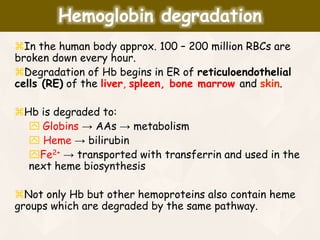
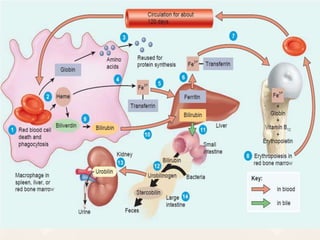
In the human body approx. 100 – 200 million RBCs are
broken down every hour.
Degradation of Hb begins in ER of reticuloendothelial
cells (RE) of the liver, spleen, bone marrow and skin.
Hb is degraded to:
 Globins → AAs → metabolism
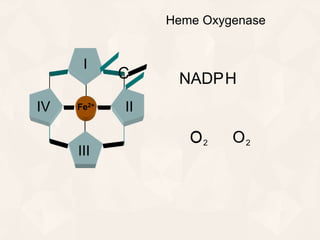
 Heme → bilirubin
Fe2+ → transported with transferrin and used in the
next heme biosynthesis
Not only Hb but other hemoproteins also contain heme
groups which are degraded by the same pathway.
Hemoglobin degradation
Breakdown of
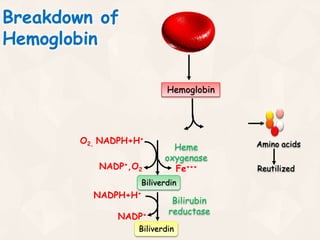
Hemoglobin
Heme globin
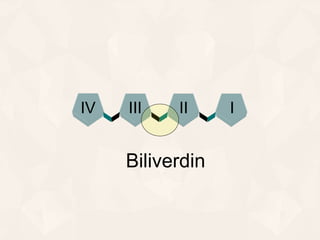
Biliverdin
Biliverdin
Amino acids
Reutilized
O2, NADPH+H+
NADP+,O2
NADPH+H+
NADP+
Heme
oxygenase
Bilirubin
reductase
Fe+++
Hemoglobin
I
II
III
IV Fe2+
NADPHC
O2O O2
Heme Oxygenase
O
IIIIIIIV
Biliverdin
NADPH
H
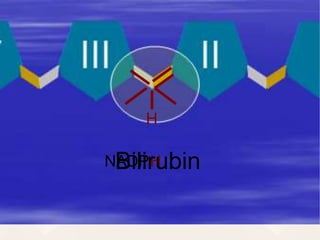
Bilirubin
250-300mg of bilirubin per day
Bilirubin is much less soluble in aqueous media
than biliverdin.
Potent anti-oxidant properties
The further metabolism (fate) & excretion of
bilirubin occurs in liver & intestine.
It can be divided into following process……
Uptake of bilirubin by liver cells
Conjugation of bilirubin in liver
Secretion of conj. Bilirubin into bile
Excretion of bilirubin (in feces & urine)
Fate of Bilirubin
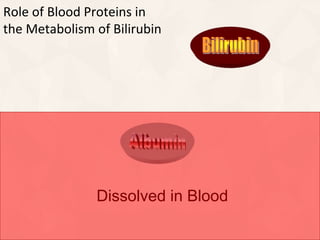
Role of Blood Proteins in
the Metabolism of Bilirubin
1. Albumin
Dissolved in Blood
Bilirubin transported to the liver by plasma
albumin.
In liver bilirubin binds to intracellular protein.
Uptake of bilirubin by liver cells
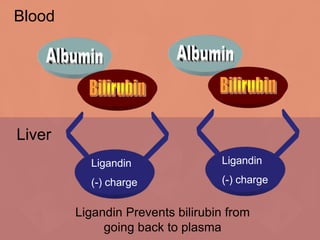
Blood
Liver
Ligandin
(-) charge
Ligandin
(-) charge
Ligandin Prevents bilirubin from
going back to plasma
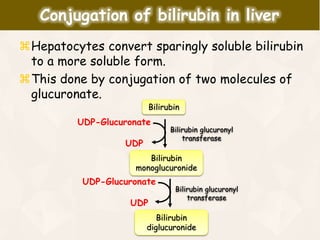
Hepatocytes convert sparingly soluble bilirubin
to a more soluble form.
This done by conjugation of two molecules of
glucuronate.
Conjugation of bilirubin in liver
Bilirubin
UDP-Glucuronate
UDP
Bilirubin glucuronyl
transferase
Bilirubin
monoglucuronide
UDP-Glucuronate
UDP
Bilirubin glucuronyl
transferase
Bilirubin
diglucuronide
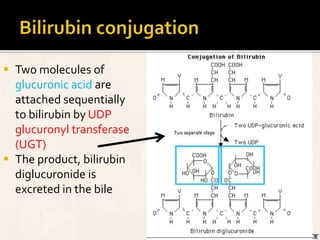
 Two molecules of
glucuronic acid are
attached sequentially
to bilirubin by UDP
glucuronyl transferase
(UGT)
 The product, bilirubin
diglucuronide is
excreted in the bile
Most conjugated bilirubin formed in the liver
secretes into bile by an active transport
process.
It is a rate limiting step for the hepatic
bilirubin metabolism.
Unconjugated bilirubin is not secreted into bile.
Secretion of bilirubin into bile
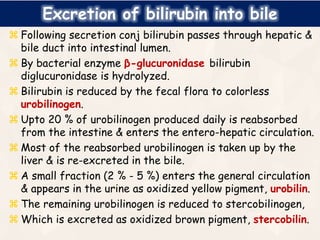
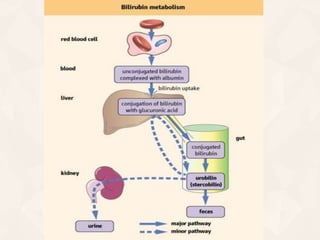
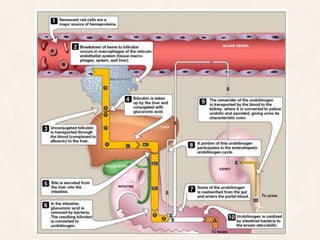
 Following secretion conj bilirubin passes through hepatic &
bile duct into intestinal lumen.
 By bacterial enzyme β-glucuronidase bilirubin
diglucuronidase is hydrolyzed.
 Bilirubin is reduced by the fecal flora to colorless
urobilinogen.
 Upto 20 % of urobilinogen produced daily is reabsorbed
from the intestine & enters the entero-hepatic circulation.
 Most of the reabsorbed urobilinogen is taken up by the
liver & is re-excreted in the bile.
 A small fraction (2 % - 5 %) enters the general circulation
& appears in the urine as oxidized yellow pigment, urobilin.
 The remaining urobilinogen is reduced to stercobilinogen,
 Which is excreted as oxidized brown pigment, stercobilin.
Excretion of bilirubin into bile
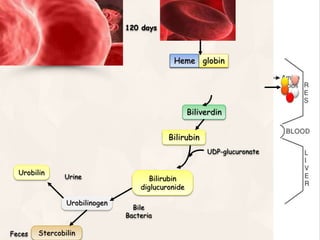
HemoglobinHeme globin
120 days
Biliverdin
Bilirubin
Bilirubin
diglucuronide
Urobilinogen
Urobilin
Stercobilin
UDP-glucuronate
Urine
Bile
Bacteria
Feces
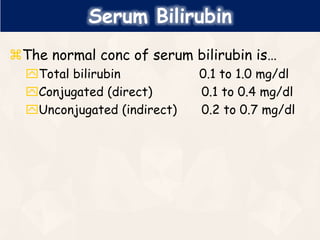
The normal conc of serum bilirubin is…
Total bilirubin 0.1 to 1.0 mg/dl
Conjugated (direct) 0.1 to 0.4 mg/dl
Unconjugated (indirect) 0.2 to 0.7 mg/dl
Serum Bilirubin
Any conditions that interfere with bilirubin
metabolism may cause a rise in its serum conc.
If bilirubin in the blood exceeds 3mg/dl, that
condition is called hyperbilirubinaemia.
Disorders of heme catabolism
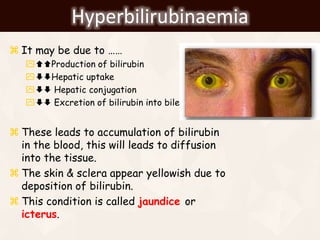
Hyperbilirubinaemia
 It may be due to ……
Production of bilirubin
Hepatic uptake
 Hepatic conjugation
 Excretion of bilirubin into bile
 These leads to accumulation of bilirubin
in the blood, this will leads to diffusion
into the tissue.
 The skin & sclera appear yellowish due to
deposition of bilirubin.
 This condition is called jaundice or
icterus.
Classification of
Hyperbilirubinaemia
Hyperbilirubinaemia may be……
Acquired
Inherited
Acquired Hyperbilirubinaemia, examples…
Hemolytic or prehepatic jaundice
Hepatocellular or Hepatic jaundice
Obstructive or posthepatic jaundice
Neonatal or physiological jaundice.
Inherited Hyperbilirubinaemia, examples…
Gilbert’s syndrome
Crigler Najjar syndrome
Dubin Johnson syndrome
Rotor syndrome
Classification of Jaundice
Hemolytic or prehepatic jaundice
Hepatocellular or Hepatic jaundice
Obstructive or posthepatic jaundice
Neonatal or physiological jaundice.
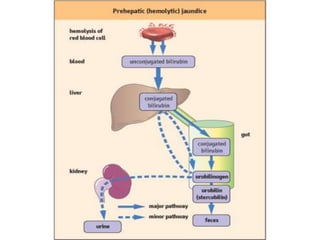
In this there is breakdown of hemoglobin to
bilirubin takes place.
The rate of bilirubin formation is more than the
ability of liver cell to conjugate bilirubin.
So, the levels of unconjugated bilirubin .
Excess hemolysis may be due to……
Sickle hemoglobin (Sickle cell anaemia)
Deficiency of G6-P dehydrogenase.
Incompatible blood transfusion.
Hemolytic or pre-hepatic Jaundice
Since the excess bilirubin is unconjugated, it is not
excretable in the urine.
The urine color is normal.
As more than normal amounts of bilirubin are
excreted into the intestine, resulting in amount
of urobilinogen in urine and faeces.
Biochemical picture in hemolytic jundice….
 serum unconjugated bilirubin
 amount of urobilinogen in urine and faeces
Absence of bilirubin in the urine.
Hemolytic or pre-hepatic Jaundice
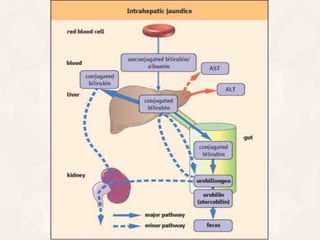
In this kind of jaundice, there is some disorder of
the liver cells or bile passages within the liver.
Hepatic cells damage impairs conjugation of bilirubin
and results in  serum unconjugated bilirubin.
Patients with jaundice due to hepatocellular damage
commonly have obstruction of the biliary tree within
the liver that results in the  serum conjugated
bilirubin.
The causes of hepatocellular damage are….
Infection (viral hepatitis)
Toxic chemicals (alcohol, chloroform,CCl4 etc)
Drugs
Cirrhosis.
Hepatocellular or Hepatic jaundice
Biochemical picture in hepatic jaundice….
 serum unconjugated & conjugated bilirubin
 amount of urobilinogen in urine and faeces
Presence of bilirubin in the urine.
 level of the SGPT (ALT).
Hepatocellular or Hepatic jaundice
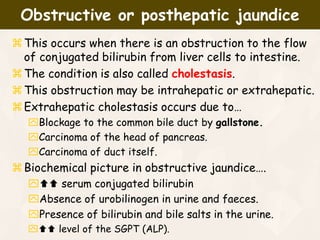
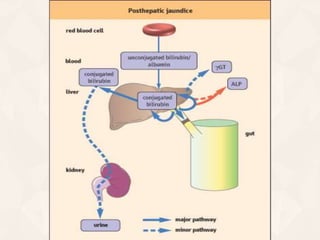
This occurs when there is an obstruction to the flow
of conjugated bilirubin from liver cells to intestine.
The condition is also called cholestasis.
This obstruction may be intrahepatic or extrahepatic.
Extrahepatic cholestasis occurs due to…
Blockage to the common bile duct by gallstone.
Carcinoma of the head of pancreas.
Carcinoma of duct itself.
Biochemical picture in obstructive jaundice….
 serum conjugated bilirubin
Absence of urobilinogen in urine and faeces.
Presence of bilirubin and bile salts in the urine.
 level of the SGPT (ALP).
Obstructive or posthepatic jaundice
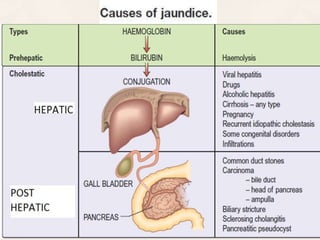
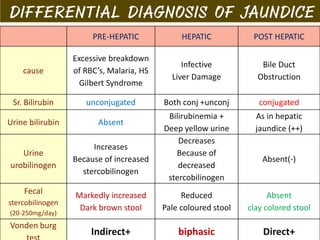
PRE-HEPATIC HEPATIC POST HEPATIC
cause
Excessive breakdown
of RBC’s, Malaria, HS
Gilbert Syndrome
Infective
Liver Damage
Bile Duct
Obstruction
Sr. Bilirubin unconjugated Both conj +unconj conjugated
Urine bilirubin Absent
Bilirubinemia +
Deep yellow urine
As in hepatic
jaundice (++)
Urine
urobilinogen
Increases
Because of increased
stercobilinogen
Decreases
Because of
decreased
stercobilinogen
Absent(-)
Fecal
stercobilinogen
(20-250mg/day)
Markedly increased
Dark brown stool
Reduced
Pale coloured stool
Absent
clay colored stool
Vonden burg
Indirect+ biphasic Direct+
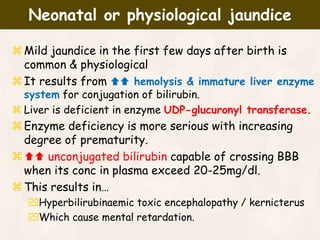
Mild jaundice in the first few days after birth is
common & physiological
It results from  hemolysis & immature liver enzyme
system for conjugation of bilirubin.
 Liver is deficient in enzyme UDP-glucuronyl transferase.
Enzyme deficiency is more serious with increasing
degree of prematurity.
 unconjugated bilirubin capable of crossing BBB
when its conc in plasma exceed 20-25mg/dl.
This results in…
Hyperbilirubinaemic toxic encephalopathy / kernicterus
Which cause mental retardation.
Neonatal or physiological jaundice
 If bilirubin levels are judged to be too high, then
phototherapy with UV light is used to convert it to a
water soluble, non-toxic form.
 If necessary, exchange blood transfusion is used to
remove excess bilirubin
 Phenobarbital is oftentimes administered to Mom
prior to an induced labor of a premature infant –
crosses the placenta and induces the synthesis of
UDP glucuronyl transferase
 Jaundice within the first 24 hrs of life or which
takes longer then 10 days to resolve is usually
pathological and needs to be further investigated
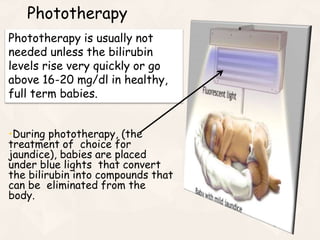
Phototherapy
•During phototherapy, (the
treatment of choice for
jaundice), babies are placed
under blue lights that convert
the bilirubin into compounds that
can be eliminated from the
body.
Phototherapy is usually not
needed unless the bilirubin
levels rise very quickly or go
above 16-20 mg/dl in healthy,
full term babies.
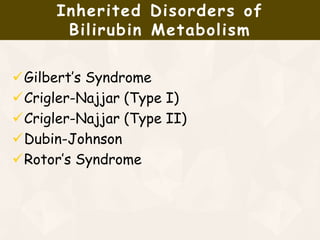
Gilbert’s Syndrome
Crigler-Najjar (Type I)
Crigler-Najjar (Type II)
Dubin-Johnson
Rotor’s Syndrome
Inherited Disorders of
Bilirubin Metabolism
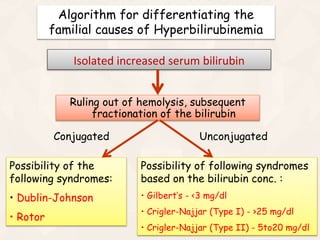
Isolated increased serum bilirubin
Ruling out of hemolysis, subsequent
fractionation of the bilirubin
Possibility of the
following syndromes:
• Dublin-Johnson
• Rotor
Possibility of following syndromes
based on the bilirubin conc. :
• Gilbert’s - <3 mg/dl
• Crigler-Najjar (Type I) - >25 mg/dl
• Crigler-Najjar (Type II) - 5to20 mg/dl
Algorithm for differentiating the
familial causes of Hyperbilirubinemia
Conjugated Unconjugated
 Autosomal recessive diseases
 Deficiency of hepatic glucuronyl transferase enzyme.
 Significant elevation of unconjugated bilirubin in serum
 Type 1
▪ No bilirubin glucuronidation (complete absence of enzyme)
▪ It causes sever jaundice and early death.
 Type 2 (rare)
▪ Some bilirubin glucuronidation (partial absence of enzyme)
▪ Less sever.
 Mild elevation of unconjugated bilirubin in serum.
 Impaired hepatic uptake of bilirubin &
 Reduced activity of UDP-glucuronyl transferase.
 Could cause neonatal jaundice
 Could result in kernicterus, brain damage due to
high bilirubin concentrations, with overt
hemolysis
 It is a benign (harmless), autosomal recessive
condition
 Characterized by jaundice with
 predominantly elevated conjugated bilirubin and
 a minor elevation of unconjugated bilirubin.
 Defective hepatic secretion of conjugated
bilirubin into bile.
 The Liver has a characteristic greenish black
pigment in hepatocytes.
 Imparting a dark brown to black colour to the
liver.
 It is another form of conjugated
hyperbilirubinemia.
 It is similar to dubin-johnson syndrome but
without pigmentation in liver.
….

Heme Degradation and Jaundice

  • 1.
  • 2.
    In the humanbody approx. 100 – 200 million RBCs are broken down every hour. Degradation of Hb begins in ER of reticuloendothelial cells (RE) of the liver, spleen, bone marrow and skin. Hb is degraded to:  Globins → AAs → metabolism  Heme → bilirubin Fe2+ → transported with transferrin and used in the next heme biosynthesis Not only Hb but other hemoproteins also contain heme groups which are degraded by the same pathway. Hemoglobin degradation
  • 3.
    Breakdown of Hemoglobin Heme globin Biliverdin Biliverdin Aminoacids Reutilized O2, NADPH+H+ NADP+,O2 NADPH+H+ NADP+ Heme oxygenase Bilirubin reductase Fe+++ Hemoglobin
  • 5.
  • 6.
  • 7.
  • 8.
    250-300mg of bilirubinper day Bilirubin is much less soluble in aqueous media than biliverdin. Potent anti-oxidant properties The further metabolism (fate) & excretion of bilirubin occurs in liver & intestine. It can be divided into following process…… Uptake of bilirubin by liver cells Conjugation of bilirubin in liver Secretion of conj. Bilirubin into bile Excretion of bilirubin (in feces & urine) Fate of Bilirubin
  • 9.
    Role of BloodProteins in the Metabolism of Bilirubin 1. Albumin Dissolved in Blood
  • 10.
    Bilirubin transported tothe liver by plasma albumin. In liver bilirubin binds to intracellular protein. Uptake of bilirubin by liver cells
  • 11.
    Blood Liver Ligandin (-) charge Ligandin (-) charge LigandinPrevents bilirubin from going back to plasma
  • 12.
    Hepatocytes convert sparinglysoluble bilirubin to a more soluble form. This done by conjugation of two molecules of glucuronate. Conjugation of bilirubin in liver Bilirubin UDP-Glucuronate UDP Bilirubin glucuronyl transferase Bilirubin monoglucuronide UDP-Glucuronate UDP Bilirubin glucuronyl transferase Bilirubin diglucuronide
  • 13.
     Two moleculesof glucuronic acid are attached sequentially to bilirubin by UDP glucuronyl transferase (UGT)  The product, bilirubin diglucuronide is excreted in the bile
  • 14.
    Most conjugated bilirubinformed in the liver secretes into bile by an active transport process. It is a rate limiting step for the hepatic bilirubin metabolism. Unconjugated bilirubin is not secreted into bile. Secretion of bilirubin into bile
  • 15.
     Following secretionconj bilirubin passes through hepatic & bile duct into intestinal lumen.  By bacterial enzyme β-glucuronidase bilirubin diglucuronidase is hydrolyzed.  Bilirubin is reduced by the fecal flora to colorless urobilinogen.  Upto 20 % of urobilinogen produced daily is reabsorbed from the intestine & enters the entero-hepatic circulation.  Most of the reabsorbed urobilinogen is taken up by the liver & is re-excreted in the bile.  A small fraction (2 % - 5 %) enters the general circulation & appears in the urine as oxidized yellow pigment, urobilin.  The remaining urobilinogen is reduced to stercobilinogen,  Which is excreted as oxidized brown pigment, stercobilin. Excretion of bilirubin into bile
  • 17.
  • 20.
    The normal concof serum bilirubin is… Total bilirubin 0.1 to 1.0 mg/dl Conjugated (direct) 0.1 to 0.4 mg/dl Unconjugated (indirect) 0.2 to 0.7 mg/dl Serum Bilirubin
  • 21.
    Any conditions thatinterfere with bilirubin metabolism may cause a rise in its serum conc. If bilirubin in the blood exceeds 3mg/dl, that condition is called hyperbilirubinaemia. Disorders of heme catabolism
  • 22.
    Hyperbilirubinaemia  It maybe due to …… Production of bilirubin Hepatic uptake  Hepatic conjugation  Excretion of bilirubin into bile  These leads to accumulation of bilirubin in the blood, this will leads to diffusion into the tissue.  The skin & sclera appear yellowish due to deposition of bilirubin.  This condition is called jaundice or icterus.
  • 24.
    Classification of Hyperbilirubinaemia Hyperbilirubinaemia maybe…… Acquired Inherited Acquired Hyperbilirubinaemia, examples… Hemolytic or prehepatic jaundice Hepatocellular or Hepatic jaundice Obstructive or posthepatic jaundice Neonatal or physiological jaundice. Inherited Hyperbilirubinaemia, examples… Gilbert’s syndrome Crigler Najjar syndrome Dubin Johnson syndrome Rotor syndrome
  • 25.
    Classification of Jaundice Hemolyticor prehepatic jaundice Hepatocellular or Hepatic jaundice Obstructive or posthepatic jaundice Neonatal or physiological jaundice.
  • 26.
    In this thereis breakdown of hemoglobin to bilirubin takes place. The rate of bilirubin formation is more than the ability of liver cell to conjugate bilirubin. So, the levels of unconjugated bilirubin . Excess hemolysis may be due to…… Sickle hemoglobin (Sickle cell anaemia) Deficiency of G6-P dehydrogenase. Incompatible blood transfusion. Hemolytic or pre-hepatic Jaundice
  • 27.
    Since the excessbilirubin is unconjugated, it is not excretable in the urine. The urine color is normal. As more than normal amounts of bilirubin are excreted into the intestine, resulting in amount of urobilinogen in urine and faeces. Biochemical picture in hemolytic jundice….  serum unconjugated bilirubin  amount of urobilinogen in urine and faeces Absence of bilirubin in the urine. Hemolytic or pre-hepatic Jaundice
  • 29.
    In this kindof jaundice, there is some disorder of the liver cells or bile passages within the liver. Hepatic cells damage impairs conjugation of bilirubin and results in  serum unconjugated bilirubin. Patients with jaundice due to hepatocellular damage commonly have obstruction of the biliary tree within the liver that results in the  serum conjugated bilirubin. The causes of hepatocellular damage are…. Infection (viral hepatitis) Toxic chemicals (alcohol, chloroform,CCl4 etc) Drugs Cirrhosis. Hepatocellular or Hepatic jaundice
  • 30.
    Biochemical picture inhepatic jaundice….  serum unconjugated & conjugated bilirubin  amount of urobilinogen in urine and faeces Presence of bilirubin in the urine.  level of the SGPT (ALT). Hepatocellular or Hepatic jaundice
  • 32.
    This occurs whenthere is an obstruction to the flow of conjugated bilirubin from liver cells to intestine. The condition is also called cholestasis. This obstruction may be intrahepatic or extrahepatic. Extrahepatic cholestasis occurs due to… Blockage to the common bile duct by gallstone. Carcinoma of the head of pancreas. Carcinoma of duct itself. Biochemical picture in obstructive jaundice….  serum conjugated bilirubin Absence of urobilinogen in urine and faeces. Presence of bilirubin and bile salts in the urine.  level of the SGPT (ALP). Obstructive or posthepatic jaundice
  • 34.
    PRE-HEPATIC HEPATIC POSTHEPATIC cause Excessive breakdown of RBC’s, Malaria, HS Gilbert Syndrome Infective Liver Damage Bile Duct Obstruction Sr. Bilirubin unconjugated Both conj +unconj conjugated Urine bilirubin Absent Bilirubinemia + Deep yellow urine As in hepatic jaundice (++) Urine urobilinogen Increases Because of increased stercobilinogen Decreases Because of decreased stercobilinogen Absent(-) Fecal stercobilinogen (20-250mg/day) Markedly increased Dark brown stool Reduced Pale coloured stool Absent clay colored stool Vonden burg Indirect+ biphasic Direct+
  • 35.
    Mild jaundice inthe first few days after birth is common & physiological It results from  hemolysis & immature liver enzyme system for conjugation of bilirubin.  Liver is deficient in enzyme UDP-glucuronyl transferase. Enzyme deficiency is more serious with increasing degree of prematurity.  unconjugated bilirubin capable of crossing BBB when its conc in plasma exceed 20-25mg/dl. This results in… Hyperbilirubinaemic toxic encephalopathy / kernicterus Which cause mental retardation. Neonatal or physiological jaundice
  • 36.
     If bilirubinlevels are judged to be too high, then phototherapy with UV light is used to convert it to a water soluble, non-toxic form.  If necessary, exchange blood transfusion is used to remove excess bilirubin  Phenobarbital is oftentimes administered to Mom prior to an induced labor of a premature infant – crosses the placenta and induces the synthesis of UDP glucuronyl transferase  Jaundice within the first 24 hrs of life or which takes longer then 10 days to resolve is usually pathological and needs to be further investigated
  • 37.
    Phototherapy •During phototherapy, (the treatmentof choice for jaundice), babies are placed under blue lights that convert the bilirubin into compounds that can be eliminated from the body. Phototherapy is usually not needed unless the bilirubin levels rise very quickly or go above 16-20 mg/dl in healthy, full term babies.
  • 38.
    Gilbert’s Syndrome Crigler-Najjar (TypeI) Crigler-Najjar (Type II) Dubin-Johnson Rotor’s Syndrome Inherited Disorders of Bilirubin Metabolism
  • 39.
    Isolated increased serumbilirubin Ruling out of hemolysis, subsequent fractionation of the bilirubin Possibility of the following syndromes: • Dublin-Johnson • Rotor Possibility of following syndromes based on the bilirubin conc. : • Gilbert’s - <3 mg/dl • Crigler-Najjar (Type I) - >25 mg/dl • Crigler-Najjar (Type II) - 5to20 mg/dl Algorithm for differentiating the familial causes of Hyperbilirubinemia Conjugated Unconjugated
  • 40.
     Autosomal recessivediseases  Deficiency of hepatic glucuronyl transferase enzyme.  Significant elevation of unconjugated bilirubin in serum  Type 1 ▪ No bilirubin glucuronidation (complete absence of enzyme) ▪ It causes sever jaundice and early death.  Type 2 (rare) ▪ Some bilirubin glucuronidation (partial absence of enzyme) ▪ Less sever.
  • 41.
     Mild elevationof unconjugated bilirubin in serum.  Impaired hepatic uptake of bilirubin &  Reduced activity of UDP-glucuronyl transferase.  Could cause neonatal jaundice  Could result in kernicterus, brain damage due to high bilirubin concentrations, with overt hemolysis
  • 42.
     It isa benign (harmless), autosomal recessive condition  Characterized by jaundice with  predominantly elevated conjugated bilirubin and  a minor elevation of unconjugated bilirubin.  Defective hepatic secretion of conjugated bilirubin into bile.  The Liver has a characteristic greenish black pigment in hepatocytes.  Imparting a dark brown to black colour to the liver.
  • 43.
     It isanother form of conjugated hyperbilirubinemia.  It is similar to dubin-johnson syndrome but without pigmentation in liver.
  • 44.