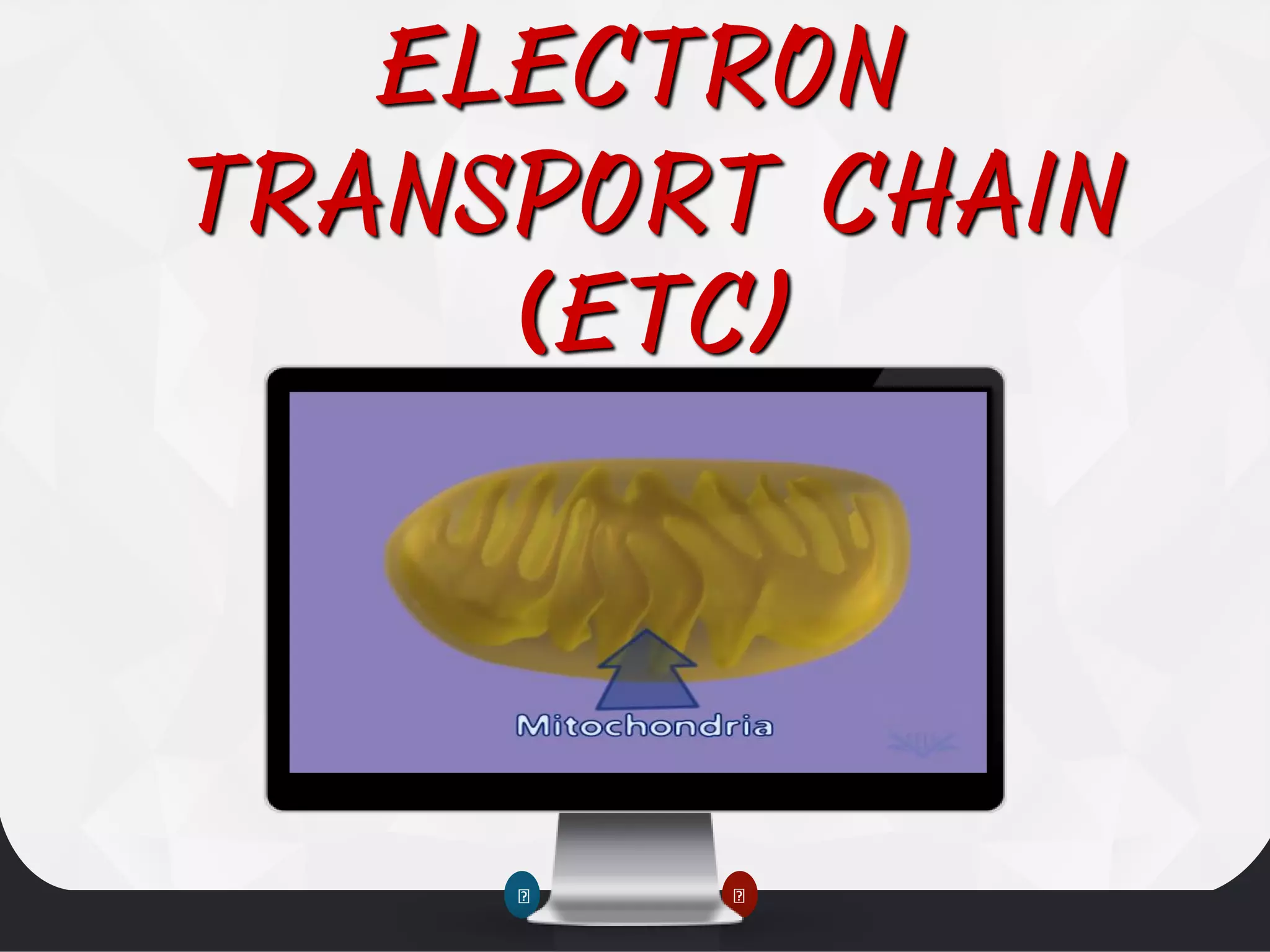
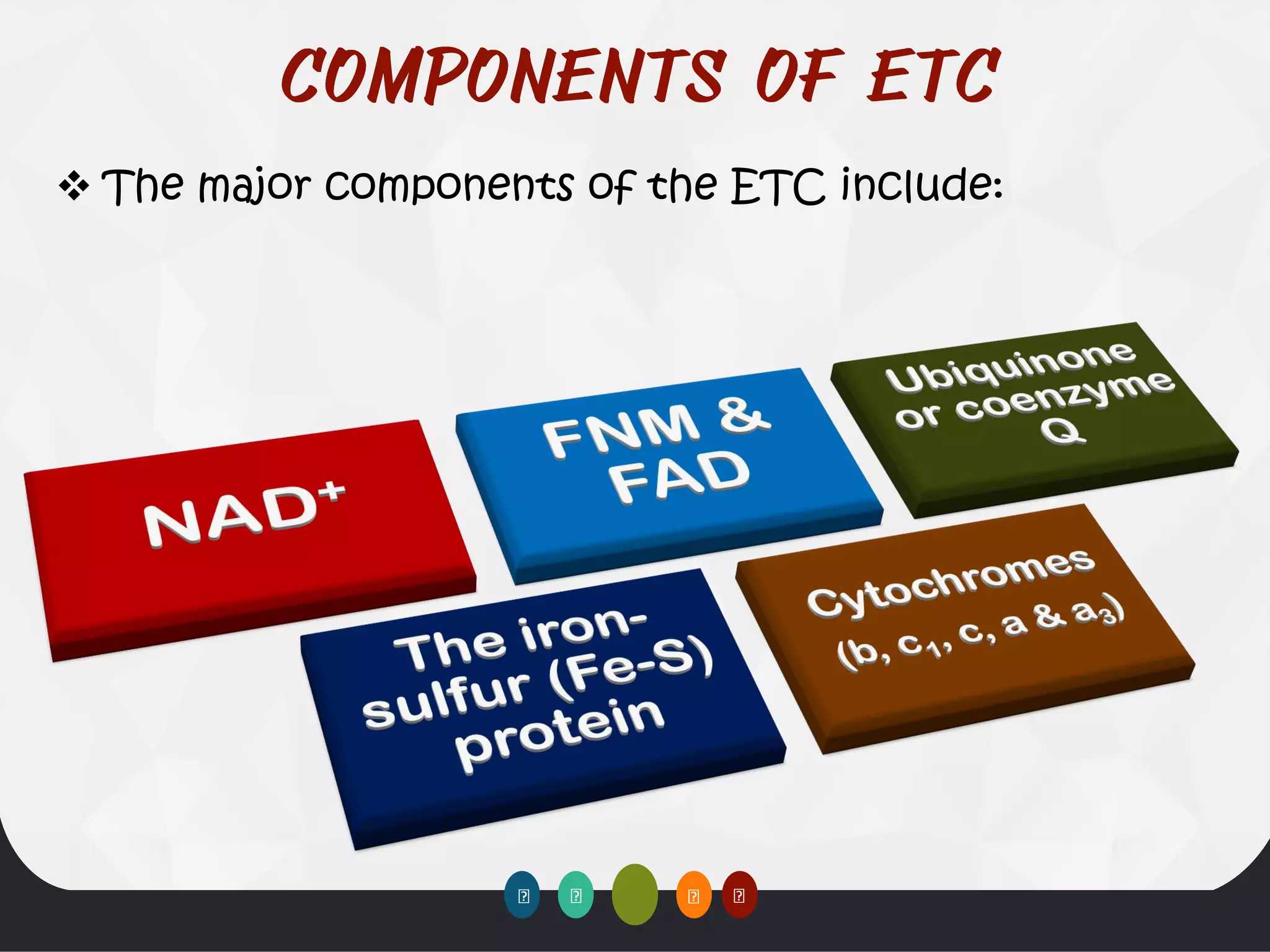

Biological oxidation (part - II) Electron Transport Chain - ETC
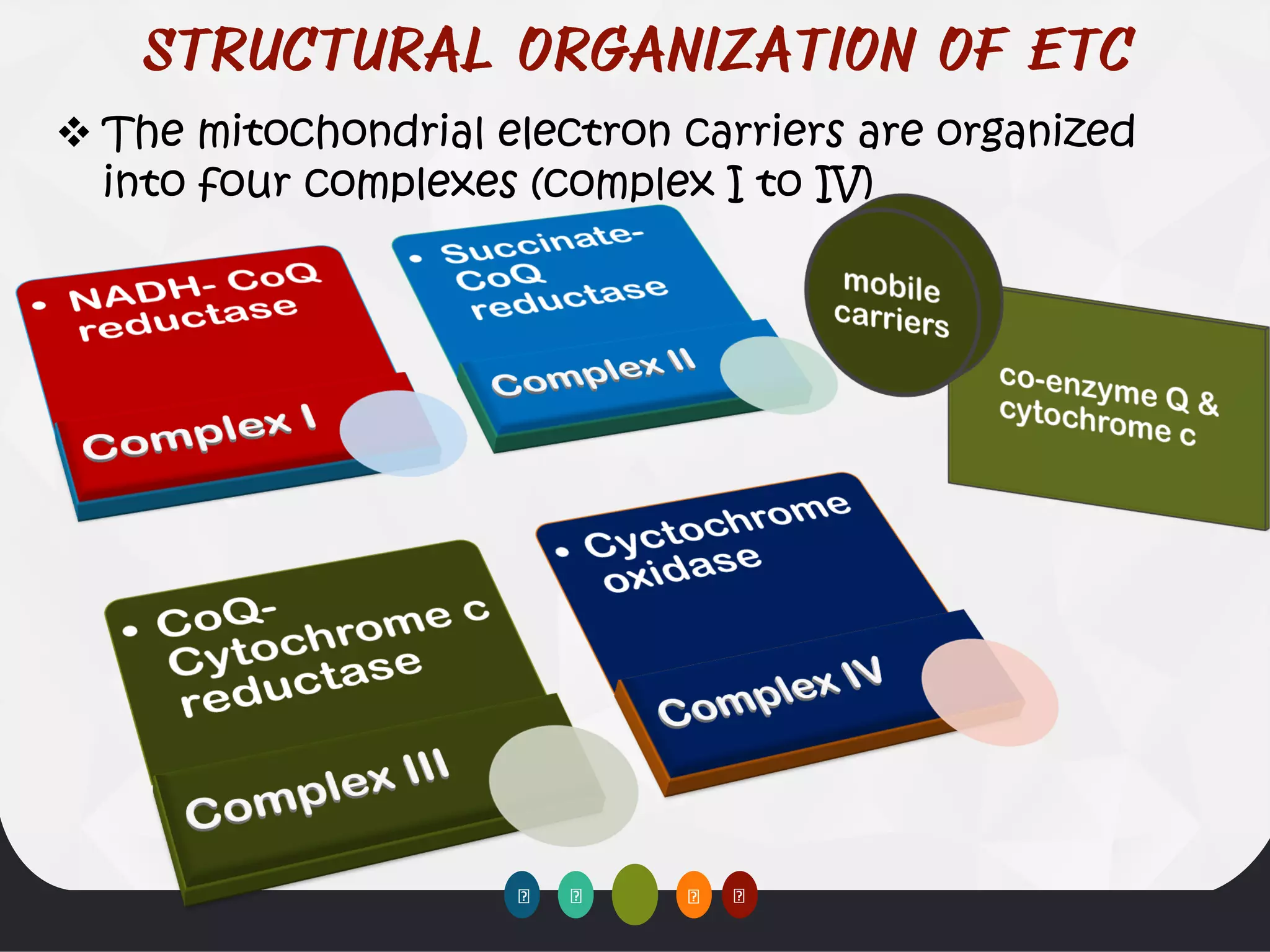
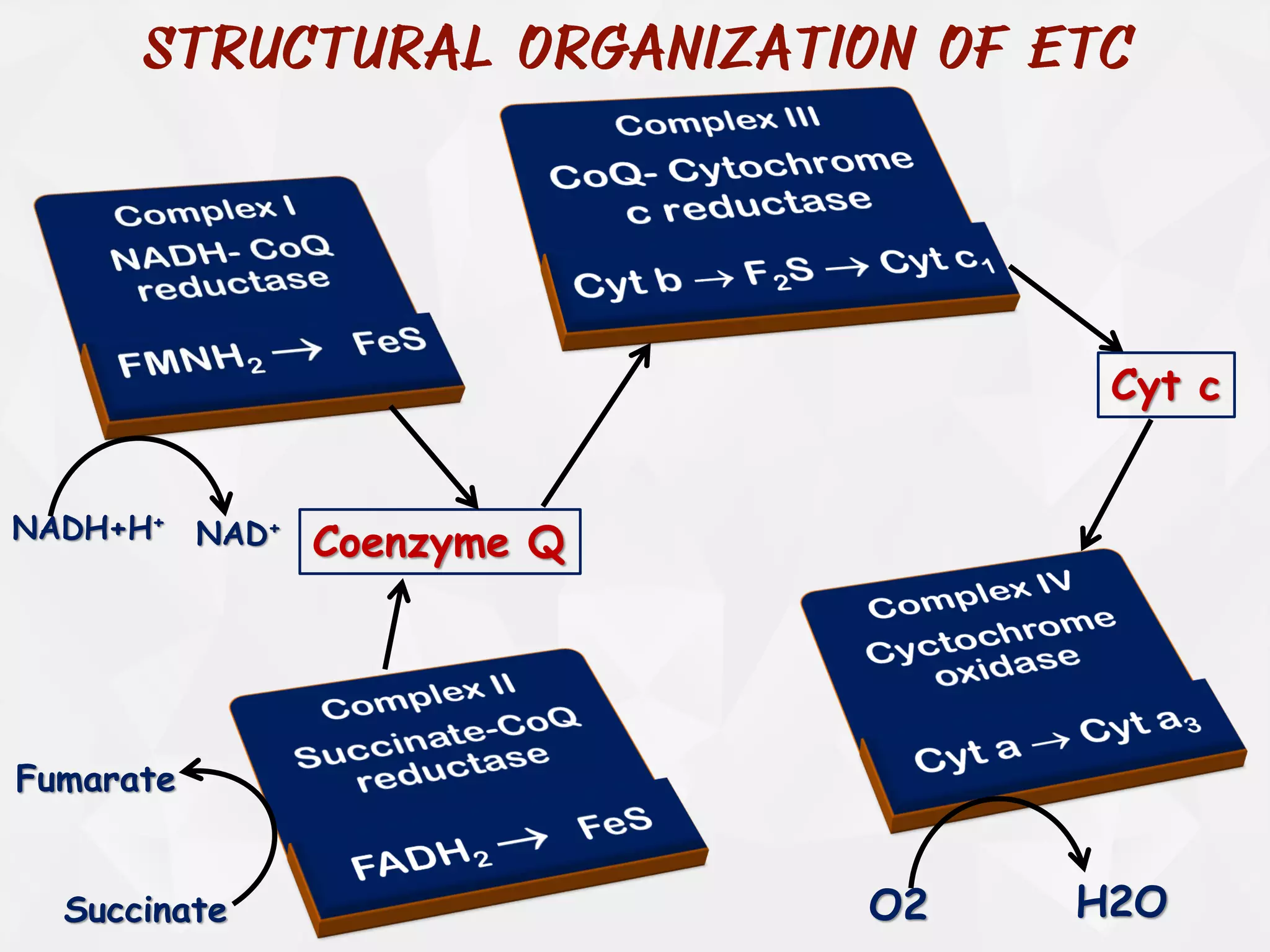
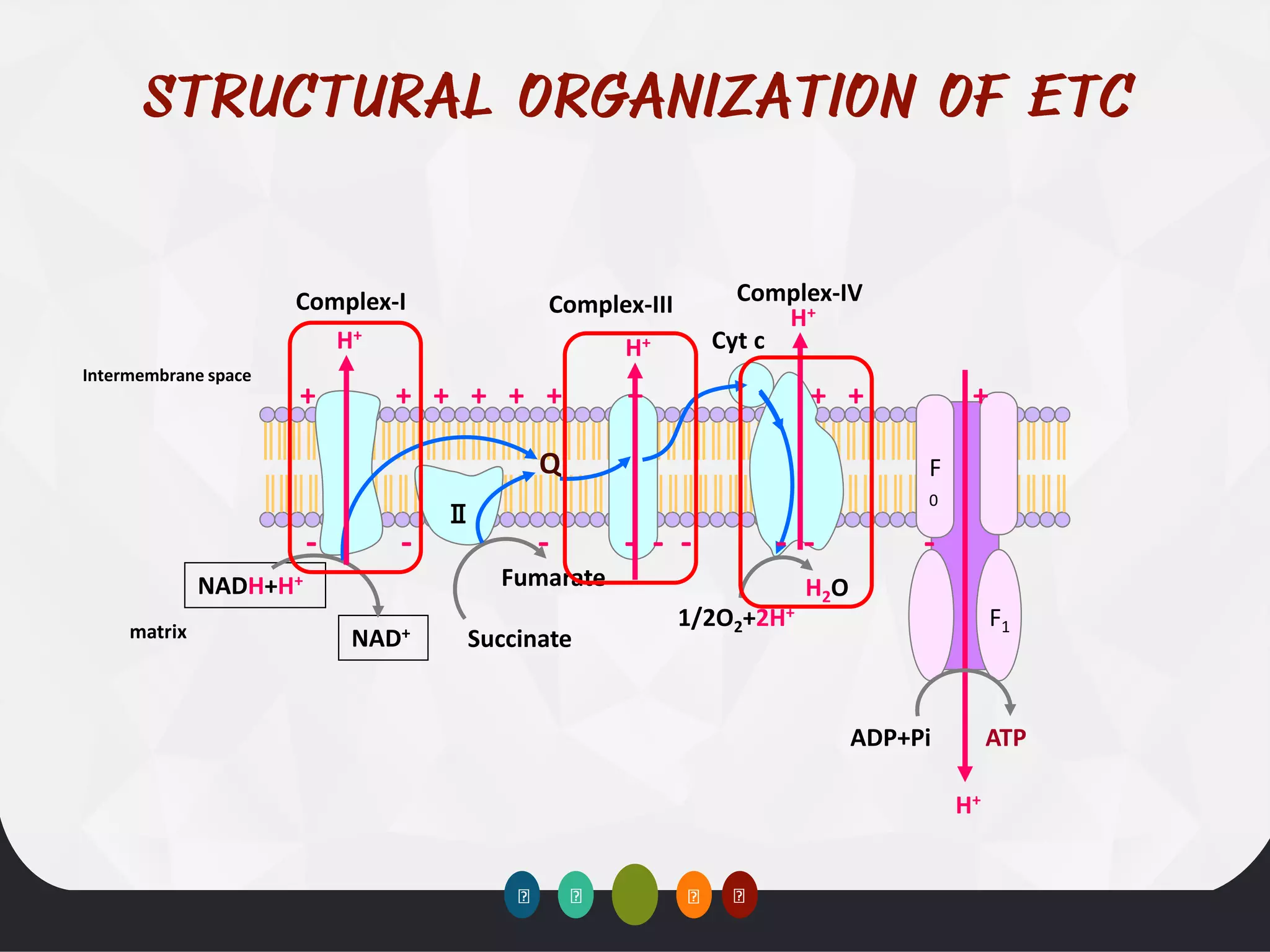
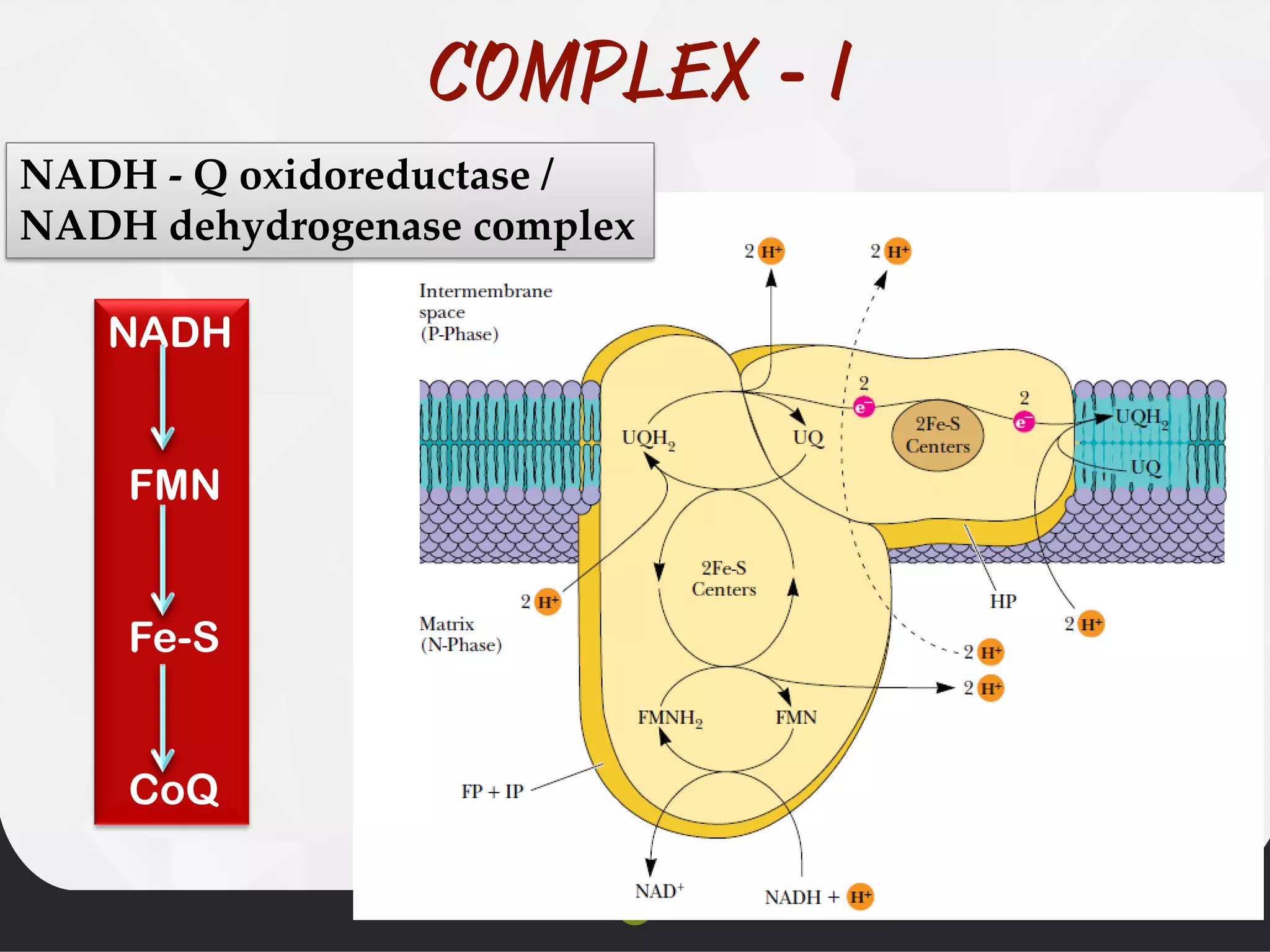
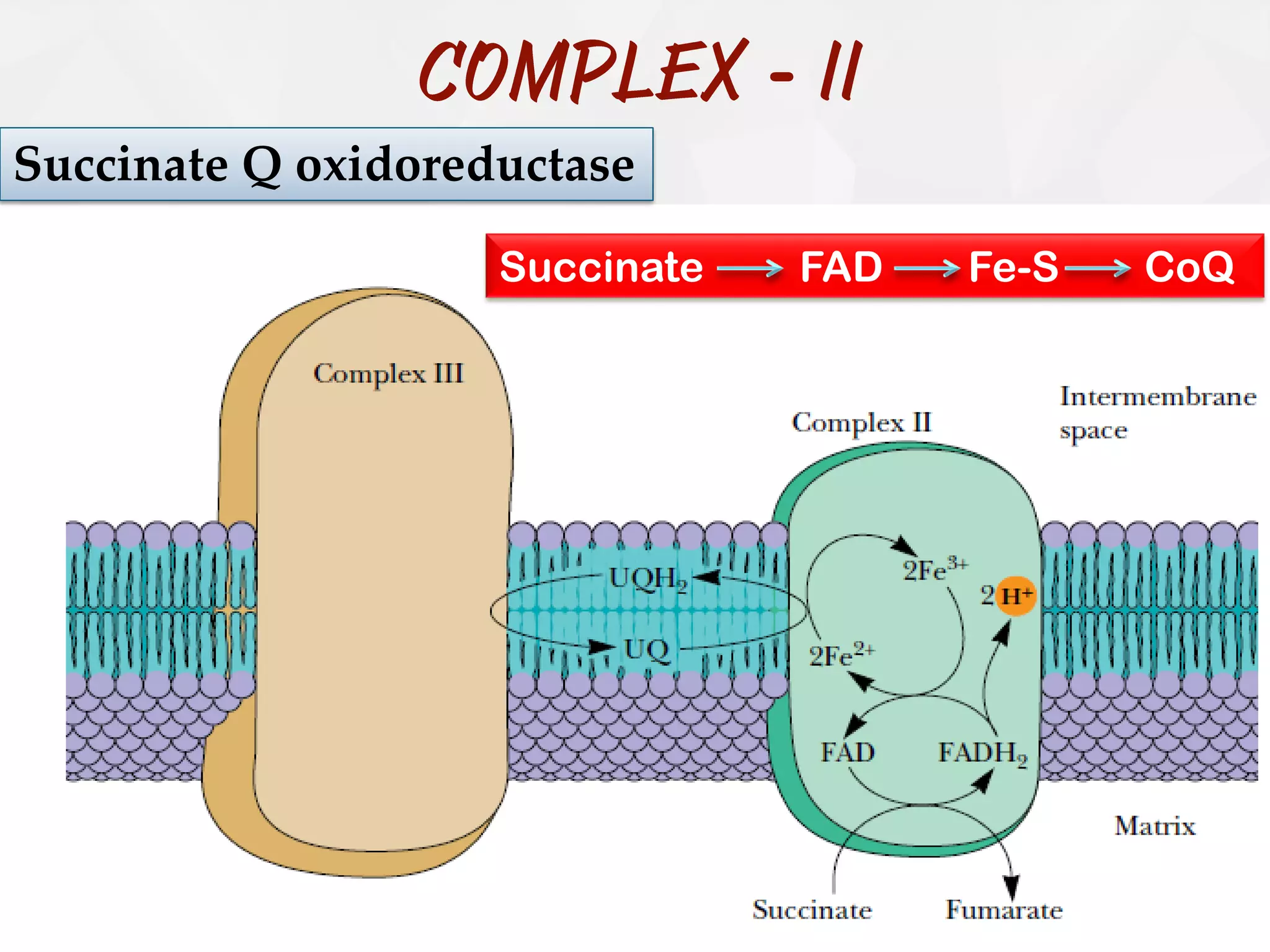
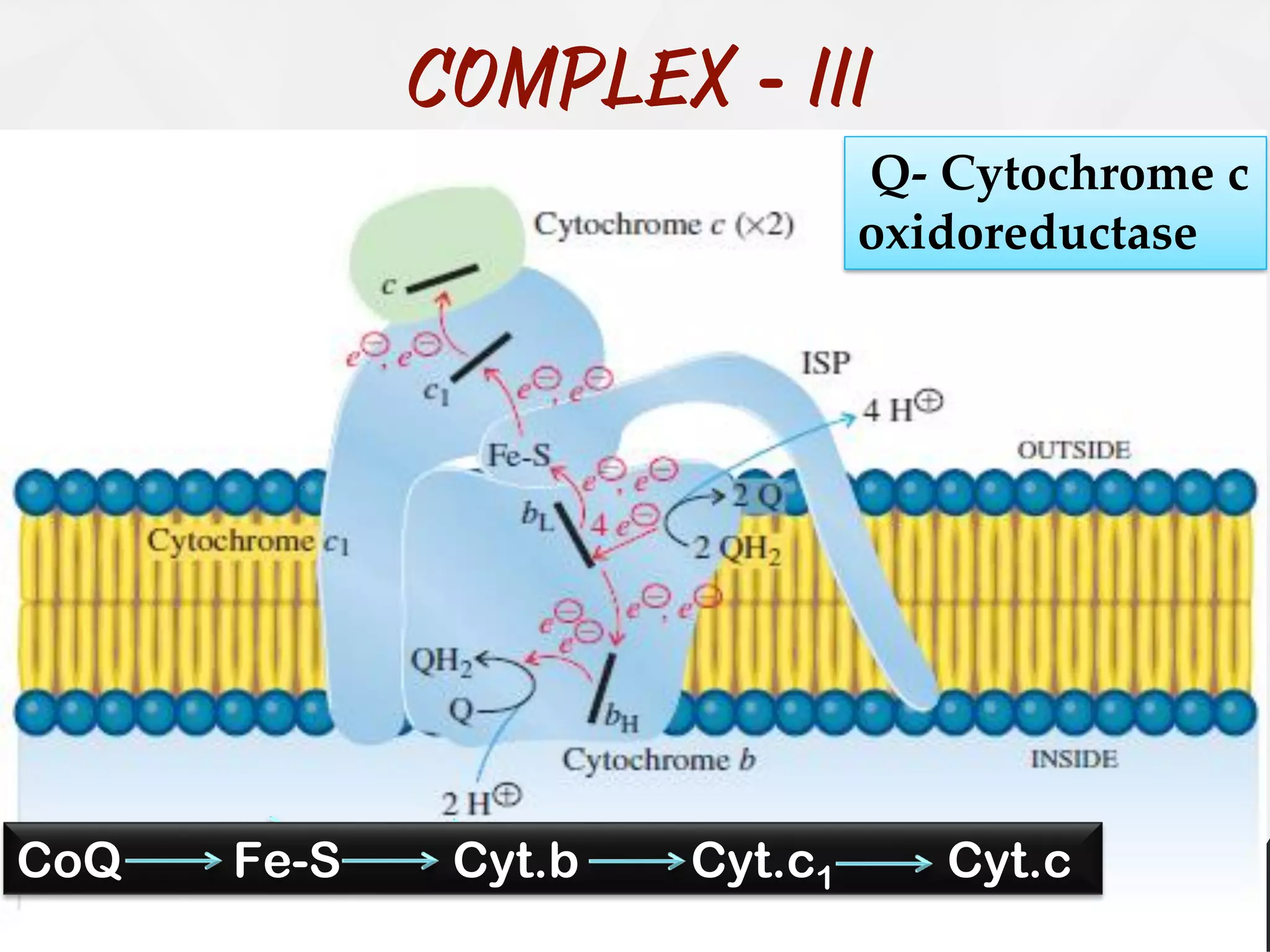
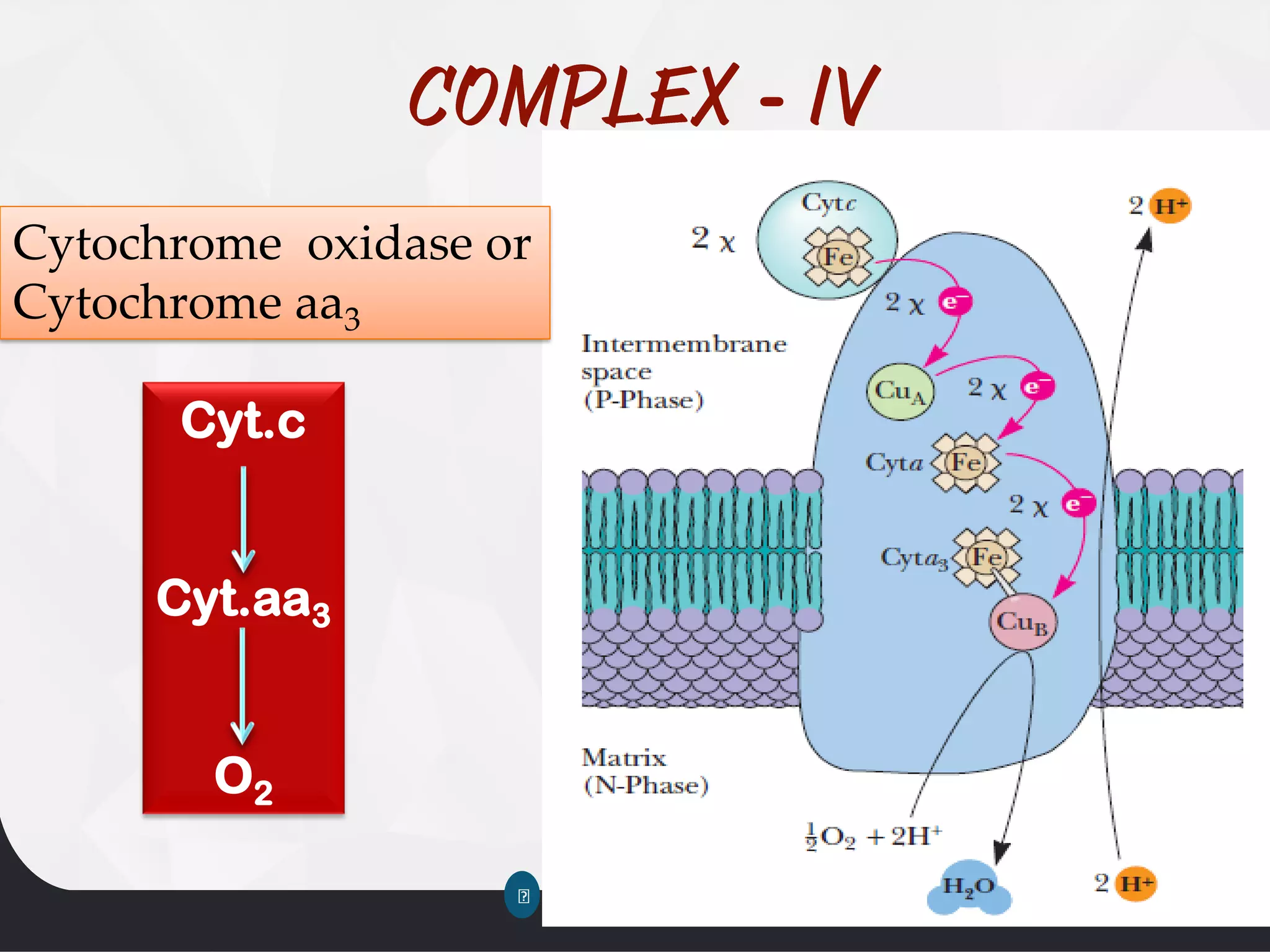
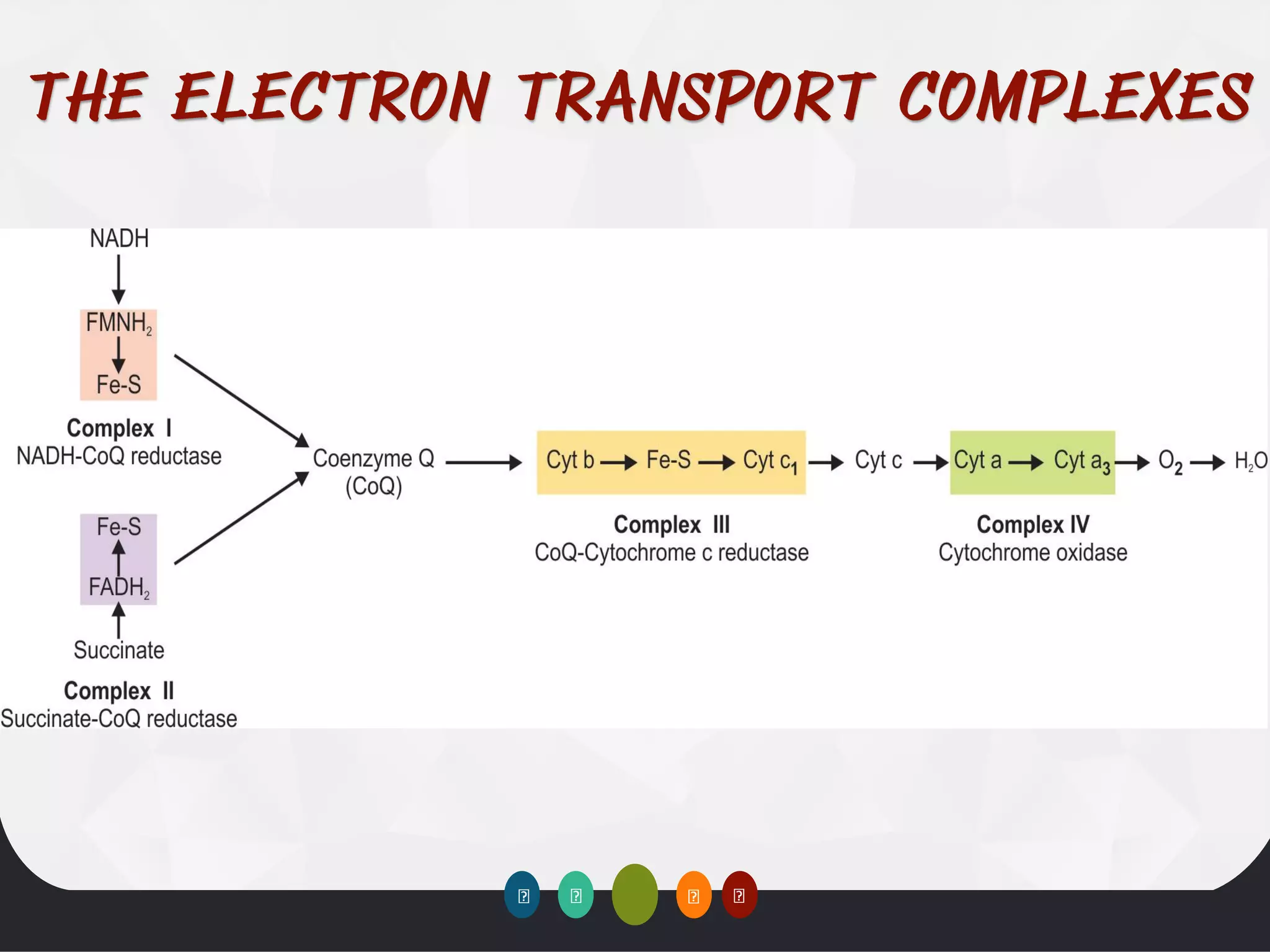
The document discusses enzymes involved in oxidation-reduction reactions and the electron transport chain. It describes several types of oxidoreductases including oxidases, dehydrogenases, hydroperoxidases, and oxygenases. It also discusses the coenzymes NAD+, NADP+, FMN, and FAD. The electron transport chain consists of four complexes embedded in the inner mitochondrial membrane that shuttle electrons from NADH and FADH2 to oxygen via electron carriers. This establishes a proton gradient used by ATP synthase to generate ATP from ADP and inorganic phosphate.
& -
❑These arecalled Oxidoreductases which include
❑Oxidases use oxygen as an electron acceptor
❑Dehydrogenases can’t use O2 as an electron acceptor
❑Hydroperoxidases use H2O2 as a substrate
❑Oxygenases catalyze direct transfer of O2 into substrate
❑Coenzymes involved in biological oxidation are…
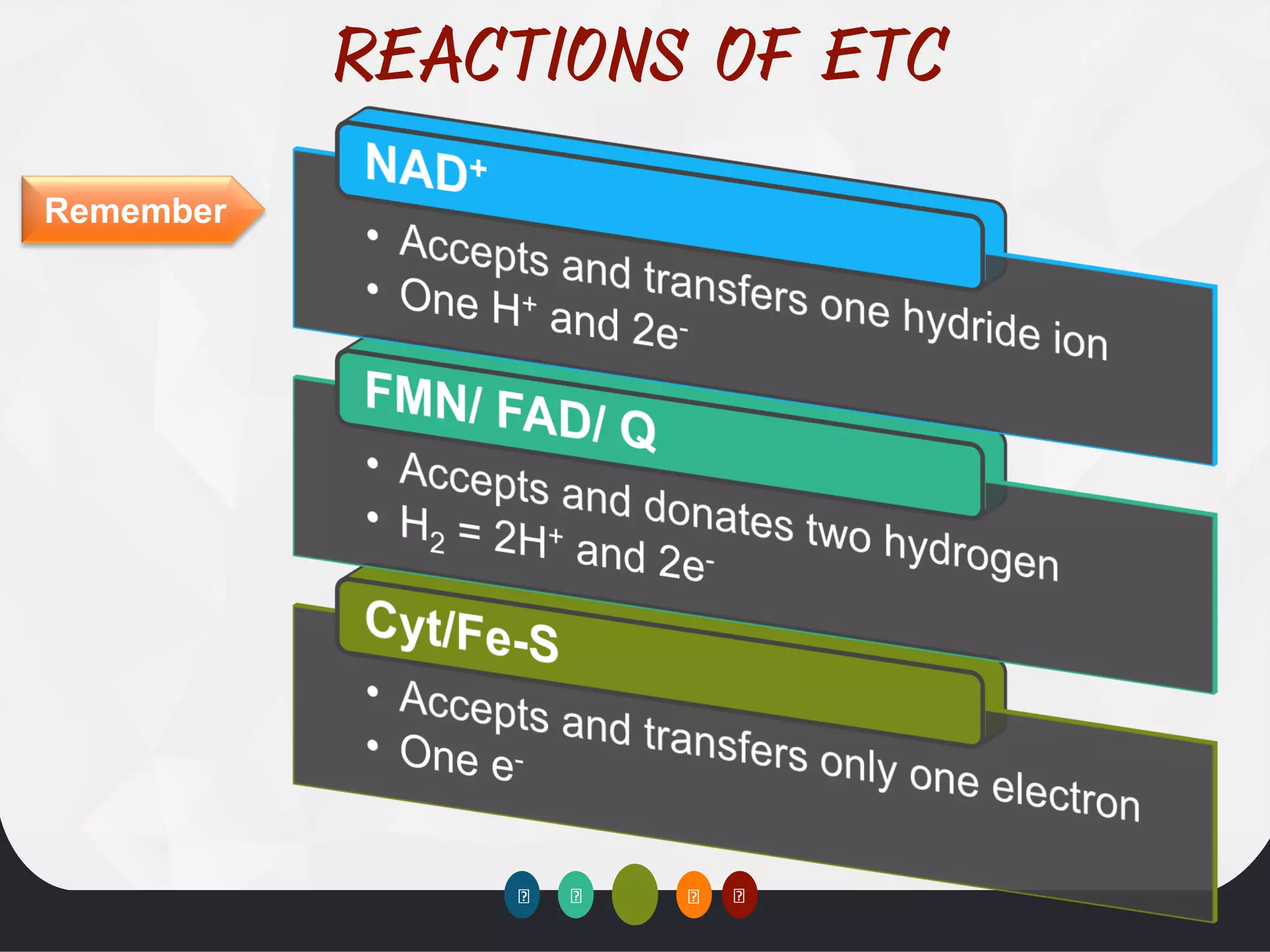
❑Nicotinamide adenine dinucleotide (NAD+)
❑Nicotinamide adenine dinucleotide phosphate (NADP+)
❑Flavin mononucleotide (FMN)
❑Flavin adenine dinucleotide (FAD).
5.
OXIDASES
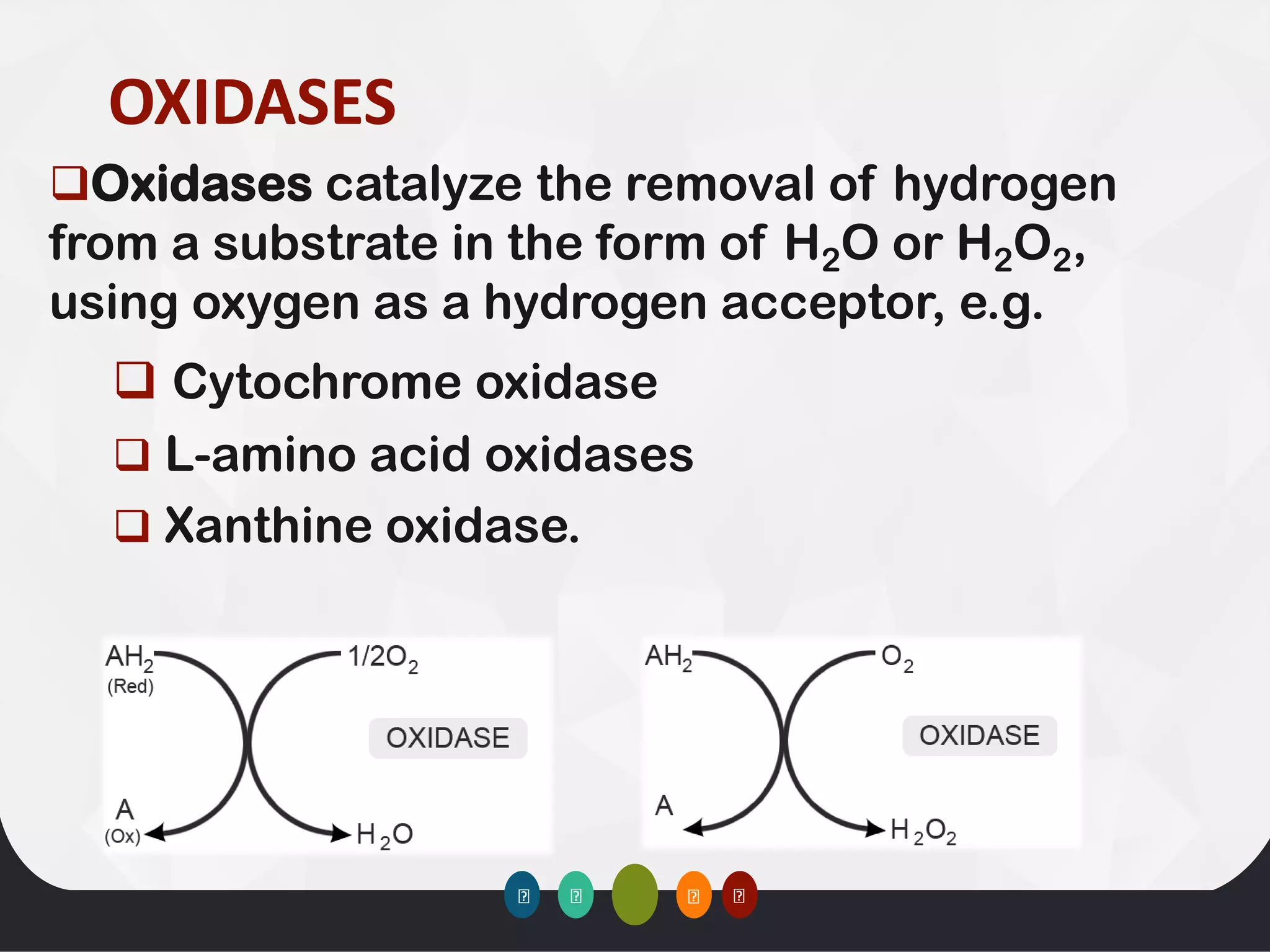
❑Oxidases catalyze theremoval of hydrogen
from a substrate in the form of H2O or H2O2,
using oxygen as a hydrogen acceptor, e.g.
❑ Cytochrome oxidase
❑ L-amino acid oxidases
❑ Xanthine oxidase.
6.
❑Exist in twodifferent forms :
❑some of them are copper containing such as,
❑Cytochrome oxidase, (the terminal component of
ETC which transfer the e - finally to O2.)
❑Other are flavoproteins such as,
❑L – amino acid oxidase (FMN linked) and
❑Xanthine oxidase (FAD linked)
7.
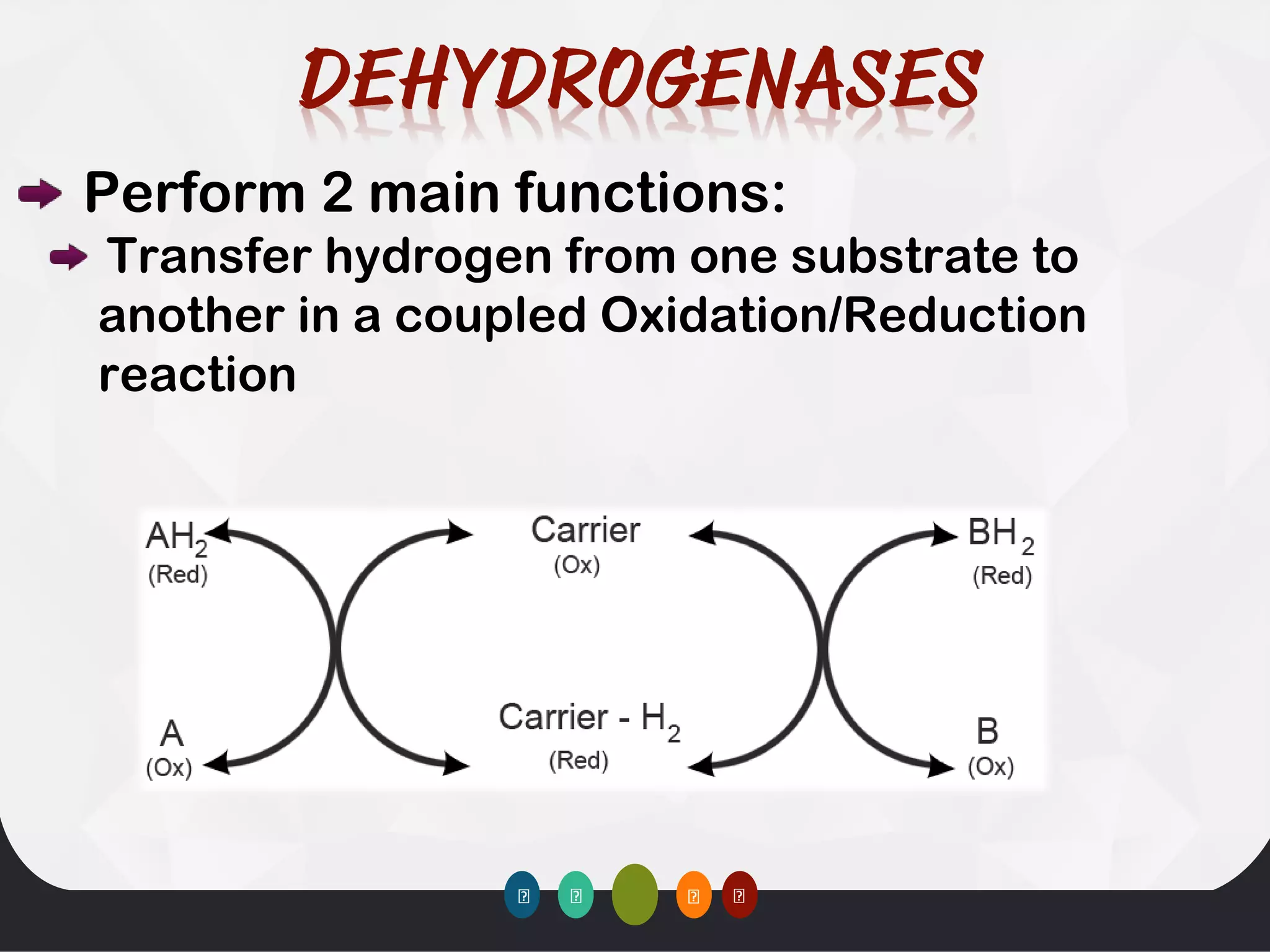
Perform 2 mainfunctions:
Transfer hydrogen from one substrate to
another in a coupled Oxidation/Reduction
reaction
8.
❑As components ofETC such as
cytochromes Dehydrogenases &
Use following coenzymes as hydrogen
carriers
NAD+ or NADP+ &
FMN or FAD -
9.
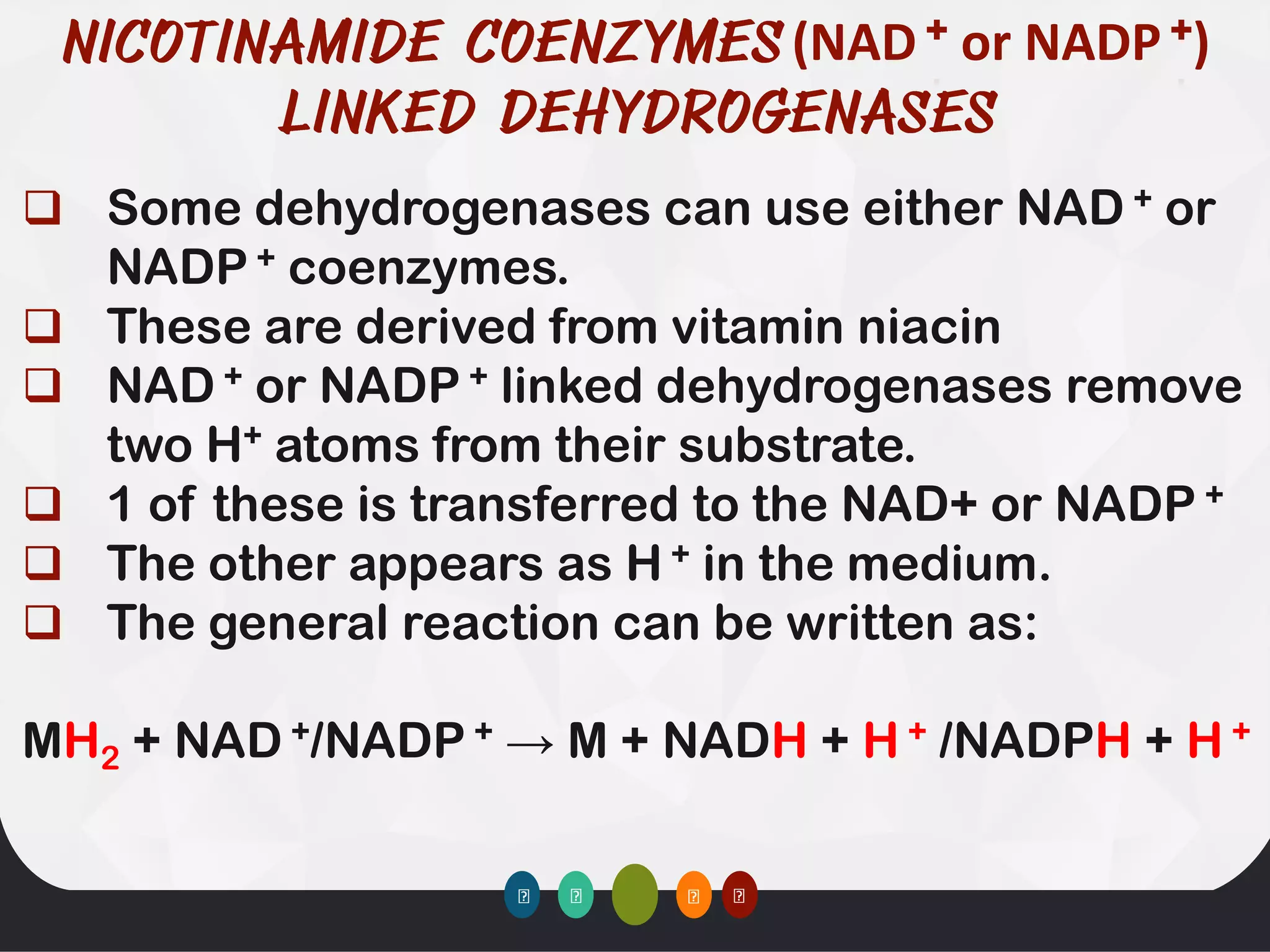
(NAD + orNADP +)
❑ Some dehydrogenases can use either NAD + or
NADP + coenzymes.
❑ These are derived from vitamin niacin
❑ NAD + or NADP + linked dehydrogenases remove
two H+ atoms from their substrate.
❑ 1 of these is transferred to the NAD+ or NADP +
❑ The other appears as H + in the medium.
❑ The general reaction can be written as:
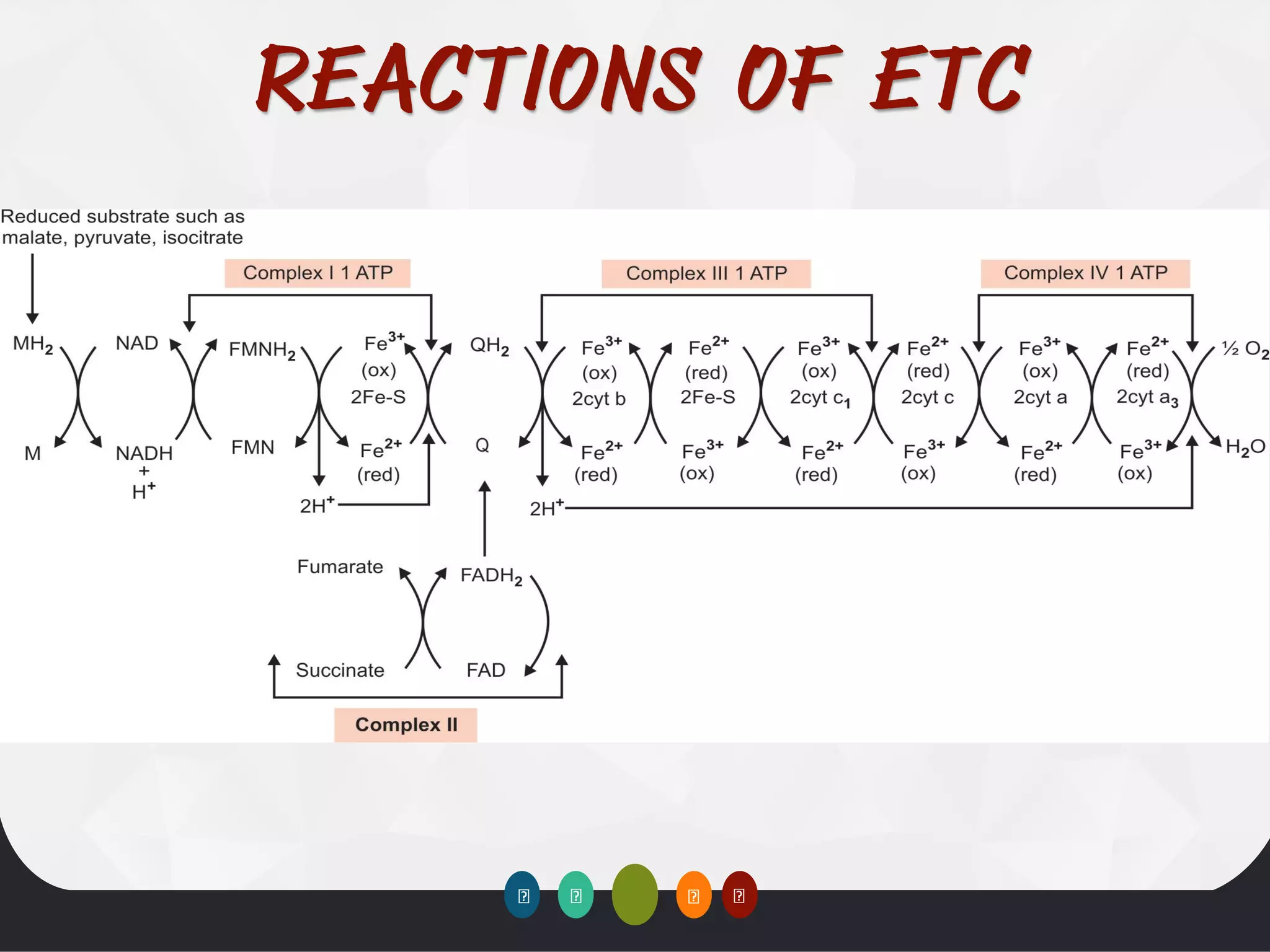
MH2 + NAD +/NADP + → M + NADH + H + /NADPH + H +
10.
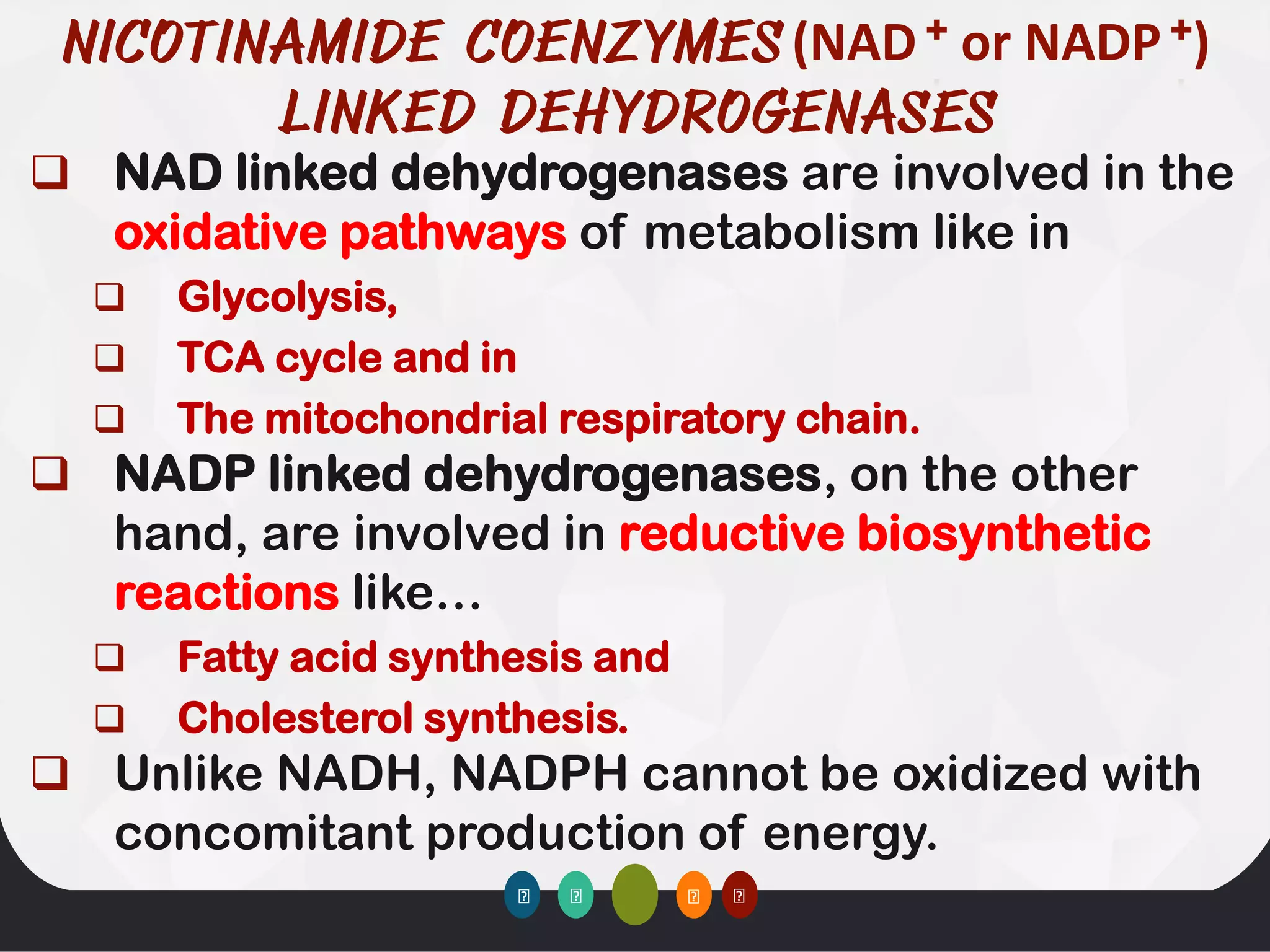
❑ NAD linkeddehydrogenases are involved in the
oxidative pathways of metabolism like in
❑ Glycolysis,
❑ TCA cycle and in
❑ The mitochondrial respiratory chain.
❑ NADP linked dehydrogenases, on the other
hand, are involved in reductive biosynthetic
reactions like…
❑ Fatty acid synthesis and
❑ Cholesterol synthesis.
❑ Unlike NADH, NADPH cannot be oxidized with
concomitant production of energy.
(NAD + or NADP +)
11.
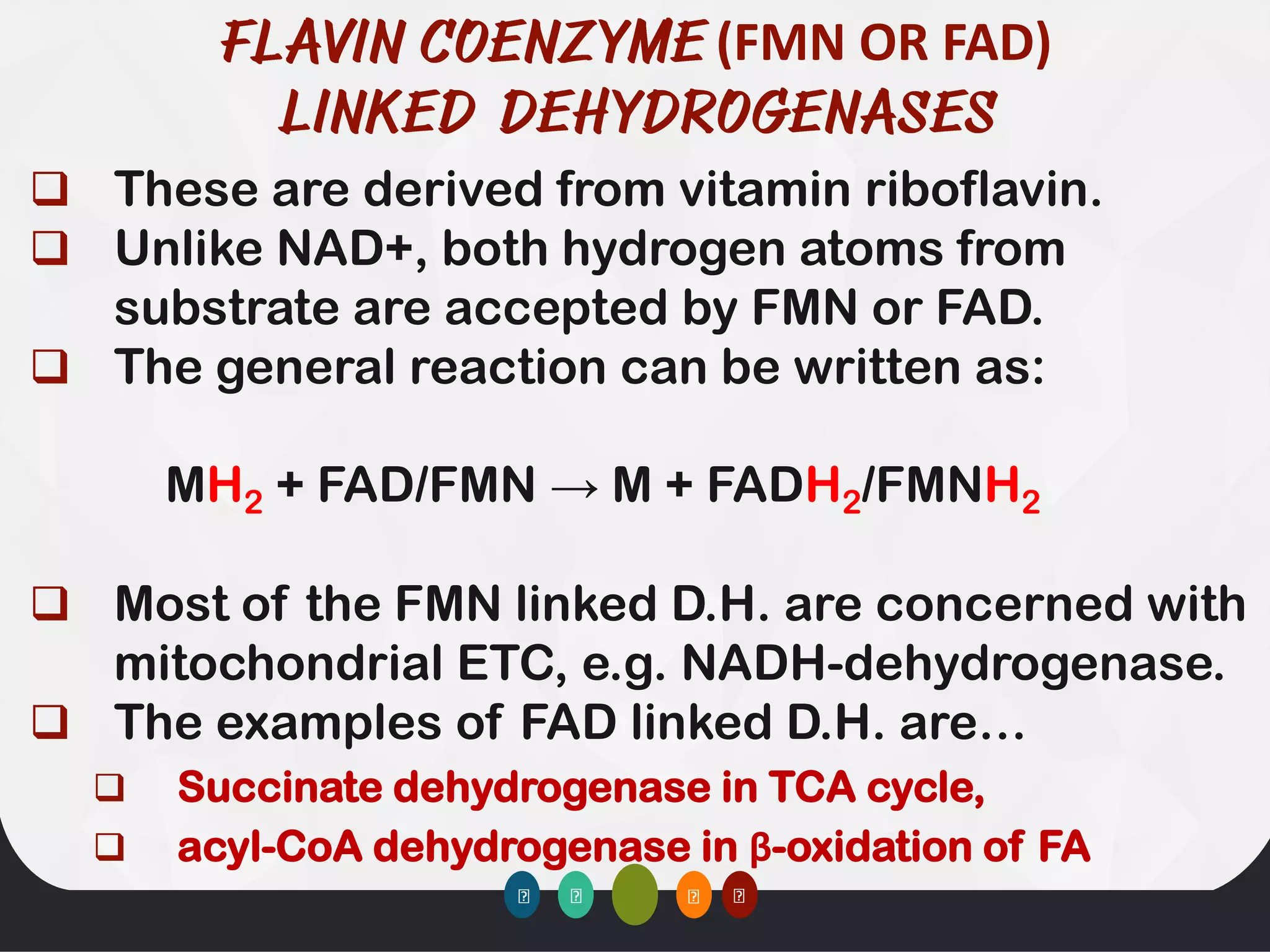
(FMN OR FAD)
❑These are derived from vitamin riboflavin.
❑ Unlike NAD+, both hydrogen atoms from
substrate are accepted by FMN or FAD.
❑ The general reaction can be written as:
MH2 + FAD/FMN → M + FADH2/FMNH2
❑ Most of the FMN linked D.H. are concerned with
mitochondrial ETC, e.g. NADH-dehydrogenase.
❑ The examples of FAD linked D.H. are…
❑ Succinate dehydrogenase in TCA cycle,
❑ acyl-CoA dehydrogenase in β-oxidation of FA
12.
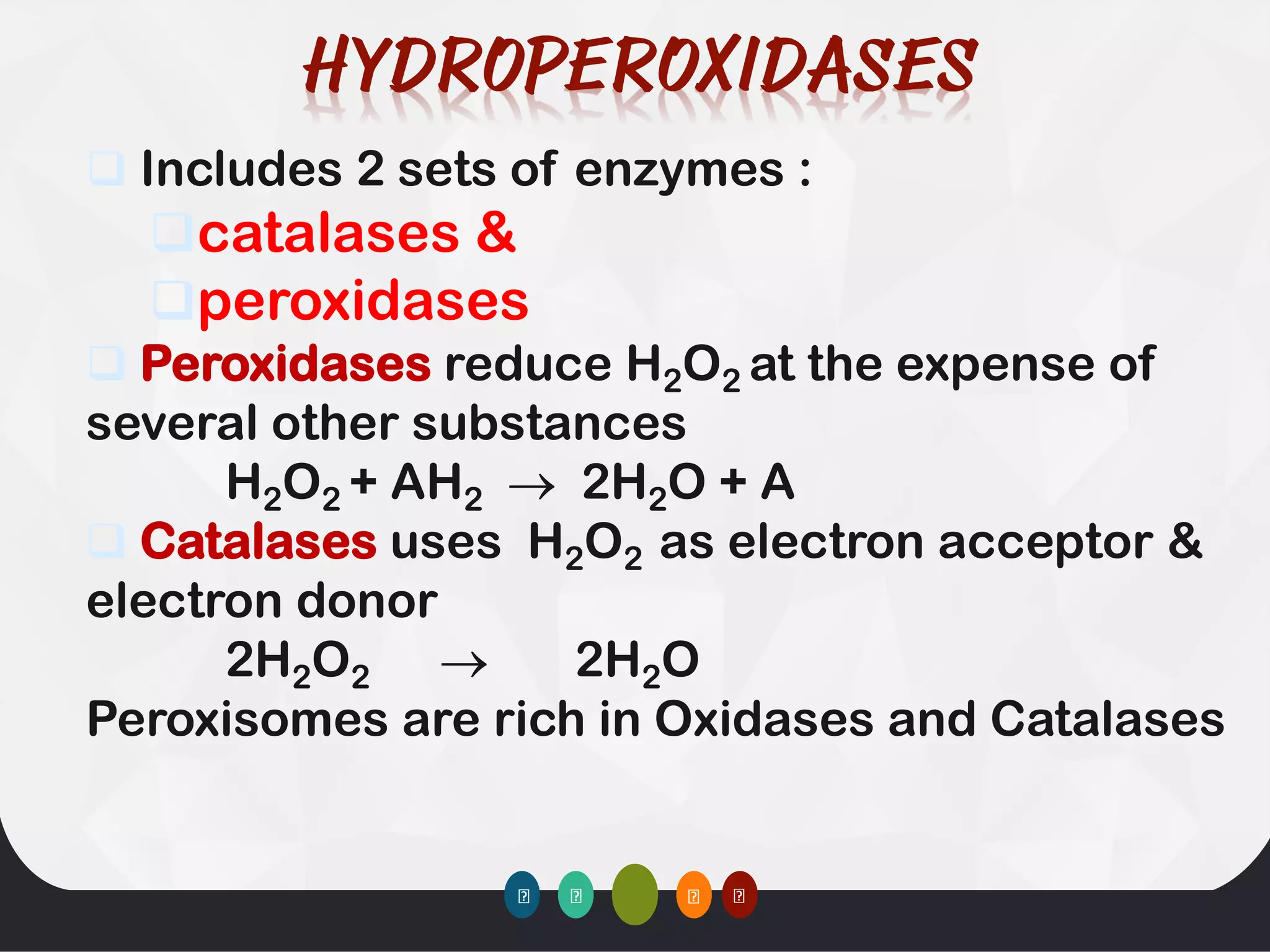
❑ Includes 2sets of enzymes :
❑catalases &
❑peroxidases
❑ Peroxidases reduce H2O2 at the expense of
several other substances
H2O2 + AH2 → 2H2O + A
❑ Catalases uses H2O2 as electron acceptor &
electron donor
2H2O2 → 2H2O
Peroxisomes are rich in Oxidases and Catalases
13.
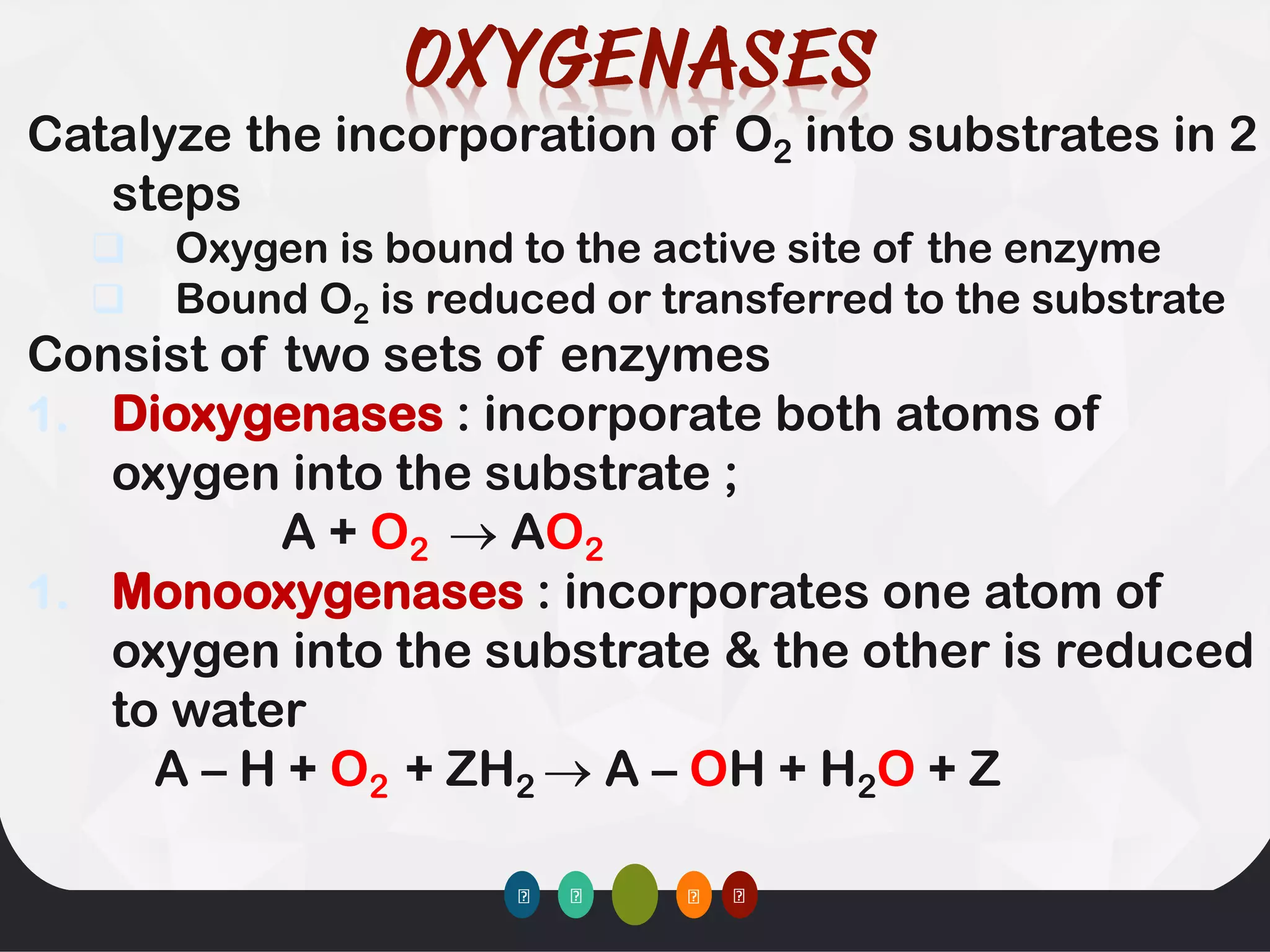
Catalyze the incorporationof O2 into substrates in 2
steps
❑ Oxygen is bound to the active site of the enzyme
❑ Bound O2 is reduced or transferred to the substrate
Consist of two sets of enzymes
1. Dioxygenases : incorporate both atoms of
oxygen into the substrate ;
A + O2 → AO2
1. Monooxygenases : incorporates one atom of
oxygen into the substrate & the other is reduced
to water
A – H + O2 + ZH2 → A – OH + H2O + Z
Sequence
of
reactions
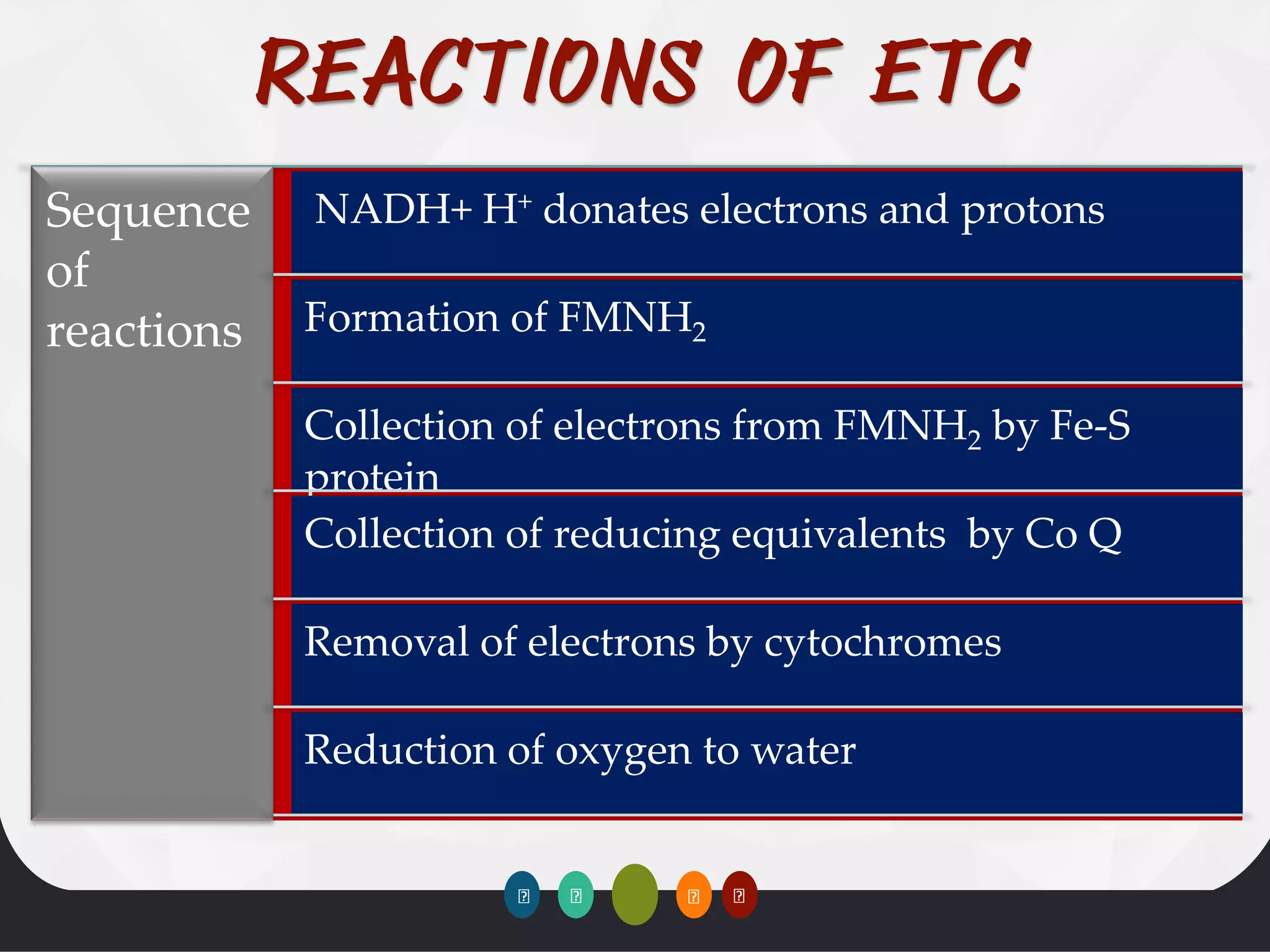
NADH+ H+ donateselectrons and protons
Formation of FMNH2
Collection of electrons from FMNH2 by Fe-S
protein
Collection of reducing equivalents by Co Q
Removal of electrons by cytochromes
Reduction of oxygen to water
31.
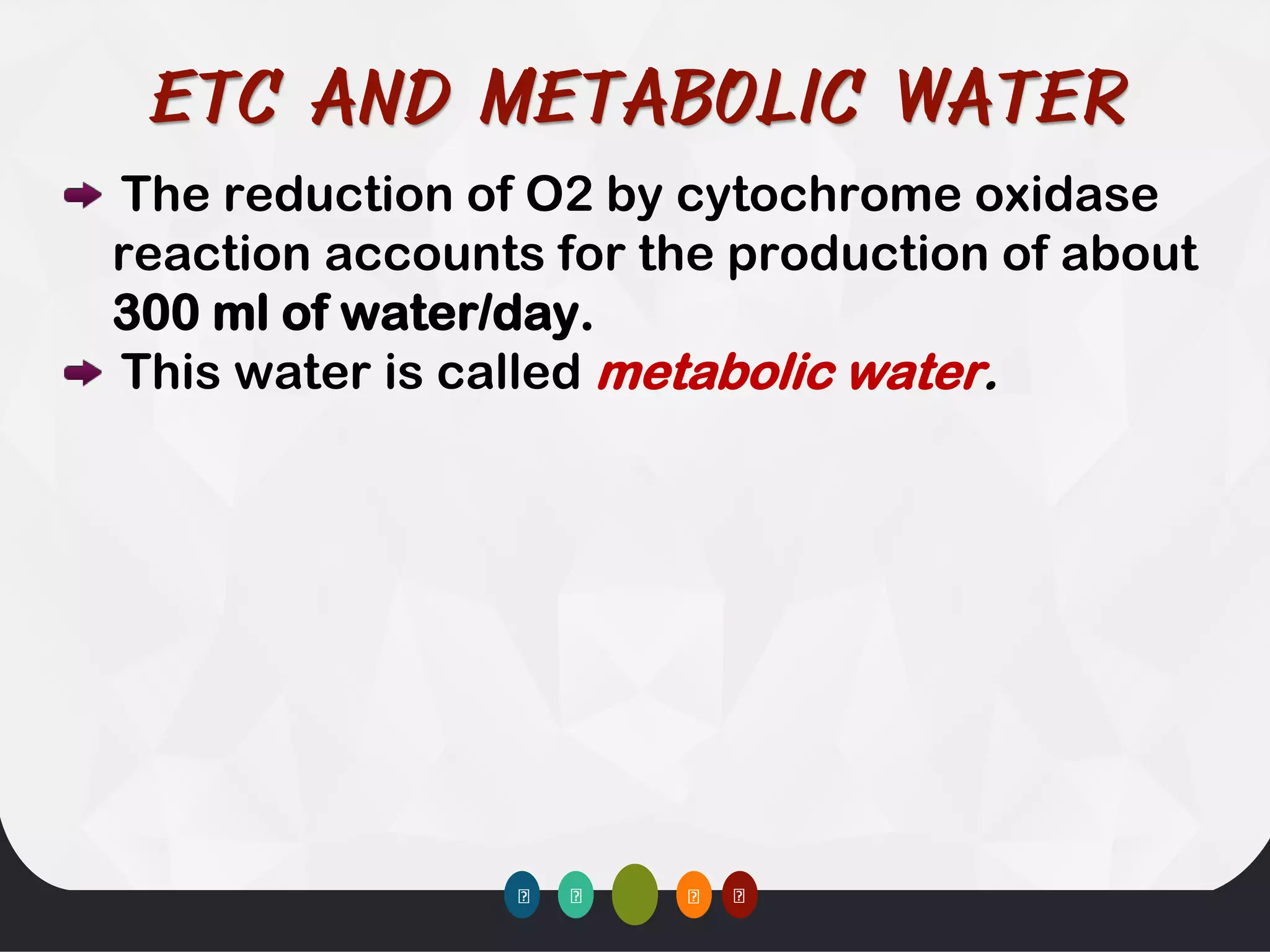
The reduction ofO2 by cytochrome oxidase
reaction accounts for the production of about
300 ml of water/day.
This water is called metabolic water.
32.
:
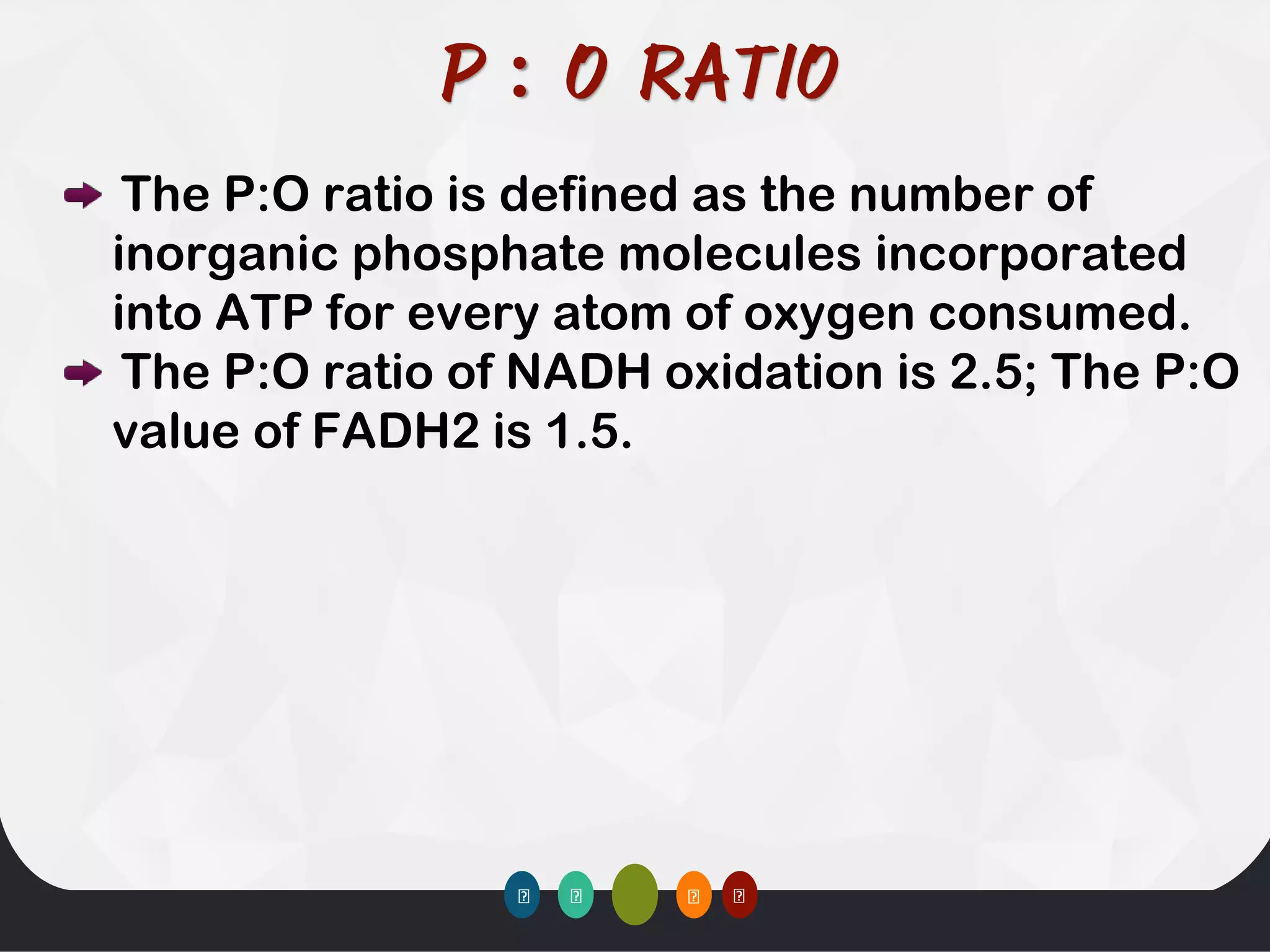
The P:O ratiois defined as the number of
inorganic phosphate molecules incorporated
into ATP for every atom of oxygen consumed.
The P:O ratio of NADH oxidation is 2.5; The P:O
value of FADH2 is 1.5.
33.
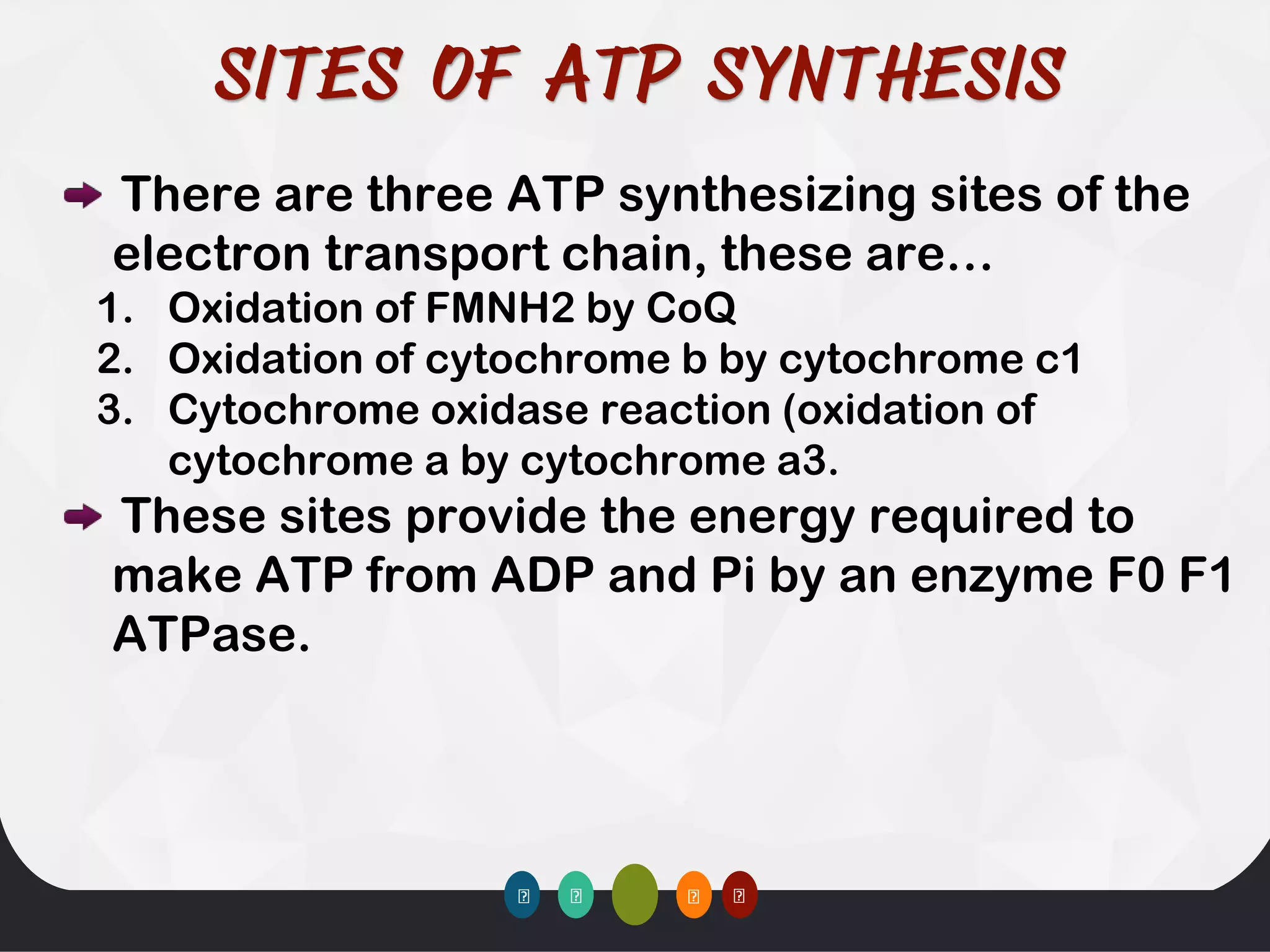
There are threeATP synthesizing sites of the
electron transport chain, these are…
1. Oxidation of FMNH2 by CoQ
2. Oxidation of cytochrome b by cytochrome c1
3. Cytochrome oxidase reaction (oxidation of
cytochrome a by cytochrome a3.
These sites provide the energy required to
make ATP from ADP and Pi by an enzyme F0 F1
ATPase.
34.
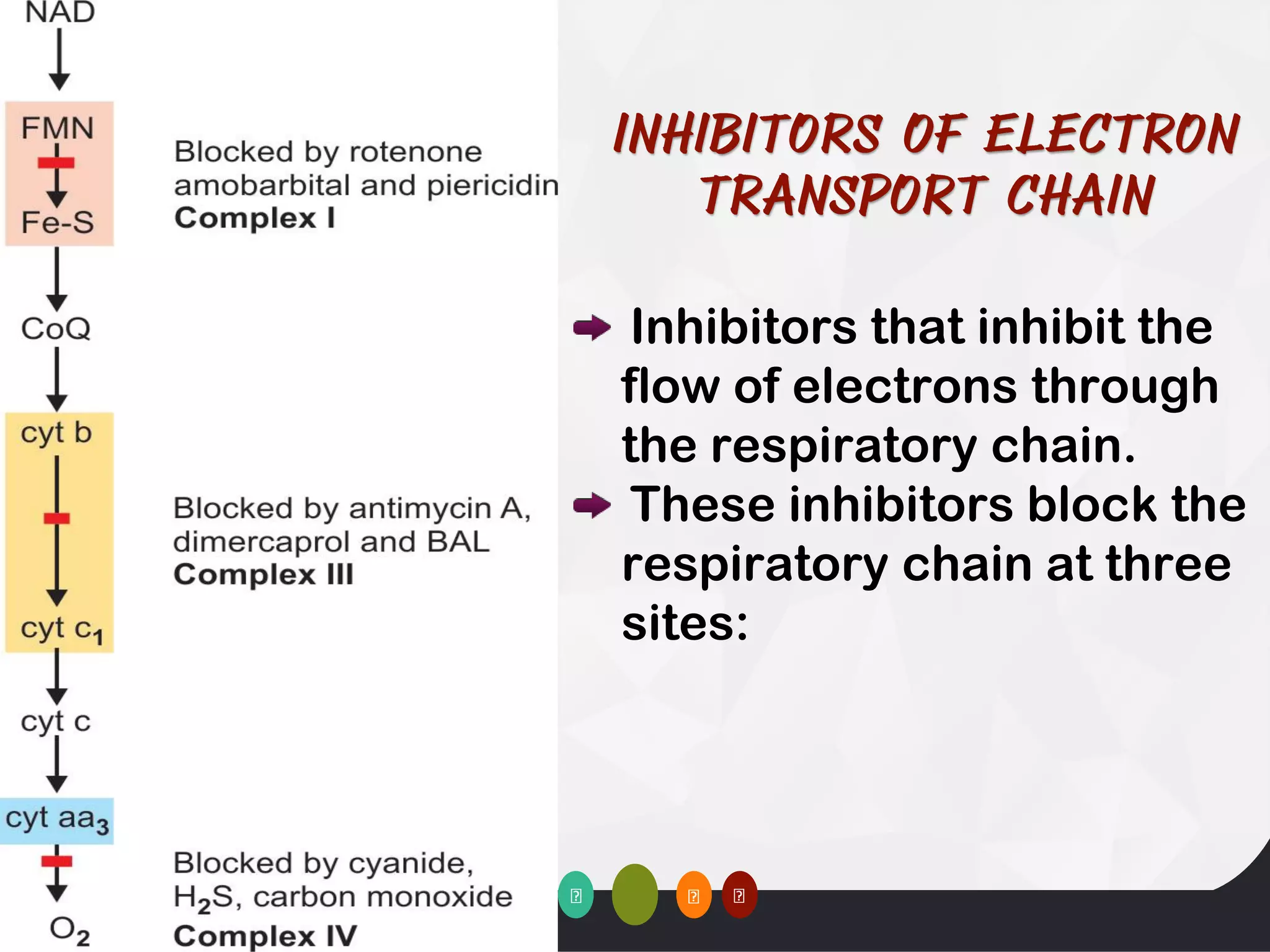
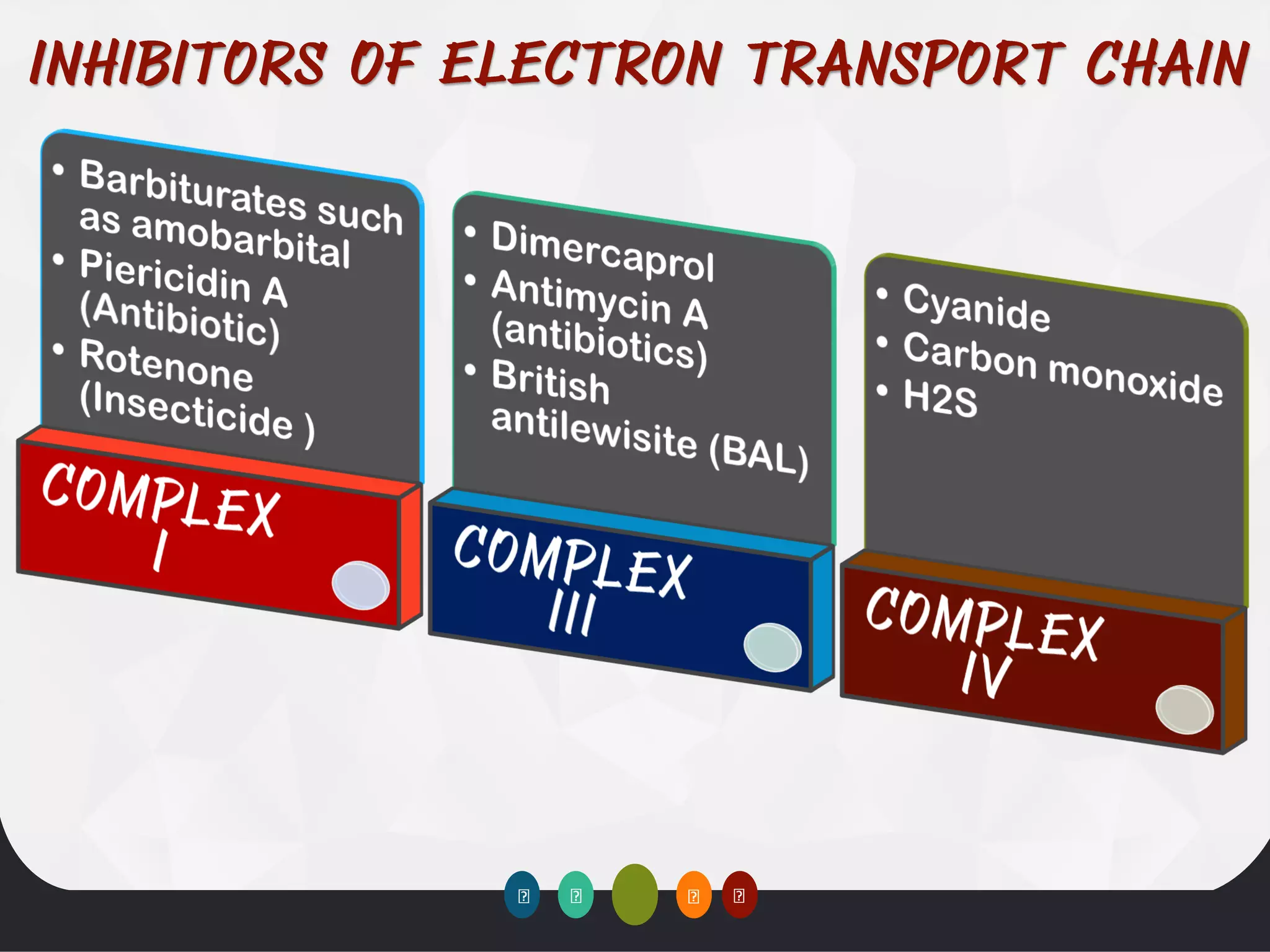
Inhibitors that inhibitthe
flow of electrons through
the respiratory chain.
These inhibitors block the
respiratory chain at three
sites: