Automation
By:Mahmoud Hussien
How to start with automation
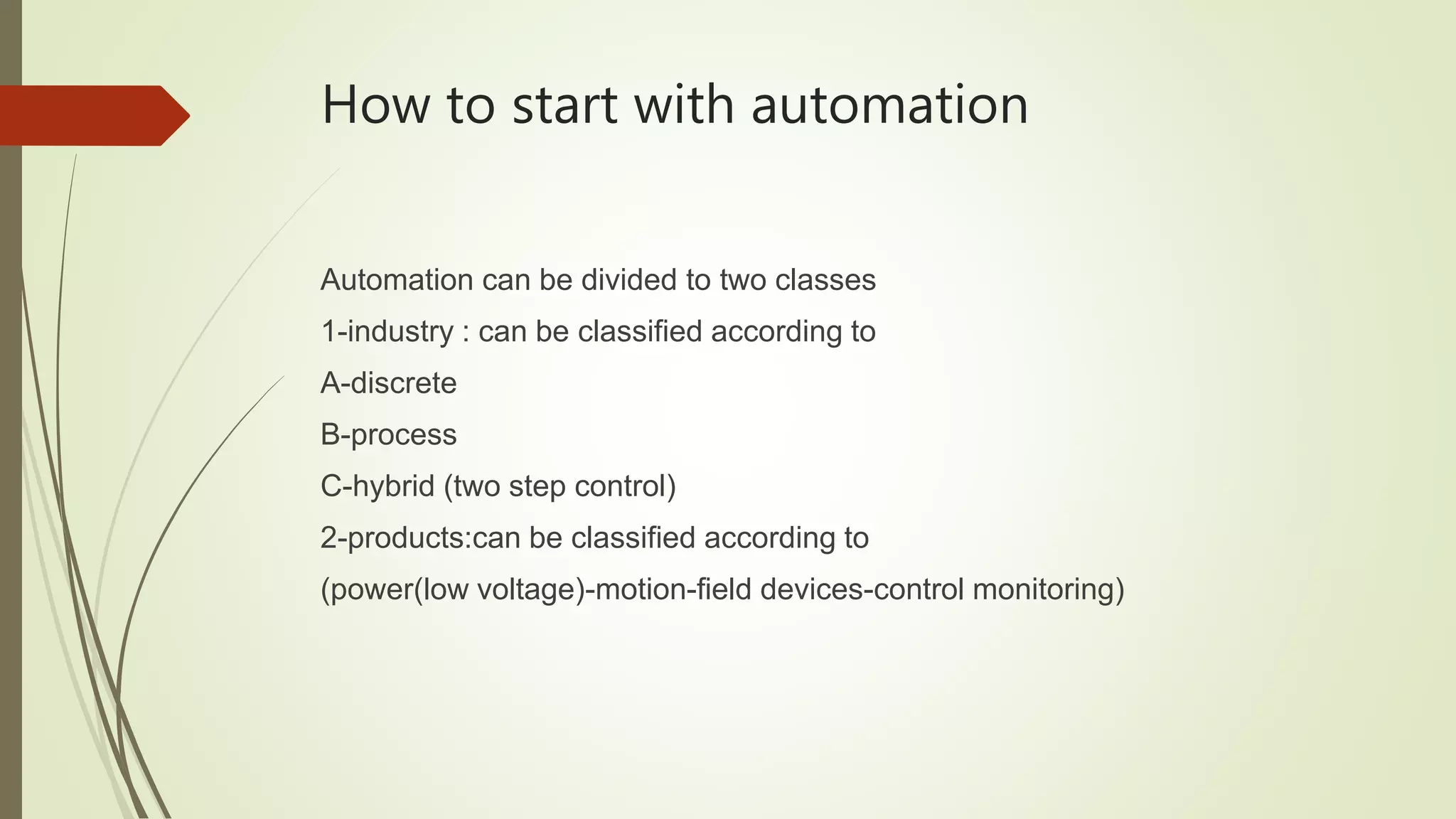
Automation can be divided to two classes
1-industry : can be classified according to
A-discrete
B-process
C-hybrid (two step control)
2-products:can be classified according to
(power(low voltage)-motion-field devices-control monitoring)
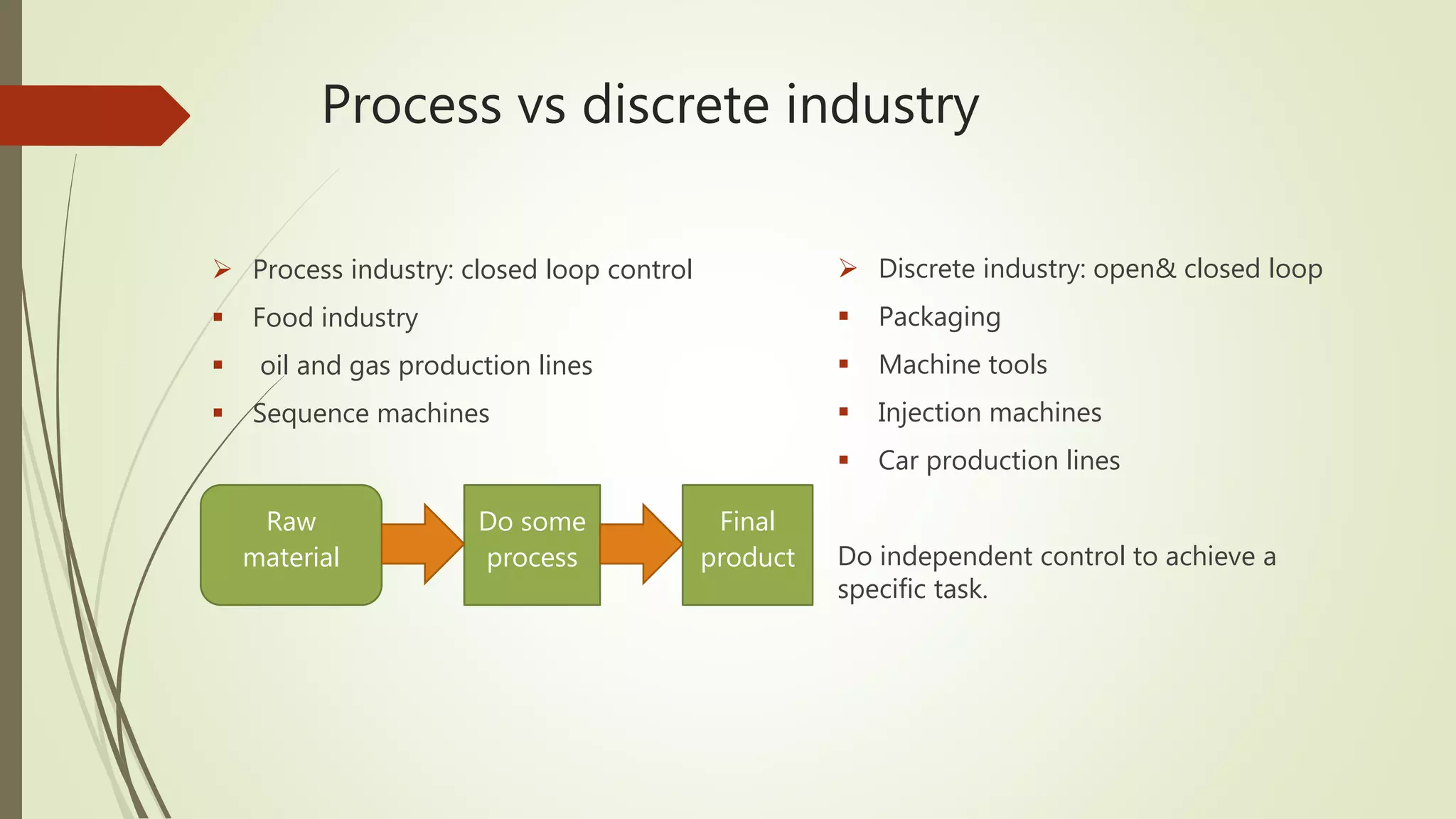
Process vs discrete industry
 Process industry: closed loop control
 Food industry
 oil and gas production lines
 Sequence machines
 Discrete industry: open& closed loop
 Packaging
 Machine tools
 Injection machines
 Car production lines
Do independent control to achieve a
specific task.
Raw
material
Do some
process
Final
product
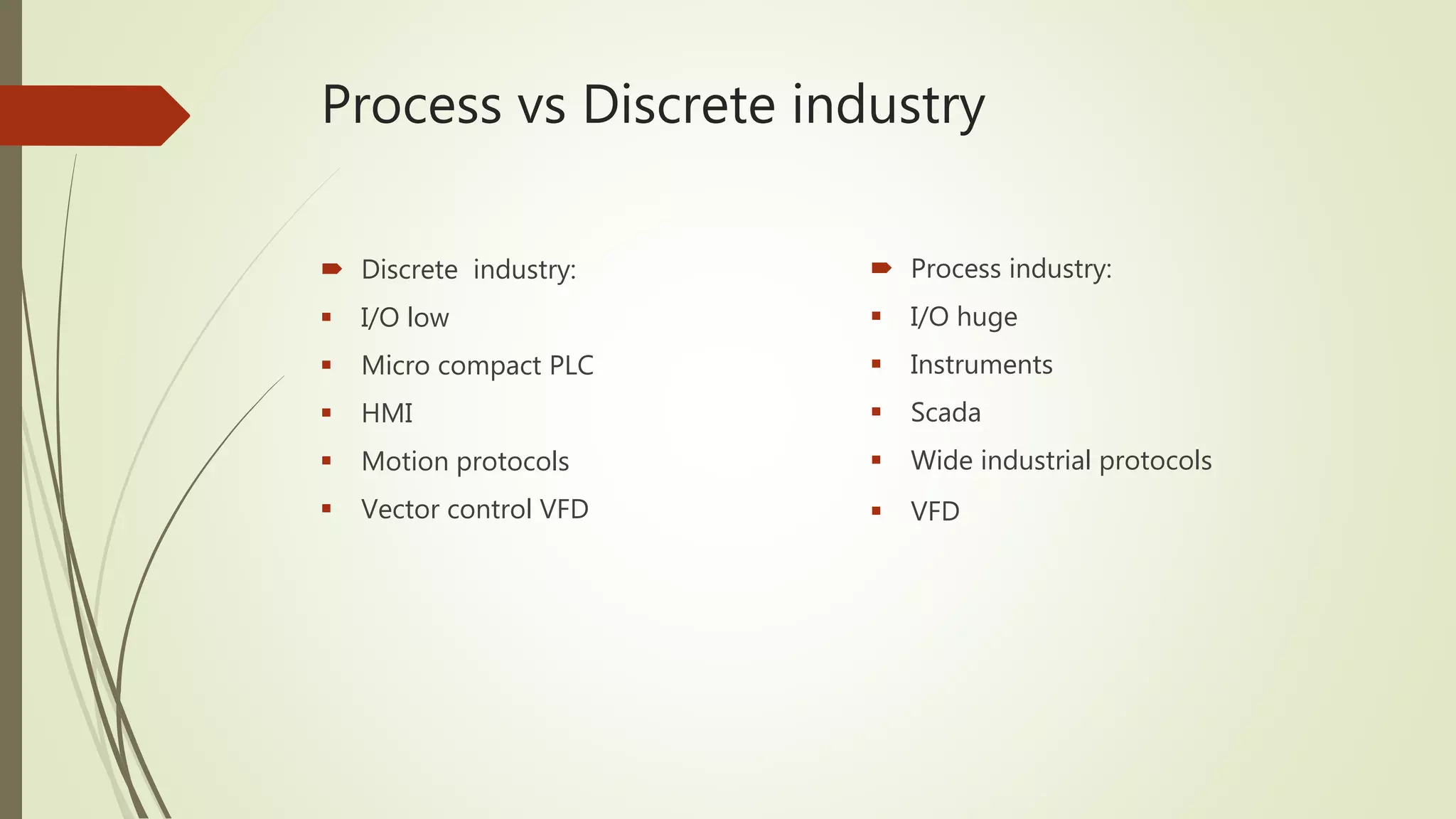
Process vs Discrete industry
 Discrete industry:
 I/O low
 Micro compact PLC
 HMI
 Motion protocols
 Vector control VFD
 Process industry:
 I/O huge
 Instruments
 Scada
 Wide industrial protocols
 VFD
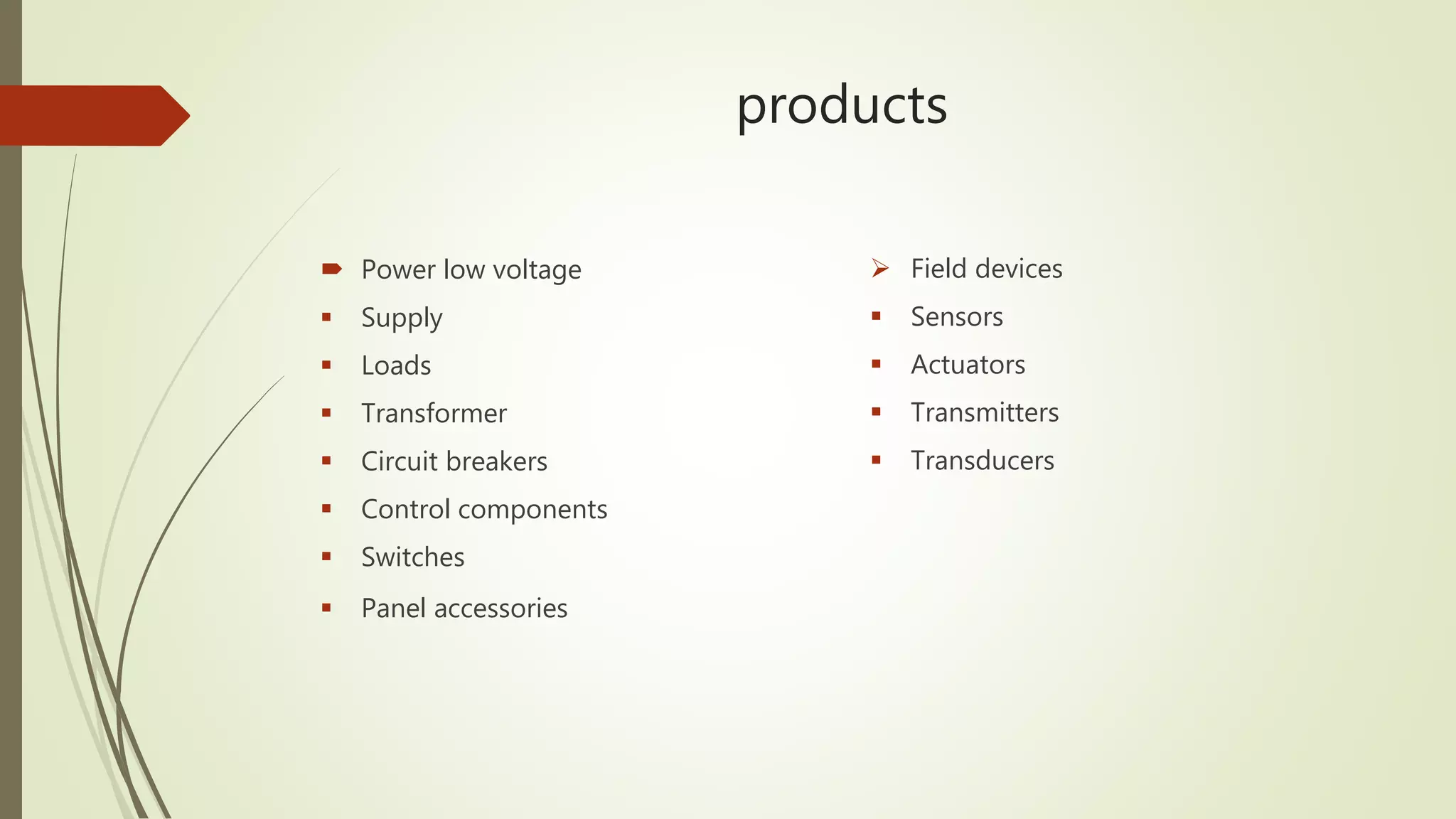
products
 Power low voltage
 Supply
 Loads
 Transformer
 Circuit breakers
 Control components
 Switches
 Panel accessories
 Field devices
 Sensors
 Actuators
 Transmitters
 Transducers
products
 control
 PLC
 Classic control
 Control instruments
 DCS
 Motion
 AC drive
 Servo drive
 Monitoring
 HMI
 SCADA
How to start with automation
 Step 1(basics)
 basic of electrical laws.
 Basic of electrical circuits
 Basic of electrical installation
 Basic knowledge of control components
 Ac induction motors
 Dc motors
How to start with automation
 Step 2(logic control)
 Classic control
 Use sensors ,counters and timers in sequential control
 Step 3 (motor starter)
 Star-delta connection
 Soft starter
 Ac motor inverse direction
How to start with automation
 Step 4(motion)
 Ac drive
 Servo drive
 CNC
 Step 5 (Basic programming)
 PLC
 Numbering system
 PLC memory management
 HMI
How to start with automation
 Step 6(industrial communication)
 PLC with VFD
 PLC with field devices
 Step 7 (advanced level)
 SCADA
 Remote I/O
 Industrial network
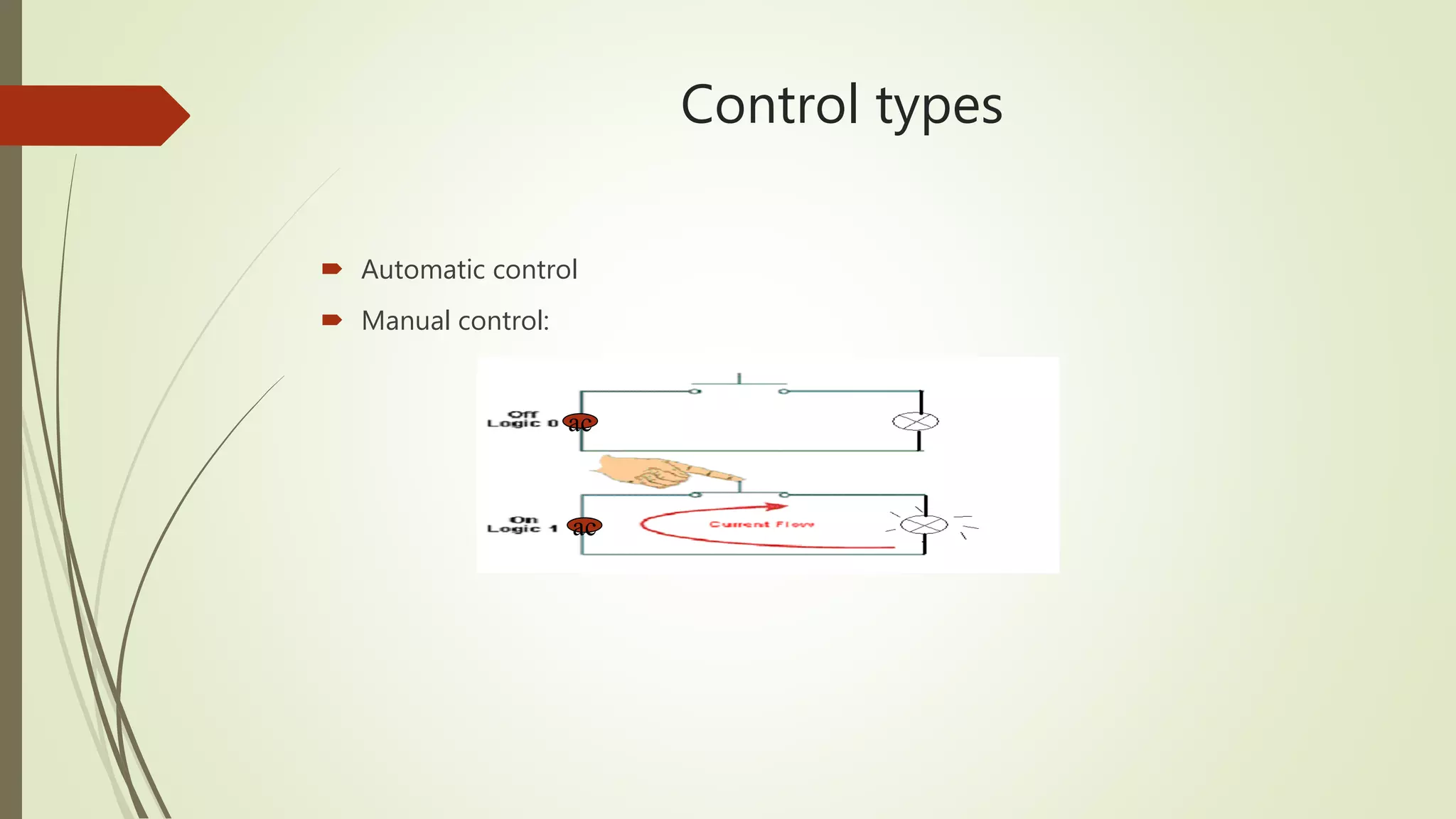
Control types
 Automatic control
 Manual control:
ac
ac
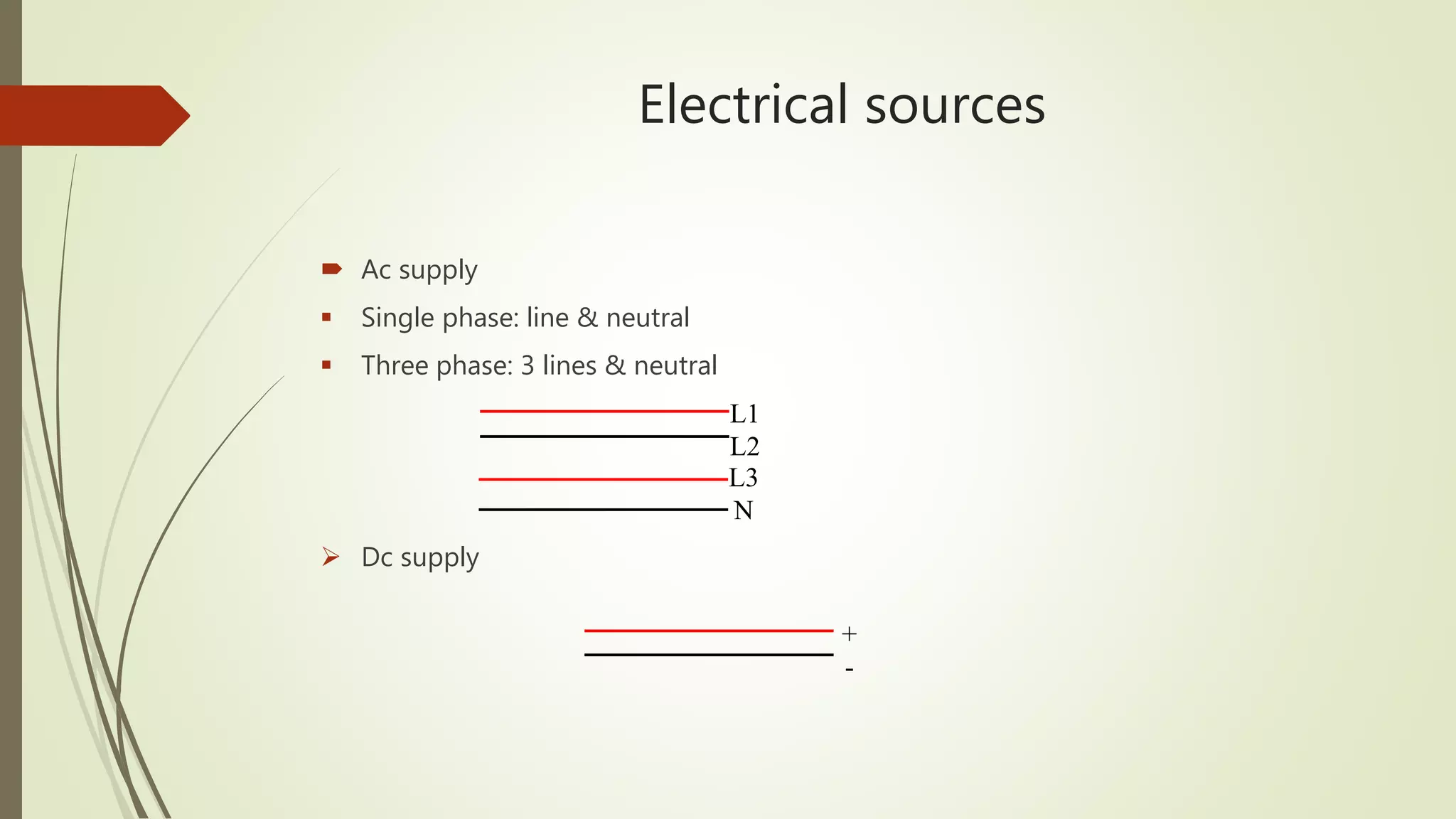
Electrical sources
 Ac supply
 Single phase: line & neutral
 Three phase: 3 lines & neutral
 Dc supply
+
-
L1
L2
L3
N
Basic electrical laws
 V=I*R
 P=V*I
 Power loss=i2*R
Where
V:is the voltage supply
I:is the current
P:is the power
Loads
 Motors
 Induction motors
• Single phase
• Three phase
 Servo motors
 Stepper motors
 Dc motors
 Pneumatic cylinders
 Hydraulic cylinders
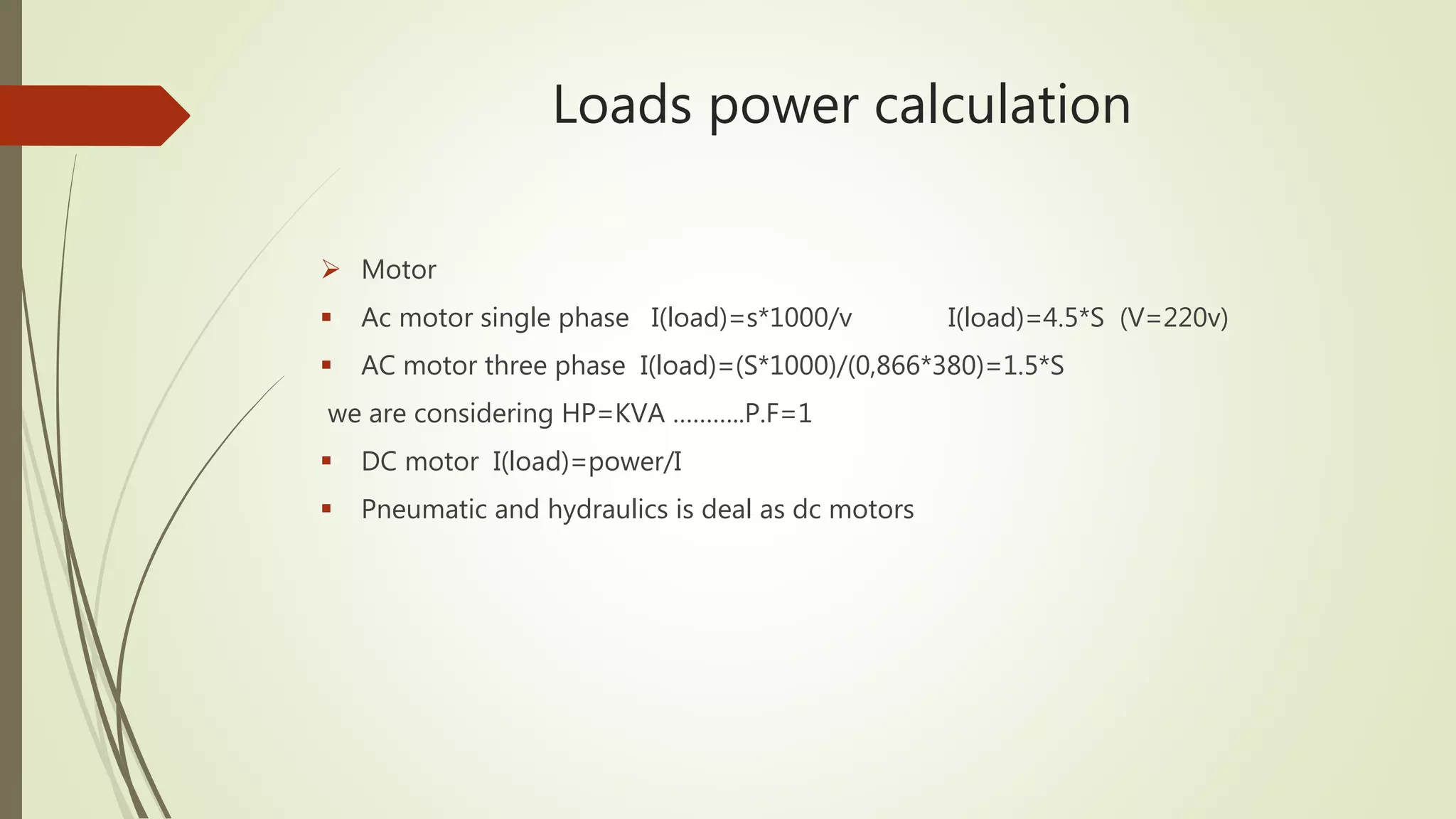
Loads power calculation
 Motor
 Ac motor single phase I(load)=s*1000/v I(load)=4.5*S (V=220v)
 AC motor three phase I(load)=(S*1000)/(0,866*380)=1.5*S
we are considering HP=KVA ………..P.F=1
 DC motor I(load)=power/I
 Pneumatic and hydraulics is deal as dc motors
Cables colors
 Red color: for 110 or 220 volts
 Blue color: for 12 or 24 volts
 Black color: for ground or neutral
 Orange color: its mean take current from another panel
 For control cables :low thickness –low current
 For power cables: huge thickness-high current
 There are a relation between cable diameter and current
 Cable diameter depends on current,environment
Control components
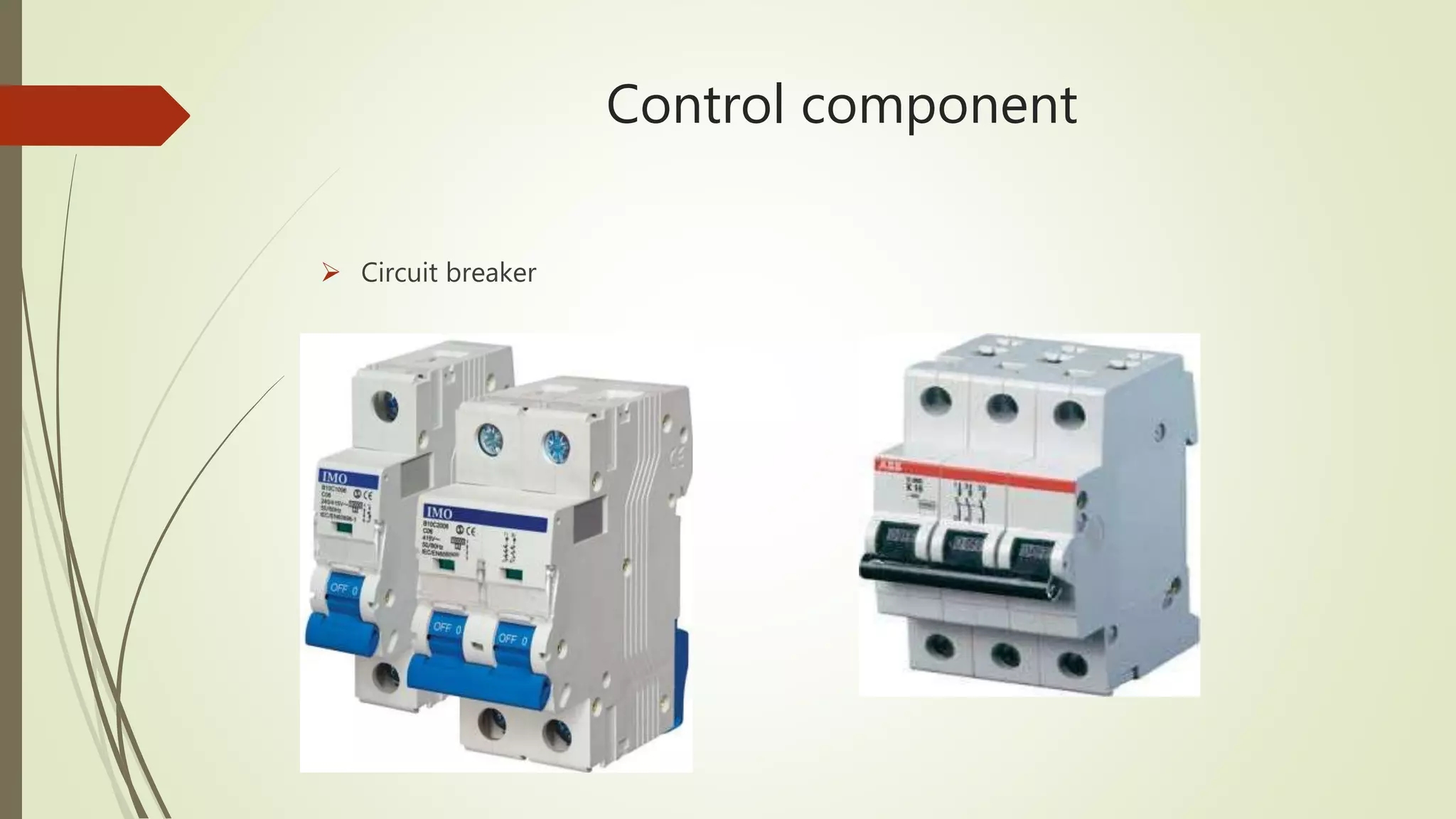
 Circuit breaker
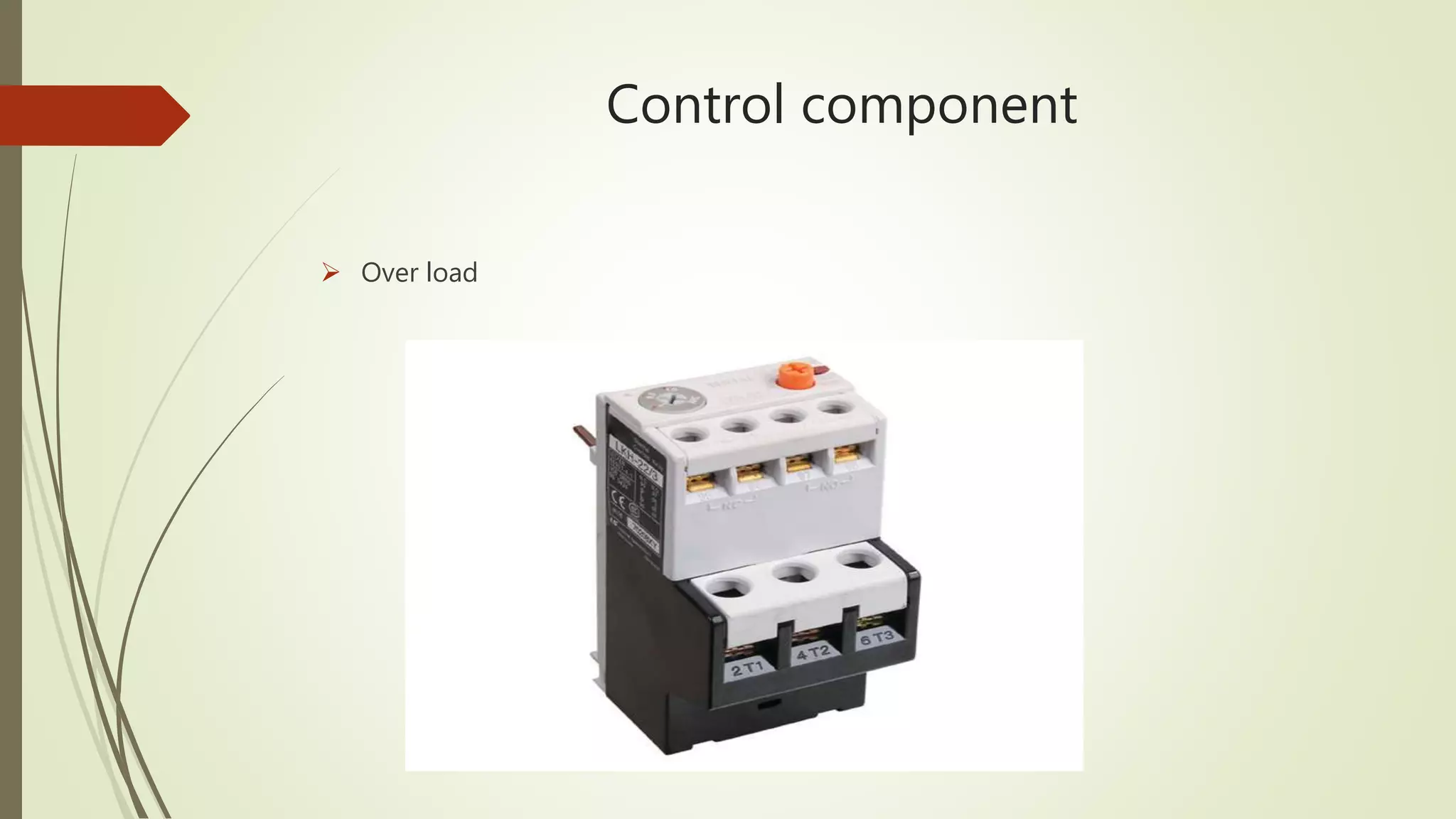
 Over load
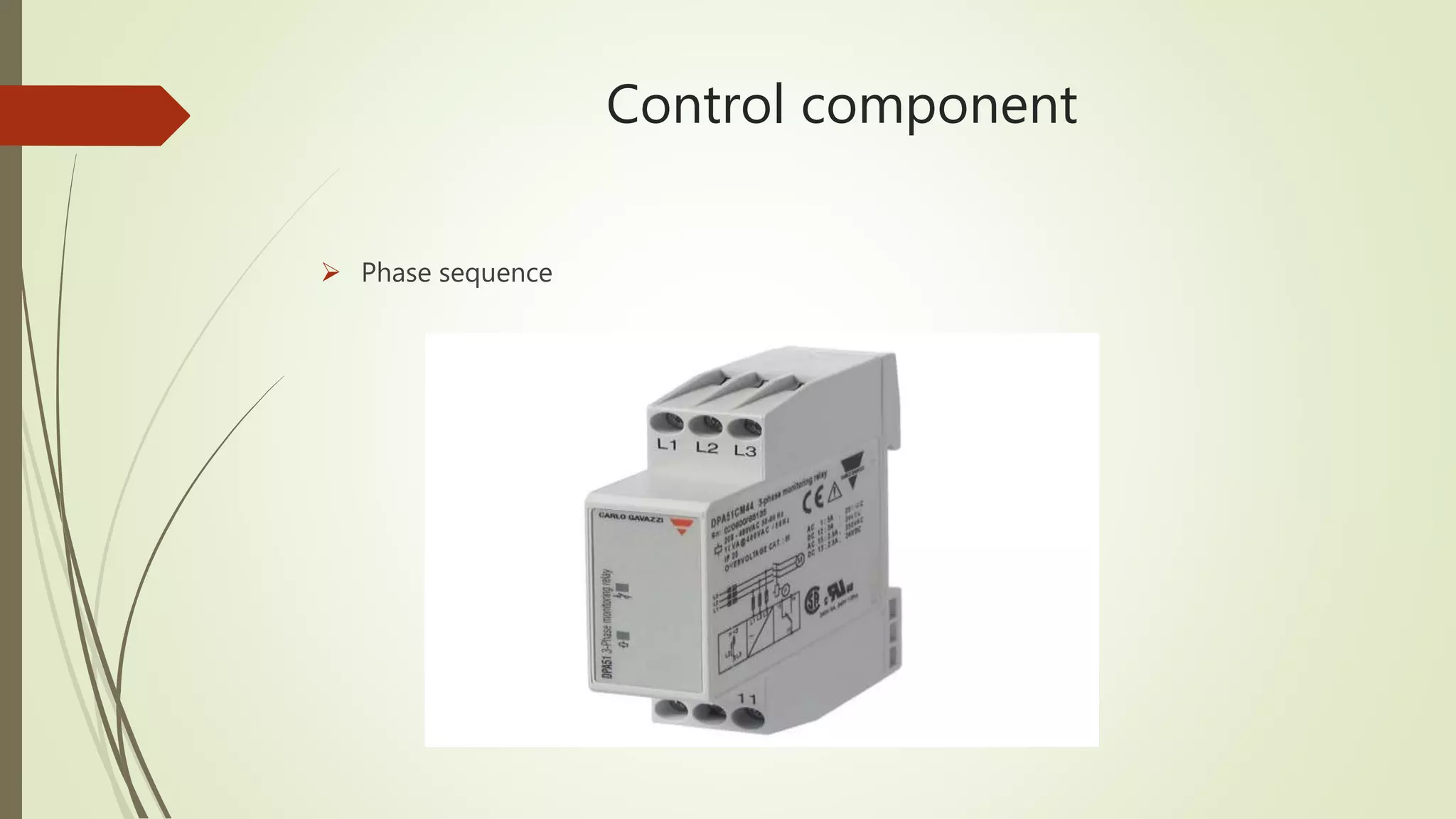
 Phase sequence
 Fuses
 Contactor
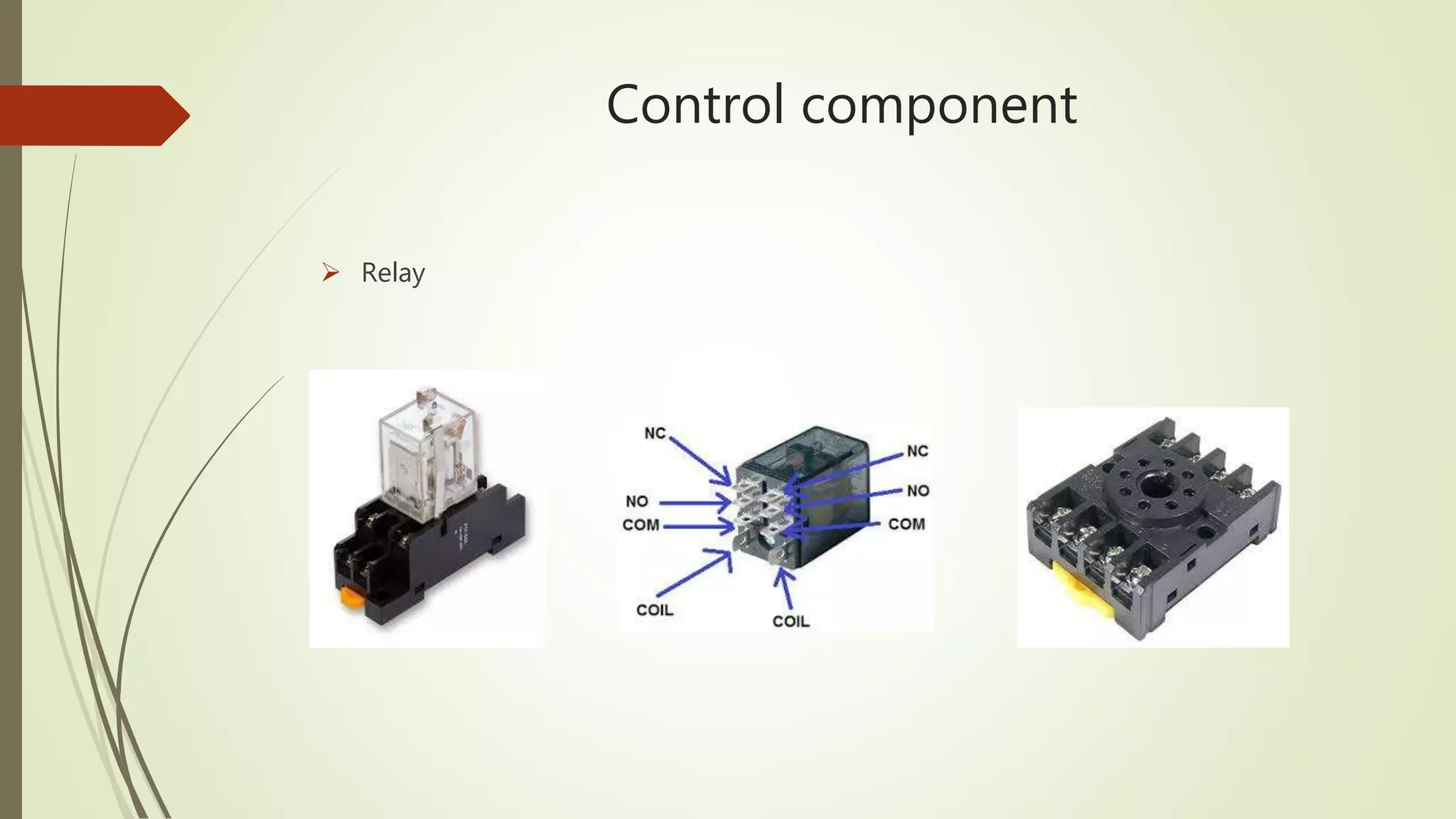
 Relay
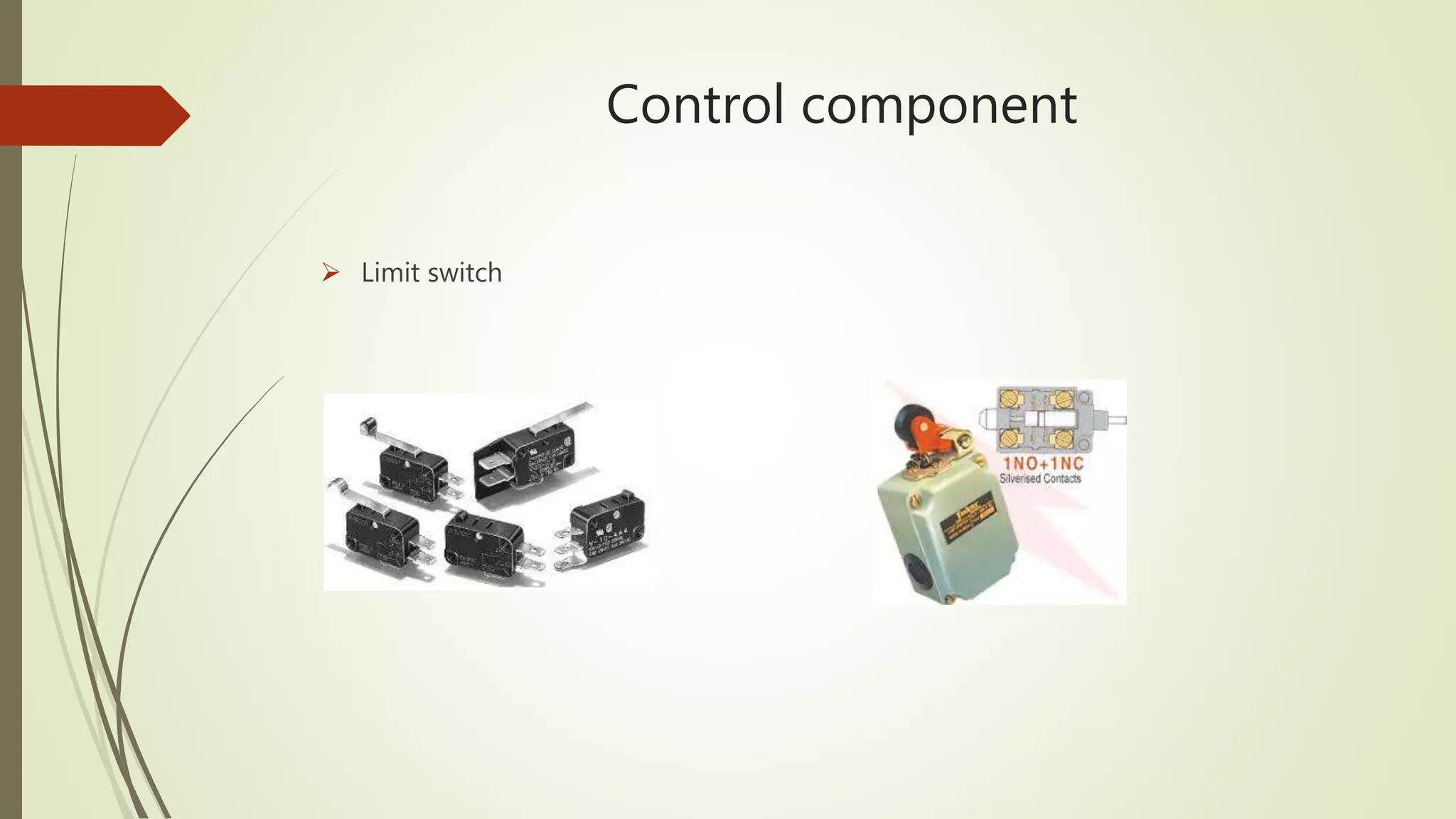
 Limit switch
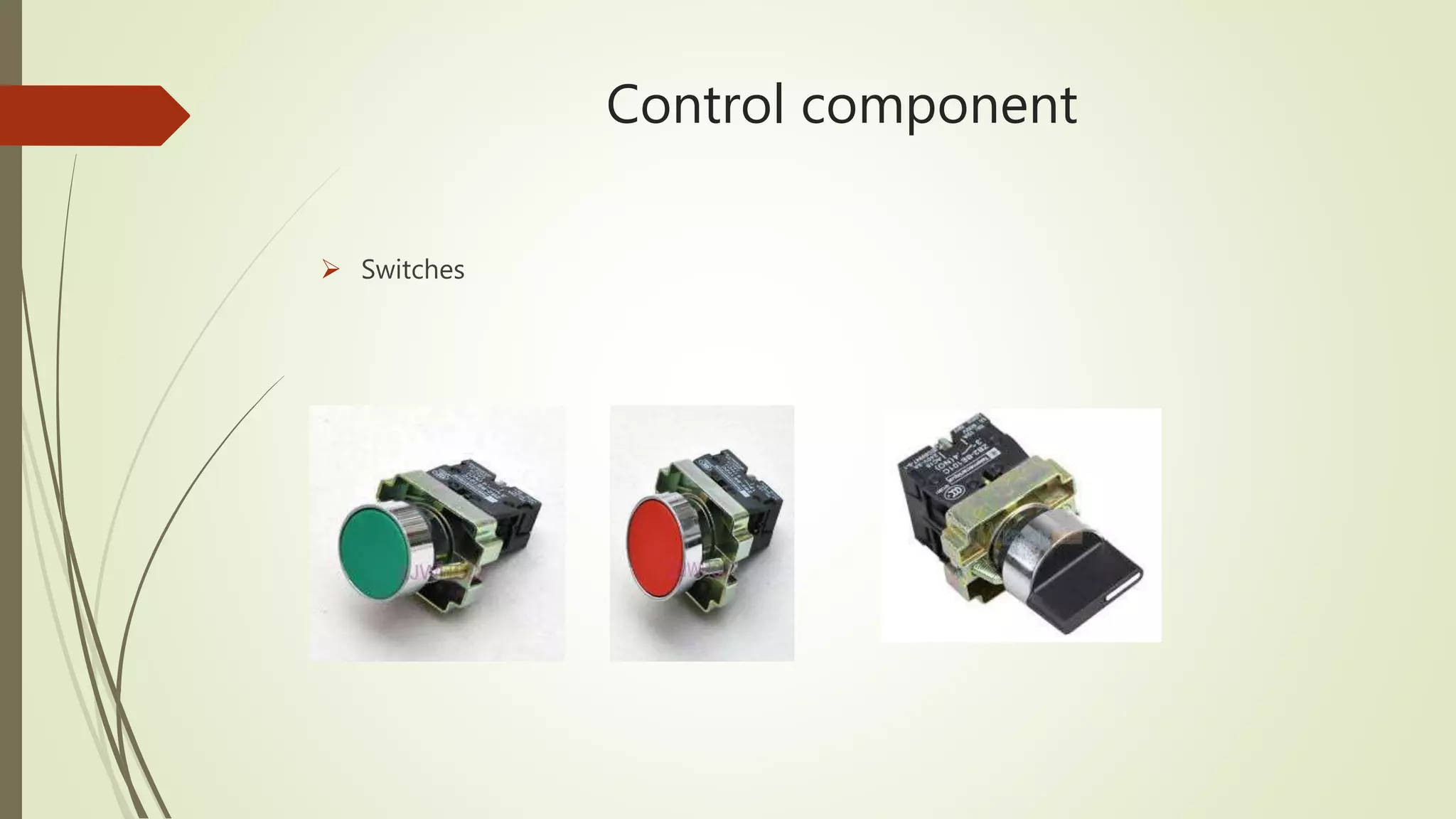
 Switches
 sensors
Control component selection
 Circuit breaker
 Short circuit current
 Time
 Voltage
 Current =1.25*rated current
 Over load
 Current=1.2*rated current
 voltage
Control component selection
 contactor
 Rated current
 Voltage
 Coil voltage
 No .of . Connected open and close
 relay
 Current
 Voltage
 No .of . Connected open and close
Control component selection
 Limit switch
 Controller supply
 sensors
 Controller supply
 Connection type
 Switches
 Open or close
 current
 preasure
Control component
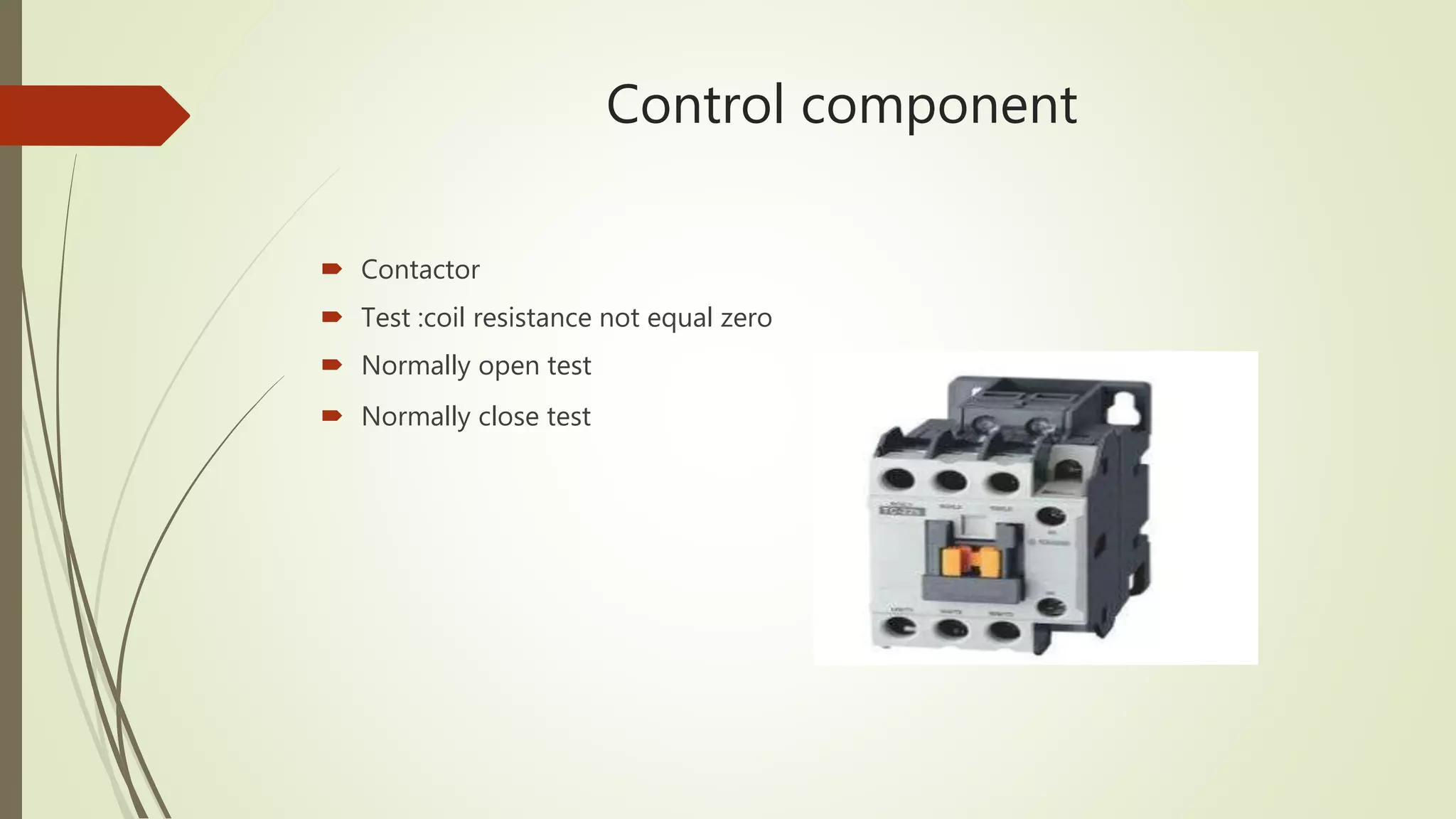
 Contactor
 Test :coil resistance not equal zero
 Normally open test
 Normally close test
Control component
 Circuit breaker
Control component
 Phase sequence
Control component
 Over load
Control component
 Relay
Control component
 Limit switch
Control component
 Switches
Panel component
 Supply
 Power supply
 Main circuit breaker
 Branch circuit breaker
 Phase sequence
 Over load
 Fuse
 Contactor(relays)
 Controller(plc –VFD-DCS)
 Wires
 Bars
Classic control circuits
 Power circuit
 Circuit breaker
 Phase sequence
 Over load
 Fuse
 contactor
Classic control circuits
 control circuit
 Phase sequence
 Closes contact Over load
 Contactor
 Switches
 Sensors
 Limit switches
Exercises
 Start motor , draw power circuit and control circuit that stop when release my
hand
 Start -stop motor , draw power circuit and control circuit
 Start – with two switches and stop from one switch
 Start with one switch stop from another and emergency switch
draw power and control circuit.
Emad Elsheikh
32
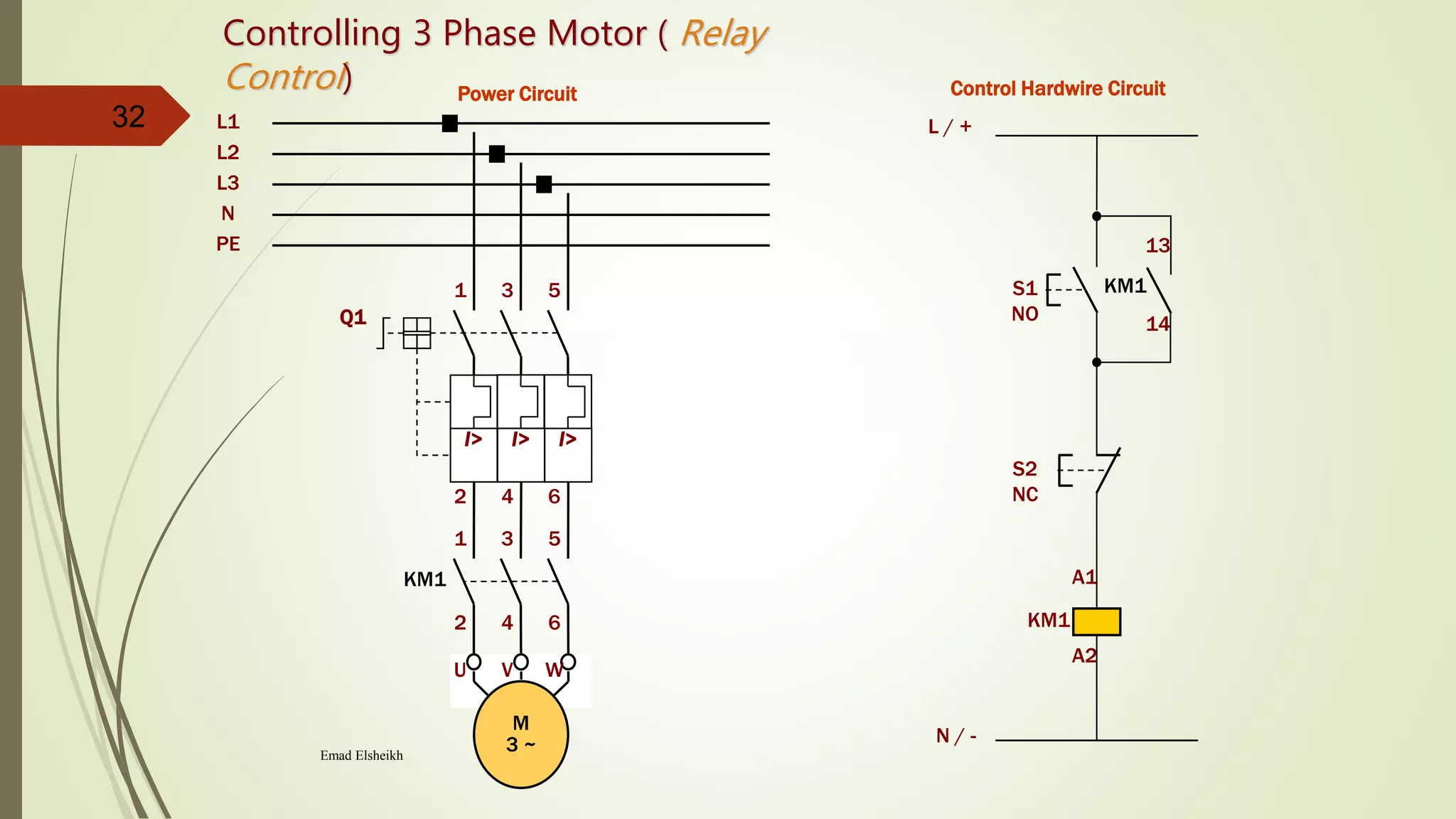
KM1
A1
A2
S1
NO
S2
NC
KM1
13
14
L / +
N / -
Power Circuit Control Hardwire Circuit
L2
N
PE
L1
L3
M
3 ~
U V W
1
2
KM1
3
4
5
6
Q1
I> I> I>
1
2
3
4
5
6
Controlling 3 Phase Motor ( Relay
Control)
Emad Elsheikh
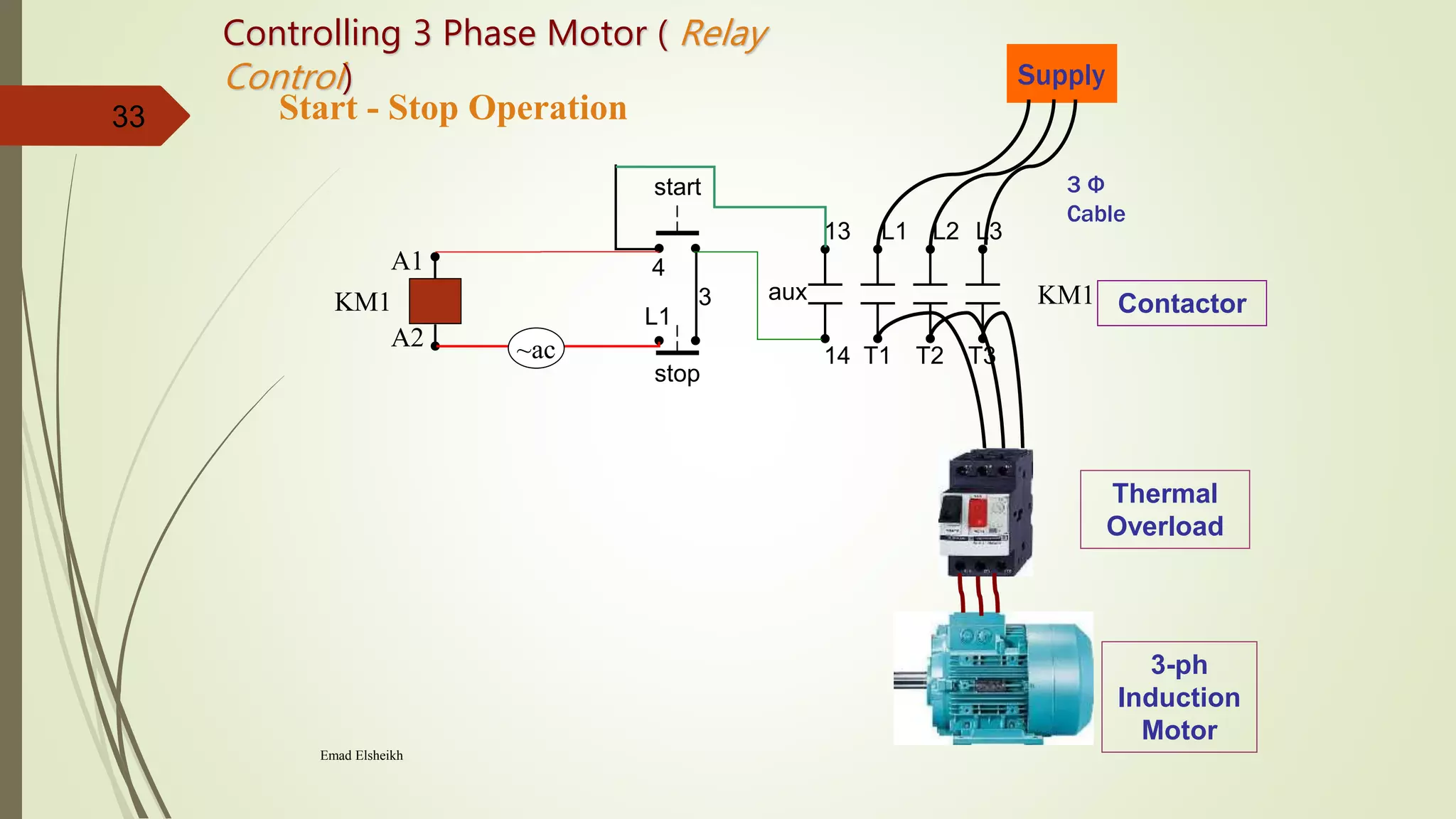
33 Start - Stop Operation
Supply
3 Ф
Cable
stop
start
4
14
3
13
L1
L1
T1 T2 T3
L2 L3
aux
A1
A2 ~ac
KM1 KM1 Contactor
Thermal
Overload
3-ph
Induction
Motor
Controlling 3 Phase Motor ( Relay
Control)

Automation lecture1

  • 1.
  • 2.
    How to startwith automation Automation can be divided to two classes 1-industry : can be classified according to A-discrete B-process C-hybrid (two step control) 2-products:can be classified according to (power(low voltage)-motion-field devices-control monitoring)
  • 3.
    Process vs discreteindustry  Process industry: closed loop control  Food industry  oil and gas production lines  Sequence machines  Discrete industry: open& closed loop  Packaging  Machine tools  Injection machines  Car production lines Do independent control to achieve a specific task. Raw material Do some process Final product
  • 4.
    Process vs Discreteindustry  Discrete industry:  I/O low  Micro compact PLC  HMI  Motion protocols  Vector control VFD  Process industry:  I/O huge  Instruments  Scada  Wide industrial protocols  VFD
  • 5.
    products  Power lowvoltage  Supply  Loads  Transformer  Circuit breakers  Control components  Switches  Panel accessories  Field devices  Sensors  Actuators  Transmitters  Transducers
  • 6.
    products  control  PLC Classic control  Control instruments  DCS  Motion  AC drive  Servo drive  Monitoring  HMI  SCADA
  • 7.
    How to startwith automation  Step 1(basics)  basic of electrical laws.  Basic of electrical circuits  Basic of electrical installation  Basic knowledge of control components  Ac induction motors  Dc motors
  • 8.
    How to startwith automation  Step 2(logic control)  Classic control  Use sensors ,counters and timers in sequential control  Step 3 (motor starter)  Star-delta connection  Soft starter  Ac motor inverse direction
  • 9.
    How to startwith automation  Step 4(motion)  Ac drive  Servo drive  CNC  Step 5 (Basic programming)  PLC  Numbering system  PLC memory management  HMI
  • 10.
    How to startwith automation  Step 6(industrial communication)  PLC with VFD  PLC with field devices  Step 7 (advanced level)  SCADA  Remote I/O  Industrial network
  • 11.
    Control types  Automaticcontrol  Manual control: ac ac
  • 12.
    Electrical sources  Acsupply  Single phase: line & neutral  Three phase: 3 lines & neutral  Dc supply + - L1 L2 L3 N
  • 13.
    Basic electrical laws V=I*R  P=V*I  Power loss=i2*R Where V:is the voltage supply I:is the current P:is the power
  • 14.
    Loads  Motors  Inductionmotors • Single phase • Three phase  Servo motors  Stepper motors  Dc motors  Pneumatic cylinders  Hydraulic cylinders
  • 15.
    Loads power calculation Motor  Ac motor single phase I(load)=s*1000/v I(load)=4.5*S (V=220v)  AC motor three phase I(load)=(S*1000)/(0,866*380)=1.5*S we are considering HP=KVA ………..P.F=1  DC motor I(load)=power/I  Pneumatic and hydraulics is deal as dc motors
  • 16.
    Cables colors  Redcolor: for 110 or 220 volts  Blue color: for 12 or 24 volts  Black color: for ground or neutral  Orange color: its mean take current from another panel  For control cables :low thickness –low current  For power cables: huge thickness-high current  There are a relation between cable diameter and current  Cable diameter depends on current,environment
  • 17.
    Control components  Circuitbreaker  Over load  Phase sequence  Fuses  Contactor  Relay  Limit switch  Switches  sensors
  • 18.
    Control component selection Circuit breaker  Short circuit current  Time  Voltage  Current =1.25*rated current  Over load  Current=1.2*rated current  voltage
  • 19.
    Control component selection contactor  Rated current  Voltage  Coil voltage  No .of . Connected open and close  relay  Current  Voltage  No .of . Connected open and close
  • 20.
    Control component selection Limit switch  Controller supply  sensors  Controller supply  Connection type  Switches  Open or close  current  preasure
  • 21.
    Control component  Contactor Test :coil resistance not equal zero  Normally open test  Normally close test
  • 22.
  • 23.
  • 24.
  • 25.
  • 26.
  • 27.
  • 28.
    Panel component  Supply Power supply  Main circuit breaker  Branch circuit breaker  Phase sequence  Over load  Fuse  Contactor(relays)  Controller(plc –VFD-DCS)  Wires  Bars
  • 29.
    Classic control circuits Power circuit  Circuit breaker  Phase sequence  Over load  Fuse  contactor
  • 30.
    Classic control circuits control circuit  Phase sequence  Closes contact Over load  Contactor  Switches  Sensors  Limit switches
  • 31.
    Exercises  Start motor, draw power circuit and control circuit that stop when release my hand  Start -stop motor , draw power circuit and control circuit  Start – with two switches and stop from one switch  Start with one switch stop from another and emergency switch draw power and control circuit.
  • 32.
    Emad Elsheikh 32 KM1 A1 A2 S1 NO S2 NC KM1 13 14 L /+ N / - Power Circuit Control Hardwire Circuit L2 N PE L1 L3 M 3 ~ U V W 1 2 KM1 3 4 5 6 Q1 I> I> I> 1 2 3 4 5 6 Controlling 3 Phase Motor ( Relay Control)
  • 33.
    Emad Elsheikh 33 Start- Stop Operation Supply 3 Ф Cable stop start 4 14 3 13 L1 L1 T1 T2 T3 L2 L3 aux A1 A2 ~ac KM1 KM1 Contactor Thermal Overload 3-ph Induction Motor Controlling 3 Phase Motor ( Relay Control)