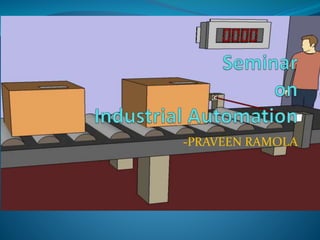
-PRAVEEN RAMOLA
Automation
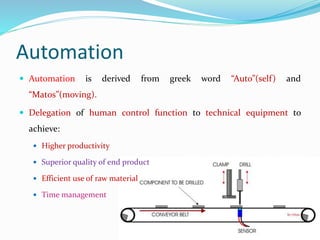
 Automation is derived from greek word “Auto”(self) and
“Matos”(moving).
 Delegation of human control function to technical equipment to
achieve:
 Higher productivity
 Superior quality of end product
 Efficient use of raw material
 Time management
Types Of Automation
 Home Automation
 E.g. Washing Machine , Microwave oven etc.
 Office Automation
 E.g. CCTV Cameras, Printers etc.
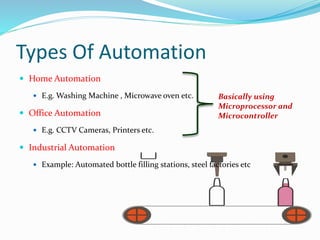
 Industrial Automation
 Example: Automated bottle filling stations, steel factories etc
Basically using
Microprocessor and
Microcontroller
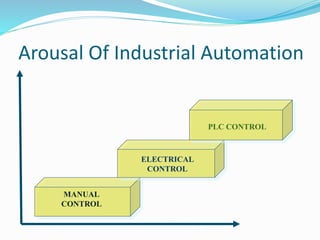
Arousal Of Industrial Automation
MANUAL
CONTROL
ELECTRICAL
CONTROL
PLC CONTROL
RELAYS
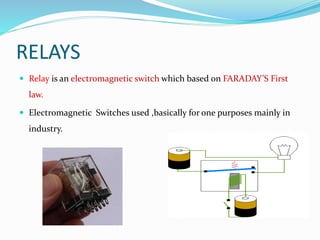
 Relay is an electromagnetic switch which based on FARADAY’S First
law.
 Electromagnetic Switches used ,basically for one purposes mainly in
industry.
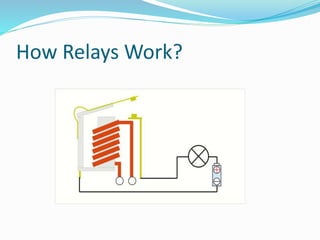
How Relays Work?
C
NC
NO
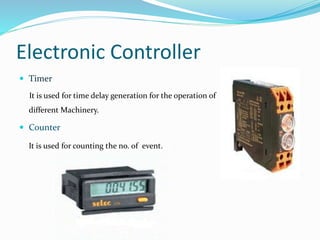
Electronic Controller
 Timer
It is used for time delay generation for the operation of
different Machinery.
 Counter
It is used for counting the no. of event.
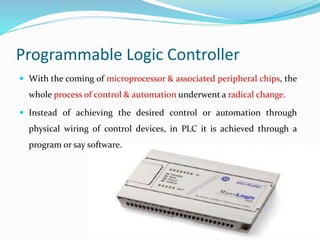
Programmable Logic Controller
 With the coming of microprocessor & associated peripheral chips, the
whole process of control & automation underwent a radical change.
 Instead of achieving the desired control or automation through
physical wiring of control devices, in PLC it is achieved through a
program or say software.
Programmable Logic Controller
 It is digital computer used for automation of electromechnical
processes.
 As desired logic control is achieved through a program ,these
controllers are reffered to as programmable logic controller.
 It is a combination of software and hardware ,through which it
monitors input ,makes decision based on its program and controls
outputs to automate a process or machine.
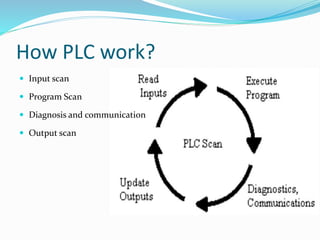
How PLC work?
 Input scan
 Program Scan
 Diagnosis and communication
 Output scan
Major components of common PLC
PROCESSOR
POWER
SUPPLY
PROGRAMMING
DEVICE
From
SENSORS
Pushbuttons,
contacts,
limit switches,
etc.
To
OUTPUT
Solenoids,
contactors,
alarms
etc.
I
N
P
U
T
M
O
D
U
L
E
O
U
T
P
U
T
M
O
D
U
L
E
Advantages of PLC
 Increased reliability
 More flexibility
 Lower cost
 Communication capability
 Faster response time
 Easier to troubleshoot
Programming Languages
 Ladder Logic Diagram
 Functional Block Diagram
 Instruction List
 Structural text
 Sequential Flow Chart
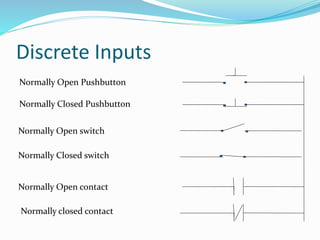
Discrete Inputs
Normally Open Pushbutton
Normally Closed Pushbutton
Normally Open switch
Normally Closed switch
Normally Open contact
Normally closed contact
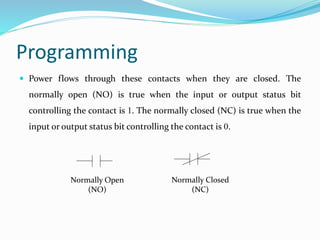
Programming
 Power flows through these contacts when they are closed. The
normally open (NO) is true when the input or output status bit
controlling the contact is 1. The normally closed (NC) is true when the
input or output status bit controlling the contact is 0.
Normally Open
(NO)
Normally Closed
(NC)
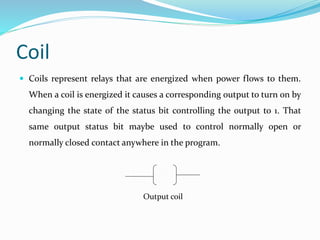
Coil
 Coils represent relays that are energized when power flows to them.
When a coil is energized it causes a corresponding output to turn on by
changing the state of the status bit controlling the output to 1. That
same output status bit maybe used to control normally open or
normally closed contact anywhere in the program.
Output coil
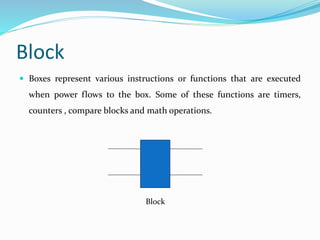
Block
 Boxes represent various instructions or functions that are executed
when power flows to the box. Some of these functions are timers,
counters , compare blocks and math operations.
Block
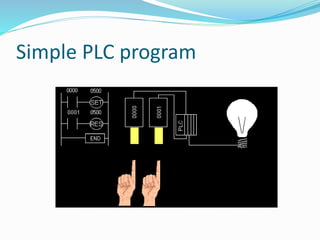
Simple PLC program
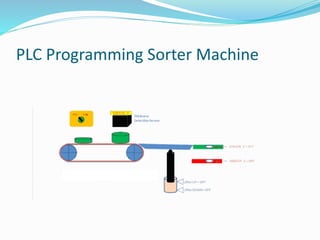
PLC Programming Sorter Machine
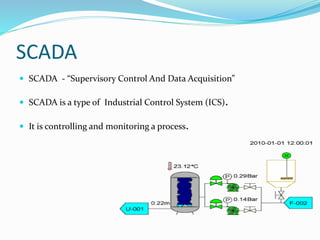
SCADA
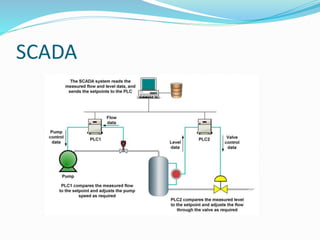
 SCADA - “Supervisory Control And Data Acquisition”
 SCADA is a type of Industrial Control System (ICS).
 It is controlling and monitoring a process.
Why SCADA?
 Saves Time and Money
 Less traveling for workers
 Reduces man-power needs
 Increases production efficiency of a company
 Cost effective for power systems
 Saves energy
 Reliable
 Supervisory control over a particular system
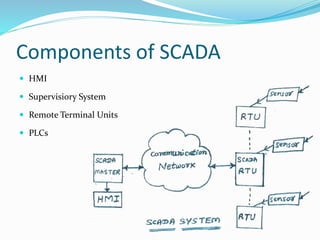
Components of SCADA
 HMI
 Supervisiory System
 Remote Terminal Units
 PLCs
SCADA
HMI
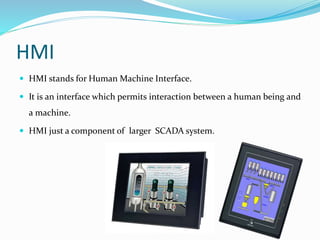
 HMI stands for Human Machine Interface.
 It is an interface which permits interaction between a human being and
a machine.
 HMI just a component of larger SCADA system.
VFD
 It stands for Variable Frequency Drive.
 It is for controlling the rotational speed often ac electric motor by
controlling the frequency of the electric power supply to the motor.
Industrial automation (PLC, SCADA, VFD & HMI)

Industrial automation (PLC, SCADA, VFD & HMI)

  • 1.
  • 2.
    Automation  Automation isderived from greek word “Auto”(self) and “Matos”(moving).  Delegation of human control function to technical equipment to achieve:  Higher productivity  Superior quality of end product  Efficient use of raw material  Time management
  • 3.
    Types Of Automation Home Automation  E.g. Washing Machine , Microwave oven etc.  Office Automation  E.g. CCTV Cameras, Printers etc.  Industrial Automation  Example: Automated bottle filling stations, steel factories etc Basically using Microprocessor and Microcontroller
  • 4.
    Arousal Of IndustrialAutomation MANUAL CONTROL ELECTRICAL CONTROL PLC CONTROL
  • 5.
    RELAYS  Relay isan electromagnetic switch which based on FARADAY’S First law.  Electromagnetic Switches used ,basically for one purposes mainly in industry.
  • 6.
  • 7.
    Electronic Controller  Timer Itis used for time delay generation for the operation of different Machinery.  Counter It is used for counting the no. of event.
  • 8.
    Programmable Logic Controller With the coming of microprocessor & associated peripheral chips, the whole process of control & automation underwent a radical change.  Instead of achieving the desired control or automation through physical wiring of control devices, in PLC it is achieved through a program or say software.
  • 9.
    Programmable Logic Controller It is digital computer used for automation of electromechnical processes.  As desired logic control is achieved through a program ,these controllers are reffered to as programmable logic controller.  It is a combination of software and hardware ,through which it monitors input ,makes decision based on its program and controls outputs to automate a process or machine.
  • 10.
    How PLC work? Input scan  Program Scan  Diagnosis and communication  Output scan
  • 11.
    Major components ofcommon PLC PROCESSOR POWER SUPPLY PROGRAMMING DEVICE From SENSORS Pushbuttons, contacts, limit switches, etc. To OUTPUT Solenoids, contactors, alarms etc. I N P U T M O D U L E O U T P U T M O D U L E
  • 12.
    Advantages of PLC Increased reliability  More flexibility  Lower cost  Communication capability  Faster response time  Easier to troubleshoot
  • 13.
    Programming Languages  LadderLogic Diagram  Functional Block Diagram  Instruction List  Structural text  Sequential Flow Chart
  • 14.
    Discrete Inputs Normally OpenPushbutton Normally Closed Pushbutton Normally Open switch Normally Closed switch Normally Open contact Normally closed contact
  • 15.
    Programming  Power flowsthrough these contacts when they are closed. The normally open (NO) is true when the input or output status bit controlling the contact is 1. The normally closed (NC) is true when the input or output status bit controlling the contact is 0. Normally Open (NO) Normally Closed (NC)
  • 16.
    Coil  Coils representrelays that are energized when power flows to them. When a coil is energized it causes a corresponding output to turn on by changing the state of the status bit controlling the output to 1. That same output status bit maybe used to control normally open or normally closed contact anywhere in the program. Output coil
  • 17.
    Block  Boxes representvarious instructions or functions that are executed when power flows to the box. Some of these functions are timers, counters , compare blocks and math operations. Block
  • 18.
  • 19.
  • 20.
    SCADA  SCADA -“Supervisory Control And Data Acquisition”  SCADA is a type of Industrial Control System (ICS).  It is controlling and monitoring a process.
  • 21.
    Why SCADA?  SavesTime and Money  Less traveling for workers  Reduces man-power needs  Increases production efficiency of a company  Cost effective for power systems  Saves energy  Reliable  Supervisory control over a particular system
  • 22.
    Components of SCADA HMI  Supervisiory System  Remote Terminal Units  PLCs
  • 23.
  • 24.
    HMI  HMI standsfor Human Machine Interface.  It is an interface which permits interaction between a human being and a machine.  HMI just a component of larger SCADA system.
  • 25.
    VFD  It standsfor Variable Frequency Drive.  It is for controlling the rotational speed often ac electric motor by controlling the frequency of the electric power supply to the motor.

Editor's Notes

  • #10 such as control of machinery on factory assembly lines, amusement rides, or lighting fixtures.
  • #21 Industrial control systems are computer controlled systems that monitor and control industrial processes that exist in the physical world
  • #23 It gathers data on the process and sending commands (or control) to the process. It connect to sensors in the process, converting sensor signals to digital data and sending digital data to the supervisory system. It is used as field devices because they are more economical, versatile, flexible, and configurable than special-purpose RTUs. It provides connectivity to the supervisory system to the Remote Terminal Units.
  • #25 needs some way to tell the machine what to do, to make requests of the machine, or to adjust the machine. Examples of input devices include keyboards, toggles, switches, touch screens