1
1
Dr. A. Ravi
Professor/EEE
FRANCIS XAVIER ENGINEERING COLLEGE
TIRUNELVELI
DIGITAL CONTROL OF
DC DRIVE
• Phase Locked Loop and micro-computer
control of DC drives
•Program flow chart for Constant torque
•Program flow chart for constant horse power
operations
•Speed detection and Current sensing circuits
and feedback elements.
Overview
2
MICRO-COMPUTER CONTROL OF
DC DRIVES
3
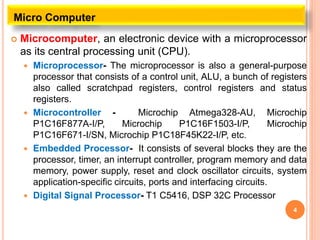
 Microcomputer, an electronic device with a microprocessor
as its central processing unit (CPU).
 Microprocessor- The microprocessor is also a general-purpose
processor that consists of a control unit, ALU, a bunch of registers
also called scratchpad registers, control registers and status
registers.
 Microcontroller - Microchip Atmega328-AU, Microchip
P1C16F877A-I/P, Microchip P1C16F1503-I/P, Microchip
P1C16F671-I/SN, Microchip P1C18F45K22-I/P, etc.
 Embedded Processor- It consists of several blocks they are the
processor, timer, an interrupt controller, program memory and data
memory, power supply, reset and clock oscillator circuits, system
application-specific circuits, ports and interfacing circuits.
 Digital Signal Processor- T1 C5416, DSP 32C Processor
4
Micro Computer
 Reduces costs and Size
 Provides Reliability and Control Performance
 Flexible to change the control strategy
 Extra Features can be added to meet performance
parameters.
5
Advantages of Microcomputer Based DC Motor Drive
 Speed Control
 Current Control
 Start and Stop of drive
 Diagnostics for built-in fault finding
 Protections
6
Performs various desirable functions such as
7
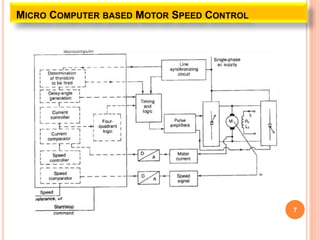
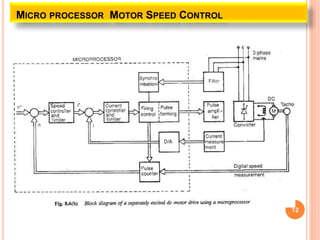
MICRO COMPUTER BASED MOTOR SPEED CONTROL
FEATURES OF MICRO COMPUTER BASED CONTROL
 Speed Signal is fed by use of D/A converter
 An inner current –control loop is used to control the
armature current
 Line Synchronizing Circuit - To Synchronize the
generation of the firing pulses with the supply line
frequency.
 Pulse amplifier-- Provides the necessary isolation and
produces the gate pulses of required magnitude and
duration.
8
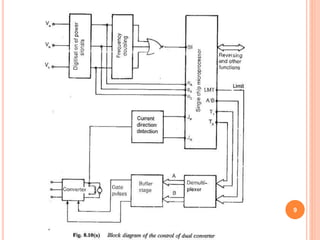
9
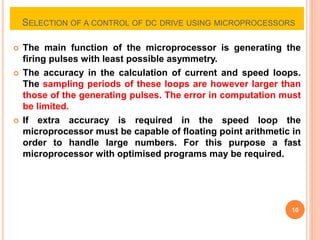
 The main function of the microprocessor is generating the
firing pulses with least possible asymmetry.
 The accuracy in the calculation of current and speed loops.
The sampling periods of these loops are however larger than
those of the generating pulses. The error in computation must
be limited.
 If extra accuracy is required in the speed loop the
microprocessor must be capable of floating point arithmetic in
order to handle large numbers. For this purpose a fast
microprocessor with optimised programs may be required.
10
SELECTION OF A CONTROL OF DC DRIVE USING MICROPROCESSORS
 chopper controlled four quadrant dc drives
using separately excited dc motor or dc series
motor.
 multiphase chopper controlled dc drives
 pulse width controlled dc drives
 The multiple firing schemes for improving the
performance of dc drives, g., TRC and CLC.
11
APPLICATIONS OF MICROPROCESSORS IN THE AREA OF DC
DRIVES
12
MICRO PROCESSOR MOTOR SPEED CONTROL
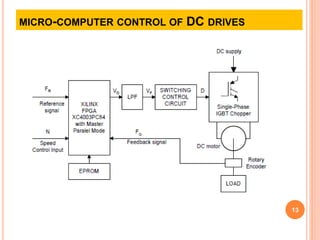
MICRO-COMPUTER CONTROL OF DC DRIVES
13
14

Micro computer control of dc drive

  • 1.
    1 1 Dr. A. Ravi Professor/EEE FRANCISXAVIER ENGINEERING COLLEGE TIRUNELVELI DIGITAL CONTROL OF DC DRIVE
  • 2.
    • Phase LockedLoop and micro-computer control of DC drives •Program flow chart for Constant torque •Program flow chart for constant horse power operations •Speed detection and Current sensing circuits and feedback elements. Overview 2
  • 3.
  • 4.
     Microcomputer, anelectronic device with a microprocessor as its central processing unit (CPU).  Microprocessor- The microprocessor is also a general-purpose processor that consists of a control unit, ALU, a bunch of registers also called scratchpad registers, control registers and status registers.  Microcontroller - Microchip Atmega328-AU, Microchip P1C16F877A-I/P, Microchip P1C16F1503-I/P, Microchip P1C16F671-I/SN, Microchip P1C18F45K22-I/P, etc.  Embedded Processor- It consists of several blocks they are the processor, timer, an interrupt controller, program memory and data memory, power supply, reset and clock oscillator circuits, system application-specific circuits, ports and interfacing circuits.  Digital Signal Processor- T1 C5416, DSP 32C Processor 4 Micro Computer
  • 5.
     Reduces costsand Size  Provides Reliability and Control Performance  Flexible to change the control strategy  Extra Features can be added to meet performance parameters. 5 Advantages of Microcomputer Based DC Motor Drive
  • 6.
     Speed Control Current Control  Start and Stop of drive  Diagnostics for built-in fault finding  Protections 6 Performs various desirable functions such as
  • 7.
    7 MICRO COMPUTER BASEDMOTOR SPEED CONTROL
  • 8.
    FEATURES OF MICROCOMPUTER BASED CONTROL  Speed Signal is fed by use of D/A converter  An inner current –control loop is used to control the armature current  Line Synchronizing Circuit - To Synchronize the generation of the firing pulses with the supply line frequency.  Pulse amplifier-- Provides the necessary isolation and produces the gate pulses of required magnitude and duration. 8
  • 9.
  • 10.
     The mainfunction of the microprocessor is generating the firing pulses with least possible asymmetry.  The accuracy in the calculation of current and speed loops. The sampling periods of these loops are however larger than those of the generating pulses. The error in computation must be limited.  If extra accuracy is required in the speed loop the microprocessor must be capable of floating point arithmetic in order to handle large numbers. For this purpose a fast microprocessor with optimised programs may be required. 10 SELECTION OF A CONTROL OF DC DRIVE USING MICROPROCESSORS
  • 11.
     chopper controlledfour quadrant dc drives using separately excited dc motor or dc series motor.  multiphase chopper controlled dc drives  pulse width controlled dc drives  The multiple firing schemes for improving the performance of dc drives, g., TRC and CLC. 11 APPLICATIONS OF MICROPROCESSORS IN THE AREA OF DC DRIVES
  • 12.
  • 13.
  • 14.