PHYSICAL SYSTEM MODELLING
MECHANICAL SYSTEMS
Eng. Mahmoud Hussein
28-Feb-17
RTECS 2015 1
RTECS_2017
Modelling the Plant
Physical System Modelling3
RTECS
Definition of System
23
 From engineering point of view, a system is defined as an
interconnection of many components that act together to
perform a certain objective
 Automobile
 Machine tool
 Robot
RTECS
Physical Systems Classification
24
Physical
System
Static System Dynamic
System
RTECS
Static System
25
 Output of the system depends only on the current input
 The system has no memory
RTECS
Dynamic System
26
 Output of the system depends on the current input as well as
previous inputs/outputs
 The system has internal memory
A dynamic system can be represented mathematically
using differential equations
RTECS
Dynamic System Mathematical
27
 For many physical systems, this rule that governs the behavior
of a dynamic system can be stated as a set of first-order
differential equations:
Where
xt:statevector,a set of variables representing theconfiguration of thesystemat time t
ut: vector of controlinputsat time t
f : possibly nonlinear function giving the time derivative (rate of change) of thestatevector
dt
dx
 f xt,ut,t

x 
RTECS
Dynamic System Mathematical
Representation RL Circuit Example
28
dt
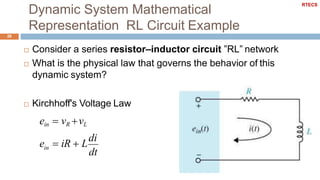
ine  iR  L
di
 Consider a series resistor–inductor circuit ”RL” network
 What is the physical law that governs the behavior of this
dynamic system?
 Kirchhoff's Voltage Law
ein  vR vL
RTECS
Dynamic System Mathematical
Representation RL Circuit Example
29
 Does the behavior of this system changes with time?
 Does ‘R’ change with time?
 Does ‘L’ change with time?
dt
ine  iR L
di
If the system parameters do not change
with time
 The system is Time-Invariant
RTECS
Example of a Time Variant System
30
RTECS
Dynamic System Mathematical
Representation RL Circuit Example
31
 Is the system equation linear?
 Does it include a state with power of 2 (i2)?
 Does it include saturation?
dt
ine  iR L
di
If the system equation is linear
 The system is linear
RTECS
Linear Time-Invariant System (LTI System)
32
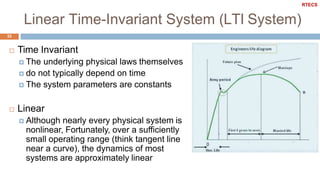
 Time Invariant
 The underlying physical laws themselves
 do not typically depend on time
 The system parameters are constants
 Linear
 Although nearly every physical system is
nonlinear, Fortunately, over a sufficiently
small operating range (think tangent line
near a curve), the dynamics of most
systems are approximately linear
RTECS
Physical Systems Classification
33
Physical
System
Static System
Dynamic
System
First Order Second Order
nth order
RTECS
The system order usually corresponds
to the number of independent energy
storage elements in the system.
Transfer Function Representation
34
 LTI systems have the extremely important property that if the
input to the system is sinusoidal, then the output will also be
sinusoidal at the same frequency but in general with different
magnitude and phase.
 These magnitude and phase differences as a function of
frequency are known as the frequency response of the system.
RTECS
Transfer Function Representation
35
 Using the Laplace transform, it is possible to convert a
system's time-domain representation into a frequency-domain
output/input representation, known as the transfer function.
 In so doing, it also transforms the governing differential equation
into an algebraic equation which is often easier to analyze.
 Frequency-domain methods are most often used for analyzing
LTI single-input/single-output (SISO)systems, e.g. those
governed by a constant coefficient differential equation
RTECS
Transfer Function Representation
36
 The Laplace transform of a time domain function
0
Where
s    j complex frequency variable

 st
F(s)  f (t)e dt
RTECS
Transfer Function Representation
37
 A transfer function is the Laplace transform of thesystem’s
differential equation with omitting initial conditions
 Hence, it is a rational function of the variable ‘s’
01nX (s) a sn
 a s
Y(s) b sm
b
G(s)  n1
n1
m m1 1 0
 a s  a
sm1
 b s b
RTECS
Transfer Function Representation
38
are constants, the system is linear If the coefficients ai and bi
time invariant (LTI)
 The highest order n of the denominator is referred to as the
order of the system.
 For a physically realizable system, m ≤ n. (Causal system)
Y(s)
nX (s) a sn
a
b sm
b
G(s)  n1
n1 1 0
m m1 1 0
s  a s  a
sm1
 b s b
RTECS
MATLAB Representations of Transfer Functions
39
 num=[b1,b2,. . .,bm,bm+1];
 den=[1,a1,a2,. . .,an−1, an];
 G=tf(num,den)
 Example
s4
 2s3
 3s2
 4s  5
s  5
G(s) 
RTECS
Transfer Function Representation
40
 It is useful to factor the numerator and denominator of the
transfer function into the so called zero-pole-gain form
 The poles are the values of s for which a(s)=0, and
 The zeros are the values of s for which b(s)=0.
G(s) 
Y(s)

b(s)
X (s) a(s)
RTECS
Zero-Pole-Gain Representation In MATLAB
41
 z=-[z1; z2; · · · ; zm];
 p=-[p1; p2; · · · ; pn];
 G=zpk(z,p,K)
 Example
s 3
(s  2)(s  4)(s  5)
 pzmap
 Plots the pole-zero map of the LTI model sys
RTECS
What is a Real Time System?42
RTECS
Real-Time System
43
 A real-time system is a software system where the correct
functioning of the system depends not only on the results
produced by the system but also on the time at which these
results are produced.
 The system has "real-time constraints"
RTECS
Hard Real-Time System
44
 A hard real-time system is a system whose operation is incorrectif
results are not produced according to the timing specification.
 Car engine control system is a hard real-time system
 because a delayed signal may cause engine failure or damage
 Flight Control System
 Airbag crash detection system
RTECS
Hard Real-Time System
RTECS 2014 13-Mar-17
45
 Delay = Failure
 Time granularity
 Millisecond
 RequiredAnalysis
 Worst possible scenario
 Need for redundancy
 To meet safety requirements
RTECS
Hard Real-Time System Example
46
 Airbag crash detection system
 Airbag must inflate between 10 and 20 msec from the detection of a crash
 Not too early—since this would make the airbag deflate before it can catch
the passenger
 Nor too late—since the airbag could then injure the passenger by blowing up
in his face and/or catch him too late to prevent his head from banging into the
steering wheel
RTECS
Soft Real-Time System
47
 A soft real-time system is a system whose operation is
degraded if results are not produced according to the specified
timing requirements.
 Non-safety-critical system
 Keypad input
 Message visualization
 System status representation
RTECS
What is an Embedded Control System?48
RTECS
Embedded Systems
49
 An embedded system combines mechanical, electrical, and
chemical components along with a computer, hidden inside, to
perform a single dedicated purpose.
RTECS
Control Objectives50
RTECS
Modelling of Plant Dynamics
4
 Deriving a dynamic model: Set of differential equations that
describes the dynamic behaviour of the plant
 Mechanical
 Electrical
 Hydraulic
 Pneumatic
 Magnetic
 Thermal
 Linearization the dynamic model if necessary
RTECS
Plant Modelling Steps
5
Real System
Physical Model
• idealized model of the
system which
determines which
aspects of the system
are important and which
can be neglected
Mathematical Model
•writing the equations
describing the system
Numerically Solving
the Mathematical
Model
• Solving this equations
numerically Which in our
case is done using
Simulink
RTECS
Modelling Mechanical Systems6
RTECS
Basic Elements of Mechanical Systems
7
 Three passive, linear components
 Mass / Inertia
 Spring
 Viscous damper
RTECS
Mass
Energy-storage Element - Kinetic Energy
8
 Newton's second law
 the sum of the forces acting on a body equals its mass times
acceleration.
 Newton's third law
 if two bodies are connected, then they experience the same
magnitude force acting in opposite directions.
Force  ma  mx
RTECS
Inertia
Energy-storage Element - Kinetic Energy
9
 Euler's Equations for Rotational Dynamics
 The torque to accelerate a body is the product of its inertia and
angular acceleration
Torque  J  J
RTECS
Spring
Energy-storage Element - Potential Energy
10
 An elastic element extends in proportion to the force (or torque)
applied to it.
 For the translational spring
F  k(x  x0 ) ; k[N / m]:springstiffness
 For the rotational spring
T  k( 0 ) ; k[Nm / rad]:springstiffness
RTECS
Viscous Damper
Energy-dissipative Element11
 A damping element produces a velocity in proportion tothe
force (or torque) applied to it.
 For the translational damper
F  dx; d [Ns / m]:damping coefficient
 For the rotational damper
T  d; d[Nms / rad]:damping coefficient
d
RTECS
Mass Spring Damper System
Modelling Mechanical System Example12
RTECS
Mass-Spring-Damper System
13
 The spring force is proportional to the displacement of the mass, x,
 The viscous damping force is proportional to the velocity of the
mass, v
d
RTECS
Free-body Diagram
14
 Both spring force and viscous damping force oppose the
motion of the mass and are therefore shown in the negative x-
direction.
 Note also, that x=0 corresponds to the position of the mass
when the spring is unstretched.
d
RTECS
Applying Newton's Second Law
15
RTECS
Newton's secondlaw
mx Force
mx f  kx dx
mx dx kx  f
 Integrator approach
mx dx kx  f

mx f  dxkx
Mass-Spring-Damper System
Integrator Approach16
mx f  dx kx
RTECS
% System Parameters
m = 20; % kg
d = 4; % N/(m/s)
k = 2; % N/m
f = 5; % N
Mass-Spring-Damper System
Transfer Function Approach17
ms2
 ds k
1
F(s)
G(s) 
X (s)

 Transfer function approach
 Taking Laplace transform
ms2
X (s)  dsX (s)  kX(s)  F(s)
Transfer Function Approach Assumes Zero Initial Conditions
RTECS
Mass-Spring-Damper System
Transfer Function in Matlab18
 s = tf('s');
 sys = 1/(m*s^2+d*s+k)
 Note that we have used the symbolic s variable here to define our
transfer function model.
 Alternatively
 num = [1];
 den = [m b k];
 sys = tf(num,den)
RTECS
Mass-Spring-Damper System
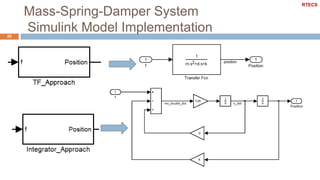
Simulink Model Implementation19
RTECS
Mass-Spring-Damper System
Simulink Model Implementation20
RTECS
Thank You for Your Attention
Vehicle Suspension System
Modelling Mechanical System Example22
RTECS
Application: Vehicle Suspension :Real System
23
 Car suspension ensures the comfort of the passengers
RTECS
Vehicle Suspension: Physical Model
24
 Quarter-car model
The body mass represents ¼ of the
vehicle’s total mass
 Required
 Vertical motion of the vehicle x(t)
in response to the input
of the road surface on the wheel u(t).
RTECS
Vehicle Suspension: Mathematical Model
25
 Newton's second law
mx Force
mx kx u dxu
mx dx kx  du ku
 Integrator approach
mx du ku  dx kx
 Transfer Function approach
 Taking Laplace transform
G(s) 
X (s)

ds  k
U(s) ms2
 ds k
RTECS
Quiz
26
RTECS
• M1= 1/4 bus body mass 2500 kg
• M2= suspension mass 320 kg
• K1= spring constant of suspension system 80,000 N/m
• K2= spring constant of wheel and tire 500,000 N/m
• B1= damping constant of suspension system 350 N.s/m
• B2= damping constant of wheel and tire 15,020 N.s/m
• U= control force
Solution
27
RTECS
Home Work
28
RTECS
 Determine the equation of motion
 Create a simulink Model
RTECS

02 physical.system.modelling mechanical.systems.

  • 1.
    PHYSICAL SYSTEM MODELLING MECHANICALSYSTEMS Eng. Mahmoud Hussein 28-Feb-17 RTECS 2015 1 RTECS_2017
  • 2.
    Modelling the Plant PhysicalSystem Modelling3 RTECS
  • 3.
    Definition of System 23 From engineering point of view, a system is defined as an interconnection of many components that act together to perform a certain objective  Automobile  Machine tool  Robot RTECS
  • 4.
  • 5.
    Static System 25  Outputof the system depends only on the current input  The system has no memory RTECS
  • 6.
    Dynamic System 26  Outputof the system depends on the current input as well as previous inputs/outputs  The system has internal memory A dynamic system can be represented mathematically using differential equations RTECS
  • 7.
    Dynamic System Mathematical 27 For many physical systems, this rule that governs the behavior of a dynamic system can be stated as a set of first-order differential equations: Where xt:statevector,a set of variables representing theconfiguration of thesystemat time t ut: vector of controlinputsat time t f : possibly nonlinear function giving the time derivative (rate of change) of thestatevector dt dx  f xt,ut,t  x  RTECS
  • 8.
    Dynamic System Mathematical RepresentationRL Circuit Example 28 dt ine  iR  L di  Consider a series resistor–inductor circuit ”RL” network  What is the physical law that governs the behavior of this dynamic system?  Kirchhoff's Voltage Law ein  vR vL RTECS
  • 9.
    Dynamic System Mathematical RepresentationRL Circuit Example 29  Does the behavior of this system changes with time?  Does ‘R’ change with time?  Does ‘L’ change with time? dt ine  iR L di If the system parameters do not change with time  The system is Time-Invariant RTECS
  • 10.
    Example of aTime Variant System 30 RTECS
  • 11.
    Dynamic System Mathematical RepresentationRL Circuit Example 31  Is the system equation linear?  Does it include a state with power of 2 (i2)?  Does it include saturation? dt ine  iR L di If the system equation is linear  The system is linear RTECS
  • 12.
    Linear Time-Invariant System(LTI System) 32  Time Invariant  The underlying physical laws themselves  do not typically depend on time  The system parameters are constants  Linear  Although nearly every physical system is nonlinear, Fortunately, over a sufficiently small operating range (think tangent line near a curve), the dynamics of most systems are approximately linear RTECS
  • 13.
    Physical Systems Classification 33 Physical System StaticSystem Dynamic System First Order Second Order nth order RTECS The system order usually corresponds to the number of independent energy storage elements in the system.
  • 14.
    Transfer Function Representation 34 LTI systems have the extremely important property that if the input to the system is sinusoidal, then the output will also be sinusoidal at the same frequency but in general with different magnitude and phase.  These magnitude and phase differences as a function of frequency are known as the frequency response of the system. RTECS
  • 15.
    Transfer Function Representation 35 Using the Laplace transform, it is possible to convert a system's time-domain representation into a frequency-domain output/input representation, known as the transfer function.  In so doing, it also transforms the governing differential equation into an algebraic equation which is often easier to analyze.  Frequency-domain methods are most often used for analyzing LTI single-input/single-output (SISO)systems, e.g. those governed by a constant coefficient differential equation RTECS
  • 16.
    Transfer Function Representation 36 The Laplace transform of a time domain function 0 Where s    j complex frequency variable   st F(s)  f (t)e dt RTECS
  • 17.
    Transfer Function Representation 37 A transfer function is the Laplace transform of thesystem’s differential equation with omitting initial conditions  Hence, it is a rational function of the variable ‘s’ 01nX (s) a sn  a s Y(s) b sm b G(s)  n1 n1 m m1 1 0  a s  a sm1  b s b RTECS
  • 18.
    Transfer Function Representation 38 areconstants, the system is linear If the coefficients ai and bi time invariant (LTI)  The highest order n of the denominator is referred to as the order of the system.  For a physically realizable system, m ≤ n. (Causal system) Y(s) nX (s) a sn a b sm b G(s)  n1 n1 1 0 m m1 1 0 s  a s  a sm1  b s b RTECS
  • 19.
    MATLAB Representations ofTransfer Functions 39  num=[b1,b2,. . .,bm,bm+1];  den=[1,a1,a2,. . .,an−1, an];  G=tf(num,den)  Example s4  2s3  3s2  4s  5 s  5 G(s)  RTECS
  • 20.
    Transfer Function Representation 40 It is useful to factor the numerator and denominator of the transfer function into the so called zero-pole-gain form  The poles are the values of s for which a(s)=0, and  The zeros are the values of s for which b(s)=0. G(s)  Y(s)  b(s) X (s) a(s) RTECS
  • 21.
    Zero-Pole-Gain Representation InMATLAB 41  z=-[z1; z2; · · · ; zm];  p=-[p1; p2; · · · ; pn];  G=zpk(z,p,K)  Example s 3 (s  2)(s  4)(s  5)  pzmap  Plots the pole-zero map of the LTI model sys RTECS
  • 22.
    What is aReal Time System?42 RTECS
  • 23.
    Real-Time System 43  Areal-time system is a software system where the correct functioning of the system depends not only on the results produced by the system but also on the time at which these results are produced.  The system has "real-time constraints" RTECS
  • 24.
    Hard Real-Time System 44 A hard real-time system is a system whose operation is incorrectif results are not produced according to the timing specification.  Car engine control system is a hard real-time system  because a delayed signal may cause engine failure or damage  Flight Control System  Airbag crash detection system RTECS
  • 25.
    Hard Real-Time System RTECS2014 13-Mar-17 45  Delay = Failure  Time granularity  Millisecond  RequiredAnalysis  Worst possible scenario  Need for redundancy  To meet safety requirements RTECS
  • 26.
    Hard Real-Time SystemExample 46  Airbag crash detection system  Airbag must inflate between 10 and 20 msec from the detection of a crash  Not too early—since this would make the airbag deflate before it can catch the passenger  Nor too late—since the airbag could then injure the passenger by blowing up in his face and/or catch him too late to prevent his head from banging into the steering wheel RTECS
  • 27.
    Soft Real-Time System 47 A soft real-time system is a system whose operation is degraded if results are not produced according to the specified timing requirements.  Non-safety-critical system  Keypad input  Message visualization  System status representation RTECS
  • 28.
    What is anEmbedded Control System?48 RTECS
  • 29.
    Embedded Systems 49  Anembedded system combines mechanical, electrical, and chemical components along with a computer, hidden inside, to perform a single dedicated purpose. RTECS
  • 30.
  • 31.
    Modelling of PlantDynamics 4  Deriving a dynamic model: Set of differential equations that describes the dynamic behaviour of the plant  Mechanical  Electrical  Hydraulic  Pneumatic  Magnetic  Thermal  Linearization the dynamic model if necessary RTECS
  • 32.
    Plant Modelling Steps 5 RealSystem Physical Model • idealized model of the system which determines which aspects of the system are important and which can be neglected Mathematical Model •writing the equations describing the system Numerically Solving the Mathematical Model • Solving this equations numerically Which in our case is done using Simulink RTECS
  • 33.
  • 34.
    Basic Elements ofMechanical Systems 7  Three passive, linear components  Mass / Inertia  Spring  Viscous damper RTECS
  • 35.
    Mass Energy-storage Element -Kinetic Energy 8  Newton's second law  the sum of the forces acting on a body equals its mass times acceleration.  Newton's third law  if two bodies are connected, then they experience the same magnitude force acting in opposite directions. Force  ma  mx RTECS
  • 36.
    Inertia Energy-storage Element -Kinetic Energy 9  Euler's Equations for Rotational Dynamics  The torque to accelerate a body is the product of its inertia and angular acceleration Torque  J  J RTECS
  • 37.
    Spring Energy-storage Element -Potential Energy 10  An elastic element extends in proportion to the force (or torque) applied to it.  For the translational spring F  k(x  x0 ) ; k[N / m]:springstiffness  For the rotational spring T  k( 0 ) ; k[Nm / rad]:springstiffness RTECS
  • 38.
    Viscous Damper Energy-dissipative Element11 A damping element produces a velocity in proportion tothe force (or torque) applied to it.  For the translational damper F  dx; d [Ns / m]:damping coefficient  For the rotational damper T  d; d[Nms / rad]:damping coefficient d RTECS
  • 39.
    Mass Spring DamperSystem Modelling Mechanical System Example12 RTECS
  • 40.
    Mass-Spring-Damper System 13  Thespring force is proportional to the displacement of the mass, x,  The viscous damping force is proportional to the velocity of the mass, v d RTECS
  • 41.
    Free-body Diagram 14  Bothspring force and viscous damping force oppose the motion of the mass and are therefore shown in the negative x- direction.  Note also, that x=0 corresponds to the position of the mass when the spring is unstretched. d RTECS
  • 42.
    Applying Newton's SecondLaw 15 RTECS Newton's secondlaw mx Force mx f  kx dx mx dx kx  f  Integrator approach mx dx kx  f  mx f  dxkx
  • 43.
    Mass-Spring-Damper System Integrator Approach16 mxf  dx kx RTECS % System Parameters m = 20; % kg d = 4; % N/(m/s) k = 2; % N/m f = 5; % N
  • 44.
    Mass-Spring-Damper System Transfer FunctionApproach17 ms2  ds k 1 F(s) G(s)  X (s)   Transfer function approach  Taking Laplace transform ms2 X (s)  dsX (s)  kX(s)  F(s) Transfer Function Approach Assumes Zero Initial Conditions RTECS
  • 45.
    Mass-Spring-Damper System Transfer Functionin Matlab18  s = tf('s');  sys = 1/(m*s^2+d*s+k)  Note that we have used the symbolic s variable here to define our transfer function model.  Alternatively  num = [1];  den = [m b k];  sys = tf(num,den) RTECS
  • 46.
  • 47.
  • 48.
    Thank You forYour Attention
  • 49.
    Vehicle Suspension System ModellingMechanical System Example22 RTECS
  • 50.
    Application: Vehicle Suspension:Real System 23  Car suspension ensures the comfort of the passengers RTECS
  • 51.
    Vehicle Suspension: PhysicalModel 24  Quarter-car model The body mass represents ¼ of the vehicle’s total mass  Required  Vertical motion of the vehicle x(t) in response to the input of the road surface on the wheel u(t). RTECS
  • 52.
    Vehicle Suspension: MathematicalModel 25  Newton's second law mx Force mx kx u dxu mx dx kx  du ku  Integrator approach mx du ku  dx kx  Transfer Function approach  Taking Laplace transform G(s)  X (s)  ds  k U(s) ms2  ds k RTECS
  • 53.
    Quiz 26 RTECS • M1= 1/4bus body mass 2500 kg • M2= suspension mass 320 kg • K1= spring constant of suspension system 80,000 N/m • K2= spring constant of wheel and tire 500,000 N/m • B1= damping constant of suspension system 350 N.s/m • B2= damping constant of wheel and tire 15,020 N.s/m • U= control force
  • 54.
  • 55.
    Home Work 28 RTECS  Determinethe equation of motion  Create a simulink Model
  • 56.