CONTROL SYSTEMS
Presented by
P GODIESWARI
M K GAYATHRI
V GULSHAN
R HARINI
system
Number of element or components are
connected in a sequence to perform the specific
function
Control system
➢ Output quantity is control by varying the input
quantity
➢ A control system consisting of interconnected
components is designed to achieve a desired
purpose
TYPE OF CONTRL SYSTEM
➢ Open loop system
➢ Closed loop system
Open loop system
Output has no effect
upon input quantity
Not automatically
correct the variation
in its output
Output not feedback
to input for correction
•Input
•R(t)
•Plant
•Or system
•Output
•C(t)
Closed loop system
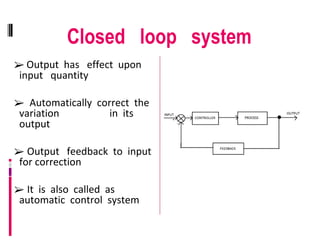
➢ Output has effect upon
input quantity
➢ Automatically correct the
variation in its
output
➢ Output feedback to input
for correction
➢ It is also called as
automatic control system
Advantage
▪ Simple
▪ Economical
▪ Easy to construct
▪ stable
open loop system
Disadvantage
▪ Inaccurate
▪ Unreliable
▪ Change in output due to external
disturbances are not corrected
automatically
Open loop system
Advantage
▪ Accurate even the presence of
nonlinearities
▪ sensitivity
▪ Stable
▪ Less affected by noise
Closed loop system
Disadvantage
▪ complex
▪ costlier
▪ Reduce the gain of system more care to
design a stable closed loop system
Closed loop system
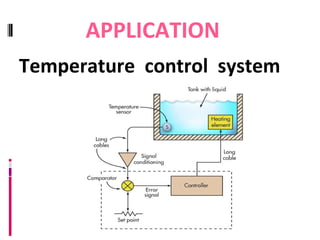
APPLICATION
Temperature control system
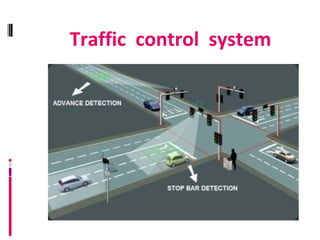
Traffic control system
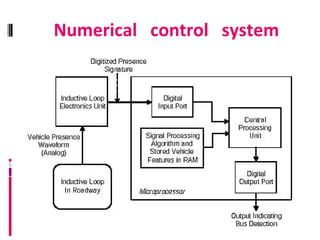
Numerical control system
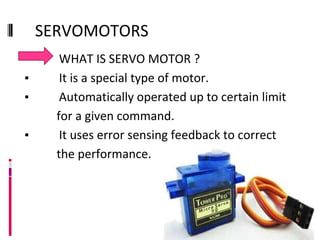
SERVOMOTORS
SERVOMOTORS
▪ WHAT IS SERVO MOTOR ?
▪ It is a special type of motor.
▪ Automatically operated up to certain limit
for a given command.
▪ It uses error sensing feedback to correct
the performance.
TYPES OF SERVO MOTORS
AC SERVOMOTORS
DC SERVOMOTORS
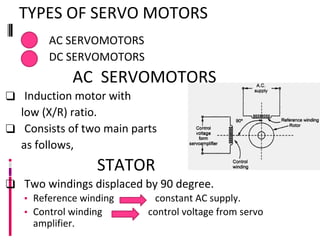
AC SERVOMOTORS
❑ Induction motor with
low (X/R) ratio.
❑ Consists of two main parts
as follows,
STATOR
❑ Two windings displaced by 90 degree.
▪ Reference winding constant AC supply.
▪ Control winding control voltage from servo
amplifier.
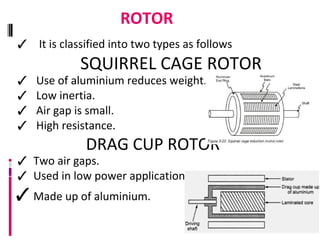
ROTOR
✓ It is classified into two types as follows
SQUIRREL CAGE ROTOR
✓ Use of aluminium reduces weight.
✓ Low inertia.
✓ Air gap is small.
✓ High resistance.
DRAG CUP ROTOR
✓ Two air gaps.
✓ Used in low power applications.
✓ Made up of aluminium.
WORKING
▪ The voltage applied to stator creates RMF which
makes rotor shaft to rotate.
▪ Torque-Speed characteristics.
✓ Linear for low (X/R) ratio.
✓ Non-linear for high (X/R) ratio.
▪ Linear characteristics depends
on control voltage.
▪ It is operated in low speed range.
AC SERVO MOTOR FEATURES
o Small (X/R) ratio & high efficiency.
o Smooth, Less weight & low cost.
o Robust construction & noise free working.
APPLICATIONS OF AC SERVO MOTORS
o Recorders,Computers and Robotics.
DC SERVOMOTORS
o It is classified as ,
o Electromagnetic field motor.
o Permanent motor.
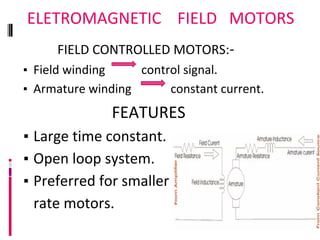
ELETROMAGNETIC FIELD MOTORS
FIELD CONTROLLED MOTORS:-
▪ Field winding control signal.
▪ Armature winding constant current.
FEATURES
▪ Large time constant.
▪ Open loop system.
▪ Preferred for smaller
rate motors.
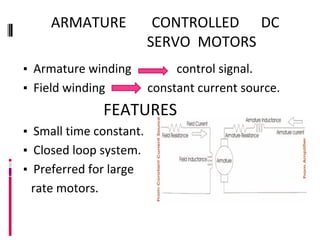
ARMATURE CONTROLLED DC
SERVO MOTORS
▪ Armature winding control signal.
▪ Field winding constant current source.
FEATURES
▪ Small time constant.
▪ Closed loop system.
▪ Preferred for large
rate motors.
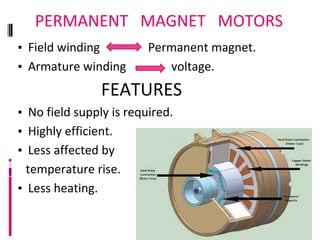
PERMANENT MAGNET MOTORS
▪ Field winding Permanent magnet.
▪ Armature winding voltage.
FEATURES
▪ No field supply is required.
▪ Highly efficient.
▪ Less affected by
temperature rise.
▪ Less heating.
SYNCHROS
Synchros
Synchros is a name for a family of
inductive devices which works on the
principle of a rotating transformer.
They can be used in following two ways
1. To control the angular position of load from
a remote place.
2. For automatic correction of changes due to
disturbance in the angular position of the
load.
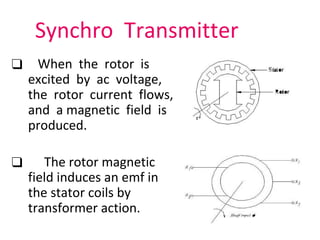
Synchro Transmitter
❑ When the rotor is
excited by ac voltage,
the rotor current flows,
and a magnetic field is
produced.
❑ The rotor magnetic
field induces an emf in
the stator coils by
transformer action.
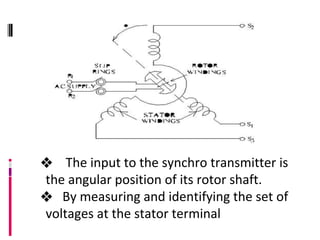
❖ The input to the synchro transmitter is
the angular position of its rotor shaft.
❖ By measuring and identifying the set of
voltages at the stator terminal
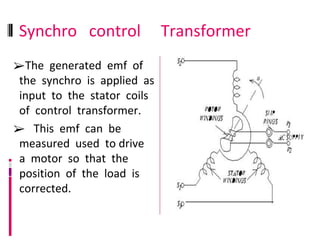
Synchro control Transformer
➢The generated emf of
the synchro is applied as
input to the stator coils
of control transformer.
➢ This emf can be
measured used to drive
a motor so that the
position of the load is
corrected.
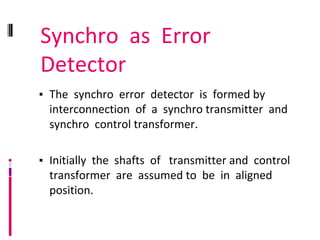
Synchro as Error
Detector
▪ The synchro error detector is formed by
interconnection of a synchro transmitter and
synchro control transformer.
▪ Initially the shafts of transmitter and control
transformer are assumed to be in aligned
position.
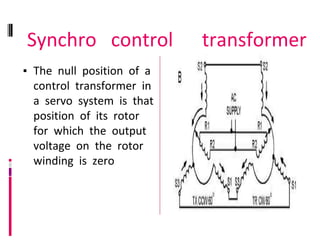
Synchro control transformer
▪ The null position of a
control transformer in
a servo system is that
position of its rotor
for which the output
voltage on the rotor
winding is zero
SIGNAL FLOW GRAPH
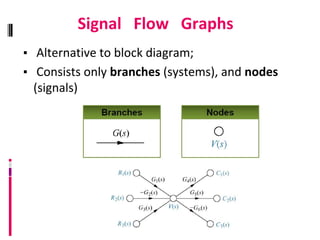
Signal Flow Graphs
▪ Alternative to block diagram;
▪ Consists only branches (systems), and nodes
(signals)
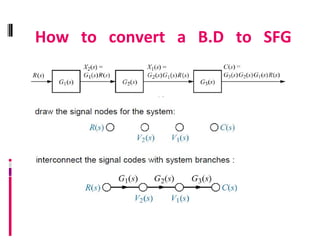
How to convert a B.D to SFG
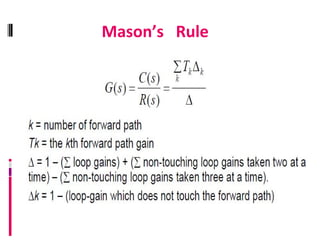
Mason’s Rule
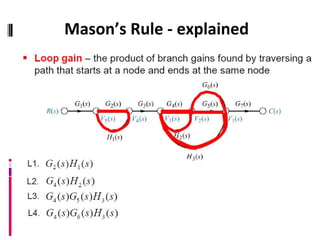
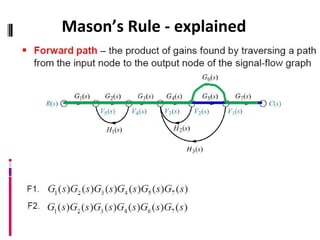
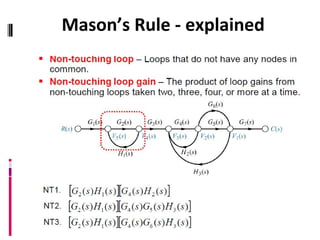
Mason’s Rule - explained
Properties of signal flow graph
▪ Applicable to linear systems only.
▪ Algebraic equations in the form of cause and
effect relationship.
▪ Node represents the variable or signal.
▪ Branch indicates functional dependence.
THANK YOU

Control system

  • 1.
    CONTROL SYSTEMS Presented by PGODIESWARI M K GAYATHRI V GULSHAN R HARINI
  • 2.
    system Number of elementor components are connected in a sequence to perform the specific function Control system ➢ Output quantity is control by varying the input quantity ➢ A control system consisting of interconnected components is designed to achieve a desired purpose TYPE OF CONTRL SYSTEM ➢ Open loop system ➢ Closed loop system
  • 3.
    Open loop system Outputhas no effect upon input quantity Not automatically correct the variation in its output Output not feedback to input for correction •Input •R(t) •Plant •Or system •Output •C(t)
  • 4.
    Closed loop system ➢Output has effect upon input quantity ➢ Automatically correct the variation in its output ➢ Output feedback to input for correction ➢ It is also called as automatic control system
  • 5.
    Advantage ▪ Simple ▪ Economical ▪Easy to construct ▪ stable open loop system
  • 6.
    Disadvantage ▪ Inaccurate ▪ Unreliable ▪Change in output due to external disturbances are not corrected automatically Open loop system
  • 7.
    Advantage ▪ Accurate eventhe presence of nonlinearities ▪ sensitivity ▪ Stable ▪ Less affected by noise Closed loop system
  • 8.
    Disadvantage ▪ complex ▪ costlier ▪Reduce the gain of system more care to design a stable closed loop system Closed loop system
  • 9.
  • 10.
  • 11.
  • 12.
  • 13.
    SERVOMOTORS ▪ WHAT ISSERVO MOTOR ? ▪ It is a special type of motor. ▪ Automatically operated up to certain limit for a given command. ▪ It uses error sensing feedback to correct the performance.
  • 14.
    TYPES OF SERVOMOTORS AC SERVOMOTORS DC SERVOMOTORS AC SERVOMOTORS ❑ Induction motor with low (X/R) ratio. ❑ Consists of two main parts as follows, STATOR ❑ Two windings displaced by 90 degree. ▪ Reference winding constant AC supply. ▪ Control winding control voltage from servo amplifier.
  • 15.
    ROTOR ✓ It isclassified into two types as follows SQUIRREL CAGE ROTOR ✓ Use of aluminium reduces weight. ✓ Low inertia. ✓ Air gap is small. ✓ High resistance. DRAG CUP ROTOR ✓ Two air gaps. ✓ Used in low power applications. ✓ Made up of aluminium.
  • 16.
    WORKING ▪ The voltageapplied to stator creates RMF which makes rotor shaft to rotate. ▪ Torque-Speed characteristics. ✓ Linear for low (X/R) ratio. ✓ Non-linear for high (X/R) ratio. ▪ Linear characteristics depends on control voltage. ▪ It is operated in low speed range.
  • 17.
    AC SERVO MOTORFEATURES o Small (X/R) ratio & high efficiency. o Smooth, Less weight & low cost. o Robust construction & noise free working. APPLICATIONS OF AC SERVO MOTORS o Recorders,Computers and Robotics. DC SERVOMOTORS o It is classified as , o Electromagnetic field motor. o Permanent motor.
  • 18.
    ELETROMAGNETIC FIELD MOTORS FIELDCONTROLLED MOTORS:- ▪ Field winding control signal. ▪ Armature winding constant current. FEATURES ▪ Large time constant. ▪ Open loop system. ▪ Preferred for smaller rate motors.
  • 19.
    ARMATURE CONTROLLED DC SERVOMOTORS ▪ Armature winding control signal. ▪ Field winding constant current source. FEATURES ▪ Small time constant. ▪ Closed loop system. ▪ Preferred for large rate motors.
  • 20.
    PERMANENT MAGNET MOTORS ▪Field winding Permanent magnet. ▪ Armature winding voltage. FEATURES ▪ No field supply is required. ▪ Highly efficient. ▪ Less affected by temperature rise. ▪ Less heating.
  • 21.
  • 22.
    Synchros Synchros is aname for a family of inductive devices which works on the principle of a rotating transformer. They can be used in following two ways 1. To control the angular position of load from a remote place. 2. For automatic correction of changes due to disturbance in the angular position of the load.
  • 23.
    Synchro Transmitter ❑ Whenthe rotor is excited by ac voltage, the rotor current flows, and a magnetic field is produced. ❑ The rotor magnetic field induces an emf in the stator coils by transformer action.
  • 24.
    ❖ The inputto the synchro transmitter is the angular position of its rotor shaft. ❖ By measuring and identifying the set of voltages at the stator terminal
  • 25.
    Synchro control Transformer ➢Thegenerated emf of the synchro is applied as input to the stator coils of control transformer. ➢ This emf can be measured used to drive a motor so that the position of the load is corrected.
  • 26.
    Synchro as Error Detector ▪The synchro error detector is formed by interconnection of a synchro transmitter and synchro control transformer. ▪ Initially the shafts of transmitter and control transformer are assumed to be in aligned position.
  • 27.
    Synchro control transformer ▪The null position of a control transformer in a servo system is that position of its rotor for which the output voltage on the rotor winding is zero
  • 28.
  • 29.
    Signal Flow Graphs ▪Alternative to block diagram; ▪ Consists only branches (systems), and nodes (signals)
  • 30.
    How to converta B.D to SFG
  • 31.
  • 32.
  • 33.
  • 34.
  • 35.
    Properties of signalflow graph ▪ Applicable to linear systems only. ▪ Algebraic equations in the form of cause and effect relationship. ▪ Node represents the variable or signal. ▪ Branch indicates functional dependence.
  • 36.