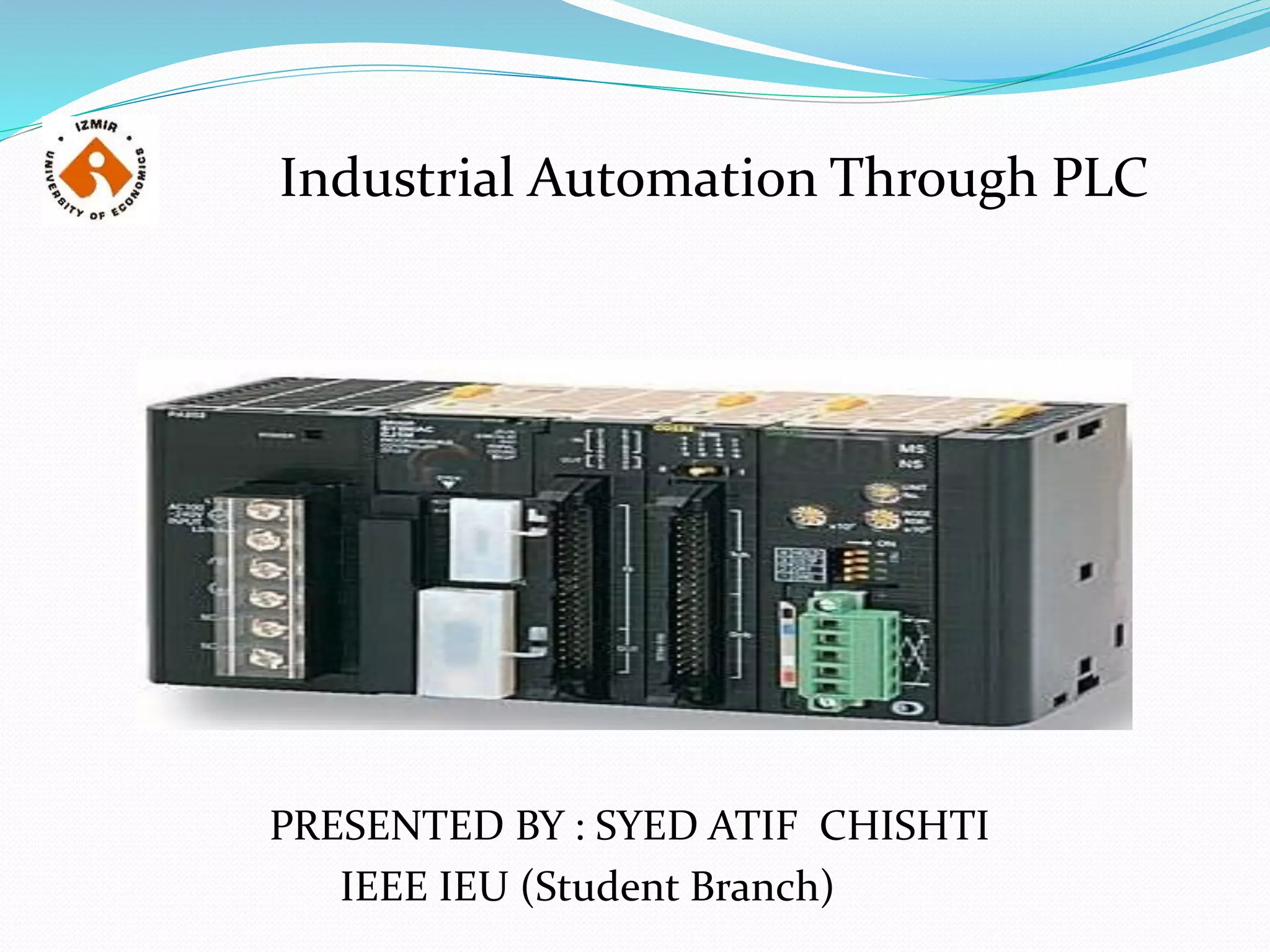
Industrial Automation Through PLC
PRESENTED BY : SYED ATIF CHISHTI
IEEE IEU (Student Branch)
CONTENTS
 INTRODUCTION
 PLC VERSUS RELAY LOGIC
 ADVANTAGES AND DISADVANTAGES
 UNIT OF PLC
 CPU PROCESSOR,MEMORY ANDPOWER SUPPLY.
 INPUT/OUTPUT MODULES
 INPUT /OUTPUT DEVICES AND SENSORS
 PLC PROGRAMMING
 PlC USED IN DIFFERENT PROCESS PLANT OF SPF
 PLC INSTALLATION,TROUBLE SHOOTING MAINTENANCE
 SELECTING A PLC
 MANUFACTURES
 OTHER APPLICATIONS(ROBOTS,SCADA System)
INTRODUCTION
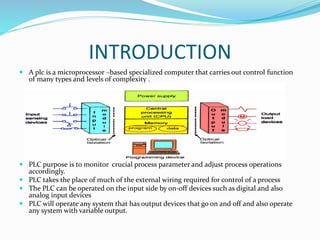
 A plc is a microprocessor –based specialized computer that carries out control function
of many types and levels of complexity .
 PLC purpose is to monitor crucial process parameter and adjust process operations
accordingly.
 PLC takes the place of much of the external wiring required for control of a process
 The PLC can be operated on the input side by on-off devices such as digital and also
analog input devices
 PLC will operate any system that has output devices that go on and off and also operate
any system with variable output.
PLC VS CONTROLLER
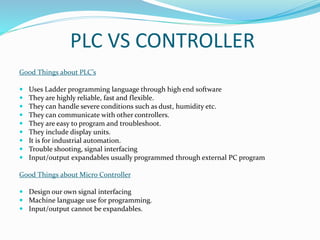
Good Things about PLC’s
 Uses Ladder programming language through high end software
 They are highly reliable, fast and flexible.
 They can handle severe conditions such as dust, humidity etc.
 They can communicate with other controllers.
 They are easy to program and troubleshoot.
 They include display units.
 It is for industrial automation.
 Trouble shooting, signal interfacing
 Input/output expandables usually programmed through external PC program
Good Things about Micro Controller
 Design our own signal interfacing
 Machine language use for programming.
 Input/output cannot be expandables.
PLC VERSUS RELAY LOGIC
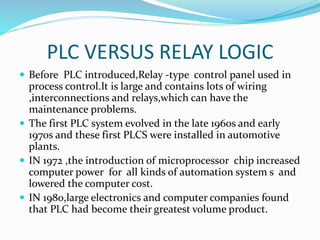
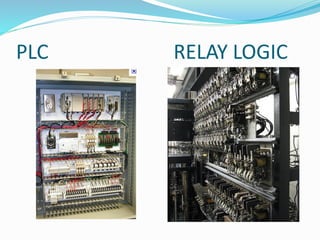
 Before PLC introduced,Relay -type control panel used in
process control.It is large and contains lots of wiring
,interconnections and relays,which can have the
maintenance problems.
 The first PLC system evolved in the late 1960s and early
1970s and these first PLCS were installed in automotive
plants.
 IN 1972 ,the introduction of microprocessor chip increased
computer power for all kinds of automation system s and
lowered the computer cost.
 IN 1980,large electronics and computer companies found
that PLC had become their greatest volume product.
PLC RELAY LOGIC
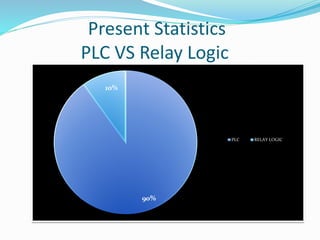
90%
10%
PLC RELAY LOGIC
Present Statistics
PLC VS Relay Logic
PLC AS A COMPUTER
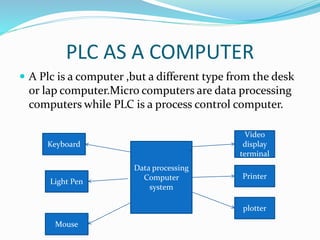
 A Plc is a computer ,but a different type from the desk
or lap computer.Micro computers are data processing
computers while PLC is a process control computer.
Data processing
Computer
system
Video
display
terminal
Printer
plotter
Keyboard
Light Pen
Mouse
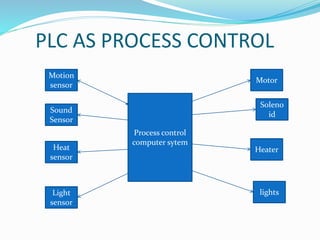
Process control
computer sytem
Motor
Heater
lights
Motion
sensor
Sound
Sensor
Heat
sensor
Light
sensor
Soleno
id
PLC AS PROCESS CONTROL
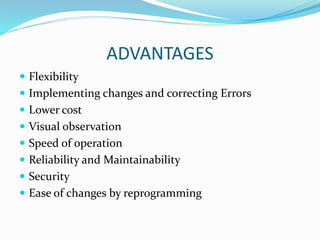
ADVANTAGES
 Flexibility
 Implementing changes and correcting Errors
 Lower cost
 Visual observation
 Speed of operation
 Reliability and Maintainability
 Security
 Ease of changes by reprogramming
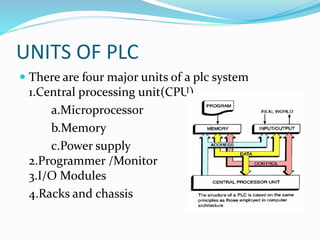
UNITS OF PLC
 There are four major units of a plc system
1.Central processing unit(CPU)
a.Microprocessor
b.Memory
c.Power supply
2.Programmer /Monitor
3.I/O Modules
4.Racks and chassis
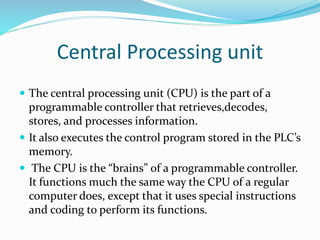
Central Processing unit
 The central processing unit (CPU) is the part of a
programmable controller that retrieves,decodes,
stores, and processes information.
 It also executes the control program stored in the PLC’s
memory.
 The CPU is the “brains” of a programmable controller.
It functions much the same way the CPU of a regular
computer does, except that it uses special instructions
and coding to perform its functions.
MEMORY
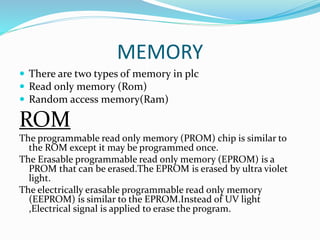
 There are two types of memory in plc
 Read only memory (Rom)
 Random access memory(Ram)
ROM
The programmable read only memory (PROM) chip is similar to
the ROM except it may be programmed once.
The Erasable programmable read only memory (EPROM) is a
PROM that can be erased.The EPROM is erased by ultra violet
light.
The electrically erasable programmable read only memory
(EEPROM) is similar to the EPROM.Instead of UV light
,Electrical signal is applied to erase the program.
RAM
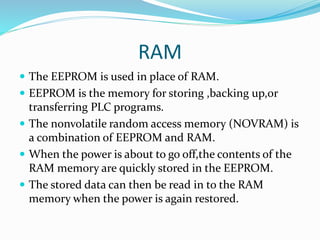
 The EEPROM is used in place of RAM.
 EEPROM is the memory for storing ,backing up,or
transferring PLC programs.
 The nonvolatile random access memory (NOVRAM) is
a combination of EEPROM and RAM.
 When the power is about to go off,the contents of the
RAM memory are quickly stored in the EEPROM.
 The stored data can then be read in to the RAM
memory when the power is again restored.
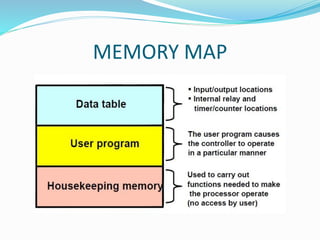
MEMORY MAP
PROCESSOR
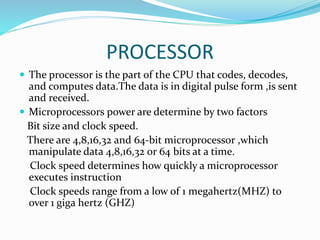
 The processor is the part of the CPU that codes, decodes,
and computes data.The data is in digital pulse form ,is sent
and received.
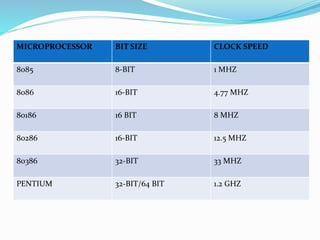
 Microprocessors power are determine by two factors
Bit size and clock speed.
There are 4,8,16,32 and 64-bit microprocessor ,which
manipulate data 4,8,16,32 or 64 bits at a time.
Clock speed determines how quickly a microprocessor
executes instruction
Clock speeds range from a low of 1 megahertz(MHZ) to
over 1 giga hertz (GHZ)
MICROPROCESSOR BIT SIZE CLOCK SPEED
8085 8-BIT 1 MHZ
8086 16-BIT 4.77 MHZ
80186 16 BIT 8 MHZ
80286 16-BIT 12.5 MHZ
80386 32-BIT 33 MHZ
PENTIUM 32-BIT/64 BIT 1.2 GHZ
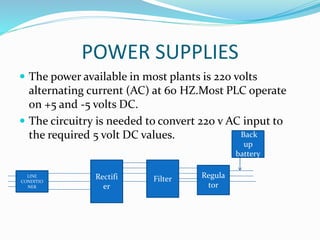
POWER SUPPLIES
 The power available in most plants is 220 volts
alternating current (AC) at 60 HZ.Most PLC operate
on +5 and -5 volts DC.
 The circuitry is needed to convert 220 v AC input to
the required 5 volt DC values.
LINE
CONDITIO
NER
Rectifi
er
Filter Regula
tor
Back
up
battery
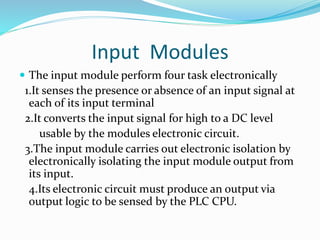
Input Modules
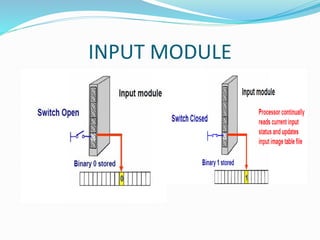
 The input module perform four task electronically
1.It senses the presence or absence of an input signal at
each of its input terminal
2.It converts the input signal for high to a DC level
usable by the modules electronic circuit.
3.The input module carries out electronic isolation by
electronically isolating the input module output from
its input.
4.Its electronic circuit must produce an output via
output logic to be sensed by the PLC CPU.
INPUT MODULE
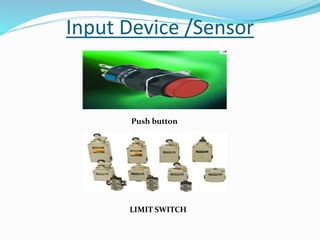
Input Device /Sensor
Push button
LIMIT SWITCH
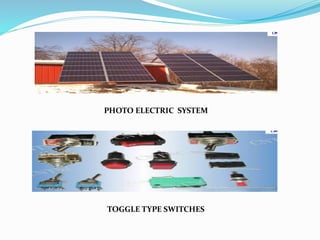
PHOTO ELECTRIC SYSTEM
TOGGLE TYPE SWITCHES
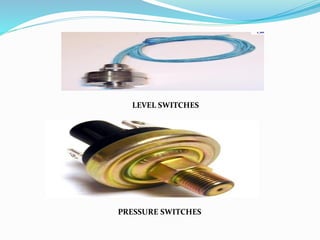
LEVEL SWITCHES
PRESSURE SWITCHES
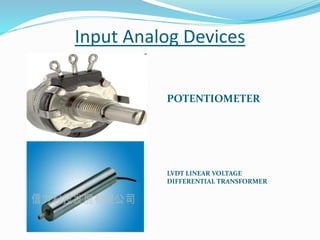
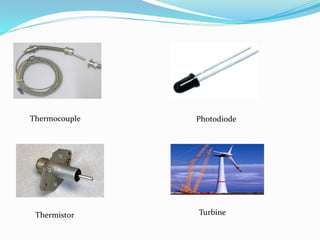
Input Analog Devices
POTENTIOMETER
LVDT LINEAR VOLTAGE
DIFFERENTIAL TRANSFORMER
Thermocouple
Thermistor
Photodiode
Turbine
OUTPUT MODULES
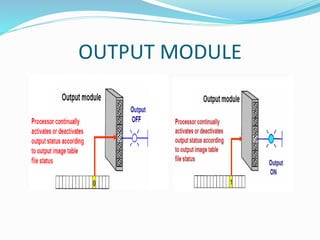
 A DC signal from the CPU is converted through each
module terminal to a usable output voltage ,either AC
or DC.
 A signal from the CPU is received by the output
module if the cpu signal code matches the assigned of
the module.the module section will turned on.
 Isolation is necessary to the output of the cpu so that
any erratic voltage surge from the output device does
not get back in to the CPU and cause damage.
OUTPUT MODULE
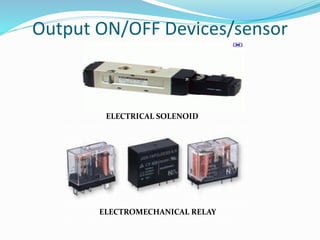
Output ON/OFF Devices/sensor
ELECTRICAL SOLENOID
ELECTROMECHANICAL RELAY
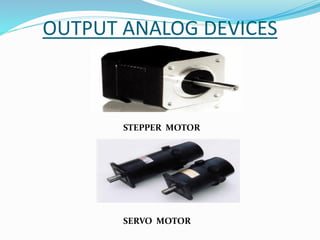
OUTPUT ANALOG DEVICES
STEPPER MOTOR
SERVO MOTOR
HOW PLC OPERATES
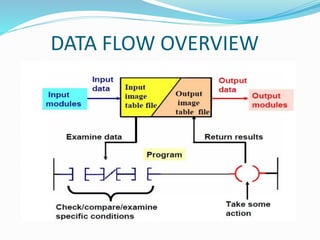
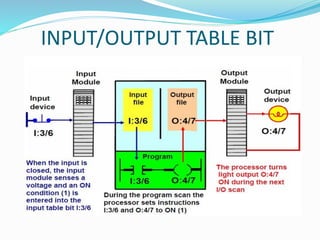
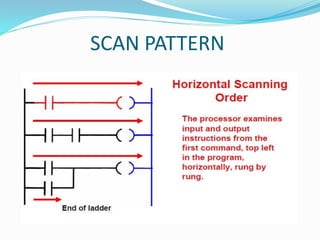
 Scan Cycle
 Over head
 Input scan
 Logic execution
 Diagnostic & Communication
 Output scan
Basic Instruction
Operational details vary widely between different PLC manufactures.
 Positive Logic
True=Logic 1= input energized
False=Logic 0=input not energized
 Negative Logic
True=Logic 0= input not energized
False=Logic 1=input energized
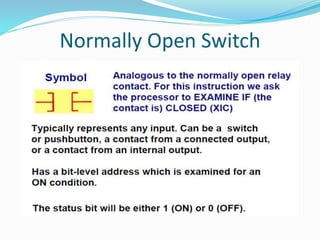
 Normally Open
(XIC) True if Closed
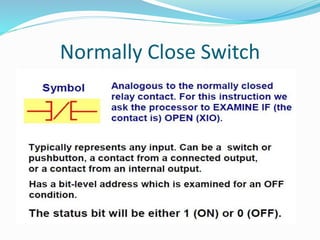
 Normally Closed
(XIO) True if open
 On Timer
 OFF Timer
 Retentive Timer
 Output Latch (OTL)
 Output Unlatch(OTU)
 Jump to Sub Routine(JSR)
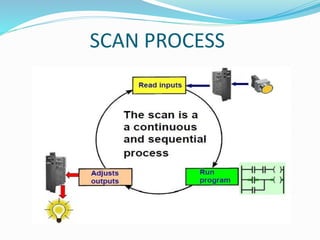
SCAN PROCESS
DATA FLOW OVERVIEW
INPUT/OUTPUT TABLE BIT
SCAN PATTERN
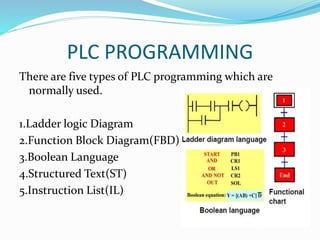
PLC PROGRAMMING
There are five types of PLC programming which are
normally used.
1.Ladder logic Diagram
2.Function Block Diagram(FBD)
3.Boolean Language
4.Structured Text(ST)
5.Instruction List(IL)
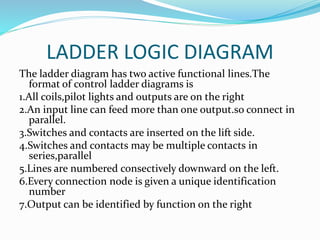
LADDER LOGIC DIAGRAM
The ladder diagram has two active functional lines.The
format of control ladder diagrams is
1.All coils,pilot lights and outputs are on the right
2.An input line can feed more than one output.so connect in
parallel.
3.Switches and contacts are inserted on the lift side.
4.Switches and contacts may be multiple contacts in
series,parallel
5.Lines are numbered consectively downward on the left.
6.Every connection node is given a unique identification
number
7.Output can be identified by function on the right
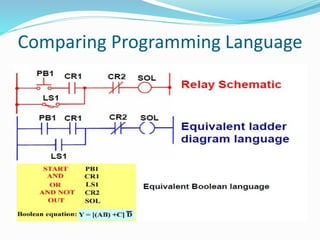
Comparing Programming Language
Normally Open Switch
Normally Close Switch
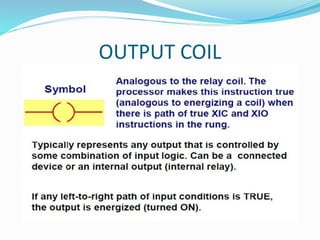
OUTPUT COIL
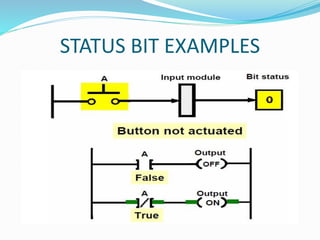
STATUS BIT EXAMPLES
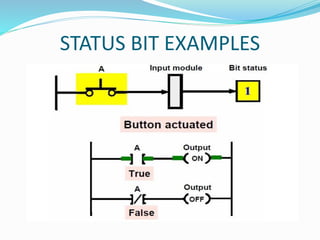
STATUS BIT EXAMPLES
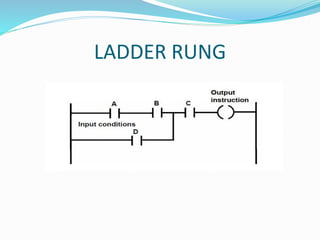
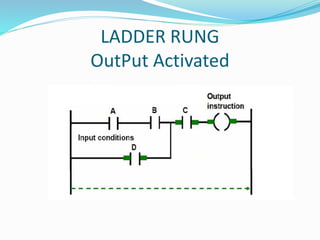
LADDER RUNG
LADDER RUNG
OutPut Activated
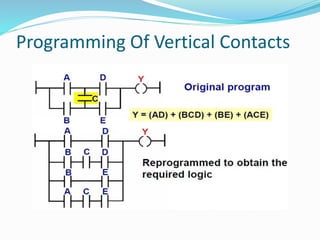
Programming Of Vertical Contacts
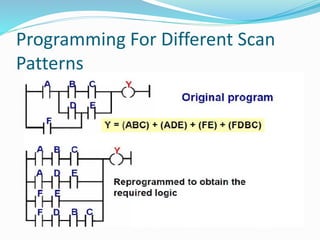
Programming For Different Scan
Patterns
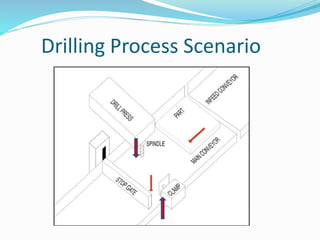
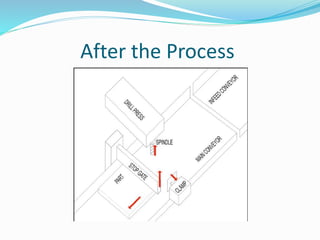
Drilling Process Scenario
After the Process
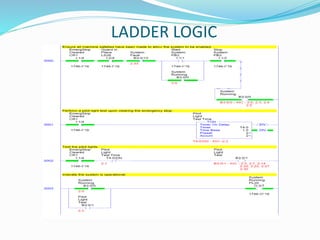
LADDER LOGIC
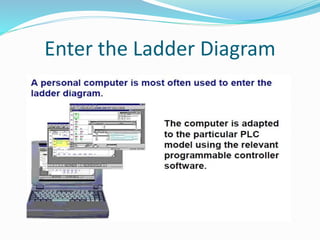
Enter the Ladder Diagram
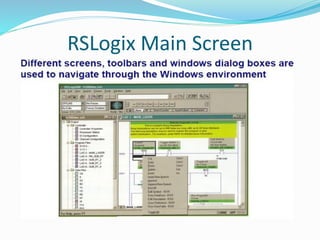
RSLogix Main Screen
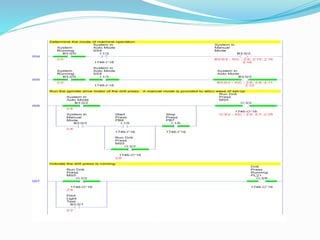
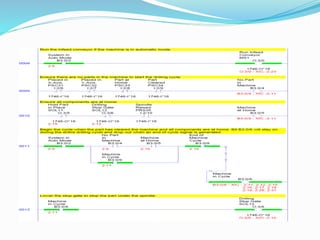
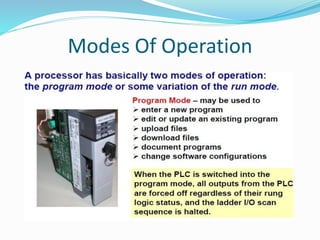
Modes Of Operation
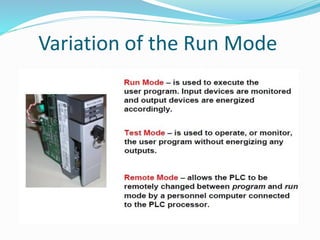
Variation of the Run Mode
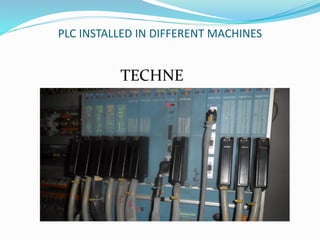
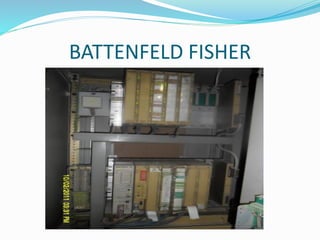
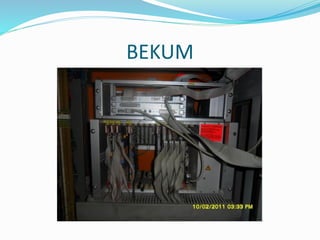
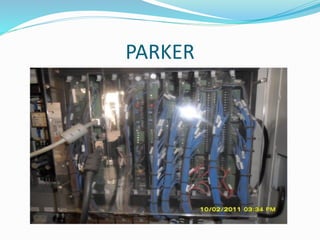
PLC INSTALLED IN DIFFERENT MACHINES
TECHNE
BATTENFELD FISHER
BEKUM
PARKER
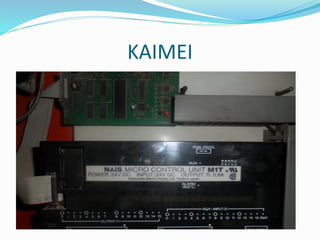
KAIMEI
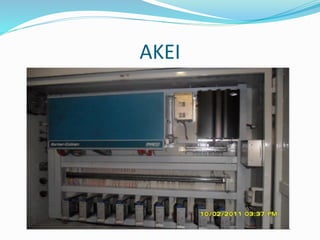
AKEI
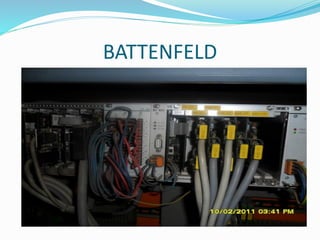
BATTENFELD
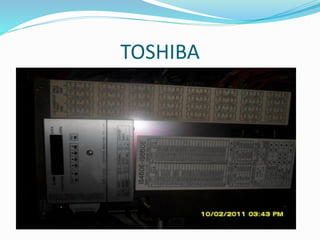
TOSHIBA
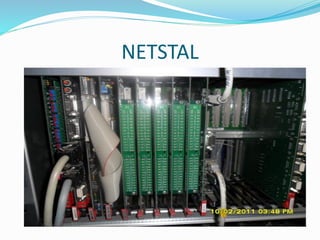
NETSTAL
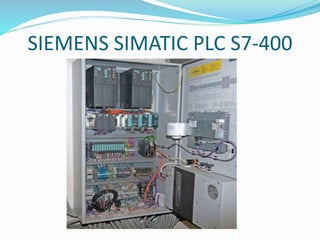
SIEMENS SIMATIC PLC S7-400
Examples of Application
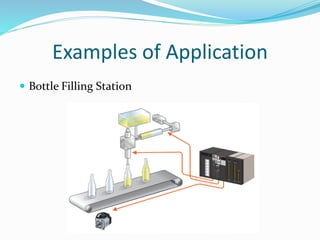
 Bottle Filling Station
Examples of Application
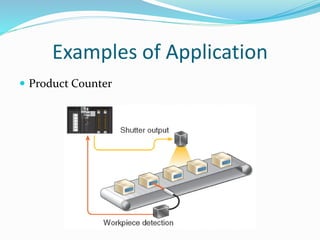
 Product Counter
Examples of Application
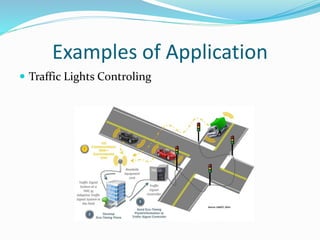
 Traffic Lights Controling
Examples of Application
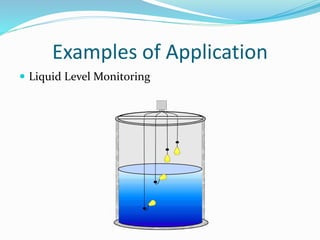
 Liquid Level Monitoring
Examples of Application
 Automatic Watering System
Examples of Application
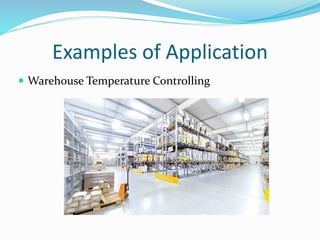
 Warehouse Temperature Controlling
PLC Installation
These are the factors which should be considered to ensure continuous ,reliable operation of PLC system
after installation.
1.Enclosure:
The PLC can be installed in the open ,NEMA(National electrical manufacturing association )type metal
enclosure.
2.Temperature:
The PLC has upper and lower temperature operationg limit normally 0 c to 60 c.
3.Moisture,Dust and Corrosive Atmosphere:
PLC may be required to operate in an area of high humidity,less moisture and dust.
4.Vibration:
Vibration also cause CPU failure and reduce the life of Plc equipment.
5.Proper Electriacal grounding:
Proper electrical grounding of the wiring of the equipment and cabinets is essential for proper
equipment operation.
6.Suppressor:
Suppression is the technique to absorbs the inductive –caused electrical disturbance.These electrical
disturbances in the air can be reduced by the use of shielded interconnecting cables.
7.Master control relay:
Master relay control system is used to safety shut down of the PLCoperation.When on the safety
shutdown allows the PLC to operate and when deenergi
Testing
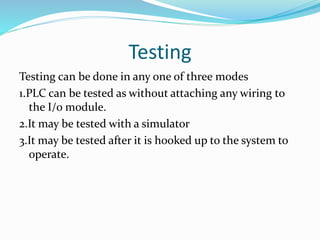
Testing can be done in any one of three modes
1.PLC can be tested as without attaching any wiring to
the I/o module.
2.It may be tested with a simulator
3.It may be tested after it is hooked up to the system to
operate.
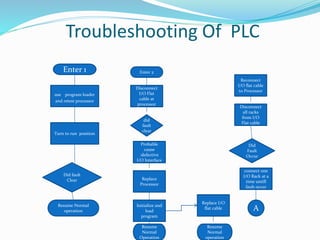
Troubleshooting Of PLC
Enter 1
use program loader
and retest processor
Turn to run position
Did fault
Clear
Resume Normal
operation
Enter 2
Disconnect
I/O Flat
cable at
processor
Probable
cause
:defective
I/O Interface
Replace
Processor
Initialize and
load
program
Replace I/O
flat cable
did
fault
clear
Resume
Normal
Operation
Resume
Normal
operation
Reconnect
I/O flat cable
to Processor
Disconnect
all racks
from I/O
Flat cable
Did
Fault
Occur
connect one
I/O Rack at a
time untill
fault occur
A
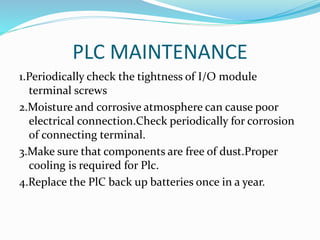
PLC MAINTENANCE
1.Periodically check the tightness of I/O module
terminal screws
2.Moisture and corrosive atmosphere can cause poor
electrical connection.Check periodically for corrosion
of connecting terminal.
3.Make sure that components are free of dust.Proper
cooling is required for Plc.
4.Replace the PlC back up batteries once in a year.
Selecting a Plc
These are the factors which have to considered in
selecting a PLC.
1.Cost
2.Service abilitiy/Support
3.Flexibility/Expandability
4.Training /Documentation.
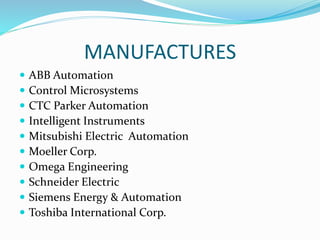
MANUFACTURES
 ABB Automation
 Control Microsystems
 CTC Parker Automation
 Intelligent Instruments
 Mitsubishi Electric Automation
 Moeller Corp.
 Omega Engineering
 Schneider Electric
 Siemens Energy & Automation
 Toshiba International Corp.
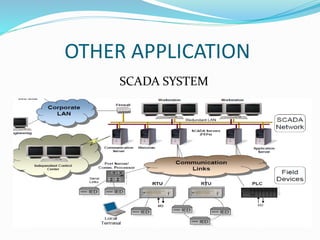
OTHER APPLICATION
SCADA SYSTEM
80
Thank You

Industrial Automation

  • 1.
    Industrial Automation ThroughPLC PRESENTED BY : SYED ATIF CHISHTI IEEE IEU (Student Branch)
  • 2.
    CONTENTS  INTRODUCTION  PLCVERSUS RELAY LOGIC  ADVANTAGES AND DISADVANTAGES  UNIT OF PLC  CPU PROCESSOR,MEMORY ANDPOWER SUPPLY.  INPUT/OUTPUT MODULES  INPUT /OUTPUT DEVICES AND SENSORS  PLC PROGRAMMING  PlC USED IN DIFFERENT PROCESS PLANT OF SPF  PLC INSTALLATION,TROUBLE SHOOTING MAINTENANCE  SELECTING A PLC  MANUFACTURES  OTHER APPLICATIONS(ROBOTS,SCADA System)
  • 3.
    INTRODUCTION  A plcis a microprocessor –based specialized computer that carries out control function of many types and levels of complexity .  PLC purpose is to monitor crucial process parameter and adjust process operations accordingly.  PLC takes the place of much of the external wiring required for control of a process  The PLC can be operated on the input side by on-off devices such as digital and also analog input devices  PLC will operate any system that has output devices that go on and off and also operate any system with variable output.
  • 4.
    PLC VS CONTROLLER GoodThings about PLC’s  Uses Ladder programming language through high end software  They are highly reliable, fast and flexible.  They can handle severe conditions such as dust, humidity etc.  They can communicate with other controllers.  They are easy to program and troubleshoot.  They include display units.  It is for industrial automation.  Trouble shooting, signal interfacing  Input/output expandables usually programmed through external PC program Good Things about Micro Controller  Design our own signal interfacing  Machine language use for programming.  Input/output cannot be expandables.
  • 5.
    PLC VERSUS RELAYLOGIC  Before PLC introduced,Relay -type control panel used in process control.It is large and contains lots of wiring ,interconnections and relays,which can have the maintenance problems.  The first PLC system evolved in the late 1960s and early 1970s and these first PLCS were installed in automotive plants.  IN 1972 ,the introduction of microprocessor chip increased computer power for all kinds of automation system s and lowered the computer cost.  IN 1980,large electronics and computer companies found that PLC had become their greatest volume product.
  • 6.
  • 7.
    90% 10% PLC RELAY LOGIC PresentStatistics PLC VS Relay Logic
  • 8.
    PLC AS ACOMPUTER  A Plc is a computer ,but a different type from the desk or lap computer.Micro computers are data processing computers while PLC is a process control computer. Data processing Computer system Video display terminal Printer plotter Keyboard Light Pen Mouse
  • 9.
  • 10.
    ADVANTAGES  Flexibility  Implementingchanges and correcting Errors  Lower cost  Visual observation  Speed of operation  Reliability and Maintainability  Security  Ease of changes by reprogramming
  • 11.
    UNITS OF PLC There are four major units of a plc system 1.Central processing unit(CPU) a.Microprocessor b.Memory c.Power supply 2.Programmer /Monitor 3.I/O Modules 4.Racks and chassis
  • 12.
    Central Processing unit The central processing unit (CPU) is the part of a programmable controller that retrieves,decodes, stores, and processes information.  It also executes the control program stored in the PLC’s memory.  The CPU is the “brains” of a programmable controller. It functions much the same way the CPU of a regular computer does, except that it uses special instructions and coding to perform its functions.
  • 13.
    MEMORY  There aretwo types of memory in plc  Read only memory (Rom)  Random access memory(Ram) ROM The programmable read only memory (PROM) chip is similar to the ROM except it may be programmed once. The Erasable programmable read only memory (EPROM) is a PROM that can be erased.The EPROM is erased by ultra violet light. The electrically erasable programmable read only memory (EEPROM) is similar to the EPROM.Instead of UV light ,Electrical signal is applied to erase the program.
  • 14.
    RAM  The EEPROMis used in place of RAM.  EEPROM is the memory for storing ,backing up,or transferring PLC programs.  The nonvolatile random access memory (NOVRAM) is a combination of EEPROM and RAM.  When the power is about to go off,the contents of the RAM memory are quickly stored in the EEPROM.  The stored data can then be read in to the RAM memory when the power is again restored.
  • 15.
  • 16.
    PROCESSOR  The processoris the part of the CPU that codes, decodes, and computes data.The data is in digital pulse form ,is sent and received.  Microprocessors power are determine by two factors Bit size and clock speed. There are 4,8,16,32 and 64-bit microprocessor ,which manipulate data 4,8,16,32 or 64 bits at a time. Clock speed determines how quickly a microprocessor executes instruction Clock speeds range from a low of 1 megahertz(MHZ) to over 1 giga hertz (GHZ)
  • 17.
    MICROPROCESSOR BIT SIZECLOCK SPEED 8085 8-BIT 1 MHZ 8086 16-BIT 4.77 MHZ 80186 16 BIT 8 MHZ 80286 16-BIT 12.5 MHZ 80386 32-BIT 33 MHZ PENTIUM 32-BIT/64 BIT 1.2 GHZ
  • 18.
    POWER SUPPLIES  Thepower available in most plants is 220 volts alternating current (AC) at 60 HZ.Most PLC operate on +5 and -5 volts DC.  The circuitry is needed to convert 220 v AC input to the required 5 volt DC values. LINE CONDITIO NER Rectifi er Filter Regula tor Back up battery
  • 19.
    Input Modules  Theinput module perform four task electronically 1.It senses the presence or absence of an input signal at each of its input terminal 2.It converts the input signal for high to a DC level usable by the modules electronic circuit. 3.The input module carries out electronic isolation by electronically isolating the input module output from its input. 4.Its electronic circuit must produce an output via output logic to be sensed by the PLC CPU.
  • 20.
  • 21.
    Input Device /Sensor Pushbutton LIMIT SWITCH
  • 22.
  • 23.
  • 24.
    Input Analog Devices POTENTIOMETER LVDTLINEAR VOLTAGE DIFFERENTIAL TRANSFORMER
  • 25.
  • 26.
    OUTPUT MODULES  ADC signal from the CPU is converted through each module terminal to a usable output voltage ,either AC or DC.  A signal from the CPU is received by the output module if the cpu signal code matches the assigned of the module.the module section will turned on.  Isolation is necessary to the output of the cpu so that any erratic voltage surge from the output device does not get back in to the CPU and cause damage.
  • 27.
  • 28.
    Output ON/OFF Devices/sensor ELECTRICALSOLENOID ELECTROMECHANICAL RELAY
  • 29.
  • 30.
    HOW PLC OPERATES Scan Cycle  Over head  Input scan  Logic execution  Diagnostic & Communication  Output scan
  • 31.
    Basic Instruction Operational detailsvary widely between different PLC manufactures.  Positive Logic True=Logic 1= input energized False=Logic 0=input not energized  Negative Logic True=Logic 0= input not energized False=Logic 1=input energized  Normally Open (XIC) True if Closed  Normally Closed (XIO) True if open  On Timer  OFF Timer  Retentive Timer  Output Latch (OTL)  Output Unlatch(OTU)  Jump to Sub Routine(JSR)
  • 32.
  • 33.
  • 34.
  • 35.
  • 36.
    PLC PROGRAMMING There arefive types of PLC programming which are normally used. 1.Ladder logic Diagram 2.Function Block Diagram(FBD) 3.Boolean Language 4.Structured Text(ST) 5.Instruction List(IL)
  • 37.
    LADDER LOGIC DIAGRAM Theladder diagram has two active functional lines.The format of control ladder diagrams is 1.All coils,pilot lights and outputs are on the right 2.An input line can feed more than one output.so connect in parallel. 3.Switches and contacts are inserted on the lift side. 4.Switches and contacts may be multiple contacts in series,parallel 5.Lines are numbered consectively downward on the left. 6.Every connection node is given a unique identification number 7.Output can be identified by function on the right
  • 38.
  • 39.
  • 40.
  • 41.
  • 42.
  • 43.
  • 44.
  • 45.
  • 46.
  • 47.
  • 48.
  • 49.
  • 50.
  • 53.
  • 54.
  • 55.
  • 56.
  • 57.
    PLC INSTALLED INDIFFERENT MACHINES TECHNE
  • 58.
  • 59.
  • 60.
  • 61.
  • 62.
  • 63.
  • 64.
  • 65.
  • 66.
  • 67.
    Examples of Application Bottle Filling Station
  • 68.
  • 69.
    Examples of Application Traffic Lights Controling
  • 70.
    Examples of Application Liquid Level Monitoring
  • 71.
    Examples of Application Automatic Watering System
  • 72.
    Examples of Application Warehouse Temperature Controlling
  • 73.
    PLC Installation These arethe factors which should be considered to ensure continuous ,reliable operation of PLC system after installation. 1.Enclosure: The PLC can be installed in the open ,NEMA(National electrical manufacturing association )type metal enclosure. 2.Temperature: The PLC has upper and lower temperature operationg limit normally 0 c to 60 c. 3.Moisture,Dust and Corrosive Atmosphere: PLC may be required to operate in an area of high humidity,less moisture and dust. 4.Vibration: Vibration also cause CPU failure and reduce the life of Plc equipment. 5.Proper Electriacal grounding: Proper electrical grounding of the wiring of the equipment and cabinets is essential for proper equipment operation. 6.Suppressor: Suppression is the technique to absorbs the inductive –caused electrical disturbance.These electrical disturbances in the air can be reduced by the use of shielded interconnecting cables. 7.Master control relay: Master relay control system is used to safety shut down of the PLCoperation.When on the safety shutdown allows the PLC to operate and when deenergi
  • 74.
    Testing Testing can bedone in any one of three modes 1.PLC can be tested as without attaching any wiring to the I/o module. 2.It may be tested with a simulator 3.It may be tested after it is hooked up to the system to operate.
  • 75.
    Troubleshooting Of PLC Enter1 use program loader and retest processor Turn to run position Did fault Clear Resume Normal operation Enter 2 Disconnect I/O Flat cable at processor Probable cause :defective I/O Interface Replace Processor Initialize and load program Replace I/O flat cable did fault clear Resume Normal Operation Resume Normal operation Reconnect I/O flat cable to Processor Disconnect all racks from I/O Flat cable Did Fault Occur connect one I/O Rack at a time untill fault occur A
  • 76.
    PLC MAINTENANCE 1.Periodically checkthe tightness of I/O module terminal screws 2.Moisture and corrosive atmosphere can cause poor electrical connection.Check periodically for corrosion of connecting terminal. 3.Make sure that components are free of dust.Proper cooling is required for Plc. 4.Replace the PlC back up batteries once in a year.
  • 77.
    Selecting a Plc Theseare the factors which have to considered in selecting a PLC. 1.Cost 2.Service abilitiy/Support 3.Flexibility/Expandability 4.Training /Documentation.
  • 78.
    MANUFACTURES  ABB Automation Control Microsystems  CTC Parker Automation  Intelligent Instruments  Mitsubishi Electric Automation  Moeller Corp.  Omega Engineering  Schneider Electric  Siemens Energy & Automation  Toshiba International Corp.
  • 79.
  • 80.
  • 81.