Cyclic Voltammetry
Present by
Priyanka Gupta
Vikash Mahule
Utsav Dalal
Yash Kumawat
Prem
Introduction to Voltammetry
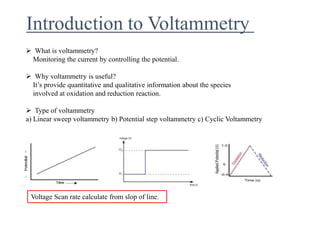
 What is voltammetry?
Monitoring the current by controlling the potential.
 Why voltammetry is useful?
It’s provide quantitative and qualitative information about the species
involved at oxidation and reduction reaction.
 Type of voltammetry
a) Linear sweep voltammetry b) Potential step voltammetry c) Cyclic Voltammetry
Voltage Scan rate calculate from slop of line.
Introduction to Cyclic Voltammetry
• A electroanalytical technique
• To investigate electrolysis mechanism
• Monitors behaviour of electrochemical species in a wide potential range
Applications of Cyclic Voltammetry
• To find information about electron transfer kinetics
• To determine the stability of reaction products
• To check reversibility of a reaction
• To find diffusion coefficient of an analyte
• To check formal reduction potential of an analyte
• To analyze reducing agents in solutions
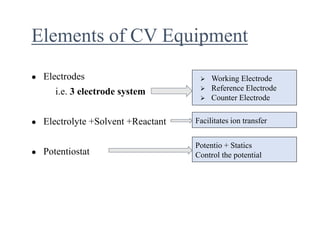
Elements of CV Equipment
● Electrodes
i.e. 3 electrode system
● Electrolyte +Solvent +Reactant
● Potentiostat
Potentio + Statics
Control the potential
Facilitates ion transfer
 Working Electrode
 Reference Electrode
 Counter Electrode
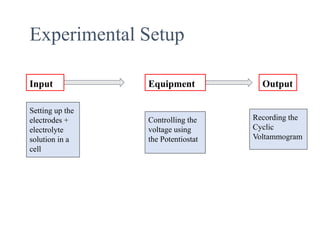
Experimental Setup
Setting up the
electrodes +
electrolyte
solution in a
cell
Controlling the
voltage using
the Potentiostat
Recording the
Cyclic
Voltammogram
Input Equipment Output
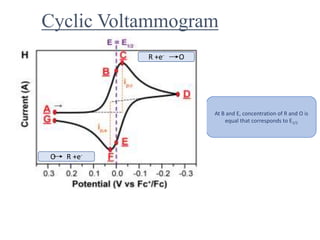
Cyclic Voltammogram
A-C: Swept negative potential. R is
reduced to O resulted in measurement
of current and depletion of R at
electrode surface.
C: At point C, peak cathodic current (ip,c)
is observed.
C-D: Scanning to more negative
potential resulted in decrease in
current.
D-F: Swept positive potential. O is
oxidised back to R.
F: At point F, peak anodic current (ip,a) is
observed.
At B and E, concentration of R and O is
equal that corresponds to E1/2
R +e- O
O R +e-
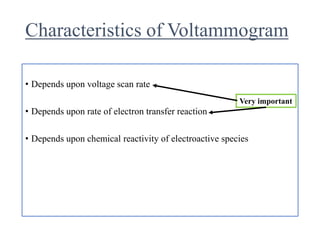
Characteristics of Voltammogram
• Depends upon voltage scan rate
• Depends upon rate of electron transfer reaction
• Depends upon chemical reactivity of electroactive species
Very important
Effect of Diffusion Layer
• Nernst equation ; E = E0 +
𝑹.𝑻
𝒏.𝑭
. 𝒍𝒏
[𝑹𝒆𝒂𝒄𝒕𝒂𝒏𝒕]
[𝑷𝒓𝒐𝒅𝒖𝒄𝒕]
Scanning of voltage Rise in current
Conversion
of
reactants
Increase
in
diffusion
layer
Sufficient growth in
diffusion layer
Rate of reaction ≠ Flux
A peak in current
and drop
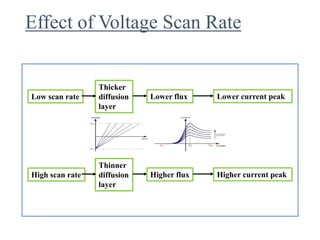
Effect of Voltage Scan Rate
Low scan rate
Thicker
diffusion
layer
Lower flux Lower current peak
High scan rate
Thinner
diffusion
layer
Higher flux Higher current peak
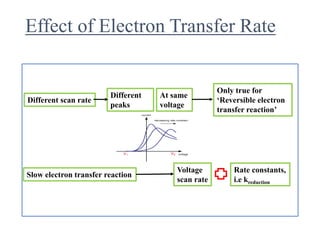
Effect of Electron Transfer Rate
Different scan rate
Different
peaks
At same
voltage
Only true for
‘Reversible electron
transfer reaction’
Slow electron transfer reaction
Voltage
scan rate
Rate constants,
i.e kreduction
Randle-Sevcik Equation
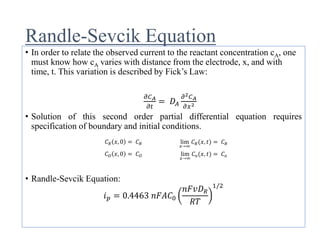
• In order to relate the observed current to the reactant concentration cA, one
must know how cA varies with distance from the electrode, x, and with
time, t. This variation is described by Fick’s Law:
𝜕𝐶 𝐴
𝜕𝑡
= 𝐷𝐴
𝜕2 𝐶 𝐴
𝜕𝑥2
• Solution of this second order partial differential equation requires
specification of boundary and initial conditions.
• Randle-Sevcik Equation:
𝑖 𝑝 = 0.4463 𝑛𝐹𝐴𝐶0
𝑛𝐹𝑣𝐷 𝑅
𝑅𝑇
1/2
𝐶 𝑅 𝑥, 0 = 𝐶 𝑅 lim
𝑥→∞
𝐶 𝑅(𝑥, 𝑡) = 𝐶 𝑅
𝐶 𝑂 𝑥, 0 = 𝐶 𝑂 lim
𝑥→∞
𝐶 𝑜(𝑥, 𝑡) = 𝐶 𝑜
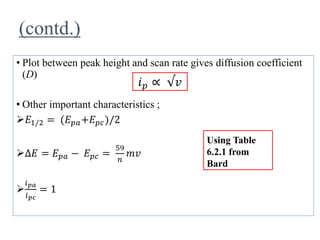
• Plot between peak height and scan rate gives diffusion coefficient
(D)
• Other important characteristics ;
𝐸1/2 = (𝐸 𝑝𝑎+𝐸 𝑝𝑐)/2
∆𝐸 = 𝐸 𝑝𝑎 − 𝐸 𝑝𝑐 =
59
𝑛
𝑚𝑣

𝑖 𝑝𝑎
𝑖 𝑝𝑐
= 1
𝑖 𝑝 ∝ √𝑣
(contd.)
Using Table
6.2.1 from
Bard
Thank you

Cyclic Voltametery

  • 1.
    Cyclic Voltammetry Present by PriyankaGupta Vikash Mahule Utsav Dalal Yash Kumawat Prem
  • 2.
    Introduction to Voltammetry What is voltammetry? Monitoring the current by controlling the potential.  Why voltammetry is useful? It’s provide quantitative and qualitative information about the species involved at oxidation and reduction reaction.  Type of voltammetry a) Linear sweep voltammetry b) Potential step voltammetry c) Cyclic Voltammetry Voltage Scan rate calculate from slop of line.
  • 3.
    Introduction to CyclicVoltammetry • A electroanalytical technique • To investigate electrolysis mechanism • Monitors behaviour of electrochemical species in a wide potential range Applications of Cyclic Voltammetry • To find information about electron transfer kinetics • To determine the stability of reaction products • To check reversibility of a reaction • To find diffusion coefficient of an analyte • To check formal reduction potential of an analyte • To analyze reducing agents in solutions
  • 4.
    Elements of CVEquipment ● Electrodes i.e. 3 electrode system ● Electrolyte +Solvent +Reactant ● Potentiostat Potentio + Statics Control the potential Facilitates ion transfer  Working Electrode  Reference Electrode  Counter Electrode
  • 5.
    Experimental Setup Setting upthe electrodes + electrolyte solution in a cell Controlling the voltage using the Potentiostat Recording the Cyclic Voltammogram Input Equipment Output
  • 6.
    Cyclic Voltammogram A-C: Sweptnegative potential. R is reduced to O resulted in measurement of current and depletion of R at electrode surface. C: At point C, peak cathodic current (ip,c) is observed. C-D: Scanning to more negative potential resulted in decrease in current. D-F: Swept positive potential. O is oxidised back to R. F: At point F, peak anodic current (ip,a) is observed. At B and E, concentration of R and O is equal that corresponds to E1/2 R +e- O O R +e-
  • 7.
    Characteristics of Voltammogram •Depends upon voltage scan rate • Depends upon rate of electron transfer reaction • Depends upon chemical reactivity of electroactive species Very important
  • 8.
    Effect of DiffusionLayer • Nernst equation ; E = E0 + 𝑹.𝑻 𝒏.𝑭 . 𝒍𝒏 [𝑹𝒆𝒂𝒄𝒕𝒂𝒏𝒕] [𝑷𝒓𝒐𝒅𝒖𝒄𝒕] Scanning of voltage Rise in current Conversion of reactants Increase in diffusion layer Sufficient growth in diffusion layer Rate of reaction ≠ Flux A peak in current and drop
  • 9.
    Effect of VoltageScan Rate Low scan rate Thicker diffusion layer Lower flux Lower current peak High scan rate Thinner diffusion layer Higher flux Higher current peak
  • 10.
    Effect of ElectronTransfer Rate Different scan rate Different peaks At same voltage Only true for ‘Reversible electron transfer reaction’ Slow electron transfer reaction Voltage scan rate Rate constants, i.e kreduction
  • 11.
    Randle-Sevcik Equation • Inorder to relate the observed current to the reactant concentration cA, one must know how cA varies with distance from the electrode, x, and with time, t. This variation is described by Fick’s Law: 𝜕𝐶 𝐴 𝜕𝑡 = 𝐷𝐴 𝜕2 𝐶 𝐴 𝜕𝑥2 • Solution of this second order partial differential equation requires specification of boundary and initial conditions. • Randle-Sevcik Equation: 𝑖 𝑝 = 0.4463 𝑛𝐹𝐴𝐶0 𝑛𝐹𝑣𝐷 𝑅 𝑅𝑇 1/2 𝐶 𝑅 𝑥, 0 = 𝐶 𝑅 lim 𝑥→∞ 𝐶 𝑅(𝑥, 𝑡) = 𝐶 𝑅 𝐶 𝑂 𝑥, 0 = 𝐶 𝑂 lim 𝑥→∞ 𝐶 𝑜(𝑥, 𝑡) = 𝐶 𝑜
  • 12.
    • Plot betweenpeak height and scan rate gives diffusion coefficient (D) • Other important characteristics ; 𝐸1/2 = (𝐸 𝑝𝑎+𝐸 𝑝𝑐)/2 ∆𝐸 = 𝐸 𝑝𝑎 − 𝐸 𝑝𝑐 = 59 𝑛 𝑚𝑣  𝑖 𝑝𝑎 𝑖 𝑝𝑐 = 1 𝑖 𝑝 ∝ √𝑣 (contd.) Using Table 6.2.1 from Bard
  • 13.