What is Forensic Science?
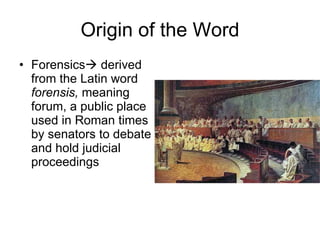
Origin of the Word Forensics   derived from the Latin word  forensis,  meaning forum, a public place used in Roman times by senators to debate and hold judicial proceedings
What is forensic science? The study and application of science to matters of law Examines the associations between people, places, things and events involved in crimes AKA  criminalistics The examination of physical evidence Evidence:  anything that tends to establish OR disprove a fact Includes: Testimony Objects documents
Forensic Scientist Job description Study evidence found at the crime ID object, its origin, and how it got to the crime scene Expert witness At trial, present data, weighs evidence, gives impartial opinion in court Researcher Performs scientific research and trains other scientists
Crime Labs Used to examine evidence Public funded (federal, state or local) Used by police, prosecutors and other law enforcement agencies Privately funded Charge a fee for services
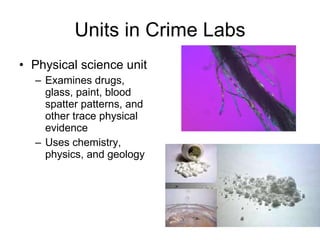
Units in Crime Labs Physical science unit Examines drugs, glass, paint, blood spatter patterns, and other trace physical evidence Uses chemistry, physics, and geology
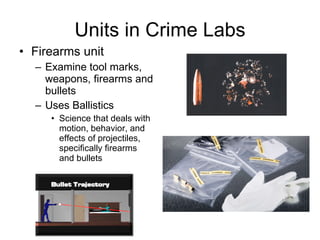
Units in Crime Labs Firearms unit Examine tool marks, weapons, firearms and bullets Uses Ballistics Science that deals with motion, behavior, and effects of projectiles, specifically firearms and bullets
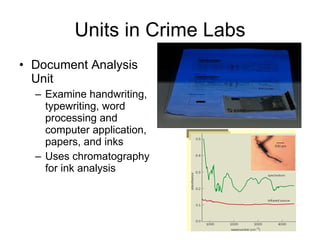
Units in Crime Labs Document Analysis Unit Examine handwriting, typewriting, word processing and computer application, papers, and inks Uses chromatography for ink analysis
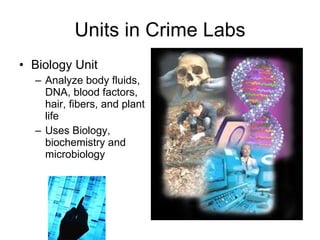
Units in Crime Labs Biology Unit Analyze body fluids, DNA, blood factors, hair, fibers, and plant life Uses Biology, biochemistry and microbiology
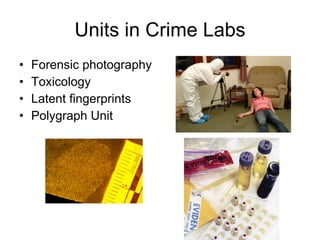
Units in Crime Labs Forensic photography Toxicology Latent fingerprints Polygraph Unit
Other specialties in forensics Anthropology Study of remains such as bones and decomposed bodies  Odontology Examine bite marks and dental identification of corpses Pathology Investigates sudden, violent and unexplained death (medical examiner) Geology Study of soil and minerals Environmental science Entomology Study of insects, useful in decomposed bodies (time of death and movement) Palynology Study of pollen and spores Voiceprint analysis
Government Crime Labs FBI Federal Bureau of Investigation Has the largest crime lab in the world
Government Crime Labs DEA Drug enforcement agency 7 crime labs across the country Investigate major illicit drug activity in and outside the country May also aid local law enforcement
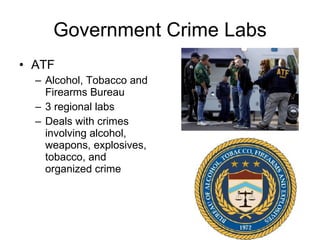
Government Crime Labs ATF Alcohol, Tobacco and Firearms Bureau 3 regional labs Deals with crimes involving alcohol, weapons, explosives, tobacco, and organized crime
Government Crime Labs IRS Internal Revenue Service Maintained by the Department of Treasury Specialize in questioned documents
Government Crime Labs USPS United States Postal service has their own lab for crimes committed through the mail
Government Crime Labs US Fish and Wildlife Service Department of Interior Maintain their own lab for crimes committed in national parks as well as crimes involving the animals, such as poaching and endangered species
Government Crime Labs Department of Homeland Security 2 secret service labs One guards against counterfeiting Lab provides research for executive protection
Edmond Locard Early 1900’s Forensic investigator Believed criminal should be connected to the crime by trace evidence collected at the crime scene “ Whenever 2 objects come into contact, there is a transfer of material.  The methods of detection may not be sensitive enough to demonstrate this or the decay rate may be too rapid that all evidence or transfer has vanished after a given amount of time.  None the less, the transfer has taken place.”
The Locard Principle 1.You are sitting at your desk.  What are you in contact with?  What possible transfer of material could have taken place?  Make a list.  How could you have prevented any transfer if you had thought about it first?  What transferred material could be traced back to you directly and what units of a crime lab would be used to trace it back to you? 2. Think about when you came to school today.  Did you leave any evidence that you were here other than being observed by others (eye witnesses)? 3. Is it difficult not to leave a trace?  And, after the fact, is there lots to worry about from leaving evidence of your presence? 4. Do you think premeditated contact can diminish identifiable transfers? Give some examples of where destroying evidence could leave more that could identify you.
Scientific Method in Forensics Observe problem or questioned evidence and collected data Make hypothesis or possible solution to the problem based on the observations, given a directed work plan Use inductive reasoning, experience, and imagination Examine, test, and analyze to support or refute hypothesis Use deductive reasoning to make a determination as to the significance of the evidence Evaluate and verify all evidence and determine a conclusion This step is important because it determines the liberty of a person All possible errors must be stated Consideration must be given to standardization, reproducibility, validity, reliability, and accuracy This will lead the scientist to a thoery or opinion they must present in court
CSI #1 Assignment Outline the scientific method utilized in the episode List each unit of the forensic lab that is used throughout the episode Explain what is realistic and what seems unrealistic in this episode.
Creative Crime Scenes: Scientific Method and Branches of the Crime Lab Investigative teams shall consist of 4-5 members Create a crime scene story with at least one victim, four suspects and four key pieces of evidence obtained at the crime scene. Keep in mind that the pieces of evidence must be able to be “testable”  Once your team has developed a rough draft of you crime scene story, type it up on the computer and save. Outline the scientific method for each piece of evidence. You must utilize at least five different branches of the crime lab Next to the test/evidence list the branch that would be used On a separate sheet of paper, list the culprit as well as how he was linked to the crime with the evidence.

Forensic Science Intro

  • 1.
  • 2.
    Origin of theWord Forensics  derived from the Latin word forensis, meaning forum, a public place used in Roman times by senators to debate and hold judicial proceedings
  • 3.
    What is forensicscience? The study and application of science to matters of law Examines the associations between people, places, things and events involved in crimes AKA criminalistics The examination of physical evidence Evidence: anything that tends to establish OR disprove a fact Includes: Testimony Objects documents
  • 4.
    Forensic Scientist Jobdescription Study evidence found at the crime ID object, its origin, and how it got to the crime scene Expert witness At trial, present data, weighs evidence, gives impartial opinion in court Researcher Performs scientific research and trains other scientists
  • 5.
    Crime Labs Usedto examine evidence Public funded (federal, state or local) Used by police, prosecutors and other law enforcement agencies Privately funded Charge a fee for services
  • 6.
    Units in CrimeLabs Physical science unit Examines drugs, glass, paint, blood spatter patterns, and other trace physical evidence Uses chemistry, physics, and geology
  • 7.
    Units in CrimeLabs Firearms unit Examine tool marks, weapons, firearms and bullets Uses Ballistics Science that deals with motion, behavior, and effects of projectiles, specifically firearms and bullets
  • 8.
    Units in CrimeLabs Document Analysis Unit Examine handwriting, typewriting, word processing and computer application, papers, and inks Uses chromatography for ink analysis
  • 9.
    Units in CrimeLabs Biology Unit Analyze body fluids, DNA, blood factors, hair, fibers, and plant life Uses Biology, biochemistry and microbiology
  • 10.
    Units in CrimeLabs Forensic photography Toxicology Latent fingerprints Polygraph Unit
  • 11.
    Other specialties inforensics Anthropology Study of remains such as bones and decomposed bodies Odontology Examine bite marks and dental identification of corpses Pathology Investigates sudden, violent and unexplained death (medical examiner) Geology Study of soil and minerals Environmental science Entomology Study of insects, useful in decomposed bodies (time of death and movement) Palynology Study of pollen and spores Voiceprint analysis
  • 12.
    Government Crime LabsFBI Federal Bureau of Investigation Has the largest crime lab in the world
  • 13.
    Government Crime LabsDEA Drug enforcement agency 7 crime labs across the country Investigate major illicit drug activity in and outside the country May also aid local law enforcement
  • 14.
    Government Crime LabsATF Alcohol, Tobacco and Firearms Bureau 3 regional labs Deals with crimes involving alcohol, weapons, explosives, tobacco, and organized crime
  • 15.
    Government Crime LabsIRS Internal Revenue Service Maintained by the Department of Treasury Specialize in questioned documents
  • 16.
    Government Crime LabsUSPS United States Postal service has their own lab for crimes committed through the mail
  • 17.
    Government Crime LabsUS Fish and Wildlife Service Department of Interior Maintain their own lab for crimes committed in national parks as well as crimes involving the animals, such as poaching and endangered species
  • 18.
    Government Crime LabsDepartment of Homeland Security 2 secret service labs One guards against counterfeiting Lab provides research for executive protection
  • 19.
    Edmond Locard Early1900’s Forensic investigator Believed criminal should be connected to the crime by trace evidence collected at the crime scene “ Whenever 2 objects come into contact, there is a transfer of material. The methods of detection may not be sensitive enough to demonstrate this or the decay rate may be too rapid that all evidence or transfer has vanished after a given amount of time. None the less, the transfer has taken place.”
  • 20.
    The Locard Principle1.You are sitting at your desk. What are you in contact with? What possible transfer of material could have taken place? Make a list. How could you have prevented any transfer if you had thought about it first? What transferred material could be traced back to you directly and what units of a crime lab would be used to trace it back to you? 2. Think about when you came to school today. Did you leave any evidence that you were here other than being observed by others (eye witnesses)? 3. Is it difficult not to leave a trace? And, after the fact, is there lots to worry about from leaving evidence of your presence? 4. Do you think premeditated contact can diminish identifiable transfers? Give some examples of where destroying evidence could leave more that could identify you.
  • 21.
    Scientific Method inForensics Observe problem or questioned evidence and collected data Make hypothesis or possible solution to the problem based on the observations, given a directed work plan Use inductive reasoning, experience, and imagination Examine, test, and analyze to support or refute hypothesis Use deductive reasoning to make a determination as to the significance of the evidence Evaluate and verify all evidence and determine a conclusion This step is important because it determines the liberty of a person All possible errors must be stated Consideration must be given to standardization, reproducibility, validity, reliability, and accuracy This will lead the scientist to a thoery or opinion they must present in court
  • 22.
    CSI #1 AssignmentOutline the scientific method utilized in the episode List each unit of the forensic lab that is used throughout the episode Explain what is realistic and what seems unrealistic in this episode.
  • 23.
    Creative Crime Scenes:Scientific Method and Branches of the Crime Lab Investigative teams shall consist of 4-5 members Create a crime scene story with at least one victim, four suspects and four key pieces of evidence obtained at the crime scene. Keep in mind that the pieces of evidence must be able to be “testable” Once your team has developed a rough draft of you crime scene story, type it up on the computer and save. Outline the scientific method for each piece of evidence. You must utilize at least five different branches of the crime lab Next to the test/evidence list the branch that would be used On a separate sheet of paper, list the culprit as well as how he was linked to the crime with the evidence.