ATOMIC ABSORPTION
SPECTROMETER
BCH-503
ATOMIC ABSORPTION
SPECTROMETER
• Introduction
• Invention
• Working Principle of AAS
• Instrumentation
• Interferences & Correlation Methods
• Applications
INTRODUCTION
• Atomic absorption spectroscopy (AAS) is a
spectroanalytical procedure for the quantitative
determination of chemical elements using the
absorption of optical radiation (light) by free
atoms in the gaseous state.
• In analytical chemistry the technique is used
for determining the concentration of a
particular element (the analyte) in a sample to
be analyze
INVENTION
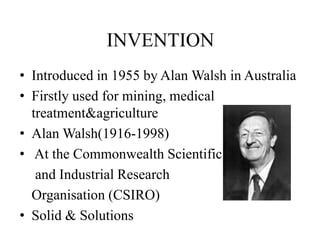
• Introduced in 1955 by Alan Walsh in Australia
• Firstly used for mining, medical
treatment&agriculture
• Alan Walsh(1916-1998)
• At the Commonwealth Scientific
and Industrial Research
Organisation (CSIRO)
• Solid & Solutions
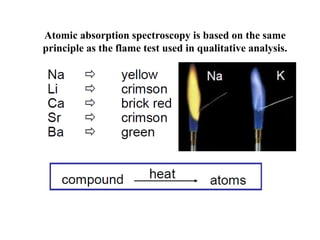
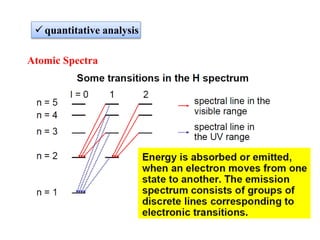
Atomic absorption spectroscopy is based on the same
principle as the flame test used in qualitative analysis.
 The high temperature of the flame excites a
valence electron to a higher-energy orbital.
 The atom then emits energy in the form of light as
the electron falls back into the lower energy orbital
(ground state).
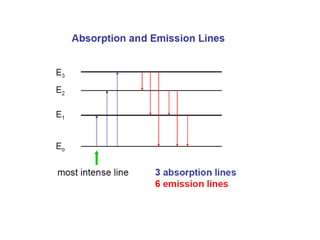
The intensity of the absorbed light is
proportional to the concentration of the element
in the flame.
 quantitative analysis
Atomic Spectra
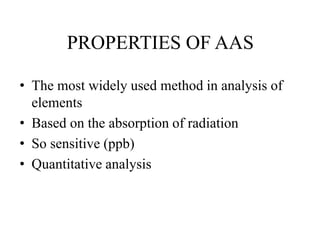
PROPERTIES OF AAS
• The most widely used method in analysis of
elements
• Based on the absorption of radiation
• So sensitive (ppb)
• Quantitative analysis
WORKING PRINCIPLE OF AAS
• Electrons promote to higher orbitals for a short
amount of time by absorbing a energy
• M + hv → M*
• Relises on Beer-Lambert Law
Each element has a characteristic spectrum.
Example: Na gives a characteristic line at 589 nm.
Atomic spectra feature sharp bands.
There is little overlap between the spectral lines of different
elements.
Atomic absorption spectroscopy and atomic emission
spectroscopy are used to determine the concentration of an
element in solution.
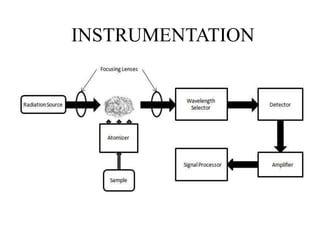
INSTRUMENTATION
LIGHT SOURCES
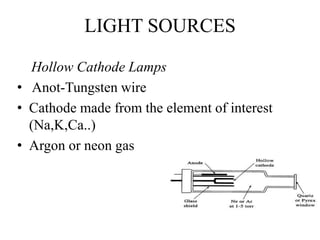
Hollow Cathode Lamps
• Anot-Tungsten wire
• Cathode made from the element of interest
(Na,K,Ca..)
• Argon or neon gas
LIGHT SOURCES
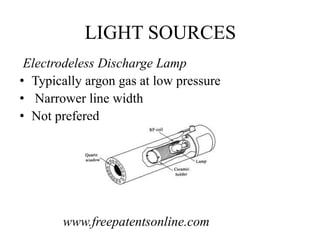
Electrodeless Discharge Lamp
• Typically argon gas at low pressure
• Narrower line width
• Not prefered
www.freepatentsonline.com
ATOMIZATION
• Compounds making up the sample are broken
into free atoms.
• High temperature is necessary
• Basic two types
-Flame atomizer (air-acetylene flame)
-Electrothermal atomizer
Process in a Flame AA
M* M+ + e_
Mo M*
MA Mo + Ao
Solid Solution
Ionization
Excitation
Atomization
Vaporization
TYPES OF ATOMIZERS
FLAME ATOMIZER
• Simplest atomization
• Converts analyte into free atoms of vapor
phase (Pnumatic Nabulizer+Aerosol)
• Flammable & caustic gases
• Not has an inert medium (−)
• Short analysis time (−)
TYPES OF ATOMIZERS
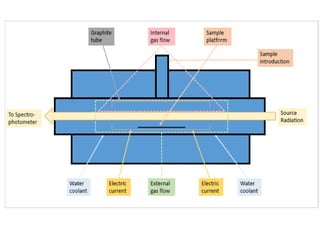
ELECTROTHERMAL ATOMIZER
• A cylindirical graphite tube atomizer
• 20–25 mm in length and 5–6 mm inner diameter
• Developed at St.Petersburg Russia
• Liquid(typically 10–50 μL) or a solid (1 mg)
– Drying – solvent is evaporated;
– Pyrolysis – matrix constituents are removed
– Atomization – analyte element is released to the gaseous phase
– Cleaning –high temperature.
• Tubes may be heated transversely or longitudinally
• Resistivity is noted
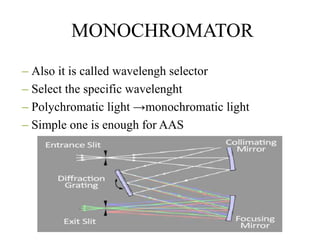
MONOCHROMATOR
– Also it is called wavelengh selector
– Select the specific wavelenght
– Polychromatic light →monochromatic light
– Simple one is enough for AAS
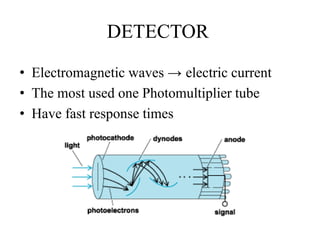
DETECTOR
• Electromagnetic waves → electric current
• The most used one Photomultiplier tube
• Have fast response times
CALIBRATION TECHNIQUES
• Two main techniques
1. Calibration curve method
2. Standart addition method
CALIBRATION TECHNIQUES
CALIBRATION CURVE METHOD
• Draw a graph
• Have two or more variables
-One is set at known values
-One is measured response
• Most convenient for a large number of similar
samples analysis.
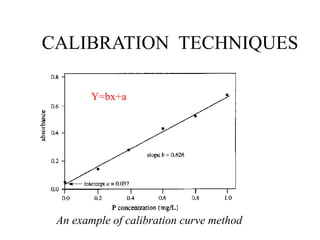
CALIBRATION TECHNIQUES
An example of calibration curve method
Y=bx+a
CALIBRATION TECHNIQUES
STANDART ADDITION METHOD
• To measure the analyte concentration in a
complex matrix.
• Most convenient for small number of samples
analysis
• Prevent effect of chemical & spectral
interferences
INTERFERENCES
• Causes higher or lower absorbance value
• Two major groups
Chemical Interferences
Spectral Interferences
CHEMICAL INTERFERENCES
• The most common one in flame atomizer.
• Consequence of chemical reactions.
• Reduce amount of oxygen in flame to
overcome
SPECTRAL INTERFERENCES
• Absorption or emission of the radiation at the
same wavelength
• Radiation which is absorbed→pozitive errors
• Radiation which is emmitted→negative errors
Atomic Absorption Overview
CONCLUSION
• One of the most important technique in
quantitative analysis
• It is based on the absorption of radiation
• Measurements could be done at ppb levels
• It’s widely used method
• The preparation of the sample is usually
simple and rapid
CONCLUSION
• There are many advantages
High sensitivity
[10-10 g (flame), 10-14 g (non-flame)]
 Good accuracy
(Relative error 0.1 ~ 0.5 % )
 High selectivity
APPLICATIONS OF AAS
• Water analysis (e.g. Ca, Mg, Fe, Si, Al, Ba
content)
• Food analysis
• Analysis of animal feedstuffs (e.g. Mn, Fe, Cu,
Cr, Se,Zn)
• Analysis of soils
• Clinical analysis (blood samples: whole blood,
plasma,serum; Ca, Mg, Li, Na, K, Fe)

Atomic Absorption Spectroscopy

  • 1.
  • 2.
    ATOMIC ABSORPTION SPECTROMETER • Introduction •Invention • Working Principle of AAS • Instrumentation • Interferences & Correlation Methods • Applications
  • 3.
    INTRODUCTION • Atomic absorptionspectroscopy (AAS) is a spectroanalytical procedure for the quantitative determination of chemical elements using the absorption of optical radiation (light) by free atoms in the gaseous state. • In analytical chemistry the technique is used for determining the concentration of a particular element (the analyte) in a sample to be analyze
  • 4.
    INVENTION • Introduced in1955 by Alan Walsh in Australia • Firstly used for mining, medical treatment&agriculture • Alan Walsh(1916-1998) • At the Commonwealth Scientific and Industrial Research Organisation (CSIRO) • Solid & Solutions
  • 5.
    Atomic absorption spectroscopyis based on the same principle as the flame test used in qualitative analysis.
  • 6.
     The hightemperature of the flame excites a valence electron to a higher-energy orbital.  The atom then emits energy in the form of light as the electron falls back into the lower energy orbital (ground state). The intensity of the absorbed light is proportional to the concentration of the element in the flame.
  • 7.
  • 9.
    PROPERTIES OF AAS •The most widely used method in analysis of elements • Based on the absorption of radiation • So sensitive (ppb) • Quantitative analysis
  • 10.
    WORKING PRINCIPLE OFAAS • Electrons promote to higher orbitals for a short amount of time by absorbing a energy • M + hv → M* • Relises on Beer-Lambert Law
  • 11.
    Each element hasa characteristic spectrum. Example: Na gives a characteristic line at 589 nm. Atomic spectra feature sharp bands. There is little overlap between the spectral lines of different elements.
  • 12.
    Atomic absorption spectroscopyand atomic emission spectroscopy are used to determine the concentration of an element in solution.
  • 13.
  • 14.
    LIGHT SOURCES Hollow CathodeLamps • Anot-Tungsten wire • Cathode made from the element of interest (Na,K,Ca..) • Argon or neon gas
  • 15.
    LIGHT SOURCES Electrodeless DischargeLamp • Typically argon gas at low pressure • Narrower line width • Not prefered www.freepatentsonline.com
  • 16.
    ATOMIZATION • Compounds makingup the sample are broken into free atoms. • High temperature is necessary • Basic two types -Flame atomizer (air-acetylene flame) -Electrothermal atomizer
  • 17.
    Process in aFlame AA M* M+ + e_ Mo M* MA Mo + Ao Solid Solution Ionization Excitation Atomization Vaporization
  • 18.
    TYPES OF ATOMIZERS FLAMEATOMIZER • Simplest atomization • Converts analyte into free atoms of vapor phase (Pnumatic Nabulizer+Aerosol) • Flammable & caustic gases • Not has an inert medium (−) • Short analysis time (−)
  • 20.
    TYPES OF ATOMIZERS ELECTROTHERMALATOMIZER • A cylindirical graphite tube atomizer • 20–25 mm in length and 5–6 mm inner diameter • Developed at St.Petersburg Russia • Liquid(typically 10–50 μL) or a solid (1 mg) – Drying – solvent is evaporated; – Pyrolysis – matrix constituents are removed – Atomization – analyte element is released to the gaseous phase – Cleaning –high temperature. • Tubes may be heated transversely or longitudinally • Resistivity is noted
  • 22.
    MONOCHROMATOR – Also itis called wavelengh selector – Select the specific wavelenght – Polychromatic light →monochromatic light – Simple one is enough for AAS
  • 23.
    DETECTOR • Electromagnetic waves→ electric current • The most used one Photomultiplier tube • Have fast response times
  • 24.
    CALIBRATION TECHNIQUES • Twomain techniques 1. Calibration curve method 2. Standart addition method
  • 25.
    CALIBRATION TECHNIQUES CALIBRATION CURVEMETHOD • Draw a graph • Have two or more variables -One is set at known values -One is measured response • Most convenient for a large number of similar samples analysis.
  • 26.
    CALIBRATION TECHNIQUES An exampleof calibration curve method Y=bx+a
  • 27.
    CALIBRATION TECHNIQUES STANDART ADDITIONMETHOD • To measure the analyte concentration in a complex matrix. • Most convenient for small number of samples analysis • Prevent effect of chemical & spectral interferences
  • 28.
    INTERFERENCES • Causes higheror lower absorbance value • Two major groups Chemical Interferences Spectral Interferences
  • 29.
    CHEMICAL INTERFERENCES • Themost common one in flame atomizer. • Consequence of chemical reactions. • Reduce amount of oxygen in flame to overcome
  • 30.
    SPECTRAL INTERFERENCES • Absorptionor emission of the radiation at the same wavelength • Radiation which is absorbed→pozitive errors • Radiation which is emmitted→negative errors
  • 31.
  • 32.
    CONCLUSION • One ofthe most important technique in quantitative analysis • It is based on the absorption of radiation • Measurements could be done at ppb levels • It’s widely used method • The preparation of the sample is usually simple and rapid
  • 33.
    CONCLUSION • There aremany advantages High sensitivity [10-10 g (flame), 10-14 g (non-flame)]  Good accuracy (Relative error 0.1 ~ 0.5 % )  High selectivity
  • 34.
    APPLICATIONS OF AAS •Water analysis (e.g. Ca, Mg, Fe, Si, Al, Ba content) • Food analysis • Analysis of animal feedstuffs (e.g. Mn, Fe, Cu, Cr, Se,Zn) • Analysis of soils • Clinical analysis (blood samples: whole blood, plasma,serum; Ca, Mg, Li, Na, K, Fe)