SUMBITTED BY:
Preeti choudhary(17/MAP/016)
MOSSBAUER
SPECTROSCOPY
 HISTORY OF MOSSBAUER EFFECT.
MOSSBAUER FEEFCT.
 IMPORTANCE OF RESONANCE.
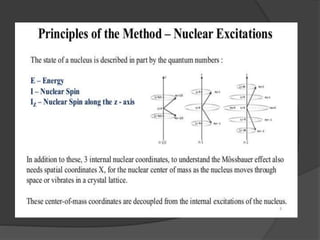
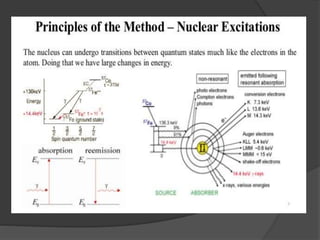
 NUCLEAR EXICTATION.
 MOSSBAUER SPECTRA.
 ISOMER SHIFT.
 QUADRPOLE SPLITING.
 MAGNETIC HYPERFINE SPLITING.
 MOSSBAUER ACTIVE ELEMENT.
 INTRODUCTION OF MOSSBAUERSPECTROMETER.
 MOSSBAUER SPECTROMETER.
 INSTRMENTATION.
 PRINCIPLE.
 STRENTH / LIMITATION.
 APPLICATION.
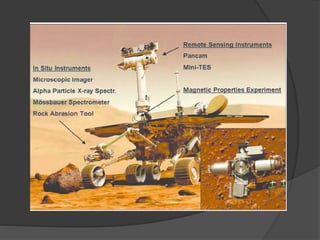
 MARS EXPLORATION ROVER 2003.
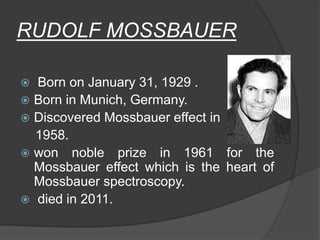
RUDOLF MOSSBAUER
 Born on January 31, 1929 .
 Born in Munich, Germany.
 Discovered Mossbauer effect in
1958.
 won noble prize in 1961 for the
Mossbauer effect which is the heart of
Mossbauer spectroscopy.
 died in 2011.
HISTORY OF MOSSBAUER
EFFECT
 After the emission and absorption of X-
rays by gases had been observed ,and it
was expected that a similar phenomenon
would be found for gamma rays which are
created by nuclear transitions.
 Later ,in 1958 Mossbauer proposed the
theory of gamma ray resonant absorption
which is called Mossbauer effect.
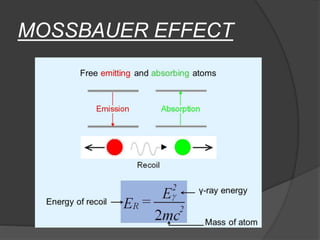
MOSSBAUER EFFECT
IMPORTANCE OF MOSSBAUER
RESONANCE:
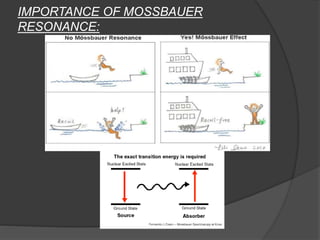
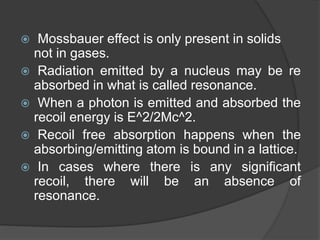
 Mossbauer effect is only present in solids
not in gases.
 Radiation emitted by a nucleus may be re
absorbed in what is called resonance.
 When a photon is emitted and absorbed the
recoil energy is E^2/2Mc^2.
 Recoil free absorption happens when the
absorbing/emitting atom is bound in a lattice.
 In cases where there is any significant
recoil, there will be an absence of
resonance.
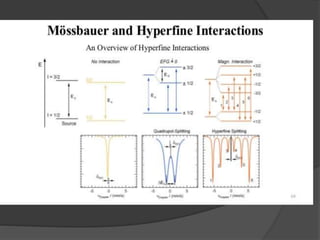
MOSSBAUER SPECTRA
 There are three types of nuclear
interactions that are observed that in a
MOSSBAUER SPECTRA which as
follows:-
 isomer shift or chemical shift.
 quadrupole splitting .
 magnetic splitting or hyperfine splitting.
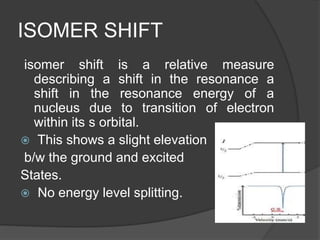
ISOMER SHIFT
isomer shift is a relative measure
describing a shift in the resonance a
shift in the resonance energy of a
nucleus due to transition of electron
within its s orbital.
 This shows a slight elevation
b/w the ground and excited
States.
 No energy level splitting.
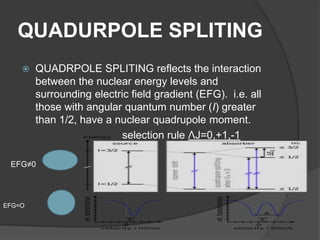
QUADURPOLE SPLITING
 QUADRPOLE SPLITING reflects the interaction
between the nuclear energy levels and
surrounding electric field gradient (EFG). i.e. all
those with angular quantum number (I) greater
than 1/2, have a nuclear quadrupole moment.
selection rule ɅJ=0,+1,-1
EFG≠0
EFG=O
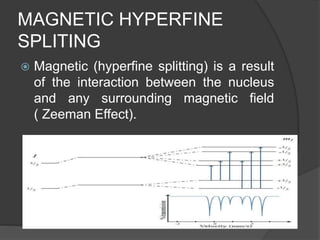
MAGNETIC HYPERFINE
SPLITING
 Magnetic (hyperfine splitting) is a result
of the interaction between the nucleus
and any surrounding magnetic field
( Zeeman Effect).
MOSSBAUER ACTIVE
ELEMENT IN THE
PERIODIC TABLE
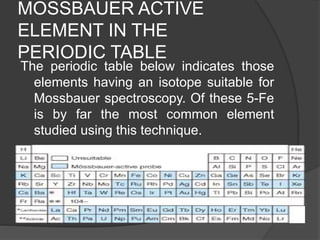
The periodic table below indicates those
elements having an isotope suitable for
Mossbauer spectroscopy. Of these 5-Fe
is by far the most common element
studied using this technique.
MOSSBAUER ACTIVE
ATOMS
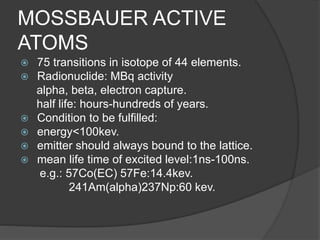
 75 transitions in isotope of 44 elements.
 Radionuclide: MBq activity
alpha, beta, electron capture.
half life: hours-hundreds of years.
 Condition to be fulfilled:
 energy<100kev.
 emitter should always bound to the lattice.
 mean life time of excited level:1ns-100ns.
e.g.: 57Co(EC) 57Fe:14.4kev.
241Am(alpha)237Np:60 kev.
 Mossbauer spectroscopy is the recoil free
emission and absorption of gamma rays.
Mossbauer spectroscopy is basically based on
the Mossbauer effect or recoilless nuclear
resonance fluorescence.
MOSSBAUER
SPETROMETER
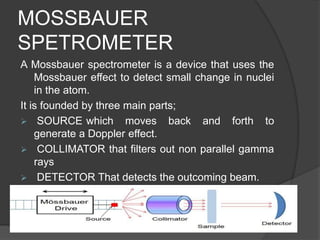
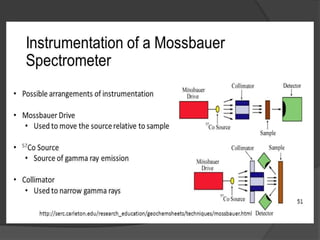
A Mossbauer spectrometer is a device that uses the
Mossbauer effect to detect small change in nuclei
in the atom.
It is founded by three main parts;
 SOURCE which moves back and forth to
generate a Doppler effect.
 COLLIMATOR that filters out non parallel gamma
rays
 DETECTOR That detects the outcoming beam.
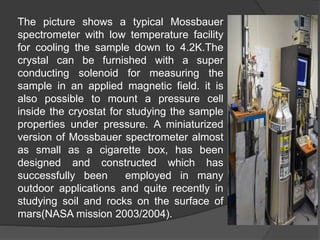
The picture shows a typical Mossbauer
spectrometer with low temperature facility
for cooling the sample down to 4.2K.The
crystal can be furnished with a super
conducting solenoid for measuring the
sample in an applied magnetic field. it is
also possible to mount a pressure cell
inside the cryostat for studying the sample
properties under pressure. A miniaturized
version of Mossbauer spectrometer almost
as small as a cigarette box, has been
designed and constructed which has
successfully been employed in many
outdoor applications and quite recently in
studying soil and rocks on the surface of
mars(NASA mission 2003/2004).
STRENGTH:
 Along with wet chemistry, Mossbauer
spectroscopy remains the "gold standard" for
quantitative determination of the valence
state of iron in minerals and identification of
various iron oxides. It is also well-suited for
determination of the coordination number of
Fe atoms.
LIMITATION: -
 The biggest limitation of the Mossbauer is
that it is inherently a bulk technique.
 only uses in solid.
APPLICATION
Mossbauer spectrometer has so many
applications in industrial physics as well
as chemistry.
Mossbauer spectrometer was used in
Mars Exploration Rover 2003 Spirit and
Opportunity in the form of miniature
Mossbauer spectrometer.
 A MIMOS II instrument was mounted on the robotic arm of
each of two identical rovers, called Spirit and Opportunity,
which were launched separately in June 2003 (from
Kennedy Space Center, Florida) and landed successfully
on Mars in January 2004, Spirit in Gusev Crater and
Opportunity in Meridiani Planum (opposite side of Mars).
 The robotic arm carries the Mössbauer spectrometer
MIMOS II, an AlphaParticle-X-ray-Spectrometer (APXS) for
elemental analysis (developed at the Max Planck-Institute
in Mainz, a Microscopic Imager, and a Rock Abrasion Tool
for polishing rocks and drilling holes up to ca. 5 mm into
rocks. The first Mössbauer spectrum recorded on the
Martian surface was obtained on soil at Spirit‗s landing
site in Gusev crater and shows a basaltic signature (olivine
and pyroxene). Soil and dust were found to be globally
distributed on Mars: spectra obtained on soil at
Opportunity‗s landing site in Meridiani Planum are almost
identical to those recorded in Gusev crater.
Mossbauer Spectroscopy

Mossbauer Spectroscopy

  • 1.
  • 2.
     HISTORY OFMOSSBAUER EFFECT. MOSSBAUER FEEFCT.  IMPORTANCE OF RESONANCE.  NUCLEAR EXICTATION.  MOSSBAUER SPECTRA.  ISOMER SHIFT.  QUADRPOLE SPLITING.  MAGNETIC HYPERFINE SPLITING.  MOSSBAUER ACTIVE ELEMENT.  INTRODUCTION OF MOSSBAUERSPECTROMETER.  MOSSBAUER SPECTROMETER.  INSTRMENTATION.  PRINCIPLE.  STRENTH / LIMITATION.  APPLICATION.  MARS EXPLORATION ROVER 2003.
  • 3.
    RUDOLF MOSSBAUER  Bornon January 31, 1929 .  Born in Munich, Germany.  Discovered Mossbauer effect in 1958.  won noble prize in 1961 for the Mossbauer effect which is the heart of Mossbauer spectroscopy.  died in 2011.
  • 4.
    HISTORY OF MOSSBAUER EFFECT After the emission and absorption of X- rays by gases had been observed ,and it was expected that a similar phenomenon would be found for gamma rays which are created by nuclear transitions.  Later ,in 1958 Mossbauer proposed the theory of gamma ray resonant absorption which is called Mossbauer effect.
  • 5.
  • 6.
  • 7.
     Mossbauer effectis only present in solids not in gases.  Radiation emitted by a nucleus may be re absorbed in what is called resonance.  When a photon is emitted and absorbed the recoil energy is E^2/2Mc^2.  Recoil free absorption happens when the absorbing/emitting atom is bound in a lattice.  In cases where there is any significant recoil, there will be an absence of resonance.
  • 10.
    MOSSBAUER SPECTRA  Thereare three types of nuclear interactions that are observed that in a MOSSBAUER SPECTRA which as follows:-  isomer shift or chemical shift.  quadrupole splitting .  magnetic splitting or hyperfine splitting.
  • 11.
    ISOMER SHIFT isomer shiftis a relative measure describing a shift in the resonance a shift in the resonance energy of a nucleus due to transition of electron within its s orbital.  This shows a slight elevation b/w the ground and excited States.  No energy level splitting.
  • 12.
    QUADURPOLE SPLITING  QUADRPOLESPLITING reflects the interaction between the nuclear energy levels and surrounding electric field gradient (EFG). i.e. all those with angular quantum number (I) greater than 1/2, have a nuclear quadrupole moment. selection rule ɅJ=0,+1,-1 EFG≠0 EFG=O
  • 13.
    MAGNETIC HYPERFINE SPLITING  Magnetic(hyperfine splitting) is a result of the interaction between the nucleus and any surrounding magnetic field ( Zeeman Effect).
  • 15.
    MOSSBAUER ACTIVE ELEMENT INTHE PERIODIC TABLE The periodic table below indicates those elements having an isotope suitable for Mossbauer spectroscopy. Of these 5-Fe is by far the most common element studied using this technique.
  • 16.
    MOSSBAUER ACTIVE ATOMS  75transitions in isotope of 44 elements.  Radionuclide: MBq activity alpha, beta, electron capture. half life: hours-hundreds of years.  Condition to be fulfilled:  energy<100kev.  emitter should always bound to the lattice.  mean life time of excited level:1ns-100ns. e.g.: 57Co(EC) 57Fe:14.4kev. 241Am(alpha)237Np:60 kev.
  • 17.
     Mossbauer spectroscopyis the recoil free emission and absorption of gamma rays. Mossbauer spectroscopy is basically based on the Mossbauer effect or recoilless nuclear resonance fluorescence.
  • 18.
    MOSSBAUER SPETROMETER A Mossbauer spectrometeris a device that uses the Mossbauer effect to detect small change in nuclei in the atom. It is founded by three main parts;  SOURCE which moves back and forth to generate a Doppler effect.  COLLIMATOR that filters out non parallel gamma rays  DETECTOR That detects the outcoming beam.
  • 21.
    The picture showsa typical Mossbauer spectrometer with low temperature facility for cooling the sample down to 4.2K.The crystal can be furnished with a super conducting solenoid for measuring the sample in an applied magnetic field. it is also possible to mount a pressure cell inside the cryostat for studying the sample properties under pressure. A miniaturized version of Mossbauer spectrometer almost as small as a cigarette box, has been designed and constructed which has successfully been employed in many outdoor applications and quite recently in studying soil and rocks on the surface of mars(NASA mission 2003/2004).
  • 22.
    STRENGTH:  Along withwet chemistry, Mossbauer spectroscopy remains the "gold standard" for quantitative determination of the valence state of iron in minerals and identification of various iron oxides. It is also well-suited for determination of the coordination number of Fe atoms. LIMITATION: -  The biggest limitation of the Mossbauer is that it is inherently a bulk technique.  only uses in solid.
  • 23.
    APPLICATION Mossbauer spectrometer hasso many applications in industrial physics as well as chemistry. Mossbauer spectrometer was used in Mars Exploration Rover 2003 Spirit and Opportunity in the form of miniature Mossbauer spectrometer.
  • 25.
     A MIMOSII instrument was mounted on the robotic arm of each of two identical rovers, called Spirit and Opportunity, which were launched separately in June 2003 (from Kennedy Space Center, Florida) and landed successfully on Mars in January 2004, Spirit in Gusev Crater and Opportunity in Meridiani Planum (opposite side of Mars).  The robotic arm carries the Mössbauer spectrometer MIMOS II, an AlphaParticle-X-ray-Spectrometer (APXS) for elemental analysis (developed at the Max Planck-Institute in Mainz, a Microscopic Imager, and a Rock Abrasion Tool for polishing rocks and drilling holes up to ca. 5 mm into rocks. The first Mössbauer spectrum recorded on the Martian surface was obtained on soil at Spirit‗s landing site in Gusev crater and shows a basaltic signature (olivine and pyroxene). Soil and dust were found to be globally distributed on Mars: spectra obtained on soil at Opportunity‗s landing site in Meridiani Planum are almost identical to those recorded in Gusev crater.