Famous Scientist in Civil Engineering
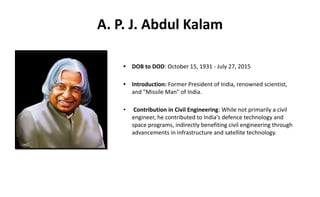
A. P. J. Abdul Kalam
• DOB to DOD: October 15, 1931 - July 27, 2015
• Introduction: Former President of India, renowned scientist,
and "Missile Man" of India.
• Contribution in Civil Engineering: While not primarily a civil
engineer, he contributed to India's defence technology and
space programs, indirectly benefiting civil engineering through
advancements in infrastructure and satellite technology.
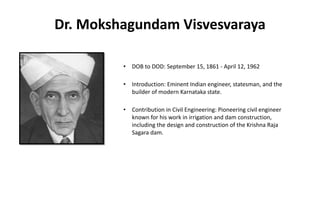
Dr. Mokshagundam Visvesvaraya
• DOB to DOD: September 15, 1861 - April 12, 1962
• Introduction: Eminent Indian engineer, statesman, and the
builder of modern Karnataka state.
• Contribution in Civil Engineering: Pioneering civil engineer
known for his work in irrigation and dam construction,
including the design and construction of the Krishna Raja
Sagara dam.
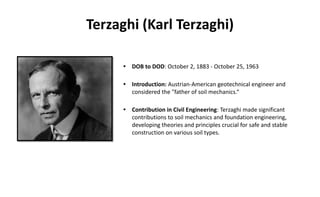
Terzaghi (Karl Terzaghi)
• DOB to DOD: October 2, 1883 - October 25, 1963
• Introduction: Austrian-American geotechnical engineer and
considered the "father of soil mechanics.“
• Contribution in Civil Engineering: Terzaghi made significant
contributions to soil mechanics and foundation engineering,
developing theories and principles crucial for safe and stable
construction on various soil types.
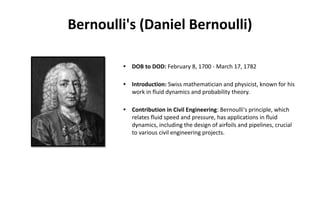
Bernoulli's (Daniel Bernoulli)
• DOB to DOD: February 8, 1700 - March 17, 1782
• Introduction: Swiss mathematician and physicist, known for his
work in fluid dynamics and probability theory.
• Contribution in Civil Engineering: Bernoulli's principle, which
relates fluid speed and pressure, has applications in fluid
dynamics, including the design of airfoils and pipelines, crucial
to various civil engineering projects.
Robert Mallet
• DOB to DOD: June 3, 1810, to November 5, 1881.
• Introduction: Robert Mallet was an Irish civil engineer and
seismologist known for his work in studying earthquakes.
• Contribution in Civil Engineering: Mallet is considered a
pioneer in seismology and earthquake engineering. His
research laid the groundwork for understanding the seismic
behavior of structures and contributed to earthquake-resistant
building design.
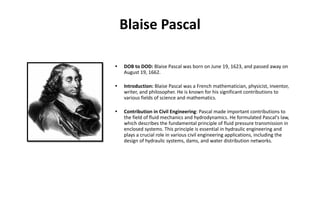
Blaise Pascal
• DOB to DOD: Blaise Pascal was born on June 19, 1623, and passed away on
August 19, 1662.
• Introduction: Blaise Pascal was a French mathematician, physicist, inventor,
writer, and philosopher. He is known for his significant contributions to
various fields of science and mathematics.
• Contribution in Civil Engineering: Pascal made important contributions to
the field of fluid mechanics and hydrodynamics. He formulated Pascal's law,
which describes the fundamental principle of fluid pressure transmission in
enclosed systems. This principle is essential in hydraulic engineering and
plays a crucial role in various civil engineering applications, including the
design of hydraulic systems, dams, and water distribution networks.
Isambard Kingdom Brunel
• DOB to DOD: Isambard Kingdom Brunel was born on April 9, 1806, and
passed away on September 15, 1859.
• Introduction: Isambard Kingdom Brunel was a British civil engineer who is
considered one of the most innovative and influential engineers of the
19th century. He worked on various engineering projects during the
Industrial Revolution in Britain.
• Contribution in Civil Engineering: Brunel's significant contributions
include designing and overseeing the construction of the Great Western
Railway, numerous bridges, tunnels, and the iconic SS Great Britain, one
of the first iron-hulled steamships. His innovative engineering solutions
had a lasting impact on transportation and infrastructure development in
Britain.
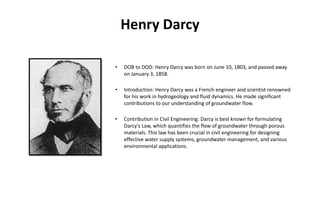
Henry Darcy
• DOB to DOD: Henry Darcy was born on June 10, 1803, and passed away
on January 3, 1858.
• Introduction: Henry Darcy was a French engineer and scientist renowned
for his work in hydrogeology and fluid dynamics. He made significant
contributions to our understanding of groundwater flow.
• Contribution in Civil Engineering: Darcy is best known for formulating
Darcy's Law, which quantifies the flow of groundwater through porous
materials. This law has been crucial in civil engineering for designing
effective water supply systems, groundwater management, and various
environmental applications.
Thomas Telford
• DOB to DOD: Thomas Telford was born on August 9, 1757, and passed
away on September 2, 1834.
• Introduction: Thomas Telford was a Scottish civil engineer, architect, and
stonemason who played a pivotal role in the early development of civil
engineering and transportation infrastructure in Britain.
• Contribution in Civil Engineering: Telford's significant contributions
include designing and supervising the construction of various road and
canal projects, including the Ellesmere Canal, Caledonian Canal, and
improvements to the Shropshire and North Wales road network. He is
known for his innovative bridge designs, such as the Menai Suspension
Bridge, which was a marvel of engineering in its time. Telford's work had a
lasting impact on the improvement of transportation and infrastructure in
the United Kingdom.
Fazlur Rahman Khan
• DOB to DOD: Fazlur Rahman Khan was born on April 3, 1929, and passed
away on March 27, 1982.
• Introduction: Fazlur Rahman Khan was a Bangladeshi-American structural
engineer and architect. He is widely recognized as one of the most
influential figures in the field of structural engineering and skyscraper
design.
• Contribution in Civil Engineering: Khan is renowned for his innovative
structural engineering designs, particularly for tall buildings. He pioneered
the development of the "bundled tube" structural system, which allowed
for the construction of exceptionally tall skyscrapers like the Sears Tower
(now Willis Tower) in Chicago. His contributions revolutionized the field of
high-rise building construction and had a profound impact on the design
of modern skyscrapers worldwide.
George Stephenson
• DOB to DOD: George Stephenson was born on June 9, 1781, and passed
away on August 12, 1848.
• Introduction: George Stephenson was an English engineer and inventor
known as the "Father of Railways." He played a pivotal role in the
development of the steam locomotive and the expansion of railway
systems in the United Kingdom during the early 19th century.
• Contribution in Civil Engineering: Stephenson's most significant
contribution was the design and construction of the world's first
successful steam locomotive, known as the "Rocket." This locomotive
revolutionized transportation by making rail travel more efficient and
reliable. He also designed and built the Stockton and Darlington Railway,
the first public railway to carry both passengers and freight using steam
locomotives. Stephenson's work laid the foundation for the modern
railway system, transforming the way people and goods were
transported.
John Smeaton
• DOB to DOD: John Smeaton was born on June 8, 1724, and passed away
on October 28, 1792.
• Introduction: John Smeaton was an English civil engineer, often regarded
as the "Father of Civil Engineering." He made significant contributions to
various engineering fields during the 18th century.
• Contribution in Civil Engineering: Smeaton is best known for his
pioneering work in the design and construction of lighthouses. His most
famous project is the Eddystone Lighthouse, which was a remarkable
engineering achievement. Smeaton's design innovations, including the
use of hydraulic lime, set new standards for lighthouse construction and
laid the groundwork for modern civil engineering practices. His work had
a lasting impact on the development of infrastructure and engineering
principles.
John Loudon McAdam
• DOB to DOD: John Loudon McAdam was born on September 21, 1756,
and passed away on November 26, 1836.
• Introduction: John Loudon McAdam was a Scottish engineer and road
builder who revolutionized road construction during the late 18th and
early 19th centuries.
• Contribution in Civil Engineering: McAdam is best known for developing
the "Macadam" road construction method, which involved layering roads
with small-sized, crushed stone that was tightly packed and compacted.
This innovation significantly improved road durability and reduced
maintenance requirements. McAdam's approach to road building became
widely adopted and had a profound impact on transportation
infrastructure, making travel on roads smoother and more reliable. His
contributions laid the foundation for modern road construction
techniques.

Top 13 Famous Civil Engineering Scientist

  • 1.
    Famous Scientist inCivil Engineering
  • 2.
    A. P. J.Abdul Kalam • DOB to DOD: October 15, 1931 - July 27, 2015 • Introduction: Former President of India, renowned scientist, and "Missile Man" of India. • Contribution in Civil Engineering: While not primarily a civil engineer, he contributed to India's defence technology and space programs, indirectly benefiting civil engineering through advancements in infrastructure and satellite technology.
  • 3.
    Dr. Mokshagundam Visvesvaraya •DOB to DOD: September 15, 1861 - April 12, 1962 • Introduction: Eminent Indian engineer, statesman, and the builder of modern Karnataka state. • Contribution in Civil Engineering: Pioneering civil engineer known for his work in irrigation and dam construction, including the design and construction of the Krishna Raja Sagara dam.
  • 4.
    Terzaghi (Karl Terzaghi) •DOB to DOD: October 2, 1883 - October 25, 1963 • Introduction: Austrian-American geotechnical engineer and considered the "father of soil mechanics.“ • Contribution in Civil Engineering: Terzaghi made significant contributions to soil mechanics and foundation engineering, developing theories and principles crucial for safe and stable construction on various soil types.
  • 5.
    Bernoulli's (Daniel Bernoulli) •DOB to DOD: February 8, 1700 - March 17, 1782 • Introduction: Swiss mathematician and physicist, known for his work in fluid dynamics and probability theory. • Contribution in Civil Engineering: Bernoulli's principle, which relates fluid speed and pressure, has applications in fluid dynamics, including the design of airfoils and pipelines, crucial to various civil engineering projects.
  • 6.
    Robert Mallet • DOBto DOD: June 3, 1810, to November 5, 1881. • Introduction: Robert Mallet was an Irish civil engineer and seismologist known for his work in studying earthquakes. • Contribution in Civil Engineering: Mallet is considered a pioneer in seismology and earthquake engineering. His research laid the groundwork for understanding the seismic behavior of structures and contributed to earthquake-resistant building design.
  • 7.
    Blaise Pascal • DOBto DOD: Blaise Pascal was born on June 19, 1623, and passed away on August 19, 1662. • Introduction: Blaise Pascal was a French mathematician, physicist, inventor, writer, and philosopher. He is known for his significant contributions to various fields of science and mathematics. • Contribution in Civil Engineering: Pascal made important contributions to the field of fluid mechanics and hydrodynamics. He formulated Pascal's law, which describes the fundamental principle of fluid pressure transmission in enclosed systems. This principle is essential in hydraulic engineering and plays a crucial role in various civil engineering applications, including the design of hydraulic systems, dams, and water distribution networks.
  • 8.
    Isambard Kingdom Brunel •DOB to DOD: Isambard Kingdom Brunel was born on April 9, 1806, and passed away on September 15, 1859. • Introduction: Isambard Kingdom Brunel was a British civil engineer who is considered one of the most innovative and influential engineers of the 19th century. He worked on various engineering projects during the Industrial Revolution in Britain. • Contribution in Civil Engineering: Brunel's significant contributions include designing and overseeing the construction of the Great Western Railway, numerous bridges, tunnels, and the iconic SS Great Britain, one of the first iron-hulled steamships. His innovative engineering solutions had a lasting impact on transportation and infrastructure development in Britain.
  • 9.
    Henry Darcy • DOBto DOD: Henry Darcy was born on June 10, 1803, and passed away on January 3, 1858. • Introduction: Henry Darcy was a French engineer and scientist renowned for his work in hydrogeology and fluid dynamics. He made significant contributions to our understanding of groundwater flow. • Contribution in Civil Engineering: Darcy is best known for formulating Darcy's Law, which quantifies the flow of groundwater through porous materials. This law has been crucial in civil engineering for designing effective water supply systems, groundwater management, and various environmental applications.
  • 10.
    Thomas Telford • DOBto DOD: Thomas Telford was born on August 9, 1757, and passed away on September 2, 1834. • Introduction: Thomas Telford was a Scottish civil engineer, architect, and stonemason who played a pivotal role in the early development of civil engineering and transportation infrastructure in Britain. • Contribution in Civil Engineering: Telford's significant contributions include designing and supervising the construction of various road and canal projects, including the Ellesmere Canal, Caledonian Canal, and improvements to the Shropshire and North Wales road network. He is known for his innovative bridge designs, such as the Menai Suspension Bridge, which was a marvel of engineering in its time. Telford's work had a lasting impact on the improvement of transportation and infrastructure in the United Kingdom.
  • 11.
    Fazlur Rahman Khan •DOB to DOD: Fazlur Rahman Khan was born on April 3, 1929, and passed away on March 27, 1982. • Introduction: Fazlur Rahman Khan was a Bangladeshi-American structural engineer and architect. He is widely recognized as one of the most influential figures in the field of structural engineering and skyscraper design. • Contribution in Civil Engineering: Khan is renowned for his innovative structural engineering designs, particularly for tall buildings. He pioneered the development of the "bundled tube" structural system, which allowed for the construction of exceptionally tall skyscrapers like the Sears Tower (now Willis Tower) in Chicago. His contributions revolutionized the field of high-rise building construction and had a profound impact on the design of modern skyscrapers worldwide.
  • 12.
    George Stephenson • DOBto DOD: George Stephenson was born on June 9, 1781, and passed away on August 12, 1848. • Introduction: George Stephenson was an English engineer and inventor known as the "Father of Railways." He played a pivotal role in the development of the steam locomotive and the expansion of railway systems in the United Kingdom during the early 19th century. • Contribution in Civil Engineering: Stephenson's most significant contribution was the design and construction of the world's first successful steam locomotive, known as the "Rocket." This locomotive revolutionized transportation by making rail travel more efficient and reliable. He also designed and built the Stockton and Darlington Railway, the first public railway to carry both passengers and freight using steam locomotives. Stephenson's work laid the foundation for the modern railway system, transforming the way people and goods were transported.
  • 13.
    John Smeaton • DOBto DOD: John Smeaton was born on June 8, 1724, and passed away on October 28, 1792. • Introduction: John Smeaton was an English civil engineer, often regarded as the "Father of Civil Engineering." He made significant contributions to various engineering fields during the 18th century. • Contribution in Civil Engineering: Smeaton is best known for his pioneering work in the design and construction of lighthouses. His most famous project is the Eddystone Lighthouse, which was a remarkable engineering achievement. Smeaton's design innovations, including the use of hydraulic lime, set new standards for lighthouse construction and laid the groundwork for modern civil engineering practices. His work had a lasting impact on the development of infrastructure and engineering principles.
  • 14.
    John Loudon McAdam •DOB to DOD: John Loudon McAdam was born on September 21, 1756, and passed away on November 26, 1836. • Introduction: John Loudon McAdam was a Scottish engineer and road builder who revolutionized road construction during the late 18th and early 19th centuries. • Contribution in Civil Engineering: McAdam is best known for developing the "Macadam" road construction method, which involved layering roads with small-sized, crushed stone that was tightly packed and compacted. This innovation significantly improved road durability and reduced maintenance requirements. McAdam's approach to road building became widely adopted and had a profound impact on transportation infrastructure, making travel on roads smoother and more reliable. His contributions laid the foundation for modern road construction techniques.