Allied Medical Science
Department of Medical Equipment Technology
MEDICAL ELECTRONICS (2)
[ FPGA Vs ASIC Differences between Them and Which One to Use ]
Name / Mohamed Morsy Elsaied (51015312)
Supervised By / Dr. Eslam Al Saba
Eng . Karim Hafez
Eng . Omnia Elshakra
Eng . Sherine Shawky
***********
FPGA Vs ASIC Differences between Them
 FPGA vs ASIC
I. Speed
ASIC rules out FPGA in terms of speed. As ASIC are designed for a
specific application they can be optimized to maximum, hence we can
have high speed in ASIC designs. ASIC can have hight speed clocks.
II. Cost
FPGAs are cost effective for small applications. But when it comes to
complex and large volume designs (like 32-bit processors) ASIC
products are cheaper.
III. Size/Area
FPGA are contains lots of LUTs, and routing channels which are
connected via bit streams (program). As they are made for general
purpose and because of re-usability. They are in-general larger
designs than corresponding ASIC design. For example, LUT gives you
both registered and non-register output, but if we require only non-
registered output, then its a waste of having a extra circuitry. In this
way ASIC will be smaller in size.
IV. Power
FPGA designs consume more power than ASIC designs. As explained
above the unwantedcircuitry results wastage of power. FPGA wont
allow us to have better power optimization. When it comes to ASIC
designs we can optimize them to the fullest.
V. Time to Market
FPGA designs will till less time, as the design cycle is small when
compared to that of ASIC designs. No need of layouts, masks or other
back-end processes. Its very simple: Specifications -- HDL +
simulations -- Synthesis -- Place and Route (along with static-
analysis) -- Dump code onto FPGA and Verify. When it comes to
ASIC we have to do floor planning and also advanced verification.
The FPGA design flow eliminates the complex and time-consuming
floor planning, place and route, timing analysis, and mask / re-spin
stages of the project since the design logic is already synthesizedto be
placed onto an already verified, characterized FPGA device.
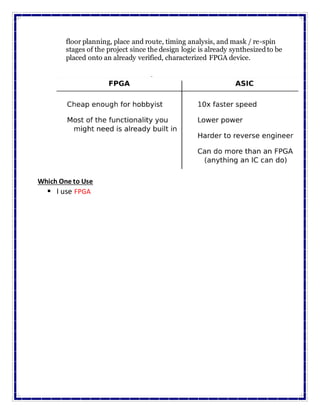
Which One to Use
 I use FPGA

Fpga vs asic

  • 1.
    Allied Medical Science Departmentof Medical Equipment Technology MEDICAL ELECTRONICS (2) [ FPGA Vs ASIC Differences between Them and Which One to Use ] Name / Mohamed Morsy Elsaied (51015312) Supervised By / Dr. Eslam Al Saba Eng . Karim Hafez Eng . Omnia Elshakra Eng . Sherine Shawky ***********
  • 2.
    FPGA Vs ASICDifferences between Them  FPGA vs ASIC I. Speed ASIC rules out FPGA in terms of speed. As ASIC are designed for a specific application they can be optimized to maximum, hence we can have high speed in ASIC designs. ASIC can have hight speed clocks. II. Cost FPGAs are cost effective for small applications. But when it comes to complex and large volume designs (like 32-bit processors) ASIC products are cheaper. III. Size/Area FPGA are contains lots of LUTs, and routing channels which are connected via bit streams (program). As they are made for general purpose and because of re-usability. They are in-general larger designs than corresponding ASIC design. For example, LUT gives you both registered and non-register output, but if we require only non- registered output, then its a waste of having a extra circuitry. In this way ASIC will be smaller in size. IV. Power FPGA designs consume more power than ASIC designs. As explained above the unwantedcircuitry results wastage of power. FPGA wont allow us to have better power optimization. When it comes to ASIC designs we can optimize them to the fullest. V. Time to Market FPGA designs will till less time, as the design cycle is small when compared to that of ASIC designs. No need of layouts, masks or other back-end processes. Its very simple: Specifications -- HDL + simulations -- Synthesis -- Place and Route (along with static- analysis) -- Dump code onto FPGA and Verify. When it comes to ASIC we have to do floor planning and also advanced verification. The FPGA design flow eliminates the complex and time-consuming
  • 3.
    floor planning, placeand route, timing analysis, and mask / re-spin stages of the project since the design logic is already synthesizedto be placed onto an already verified, characterized FPGA device. Which One to Use  I use FPGA