ABSORPTION OF DRUGS FROM
NON PER OS EXTRA VASCULAR
ROUTES
1
Contents1,2
 Introduction
 Definition
 Other than oral routes
 Advantages
 Summary
 Conclusion
 References
2
Introduction1
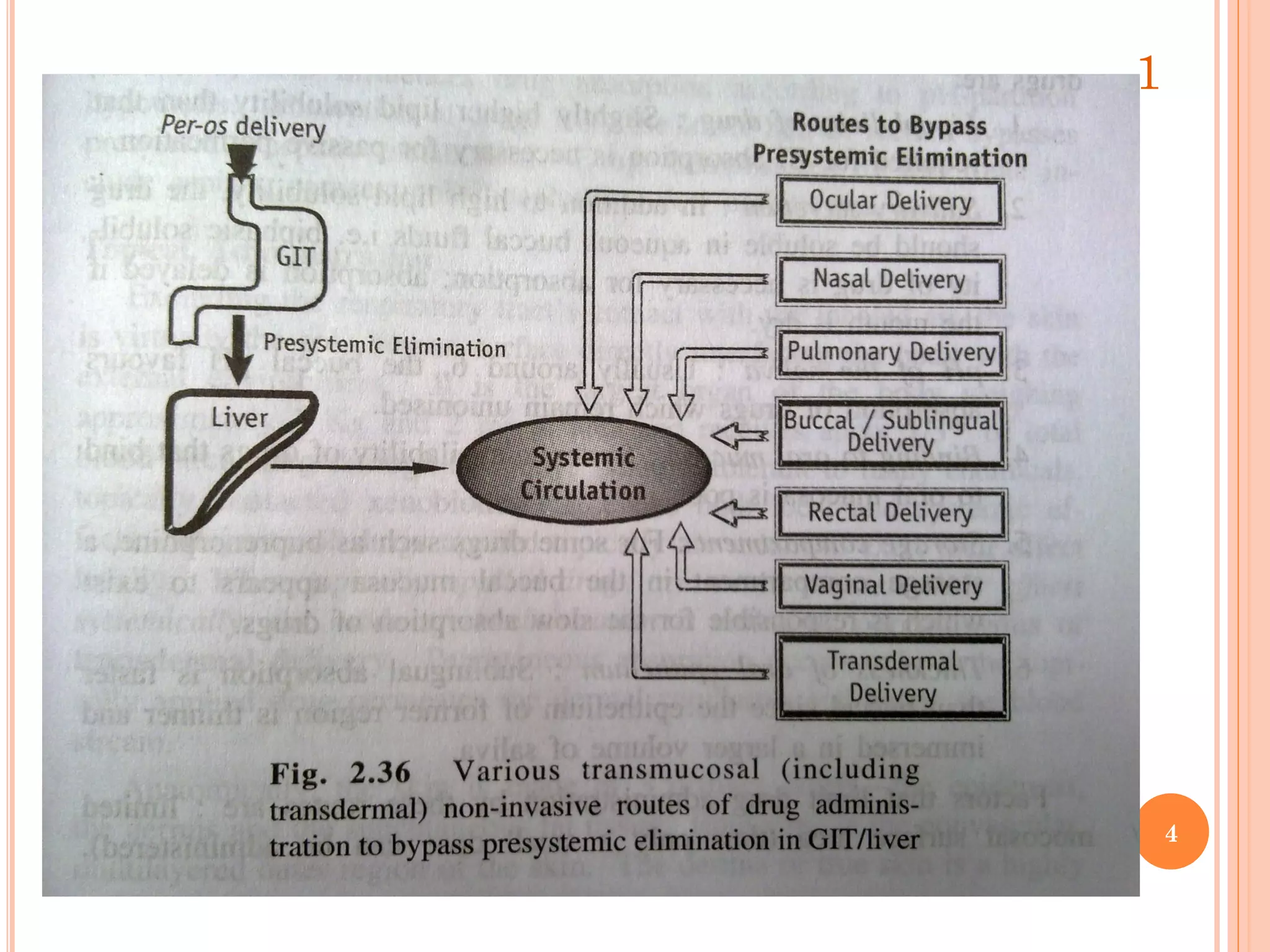
 NON PER OS Means other than oral routes which by
passes the GIT and reaches to systemic circulation.
 One of the major advantages of administering drugs
by non-invasive transmucosal (& transdermal) routes
such as nasal, buccal, rectal, etc. is that greater
systemic availability is attainable
3
1
4
5
NON PER OS ROUTES1,2
 BUCCAL/SUBLINGUAL
 RECTAL
 TOPICAL
 INTRAMASCULAR
 SUBCUTANIOUS
 PULMONARY
 INTRANASAL
 INTRAOCCULAR
 VAGINAL
6
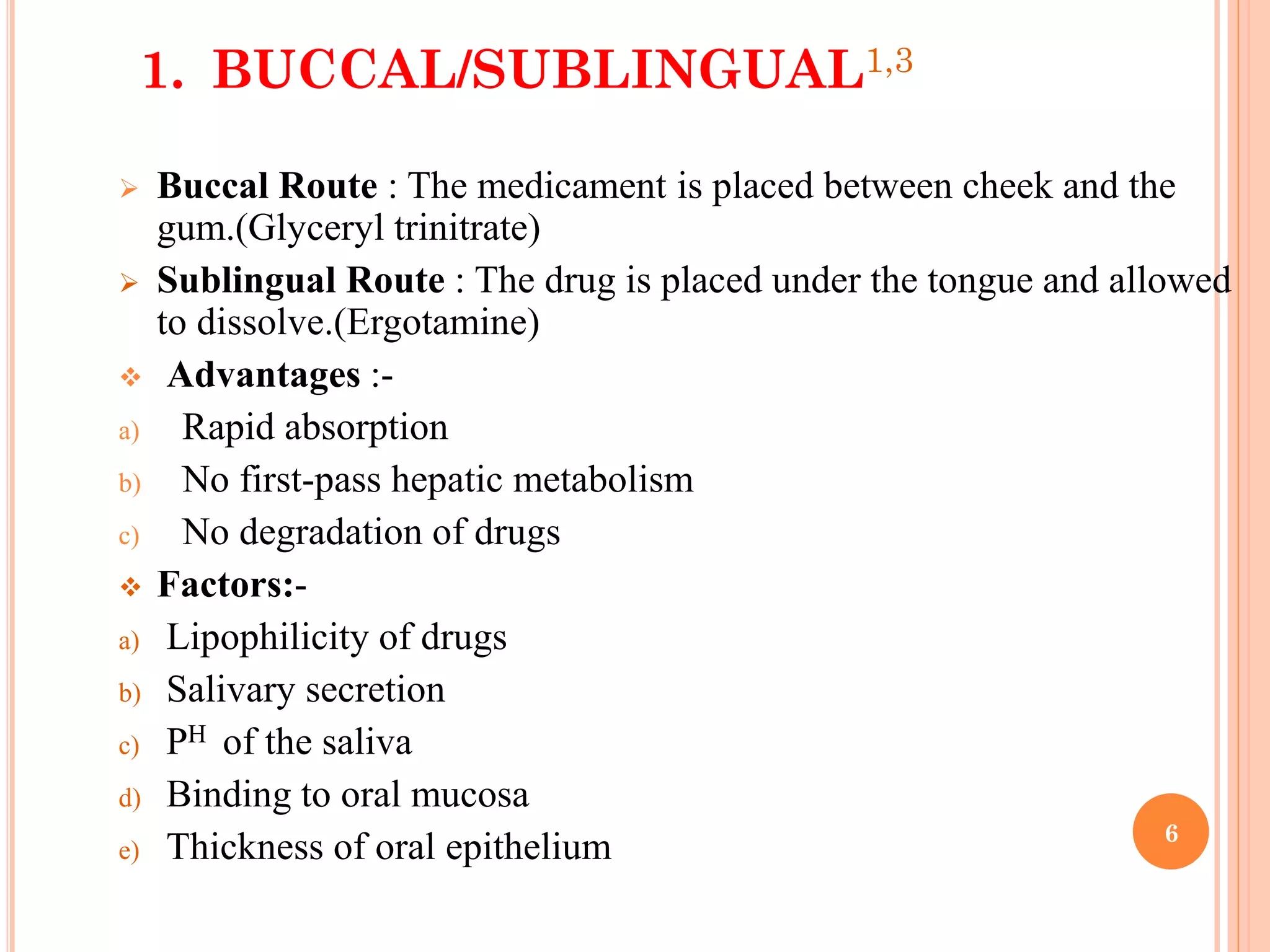
1. BUCCAL/SUBLINGUAL1,3
 Buccal Route : The medicament is placed between cheek and the
gum.(Glyceryl trinitrate)
 Sublingual Route : The drug is placed under the tongue and allowed
to dissolve.(Ergotamine)
 Advantages :-
a) Rapid absorption
b) No first-pass hepatic metabolism
c) No degradation of drugs
 Factors:-
a) Lipophilicity of drugs
b) Salivary secretion
c) PH of the saliva
d) Binding to oral mucosa
e) Thickness of oral epithelium
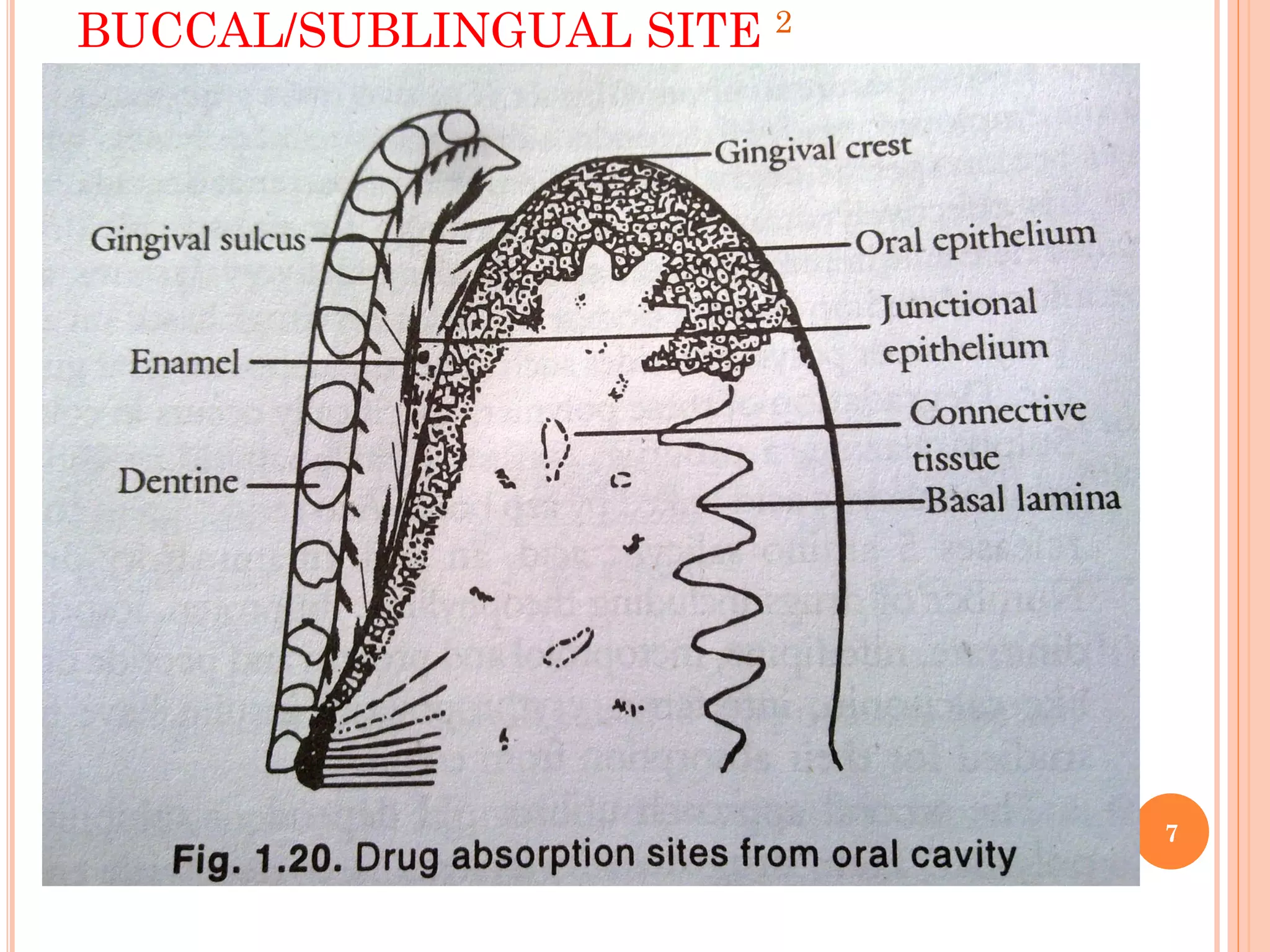
BUCCAL/SUBLINGUAL SITE 2
7
8
2. RECTAL1,2
 The rectal route of administration is still an important
route for Children & Old Patients.
 The drug may be administered as solutions(microenemas)
or suppositories.
 Advantage :-
a) Absorption is more rapid
b) Bypasses presystemic hepatic metabolism
 Factors:-
1. Presence of faecal matter
2. pH of rectal fluid ( Around 8)
3. Drug Irritability
4. Surface area
9
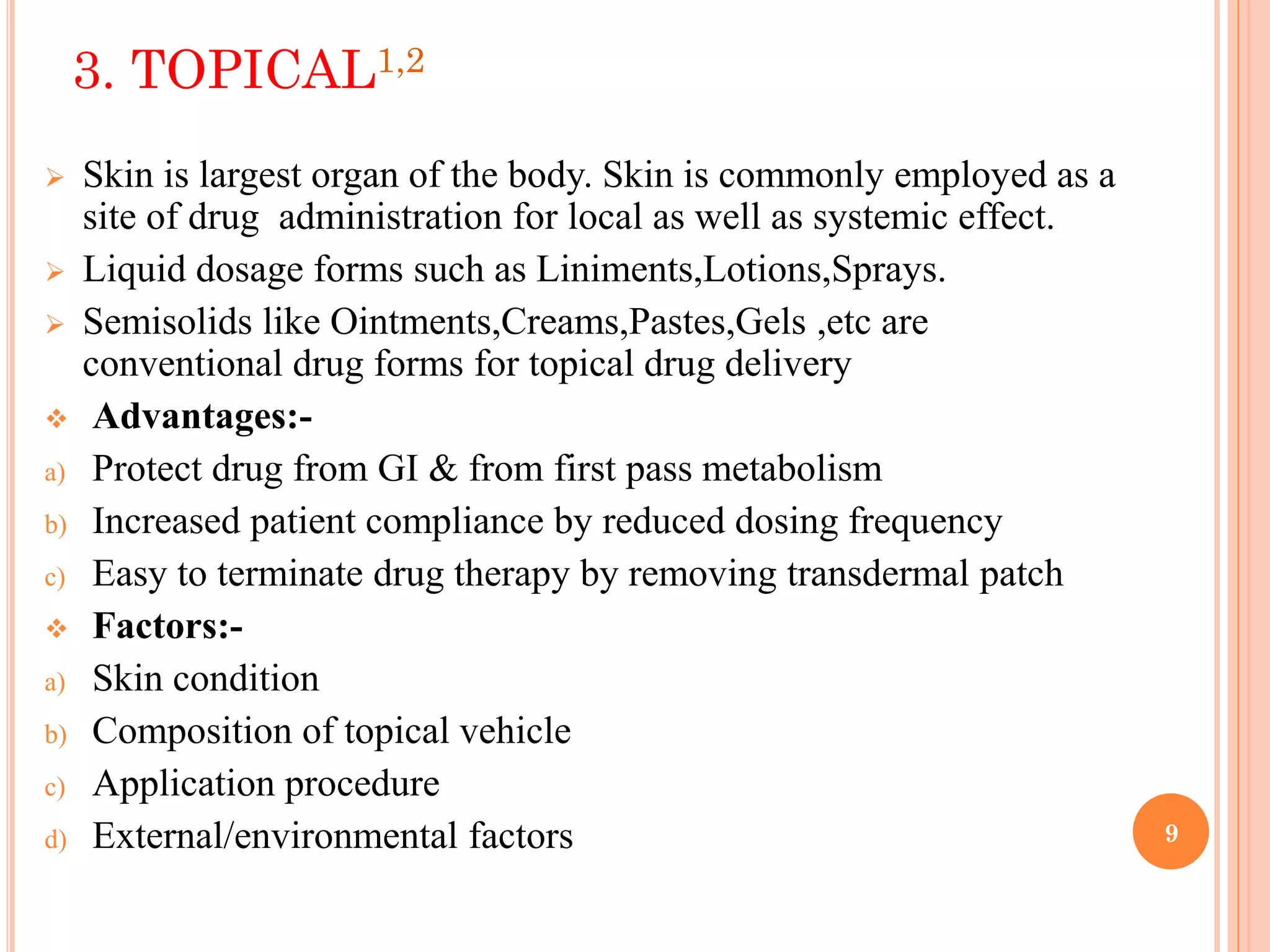
3. TOPICAL1,2
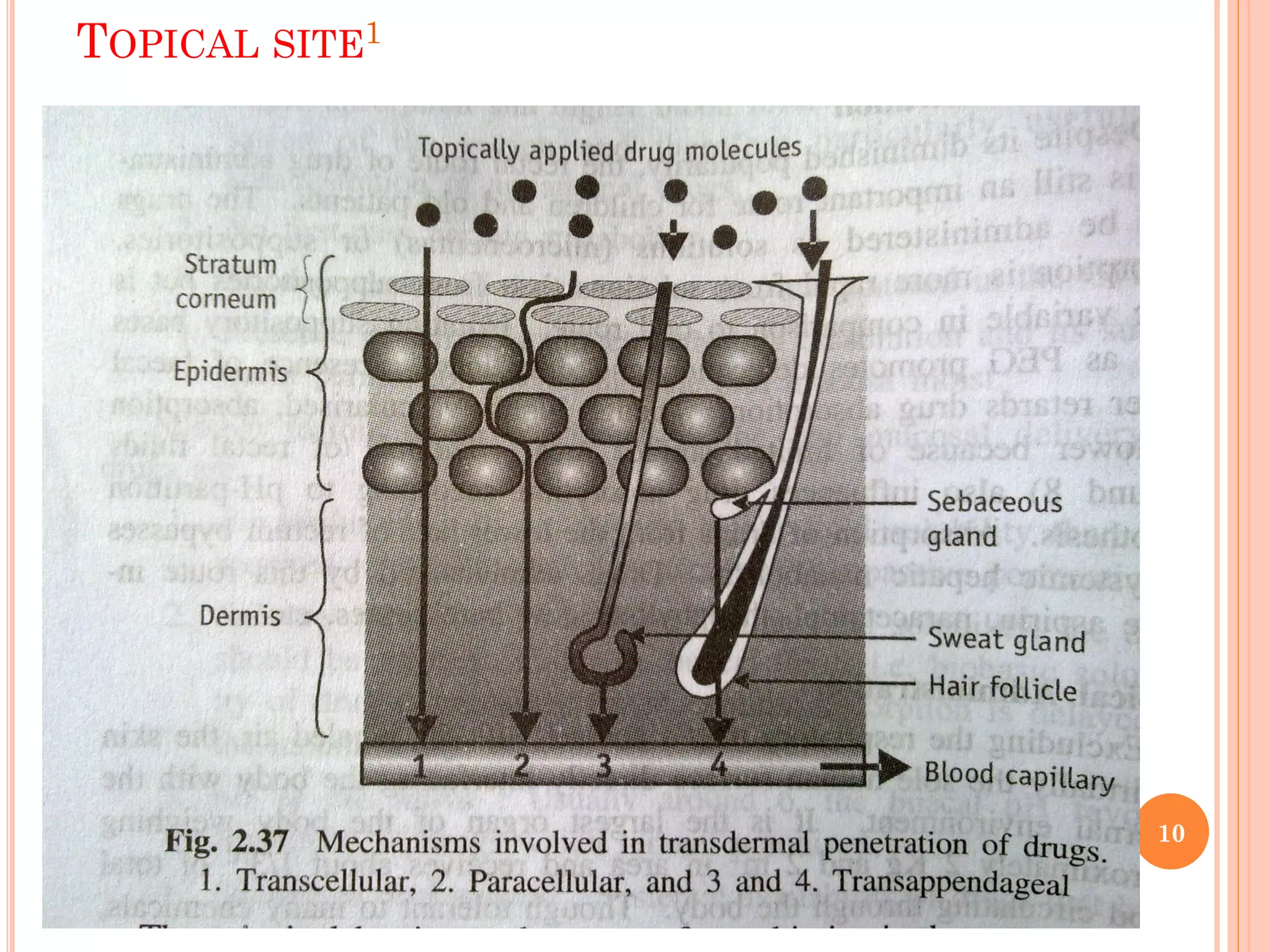
 Skin is largest organ of the body. Skin is commonly employed as a
site of drug administration for local as well as systemic effect.
 Liquid dosage forms such as Liniments,Lotions,Sprays.
 Semisolids like Ointments,Creams,Pastes,Gels ,etc are
conventional drug forms for topical drug delivery
 Advantages:-
a) Protect drug from GI & from first pass metabolism
b) Increased patient compliance by reduced dosing frequency
c) Easy to terminate drug therapy by removing transdermal patch
 Factors:-
a) Skin condition
b) Composition of topical vehicle
c) Application procedure
d) External/environmental factors
TOPICAL SITE1
10
11
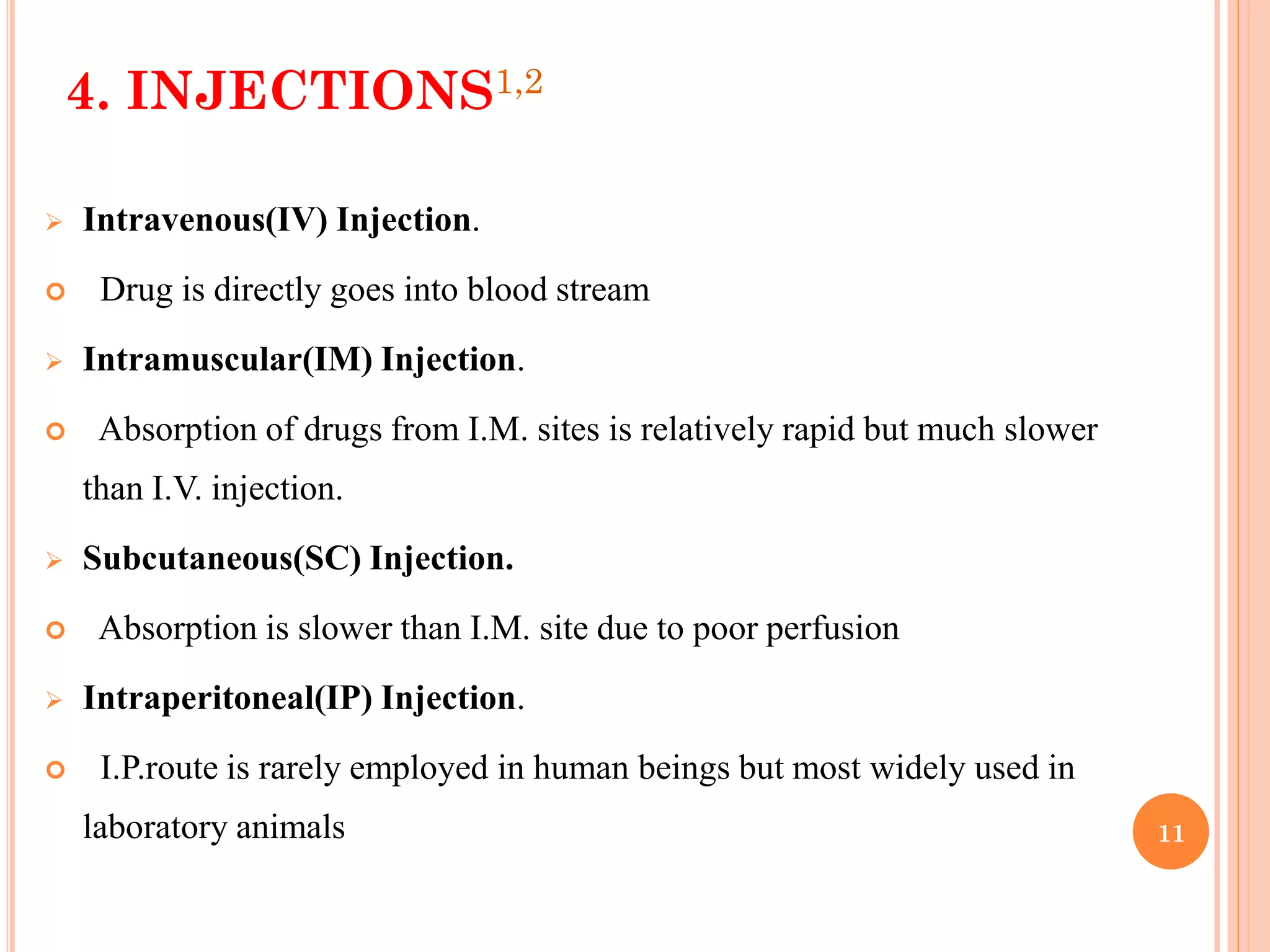
4. INJECTIONS1,2
 Intravenous(IV) Injection.
 Drug is directly goes into blood stream
 Intramuscular(IM) Injection.
 Absorption of drugs from I.M. sites is relatively rapid but much slower
than I.V. injection.
 Subcutaneous(SC) Injection.
 Absorption is slower than I.M. site due to poor perfusion
 Intraperitoneal(IP) Injection.
 I.P.route is rarely employed in human beings but most widely used in
laboratory animals
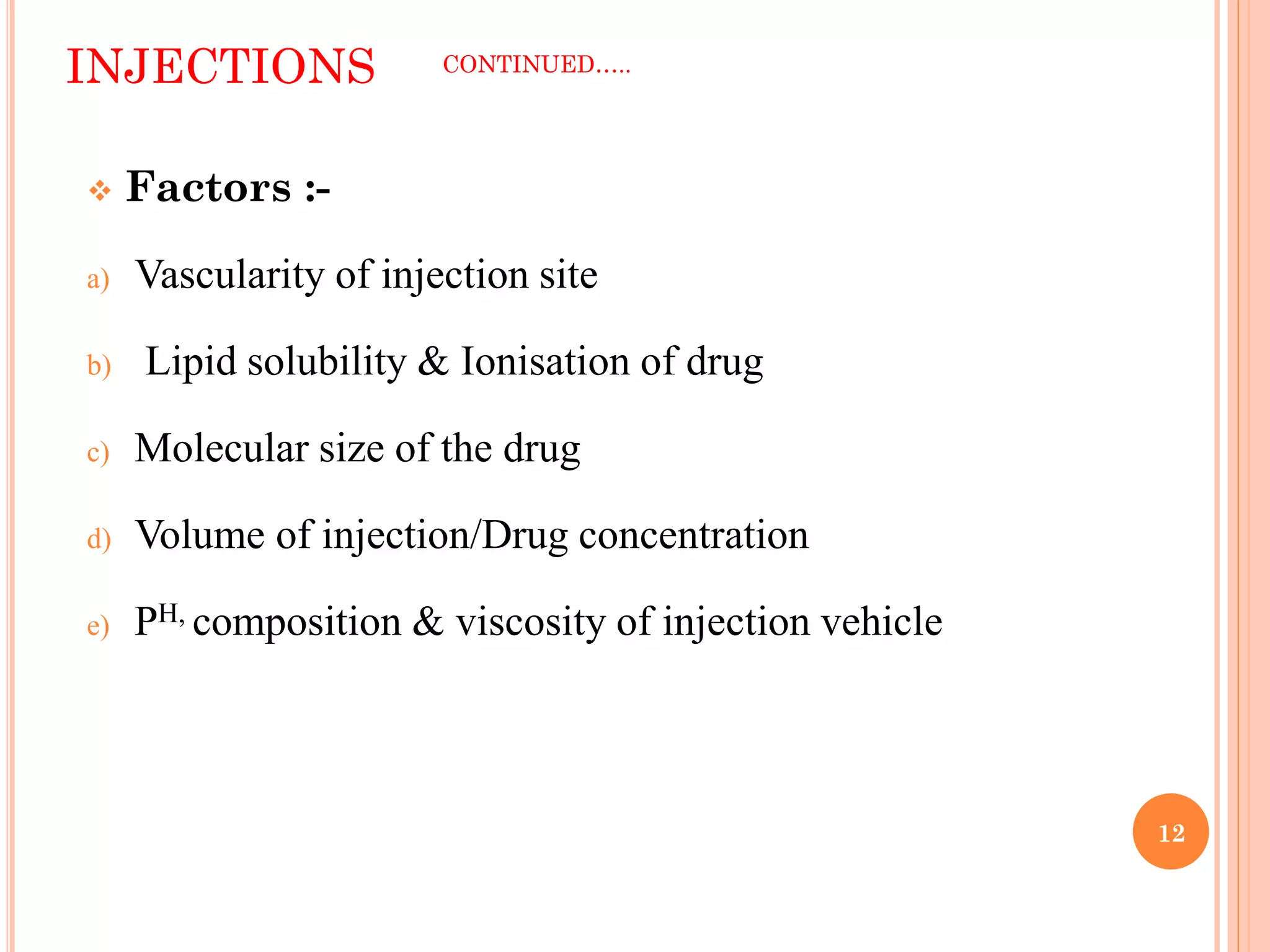
INJECTIONS CONTINUED…..
12
 Factors :-
a) Vascularity of injection site
b) Lipid solubility & Ionisation of drug
c) Molecular size of the drug
d) Volume of injection/Drug concentration
e) PH, composition & viscosity of injection vehicle
13
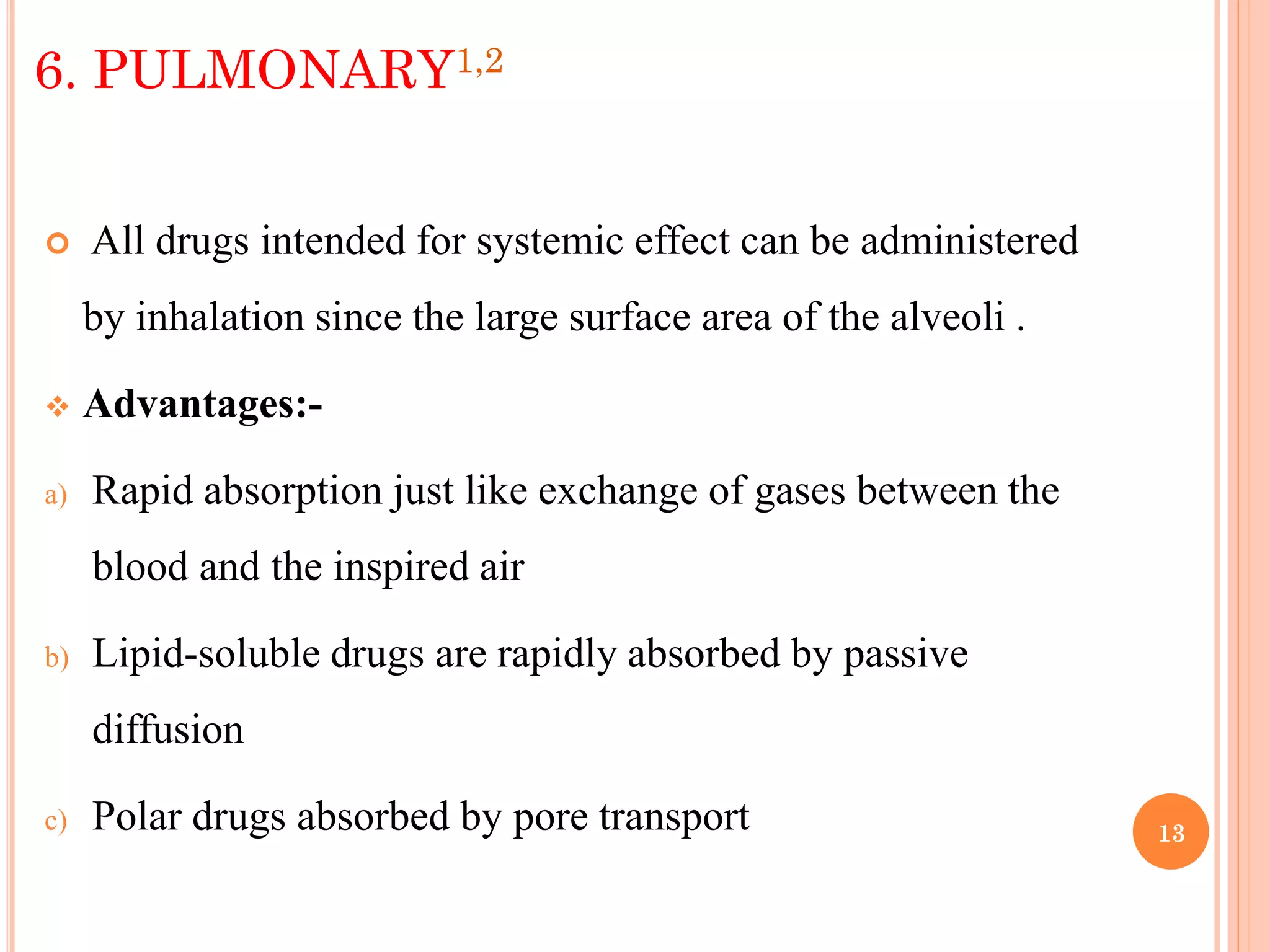
6. PULMONARY1,2
 All drugs intended for systemic effect can be administered
by inhalation since the large surface area of the alveoli .
 Advantages:-
a) Rapid absorption just like exchange of gases between the
blood and the inspired air
b) Lipid-soluble drugs are rapidly absorbed by passive
diffusion
c) Polar drugs absorbed by pore transport
14
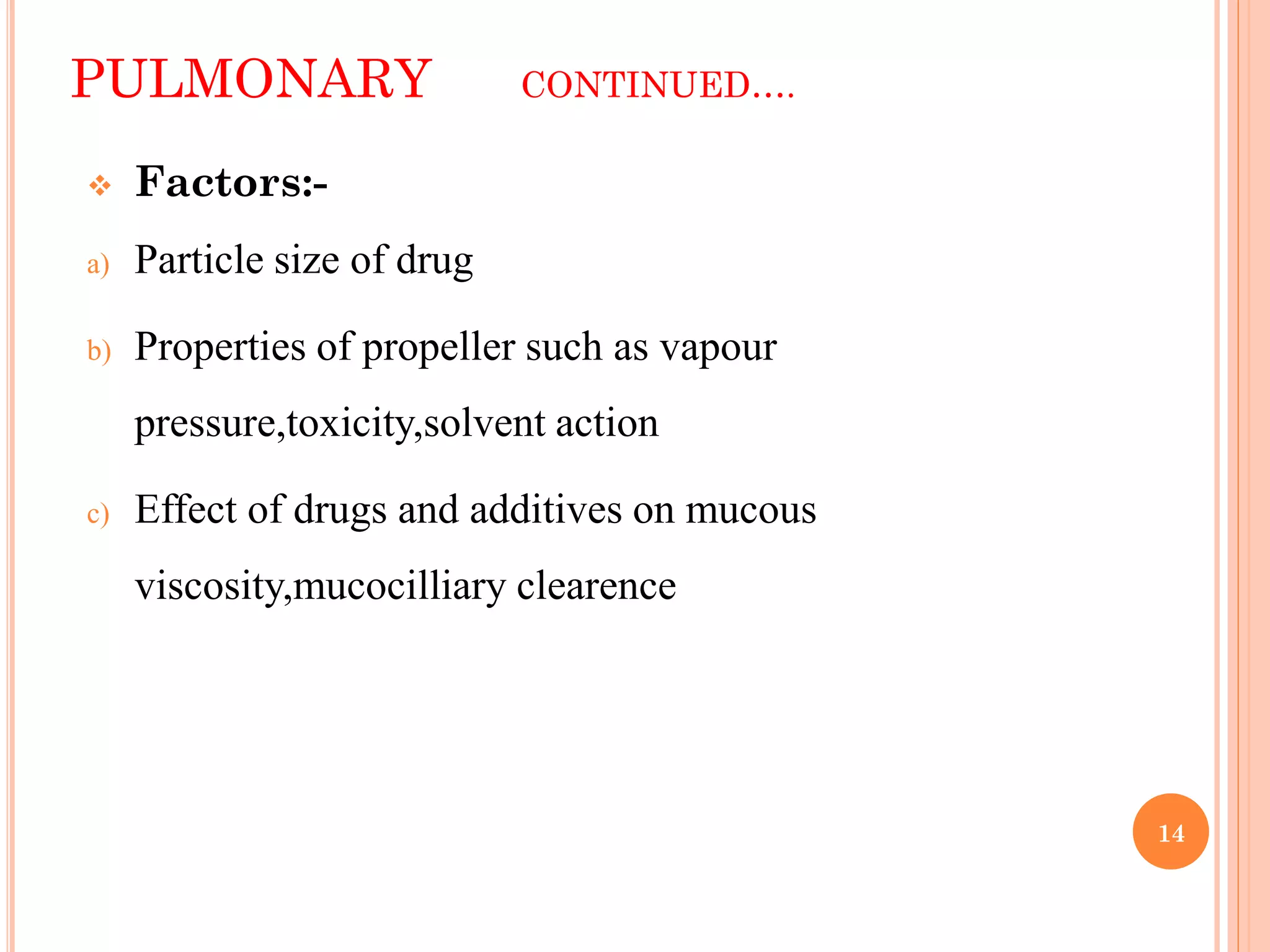
PULMONARY CONTINUED….
 Factors:-
a) Particle size of drug
b) Properties of propeller such as vapour
pressure,toxicity,solvent action
c) Effect of drugs and additives on mucous
viscosity,mucocilliary clearence
15
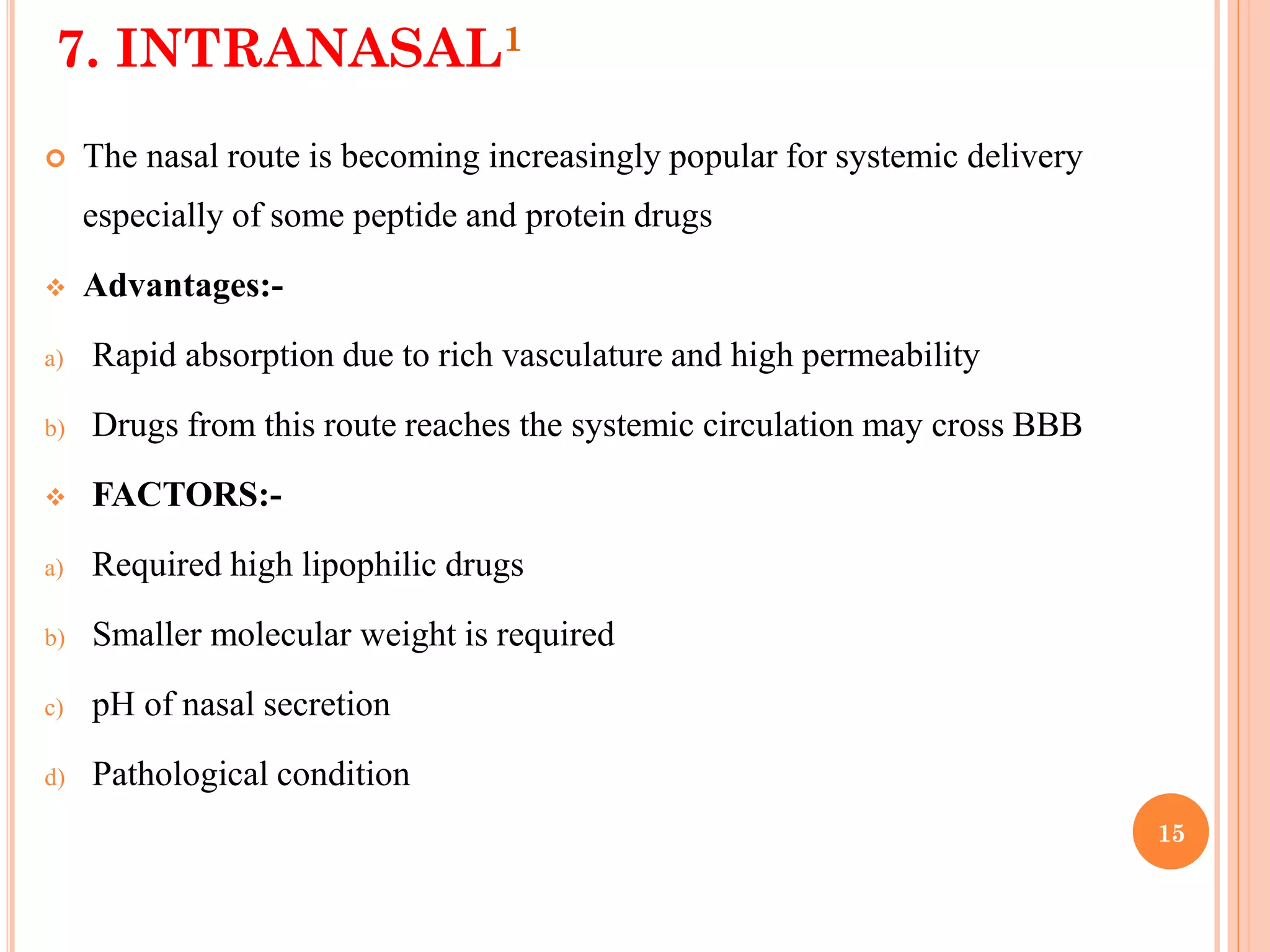
7. INTRANASAL1
 The nasal route is becoming increasingly popular for systemic delivery
especially of some peptide and protein drugs
 Advantages:-
a) Rapid absorption due to rich vasculature and high permeability
b) Drugs from this route reaches the systemic circulation may cross BBB
 FACTORS:-
a) Required high lipophilic drugs
b) Smaller molecular weight is required
c) pH of nasal secretion
d) Pathological condition
16
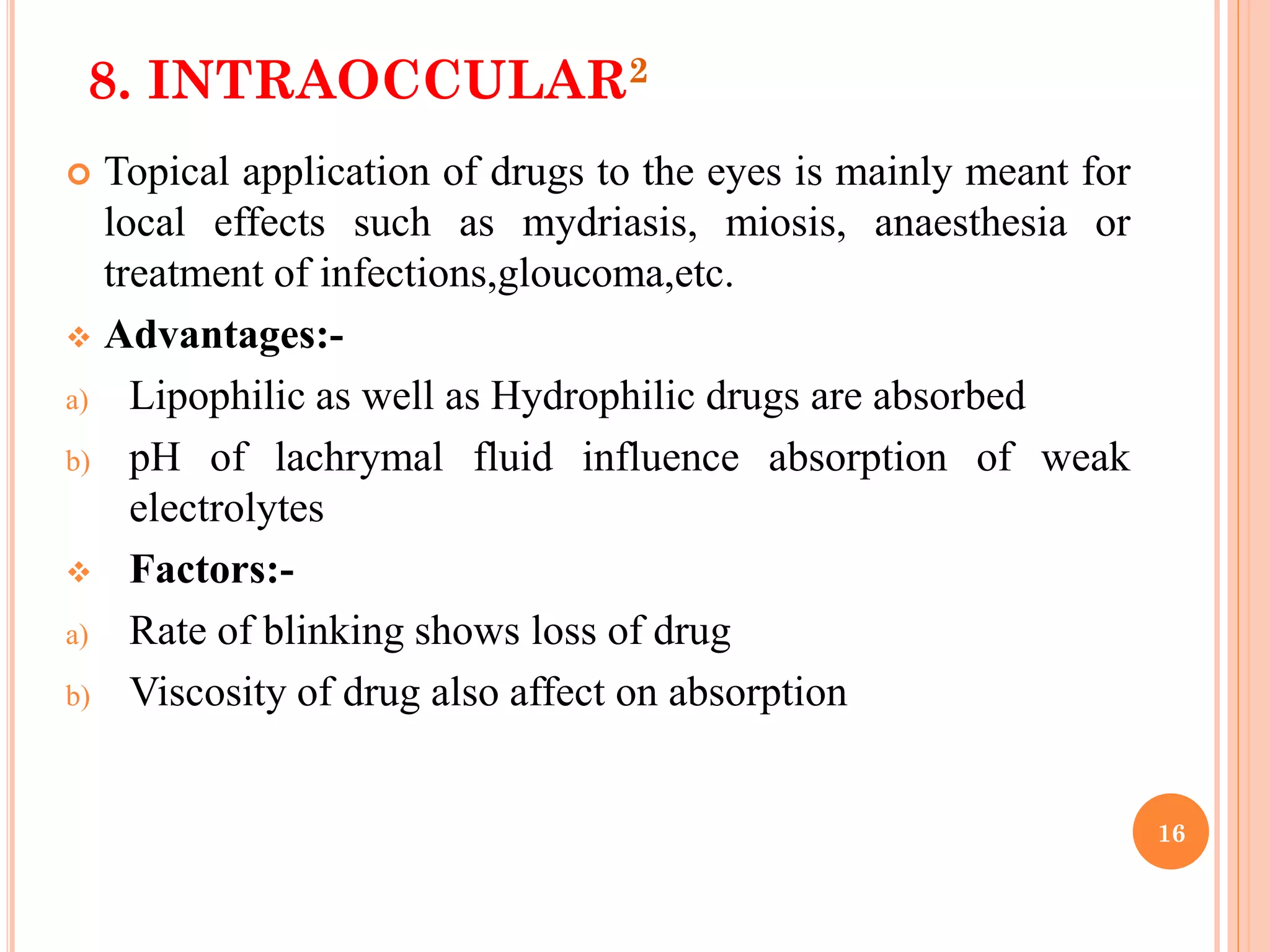
8. INTRAOCCULAR2
 Topical application of drugs to the eyes is mainly meant for
local effects such as mydriasis, miosis, anaesthesia or
treatment of infections,gloucoma,etc.
 Advantages:-
a) Lipophilic as well as Hydrophilic drugs are absorbed
b) pH of lachrymal fluid influence absorption of weak
electrolytes
 Factors:-
a) Rate of blinking shows loss of drug
b) Viscosity of drug also affect on absorption
17
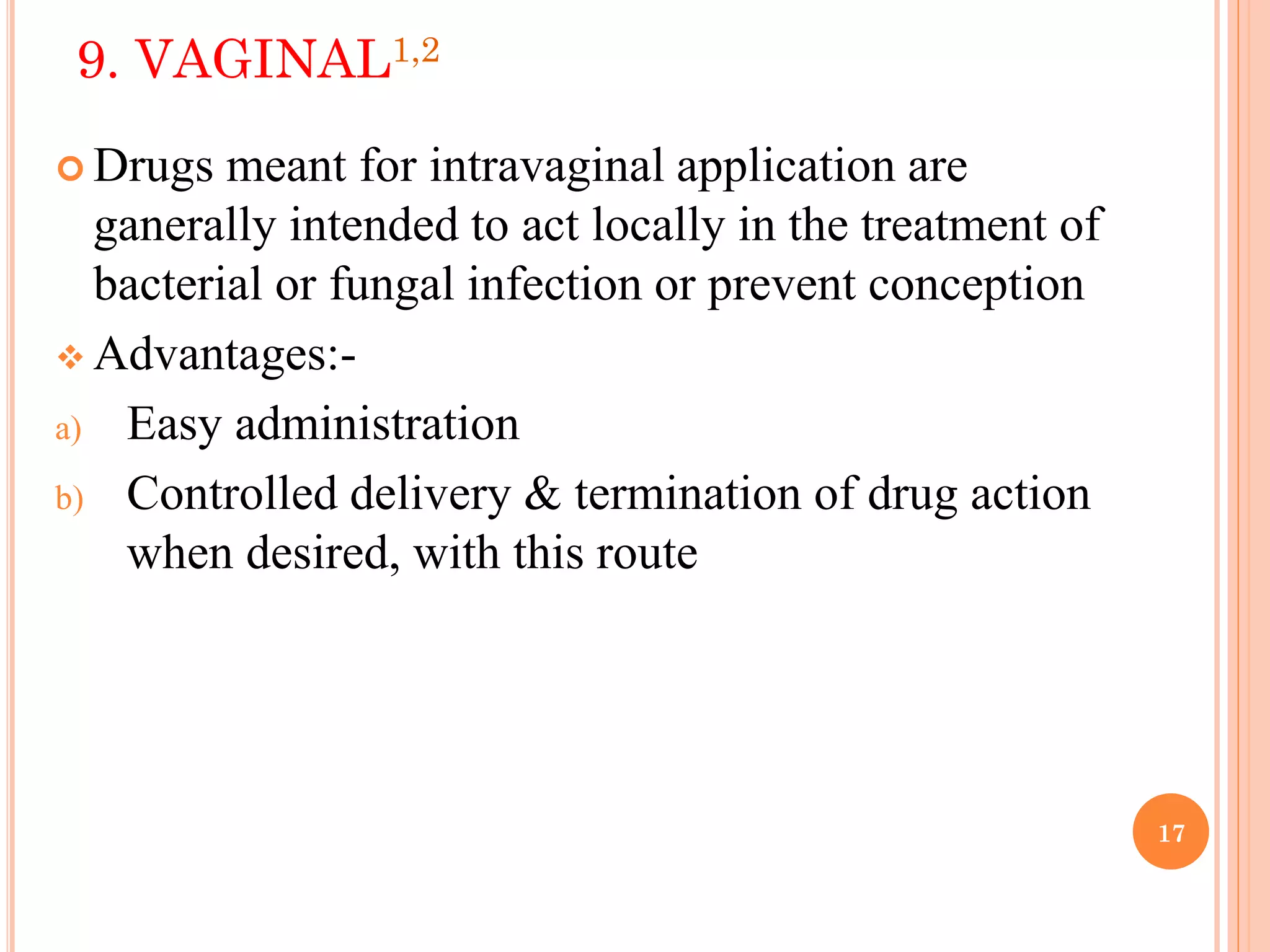
9. VAGINAL1,2
 Drugs meant for intravaginal application are
ganerally intended to act locally in the treatment of
bacterial or fungal infection or prevent conception
 Advantages:-
a) Easy administration
b) Controlled delivery & termination of drug action
when desired, with this route
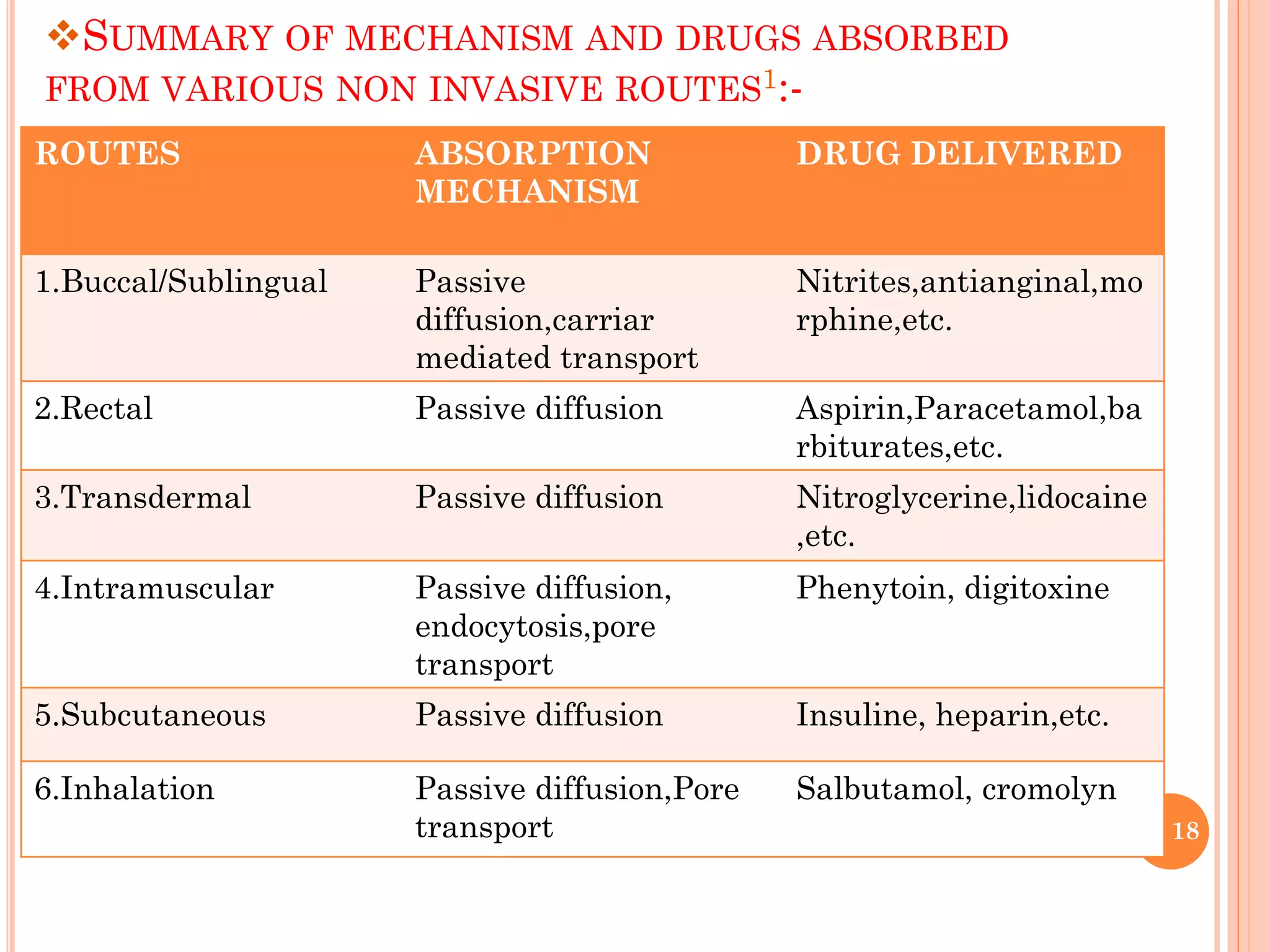
SUMMARY OF MECHANISM AND DRUGS ABSORBED
FROM VARIOUS NON INVASIVE ROUTES1:-
18
ROUTES ABSORPTION
MECHANISM
DRUG DELIVERED
1.Buccal/Sublingual Passive
diffusion,carriar
mediated transport
Nitrites,antianginal,mo
rphine,etc.
2.Rectal Passive diffusion Aspirin,Paracetamol,ba
rbiturates,etc.
3.Transdermal Passive diffusion Nitroglycerine,lidocaine
,etc.
4.Intramuscular Passive diffusion,
endocytosis,pore
transport
Phenytoin, digitoxine
5.Subcutaneous Passive diffusion Insuline, heparin,etc.
6.Inhalation Passive diffusion,Pore
transport
Salbutamol, cromolyn
19
ROUTES ABSORPTION
MECHANISM
DRUG DELIVERED
7.Intranasal Passive diffusion,
Pore transport
Phenylpropanolamine,
antihistaminics
8.Intraocular Passive diffusion Atropine,pilocarpine
9.Vaginal Passive diffusion Steroidal drugs &
contraceptives
20
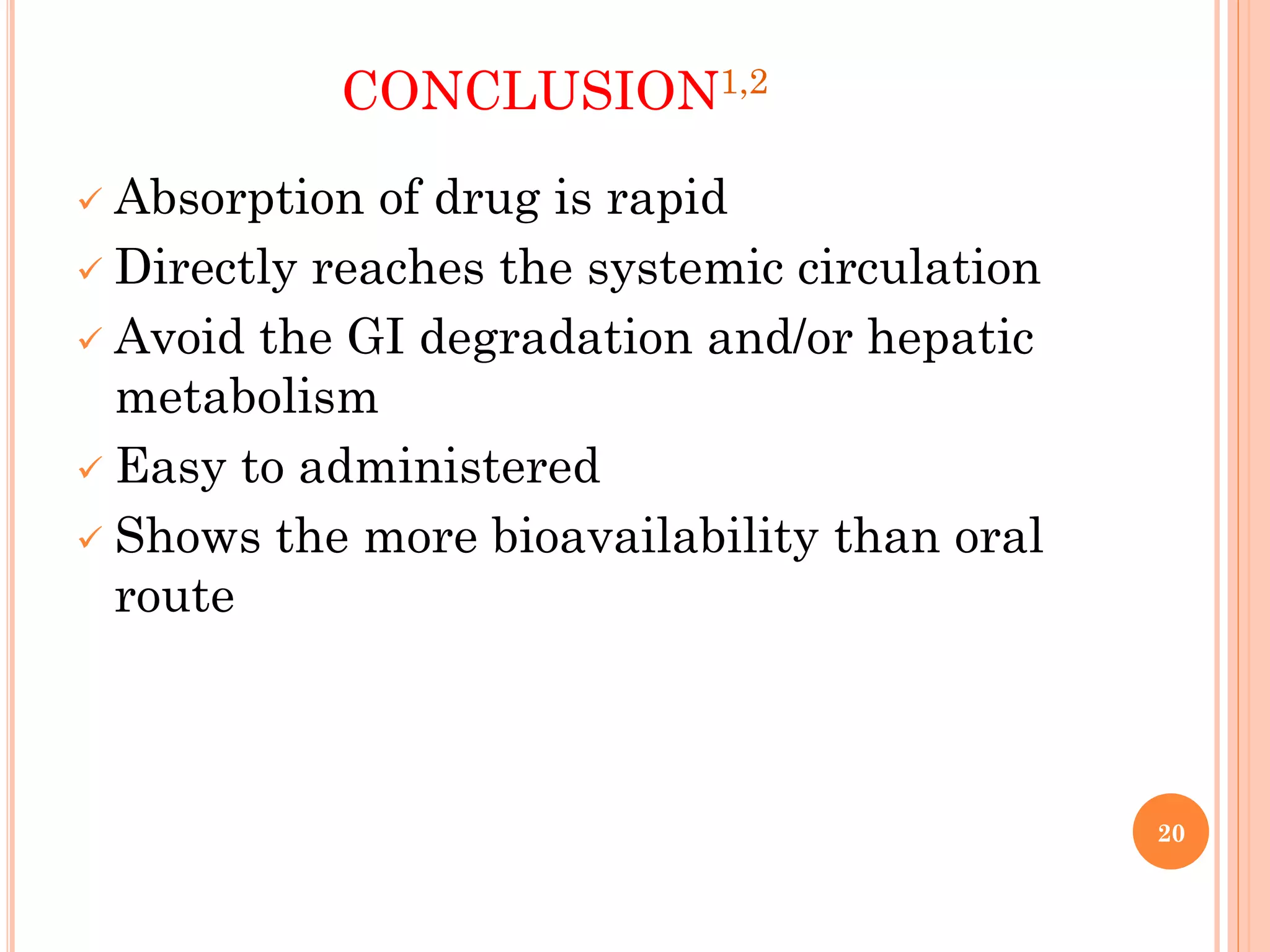
CONCLUSION1,2
 Absorption of drug is rapid
 Directly reaches the systemic circulation
 Avoid the GI degradation and/or hepatic
metabolism
 Easy to administered
 Shows the more bioavailability than oral
route
21
REFERANCES
1. Brahmankar D. M., Jaiswal S.B.,
Biopharmaceutics & Pharmacokinetics A
Treatise, Second Edition 2009 Published by
Jain M.K. for Vallabh Prakashan, Delhi.81-92.
2. Kulkarni J.S., Pawar A.P., Shedbalkar V.P.,
Biopharmaceutics & Pharmacokinetics First
edition 2006, CBS Publication,New Delhi.47-
59.
3. www.vodlo.com
THANK YOU
22

Absorption of drugs from non per os extravascular administration

  • 1.
    ABSORPTION OF DRUGSFROM NON PER OS EXTRA VASCULAR ROUTES 1
  • 2.
    Contents1,2  Introduction  Definition Other than oral routes  Advantages  Summary  Conclusion  References 2
  • 3.
    Introduction1  NON PEROS Means other than oral routes which by passes the GIT and reaches to systemic circulation.  One of the major advantages of administering drugs by non-invasive transmucosal (& transdermal) routes such as nasal, buccal, rectal, etc. is that greater systemic availability is attainable 3
  • 4.
  • 5.
    5 NON PER OSROUTES1,2  BUCCAL/SUBLINGUAL  RECTAL  TOPICAL  INTRAMASCULAR  SUBCUTANIOUS  PULMONARY  INTRANASAL  INTRAOCCULAR  VAGINAL
  • 6.
    6 1. BUCCAL/SUBLINGUAL1,3  BuccalRoute : The medicament is placed between cheek and the gum.(Glyceryl trinitrate)  Sublingual Route : The drug is placed under the tongue and allowed to dissolve.(Ergotamine)  Advantages :- a) Rapid absorption b) No first-pass hepatic metabolism c) No degradation of drugs  Factors:- a) Lipophilicity of drugs b) Salivary secretion c) PH of the saliva d) Binding to oral mucosa e) Thickness of oral epithelium
  • 7.
  • 8.
    8 2. RECTAL1,2  Therectal route of administration is still an important route for Children & Old Patients.  The drug may be administered as solutions(microenemas) or suppositories.  Advantage :- a) Absorption is more rapid b) Bypasses presystemic hepatic metabolism  Factors:- 1. Presence of faecal matter 2. pH of rectal fluid ( Around 8) 3. Drug Irritability 4. Surface area
  • 9.
    9 3. TOPICAL1,2  Skinis largest organ of the body. Skin is commonly employed as a site of drug administration for local as well as systemic effect.  Liquid dosage forms such as Liniments,Lotions,Sprays.  Semisolids like Ointments,Creams,Pastes,Gels ,etc are conventional drug forms for topical drug delivery  Advantages:- a) Protect drug from GI & from first pass metabolism b) Increased patient compliance by reduced dosing frequency c) Easy to terminate drug therapy by removing transdermal patch  Factors:- a) Skin condition b) Composition of topical vehicle c) Application procedure d) External/environmental factors
  • 10.
  • 11.
    11 4. INJECTIONS1,2  Intravenous(IV)Injection.  Drug is directly goes into blood stream  Intramuscular(IM) Injection.  Absorption of drugs from I.M. sites is relatively rapid but much slower than I.V. injection.  Subcutaneous(SC) Injection.  Absorption is slower than I.M. site due to poor perfusion  Intraperitoneal(IP) Injection.  I.P.route is rarely employed in human beings but most widely used in laboratory animals
  • 12.
    INJECTIONS CONTINUED….. 12  Factors:- a) Vascularity of injection site b) Lipid solubility & Ionisation of drug c) Molecular size of the drug d) Volume of injection/Drug concentration e) PH, composition & viscosity of injection vehicle
  • 13.
    13 6. PULMONARY1,2  Alldrugs intended for systemic effect can be administered by inhalation since the large surface area of the alveoli .  Advantages:- a) Rapid absorption just like exchange of gases between the blood and the inspired air b) Lipid-soluble drugs are rapidly absorbed by passive diffusion c) Polar drugs absorbed by pore transport
  • 14.
    14 PULMONARY CONTINUED….  Factors:- a)Particle size of drug b) Properties of propeller such as vapour pressure,toxicity,solvent action c) Effect of drugs and additives on mucous viscosity,mucocilliary clearence
  • 15.
    15 7. INTRANASAL1  Thenasal route is becoming increasingly popular for systemic delivery especially of some peptide and protein drugs  Advantages:- a) Rapid absorption due to rich vasculature and high permeability b) Drugs from this route reaches the systemic circulation may cross BBB  FACTORS:- a) Required high lipophilic drugs b) Smaller molecular weight is required c) pH of nasal secretion d) Pathological condition
  • 16.
    16 8. INTRAOCCULAR2  Topicalapplication of drugs to the eyes is mainly meant for local effects such as mydriasis, miosis, anaesthesia or treatment of infections,gloucoma,etc.  Advantages:- a) Lipophilic as well as Hydrophilic drugs are absorbed b) pH of lachrymal fluid influence absorption of weak electrolytes  Factors:- a) Rate of blinking shows loss of drug b) Viscosity of drug also affect on absorption
  • 17.
    17 9. VAGINAL1,2  Drugsmeant for intravaginal application are ganerally intended to act locally in the treatment of bacterial or fungal infection or prevent conception  Advantages:- a) Easy administration b) Controlled delivery & termination of drug action when desired, with this route
  • 18.
    SUMMARY OF MECHANISMAND DRUGS ABSORBED FROM VARIOUS NON INVASIVE ROUTES1:- 18 ROUTES ABSORPTION MECHANISM DRUG DELIVERED 1.Buccal/Sublingual Passive diffusion,carriar mediated transport Nitrites,antianginal,mo rphine,etc. 2.Rectal Passive diffusion Aspirin,Paracetamol,ba rbiturates,etc. 3.Transdermal Passive diffusion Nitroglycerine,lidocaine ,etc. 4.Intramuscular Passive diffusion, endocytosis,pore transport Phenytoin, digitoxine 5.Subcutaneous Passive diffusion Insuline, heparin,etc. 6.Inhalation Passive diffusion,Pore transport Salbutamol, cromolyn
  • 19.
    19 ROUTES ABSORPTION MECHANISM DRUG DELIVERED 7.IntranasalPassive diffusion, Pore transport Phenylpropanolamine, antihistaminics 8.Intraocular Passive diffusion Atropine,pilocarpine 9.Vaginal Passive diffusion Steroidal drugs & contraceptives
  • 20.
    20 CONCLUSION1,2  Absorption ofdrug is rapid  Directly reaches the systemic circulation  Avoid the GI degradation and/or hepatic metabolism  Easy to administered  Shows the more bioavailability than oral route
  • 21.
    21 REFERANCES 1. Brahmankar D.M., Jaiswal S.B., Biopharmaceutics & Pharmacokinetics A Treatise, Second Edition 2009 Published by Jain M.K. for Vallabh Prakashan, Delhi.81-92. 2. Kulkarni J.S., Pawar A.P., Shedbalkar V.P., Biopharmaceutics & Pharmacokinetics First edition 2006, CBS Publication,New Delhi.47- 59. 3. www.vodlo.com
  • 22.