Asraful Islam Rayhan Rafiqul Islam
Shaharul Islam Assistant professor
Sadikur Rahman Dept. of pharmacy
Sohel Rana JUST
Arman Ahmed
Dept. of pharmacy
JUST
presented by, presented to,
CONTENT
 Definition
 Source
 Chemistry
 Structure activity relationship
 Physical & chemical properties
 Mechanism of action
 Types of macrolide
 Pharmacokinetics
 Macrolide resistance
 Spectrum of activity
 Indication
 Contraindication
 Side effect
 Market preparation
Macrolides
The macrolides are a group of antibiotics produced by
various strains of Streptomyces and having a macrolide
ring structure linked to one or more sugars. They act by
inhibiting protein synthesis, specifically by blocking the
50S ribosomal subunit. They are broad spectrum
antibiotics.
Examples: Erythromycin, Azithromycin, Clarithromycin,
Roxithromycin etc……………
SOURCE:
These Are Produced By Streptomyces species.
CHEMISTRY:
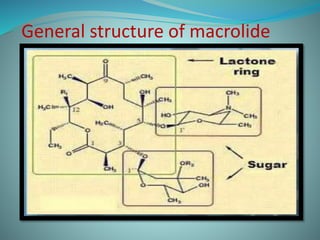
 A macro cyclic lactone, usually having 12 to 17 atoms.
 A ketone group.
 One or two amino sugars linked to the nucleus.
 A neutral sugar linked either to amino sugar or to
lactone ring.
 The presence of the dimethyl amino moiety on the
sugar residue, which explains the basicity of these
compounds and consequently formation salts.
General structure of macrolide
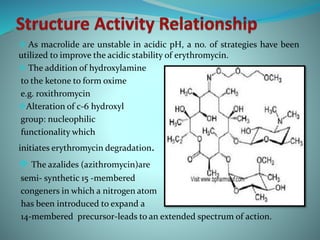
 As macrolide are unstable in acidic pH, a no. of strategies have been
utilized to improve the acidic stability of erythromycin.
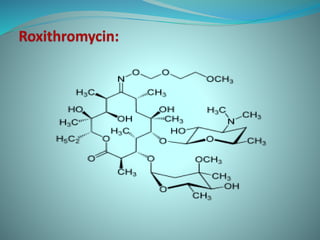
 The addition of hydroxylamine
to the ketone to form oxime
e.g. roxithromycin
Alteration of c-6 hydroxyl
group: nucleophilic
functionality which
initiates erythromycin degradation.
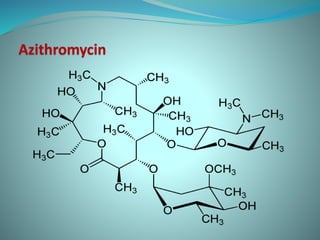
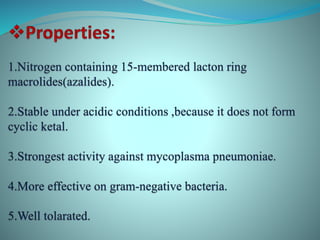
 The azalides (azithromycin)are
semi- synthetic 15 -membered
congeners in which a nitrogen atom
has been introduced to expand a
14-membered precursor-leads to an extended spectrum of action.
Physical & Chemical properties
Water insoluble molecules.
Occurs as crystalline powders.
Stable in aqueous solutions at or bellow
room temperature.
 Unstable in acidic conditions and forms
internal cyclic ketal.
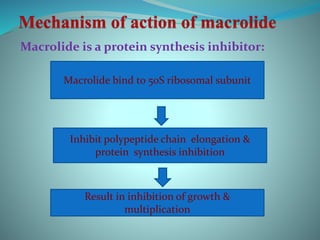
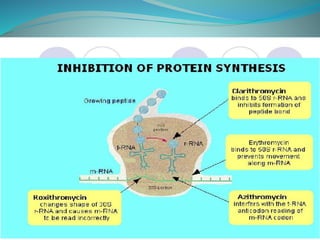
Macrolide is a protein synthesis inhibitor:
Macrolide bind to 50S ribosomal subunit
Inhibit polypeptide chain elongation &
protein synthesis inhibition
Result in inhibition of growth &
multiplication
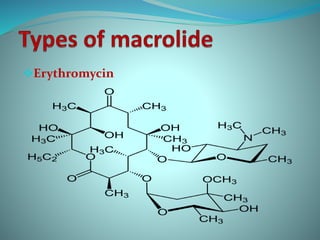
Erythromycin
Physical properties:
Yellow to white crystalline powder.
Soluble in alcohol, slightly soluble in water.
Stable at neutral pH.
Dosage forms:
Oral and topical dosage forms.
Enteric coted and delayed realese dosage forms.
Drug interactions:
Anticoagulants
Benzodiazepines
Antihistaminic drugs
It is used in,
Streptococcal pharyngitis
Tonsillitis
Respiratory infection
Diphtheria
Tetanus
Syphilis & gonorrhoea
Whooping cough
Abdominal cramps
Epigastric distress
Jaundice
Transient deafness
Hypersensitivity rashes
Hearing impairment
Therapeutic agents of erythromycin
Erythromycin ethylsuccinate
Erythromycin estolate
Erythromycin gluceptate
Erythromycin lactobionate
Advantages
Cannot undergo cyclic ketal formation, so doesn’t
cause cramp in GI
 Higher blood concentrations.
More lipophyl.
Lower doses with less intervals.
Uses:
Atypical mycobacterial infection
Resistant leprosy
Toxoplasmosis
H.Pylori induced peptic ulcers
In the treatment of Urogenital infections caused by
N.gonorrhoeae and Chlamydia trachomatis.
For the treatment of respiratory tract infections.
Pregnant women infected with scrub typhus:
Azithromycin can suitable for doxycyclin.
properties:
Semi-synthetic 14–membered ring macrolide
antibiotic in which the erythronolide lactone ring has
been altered to prevent inactivation in the milieu.
Uses:
 Active against both gram (+) & gram (-).
Treatment of skin ,dental & genital infections.
Treatment of upper & lower respiratory tract
infections.
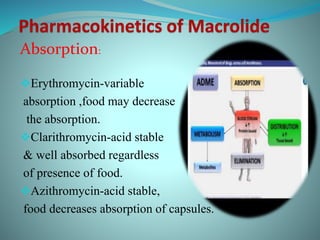
Absorption:
Erythromycin-variable
absorption ,food may decrease
the absorption.
Clarithromycin-acid stable
& well absorbed regardless
of presence of food.
Azithromycin-acid stable,
food decreases absorption of capsules.
Distribution:
Extensive tissue & cellular distribution.
Clarithromycin & azithromycin with extensive
penetration.
Minimal CSF penetration.
Metabolism:
 Via liver
Elimination:
Clarithromycin is the only macrolide partially
eliminated by the kidney.
Hepatically eliminated:(All)
None of the macrolides are removed during
hemodialysis.
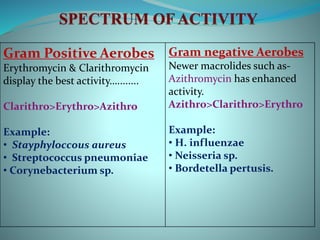
Gram Positive Aerobes
Erythromycin & Clarithromycin
display the best activity…........
Clarithro>Erythro>Azithro
Example:
• Stayphyloccous aureus
• Streptococcus pneumoniae
• Corynebacterium sp.
Gram negative Aerobes
Newer macrolides such as-
Azithromycin has enhanced
activity.
Azithro>Clarithro>Erythro
Example:
• H. influenzae
• Neisseria sp.
• Bordetella pertusis.
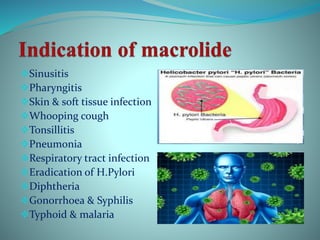
Sinusitis
Pharyngitis
Skin & soft tissue infection
Whooping cough
Tonsillitis
Pneumonia
Respiratory tract infection
Eradication of H.Pylori
Diphtheria
Gonorrhoea & Syphilis
Typhoid & malaria
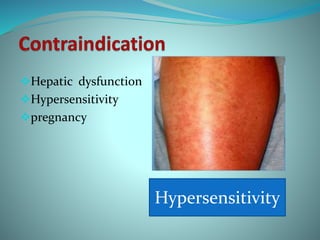
Hepatic dysfunction
Hypersensitivity
pregnancy
Hypersensitivity
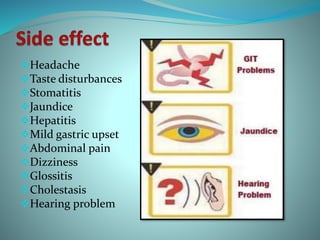
Headache
Taste disturbances
Stomatitis
Jaundice
Hepatitis
Mild gastric upset
Abdominal pain
Dizziness
Glossitis
Cholestasis
Hearing problem
Erythromycin:
Brand Name:
 Eromycin(Square pharmaceuticals)
Erocin(Acme pharmaceuticals)
Ero(Hudson pharmaceuticals)
Strength:
250mg,500mg; tablet
125mg/5ml suspension
Azithromycin:
Brand name:
AZICIN(Opsonin)
AZIN(Acme)
AZYTH(Sandoz)
ZMAX (Square)
Strength:
250mg,500mg; tablet
200mg/5ml suspension
500mg/5ml vial injection
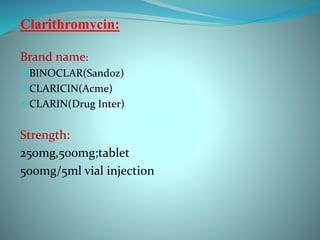
Clarithromycin:
Brand name:
BINOCLAR(Sandoz)
CLARICIN(Acme)
CLARIN(Drug Inter)
Strength:
250mg,500mg;tablet
500mg/5ml vial injection
 An introduction to medicinal chemistry; Graham L.
Patrick
Essentials of MEDICINAL PHARMACOLOGY; KD
Tripathy.
Foyel’s Principle of MEDICINAL CHEMISTRY.
Lippincott’s Pharmacology.
Qimp index of medicinal products & problem.
Basic & clinical pharmacology; katzumg, masters &
Trevor.
Macroloid antibiotics

Macroloid antibiotics

  • 2.
    Asraful Islam RayhanRafiqul Islam Shaharul Islam Assistant professor Sadikur Rahman Dept. of pharmacy Sohel Rana JUST Arman Ahmed Dept. of pharmacy JUST presented by, presented to,
  • 3.
    CONTENT  Definition  Source Chemistry  Structure activity relationship  Physical & chemical properties  Mechanism of action  Types of macrolide  Pharmacokinetics  Macrolide resistance  Spectrum of activity  Indication  Contraindication  Side effect  Market preparation
  • 4.
    Macrolides The macrolides area group of antibiotics produced by various strains of Streptomyces and having a macrolide ring structure linked to one or more sugars. They act by inhibiting protein synthesis, specifically by blocking the 50S ribosomal subunit. They are broad spectrum antibiotics. Examples: Erythromycin, Azithromycin, Clarithromycin, Roxithromycin etc……………
  • 5.
    SOURCE: These Are ProducedBy Streptomyces species. CHEMISTRY:  A macro cyclic lactone, usually having 12 to 17 atoms.  A ketone group.  One or two amino sugars linked to the nucleus.  A neutral sugar linked either to amino sugar or to lactone ring.  The presence of the dimethyl amino moiety on the sugar residue, which explains the basicity of these compounds and consequently formation salts.
  • 6.
  • 7.
     As macrolideare unstable in acidic pH, a no. of strategies have been utilized to improve the acidic stability of erythromycin.  The addition of hydroxylamine to the ketone to form oxime e.g. roxithromycin Alteration of c-6 hydroxyl group: nucleophilic functionality which initiates erythromycin degradation.  The azalides (azithromycin)are semi- synthetic 15 -membered congeners in which a nitrogen atom has been introduced to expand a 14-membered precursor-leads to an extended spectrum of action.
  • 8.
    Physical & Chemicalproperties Water insoluble molecules. Occurs as crystalline powders. Stable in aqueous solutions at or bellow room temperature.  Unstable in acidic conditions and forms internal cyclic ketal.
  • 9.
    Macrolide is aprotein synthesis inhibitor: Macrolide bind to 50S ribosomal subunit Inhibit polypeptide chain elongation & protein synthesis inhibition Result in inhibition of growth & multiplication
  • 11.
  • 12.
    Physical properties: Yellow towhite crystalline powder. Soluble in alcohol, slightly soluble in water. Stable at neutral pH. Dosage forms: Oral and topical dosage forms. Enteric coted and delayed realese dosage forms. Drug interactions: Anticoagulants Benzodiazepines Antihistaminic drugs
  • 13.
    It is usedin, Streptococcal pharyngitis Tonsillitis Respiratory infection Diphtheria Tetanus Syphilis & gonorrhoea Whooping cough
  • 14.
    Abdominal cramps Epigastric distress Jaundice Transientdeafness Hypersensitivity rashes Hearing impairment Therapeutic agents of erythromycin Erythromycin ethylsuccinate Erythromycin estolate Erythromycin gluceptate Erythromycin lactobionate
  • 16.
    Advantages Cannot undergo cyclicketal formation, so doesn’t cause cramp in GI  Higher blood concentrations. More lipophyl. Lower doses with less intervals. Uses: Atypical mycobacterial infection Resistant leprosy Toxoplasmosis H.Pylori induced peptic ulcers
  • 19.
    In the treatmentof Urogenital infections caused by N.gonorrhoeae and Chlamydia trachomatis. For the treatment of respiratory tract infections. Pregnant women infected with scrub typhus: Azithromycin can suitable for doxycyclin.
  • 21.
    properties: Semi-synthetic 14–membered ringmacrolide antibiotic in which the erythronolide lactone ring has been altered to prevent inactivation in the milieu. Uses:  Active against both gram (+) & gram (-). Treatment of skin ,dental & genital infections. Treatment of upper & lower respiratory tract infections.
  • 22.
    Absorption: Erythromycin-variable absorption ,food maydecrease the absorption. Clarithromycin-acid stable & well absorbed regardless of presence of food. Azithromycin-acid stable, food decreases absorption of capsules.
  • 23.
    Distribution: Extensive tissue &cellular distribution. Clarithromycin & azithromycin with extensive penetration. Minimal CSF penetration. Metabolism:  Via liver
  • 24.
    Elimination: Clarithromycin is theonly macrolide partially eliminated by the kidney. Hepatically eliminated:(All) None of the macrolides are removed during hemodialysis.
  • 26.
    Gram Positive Aerobes Erythromycin& Clarithromycin display the best activity…........ Clarithro>Erythro>Azithro Example: • Stayphyloccous aureus • Streptococcus pneumoniae • Corynebacterium sp. Gram negative Aerobes Newer macrolides such as- Azithromycin has enhanced activity. Azithro>Clarithro>Erythro Example: • H. influenzae • Neisseria sp. • Bordetella pertusis.
  • 27.
    Sinusitis Pharyngitis Skin & softtissue infection Whooping cough Tonsillitis Pneumonia Respiratory tract infection Eradication of H.Pylori Diphtheria Gonorrhoea & Syphilis Typhoid & malaria
  • 28.
  • 29.
    Headache Taste disturbances Stomatitis Jaundice Hepatitis Mild gastricupset Abdominal pain Dizziness Glossitis Cholestasis Hearing problem
  • 30.
    Erythromycin: Brand Name:  Eromycin(Squarepharmaceuticals) Erocin(Acme pharmaceuticals) Ero(Hudson pharmaceuticals) Strength: 250mg,500mg; tablet 125mg/5ml suspension
  • 31.
  • 32.
  • 33.
     An introductionto medicinal chemistry; Graham L. Patrick Essentials of MEDICINAL PHARMACOLOGY; KD Tripathy. Foyel’s Principle of MEDICINAL CHEMISTRY. Lippincott’s Pharmacology. Qimp index of medicinal products & problem. Basic & clinical pharmacology; katzumg, masters & Trevor.