ANTIBIOTICS
From the Greek:
anti - against
bios - life
Chemotherapy
• Paul Ehrlich
• Use of chemical agent to kill bacteria and
not harm the host
• Search for the “Magic bullet”
• Developed an arsenic compound that
killed the bacteria that causes syphilis
• Compound was called salvarsan but was
quite toxic to the host
Antibiotics
• Natural compounds produced by
microorganisms that inhibit the growth of other
microbes
• Majority of antibiotics come from Streptomyces
bacteria and molds
• Over 100 different antibiotics
• Antibiotics generally have two names
– Brand name created by the drug company
– Generic name based on the chemical structure or
class of antibiotics
HISTORICAL PERSPECTIVES
• The discovery of the first antibiotic was an
accident.
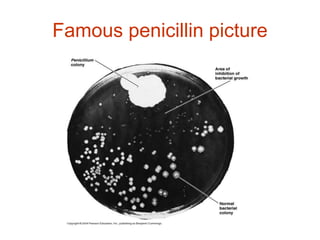
– Alexander Fleming accidentally contaminated a
plate with a fungus.
– He observed a clearly defined region of no bacterial
growth where the fungi had contaminated the plate.
– The area around the fungus was eventually referred
to as a zone of inhibition.
…HISTORICAL PERSPECTIVES
•
It is estimated that over 80 million
prescriptions are written in America each year.
•
12,500 tons of antibiotics are produced
annually.
–
25-50 % is fed to livestock to increase the rate of
weight gain.
•
From 1900 to 1980, mortality from infectious
diseases dropped from 797 per 100,000 persons
to 36 per 100,000 persons.
…HISTORICAL PERSPECTIVES
• No major discoveries of natural antibiotic
substances have occurred for several years.
– Efforts have now shifted to modifying existing
antibiotics.
– Searching in new places for potential antibiotics
has also gained in prominence.
• Many antibiotics are produced by
microorganisms as part of their survival
mechanism.
– They keep other organisms away.
– They protect the supply of nutrients and oxygen.
ANTIBIOTICS ARE PART OF BACTERIAL
SELF PROTECTION
• Microorganisms that produce these substances
have molecular mechanisms to control
production and prevent self-destruction.
• Naturally produced antibiotics are products of
secondary metabolic pathways.
– These pathways are not turned on all the time.
– Continuous production could adversely affect the
organism.
– Some bacteria restrict antibiotic production to the
stationary phase.
– Others keep the intracellular concentrations at low
levels.
…ANTIBIOTIC SPECTRA
• The first molecules that inhibited bacterial
growth were natural products.
• Over time, these natural molecules have been
modified.
• Several types of semi-synthetic antibiotics have
been derived from these molecules.
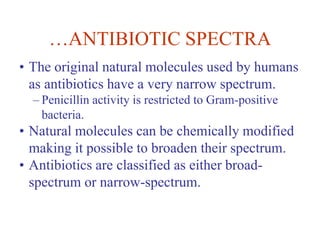
…ANTIBIOTIC SPECTRA
• The original natural molecules used by humans
as antibiotics have a very narrow spectrum.
– Penicillin activity is restricted to Gram-positive
bacteria.
• Natural molecules can be chemically modified
making it possible to broaden their spectrum.
• Antibiotics are classified as either broad-
spectrum or narrow-spectrum.
Famous penicillin picture
Alexander Fleming
• Discovered penicillin by accident in 1928
• A mold contaminating a plate of Staphylococcus
aureus showed anti-bacterial properties
• The mold was identified as a member of genus
Penicillum, hence the name for the naturally
produced antibiotic
• Fleming won the Nobel prize in 1945 for this
discovery, shared with Howard Florey and Ernst
Chain
Penicillin
• Wonder drug
• Killed bacteria with
few side effects on
the patient
• SELECTIVE
TOXICITY
• Penicillin was NOT
the first anti-bacterial
compound
• Penicillin was the
FIRST natural
compound that kills
bacteria
• Antibiotic
• Not made in the lab
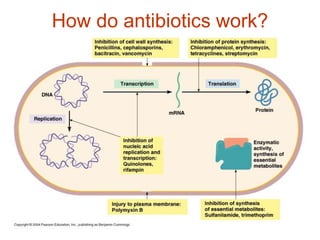
How do antibiotics work?
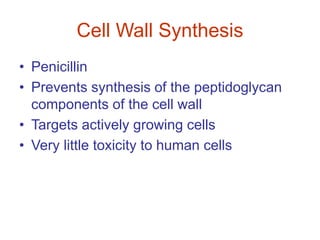
Cell Wall Synthesis
• Penicillin
• Prevents synthesis of the peptidoglycan
components of the cell wall
• Targets actively growing cells
• Very little toxicity to human cells
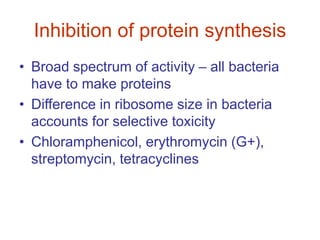
Inhibition of protein synthesis
• Broad spectrum of activity – all bacteria
have to make proteins
• Difference in ribosome size in bacteria
accounts for selective toxicity
• Chloramphenicol, erythromycin (G+),
streptomycin, tetracyclines
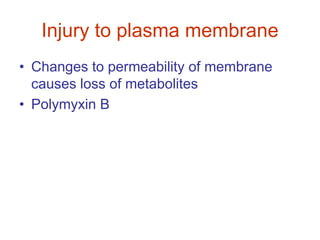
Injury to plasma membrane
• Changes to permeability of membrane
causes loss of metabolites
• Polymyxin B
Inhibition of nucleic acid synthesis
• Inhibition if either DNA replication or
mRNA synthesis
• Toxicity problems
• Rifampin – mRNA blocker
• Nofloxacin and ciprofloxacin – DNA
synthesis blockers
Inhibition of synthesis of essential
metabolites
• Block enzyme activity
• Competitive inhibition of enzyme activity
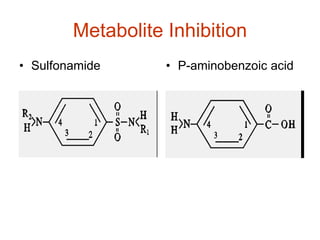
• PABA (para-aminobenzoic acid)
competition
• Sulfonamides
Metabolite Inhibition
• Sulfonamide • P-aminobenzoic acid
Commonly used antibiotic types
• Penicillins
• Cephalosporins
• Animoglycosides
• Macolides
• Sulfonamides
• Fluoroquinolones
• Tetracyclines
• Polypeptides
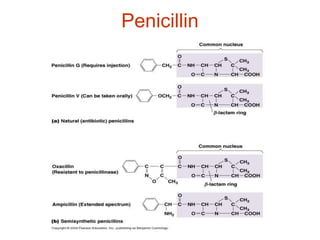
Penicillin
• Destroys the cell wall of bacteria
• Best against G+ bacteria during active
growth
• Examples:
– Penicillin G
– Penicillin V
– Ampicillin
– Amoxicillin
Cephalosprorins
• Similar to penicillin - interferes with cell
wall formation
• Used when patient is allergic to penicillin
• Examples
– Cefadroxil
– Cephapirin
– Cephalexin
– Cephalothin
Aminoglycosides
• Inhibition of protein synthesis in bacteria
• Some toxic reactions possible in kidney
and liver
• Examples
– Gentamicin
– Streptomycin
– Neomycin
Macrolides
• Interfere with bacterial protein synthesis
• Commonly given to patients that are
sensitive to penicillin
• Gastrointestinal discomfort is a common
side effect
• Examples
– Azithromycin
– Erthromycin
Sulfonamides
• Very early antimicrobial substance
• Commonly called sulfa drugs
• Developed in the 1930’s in Germany
• Mode of action is enzyme inhibition
• Allergy to sulfa is common
Fluoroquinolones
• Large class of semi-synthetic broad
spectrum antibiotics
• Inhibition of bacterial DNA replication
• Few side effects, well tolerated
• Examples
– Ciprofloxacin
– Norfloxacin
Tetracycline Antibiotics
• Members of this group of antibiotics are
produced by Streptomyces group of
bacteria
• Inhibition of protein synthesis
• Used commonly to treat acne
• Examples
– Tetracycline
– Deoxycycline
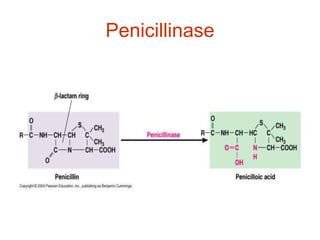
Penicillin
Penicillinase
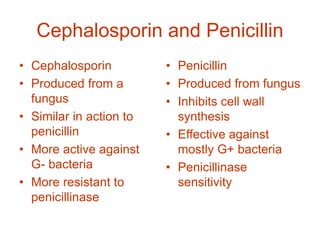
Cephalosporin and Penicillin
• Cephalosporin
• Produced from a
fungus
• Similar in action to
penicillin
• More active against
G- bacteria
• More resistant to
penicillinase
• Penicillin
• Produced from fungus
• Inhibits cell wall
synthesis
• Effective against
mostly G+ bacteria
• Penicillinase
sensitivity
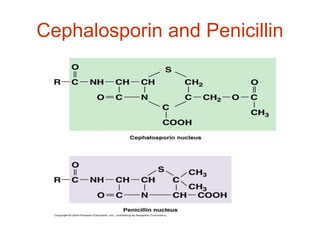
Cephalosporin and Penicillin
Adverse reactions
• Toxicity
• Allergy
• Disruption of natural flora
– Yeast infections
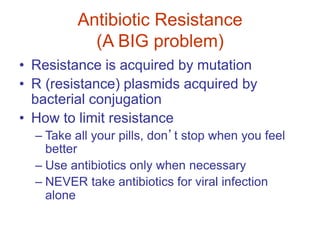
Antibiotic Resistance
(A BIG problem)
• Resistance is acquired by mutation
• R (resistance) plasmids acquired by
bacterial conjugation
• How to limit resistance
– Take all your pills, don’t stop when you feel
better
– Use antibiotics only when necessary
– NEVER take antibiotics for viral infection
alone
Nosocomial Infections
• Infections acquired while in a health care
facilities
• CDC estimates 2 million people per year
get these infections
• 90,000 deaths per year
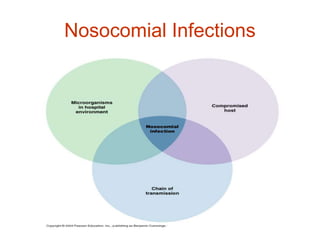
Nosocomial Infections
Antiviral Drugs
• Limited in number
• Targets for these drugs are viral
reproduction
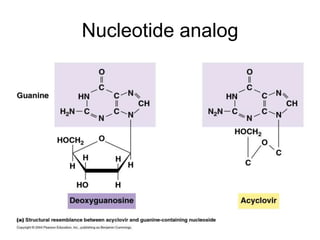
• Nucleotide analogs are the most
commonly used agents – disrupt viral
nucleic acid replication
• Acyclovir
Nucleotide analog
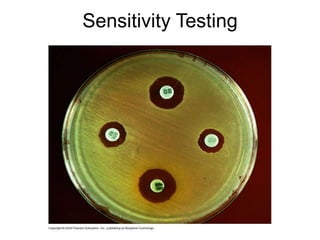
Sensitivity Testing

first lecture natural antibiotics.ppt

  • 1.
    ANTIBIOTICS From the Greek: anti- against bios - life
  • 2.
    Chemotherapy • Paul Ehrlich •Use of chemical agent to kill bacteria and not harm the host • Search for the “Magic bullet” • Developed an arsenic compound that killed the bacteria that causes syphilis • Compound was called salvarsan but was quite toxic to the host
  • 3.
    Antibiotics • Natural compoundsproduced by microorganisms that inhibit the growth of other microbes • Majority of antibiotics come from Streptomyces bacteria and molds • Over 100 different antibiotics • Antibiotics generally have two names – Brand name created by the drug company – Generic name based on the chemical structure or class of antibiotics
  • 4.
    HISTORICAL PERSPECTIVES • Thediscovery of the first antibiotic was an accident. – Alexander Fleming accidentally contaminated a plate with a fungus. – He observed a clearly defined region of no bacterial growth where the fungi had contaminated the plate. – The area around the fungus was eventually referred to as a zone of inhibition.
  • 5.
    …HISTORICAL PERSPECTIVES • It isestimated that over 80 million prescriptions are written in America each year. • 12,500 tons of antibiotics are produced annually. – 25-50 % is fed to livestock to increase the rate of weight gain. • From 1900 to 1980, mortality from infectious diseases dropped from 797 per 100,000 persons to 36 per 100,000 persons.
  • 6.
    …HISTORICAL PERSPECTIVES • Nomajor discoveries of natural antibiotic substances have occurred for several years. – Efforts have now shifted to modifying existing antibiotics. – Searching in new places for potential antibiotics has also gained in prominence. • Many antibiotics are produced by microorganisms as part of their survival mechanism. – They keep other organisms away. – They protect the supply of nutrients and oxygen.
  • 7.
    ANTIBIOTICS ARE PARTOF BACTERIAL SELF PROTECTION • Microorganisms that produce these substances have molecular mechanisms to control production and prevent self-destruction. • Naturally produced antibiotics are products of secondary metabolic pathways. – These pathways are not turned on all the time. – Continuous production could adversely affect the organism. – Some bacteria restrict antibiotic production to the stationary phase. – Others keep the intracellular concentrations at low levels.
  • 8.
    …ANTIBIOTIC SPECTRA • Thefirst molecules that inhibited bacterial growth were natural products. • Over time, these natural molecules have been modified. • Several types of semi-synthetic antibiotics have been derived from these molecules.
  • 9.
    …ANTIBIOTIC SPECTRA • Theoriginal natural molecules used by humans as antibiotics have a very narrow spectrum. – Penicillin activity is restricted to Gram-positive bacteria. • Natural molecules can be chemically modified making it possible to broaden their spectrum. • Antibiotics are classified as either broad- spectrum or narrow-spectrum.
  • 10.
  • 11.
    Alexander Fleming • Discoveredpenicillin by accident in 1928 • A mold contaminating a plate of Staphylococcus aureus showed anti-bacterial properties • The mold was identified as a member of genus Penicillum, hence the name for the naturally produced antibiotic • Fleming won the Nobel prize in 1945 for this discovery, shared with Howard Florey and Ernst Chain
  • 12.
    Penicillin • Wonder drug •Killed bacteria with few side effects on the patient • SELECTIVE TOXICITY • Penicillin was NOT the first anti-bacterial compound • Penicillin was the FIRST natural compound that kills bacteria • Antibiotic • Not made in the lab
  • 13.
  • 14.
    Cell Wall Synthesis •Penicillin • Prevents synthesis of the peptidoglycan components of the cell wall • Targets actively growing cells • Very little toxicity to human cells
  • 15.
    Inhibition of proteinsynthesis • Broad spectrum of activity – all bacteria have to make proteins • Difference in ribosome size in bacteria accounts for selective toxicity • Chloramphenicol, erythromycin (G+), streptomycin, tetracyclines
  • 16.
    Injury to plasmamembrane • Changes to permeability of membrane causes loss of metabolites • Polymyxin B
  • 17.
    Inhibition of nucleicacid synthesis • Inhibition if either DNA replication or mRNA synthesis • Toxicity problems • Rifampin – mRNA blocker • Nofloxacin and ciprofloxacin – DNA synthesis blockers
  • 18.
    Inhibition of synthesisof essential metabolites • Block enzyme activity • Competitive inhibition of enzyme activity • PABA (para-aminobenzoic acid) competition • Sulfonamides
  • 19.
  • 20.
    Commonly used antibiotictypes • Penicillins • Cephalosporins • Animoglycosides • Macolides • Sulfonamides • Fluoroquinolones • Tetracyclines • Polypeptides
  • 21.
    Penicillin • Destroys thecell wall of bacteria • Best against G+ bacteria during active growth • Examples: – Penicillin G – Penicillin V – Ampicillin – Amoxicillin
  • 22.
    Cephalosprorins • Similar topenicillin - interferes with cell wall formation • Used when patient is allergic to penicillin • Examples – Cefadroxil – Cephapirin – Cephalexin – Cephalothin
  • 23.
    Aminoglycosides • Inhibition ofprotein synthesis in bacteria • Some toxic reactions possible in kidney and liver • Examples – Gentamicin – Streptomycin – Neomycin
  • 24.
    Macrolides • Interfere withbacterial protein synthesis • Commonly given to patients that are sensitive to penicillin • Gastrointestinal discomfort is a common side effect • Examples – Azithromycin – Erthromycin
  • 25.
    Sulfonamides • Very earlyantimicrobial substance • Commonly called sulfa drugs • Developed in the 1930’s in Germany • Mode of action is enzyme inhibition • Allergy to sulfa is common
  • 26.
    Fluoroquinolones • Large classof semi-synthetic broad spectrum antibiotics • Inhibition of bacterial DNA replication • Few side effects, well tolerated • Examples – Ciprofloxacin – Norfloxacin
  • 27.
    Tetracycline Antibiotics • Membersof this group of antibiotics are produced by Streptomyces group of bacteria • Inhibition of protein synthesis • Used commonly to treat acne • Examples – Tetracycline – Deoxycycline
  • 28.
  • 29.
  • 30.
    Cephalosporin and Penicillin •Cephalosporin • Produced from a fungus • Similar in action to penicillin • More active against G- bacteria • More resistant to penicillinase • Penicillin • Produced from fungus • Inhibits cell wall synthesis • Effective against mostly G+ bacteria • Penicillinase sensitivity
  • 31.
  • 32.
    Adverse reactions • Toxicity •Allergy • Disruption of natural flora – Yeast infections
  • 33.
    Antibiotic Resistance (A BIGproblem) • Resistance is acquired by mutation • R (resistance) plasmids acquired by bacterial conjugation • How to limit resistance – Take all your pills, don’t stop when you feel better – Use antibiotics only when necessary – NEVER take antibiotics for viral infection alone
  • 34.
    Nosocomial Infections • Infectionsacquired while in a health care facilities • CDC estimates 2 million people per year get these infections • 90,000 deaths per year
  • 35.
  • 36.
    Antiviral Drugs • Limitedin number • Targets for these drugs are viral reproduction • Nucleotide analogs are the most commonly used agents – disrupt viral nucleic acid replication • Acyclovir
  • 37.
  • 38.