
MONOBACTAMS
Dr. Shilpa Sudhakar Harak
Asst. Prof., Pharm. Chem.,
GES Sir Dr. M. S. Gosavi College of Pharmaceutical Education and Research, Nashik
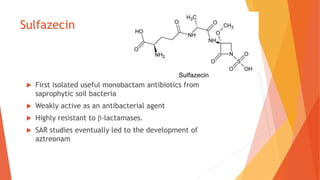
Sulfazecin
 First isolated useful monobactam antibiotics from
saprophytic soil bacteria
 Weakly active as an antibacterial agent
 Highly resistant to β-lactamases.
 SAR studies eventually led to the development of
aztreonam
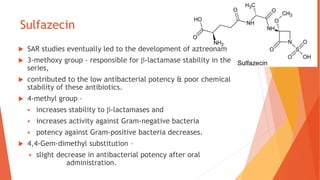
Sulfazecin
 SAR studies eventually led to the development of aztreonam
 3-methoxy group - responsible for β-lactamase stability in the
series,
 contributed to the low antibacterial potency & poor chemical
stability of these antibiotics.
 4-methyl group –
 increases stability to β-lactamases and
 increases activity against Gram-negative bacteria
 potency against Gram-positive bacteria decreases.
 4,4-Gem-dimethyl substitution –
 slight decrease in antibacterial potency after oral
administration.
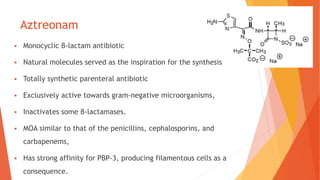
Aztreonam
 Monocyclic β-lactam antibiotic
 Natural molecules served as the inspiration for the synthesis
 Totally synthetic parenteral antibiotic
 Exclusively active towards gram-negative microorganisms,
 Inactivates some β-lactamases.
 MOA similar to that of the penicillins, cephalosporins, and
carbapenems,
 Has strong affinity for PBP-3, producing filamentous cells as a
consequence.
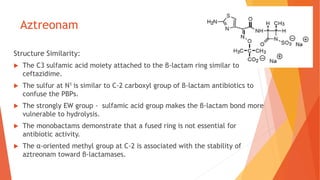
Aztreonam
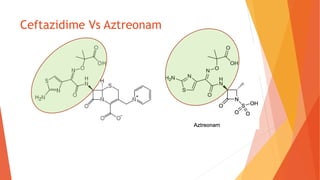
Structure Similarity:
 The C3 sulfamic acid moiety attached to the β-lactam ring similar to
ceftazidime.
 The sulfur at N1 is similar to C-2 carboxyl group of β-lactam antibiotics to
confuse the PBPs.
 The strongly EW group - sulfamic acid group makes the β-lactam bond more
vulnerable to hydrolysis.
 The monobactams demonstrate that a fused ring is not essential for
antibiotic activity.
 The α-oriented methyl group at C-2 is associated with the stability of
aztreonam toward β-lactamases.
Ceftazidime Vs Aztreonam
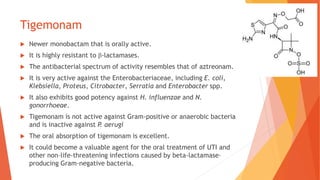
Tigemonam
 Newer monobactam that is orally active.
 It is highly resistant to β-lactamases.
 The antibacterial spectrum of activity resembles that of aztreonam.
 It is very active against the Enterobacteriaceae, including E. coli,
Klebsiella, Proteus, Citrobacter, Serratia and Enterobacter spp.
 It also exhibits good potency against H. influenzae and N.
gonorrhoeae.
 Tigemonam is not active against Gram-positive or anaerobic bacteria
and is inactive against P. aerugi
 The oral absorption of tigemonam is excellent.
 It could become a valuable agent for the oral treatment of UTI and
other non–life-threatening infections caused by beta-lactamase–
producing Gram-negative bacteria.

Monobactum

  • 1.
    MONOBACTAMS Dr. Shilpa SudhakarHarak Asst. Prof., Pharm. Chem., GES Sir Dr. M. S. Gosavi College of Pharmaceutical Education and Research, Nashik
  • 2.
    Sulfazecin  First isolateduseful monobactam antibiotics from saprophytic soil bacteria  Weakly active as an antibacterial agent  Highly resistant to β-lactamases.  SAR studies eventually led to the development of aztreonam
  • 3.
    Sulfazecin  SAR studieseventually led to the development of aztreonam  3-methoxy group - responsible for β-lactamase stability in the series,  contributed to the low antibacterial potency & poor chemical stability of these antibiotics.  4-methyl group –  increases stability to β-lactamases and  increases activity against Gram-negative bacteria  potency against Gram-positive bacteria decreases.  4,4-Gem-dimethyl substitution –  slight decrease in antibacterial potency after oral administration.
  • 4.
    Aztreonam  Monocyclic β-lactamantibiotic  Natural molecules served as the inspiration for the synthesis  Totally synthetic parenteral antibiotic  Exclusively active towards gram-negative microorganisms,  Inactivates some β-lactamases.  MOA similar to that of the penicillins, cephalosporins, and carbapenems,  Has strong affinity for PBP-3, producing filamentous cells as a consequence.
  • 5.
    Aztreonam Structure Similarity:  TheC3 sulfamic acid moiety attached to the β-lactam ring similar to ceftazidime.  The sulfur at N1 is similar to C-2 carboxyl group of β-lactam antibiotics to confuse the PBPs.  The strongly EW group - sulfamic acid group makes the β-lactam bond more vulnerable to hydrolysis.  The monobactams demonstrate that a fused ring is not essential for antibiotic activity.  The α-oriented methyl group at C-2 is associated with the stability of aztreonam toward β-lactamases.
  • 6.
  • 7.
    Tigemonam  Newer monobactamthat is orally active.  It is highly resistant to β-lactamases.  The antibacterial spectrum of activity resembles that of aztreonam.  It is very active against the Enterobacteriaceae, including E. coli, Klebsiella, Proteus, Citrobacter, Serratia and Enterobacter spp.  It also exhibits good potency against H. influenzae and N. gonorrhoeae.  Tigemonam is not active against Gram-positive or anaerobic bacteria and is inactive against P. aerugi  The oral absorption of tigemonam is excellent.  It could become a valuable agent for the oral treatment of UTI and other non–life-threatening infections caused by beta-lactamase– producing Gram-negative bacteria.