Projected by : Pragati Arun Yadav
Guided By :Reddy K.V(M.Pharm)
SEAT NO. ROLL NO-
BPA700473 37
1
S. BSPM'S B. PHARMACY COLLEGE
AMBAJOGAI
 Introduction of combinatorial chemistry
 History of combi-chem
 Principle of combi-chem
 Synthetic methods
a)solid phase synthesis,
b) solution phase synthesis,
 Screening methods
 Application
 Conclusion
 References
 Combinatorial chemistry (or CombiChem) is a method of synthesizing
many different substances quickly and at the same time.
 CombiChem is used to synthesize large number of chemical
compounds by combining sets of building blocks. Each newly
synthesized compound's composition is slightly different from the
previous one.
History of combi-chem
-> Although combinatorial chemistry
has only really been taken up by
industry since the 1990s, its roots can
be seen as far back as the 1960s when
are searcher at Rockefeller University,
Bruce Merrifield, started investigating
the solid-state synthesis of peptides
-> Bruce Merrifield won the Nobel prize
in chemistry in 1984 for his work on
solid-phase synthesis.
Principle:
HTS Library
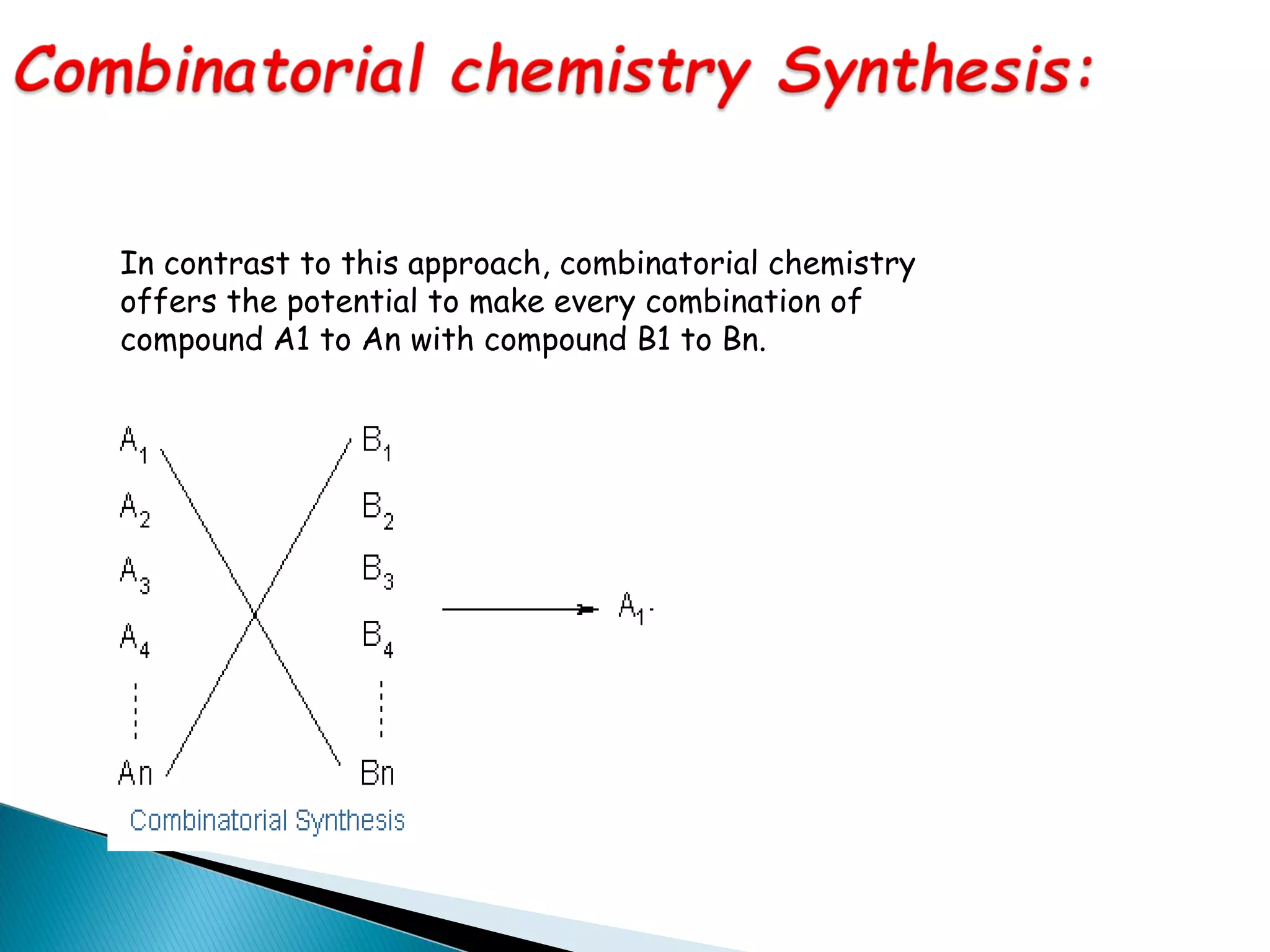
In contrast to this approach, combinatorial chemistry
offers the potential to make every combination of
compound A1 to An with compound B1 to Bn.
a)Solid phase synthesis :
The compound library have been synthesized on
solid phase such as
resin bead , pins or
chips.
b) solution phase synthesis:
In this method synthesis of compounds takes
place in solution phase.
Organic reaction that carried out on solid support
/ substrate that are covalently
attached to a polymeric resin
Solid phase synthesis. Introduction
RECENT EXAMPLES
- Epothilone A
- Dipeptide mimetic
- Phosphopeptide thioesters
Advantages of solid phase synthesis
over traditional synthesis.
1. Over all process is quick.
2. Purification of each product can be achieved in
one step.Only purification technique
is filtration.
3. Purification in each step is possible.
4. Synthetic intermediates don’t have to be isolated.
5. Can be automated with robots.
Disadvantages of solid
phase synthesis
1.High chemical consume.
2.Expensive.
3.Low reaction rates.
4.Special substrates needed.
5.Extra labor required to develop solid phase
route.
6.Yields can be low and produces very few
molecule at a time for testing.
 There are multiple techniques available for this
synthesis and beacause of that its use increasing.
 Advantages:
 - Purification easy.
 -Handling of material is easy.
 Disadvantages :
 -Quantities produced very low for very large libaries.
Solution phase synthesis :Solution phase synthesis :
Combinatorial Chemistry
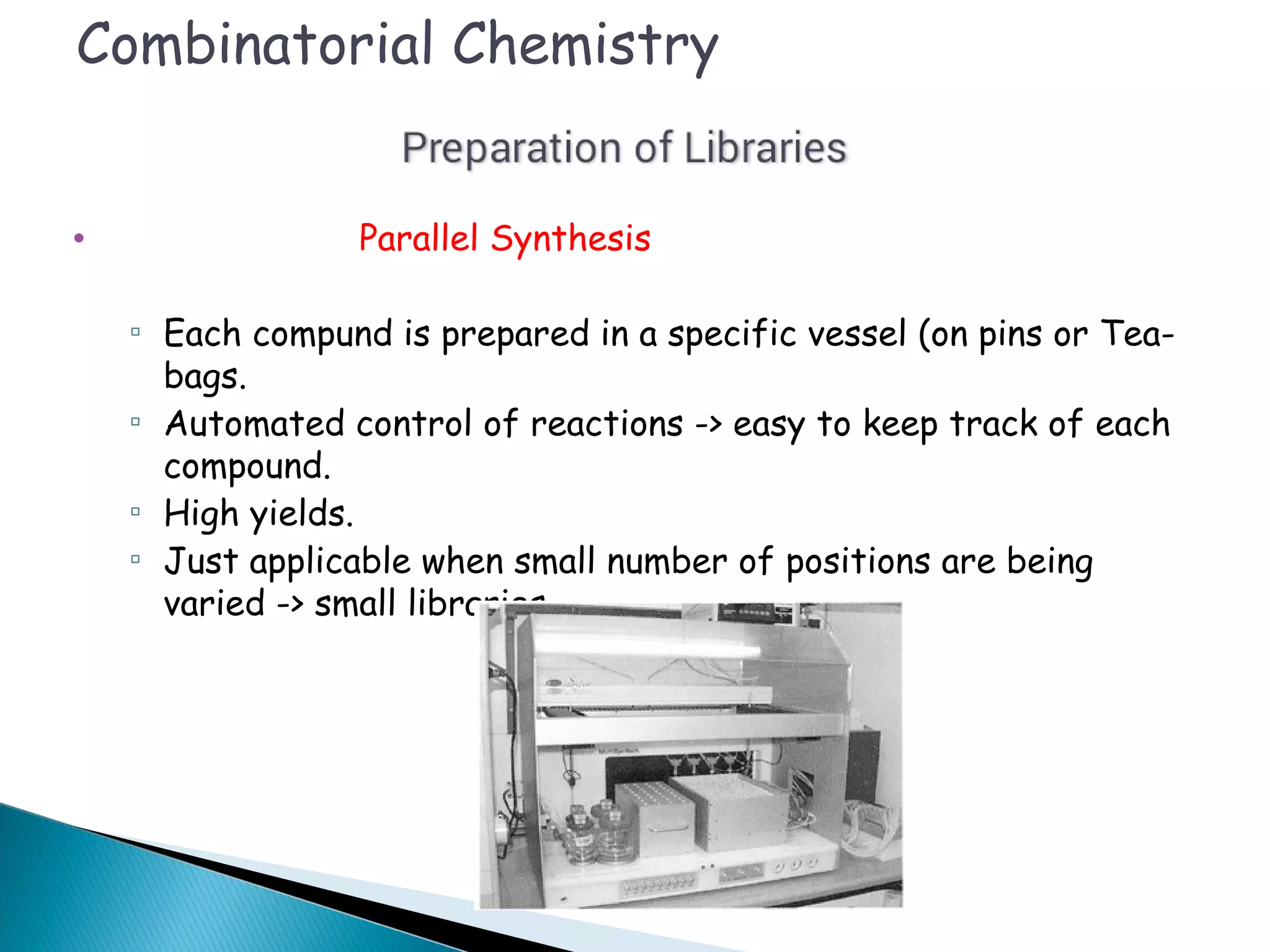
• Parallel Synthesis
▫ Each compund is prepared in a specific vessel (on pins or Tea-
bags.
▫ Automated control of reactions -> easy to keep track of each
compound.
▫ High yields.
▫ Just applicable when small number of positions are being
varied -> small libraries.
 HPLC – it is used to separate the
compounds of combinatorial
libraries
 UV-spectrophotometry
 IR- spectrophotometry
 Screening is a process by which the biologically
active compounds are identified among a
mixture of chemical compounds.
 The screening methods are
 High-throuhput screening,
 Virtual screening.
 To examine, evaluate and compare complex molecular
structure
 To modify structure and assess geometric and
energetic consequences of such modifications
 To perform conformational analysis
 To build macromolecules
CADD methods (COMPUTER AIDED DRUG
DESIGN)
 Mainly it is applied in the discovery of drugs
Eg: RALOXIFN
 To synthesis analogues of existing lead
molecules to elucidate the SAR.
 Preparation of hydrazones and discovery of
anti biotic compounds synthesis.
The early year combinatorial chemistry suffered from an
excess of type of hype, and a major victim was natural
product screening.
In the coming years, it will be intresting to see if such
diversity -oriented syntheses are adopted by big pharma and
commercial suppliers of libraries.
References:
 http://en. wikipedia. org/wiki/drug discovery|.
 Boa A. Introduction to Drug Discovery -Combinatorial
Chemistry. Lecture, Department of Chemistry,
University of Hull, UK; p:40.
 X. -D. Xiang et al. "A Combinatorial Approach to
Material Discovery " Science 268 (1995)1738.
Thank You

Combinatorial chemistry

  • 1.
    Projected by :Pragati Arun Yadav Guided By :Reddy K.V(M.Pharm) SEAT NO. ROLL NO- BPA700473 37 1 S. BSPM'S B. PHARMACY COLLEGE AMBAJOGAI
  • 2.
     Introduction ofcombinatorial chemistry  History of combi-chem  Principle of combi-chem  Synthetic methods a)solid phase synthesis, b) solution phase synthesis,  Screening methods  Application  Conclusion  References
  • 3.
     Combinatorial chemistry(or CombiChem) is a method of synthesizing many different substances quickly and at the same time.  CombiChem is used to synthesize large number of chemical compounds by combining sets of building blocks. Each newly synthesized compound's composition is slightly different from the previous one.
  • 4.
    History of combi-chem ->Although combinatorial chemistry has only really been taken up by industry since the 1990s, its roots can be seen as far back as the 1960s when are searcher at Rockefeller University, Bruce Merrifield, started investigating the solid-state synthesis of peptides -> Bruce Merrifield won the Nobel prize in chemistry in 1984 for his work on solid-phase synthesis.
  • 5.
  • 6.
    In contrast tothis approach, combinatorial chemistry offers the potential to make every combination of compound A1 to An with compound B1 to Bn.
  • 7.
    a)Solid phase synthesis: The compound library have been synthesized on solid phase such as resin bead , pins or chips. b) solution phase synthesis: In this method synthesis of compounds takes place in solution phase.
  • 8.
    Organic reaction thatcarried out on solid support / substrate that are covalently attached to a polymeric resin Solid phase synthesis. Introduction
  • 9.
    RECENT EXAMPLES - EpothiloneA - Dipeptide mimetic - Phosphopeptide thioesters
  • 10.
    Advantages of solidphase synthesis over traditional synthesis. 1. Over all process is quick. 2. Purification of each product can be achieved in one step.Only purification technique is filtration. 3. Purification in each step is possible. 4. Synthetic intermediates don’t have to be isolated. 5. Can be automated with robots.
  • 11.
    Disadvantages of solid phasesynthesis 1.High chemical consume. 2.Expensive. 3.Low reaction rates. 4.Special substrates needed. 5.Extra labor required to develop solid phase route. 6.Yields can be low and produces very few molecule at a time for testing.
  • 12.
     There aremultiple techniques available for this synthesis and beacause of that its use increasing.  Advantages:  - Purification easy.  -Handling of material is easy.  Disadvantages :  -Quantities produced very low for very large libaries. Solution phase synthesis :Solution phase synthesis :
  • 13.
    Combinatorial Chemistry • ParallelSynthesis ▫ Each compund is prepared in a specific vessel (on pins or Tea- bags. ▫ Automated control of reactions -> easy to keep track of each compound. ▫ High yields. ▫ Just applicable when small number of positions are being varied -> small libraries.
  • 14.
     HPLC –it is used to separate the compounds of combinatorial libraries  UV-spectrophotometry  IR- spectrophotometry
  • 15.
     Screening isa process by which the biologically active compounds are identified among a mixture of chemical compounds.  The screening methods are  High-throuhput screening,  Virtual screening.
  • 16.
     To examine,evaluate and compare complex molecular structure  To modify structure and assess geometric and energetic consequences of such modifications  To perform conformational analysis  To build macromolecules CADD methods (COMPUTER AIDED DRUG DESIGN)
  • 17.
     Mainly itis applied in the discovery of drugs Eg: RALOXIFN  To synthesis analogues of existing lead molecules to elucidate the SAR.  Preparation of hydrazones and discovery of anti biotic compounds synthesis.
  • 18.
    The early yearcombinatorial chemistry suffered from an excess of type of hype, and a major victim was natural product screening. In the coming years, it will be intresting to see if such diversity -oriented syntheses are adopted by big pharma and commercial suppliers of libraries.
  • 19.
    References:  http://en. wikipedia.org/wiki/drug discovery|.  Boa A. Introduction to Drug Discovery -Combinatorial Chemistry. Lecture, Department of Chemistry, University of Hull, UK; p:40.  X. -D. Xiang et al. "A Combinatorial Approach to Material Discovery " Science 268 (1995)1738.
  • 20.