Khadija Tahira
M.Sc MLT
UHS
OBJECTIVES
 What are antimicrobials?
 Types of antimicrobials
 Bactericidal & Bacteriostatic
 History
 Sources of antibiotics
 Selective toxicity
 Classification of antibiotics
 Mode of action
Definition
The word “antibiotics” comes from the Greek
Anti- “against” & bios- “life”.
“ Antimicrobial agents are chemical substances that can
either kill or inhibit the growth of micro-organism that
may be natural products or synthetic chemicals”.
It may be
Anti-bacterial
Anti-viral
Anti-fungal
Anti-parasitic
Bactericidal & Bacteriostatic
 An antibiotic may be Bactericidal or Bacteriostatic
In some clinical situations, it is essential to use
bactericidal rather than a bacteriostatic one.
The salient features of the behavior of bacteriostatic
drugs are:
1- The bacteria can grow again when drug is withdrawn.
2- Host defense mechanism(eg phagocytosis) are
required to kill the bacteria.
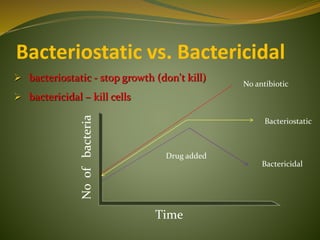
Bacteriostatic vs. Bactericidal
 bacteriostatic - stop growth (don't kill)
 bactericidal – kill cells
No antibiotic
Bacteriostatic
Bactericidal
Time
Drug added
Noofbacteria
HISTORY
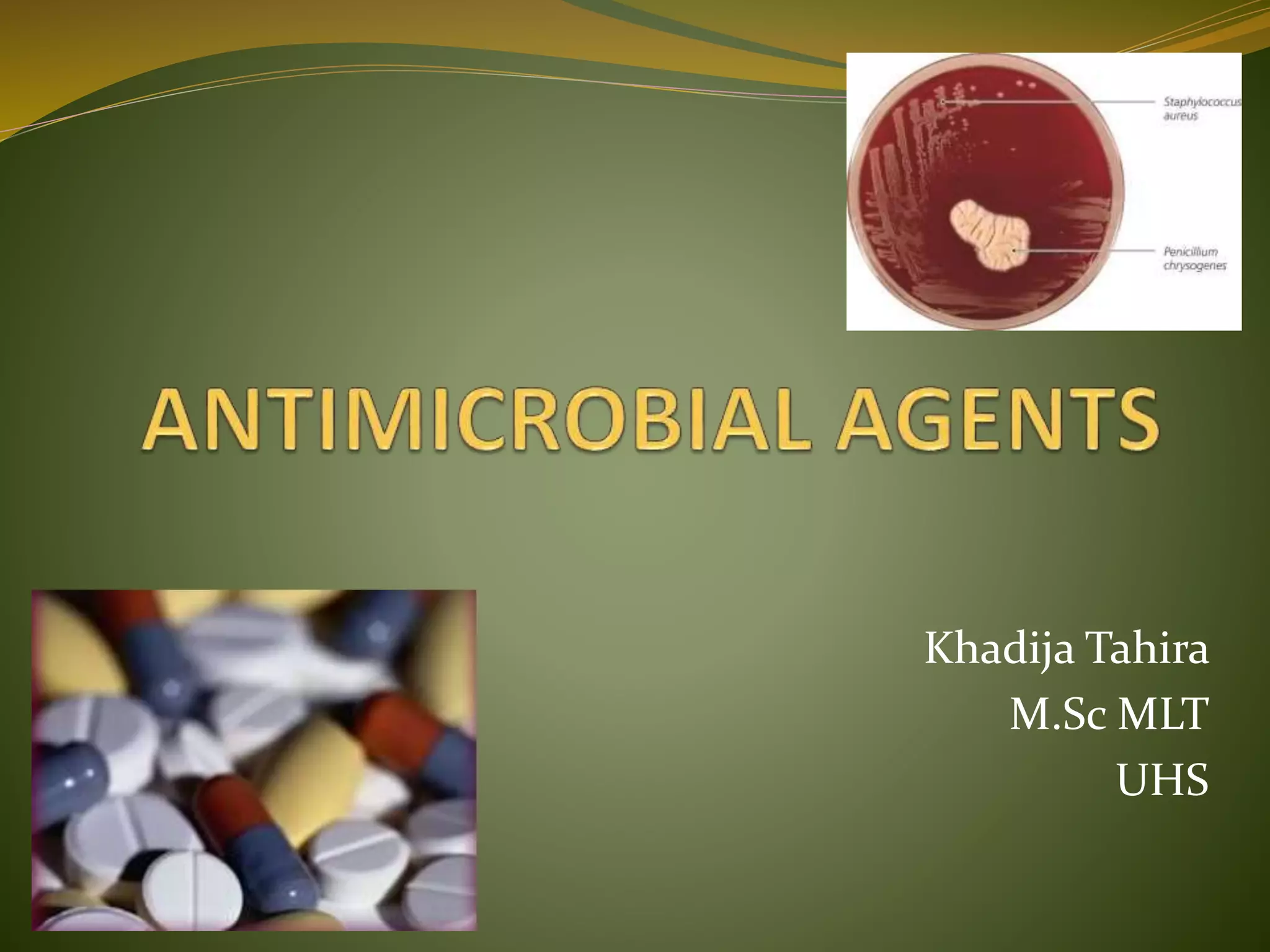
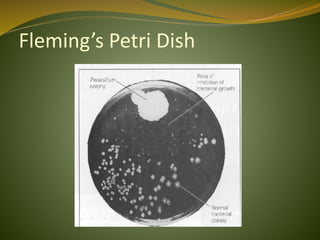
In 1928, Sir Alexander Fleming, a Scottish biologist,
observed that Penicillium notatum, a common mold,
had destroyed staphylococcus bacteria in culture, that
was left uncovered accidentally.
Penicillin was isolated in 1939,and in 1944 Selman and
Albert American Microbiologist , isolated
Streptomycin & a number of other antibiotics.
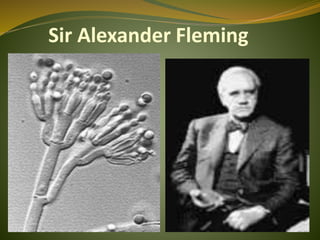
Sir Alexander Fleming
Fleming’s Petri Dish
Selective toxicity
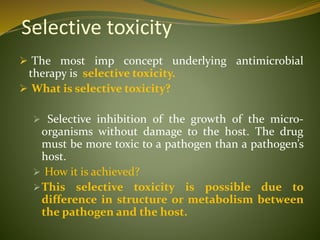
 The most imp concept underlying antimicrobial
therapy is selective toxicity.
 What is selective toxicity?
 Selective inhibition of the growth of the micro-
organisms without damage to the host. The drug
must be more toxic to a pathogen than a pathogen’s
host.
 How it is achieved?
This selective toxicity is possible due to
difference in structure or metabolism between
the pathogen and the host.
Selective toxicity
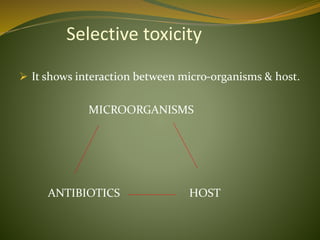
 It shows interaction between micro-organisms & host.
MICROORGANISMS
ANTIBIOTICS HOST
Selective toxicity
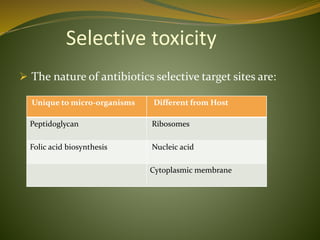
 The nature of antibiotics selective target sites are:
Unique to micro-organisms Different from Host
Peptidoglycan Ribosomes
Folic acid biosynthesis Nucleic acid
Cytoplasmic membrane
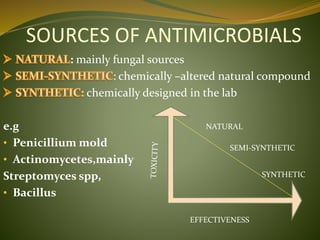
SOURCES OF ANTIMICROBIALS
: mainly fungal sources
: chemically –altered natural compound
chemically designed in the lab
e.g
• Penicillium mold
• Actinomycetes,mainly
Streptomyces spp,
• Bacillus
NATURAL
SEMI-SYNTHETIC
SYNTHETIC
EFFECTIVENESS
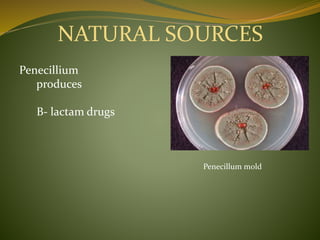
Penecillum mold
Penecillium
produces
B- lactam drugs
NATURAL SOURCES
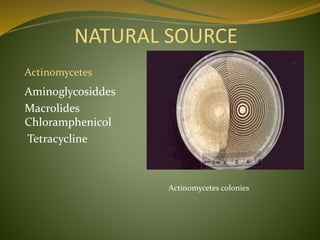
NATURAL SOURCE
Aminoglycosiddes
Macrolides
Chloramphenicol
Tetracycline
Actinomycetes colonies
Actinomycetes
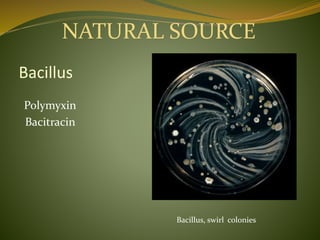
Bacillus
Polymyxin
Bacitracin
Bacillus, swirl colonies
NATURAL SOURCE
CLASSIFICATION OF ANTIBIOTICS
 Antibacterial agents can be classified in one of 3 ways:
1- Bactericidal or Bacteriostatic
2- By the level of selective toxicity at the target site
3- By chemical structure
CLASSIFICATION OF ANTIBIOTICS
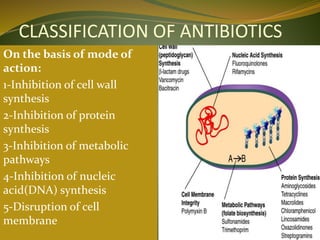
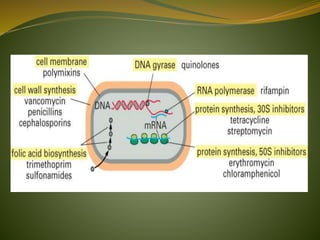
On the basis of mode of
action:
1-Inhibition of cell wall
synthesis
2-Inhibition of protein
synthesis
3-Inhibition of metabolic
pathways
4-Inhibition of nucleic
acid(DNA) synthesis
5-Disruption of cell
membrane
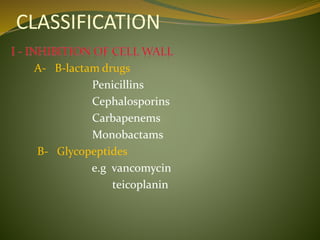
CLASSIFICATION
A- B-lactam drugs
Penicillins
Cephalosporins
Carbapenems
Monobactams
B- Glycopeptides
e.g vancomycin
teicoplanin
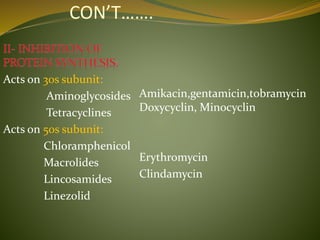
CON’T…….
Acts on 30s subunit:
Aminoglycosides
Tetracyclines
Acts on 50s subunit:
Chloramphenicol
Macrolides
Lincosamides
Linezolid
Amikacin,gentamicin,tobramycin
Doxycyclin, Minocyclin
Erythromycin
Clindamycin
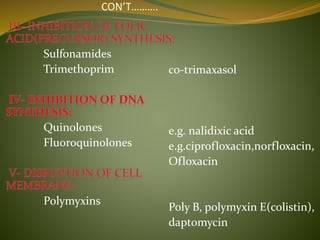
CON’T……….
Sulfonamides
Trimethoprim
Quinolones
Fluoroquinolones
Polymyxins
co-trimaxasol
e.g. nalidixic acid
e.g.ciprofloxacin,norfloxacin,
Ofloxacin
Poly B, polymyxin E(colistin),
daptomycin
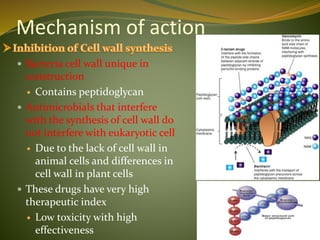
Mechanism of action
 Bacteria cell wall unique in
construction
 Contains peptidoglycan
 Antimicrobials that interfere
with the synthesis of cell wall do
not interfere with eukaryotic cell
 Due to the lack of cell wall in
animal cells and differences in
cell wall in plant cells
 These drugs have very high
therapeutic index
 Low toxicity with high
effectiveness
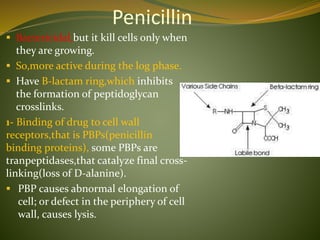
Penicillin
 Bactericidal,but it kill cells only when
they are growing.
 So,more active during the log phase.
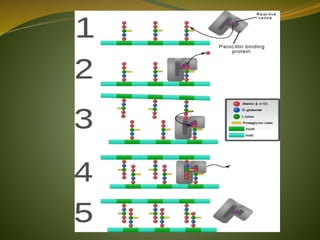
 Have B-lactam ring,which inhibits
the formation of peptidoglycan
crosslinks.
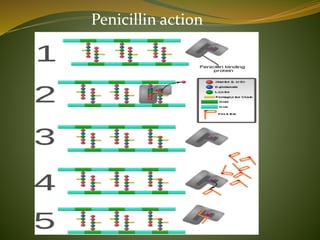
1- Binding of drug to cell wall
receptors,that is PBPs(penicillin
binding proteins), some PBPs are
tranpeptidases,that catalyze final cross-
linking(loss of D-alanine).
 PBP causes abnormal elongation of
cell; or defect in the periphery of cell
wall, causes lysis.
Penicillin action
Penicillin
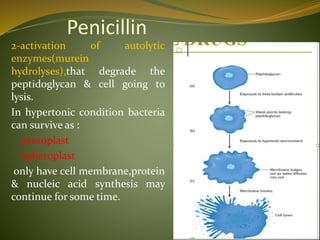
2-activation of autolytic
enzymes(murein
hydrolyses),that degrade the
peptidoglycan & cell going to
lysis.
In hypertonic condition bacteria
can survive as :
protoplast
spheroplast
only have cell membrane,protein
& nucleic acid synthesis may
continue for some time.
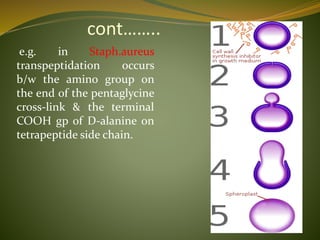
cont……..
e.g. in Staph.aureus
transpeptidation occurs
b/w the amino group on
the end of the pentaglycine
cross-link & the terminal
COOH gp of D-alanine on
tetrapeptide side chain.
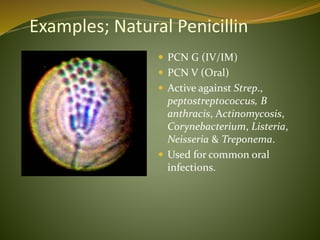
Examples; Natural Penicillin
 PCN G (IV/IM)
 PCN V (Oral)
 Active against Strep.,
peptostreptococcus, B
anthracis, Actinomycosis,
Corynebacterium, Listeria,
Neisseria & Treponema.
 Used for common oral
infections.
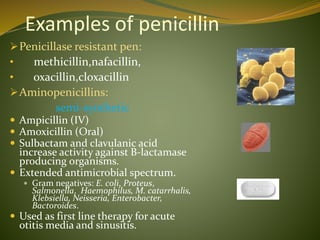
Examples of penicillin
Penicillase resistant pen:
• methicillin,nafacillin,
• oxacillin,cloxacillin
Aminopenicillins:
semi-synthetic
 Ampicillin (IV)
 Amoxicillin (Oral)
 Sulbactam and clavulanic acid
increase activity against B-lactamase
producing organisms.
 Extended antimicrobial spectrum.
 Gram negatives: E. coli, Proteus,
Salmonella, Haemophilus, M. catarrhalis,
Klebsiella, Neisseria, Enterobacter,
Bactoroides.
 Used as first line therapy for acute
otitis media and sinusitis.
Antipseudomonal Penicillins
 Ticarcillin, Piperacillin ,
Mezlocillin.
 Piperacillin/tazobactam
 Active against
Pseudomonas, E. coli,
klebsiella, enterobacter,
serratia and B. fragilis.
 Lower activity against gram
positives
 Often used with
aminoglycosides when
treating pseudomonal
infections.
B-Lactamase inhibitors
 Clavulanic acid
 Sulbactam
 Tazobactam
Amoxicillin-clavulanic acid
(Augmentin)
Ampicillin-sulbactam
Piperacillin-tazobactam
Ticracillin-tazobactam(Timentin)
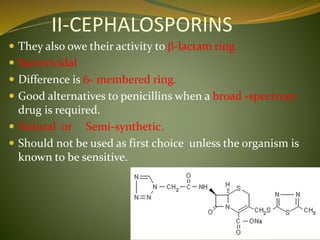
II-CEPHALOSPORINS
 They also owe their activity to b-lactam ring.
 Bactericidal
 Difference is 6- membered ring.
 Good alternatives to penicillins when a broad -spectrum
drug is required.
 Natural or Semi-synthetic.
 Should not be used as first choice unless the organism is
known to be sensitive.
Cephalosporin's
Mode of action is same as of Penicillin.
Classification:
 First generation are early compounds
 Second generation resistant to β-lactamases
 Third generation resistant to β-lactamases &
increased spectrum of activity
 Fourth generation increased spectrum of activity
First Generation(g+):
cephradine
cefazolin
Second Generation(mostly g-):
cefuroxime
Third Generation
spectrum: gram negative > gram positive.
ceftriaxone( IM/IV)
ceftazidime
cefotaxime
Fourth Generation(broad spectrum)
cefipime
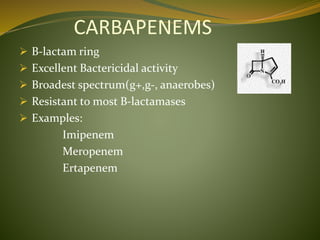
CARBAPENEMS
 B-lactam ring
 Excellent Bactericidal activity
 Broadest spectrum(g+,g-, anaerobes)
 Resistant to most B-lactamases
 Examples:
Imipenem
Meropenem
Ertapenem
MONOBACTAMS
B –lactam ring without an adjacent sulfur-containing
ring
Bactericidal
Resistant to most B-lactamases
Narrow antibacterial spectrum; active against
many g- rods & Pseudomonas.
Inactive against g+ & anaerobic bacteria.
 Example:
Aztreonam
GLYCOPEPTIDES
 Bactericidal
 Narrow spectrum(g+)
 Mode of action:
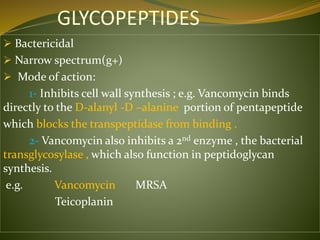
1- Inhibits cell wall synthesis ; e.g. Vancomycin binds
directly to the D-alanyl -D –alanine portion of pentapeptide
which blocks the transpeptidase from binding .
2- Vancomycin also inhibits a 2nd enzyme , the bacterial
transglycosylase , which also function in peptidoglycan
synthesis.
e.g. Vancomycin MRSA
Teicoplanin
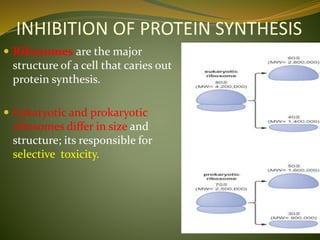
INHIBITION OF PROTEIN SYNTHESIS
 Ribosomes are the major
structure of a cell that caries out
protein synthesis.
 Eukaryotic and prokaryotic
ribosomes differ in size and
structure; its responsible for
selective toxicity.
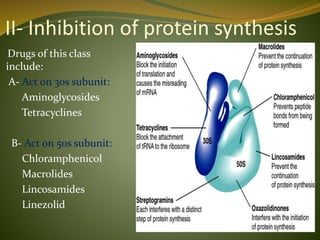
II- Inhibition of protein synthesis
Drugs of this class
include:
A- Act on 30s subunit:
Aminoglycosides
Tetracyclines
B- Act on 50s subunit:
Chloramphenicol
Macrolides
Lincosamides
Linezolid
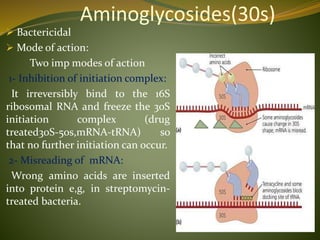
Aminoglycosides(30s)
 Bactericidal
 Mode of action:
Two imp modes of action
1- Inhibition of initiation complex:
It irreversibly bind to the 16S
ribosomal RNA and freeze the 30S
initiation complex (drug
treated30S-50s,mRNA-tRNA) so
that no further initiation can occur.
2- Misreading of mRNA:
Wrong amino acids are inserted
into protein e,g, in streptomycin-
treated bacteria.
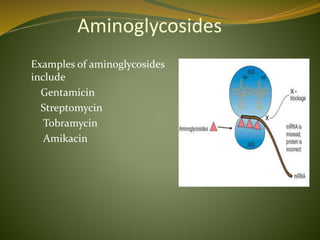
Aminoglycosides
Examples of aminoglycosides
include
Gentamicin
Streptomycin
Tobramycin
Amikacin
TETRACYCLINES(30s)
 Bacteriostatic
 Broad spectrum(g+,g-
mycoplasma,chlamydia &
rickettsiae)
 Mode of action:
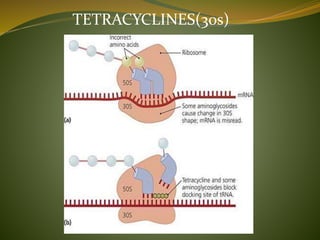
Inhibit protein synthesis by
blocking the aminoacyl
transfer RNA (tRNA)from
entering the acceptor site
on the ribosome's.
e.g. Tetracyclin, Doxycyclin,
Minocyclin, Tegicyclin
TETRACYCLINES(30s)
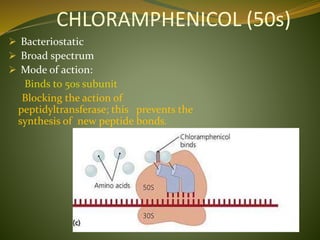
CHLORAMPHENICOL (50s)
 Bacteriostatic
 Broad spectrum
 Mode of action:
Binds to 50s subunit
Blocking the action of
peptidyltransferase; this prevents the
synthesis of new peptide bonds.
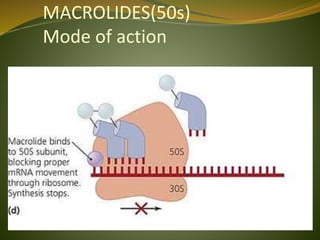
MACROLIDES(50s)
 Binds to 50s subunit
 Bacteriostatic
 Broad spectrum (Legionelle,Mycoplasma)
 least toxic drug
 Mode of action:
It blocks the protein synthesis(translocation) by
preventing the release of uncharged tRNA from the
donar site after the peptide bond is formed.
Ex; Erythromycin
Azithromycin
Clarithromycin
MACROLIDES(50s)
Mode of action
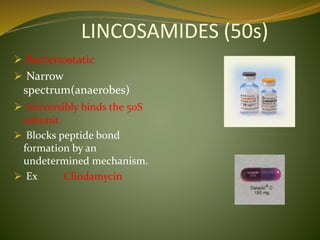
LINCOSAMIDES (50s)
 Bacteriostatic
 Narrow
spectrum(anaerobes)
 Irreversibly binds the 50S
subunit.
 Blocks peptide bond
formation by an
undetermined mechanism.
 Ex Clindamycin
Linezolid (50s)
 Bacteriostatic(enterococci & staphylococci)
 Bactericidal(pneumococci)
 Binds to 23s ribosomal RNA in the 50s subunit &
inhibits protein synthesis, but the precise mechanism
is unknown.
It appears to block some early step(initiation) in
ribosome formation.
 Useful for the treatment of
VRE
MRSA
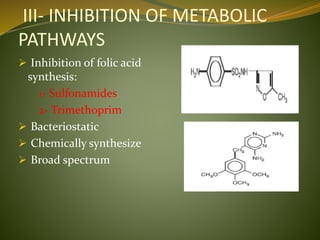
III- INHIBITION OF METABOLIC
PATHWAYS
 Inhibition of folic acid
synthesis:
1- Sulfonamides
2- Trimethoprim
 Bacteriostatic
 Chemically synthesize
 Broad spectrum
Sulfonamides, Sulfones
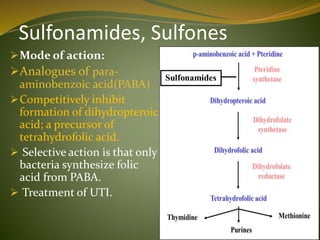
Mode of action:
Analogues of para-
aminobenzoic acid(PABA)
Competitively inhibit
formation of dihydropteroic
acid; a precursor of
tetrahydrofolic acid.
 Selective action is that only
bacteria synthesize folic
acid from PABA.
 Treatment of UTI.
TRIMETHOPRIM
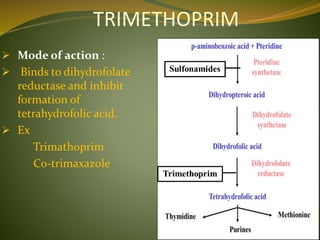
 Mode of action :
 Binds to dihydrofolate
reductase and inhibit
formation of
tetrahydrofolic acid.
 Ex
Trimathoprim
Co-trimaxazole
IV- INHIBITION OF DNA SYNTHESIS
 Bactericidal
 Synthetic
 Groups include:
Quinolones
Fluoroquinolones
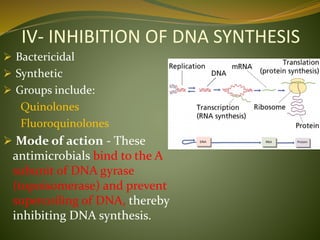
 Mode of action - These
antimicrobials bind to the A
subunit of DNA gyrase
(topoisomerase) and prevent
supercoiling of DNA, thereby
inhibiting DNA synthesis.
Quinolones
eg
 Nalidix acid
 Only for UTI
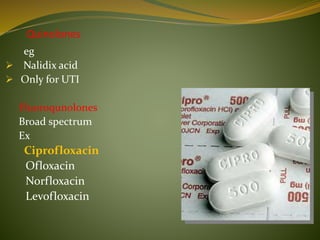
Fluoroqunolones
Broad spectrum
Ex
Ciprofloxacin
Ofloxacin
Norfloxacin
Levofloxacin
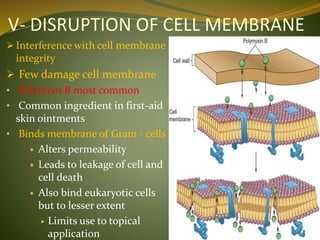
V- DISRUPTION OF CELL MEMBRANE
 Interference with cell membrane
integrity
 Few damage cell membrane
• Polymixn B most common
• Common ingredient in first-aid
skin ointments
• Binds membrane of Gram - cells
 Alters permeability
 Leads to leakage of cell and
cell death
 Also bind eukaryotic cells
but to lesser extent
 Limits use to topical
application
V- DISRUPTION OF CELL
MEMBRANE
Examples:
Polymyxin B
Polymyxin E (Colistin)
Daptomycin
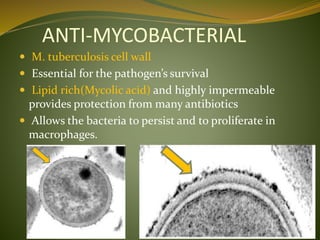
ANTI-MYCOBACTERIAL
 M. tuberculosis cell wall
 Essential for the pathogen’s survival
 Lipid rich(Mycolic acid) and highly impermeable
provides protection from many antibiotics
 Allows the bacteria to persist and to proliferate in
macrophages.
Mycolic acids
long-chain fatty acids (between 60 and 90
carbon atoms), constitute up to 60% of the
cell wall.
Mainly responsible for the low permeability of
the waxy cell envelop.
ANTI –TUBERCULOUS DRUGS
 It includes:
Strepomycin
Isoniazid
Rifampin
Ethambutol
Parazinamide
ANTI –TUBERCULOUS DRUGS
 ISONIAZID
Inhibits mycolic acid synthesis, by inhibiting the
REDUCTSE enzyme; which is required for long chain
fatty acid synthesis.
 Rifampin
It blocking the mRNA synthesis by bacterial
RNA polymerase without affecting the RNA
polymerase of human cells.
ANTI –TUBERCULOUS DRUGS
 Metronidazol
Inhibit DNA synthesis, drugs binds to DNA &
causes strand breakage, which prevents its proper
functioning as a template for DNA polymerase.
PZA
Pyrazinamide is a prodrug that stops the growth of
Mycobacterium tuberculosis.
 M. tuberculosis has the enzyme pyrazinamidase which is
only active in acidic conditions. Pyrazinamidase converts
pyrazinamide to the active form, pyrazinoic acid which
accumulates in the bacilli. Pyrazinoic acid was thought to
inhibit the enzyme fatty acid synthase (FAS) I, which is
required by the bacterium to synthesise fatty acids although
this has been discounted. It was also suggested that the
accumulation of pyrazinoic acid disrupts membrane
potential and interferes with energy production, necessary
for survival of M. tuberculosis at an acidic site of infection.
Pyrazinamide and its analogs inhibited the activity of
purified FAS I.
Pyrazinoic acid binds to the ribosomal protein S1
(RpsA) and inhibits trans-translation.
This may explain the ability of the drug to kill dormant
mycobacteria.

Antibiotics

  • 1.
  • 2.
    OBJECTIVES  What areantimicrobials?  Types of antimicrobials  Bactericidal & Bacteriostatic  History  Sources of antibiotics  Selective toxicity  Classification of antibiotics  Mode of action
  • 3.
    Definition The word “antibiotics”comes from the Greek Anti- “against” & bios- “life”. “ Antimicrobial agents are chemical substances that can either kill or inhibit the growth of micro-organism that may be natural products or synthetic chemicals”. It may be Anti-bacterial Anti-viral Anti-fungal Anti-parasitic
  • 4.
    Bactericidal & Bacteriostatic An antibiotic may be Bactericidal or Bacteriostatic In some clinical situations, it is essential to use bactericidal rather than a bacteriostatic one. The salient features of the behavior of bacteriostatic drugs are: 1- The bacteria can grow again when drug is withdrawn. 2- Host defense mechanism(eg phagocytosis) are required to kill the bacteria.
  • 5.
    Bacteriostatic vs. Bactericidal bacteriostatic - stop growth (don't kill)  bactericidal – kill cells No antibiotic Bacteriostatic Bactericidal Time Drug added Noofbacteria
  • 6.
    HISTORY In 1928, SirAlexander Fleming, a Scottish biologist, observed that Penicillium notatum, a common mold, had destroyed staphylococcus bacteria in culture, that was left uncovered accidentally. Penicillin was isolated in 1939,and in 1944 Selman and Albert American Microbiologist , isolated Streptomycin & a number of other antibiotics.
  • 7.
  • 8.
  • 9.
    Selective toxicity  Themost imp concept underlying antimicrobial therapy is selective toxicity.  What is selective toxicity?  Selective inhibition of the growth of the micro- organisms without damage to the host. The drug must be more toxic to a pathogen than a pathogen’s host.  How it is achieved? This selective toxicity is possible due to difference in structure or metabolism between the pathogen and the host.
  • 10.
    Selective toxicity  Itshows interaction between micro-organisms & host. MICROORGANISMS ANTIBIOTICS HOST
  • 11.
    Selective toxicity  Thenature of antibiotics selective target sites are: Unique to micro-organisms Different from Host Peptidoglycan Ribosomes Folic acid biosynthesis Nucleic acid Cytoplasmic membrane
  • 12.
    SOURCES OF ANTIMICROBIALS :mainly fungal sources : chemically –altered natural compound chemically designed in the lab e.g • Penicillium mold • Actinomycetes,mainly Streptomyces spp, • Bacillus NATURAL SEMI-SYNTHETIC SYNTHETIC EFFECTIVENESS
  • 13.
  • 14.
  • 15.
  • 16.
    CLASSIFICATION OF ANTIBIOTICS Antibacterial agents can be classified in one of 3 ways: 1- Bactericidal or Bacteriostatic 2- By the level of selective toxicity at the target site 3- By chemical structure
  • 17.
    CLASSIFICATION OF ANTIBIOTICS Onthe basis of mode of action: 1-Inhibition of cell wall synthesis 2-Inhibition of protein synthesis 3-Inhibition of metabolic pathways 4-Inhibition of nucleic acid(DNA) synthesis 5-Disruption of cell membrane
  • 19.
  • 20.
    CON’T……. Acts on 30ssubunit: Aminoglycosides Tetracyclines Acts on 50s subunit: Chloramphenicol Macrolides Lincosamides Linezolid Amikacin,gentamicin,tobramycin Doxycyclin, Minocyclin Erythromycin Clindamycin
  • 21.
  • 22.
    Mechanism of action Bacteria cell wall unique in construction  Contains peptidoglycan  Antimicrobials that interfere with the synthesis of cell wall do not interfere with eukaryotic cell  Due to the lack of cell wall in animal cells and differences in cell wall in plant cells  These drugs have very high therapeutic index  Low toxicity with high effectiveness
  • 24.
    Penicillin  Bactericidal,but itkill cells only when they are growing.  So,more active during the log phase.  Have B-lactam ring,which inhibits the formation of peptidoglycan crosslinks. 1- Binding of drug to cell wall receptors,that is PBPs(penicillin binding proteins), some PBPs are tranpeptidases,that catalyze final cross- linking(loss of D-alanine).  PBP causes abnormal elongation of cell; or defect in the periphery of cell wall, causes lysis.
  • 25.
  • 26.
    Penicillin 2-activation of autolytic enzymes(murein hydrolyses),thatdegrade the peptidoglycan & cell going to lysis. In hypertonic condition bacteria can survive as : protoplast spheroplast only have cell membrane,protein & nucleic acid synthesis may continue for some time.
  • 27.
    cont…….. e.g. in Staph.aureus transpeptidationoccurs b/w the amino group on the end of the pentaglycine cross-link & the terminal COOH gp of D-alanine on tetrapeptide side chain.
  • 28.
    Examples; Natural Penicillin PCN G (IV/IM)  PCN V (Oral)  Active against Strep., peptostreptococcus, B anthracis, Actinomycosis, Corynebacterium, Listeria, Neisseria & Treponema.  Used for common oral infections.
  • 29.
    Examples of penicillin Penicillaseresistant pen: • methicillin,nafacillin, • oxacillin,cloxacillin Aminopenicillins: semi-synthetic  Ampicillin (IV)  Amoxicillin (Oral)  Sulbactam and clavulanic acid increase activity against B-lactamase producing organisms.  Extended antimicrobial spectrum.  Gram negatives: E. coli, Proteus, Salmonella, Haemophilus, M. catarrhalis, Klebsiella, Neisseria, Enterobacter, Bactoroides.  Used as first line therapy for acute otitis media and sinusitis.
  • 30.
    Antipseudomonal Penicillins  Ticarcillin,Piperacillin , Mezlocillin.  Piperacillin/tazobactam  Active against Pseudomonas, E. coli, klebsiella, enterobacter, serratia and B. fragilis.  Lower activity against gram positives  Often used with aminoglycosides when treating pseudomonal infections.
  • 31.
    B-Lactamase inhibitors  Clavulanicacid  Sulbactam  Tazobactam Amoxicillin-clavulanic acid (Augmentin) Ampicillin-sulbactam Piperacillin-tazobactam Ticracillin-tazobactam(Timentin)
  • 32.
    II-CEPHALOSPORINS  They alsoowe their activity to b-lactam ring.  Bactericidal  Difference is 6- membered ring.  Good alternatives to penicillins when a broad -spectrum drug is required.  Natural or Semi-synthetic.  Should not be used as first choice unless the organism is known to be sensitive.
  • 33.
    Cephalosporin's Mode of actionis same as of Penicillin. Classification:  First generation are early compounds  Second generation resistant to β-lactamases  Third generation resistant to β-lactamases & increased spectrum of activity  Fourth generation increased spectrum of activity
  • 34.
    First Generation(g+): cephradine cefazolin Second Generation(mostlyg-): cefuroxime Third Generation spectrum: gram negative > gram positive. ceftriaxone( IM/IV) ceftazidime cefotaxime Fourth Generation(broad spectrum) cefipime
  • 35.
    CARBAPENEMS  B-lactam ring Excellent Bactericidal activity  Broadest spectrum(g+,g-, anaerobes)  Resistant to most B-lactamases  Examples: Imipenem Meropenem Ertapenem
  • 36.
    MONOBACTAMS B –lactam ringwithout an adjacent sulfur-containing ring Bactericidal Resistant to most B-lactamases Narrow antibacterial spectrum; active against many g- rods & Pseudomonas. Inactive against g+ & anaerobic bacteria.  Example: Aztreonam
  • 37.
    GLYCOPEPTIDES  Bactericidal  Narrowspectrum(g+)  Mode of action: 1- Inhibits cell wall synthesis ; e.g. Vancomycin binds directly to the D-alanyl -D –alanine portion of pentapeptide which blocks the transpeptidase from binding . 2- Vancomycin also inhibits a 2nd enzyme , the bacterial transglycosylase , which also function in peptidoglycan synthesis. e.g. Vancomycin MRSA Teicoplanin
  • 39.
    INHIBITION OF PROTEINSYNTHESIS  Ribosomes are the major structure of a cell that caries out protein synthesis.  Eukaryotic and prokaryotic ribosomes differ in size and structure; its responsible for selective toxicity.
  • 40.
    II- Inhibition ofprotein synthesis Drugs of this class include: A- Act on 30s subunit: Aminoglycosides Tetracyclines B- Act on 50s subunit: Chloramphenicol Macrolides Lincosamides Linezolid
  • 41.
    Aminoglycosides(30s)  Bactericidal  Modeof action: Two imp modes of action 1- Inhibition of initiation complex: It irreversibly bind to the 16S ribosomal RNA and freeze the 30S initiation complex (drug treated30S-50s,mRNA-tRNA) so that no further initiation can occur. 2- Misreading of mRNA: Wrong amino acids are inserted into protein e,g, in streptomycin- treated bacteria.
  • 42.
  • 43.
    TETRACYCLINES(30s)  Bacteriostatic  Broadspectrum(g+,g- mycoplasma,chlamydia & rickettsiae)  Mode of action: Inhibit protein synthesis by blocking the aminoacyl transfer RNA (tRNA)from entering the acceptor site on the ribosome's. e.g. Tetracyclin, Doxycyclin, Minocyclin, Tegicyclin
  • 44.
  • 45.
    CHLORAMPHENICOL (50s)  Bacteriostatic Broad spectrum  Mode of action: Binds to 50s subunit Blocking the action of peptidyltransferase; this prevents the synthesis of new peptide bonds.
  • 46.
    MACROLIDES(50s)  Binds to50s subunit  Bacteriostatic  Broad spectrum (Legionelle,Mycoplasma)  least toxic drug  Mode of action: It blocks the protein synthesis(translocation) by preventing the release of uncharged tRNA from the donar site after the peptide bond is formed. Ex; Erythromycin Azithromycin Clarithromycin
  • 47.
  • 48.
    LINCOSAMIDES (50s)  Bacteriostatic Narrow spectrum(anaerobes)  Irreversibly binds the 50S subunit.  Blocks peptide bond formation by an undetermined mechanism.  Ex Clindamycin
  • 49.
    Linezolid (50s)  Bacteriostatic(enterococci& staphylococci)  Bactericidal(pneumococci)  Binds to 23s ribosomal RNA in the 50s subunit & inhibits protein synthesis, but the precise mechanism is unknown. It appears to block some early step(initiation) in ribosome formation.  Useful for the treatment of VRE MRSA
  • 50.
    III- INHIBITION OFMETABOLIC PATHWAYS  Inhibition of folic acid synthesis: 1- Sulfonamides 2- Trimethoprim  Bacteriostatic  Chemically synthesize  Broad spectrum
  • 51.
    Sulfonamides, Sulfones Mode ofaction: Analogues of para- aminobenzoic acid(PABA) Competitively inhibit formation of dihydropteroic acid; a precursor of tetrahydrofolic acid.  Selective action is that only bacteria synthesize folic acid from PABA.  Treatment of UTI.
  • 52.
    TRIMETHOPRIM  Mode ofaction :  Binds to dihydrofolate reductase and inhibit formation of tetrahydrofolic acid.  Ex Trimathoprim Co-trimaxazole
  • 53.
    IV- INHIBITION OFDNA SYNTHESIS  Bactericidal  Synthetic  Groups include: Quinolones Fluoroquinolones  Mode of action - These antimicrobials bind to the A subunit of DNA gyrase (topoisomerase) and prevent supercoiling of DNA, thereby inhibiting DNA synthesis.
  • 54.
    Quinolones eg  Nalidix acid Only for UTI Fluoroqunolones Broad spectrum Ex Ciprofloxacin Ofloxacin Norfloxacin Levofloxacin
  • 55.
    V- DISRUPTION OFCELL MEMBRANE  Interference with cell membrane integrity  Few damage cell membrane • Polymixn B most common • Common ingredient in first-aid skin ointments • Binds membrane of Gram - cells  Alters permeability  Leads to leakage of cell and cell death  Also bind eukaryotic cells but to lesser extent  Limits use to topical application
  • 56.
    V- DISRUPTION OFCELL MEMBRANE Examples: Polymyxin B Polymyxin E (Colistin) Daptomycin
  • 57.
    ANTI-MYCOBACTERIAL  M. tuberculosiscell wall  Essential for the pathogen’s survival  Lipid rich(Mycolic acid) and highly impermeable provides protection from many antibiotics  Allows the bacteria to persist and to proliferate in macrophages.
  • 58.
    Mycolic acids long-chain fattyacids (between 60 and 90 carbon atoms), constitute up to 60% of the cell wall. Mainly responsible for the low permeability of the waxy cell envelop.
  • 59.
    ANTI –TUBERCULOUS DRUGS It includes: Strepomycin Isoniazid Rifampin Ethambutol Parazinamide
  • 60.
    ANTI –TUBERCULOUS DRUGS ISONIAZID Inhibits mycolic acid synthesis, by inhibiting the REDUCTSE enzyme; which is required for long chain fatty acid synthesis.  Rifampin It blocking the mRNA synthesis by bacterial RNA polymerase without affecting the RNA polymerase of human cells.
  • 61.
    ANTI –TUBERCULOUS DRUGS Metronidazol Inhibit DNA synthesis, drugs binds to DNA & causes strand breakage, which prevents its proper functioning as a template for DNA polymerase.
  • 62.
    PZA Pyrazinamide is aprodrug that stops the growth of Mycobacterium tuberculosis.  M. tuberculosis has the enzyme pyrazinamidase which is only active in acidic conditions. Pyrazinamidase converts pyrazinamide to the active form, pyrazinoic acid which accumulates in the bacilli. Pyrazinoic acid was thought to inhibit the enzyme fatty acid synthase (FAS) I, which is required by the bacterium to synthesise fatty acids although this has been discounted. It was also suggested that the accumulation of pyrazinoic acid disrupts membrane potential and interferes with energy production, necessary for survival of M. tuberculosis at an acidic site of infection.
  • 63.
    Pyrazinamide and itsanalogs inhibited the activity of purified FAS I. Pyrazinoic acid binds to the ribosomal protein S1 (RpsA) and inhibits trans-translation. This may explain the ability of the drug to kill dormant mycobacteria.