1
PERICYCLIC REACTION
Prepared By :
Mahendra G S
M-Pharm,Pharmaceutical
Chemistry
JSSCP, MYSURU
FLOW OF PRESENTATION
Introduction1
Classification2
Mechanism3
Example4
2
Introduction
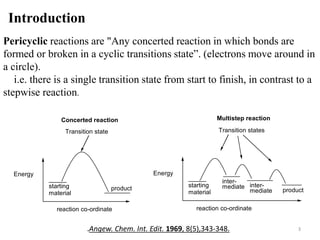
Pericyclic reactions are "Any concerted reaction in which bonds are
formed or broken in a cyclic transitions state”. (electrons move around in
a circle).
i.e. there is a single transition state from start to finish, in contrast to a
stepwise reaction.
Transition state
reaction co-ordinate
Energy
starting
material
product
Concerted reaction
Transition states
reaction co-ordinate
Energy
starting
material product
Multistep reaction
inter-
mediate inter-
mediate
3.Angew. Chem. Int. Edit. 1969, 8(5),343-348.
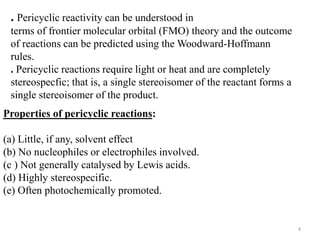
. Pericyclic reactivity can be understood in
terms of frontier molecular orbital (FMO) theory and the outcome
of reactions can be predicted using the Woodward-Hoffmann
rules.
. Pericyclic reactions require light or heat and are completely
stereospecfic; that is, a single stereoisomer of the reactant forms a
single stereoisomer of the product.
Properties of pericyclic reactions:
(a) Little, if any, solvent effect
(b) No nucleophiles or electrophiles involved.
(c ) Not generally catalysed by Lewis acids.
(d) Highly stereospecific.
(e) Often photochemically promoted.
4
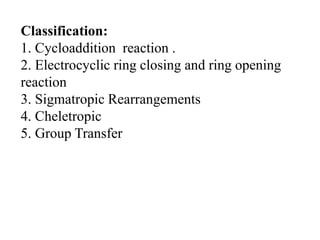
Classification:
1. Cycloaddition reaction .
2. Electrocyclic ring closing and ring opening
reaction
3. Sigmatropic Rearrangements
4. Cheletropic
5. Group Transfer
Cycloaddition reaction
• A cycloaddition is a pericyclic chemical reaction, in which
"two or more unsaturated molecules (or parts of the same
molecule) combine with the formation of a cyclic adduct in
which there is a net reduction of the bond multiplicity." The
resulting reaction is a cyclization reaction. Designated as
[A+B].
• A and B refers to number of atoms containing π-electrons
• Three important classes of cycloaddition reactions
(i) Diels-Alder reaction
(iii) [2+2] Cycloaddition
(ii) [1,3]-Dipolar cycloaddition
6
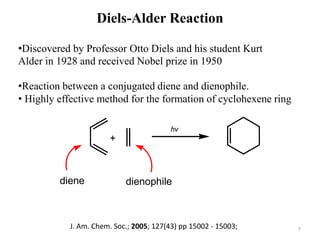
Diels-Alder Reaction
•Reaction between a conjugated diene and dienophile.
• Highly effective method for the formation of cyclohexene ring
•Discovered by Professor Otto Diels and his student Kurt
Alder in 1928 and received Nobel prize in 1950
+
diene dienophile
7J. Am. Chem. Soc.; 2005; 127(43) pp 15002 - 15003;
hv
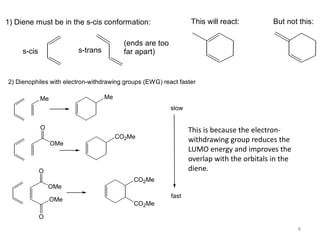
1) Diene must be in the s-cis conformation:
s-cis s-trans
This will react: But not this:
(ends are too
far apart)
2) Dienophiles with electron-withdrawing groups (EWG) react faster:
Me Me
CO2Me
O
OMe
CO2Me
O
OMe
O
OMe
CO2Me
slow
fast
This is because the electron-
withdrawing group reduces the
LUMO energy and improves the
overlap with the orbitals in the
diene.
8
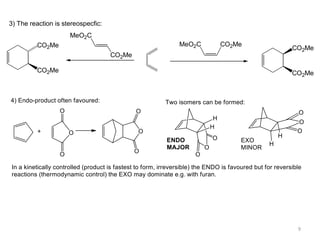
3) The reaction is stereospecfic:
MeO2C
CO2Me
CO2Me
CO2Me
MeO2C
CO2Me
CO2Me
CO2Me
9
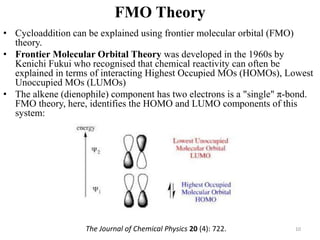
FMO Theory
• Cycloaddition can be explained using frontier molecular orbital (FMO)
theory.
• Frontier Molecular Orbital Theory was developed in the 1960s by
Kenichi Fukui who recognised that chemical reactivity can often be
explained in terms of interacting Highest Occupied MOs (HOMOs), Lowest
Unoccupied MOs (LUMOs)
• The alkene (dienophile) component has two electrons is a "single" π-bond.
FMO theory, here, identifies the HOMO and LUMO components of this
system:
10The Journal of Chemical Physics 20 (4): 722.
11
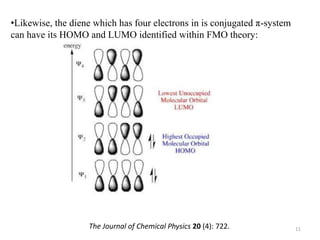
•Likewise, the diene which has four electrons in is conjugated π-system
can have its HOMO and LUMO identified within FMO theory:
The Journal of Chemical Physics 20 (4): 722.
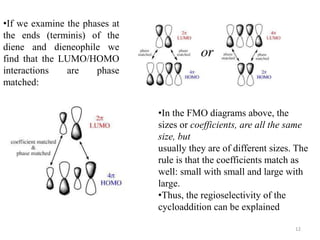
•If we examine the phases at
the ends (terminis) of the
diene and dieneophile we
find that the LUMO/HOMO
interactions are phase
matched:
12
•In the FMO diagrams above, the
sizes or coefficients, are all the same
size, but
usually they are of different sizes. The
rule is that the coefficients match as
well: small with small and large with
large.
•Thus, the regioselectivity of the
cycloaddition can be explained
[2+2] Cycloaddition reaction
The [2+2] photocycloaddition is a cycloaddition-type reaction –
it generally entails the formation of new molecules by the reaction
of two unsaturated molecules via two atoms from each molecules
(hence "[2 + 2]").
13Polym. Int. 58 (7): 720
1,3 dipolar cycloaddition reaction
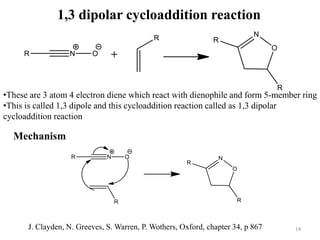
•These are 3 atom 4 electron diene which react with dienophile and form 5-member ring
•This is called 1,3 dipole and this cycloaddition reaction called as 1,3 dipolar
cycloaddition reaction
Mechanism
14J. Clayden, N. Greeves, S. Warren, P. Wothers, Oxford, chapter 34, p 867
•Molecular rearrangements in which a σ-bonded atom or
group, flanked by one or more π-electron systems, shifts
to a new location with a corresponding reorganization of
the π-bonds are called sigmatropic reactions. The total
number of σ-bonds and π-bonds remain
unchanged. Diffenent type of sigmatropic rearrangement
reaction are-
Sigmatropic Rearrangements
•(3,3)-sigmatropic rearrangement
• (2,3)-sigmatropic rearrangement
•(1,5)-sigmatropic rearrangement
15
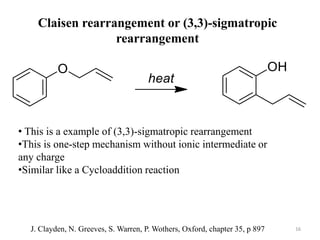
Claisen rearrangement or (3,3)-sigmatropic
rearrangement
• This is a example of (3,3)-sigmatropic rearrangement
•This is one-step mechanism without ionic intermediate or
any charge
•Similar like a Cycloaddition reaction
16J. Clayden, N. Greeves, S. Warren, P. Wothers, Oxford, chapter 35, p 897
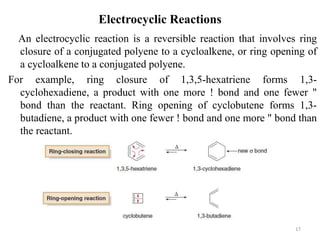
Electrocyclic Reactions
An electrocyclic reaction is a reversible reaction that involves ring
closure of a conjugated polyene to a cycloalkene, or ring opening of
a cycloalkene to a conjugated polyene.
For example, ring closure of 1,3,5-hexatriene forms 1,3-
cyclohexadiene, a product with one more ! bond and one fewer "
bond than the reactant. Ring opening of cyclobutene forms 1,3-
butadiene, a product with one fewer ! bond and one more " bond than
the reactant.
17
EXAMPLE OF PERICYCLIC
REACTION
18
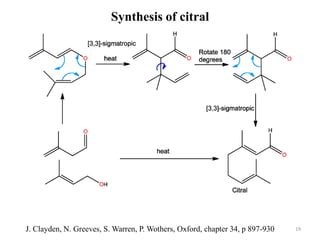
Synthesis of citral
19J. Clayden, N. Greeves, S. Warren, P. Wothers, Oxford, chapter 34, p 897-930
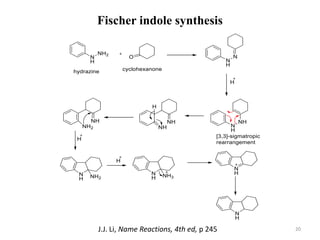
Fischer indole synthesis
20J.J. Li, Name Reactions, 4th ed, p 245
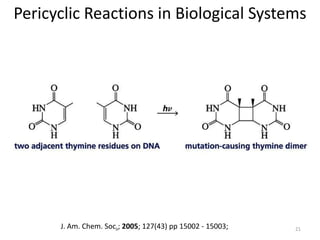
Pericyclic Reactions in Biological Systems
21J. Am. Chem. Soc.; 2005; 127(43) pp 15002 - 15003;
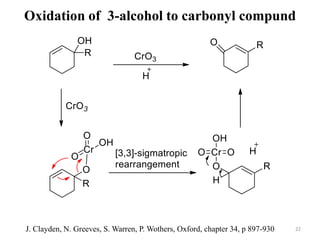
Oxidation of 3-alcohol to carbonyl compund
22J. Clayden, N. Greeves, S. Warren, P. Wothers, Oxford, chapter 34, p 897-930
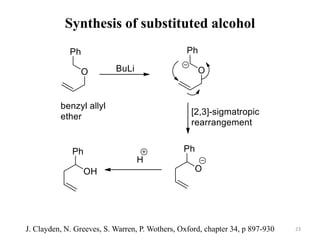
Synthesis of substituted alcohol
23J. Clayden, N. Greeves, S. Warren, P. Wothers, Oxford, chapter 34, p 897-930
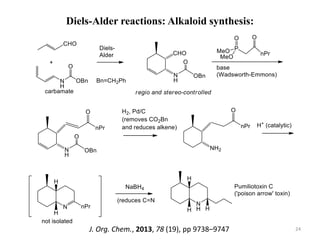
Diels-Alder reactions: Alkaloid synthesis:
24J. Org. Chem., 2013, 78 (19), pp 9738–9747
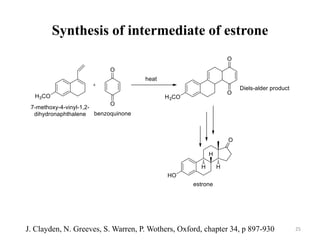
Synthesis of intermediate of estrone
25J. Clayden, N. Greeves, S. Warren, P. Wothers, Oxford, chapter 34, p 897-930
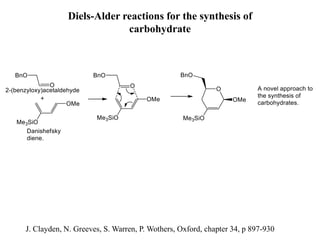
Diels-Alder reactions for the synthesis of
carbohydrate
J. Clayden, N. Greeves, S. Warren, P. Wothers, Oxford, chapter 34, p 897-930
27

Pericyclic reactions

  • 1.
    1 PERICYCLIC REACTION Prepared By: Mahendra G S M-Pharm,Pharmaceutical Chemistry JSSCP, MYSURU
  • 2.
  • 3.
    Introduction Pericyclic reactions are"Any concerted reaction in which bonds are formed or broken in a cyclic transitions state”. (electrons move around in a circle). i.e. there is a single transition state from start to finish, in contrast to a stepwise reaction. Transition state reaction co-ordinate Energy starting material product Concerted reaction Transition states reaction co-ordinate Energy starting material product Multistep reaction inter- mediate inter- mediate 3.Angew. Chem. Int. Edit. 1969, 8(5),343-348.
  • 4.
    . Pericyclic reactivitycan be understood in terms of frontier molecular orbital (FMO) theory and the outcome of reactions can be predicted using the Woodward-Hoffmann rules. . Pericyclic reactions require light or heat and are completely stereospecfic; that is, a single stereoisomer of the reactant forms a single stereoisomer of the product. Properties of pericyclic reactions: (a) Little, if any, solvent effect (b) No nucleophiles or electrophiles involved. (c ) Not generally catalysed by Lewis acids. (d) Highly stereospecific. (e) Often photochemically promoted. 4
  • 5.
    Classification: 1. Cycloaddition reaction. 2. Electrocyclic ring closing and ring opening reaction 3. Sigmatropic Rearrangements 4. Cheletropic 5. Group Transfer
  • 6.
    Cycloaddition reaction • Acycloaddition is a pericyclic chemical reaction, in which "two or more unsaturated molecules (or parts of the same molecule) combine with the formation of a cyclic adduct in which there is a net reduction of the bond multiplicity." The resulting reaction is a cyclization reaction. Designated as [A+B]. • A and B refers to number of atoms containing π-electrons • Three important classes of cycloaddition reactions (i) Diels-Alder reaction (iii) [2+2] Cycloaddition (ii) [1,3]-Dipolar cycloaddition 6
  • 7.
    Diels-Alder Reaction •Reaction betweena conjugated diene and dienophile. • Highly effective method for the formation of cyclohexene ring •Discovered by Professor Otto Diels and his student Kurt Alder in 1928 and received Nobel prize in 1950 + diene dienophile 7J. Am. Chem. Soc.; 2005; 127(43) pp 15002 - 15003; hv
  • 8.
    1) Diene mustbe in the s-cis conformation: s-cis s-trans This will react: But not this: (ends are too far apart) 2) Dienophiles with electron-withdrawing groups (EWG) react faster: Me Me CO2Me O OMe CO2Me O OMe O OMe CO2Me slow fast This is because the electron- withdrawing group reduces the LUMO energy and improves the overlap with the orbitals in the diene. 8
  • 9.
    3) The reactionis stereospecfic: MeO2C CO2Me CO2Me CO2Me MeO2C CO2Me CO2Me CO2Me 9
  • 10.
    FMO Theory • Cycloadditioncan be explained using frontier molecular orbital (FMO) theory. • Frontier Molecular Orbital Theory was developed in the 1960s by Kenichi Fukui who recognised that chemical reactivity can often be explained in terms of interacting Highest Occupied MOs (HOMOs), Lowest Unoccupied MOs (LUMOs) • The alkene (dienophile) component has two electrons is a "single" π-bond. FMO theory, here, identifies the HOMO and LUMO components of this system: 10The Journal of Chemical Physics 20 (4): 722.
  • 11.
    11 •Likewise, the dienewhich has four electrons in is conjugated π-system can have its HOMO and LUMO identified within FMO theory: The Journal of Chemical Physics 20 (4): 722.
  • 12.
    •If we examinethe phases at the ends (terminis) of the diene and dieneophile we find that the LUMO/HOMO interactions are phase matched: 12 •In the FMO diagrams above, the sizes or coefficients, are all the same size, but usually they are of different sizes. The rule is that the coefficients match as well: small with small and large with large. •Thus, the regioselectivity of the cycloaddition can be explained
  • 13.
    [2+2] Cycloaddition reaction The[2+2] photocycloaddition is a cycloaddition-type reaction – it generally entails the formation of new molecules by the reaction of two unsaturated molecules via two atoms from each molecules (hence "[2 + 2]"). 13Polym. Int. 58 (7): 720
  • 14.
    1,3 dipolar cycloadditionreaction •These are 3 atom 4 electron diene which react with dienophile and form 5-member ring •This is called 1,3 dipole and this cycloaddition reaction called as 1,3 dipolar cycloaddition reaction Mechanism 14J. Clayden, N. Greeves, S. Warren, P. Wothers, Oxford, chapter 34, p 867
  • 15.
    •Molecular rearrangements inwhich a σ-bonded atom or group, flanked by one or more π-electron systems, shifts to a new location with a corresponding reorganization of the π-bonds are called sigmatropic reactions. The total number of σ-bonds and π-bonds remain unchanged. Diffenent type of sigmatropic rearrangement reaction are- Sigmatropic Rearrangements •(3,3)-sigmatropic rearrangement • (2,3)-sigmatropic rearrangement •(1,5)-sigmatropic rearrangement 15
  • 16.
    Claisen rearrangement or(3,3)-sigmatropic rearrangement • This is a example of (3,3)-sigmatropic rearrangement •This is one-step mechanism without ionic intermediate or any charge •Similar like a Cycloaddition reaction 16J. Clayden, N. Greeves, S. Warren, P. Wothers, Oxford, chapter 35, p 897
  • 17.
    Electrocyclic Reactions An electrocyclicreaction is a reversible reaction that involves ring closure of a conjugated polyene to a cycloalkene, or ring opening of a cycloalkene to a conjugated polyene. For example, ring closure of 1,3,5-hexatriene forms 1,3- cyclohexadiene, a product with one more ! bond and one fewer " bond than the reactant. Ring opening of cyclobutene forms 1,3- butadiene, a product with one fewer ! bond and one more " bond than the reactant. 17
  • 18.
  • 19.
    Synthesis of citral 19J.Clayden, N. Greeves, S. Warren, P. Wothers, Oxford, chapter 34, p 897-930
  • 20.
    Fischer indole synthesis 20J.J.Li, Name Reactions, 4th ed, p 245
  • 21.
    Pericyclic Reactions inBiological Systems 21J. Am. Chem. Soc.; 2005; 127(43) pp 15002 - 15003;
  • 22.
    Oxidation of 3-alcoholto carbonyl compund 22J. Clayden, N. Greeves, S. Warren, P. Wothers, Oxford, chapter 34, p 897-930
  • 23.
    Synthesis of substitutedalcohol 23J. Clayden, N. Greeves, S. Warren, P. Wothers, Oxford, chapter 34, p 897-930
  • 24.
    Diels-Alder reactions: Alkaloidsynthesis: 24J. Org. Chem., 2013, 78 (19), pp 9738–9747
  • 25.
    Synthesis of intermediateof estrone 25J. Clayden, N. Greeves, S. Warren, P. Wothers, Oxford, chapter 34, p 897-930
  • 26.
    Diels-Alder reactions forthe synthesis of carbohydrate J. Clayden, N. Greeves, S. Warren, P. Wothers, Oxford, chapter 34, p 897-930
  • 27.