MR. MANGESH BANSOD
ASST. PROF.
SDDVCPRC, PANVEL
Beta-Lactam Antibiotics
 These are antibiotics having a β-lactam ring.
 The two major groups are penicillins and
cephalosporins.
 Monobactams and carbapenems
PENICILLINS
 Penicillin was the first antibiotic to be used clinically
in 1941.
 It was originally obtained from the fungus Penicillium
notatum, but the present source is a high yielding
mutant of P. chrysogenum.
Chemistry and properties
 The penicillin nucleus consists of
fused thiazolidine and β-lactam rings
to which side chains are attached
through an amide linkage
 PnG is highly water soluble. It is stable
in the dry state, but solution
deteriorates rapidly at room
temperature, though it remains stable
at 4°C for 3 days. Therefore, PnG
solutions are always prepared freshly.
PnG is also thermolabile and acid
labile
 Unitage 1 U of crystalline sod. benzyl
penicillin = 0.6 µg of the standard
preparation. Accordingly, 1 g = 1.6
million units or 1 MU = 0.6 g.
Mechanism of action
 All β-lactam antibiotics interfere with the synthesis of
bacterial cell wall.
 The bacteria synthesize UDP-N-acetylmuramic acid
pentapeptide, called ‘Park nucleotide’ and UDP-N-acetyl
glucosamine.
 The peptidoglycan residues are linked together forming
long strands and UDP is split off.
 The final step is cleavage of the terminal D-alanine of the
peptide chains by transpeptidases; the energy so released
is utilized for establishment of cross linkages between
peptide chains of the neighbouring strands
 This cross linking provides stability and rigidity to the cell
wall.
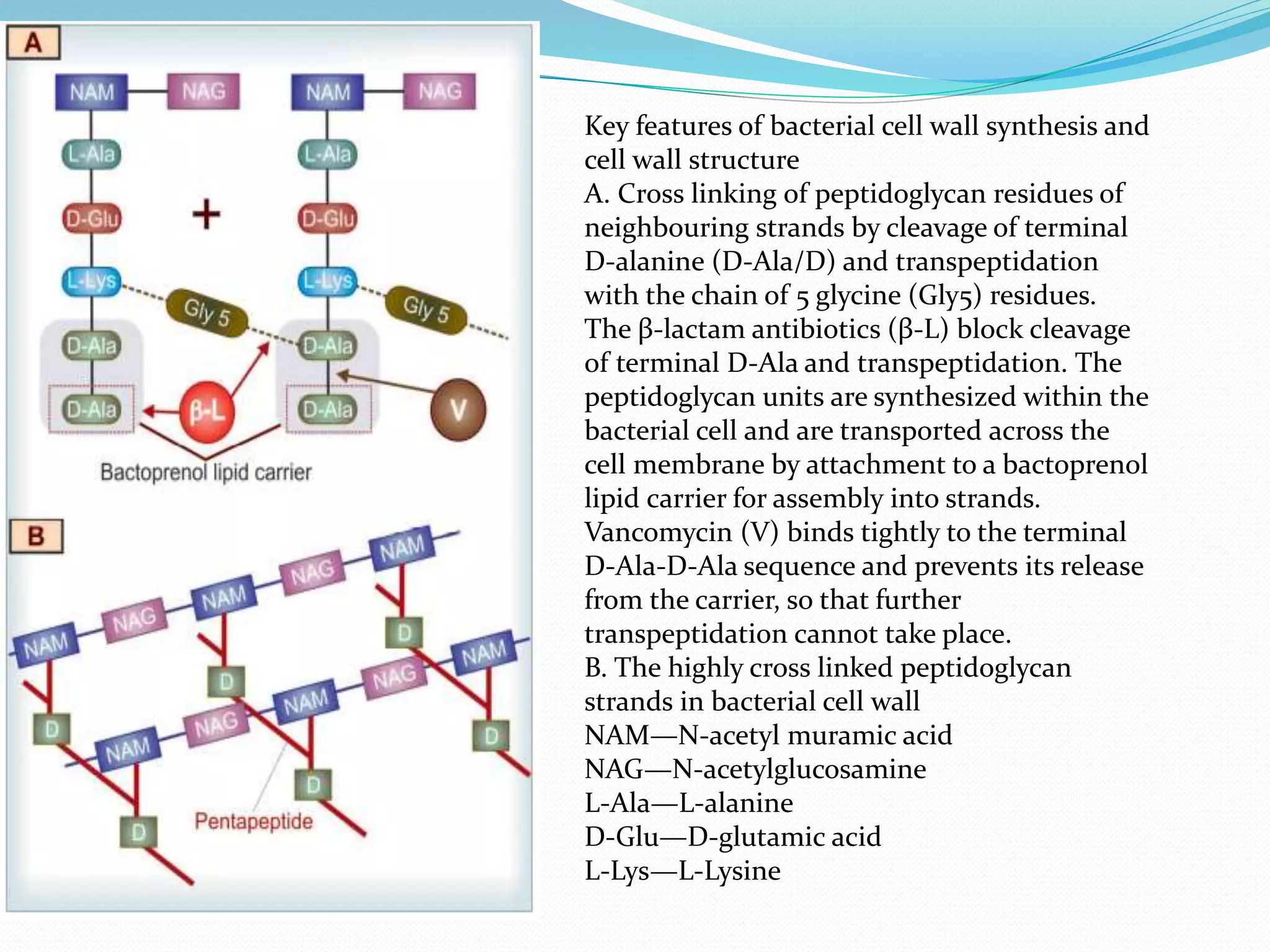
Key features of bacterial cell wall synthesis and
cell wall structure
A. Cross linking of peptidoglycan residues of
neighbouring strands by cleavage of terminal
D-alanine (D-Ala/D) and transpeptidation
with the chain of 5 glycine (Gly5) residues.
The β-lactam antibiotics (β-L) block cleavage
of terminal D-Ala and transpeptidation. The
peptidoglycan units are synthesized within the
bacterial cell and are transported across the
cell membrane by attachment to a bactoprenol
lipid carrier for assembly into strands.
Vancomycin (V) binds tightly to the terminal
D-Ala-D-Ala sequence and prevents its release
from the carrier, so that further
transpeptidation cannot take place.
B. The highly cross linked peptidoglycan
strands in bacterial cell wall
NAM—N-acetyl muramic acid
NAG—N-acetylglucosamine
L-Ala—L-alanine
D-Glu—D-glutamic acid
L-Lys—L-Lysine
 The β-lactam antibiotics inhibit the transpeptidases so
that cross linking does not take place.
 These enzymes and related proteins constitute the
penicillin binding proteins (PBPs) which have been
located in the bacterial cell membrane.
 Each organism has several PBPs, and PBPs obtained
from different species differ in their affinity towards
different β-lactam antibiotics.
 When susceptible bacteria divide in the presence of a β-
lactam antibiotic—cell wall deficient (CWD) forms are
produced.
 Because the interior of the bacterium is hyperosmotic,
the CWD forms swell and burst → bacterial lysis occurs.
This is how β-lactam antibiotics exert bactericidal
action.
 In gram-positive bacteria, the cell wall is almost entirely
made of peptidoglycan, which is >50 layers thick and
extensively cross linked, so that it may be regarded as a
single giant mucopeptide molecule.
 In gram-negative bacteria, it consists of alternating
layers of lipoprotein and peptidoglycan (each layer 1–2
molecule thick with little cross linking).
 This may be the reason for higher susceptibility of the
gram-positive bacteria to PnG.
PENICILLIN-G (BENZYL PENICILLIN)
 Antibacterial spectrum- PnG is a narrow spectrum antibiotic;
activity is limited primarily to gram-positive bacteria
 Cocci: Streptococci are highly sensitive, so are many
pneumococci. Staph. aureus, though originally very sensitive
 Gram negative cocci—Neisseria gonorrhoeae and N.
meningitidis are susceptible to PnG,
 Bacilli: Gram-positive bacilli—majority of B. anthracis,
Corynebacterium diphtheriae, and practically all Clostridia
(tetani and others), Listeria
 Bacterial resistance - Many bacteria are inherently insensitive
to PnG because in them the target enzymes and PBPs are
located deeper under lipoprotein barrier where PnG is unable
to penetrate or have low affinity for PnG.
 The primary mechanism of acquired resistance is production of
penicillinase.
Penicillinase
 It is a narrow spectrum β-lactamase which opens the β-lactam ring
and inactivates PnG and some closely related congeners.
 Majority of Staphylococci and some strains of gonococci, B. subtilis,
E. coli, H. influenzae and few other bacteria produce penicillinase.
 In gram-negative bacteria, penicillinase is found in small quantity,
but is strategically located inbetween the lipoprotein and
peptidoglycan layers of the cell wall.
 The gram-negative bacteria have ‘porin’ channels formed by
specific proteins located in their outer membrane. Permeability of
various β-lactam antibiotics through these channels differs:
ampicillin and other members which are active against gram-
negative bacteria cross the porin channels much better than PnG.
Some gram-negative bacteria become resistant by loss or alteration
of porin channels.
Pharmacokinetics
 Penicillin G is acid labile, therefore destroyed
by gastric acid.
 As such, less than 1/3rd of an oral dose is
absorbed in the active form. Absorption of sod.
PnG from i.m. site is rapid and complete; peak
plasma level is attained in 30 min.
 It is distributed mainly extracellularly; reaches
most body fluids, but penetration in serous
cavities and CSF is poor.
 The plasma t½ of PnG in healthy adult is 30
min.
Adverse effects
 Local irritancy and direct toxicity- Pain at i.m. injection
site, nausea on oral ingestion and thrombophlebitis of
injected vein are dose related expressions of irritancy.
 Toxicity to the brain may be manifested as mental
confusion, muscular twitchings, convulsions and coma,
when very large doses (> 20 MU) are injected i.v.; especially
in patients with renal insufficiency.
 Hypersensitivity - These reactions are the major problem in
the use of penicillins. An incidence of 1–10% is reported.
Individuals with an allergic diathesis are more prone to
develop penicillin reactions.
Uses
 Penicillin G is the drug of choice for infections caused by
organisms susceptible to it, unless the patient is allergic to
this antibiotic. However, use has declined very much due to
fear of causing anaphylaxis.
 1. Streptococcal infections
 2. Pneumococcal infections
 3. Meningococcal infections
 4. Gonorrhoea
 5. Syphilis T
 6. Diphtheria
 7. Tetanus and gas gangrene
 8. Penicillin G is the drug of choice for rare infections like
anthrax, actinomycosis, rat bite fever
 9. Prophylactic uses (a) Rheumatic fever, (b) Bacterial
endocarditis:
SEMISYNTHETIC PENICILLINS
 Semisynthetic penicillins are produced by chemically combining
specific side chains (in place of benzyl side chain of PnG) or by
incorporating specific precursors in the mould cultures.
ACID-RESISTANT ALTERNATIVE TO PENICILLIN-G
 Phenoxymethyl penicillin (Penicillin V)
 It differs from PnG only in that it is acid stable.
 Oral absorption is better; peak blood level is reached in 1
hour and plasma t½ is 30–60 min.
 The antibacterial spectrum of penicillin V is identical to PnG,
but it is about 1/5 as active against Neisseria, other gram
negative bacteria and anaerobes.
 It cannot be depended upon for more serious infections and
is used only for streptococcal pharyngitis, sinusitis, otitis
media, prophylaxis of rheumatic fever
PENICILLINASE-RESISTANT PENICILLINS
 These congeners have side chains that protect the β-
lactam ring from attack by staphylococcal penicillinase.
 Their only indication is infections caused by penicillinase
producing Staphylococci, for which they are the drugs of
choice, except in areas where methicillin resistant Staph.
aureus (MRSA) has become prevalent.
EXTENDED SPECTRUM PENICILLINS
 These semisynthetic penicillins are active against a variety of gram-negative
bacilli as well. They can be grouped according to their spectrum of activity
 1. Aminopenicillins - This group, led by ampicillin, has an amino substitution
in the side chain. Some are prodrugs and all have quite similar antibacterial
spectra. None is resistant to penicillinase or to other β-lactamases.
 Ampicillin - It is active against all organisms sensitive to PnG.
 In addition, many gram-negative bacilli, e.g. H. influenzae, E. coli, Proteus,
Salmonella Shigella and Helicobacter pylori are inhibited.
 However, due to wide-spread use, many of these have developed resistance;
usefulness of this antibiotic has decreased considerably.
 Uses- 1. Urinary tract infections: Ampicillin has been the drug of choice for
most acute infections
 2. Respiratory tract infections:
 3. Meningitis:
 5. Gonorrhoea: It is one of the first line drugs for oral treatment
 6. Cholecystitis:
 7. H. pylori:
 2. Carboxypenicillins - Carbenicillin The special
feature of this penicillin congener is its activity
against Pseudomonas aeruginosa and indole positive
Proteus which are not inhibited by PnG or
aminopenicillins.
 The indications for carbenicillin are—serious
infections caused by Pseudomonas or Proteus, e.g.
burns, urinary tract infection, septicaemia, but
piperacillin is now mostly used.
 3. Ureidopenicillins
 Piperacillin
 This antipseudomonal penicillin is about 8 times
more active than carbenicillin. It has good activity
against Klebsiella, many Enterobacteriaceae and
some Bacteroides.
 It is frequently employed for treating serious
gramnegative infections in
neutropenic/immunocompromised or burn patients.
BETA-LACTAMASE INHIBITORS
 β-lactamases are a family of enzymes produced
by many gram-positive and gram-negative
bacteria that inactivate β-lactam antibiotics by
opening the β-lactam ring.
 Different β-lactamases differ in their substrate
affinities.
 Three inhibitors of this enzyme clavulanic acid,
sulbactam and tazobactam are available for
clinical use.
Clavulanic acid
 Obtained from Streptomyces clavuligerus, it has a β-
lactam ring but no antibacterial activity of its own.
 Clavulanic acid is a ‘progressive’ inhibitor: binding with
β-lactamase is reversible initially, but becomes covalent
later—inhibition increasing with time.
 Called a ‘suicide’ inhibitor, it gets inactivated after
binding to the enzyme.
 It permeates the outer layers of the cell wall of gram-
negative bacteria and inhibits the periplasmically located
β-lactamase
 Uses - Addition of clavulanic acid re-establishes the
activity of amoxicillin against β-lactamase producing
resistant Staph. Aureus H. influenzae, N. gonorrhoeae,
E. coli, Proteus, Klebsiella, Salmonella and Shigella.
CEPHALOSPORINS
 These are a group of semisynthetic antibiotics derived from
‘cephalosporin-C’ obtained from a fungus Cephalosporium.
 They are chemically related to penicillins; the nucleus consists
of a β-lactam ring fused to a dihydrothiazine ring, (7-
aminocephalosporanic acid).
 These have been conventionally divided into 4 generations.
 All cephalosporins are bactericidal and have the same
mechanism of action as penicillin, i.e. inhibition of bacterial
cell wall synthesis.
 Acquired resistance to cephalosporins could have the same
basis as for penicillins, i.e.: A. alteration in target proteins
(PBPs) reducing affinity for the antibiotic.
 B. elaboration of β-lactamases which destroy specific
cephalosporins (cephalosporinases); the most common
mechanism.
FIRST GENERATION CEPHALOSPORINS
 These were developed in the 1960s, have high activity
against gram-positive but weaker against gram-negative
bacteria.
 Cefazolin
 It is the prototype first generation cephalosporin that is
active against most PnG sensitive organisms, i.e.
Streptococci , gonococci, meningococci, C. diphtheriae,
H. influenzae, clostridia and Actinomyces.
 It can be given i.m. (less painful) as well as i.v. and has a
longer t½ (2 hours) due to slower tubular secretion;
attains higher concentration in plasma and in bile.
 It is the preferred parenteral first generation
cephalosporin, especially for surgical prophylaxis.
SECOND GENERATION CEPHALOSPORINS
 These were developed subsequent to the first generation
compounds and are more active against gram-negative
organisms,
 They are weaker than the first generation compounds against
gram positive bacteria. Their utility has declined in favour of the
3rd generation agents.
 Cefuroxime
 It is resistant to gram-negative β-lactamases: has high activity
against organisms producing these enzymes including PPNG and
ampicillin-resistant
 It is well tolerated by i.m. route and attains relatively higher CSF
levels, but has been superseded by 3rd generation cephalosporins
in the treatment of meningitis.
 It can be employed for single dose i.m. therapy of gonorrhoea due
to PPNG.
THIRD GENERATION CEPHALOSPORINS
 These compounds introduced in the 1980s have highly active
against gram-negative Enterobacteriaceae; and few members
inhibit Pseudomonas as well.
 All are highly resistant to β-lactamases from gram-negative
bacteria.
 Cefotaxime
 It is the prototype of the third generation cephalosporins;
exerts potent action on aerobic gram-negative as well as some
grampositive bacteria,
 Prominent indications are meningitis caused by gram-
negative bacilli (attains relatively high CSF levels), life-
threatening resistant/ hospital-acquired infections,
septicaemias and infections in immunocompromised
patients.
 It is an alternative to ceftriaxone for typhoid fever
FOURTH GENERATION CEPHALOSPORINS
 The distinctive feature of this last developed subgroup of
cephalosporins is non-susceptibility to inducible
chromosomal β lactamases in addition to high potency
against Enterobacteriaceae and spectrum of activity
resembling the 3rd generation compounds..
 Cefepime
 Developed in 1990s, this 4th generation cephalosporin has
antibacterial spectrum similar to that of 3rd generation
compounds, but is highly resistant to β-lactamases, hence
active against many bacteria resistant to the earlier drugs.
 Due to high potency and extended spectrum, it is effective in
many serious infections like hospital-acquired pneumonia,
febrile neutropenia, bacteraemia, septicaemia.
Adverse effects
 Cephalosporins are generally well tolerated, but are
more toxic than penicillin.
 1. Pain after i.m. injection occurs with many
cephalosporins
 2. Diarrhoea due to alteration of gut ecology or
irritative effect is more common with orally
administered
 3. Hypersensitivity reactions are the most
important adverse effects of cephalosporins.
 4. Nephrotoxicity
 5. Bleeding occurs with cephalosporins having a
methylthiotetrazole
Uses
Currently cephalosporins are one of the most commonly used antibiotics.
1. As alternatives to penicillins for ENT, upper respiratory and cutaneous
infections
2. Respiratory, urinary and soft tissue infections caused by gram-negative
organisms
3. Penicillinase producing staphylococcal infections.
4. Septicaemias caused by gram-negative organisms
5. Surgical prophylaxis: the first generation cephalosporins are popular drugs.
6. Meningitis:
7. Gonorrhoea
8. Typhoid:
9. Mixed aerobic-anaerobic infections in cancer patients
10. Hospital acquired infections, especially respiratory and other infections in
intensive care units
11. Prophylaxis and treatment of infections in neutropenic patients

Beta lactam antibiotics

  • 1.
    MR. MANGESH BANSOD ASST.PROF. SDDVCPRC, PANVEL
  • 2.
    Beta-Lactam Antibiotics  Theseare antibiotics having a β-lactam ring.  The two major groups are penicillins and cephalosporins.  Monobactams and carbapenems
  • 3.
    PENICILLINS  Penicillin wasthe first antibiotic to be used clinically in 1941.  It was originally obtained from the fungus Penicillium notatum, but the present source is a high yielding mutant of P. chrysogenum.
  • 4.
    Chemistry and properties The penicillin nucleus consists of fused thiazolidine and β-lactam rings to which side chains are attached through an amide linkage  PnG is highly water soluble. It is stable in the dry state, but solution deteriorates rapidly at room temperature, though it remains stable at 4°C for 3 days. Therefore, PnG solutions are always prepared freshly. PnG is also thermolabile and acid labile  Unitage 1 U of crystalline sod. benzyl penicillin = 0.6 µg of the standard preparation. Accordingly, 1 g = 1.6 million units or 1 MU = 0.6 g.
  • 5.
    Mechanism of action All β-lactam antibiotics interfere with the synthesis of bacterial cell wall.  The bacteria synthesize UDP-N-acetylmuramic acid pentapeptide, called ‘Park nucleotide’ and UDP-N-acetyl glucosamine.  The peptidoglycan residues are linked together forming long strands and UDP is split off.  The final step is cleavage of the terminal D-alanine of the peptide chains by transpeptidases; the energy so released is utilized for establishment of cross linkages between peptide chains of the neighbouring strands  This cross linking provides stability and rigidity to the cell wall.
  • 6.
    Key features ofbacterial cell wall synthesis and cell wall structure A. Cross linking of peptidoglycan residues of neighbouring strands by cleavage of terminal D-alanine (D-Ala/D) and transpeptidation with the chain of 5 glycine (Gly5) residues. The β-lactam antibiotics (β-L) block cleavage of terminal D-Ala and transpeptidation. The peptidoglycan units are synthesized within the bacterial cell and are transported across the cell membrane by attachment to a bactoprenol lipid carrier for assembly into strands. Vancomycin (V) binds tightly to the terminal D-Ala-D-Ala sequence and prevents its release from the carrier, so that further transpeptidation cannot take place. B. The highly cross linked peptidoglycan strands in bacterial cell wall NAM—N-acetyl muramic acid NAG—N-acetylglucosamine L-Ala—L-alanine D-Glu—D-glutamic acid L-Lys—L-Lysine
  • 7.
     The β-lactamantibiotics inhibit the transpeptidases so that cross linking does not take place.  These enzymes and related proteins constitute the penicillin binding proteins (PBPs) which have been located in the bacterial cell membrane.  Each organism has several PBPs, and PBPs obtained from different species differ in their affinity towards different β-lactam antibiotics.  When susceptible bacteria divide in the presence of a β- lactam antibiotic—cell wall deficient (CWD) forms are produced.  Because the interior of the bacterium is hyperosmotic, the CWD forms swell and burst → bacterial lysis occurs. This is how β-lactam antibiotics exert bactericidal action.
  • 8.
     In gram-positivebacteria, the cell wall is almost entirely made of peptidoglycan, which is >50 layers thick and extensively cross linked, so that it may be regarded as a single giant mucopeptide molecule.  In gram-negative bacteria, it consists of alternating layers of lipoprotein and peptidoglycan (each layer 1–2 molecule thick with little cross linking).  This may be the reason for higher susceptibility of the gram-positive bacteria to PnG.
  • 9.
    PENICILLIN-G (BENZYL PENICILLIN) Antibacterial spectrum- PnG is a narrow spectrum antibiotic; activity is limited primarily to gram-positive bacteria  Cocci: Streptococci are highly sensitive, so are many pneumococci. Staph. aureus, though originally very sensitive  Gram negative cocci—Neisseria gonorrhoeae and N. meningitidis are susceptible to PnG,  Bacilli: Gram-positive bacilli—majority of B. anthracis, Corynebacterium diphtheriae, and practically all Clostridia (tetani and others), Listeria  Bacterial resistance - Many bacteria are inherently insensitive to PnG because in them the target enzymes and PBPs are located deeper under lipoprotein barrier where PnG is unable to penetrate or have low affinity for PnG.  The primary mechanism of acquired resistance is production of penicillinase.
  • 10.
    Penicillinase  It isa narrow spectrum β-lactamase which opens the β-lactam ring and inactivates PnG and some closely related congeners.  Majority of Staphylococci and some strains of gonococci, B. subtilis, E. coli, H. influenzae and few other bacteria produce penicillinase.  In gram-negative bacteria, penicillinase is found in small quantity, but is strategically located inbetween the lipoprotein and peptidoglycan layers of the cell wall.  The gram-negative bacteria have ‘porin’ channels formed by specific proteins located in their outer membrane. Permeability of various β-lactam antibiotics through these channels differs: ampicillin and other members which are active against gram- negative bacteria cross the porin channels much better than PnG. Some gram-negative bacteria become resistant by loss or alteration of porin channels.
  • 11.
    Pharmacokinetics  Penicillin Gis acid labile, therefore destroyed by gastric acid.  As such, less than 1/3rd of an oral dose is absorbed in the active form. Absorption of sod. PnG from i.m. site is rapid and complete; peak plasma level is attained in 30 min.  It is distributed mainly extracellularly; reaches most body fluids, but penetration in serous cavities and CSF is poor.  The plasma t½ of PnG in healthy adult is 30 min.
  • 12.
    Adverse effects  Localirritancy and direct toxicity- Pain at i.m. injection site, nausea on oral ingestion and thrombophlebitis of injected vein are dose related expressions of irritancy.  Toxicity to the brain may be manifested as mental confusion, muscular twitchings, convulsions and coma, when very large doses (> 20 MU) are injected i.v.; especially in patients with renal insufficiency.  Hypersensitivity - These reactions are the major problem in the use of penicillins. An incidence of 1–10% is reported. Individuals with an allergic diathesis are more prone to develop penicillin reactions.
  • 13.
    Uses  Penicillin Gis the drug of choice for infections caused by organisms susceptible to it, unless the patient is allergic to this antibiotic. However, use has declined very much due to fear of causing anaphylaxis.  1. Streptococcal infections  2. Pneumococcal infections  3. Meningococcal infections  4. Gonorrhoea  5. Syphilis T  6. Diphtheria  7. Tetanus and gas gangrene  8. Penicillin G is the drug of choice for rare infections like anthrax, actinomycosis, rat bite fever  9. Prophylactic uses (a) Rheumatic fever, (b) Bacterial endocarditis:
  • 14.
    SEMISYNTHETIC PENICILLINS  Semisyntheticpenicillins are produced by chemically combining specific side chains (in place of benzyl side chain of PnG) or by incorporating specific precursors in the mould cultures.
  • 15.
    ACID-RESISTANT ALTERNATIVE TOPENICILLIN-G  Phenoxymethyl penicillin (Penicillin V)  It differs from PnG only in that it is acid stable.  Oral absorption is better; peak blood level is reached in 1 hour and plasma t½ is 30–60 min.  The antibacterial spectrum of penicillin V is identical to PnG, but it is about 1/5 as active against Neisseria, other gram negative bacteria and anaerobes.  It cannot be depended upon for more serious infections and is used only for streptococcal pharyngitis, sinusitis, otitis media, prophylaxis of rheumatic fever
  • 16.
    PENICILLINASE-RESISTANT PENICILLINS  Thesecongeners have side chains that protect the β- lactam ring from attack by staphylococcal penicillinase.  Their only indication is infections caused by penicillinase producing Staphylococci, for which they are the drugs of choice, except in areas where methicillin resistant Staph. aureus (MRSA) has become prevalent.
  • 17.
    EXTENDED SPECTRUM PENICILLINS These semisynthetic penicillins are active against a variety of gram-negative bacilli as well. They can be grouped according to their spectrum of activity  1. Aminopenicillins - This group, led by ampicillin, has an amino substitution in the side chain. Some are prodrugs and all have quite similar antibacterial spectra. None is resistant to penicillinase or to other β-lactamases.  Ampicillin - It is active against all organisms sensitive to PnG.  In addition, many gram-negative bacilli, e.g. H. influenzae, E. coli, Proteus, Salmonella Shigella and Helicobacter pylori are inhibited.  However, due to wide-spread use, many of these have developed resistance; usefulness of this antibiotic has decreased considerably.  Uses- 1. Urinary tract infections: Ampicillin has been the drug of choice for most acute infections  2. Respiratory tract infections:  3. Meningitis:  5. Gonorrhoea: It is one of the first line drugs for oral treatment  6. Cholecystitis:  7. H. pylori:
  • 18.
     2. Carboxypenicillins- Carbenicillin The special feature of this penicillin congener is its activity against Pseudomonas aeruginosa and indole positive Proteus which are not inhibited by PnG or aminopenicillins.  The indications for carbenicillin are—serious infections caused by Pseudomonas or Proteus, e.g. burns, urinary tract infection, septicaemia, but piperacillin is now mostly used.
  • 19.
     3. Ureidopenicillins Piperacillin  This antipseudomonal penicillin is about 8 times more active than carbenicillin. It has good activity against Klebsiella, many Enterobacteriaceae and some Bacteroides.  It is frequently employed for treating serious gramnegative infections in neutropenic/immunocompromised or burn patients.
  • 20.
    BETA-LACTAMASE INHIBITORS  β-lactamasesare a family of enzymes produced by many gram-positive and gram-negative bacteria that inactivate β-lactam antibiotics by opening the β-lactam ring.  Different β-lactamases differ in their substrate affinities.  Three inhibitors of this enzyme clavulanic acid, sulbactam and tazobactam are available for clinical use.
  • 21.
    Clavulanic acid  Obtainedfrom Streptomyces clavuligerus, it has a β- lactam ring but no antibacterial activity of its own.  Clavulanic acid is a ‘progressive’ inhibitor: binding with β-lactamase is reversible initially, but becomes covalent later—inhibition increasing with time.  Called a ‘suicide’ inhibitor, it gets inactivated after binding to the enzyme.  It permeates the outer layers of the cell wall of gram- negative bacteria and inhibits the periplasmically located β-lactamase  Uses - Addition of clavulanic acid re-establishes the activity of amoxicillin against β-lactamase producing resistant Staph. Aureus H. influenzae, N. gonorrhoeae, E. coli, Proteus, Klebsiella, Salmonella and Shigella.
  • 22.
    CEPHALOSPORINS  These area group of semisynthetic antibiotics derived from ‘cephalosporin-C’ obtained from a fungus Cephalosporium.  They are chemically related to penicillins; the nucleus consists of a β-lactam ring fused to a dihydrothiazine ring, (7- aminocephalosporanic acid).  These have been conventionally divided into 4 generations.  All cephalosporins are bactericidal and have the same mechanism of action as penicillin, i.e. inhibition of bacterial cell wall synthesis.  Acquired resistance to cephalosporins could have the same basis as for penicillins, i.e.: A. alteration in target proteins (PBPs) reducing affinity for the antibiotic.  B. elaboration of β-lactamases which destroy specific cephalosporins (cephalosporinases); the most common mechanism.
  • 24.
    FIRST GENERATION CEPHALOSPORINS These were developed in the 1960s, have high activity against gram-positive but weaker against gram-negative bacteria.  Cefazolin  It is the prototype first generation cephalosporin that is active against most PnG sensitive organisms, i.e. Streptococci , gonococci, meningococci, C. diphtheriae, H. influenzae, clostridia and Actinomyces.  It can be given i.m. (less painful) as well as i.v. and has a longer t½ (2 hours) due to slower tubular secretion; attains higher concentration in plasma and in bile.  It is the preferred parenteral first generation cephalosporin, especially for surgical prophylaxis.
  • 25.
    SECOND GENERATION CEPHALOSPORINS These were developed subsequent to the first generation compounds and are more active against gram-negative organisms,  They are weaker than the first generation compounds against gram positive bacteria. Their utility has declined in favour of the 3rd generation agents.  Cefuroxime  It is resistant to gram-negative β-lactamases: has high activity against organisms producing these enzymes including PPNG and ampicillin-resistant  It is well tolerated by i.m. route and attains relatively higher CSF levels, but has been superseded by 3rd generation cephalosporins in the treatment of meningitis.  It can be employed for single dose i.m. therapy of gonorrhoea due to PPNG.
  • 26.
    THIRD GENERATION CEPHALOSPORINS These compounds introduced in the 1980s have highly active against gram-negative Enterobacteriaceae; and few members inhibit Pseudomonas as well.  All are highly resistant to β-lactamases from gram-negative bacteria.  Cefotaxime  It is the prototype of the third generation cephalosporins; exerts potent action on aerobic gram-negative as well as some grampositive bacteria,  Prominent indications are meningitis caused by gram- negative bacilli (attains relatively high CSF levels), life- threatening resistant/ hospital-acquired infections, septicaemias and infections in immunocompromised patients.  It is an alternative to ceftriaxone for typhoid fever
  • 27.
    FOURTH GENERATION CEPHALOSPORINS The distinctive feature of this last developed subgroup of cephalosporins is non-susceptibility to inducible chromosomal β lactamases in addition to high potency against Enterobacteriaceae and spectrum of activity resembling the 3rd generation compounds..  Cefepime  Developed in 1990s, this 4th generation cephalosporin has antibacterial spectrum similar to that of 3rd generation compounds, but is highly resistant to β-lactamases, hence active against many bacteria resistant to the earlier drugs.  Due to high potency and extended spectrum, it is effective in many serious infections like hospital-acquired pneumonia, febrile neutropenia, bacteraemia, septicaemia.
  • 28.
    Adverse effects  Cephalosporinsare generally well tolerated, but are more toxic than penicillin.  1. Pain after i.m. injection occurs with many cephalosporins  2. Diarrhoea due to alteration of gut ecology or irritative effect is more common with orally administered  3. Hypersensitivity reactions are the most important adverse effects of cephalosporins.  4. Nephrotoxicity  5. Bleeding occurs with cephalosporins having a methylthiotetrazole
  • 29.
    Uses Currently cephalosporins areone of the most commonly used antibiotics. 1. As alternatives to penicillins for ENT, upper respiratory and cutaneous infections 2. Respiratory, urinary and soft tissue infections caused by gram-negative organisms 3. Penicillinase producing staphylococcal infections. 4. Septicaemias caused by gram-negative organisms 5. Surgical prophylaxis: the first generation cephalosporins are popular drugs. 6. Meningitis: 7. Gonorrhoea 8. Typhoid: 9. Mixed aerobic-anaerobic infections in cancer patients 10. Hospital acquired infections, especially respiratory and other infections in intensive care units 11. Prophylaxis and treatment of infections in neutropenic patients