Body Organization  & Terminology
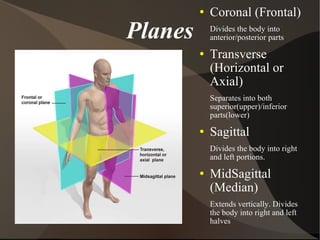
Planes Coronal (Frontal) Divides the body into anterior/posterior parts Transverse (Horizontal or Axial) Separates into both superior(upper)/inferior parts(lower) Sagittal Divides the body into right and left portions. MidSagittal (Median) Extends vertically. Divides the body into right and left halves
Anatomic Directional Terms
Body Regions
 
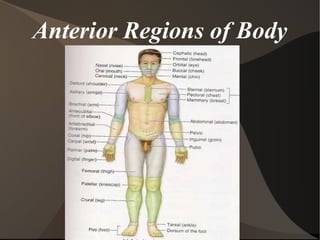
Anterior Regions of Body
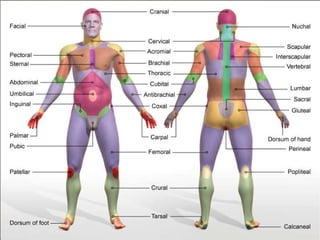
Inferior to the thorax (chest) and superior to the hipbones? Abdominal Region Portion of the upper limb between the elbow and wrist? Forearm (Antebrachium) Front of the elbow Antecubital What is the depression on the anterior surface of the elbow? Antecubital fossa Portion of the upper limb between the shoulder and the elbow? Brachium, Brachial Region Armpit =  Axilla, Axillary Region Cheek =  Buccal, Buccal Region Wrist =  Carpus, Carpal Region Head =  Cephalic Region
Neck =  Cervix, Cervical Region Fingers or Toes =  Digits Thumb 1 Index Finger 2 Middle Finger 3 Ring Finger 4 Pinky 5 Portion of the cranium overlying the frontal bone? Forehead, Frontal Region Big toe =  Great Toe, Hallux The anterior region where a fold is created as the torso meets the thigh? Groin, Inguinal Region Small of the back =  Lumbar Region Naval =  Umbilicus
Surrounds the nipple on the anterior thorax Mammary Region Chin =  Mental Region (Chin is more commonly used) Portion of the face associated with the nose Nasal Region Mouth =  Oral Cavity The region of the face associated with the eye Orbital Region The anterior portion of the hand formed by the metacarpals Palm Anterior portion of the fingers =  Palmar Aspect The region overlying the kneecap Patellar Region Thumb =  Pollex (commonly called thumb or first digit)
The region associated with the pelvis Pelvic Region The region between the pubic symphysis, the coccyx, and the ischial tuberosities? Perineum, Perineal Region Foot =  Pes (commonly called the foot) Superior portion of the foot =  Dorsum, Dorsal Region Sole of the foot =  Plantar Surface Area overlying the pubic bones =  Pubic Region Area superficial to the shoulder blade =  Scapular Region Anterior thoracic region on the midline =  Sternal region Chest =  Thoracic Region
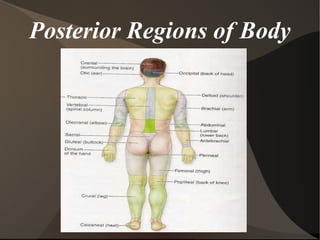
Posterior Regions of Body
Dorsum of the body from the base of the neck to the end of the spine? Back, Dorsum, Dorsal Region Portion of the lower limb from the hip to the knee? Thigh, Femoral Region Portion of the lower limb from the knee to the ankle? Leg or Crural Region Region of the pelvis associated with the large, posterior, hip muscles? Buttocks, Gluteal Region The region at the posterior base of the head Occipital Region Posterior portion of the fingers =  Dorsum, Dorsal Aspect Area on the posterior aspect of the knee =  Popliteal Region Area superficial to the sacrum =  Sacral Region Braincase =  Cranium, Cranial Region
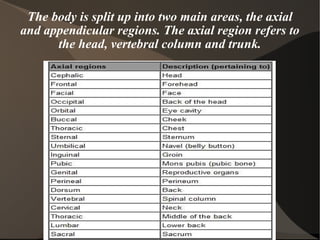
The body is split up into two main areas, the axial and appendicular regions. The axial region refers to the head, vertebral column and trunk.
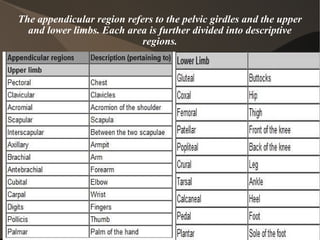
The appendicular region refers to the pelvic girdles and the upper and lower limbs. Each area is further divided into descriptive regions.
Body Cavities
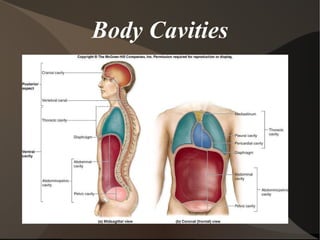
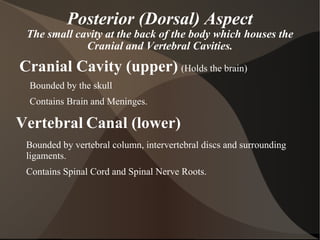
Posterior (Dorsal) Aspect The small cavity at the back of the body which houses the Cranial and Vertebral Cavities. Cranial Cavity (upper)   (Holds the brain) Bounded by the skull Contains Brain and Meninges. Vertebral   Canal (lower) Bounded by vertebral column, intervertebral discs and surrounding ligaments. Contains Spinal Cord and Spinal Nerve Roots.
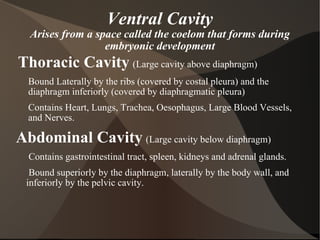
Ventral Cavity Arises from a space called the coelom that forms during embryonic development Thoracic   Cavity   (Large cavity above diaphragm) Bound Laterally by the ribs (covered by costal pleura) and the diaphragm inferiorly (covered by diaphragmatic pleura) Contains Heart, Lungs, Trachea, Oesophagus, Large Blood Vessels, and Nerves. Abdominal Cavity   (Large cavity below diaphragm)   Contains gastrointestinal tract, spleen, kidneys and adrenal glands.   Bound superiorly by the diaphragm, laterally by the body wall, and inferiorly by the pelvic cavity.
Ventral Cavity Pelvic Cavity   (Small cavity below the brim of the pelvis) Bounded superiorly by the abdominal cavity, posteriorly by the sacrum, and laterally by the pelvis. Contains urinary bladder, genitals, sigmoid colon and rectum.
Body Membranes Membrane that lines the ventral cavity Serous membranes Layer that adheres to the internal surface of the body wall Parietal Layer Layer that adheres to the external surface of the internal organs Visceral Layer Space between the two layers lining the ventral cavity Serous Cavity (Lubrication) Space within the thoracic cavity Mediastinum Serous membrane that surrounds the heart Pericardium
What portion forms the sac surrounding the heart? Parietal Pericardium What portion forms the heart’s external surface? Visceral Pericardium Space that surrounds the heart Pericardial Cavity Serous membrane associated with the lungs, what portion adheres to the internal thoracic wall? Pleural Membrane What portion adheres to the internal thoracic wall? Parietal Pleura What portion adheres directly to the lungs? Visceral Pleura Space between the lungs and the thoracic wall Pleural Cavity
Membrane that lines the abdominopelvic cavity Peritoneum Portion of the membrane that lines the internal walls of the cavity Parietal Peritoneum Portion of the membrane that ensheathes the external surfaces of most digestive organs Visceral Peritoneum Space that lies between the two layers of the membrane lining this cavity Peritoneal Cavity
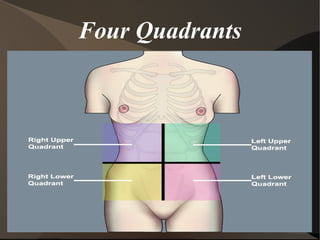
Four Quadrants
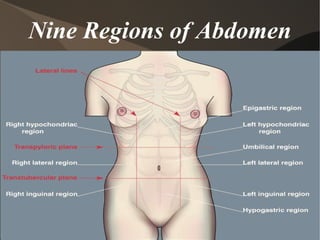
Nine Regions of Abdomen

Anatomical terminology

  • 1.
    Body Organization & Terminology
  • 2.
    Planes Coronal (Frontal)Divides the body into anterior/posterior parts Transverse (Horizontal or Axial) Separates into both superior(upper)/inferior parts(lower) Sagittal Divides the body into right and left portions. MidSagittal (Median) Extends vertically. Divides the body into right and left halves
  • 3.
  • 4.
  • 5.
  • 6.
  • 7.
    Inferior to thethorax (chest) and superior to the hipbones? Abdominal Region Portion of the upper limb between the elbow and wrist? Forearm (Antebrachium) Front of the elbow Antecubital What is the depression on the anterior surface of the elbow? Antecubital fossa Portion of the upper limb between the shoulder and the elbow? Brachium, Brachial Region Armpit = Axilla, Axillary Region Cheek = Buccal, Buccal Region Wrist = Carpus, Carpal Region Head = Cephalic Region
  • 8.
    Neck = Cervix, Cervical Region Fingers or Toes = Digits Thumb 1 Index Finger 2 Middle Finger 3 Ring Finger 4 Pinky 5 Portion of the cranium overlying the frontal bone? Forehead, Frontal Region Big toe = Great Toe, Hallux The anterior region where a fold is created as the torso meets the thigh? Groin, Inguinal Region Small of the back = Lumbar Region Naval = Umbilicus
  • 9.
    Surrounds the nippleon the anterior thorax Mammary Region Chin = Mental Region (Chin is more commonly used) Portion of the face associated with the nose Nasal Region Mouth = Oral Cavity The region of the face associated with the eye Orbital Region The anterior portion of the hand formed by the metacarpals Palm Anterior portion of the fingers = Palmar Aspect The region overlying the kneecap Patellar Region Thumb = Pollex (commonly called thumb or first digit)
  • 10.
    The region associatedwith the pelvis Pelvic Region The region between the pubic symphysis, the coccyx, and the ischial tuberosities? Perineum, Perineal Region Foot = Pes (commonly called the foot) Superior portion of the foot = Dorsum, Dorsal Region Sole of the foot = Plantar Surface Area overlying the pubic bones = Pubic Region Area superficial to the shoulder blade = Scapular Region Anterior thoracic region on the midline = Sternal region Chest = Thoracic Region
  • 11.
  • 12.
    Dorsum of thebody from the base of the neck to the end of the spine? Back, Dorsum, Dorsal Region Portion of the lower limb from the hip to the knee? Thigh, Femoral Region Portion of the lower limb from the knee to the ankle? Leg or Crural Region Region of the pelvis associated with the large, posterior, hip muscles? Buttocks, Gluteal Region The region at the posterior base of the head Occipital Region Posterior portion of the fingers = Dorsum, Dorsal Aspect Area on the posterior aspect of the knee = Popliteal Region Area superficial to the sacrum = Sacral Region Braincase = Cranium, Cranial Region
  • 13.
    The body issplit up into two main areas, the axial and appendicular regions. The axial region refers to the head, vertebral column and trunk.
  • 14.
    The appendicular regionrefers to the pelvic girdles and the upper and lower limbs. Each area is further divided into descriptive regions.
  • 15.
  • 16.
    Posterior (Dorsal) AspectThe small cavity at the back of the body which houses the Cranial and Vertebral Cavities. Cranial Cavity (upper) (Holds the brain) Bounded by the skull Contains Brain and Meninges. Vertebral Canal (lower) Bounded by vertebral column, intervertebral discs and surrounding ligaments. Contains Spinal Cord and Spinal Nerve Roots.
  • 17.
    Ventral Cavity Arisesfrom a space called the coelom that forms during embryonic development Thoracic Cavity (Large cavity above diaphragm) Bound Laterally by the ribs (covered by costal pleura) and the diaphragm inferiorly (covered by diaphragmatic pleura) Contains Heart, Lungs, Trachea, Oesophagus, Large Blood Vessels, and Nerves. Abdominal Cavity (Large cavity below diaphragm) Contains gastrointestinal tract, spleen, kidneys and adrenal glands. Bound superiorly by the diaphragm, laterally by the body wall, and inferiorly by the pelvic cavity.
  • 18.
    Ventral Cavity PelvicCavity (Small cavity below the brim of the pelvis) Bounded superiorly by the abdominal cavity, posteriorly by the sacrum, and laterally by the pelvis. Contains urinary bladder, genitals, sigmoid colon and rectum.
  • 19.
    Body Membranes Membranethat lines the ventral cavity Serous membranes Layer that adheres to the internal surface of the body wall Parietal Layer Layer that adheres to the external surface of the internal organs Visceral Layer Space between the two layers lining the ventral cavity Serous Cavity (Lubrication) Space within the thoracic cavity Mediastinum Serous membrane that surrounds the heart Pericardium
  • 20.
    What portion formsthe sac surrounding the heart? Parietal Pericardium What portion forms the heart’s external surface? Visceral Pericardium Space that surrounds the heart Pericardial Cavity Serous membrane associated with the lungs, what portion adheres to the internal thoracic wall? Pleural Membrane What portion adheres to the internal thoracic wall? Parietal Pleura What portion adheres directly to the lungs? Visceral Pleura Space between the lungs and the thoracic wall Pleural Cavity
  • 21.
    Membrane that linesthe abdominopelvic cavity Peritoneum Portion of the membrane that lines the internal walls of the cavity Parietal Peritoneum Portion of the membrane that ensheathes the external surfaces of most digestive organs Visceral Peritoneum Space that lies between the two layers of the membrane lining this cavity Peritoneal Cavity
  • 22.
  • 23.