Central Nervous System
OrganizationWhat are the 3 general functions of the CNS and PNS?Collect information (receptors)Process and Evaluate InformationRespond to informationHow do neurons communicate with each other?action potential propagation and neurotransmitter release
Sensory DivisionList and define the 2 subdivisions of he sensory division of the nervous system?Somatic sensorytouch, pain, pressure, vibration, temperature, proprioception, and special sensesVisceral sensoryblood vessels and viscera-temperature and stretchIs “visceral sensory” part of autonomic system? Why or why not?
Motor DivisionList and define the 2 subdivisions of he motor division of the nervous system?Somatic motorCNS to skeletal musclesVoluntaryAutonomic motorCNS to smooth muscle, cardiac muscle and glandsInvoluntary
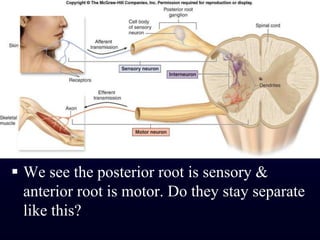
We see the posterior root is sensory & anterior root is motor. Do they stay separate like this?
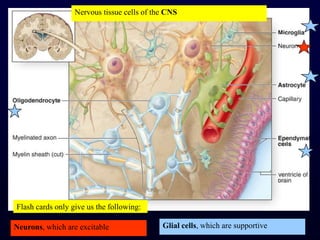
Nervous tissue cells of the CNSFlash cards only give us the following: Glial cells, which are supportiveNeurons, which are excitable
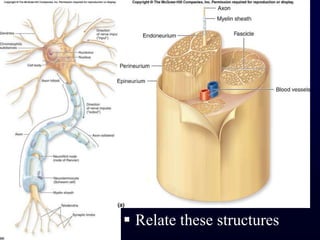
Relate these structures
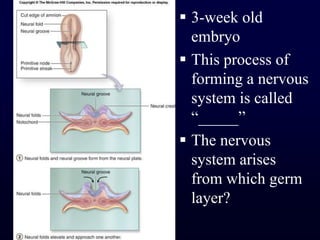
3-week old embryoThis process of forming a nervous system is called “_____”The nervous system arises from which germ layer?
Do you recall?In order for neurulation to occur there must already be 3 germ layers. Do you recall what the process was for making 3 germ layers?Gastrulation! It resulted in ectoderm, mesoderm, and endoderm
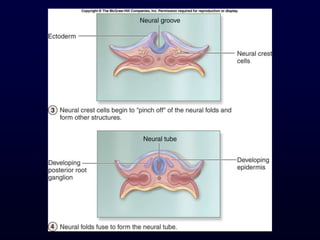
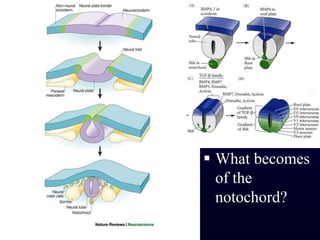
DevelopmentDuring the development of the nervous system, what longitudinal indentation forms from the neural plate?Neural grooveDuring the development of the nervous system, what hollow structure is formed as the neural folds meet?Neural tube
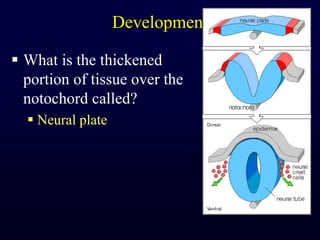
DevelopmentWhat is the thickened portion of tissue over the notochord called?Neural plate
What becomes of the notochord?
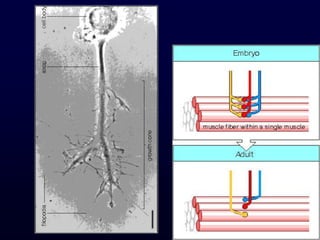
Side note (not in flash cards)Neurons grow until they reach their target organ and form a synapse. If they don’t reach the target they die (apoptosis). Even after neuromuscular connections are made, some are eliminated until each muscle fiber is innervated by only one motor neuron. For example, 20,000 motor neurons are formed in the spinal cord of the chick but ~half die.
How many neurons make up the CNS?100 billion (mostly in brain)What is the average volume of the human brain?1200 ccSize matters not—you are ALL brilliant and possess the most complex machine in the known universe
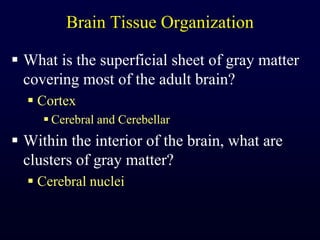
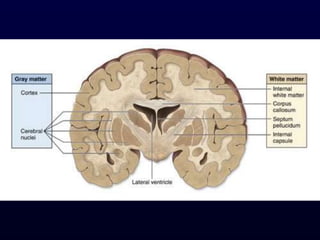
Brain Tissue OrganizationWhat is the superficial sheet of gray matter covering most of the adult brain?CortexCerebral and CerebellarWithin the interior of the brain, what are clusters of gray matter?Cerebral nuclei
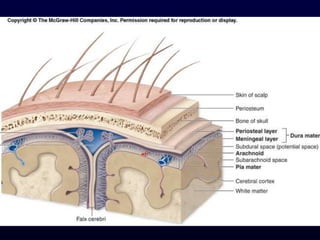
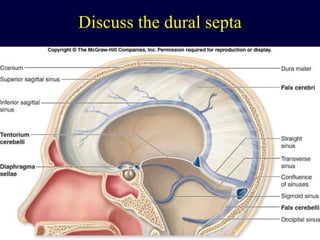
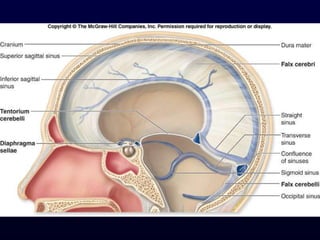
Discuss the dural septa
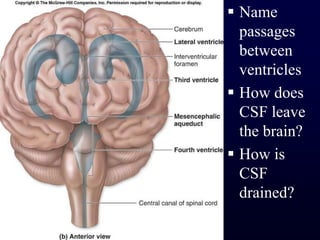
Name passages between ventriclesHow does CSF leave the brain?How is CSF drained?
CerebrumWhat are the functions of the cerebrum?IntelligenceReasoningSensory perceptionThoughtMemoryJudgmentVoluntary motor, visual, and auditory fcns
Cerebral Hemispheres3 points about the cerebral hemispheres1) it is usually difficult to assign a precise function to a specific region2) Usually the hemisphere receives information from and sends motor commands to the opposite side of the body3) The hemispheres display functional differences (lateralization)
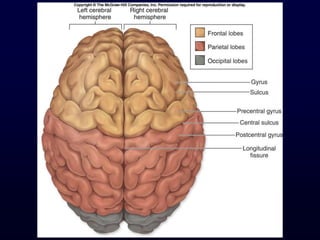
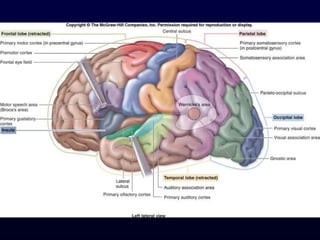
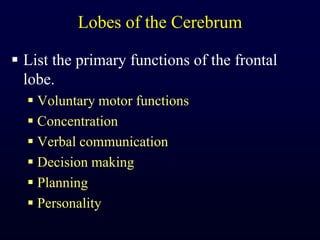
Lobes of the CerebrumList the primary functions of the frontal lobe.Voluntary motor functionsConcentrationVerbal communicationDecision makingPlanningPersonality
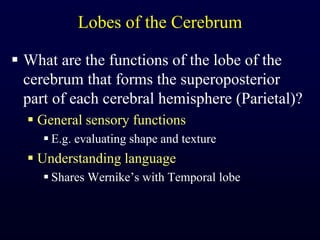
Lobes of the CerebrumWhat are the functions of the lobe of the cerebrum that forms the superoposterior part of each cerebral hemisphere (Parietal)?General sensory functionsE.g. evaluating shape and textureUnderstanding languageShares Wernike’s with Temporal lobe
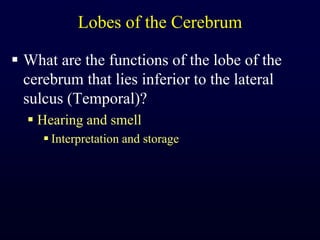
Lobes of the CerebrumWhat are the functions of the lobe of the cerebrum that lies inferior to the lateral sulcus (Temporal)?Hearing and smellInterpretation and storage
Lobes of the CerebrumWhat are the functions of the lobe of the cerebrum that forms the most posterior region of each cerebral hemisphere (Occipital)?Perceive visual informationStore and use visual memories
Lobes of the CerebrumWhat are the apparent functions of the small, deep lobe of each cerebral hemisphere lies deep to the lateral sulcus (Insula)?MemoryTaste interpretation
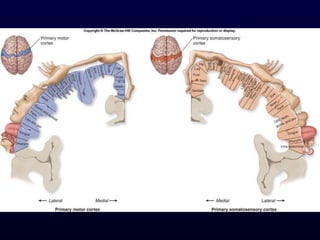
Functional Areas of the CerebrumThe primary motor cortex is located within what structure of the brain?Precentral gyrus of the frontal lobe
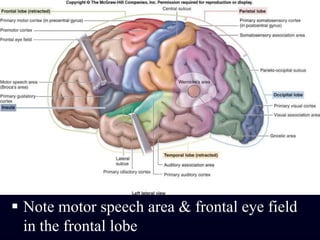
Note motor speech area & frontal eye field in the frontal lobe
Functional Areas of the CerebrumWhat is the function of the association areas within the cerebrum?Integrate new sensory inputs with memories
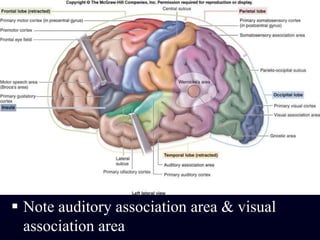
Note auditory association area & visual association area
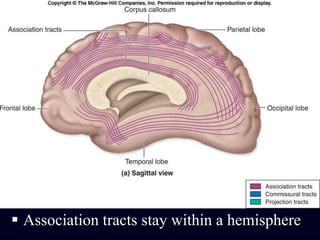
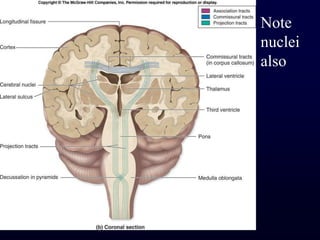
Cerebral White MatterWhat are bundles of myelinated axons that lie deep to the cerebral cortex?TractsProjection (linking cerebrum to lower brain structures)Association (linking multiple places in cerebrum, but on one side or the other)Commissural  (linking similar parts on the two hemispheres)
Association tracts stay within a hemisphere
Note nuclei also
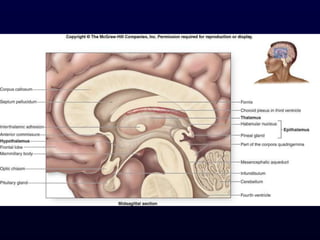
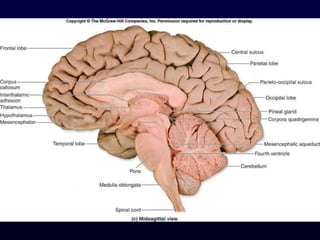
DiencephalonWhat part of the brain is composed of the epithalamus, right and left thalami, and the hypothalamus?Diencephalon
DiencephalonWhat is the function of the thalamus?Final relay for sensory information projected to the primary sensory cortex Filter sensory informationInform cerebrum where sensory information is coming from
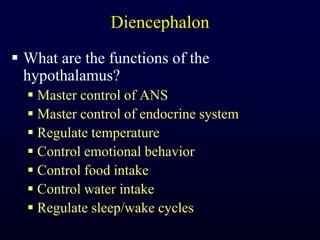
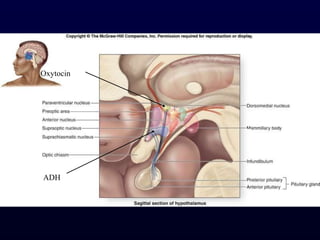
DiencephalonWhat are the functions of the hypothalamus?Master control of ANSMaster control of endocrine systemRegulate temperatureControl emotional behaviorControl food intakeControl water intakeRegulate sleep/wake cycles
OxytocinADH
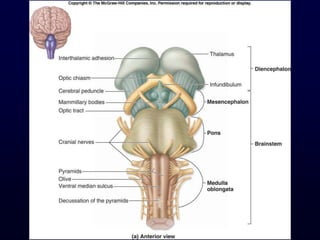
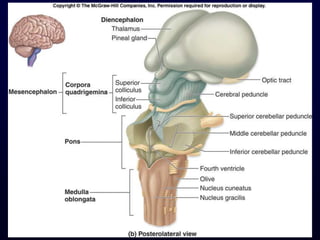
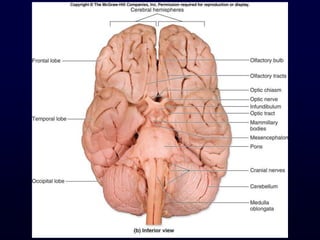
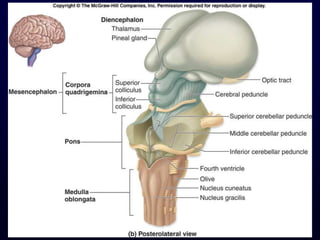
BrainstemWhat 3 regions form the brainstem?MidbrainPonsMedulla oblongata
MesencephalonWithin the midbrain what are the motor tracts located on the anterolateral surfaces?Cerebral pedunclesWithin the midbrain what is the “body of 4 twins”?Corpora quadrigemina
MesencephalonWhat are the “visual reflex centers” of the midbrain?Superior colliculiWhat are the “auditory reflex centers” of the midbrain?Inferior colliculi
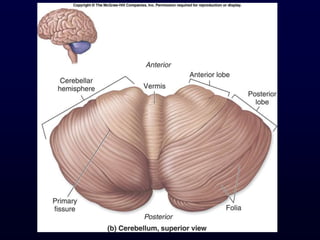
CerebellumWhat is the function of the cerebellum?Coordinate (and fine tune) skeletal muscle movementsMaintain equilibrium and posture
CerebellumWhat thick tracts connect the cerebellum to the brainstem?Cerebellar pedunclesSuperior to mesencephalonMiddle to ponsInferior to medulla oblongata
Central Nervous System

Central Nervous System

  • 1.
  • 2.
    OrganizationWhat are the3 general functions of the CNS and PNS?Collect information (receptors)Process and Evaluate InformationRespond to informationHow do neurons communicate with each other?action potential propagation and neurotransmitter release
  • 3.
    Sensory DivisionList anddefine the 2 subdivisions of he sensory division of the nervous system?Somatic sensorytouch, pain, pressure, vibration, temperature, proprioception, and special sensesVisceral sensoryblood vessels and viscera-temperature and stretchIs “visceral sensory” part of autonomic system? Why or why not?
  • 4.
    Motor DivisionList anddefine the 2 subdivisions of he motor division of the nervous system?Somatic motorCNS to skeletal musclesVoluntaryAutonomic motorCNS to smooth muscle, cardiac muscle and glandsInvoluntary
  • 5.
    We see theposterior root is sensory & anterior root is motor. Do they stay separate like this?
  • 6.
    Nervous tissue cellsof the CNSFlash cards only give us the following: Glial cells, which are supportiveNeurons, which are excitable
  • 7.
  • 8.
    3-week old embryoThisprocess of forming a nervous system is called “_____”The nervous system arises from which germ layer?
  • 9.
    Do you recall?Inorder for neurulation to occur there must already be 3 germ layers. Do you recall what the process was for making 3 germ layers?Gastrulation! It resulted in ectoderm, mesoderm, and endoderm
  • 10.
    DevelopmentDuring the developmentof the nervous system, what longitudinal indentation forms from the neural plate?Neural grooveDuring the development of the nervous system, what hollow structure is formed as the neural folds meet?Neural tube
  • 11.
    DevelopmentWhat is thethickened portion of tissue over the notochord called?Neural plate
  • 13.
    What becomes ofthe notochord?
  • 14.
    Side note (notin flash cards)Neurons grow until they reach their target organ and form a synapse. If they don’t reach the target they die (apoptosis). Even after neuromuscular connections are made, some are eliminated until each muscle fiber is innervated by only one motor neuron. For example, 20,000 motor neurons are formed in the spinal cord of the chick but ~half die.
  • 16.
    How many neuronsmake up the CNS?100 billion (mostly in brain)What is the average volume of the human brain?1200 ccSize matters not—you are ALL brilliant and possess the most complex machine in the known universe
  • 17.
    Brain Tissue OrganizationWhatis the superficial sheet of gray matter covering most of the adult brain?CortexCerebral and CerebellarWithin the interior of the brain, what are clusters of gray matter?Cerebral nuclei
  • 20.
  • 21.
    Name passages betweenventriclesHow does CSF leave the brain?How is CSF drained?
  • 23.
    CerebrumWhat are thefunctions of the cerebrum?IntelligenceReasoningSensory perceptionThoughtMemoryJudgmentVoluntary motor, visual, and auditory fcns
  • 24.
    Cerebral Hemispheres3 pointsabout the cerebral hemispheres1) it is usually difficult to assign a precise function to a specific region2) Usually the hemisphere receives information from and sends motor commands to the opposite side of the body3) The hemispheres display functional differences (lateralization)
  • 26.
    Lobes of theCerebrumList the primary functions of the frontal lobe.Voluntary motor functionsConcentrationVerbal communicationDecision makingPlanningPersonality
  • 27.
    Lobes of theCerebrumWhat are the functions of the lobe of the cerebrum that forms the superoposterior part of each cerebral hemisphere (Parietal)?General sensory functionsE.g. evaluating shape and textureUnderstanding languageShares Wernike’s with Temporal lobe
  • 28.
    Lobes of theCerebrumWhat are the functions of the lobe of the cerebrum that lies inferior to the lateral sulcus (Temporal)?Hearing and smellInterpretation and storage
  • 29.
    Lobes of theCerebrumWhat are the functions of the lobe of the cerebrum that forms the most posterior region of each cerebral hemisphere (Occipital)?Perceive visual informationStore and use visual memories
  • 30.
    Lobes of theCerebrumWhat are the apparent functions of the small, deep lobe of each cerebral hemisphere lies deep to the lateral sulcus (Insula)?MemoryTaste interpretation
  • 31.
    Functional Areas ofthe CerebrumThe primary motor cortex is located within what structure of the brain?Precentral gyrus of the frontal lobe
  • 33.
    Note motor speecharea & frontal eye field in the frontal lobe
  • 34.
    Functional Areas ofthe CerebrumWhat is the function of the association areas within the cerebrum?Integrate new sensory inputs with memories
  • 35.
    Note auditory associationarea & visual association area
  • 36.
    Cerebral White MatterWhatare bundles of myelinated axons that lie deep to the cerebral cortex?TractsProjection (linking cerebrum to lower brain structures)Association (linking multiple places in cerebrum, but on one side or the other)Commissural (linking similar parts on the two hemispheres)
  • 37.
    Association tracts staywithin a hemisphere
  • 38.
  • 39.
    DiencephalonWhat part ofthe brain is composed of the epithalamus, right and left thalami, and the hypothalamus?Diencephalon
  • 40.
    DiencephalonWhat is thefunction of the thalamus?Final relay for sensory information projected to the primary sensory cortex Filter sensory informationInform cerebrum where sensory information is coming from
  • 42.
    DiencephalonWhat are thefunctions of the hypothalamus?Master control of ANSMaster control of endocrine systemRegulate temperatureControl emotional behaviorControl food intakeControl water intakeRegulate sleep/wake cycles
  • 43.
  • 45.
    BrainstemWhat 3 regionsform the brainstem?MidbrainPonsMedulla oblongata
  • 48.
    MesencephalonWithin the midbrainwhat are the motor tracts located on the anterolateral surfaces?Cerebral pedunclesWithin the midbrain what is the “body of 4 twins”?Corpora quadrigemina
  • 49.
    MesencephalonWhat are the“visual reflex centers” of the midbrain?Superior colliculiWhat are the “auditory reflex centers” of the midbrain?Inferior colliculi
  • 51.
    CerebellumWhat is thefunction of the cerebellum?Coordinate (and fine tune) skeletal muscle movementsMaintain equilibrium and posture
  • 52.
    CerebellumWhat thick tractsconnect the cerebellum to the brainstem?Cerebellar pedunclesSuperior to mesencephalonMiddle to ponsInferior to medulla oblongata