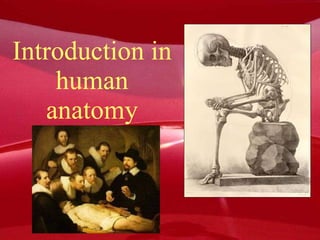
Introduction in human anatomy
Anatomy Definition -  anatome = up (ana)  +  cutting   (tome) Disciplines of anatomy Macroscopic Microscopic Developmental Neuroanatomy Approach to study of gross anatomy Upper extremity Back Head and neck Thorax Abdomen Pelvis and perineum Lower extremity
Basis for Terminology Terms informative Nomina anatomica Use of eponyms   Use correct terminology on exams; avoid nonspecific, general terms, like “front,” “up,” and “behind.”
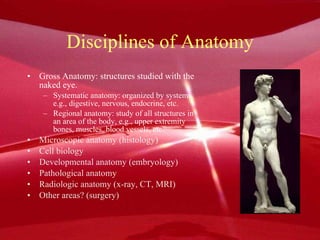
Disciplines of Anatomy Gross Anatomy: structures studied with the naked eye. Systematic anatomy: organized by systems, e.g., digestive, nervous, endocrine, etc. Regional anatomy: study of all structures in an area of the body, e.g., upper extremity bones, muscles, blood vessels, etc. Microscopic anatomy (histology) Cell biology Developmental anatomy (embryology) Pathological anatomy Radiologic anatomy (x-ray, CT, MRI) Other areas? (surgery)
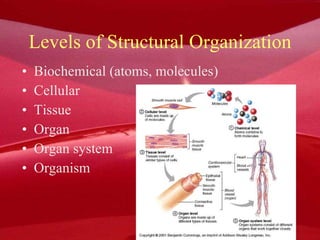
Levels of Structural Organization Biochemical (atoms, molecules) Cellular Tissue Organ Organ system Organism
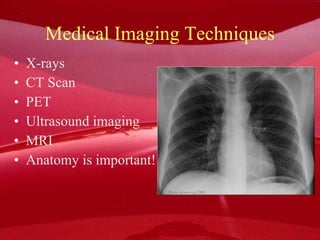
Medical Imaging Techniques X-rays  CT Scan  PET Ultrasound imaging MRI  Anatomy is important!
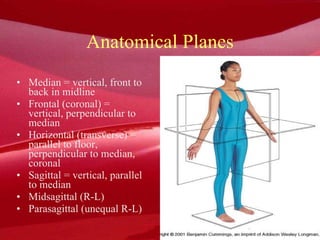
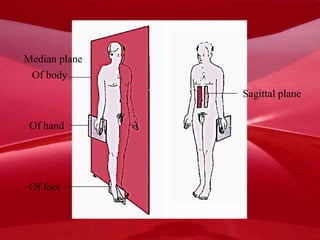
Anatomical Planes Median = vertical, front to back in midline Frontal (coronal) = vertical, perpendicular to median Horizontal (transverse) = parallel to floor, perpendicular to median, coronal Sagittal = vertical, parallel to median Midsagittal (R-L) Parasagittal (unequal R-L)
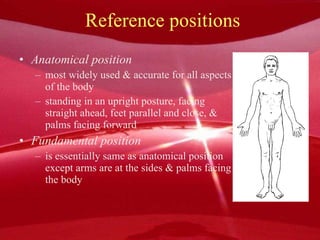
Reference positions Anatomical position most widely used & accurate for all aspects of the body standing in an upright posture, facing straight ahead, feet parallel and close, & palms facing forward Fundamental position is essentially same as anatomical position except arms are at the sides & palms facing the body
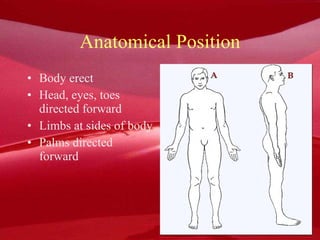
Anatomical Position Body erect Head, eyes, toes directed forward Limbs at sides of body Palms directed forward
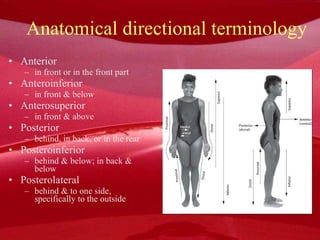
Anatomical directional terminology Anterior in front or in the front part Anteroinferior in front & below Anterosuperior in front & above Posterior behind, in back, or in the rear Posteroinferior behind & below; in back & below Posterolateral behind & to one side, specifically to the outside
Anatomical directional terminology Contralateral pertaining or relating to the opposite side Ipsilateral on the same side Bilateral relating to the right and left sides of the body or of a body structure such as the right & left extremities
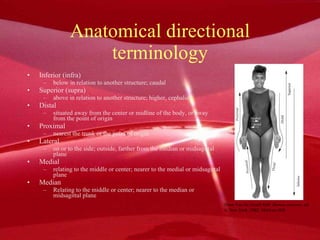
Anatomical directional terminology Inferior (infra) below in relation to another structure; caudal Superior (supra) above in relation to another structure; higher, cephalic Distal situated away from the center or midline of the body, or away from the point of origin Proximal nearest the trunk or the point of origin Lateral on or to the side; outside, farther from the median or midsagittal plane Medial relating to the middle or center; nearer to the medial or midsagittal plane Median Relating to the middle or center; nearer to the median or midsagittal plane From Van De Graaff KM:  Human anatomy , ed 6, New York, 2002, McGraw-Hill
Anatomical directional terminology Caudal below in relation to another structure; inferior Cephalic above in relation to another structure; higher, superior Deep beneath or below the surface; used to describe relative depth or location of muscles or tissue Superficial near the surface; used to describe relative depth or location of muscles or tissue
Anatomical directional terminology Prone the body lying face downward; stomach lying Supine lying on the back; face upward position of the body Dorsal relating to the back; being or located near, on, or toward the back, posterior part, or upper surface of  Ventral relating to the belly or abdomen, on or toward the front, anterior part of  Volar relating to palm of the hand or sole of the foot Plantar relating to the sole or undersurface of the foot
Directional Terms Toward the upper part Superior Cephalic Toward the lower part Inferior Caudal Front Ventral Anterior Back Dorsal Posterior
Directional Terms Front Down Prone Toward Midline Medial Away from Midline Lateral Same-Ipsilateral Opposite-Contralateral Between Intermediate Near Proximal
Directional Terms Far Distal On the Surface Superficial On the Inside Deep On the Wall of the Body Cavity Parietal On an Organ Visceral
The Skeleton Consists of Bones, cartilage, joints, and ligaments Composed of 206 named bones grouped into two divisions Axial skeleton (80 bones) Appendicular skeleton (126 bones)
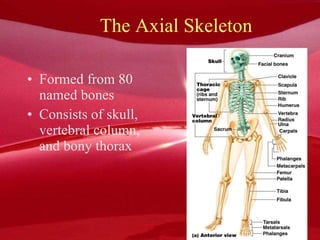
The Axial Skeleton Formed from 80 named bones Consists of skull, vertebral column, and bony thorax Figure 7.1a
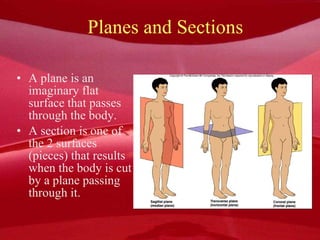
Planes and Sections A plane is an imaginary flat surface that passes through the body.  A section is one of the 2 surfaces (pieces) that results when the body is cut by a plane passing through it.
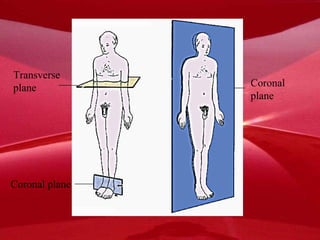
Transverse plane Coronal plane Coronal plane
Median plane Of body Of hand Of foot Sagittal plane
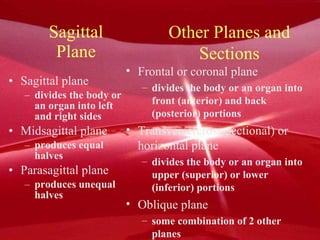
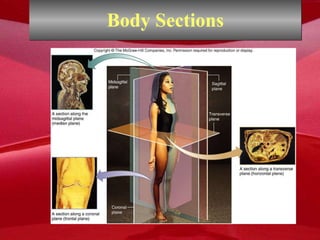
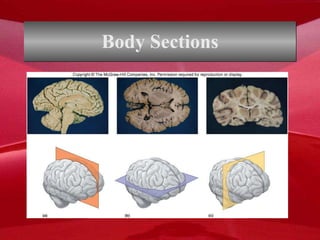
Sagittal Plane Sagittal plane divides the body or an organ into left and right sides Midsagittal plane produces equal halves Parasagittal plane produces unequal halves Other Planes and Sections Frontal or coronal plane divides the body or an organ into front (anterior) and back (posterior) portions Transverse(cross-sectional) or horizontal plane divides the body or an organ into upper (superior) or lower (inferior) portions Oblique plane some combination of 2 other planes
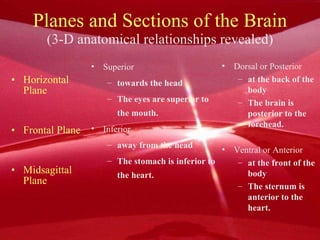
Planes and Sections of the Brain (3-D anatomical relationships revealed) Horizontal Plane Frontal Plane Midsagittal Plane Superior towards the head The eyes are superior to the mouth. Inferior away from the head The stomach is inferior to the heart. Dorsal or Posterior at the back of the body The brain is posterior to the forehead. Ventral or Anterior at the front of the body The sternum is anterior to the heart.
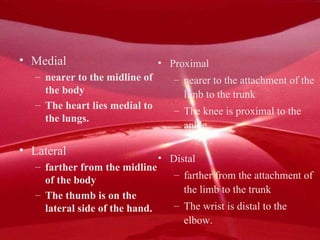
Medial nearer to the midline of the body The heart lies medial to the lungs. Lateral farther from the midline of the body The thumb is on the lateral side of the hand. Proximal nearer to the attachment of the limb to the trunk The knee is proximal to the ankle. Distal farther from the attachment of the limb to the trunk The wrist is distal to the elbow.
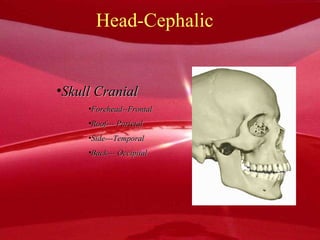
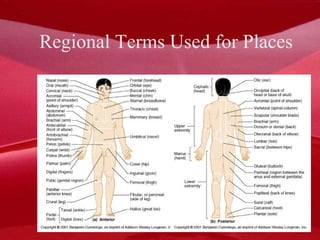
Head-Cephalic Skull Cranial Forehead--Frontal Roof--- Parietal Side---Temporal Back--- Occipital
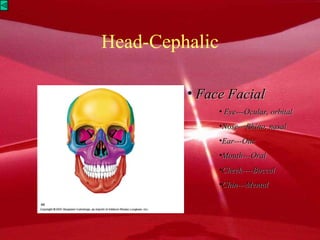
Head-Cephalic Face Facial Eye---Ocular, orbital Nose---Rhino, nasal Ear---Otic Mouth---Oral Cheek----Buccal Chin---Mental
Neck-Cervical Area between shoulder and base of skull. Includes 7 neck vertebrae. “ C” collar used for whiplash.
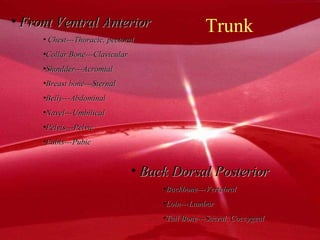
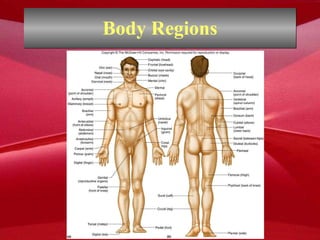
Trunk Front Ventral Anterior Chest---Thoracic, pectoral Collar Bone---Clavicular Shoulder---Acromial Breast bone---Sternal Belly---Abdominal Navel---Umbilical Pelvis---Pelvic Pubis---Pubic Back Dorsal Posterior Backbone---Vertebral Loin---Lumbar Tail Bone---Sacral, Coccygeal
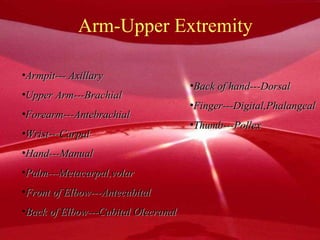
Arm-Upper Extremity Armpit--- Axillary Upper Arm---Brachial Forearm---Antebrachial Wrist---Carpal Hand---Manual Palm---Metacarpal,volar Front of Elbow---Antecubital Back of Elbow---Cubital Olecranal Back of hand---Dorsal Finger---Digital,Phalangeal Thumb---Pollex
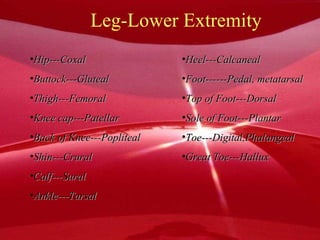
Leg-Lower Extremity Hip---Coxal Buttock---Gluteal Thigh---Femoral Knee cap---Patellar Back of Knee---Popliteal Shin---Crural Calf---Sural Ankle---Tarsal Heel---Calcaneal Foot------Pedal, metatarsal Top of Foot---Dorsal Sole of Foot---Plantar Toe---Digital,Phalangeal Great Toe---Hallux
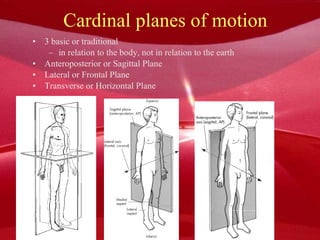
Cardinal planes of motion 3 basic or traditional in relation to the body, not in relation to the earth Anteroposterior or Sagittal Plane Lateral or Frontal Plane Transverse or Horizontal Plane
Body Sections
Body Sections
Body Regions
Regional Terms Used for Places
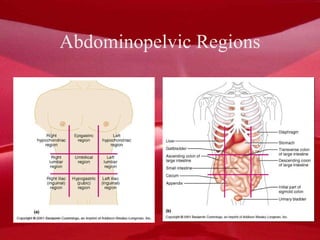
Abdominopelvic Regions
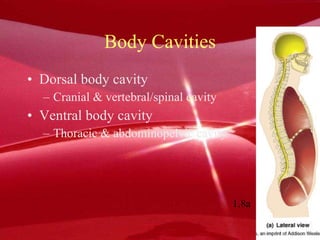
Body Cavities Dorsal body cavity Cranial & vertebral/spinal cavity Ventral body cavity Thoracic & abdominopelvic cavity 1.8a
Dorsal Body Cavity Near dorsal surface of body 2 subdivisions cranial cavity holds the brain formed by skull vertebral or spinal canal contains the spinal cord formed by vertebral column Meninges line dorsal body cavity
Ventral Body Cavity Near ventral surface of body 2 subdivisions thoracic cavity above diaphragm abdominopelvic cavity below diaphragm Diaphragm = large, dome-shaped muscle Organs called viscera Organs covered with serous membrane
Abdominopelvic Cavity Inferior portion of ventral body cavity below diaphragm Encircled by abdominal wall, bones & muscles of pelvis
Thoracic Cavity Encircled by ribs, sternum, vertebral column and muscle Divided into 2 pleural cavities by mediastinum  Mediastinum contains all thoracic organs except lungs
Mediastinum Midline wall of tissue that contains heart and great vessels, esophagus, trachea and thymus.
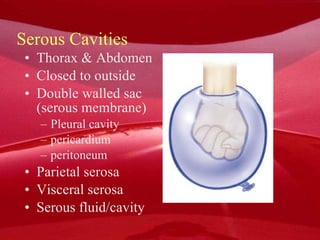
Serous Cavities Thorax & Abdomen Closed to outside Double walled sac (serous membrane) Pleural cavity pericardium peritoneum Parietal serosa Visceral serosa Serous fluid/cavity
Serous Cavities Double walled sac Pleural cavity pericardium peritoneum Parietal serosa Visceral serosa Serous fluid (1.9bcd) [name views and planes]
Serous Membranes Thin slippery membrane lines body cavities not open to the outside parietal layer lines walls of cavities visceral layer covers viscera within the cavities Serous fluid reduces friction
Pleural & Pericardial Cavities Visceral pleura clings to surface of lungs --- Parietal pleura lines chest wall Visceral pericardium covers heart --- Parietal pericardium lines pericardial sac
Peritoneum Visceral peritoneum --- serous membrane that covers the abdominal viscera Parietal peritoneum --- serous membrane that lines the abdominal wall
Mucous Membranes Lines body cavities open to the outside Respiratory system Digestive system Urinary system Reproductive system
The Body Systems The Skeletal System The basic framework of the body is a system  of over 200 bones with their joints, collectively known as the skeleton. Protects and supports body organs. Provides a framework the muscles use to cause movement. Blood cells are formed within bones. Stores minerals .
The Body Systems The Muscular System Body movements are due to the action of the muscles which are attached to the bones.  Other types of muscles are present in the walls of such organs as the intestine and the heart.  Allows manipulation of the environment, locomotion and facial  expression. Maintains posture. Produces heat.
The Body Systems The Circulatory System The heart, blood vessels, lymph vessels and lymph nodes all  make up the system whereby blood is pumped to all the body  tissues, bringing with it food, oxygen and other substances, and carrying away waste materials. Blood vessels transport blood, which carries oxygen, carbon dioxide,  nutrients, wastes, etc. The heart pumps blood.
The Body Systems The Digestive System This system comprises all organs which have to do with taking in food and converting the useful parts of it into substances that the body cells can use.  Examples of these organs are the mouth, the teeth, and the alimentary tract (esophagus, stomach, intestine, and accessory organs such as the liver and the pancreas). Breaks down food into absorbable units that enter the blood for  distribution to body cells. Indigestible foodstuffs are eliminated as feces.
The Body Systems The Respiratory System This includes the lungs and the passages leading to and from them. The purpose of this system is to take in air, and from it extract oxygen which is then dissolved in the blood and conveyed to all the tissues. A waste product of the cells, carbon dioxide, is taken by the blood to the lungs, whence it is expelled to the outside air. Keeps blood constantly supplied with oxygen and removes carbon dioxide. The gaseous changes occur through the walls of the air sacs of the  lungs.
The Body Systems The Integumentary System The word “integument” (in-teg’u-ment) means “skin.”  The skin is considered by some authorities to be a separate body system.  It includes the hair, nails, sweat and oil glands, and other related  structures.  Forms the external body covering. Protects deeper tissues from injury. Synthesis vitamin D. Site of cutaneous (pain, pressure, etc.) receptors, and sweat and oil glands.
The Body Systems The Urinary System This is also called the excretory system.  Its main components are the kidneys, the ureters, the bladder and the urethra.  Its purpose is to filter out and rid the body of certain waste products taken by the  blood from the cells. (Note that other waste products are removed via the digestive and respiratory systems). Eliminates nitrogenous waste from the body. Regulates water, electrolyte and acid-base balance of the blood.
The Body Systems The Nervous System The brain, the spinal cord and the nerves all make up this very complex  system by which all parts of the body are controlled and coordinated.  The organs of special sense (such as the eyes, ears, taste buds, and organs of smell), sometimes classed as a separate  sensory system , together with  the sense of tough, receive stimuli from the outside world, which are then converted into impulses that are transmitted to the brain.  The brain  determines to a great extent the body’s responses to messages from without  and within, and in it occur such higher functions as memory and reasoning. Fast-acting control system of the body. Responds to internal and external changes by activating appropriate muscles and glands.
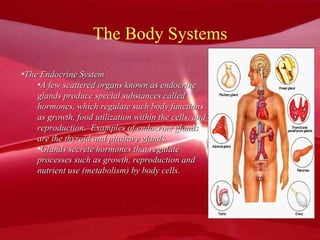
The Body Systems The Endocrine System A few scattered organs known as endocrine  glands produce special substances called hormones, which regulate such body functions as growth, food utilization within the cells, and reproduction.  Examples of endocrine glands  are the thyroid and pituitary glands. Glands secrete hormones that regulate processes such as growth, reproduction and  nutrient use (metabolism) by body cells.
The Body Systems The Reproductive System This system includes the external sex organs and all related inner structures which  are concerned with the production of new individuals. Overall function is production of offspring. Testes produce sperm and male sex hormone; ducts and glands aid in delivery of sperm to the female reproductive tract. Ovaries produce eggs and female sex hormone; remaining structures  serve as sites for fertilization and development of fetus. Mammary glands of female breasts produce milk to nourish the newborn .
 

Human anatomy 101

  • 1.
  • 2.
    Anatomy Definition - anatome = up (ana) + cutting (tome) Disciplines of anatomy Macroscopic Microscopic Developmental Neuroanatomy Approach to study of gross anatomy Upper extremity Back Head and neck Thorax Abdomen Pelvis and perineum Lower extremity
  • 3.
    Basis for TerminologyTerms informative Nomina anatomica Use of eponyms Use correct terminology on exams; avoid nonspecific, general terms, like “front,” “up,” and “behind.”
  • 4.
    Disciplines of AnatomyGross Anatomy: structures studied with the naked eye. Systematic anatomy: organized by systems, e.g., digestive, nervous, endocrine, etc. Regional anatomy: study of all structures in an area of the body, e.g., upper extremity bones, muscles, blood vessels, etc. Microscopic anatomy (histology) Cell biology Developmental anatomy (embryology) Pathological anatomy Radiologic anatomy (x-ray, CT, MRI) Other areas? (surgery)
  • 5.
    Levels of StructuralOrganization Biochemical (atoms, molecules) Cellular Tissue Organ Organ system Organism
  • 6.
    Medical Imaging TechniquesX-rays CT Scan PET Ultrasound imaging MRI Anatomy is important!
  • 7.
    Anatomical Planes Median= vertical, front to back in midline Frontal (coronal) = vertical, perpendicular to median Horizontal (transverse) = parallel to floor, perpendicular to median, coronal Sagittal = vertical, parallel to median Midsagittal (R-L) Parasagittal (unequal R-L)
  • 8.
    Reference positions Anatomicalposition most widely used & accurate for all aspects of the body standing in an upright posture, facing straight ahead, feet parallel and close, & palms facing forward Fundamental position is essentially same as anatomical position except arms are at the sides & palms facing the body
  • 9.
    Anatomical Position Bodyerect Head, eyes, toes directed forward Limbs at sides of body Palms directed forward
  • 10.
    Anatomical directional terminologyAnterior in front or in the front part Anteroinferior in front & below Anterosuperior in front & above Posterior behind, in back, or in the rear Posteroinferior behind & below; in back & below Posterolateral behind & to one side, specifically to the outside
  • 11.
    Anatomical directional terminologyContralateral pertaining or relating to the opposite side Ipsilateral on the same side Bilateral relating to the right and left sides of the body or of a body structure such as the right & left extremities
  • 12.
    Anatomical directional terminologyInferior (infra) below in relation to another structure; caudal Superior (supra) above in relation to another structure; higher, cephalic Distal situated away from the center or midline of the body, or away from the point of origin Proximal nearest the trunk or the point of origin Lateral on or to the side; outside, farther from the median or midsagittal plane Medial relating to the middle or center; nearer to the medial or midsagittal plane Median Relating to the middle or center; nearer to the median or midsagittal plane From Van De Graaff KM: Human anatomy , ed 6, New York, 2002, McGraw-Hill
  • 13.
    Anatomical directional terminologyCaudal below in relation to another structure; inferior Cephalic above in relation to another structure; higher, superior Deep beneath or below the surface; used to describe relative depth or location of muscles or tissue Superficial near the surface; used to describe relative depth or location of muscles or tissue
  • 14.
    Anatomical directional terminologyProne the body lying face downward; stomach lying Supine lying on the back; face upward position of the body Dorsal relating to the back; being or located near, on, or toward the back, posterior part, or upper surface of Ventral relating to the belly or abdomen, on or toward the front, anterior part of Volar relating to palm of the hand or sole of the foot Plantar relating to the sole or undersurface of the foot
  • 15.
    Directional Terms Towardthe upper part Superior Cephalic Toward the lower part Inferior Caudal Front Ventral Anterior Back Dorsal Posterior
  • 16.
    Directional Terms FrontDown Prone Toward Midline Medial Away from Midline Lateral Same-Ipsilateral Opposite-Contralateral Between Intermediate Near Proximal
  • 17.
    Directional Terms FarDistal On the Surface Superficial On the Inside Deep On the Wall of the Body Cavity Parietal On an Organ Visceral
  • 18.
    The Skeleton Consistsof Bones, cartilage, joints, and ligaments Composed of 206 named bones grouped into two divisions Axial skeleton (80 bones) Appendicular skeleton (126 bones)
  • 19.
    The Axial SkeletonFormed from 80 named bones Consists of skull, vertebral column, and bony thorax Figure 7.1a
  • 20.
    Planes and SectionsA plane is an imaginary flat surface that passes through the body. A section is one of the 2 surfaces (pieces) that results when the body is cut by a plane passing through it.
  • 21.
    Transverse plane Coronalplane Coronal plane
  • 22.
    Median plane Ofbody Of hand Of foot Sagittal plane
  • 23.
    Sagittal Plane Sagittalplane divides the body or an organ into left and right sides Midsagittal plane produces equal halves Parasagittal plane produces unequal halves Other Planes and Sections Frontal or coronal plane divides the body or an organ into front (anterior) and back (posterior) portions Transverse(cross-sectional) or horizontal plane divides the body or an organ into upper (superior) or lower (inferior) portions Oblique plane some combination of 2 other planes
  • 24.
    Planes and Sectionsof the Brain (3-D anatomical relationships revealed) Horizontal Plane Frontal Plane Midsagittal Plane Superior towards the head The eyes are superior to the mouth. Inferior away from the head The stomach is inferior to the heart. Dorsal or Posterior at the back of the body The brain is posterior to the forehead. Ventral or Anterior at the front of the body The sternum is anterior to the heart.
  • 25.
    Medial nearer tothe midline of the body The heart lies medial to the lungs. Lateral farther from the midline of the body The thumb is on the lateral side of the hand. Proximal nearer to the attachment of the limb to the trunk The knee is proximal to the ankle. Distal farther from the attachment of the limb to the trunk The wrist is distal to the elbow.
  • 26.
    Head-Cephalic Skull CranialForehead--Frontal Roof--- Parietal Side---Temporal Back--- Occipital
  • 27.
    Head-Cephalic Face FacialEye---Ocular, orbital Nose---Rhino, nasal Ear---Otic Mouth---Oral Cheek----Buccal Chin---Mental
  • 28.
    Neck-Cervical Area betweenshoulder and base of skull. Includes 7 neck vertebrae. “ C” collar used for whiplash.
  • 29.
    Trunk Front VentralAnterior Chest---Thoracic, pectoral Collar Bone---Clavicular Shoulder---Acromial Breast bone---Sternal Belly---Abdominal Navel---Umbilical Pelvis---Pelvic Pubis---Pubic Back Dorsal Posterior Backbone---Vertebral Loin---Lumbar Tail Bone---Sacral, Coccygeal
  • 30.
    Arm-Upper Extremity Armpit---Axillary Upper Arm---Brachial Forearm---Antebrachial Wrist---Carpal Hand---Manual Palm---Metacarpal,volar Front of Elbow---Antecubital Back of Elbow---Cubital Olecranal Back of hand---Dorsal Finger---Digital,Phalangeal Thumb---Pollex
  • 31.
    Leg-Lower Extremity Hip---CoxalButtock---Gluteal Thigh---Femoral Knee cap---Patellar Back of Knee---Popliteal Shin---Crural Calf---Sural Ankle---Tarsal Heel---Calcaneal Foot------Pedal, metatarsal Top of Foot---Dorsal Sole of Foot---Plantar Toe---Digital,Phalangeal Great Toe---Hallux
  • 32.
    Cardinal planes ofmotion 3 basic or traditional in relation to the body, not in relation to the earth Anteroposterior or Sagittal Plane Lateral or Frontal Plane Transverse or Horizontal Plane
  • 33.
  • 34.
  • 35.
  • 36.
  • 37.
  • 38.
    Body Cavities Dorsalbody cavity Cranial & vertebral/spinal cavity Ventral body cavity Thoracic & abdominopelvic cavity 1.8a
  • 39.
    Dorsal Body CavityNear dorsal surface of body 2 subdivisions cranial cavity holds the brain formed by skull vertebral or spinal canal contains the spinal cord formed by vertebral column Meninges line dorsal body cavity
  • 40.
    Ventral Body CavityNear ventral surface of body 2 subdivisions thoracic cavity above diaphragm abdominopelvic cavity below diaphragm Diaphragm = large, dome-shaped muscle Organs called viscera Organs covered with serous membrane
  • 41.
    Abdominopelvic Cavity Inferiorportion of ventral body cavity below diaphragm Encircled by abdominal wall, bones & muscles of pelvis
  • 42.
    Thoracic Cavity Encircledby ribs, sternum, vertebral column and muscle Divided into 2 pleural cavities by mediastinum Mediastinum contains all thoracic organs except lungs
  • 43.
    Mediastinum Midline wallof tissue that contains heart and great vessels, esophagus, trachea and thymus.
  • 44.
    Serous Cavities Thorax& Abdomen Closed to outside Double walled sac (serous membrane) Pleural cavity pericardium peritoneum Parietal serosa Visceral serosa Serous fluid/cavity
  • 45.
    Serous Cavities Doublewalled sac Pleural cavity pericardium peritoneum Parietal serosa Visceral serosa Serous fluid (1.9bcd) [name views and planes]
  • 46.
    Serous Membranes Thinslippery membrane lines body cavities not open to the outside parietal layer lines walls of cavities visceral layer covers viscera within the cavities Serous fluid reduces friction
  • 47.
    Pleural & PericardialCavities Visceral pleura clings to surface of lungs --- Parietal pleura lines chest wall Visceral pericardium covers heart --- Parietal pericardium lines pericardial sac
  • 48.
    Peritoneum Visceral peritoneum--- serous membrane that covers the abdominal viscera Parietal peritoneum --- serous membrane that lines the abdominal wall
  • 49.
    Mucous Membranes Linesbody cavities open to the outside Respiratory system Digestive system Urinary system Reproductive system
  • 50.
    The Body SystemsThe Skeletal System The basic framework of the body is a system of over 200 bones with their joints, collectively known as the skeleton. Protects and supports body organs. Provides a framework the muscles use to cause movement. Blood cells are formed within bones. Stores minerals .
  • 51.
    The Body SystemsThe Muscular System Body movements are due to the action of the muscles which are attached to the bones. Other types of muscles are present in the walls of such organs as the intestine and the heart. Allows manipulation of the environment, locomotion and facial expression. Maintains posture. Produces heat.
  • 52.
    The Body SystemsThe Circulatory System The heart, blood vessels, lymph vessels and lymph nodes all make up the system whereby blood is pumped to all the body tissues, bringing with it food, oxygen and other substances, and carrying away waste materials. Blood vessels transport blood, which carries oxygen, carbon dioxide, nutrients, wastes, etc. The heart pumps blood.
  • 53.
    The Body SystemsThe Digestive System This system comprises all organs which have to do with taking in food and converting the useful parts of it into substances that the body cells can use. Examples of these organs are the mouth, the teeth, and the alimentary tract (esophagus, stomach, intestine, and accessory organs such as the liver and the pancreas). Breaks down food into absorbable units that enter the blood for distribution to body cells. Indigestible foodstuffs are eliminated as feces.
  • 54.
    The Body SystemsThe Respiratory System This includes the lungs and the passages leading to and from them. The purpose of this system is to take in air, and from it extract oxygen which is then dissolved in the blood and conveyed to all the tissues. A waste product of the cells, carbon dioxide, is taken by the blood to the lungs, whence it is expelled to the outside air. Keeps blood constantly supplied with oxygen and removes carbon dioxide. The gaseous changes occur through the walls of the air sacs of the lungs.
  • 55.
    The Body SystemsThe Integumentary System The word “integument” (in-teg’u-ment) means “skin.” The skin is considered by some authorities to be a separate body system. It includes the hair, nails, sweat and oil glands, and other related structures. Forms the external body covering. Protects deeper tissues from injury. Synthesis vitamin D. Site of cutaneous (pain, pressure, etc.) receptors, and sweat and oil glands.
  • 56.
    The Body SystemsThe Urinary System This is also called the excretory system. Its main components are the kidneys, the ureters, the bladder and the urethra. Its purpose is to filter out and rid the body of certain waste products taken by the blood from the cells. (Note that other waste products are removed via the digestive and respiratory systems). Eliminates nitrogenous waste from the body. Regulates water, electrolyte and acid-base balance of the blood.
  • 57.
    The Body SystemsThe Nervous System The brain, the spinal cord and the nerves all make up this very complex system by which all parts of the body are controlled and coordinated. The organs of special sense (such as the eyes, ears, taste buds, and organs of smell), sometimes classed as a separate sensory system , together with the sense of tough, receive stimuli from the outside world, which are then converted into impulses that are transmitted to the brain. The brain determines to a great extent the body’s responses to messages from without and within, and in it occur such higher functions as memory and reasoning. Fast-acting control system of the body. Responds to internal and external changes by activating appropriate muscles and glands.
  • 58.
    The Body SystemsThe Endocrine System A few scattered organs known as endocrine glands produce special substances called hormones, which regulate such body functions as growth, food utilization within the cells, and reproduction. Examples of endocrine glands are the thyroid and pituitary glands. Glands secrete hormones that regulate processes such as growth, reproduction and nutrient use (metabolism) by body cells.
  • 59.
    The Body SystemsThe Reproductive System This system includes the external sex organs and all related inner structures which are concerned with the production of new individuals. Overall function is production of offspring. Testes produce sperm and male sex hormone; ducts and glands aid in delivery of sperm to the female reproductive tract. Ovaries produce eggs and female sex hormone; remaining structures serve as sites for fertilization and development of fetus. Mammary glands of female breasts produce milk to nourish the newborn .
  • 60.