Muscles 2 McKinley and O’Laughlin Chapter 12
Introduction Muscles of the pectoral girdle and upper extremity may be classified into what 5 groups? Muscles that move the: Pectoral girdle Glenohumeral joint Elbow/forearm Wrist, hand, fingers Intrinsic muscles of the hand
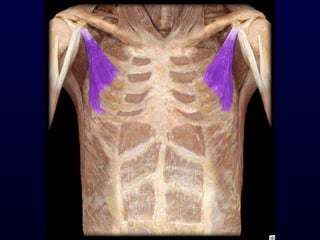
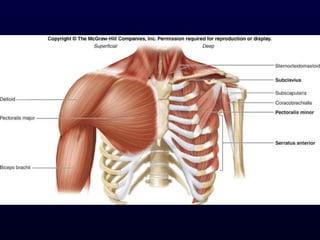
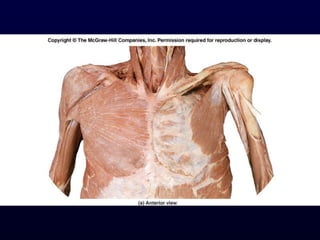
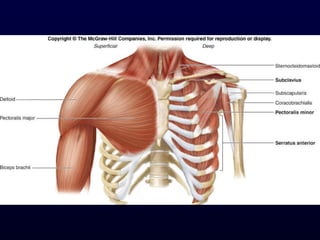
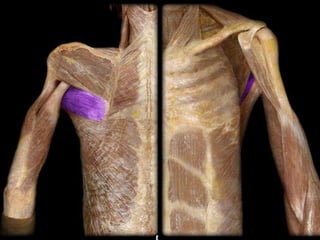
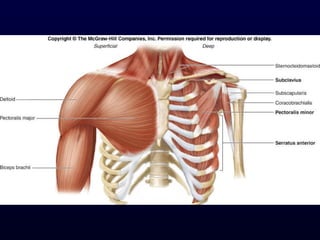
Move the Pectoral Girdle Name:  Pectoralis minor Origin: ribs 3-5 (sternal ends) Insertion: Coracoid process of scapula Action: Pulls scapula forward and down (protracts and depresses)
 
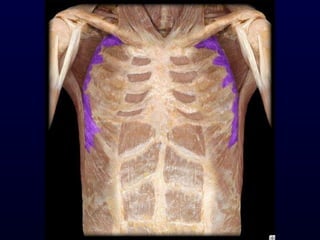
Move the Pectoral Girdle Name:  Serratus anterior Origin: (External surfaces of) lateral parts of ribs 1-8/9 (upper and middle) Insertion: Anterior vertebral border of scapula Action: Pulls scapula forward and down (protracts and depresses)


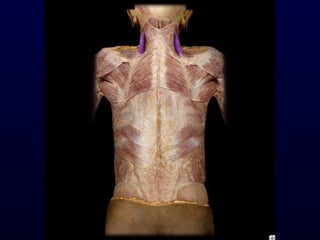
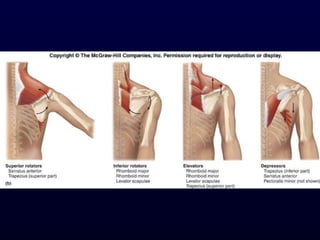
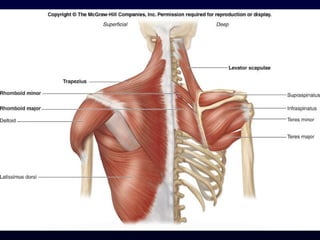
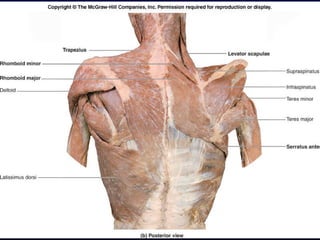
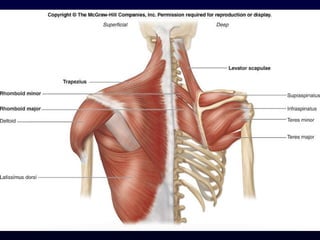
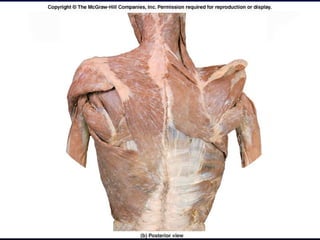
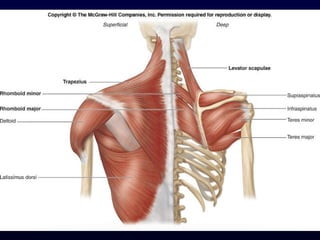
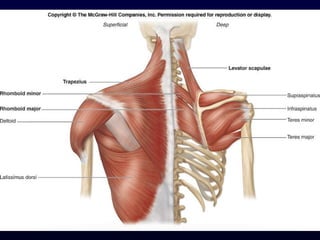
Move the Pectoral Girdle Name:  Levator scapulae Origin: (Posterior tubercle of) transverse process of C1-C4 Insertion: Superior vertebral border (near superior angle) of scapula Action: Elevates scapula. Rotates glenoid inferiorly.
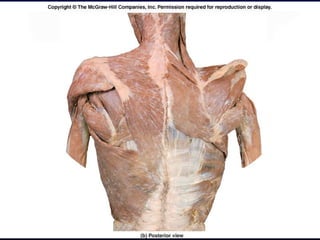
 
Move the Pectoral Girdle Name:  Rhomboid major Origin: Spinous process of T2-T5 Insertion: Vertebral border (from rhomboid minor to inferior angle) of scapula Action: Adducts (retracts) and elevates scapula. Rotates glenoid inferiorly.
 
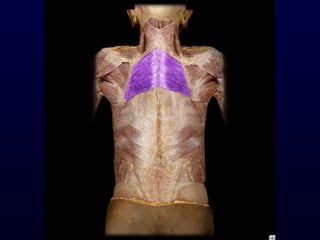
Move the Pectoral Girdle Name:  Rhomboid minor Origin: Spinous process of C7-T1 Insertion: Vertebral border (just below spine) of scapula Action: Adducts (retracts) and elevates scapula. Rotates glenoid inferiorly.
 
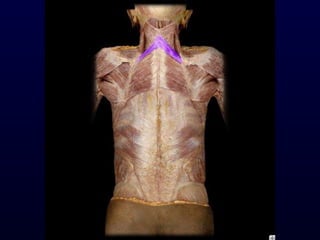
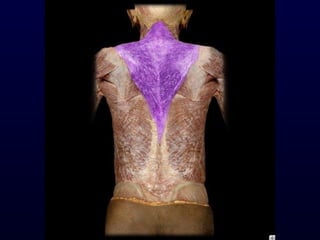
Move the Pectoral Girdle Name:  Trapezius Origin: Medial superior nuchal line. External occipital protuberance. Nuchal ligament. Spines of C7-T12. Insertion: Acromial end of clavicle. Acromion. Spine of scapula.
 
Move the Pectoral Girdle Name:  Trapezius Action:  Superior fibers: Elevate scapula Middle fibers: Retract (adduct) scapula Inferior fibers: Depress scapula Sup and Inf: Rotate glenoid superiorly


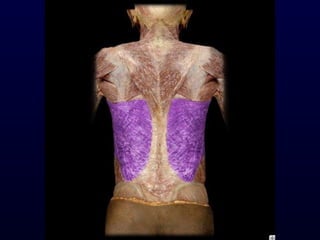
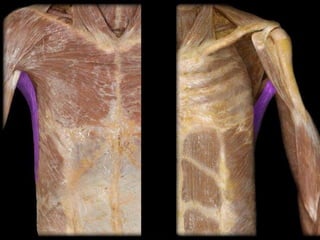
Move the Glenohumeral joint Name:  Latissimus dorsi Origin: Spines of sacral, lumbar and lower thoracic vertebrae (thoracolumbar fascia). Iliac crest. Lower 4 ribs. Insertion: Intertubercular groove Action: Extends, adducts, and rotates humerus medially. Retracts shoulder.


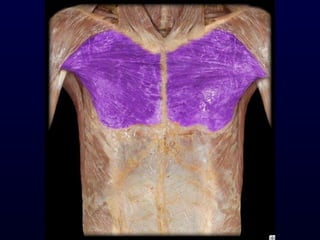
Move the Glenohumeral joint Name:  Pectoralis major Origin:  Clavicular head: Medial clavicle Sternocostal head: Anterior sternum. Superior 6 costal cartilages. Aponeurosis of external obliques. Insertion: Crest of greater tubercle
 
Move the Glenohumeral joint Name:  Pectoralis major Action:  Both heads: Adduct and medially rotate humerus. Draw shoulder anteriorly and inferiorly (protract and depress) Clavicular head: flex humerus Sternocostal head: extend humerus
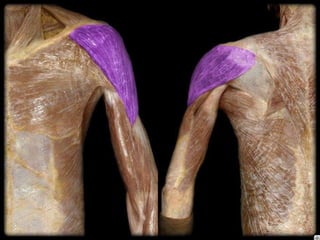
Move the Glenohumeral joint Name:  Deltoid Origin: Clavicle. Acromion. Spine of scapula. Insertion: Deltoid tuberosity Action:  Anterior: Flex and medially rotate humerus Middle: Abduct humerus Posterior: Extend and laterally rotate humerus
 
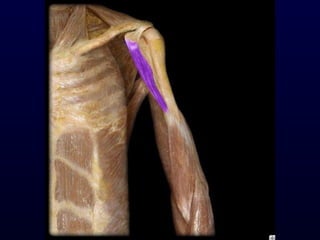
Move the Glenohumeral joint Name:  Coracobrachialis Origin: Coracoid process of scapula Insertion: Medial humerus (middle 1/3) Action: Flex and adduct humerus


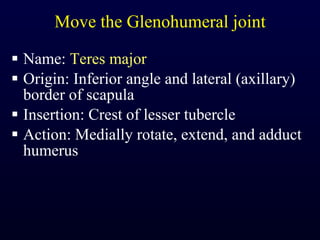
Move the Glenohumeral joint Name:  Teres major Origin: Inferior angle and lateral (axillary) border of scapula Insertion: Crest of lesser tubercle Action: Medially rotate, extend, and adduct humerus


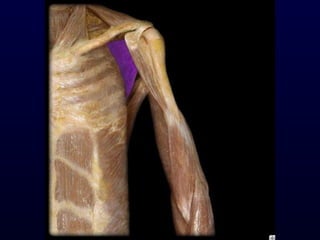
Move the Glenohumeral joint Name:  Subscapularis Origin: Subscapular fossa Insertion: Lesser tubercle Action: Medially rotate humerus (extend and adduct)
 
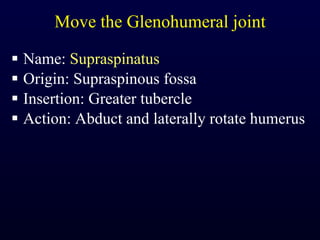
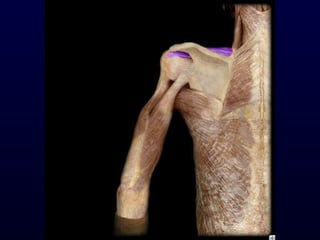
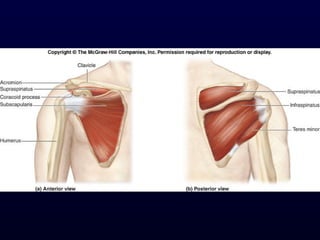
Move the Glenohumeral joint Name:  Supraspinatus Origin: Supraspinous fossa Insertion: Greater tubercle Action: Abduct and laterally rotate humerus
 
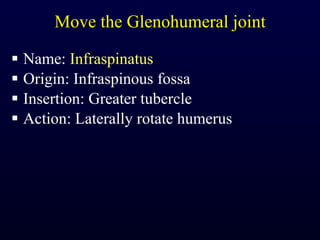
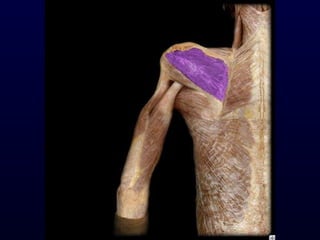
Move the Glenohumeral joint Name:  Infraspinatus Origin: Infraspinous fossa Insertion: Greater tubercle Action: Laterally rotate humerus
 
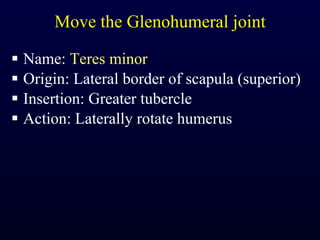
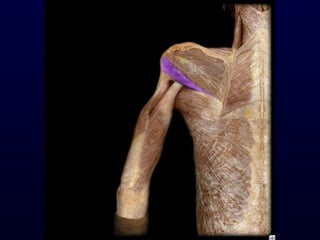
Move the Glenohumeral joint Name:  Teres minor Origin: Lateral border of scapula (superior) Insertion: Greater tubercle Action: Laterally rotate humerus


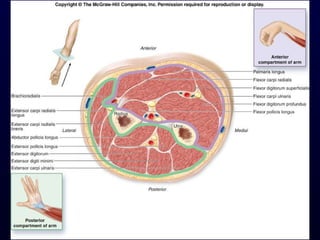
Move the Elbow/Antebrachium What separates the limbs into compartments? Deep fascia
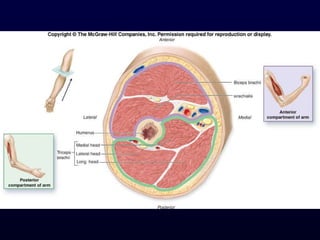
Move the Elbow/Antebrachium What 2 compartments occur in the brachium? Anterior -  (Flexors) Posterior -  (Extensors)
 
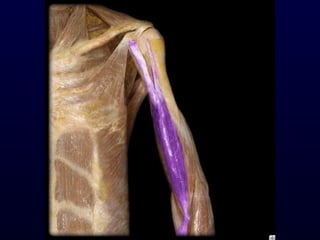
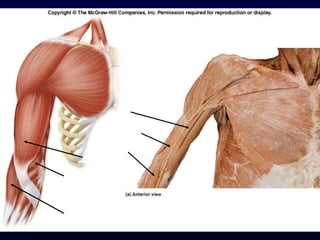
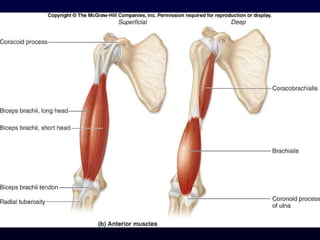
Move the Elbow/Antebrachium Name:  Biceps brachii Origin:  Short head: Coracoid process Long head: Supraglenoid tubercle Insertion: Radial tuberosity. Bicipital aponeurosis. Action: Flex and supinate antebrachium
 
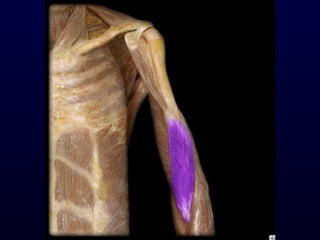
Move the Elbow/Antebrachium Name:  Brachialis Origin: Distal, anterior humerus Insertion: Coronoid process (ulna) Action: Flex antebrachium
 
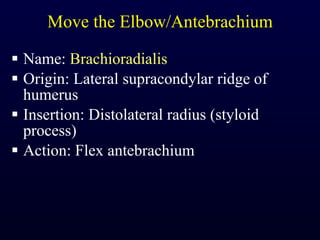
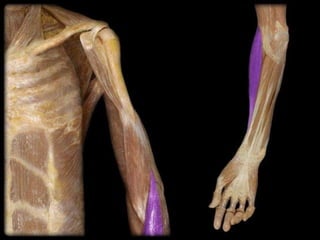
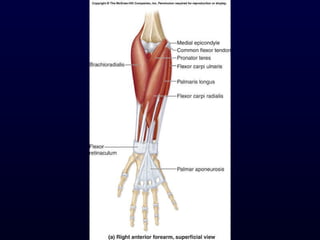
Move the Elbow/Antebrachium Name:  Brachioradialis Origin: Lateral supracondylar ridge of humerus Insertion: Distolateral radius (styloid process) Action: Flex antebrachium


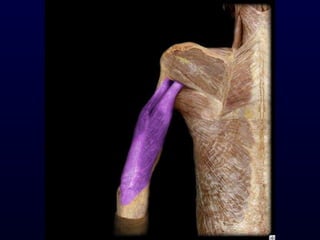
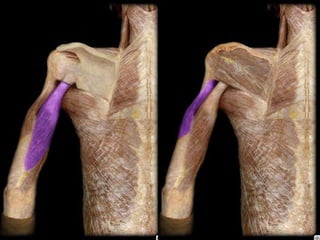
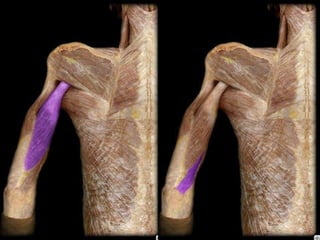
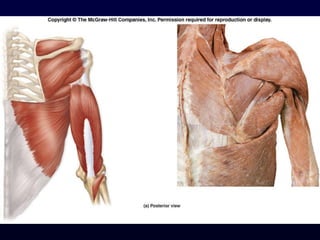
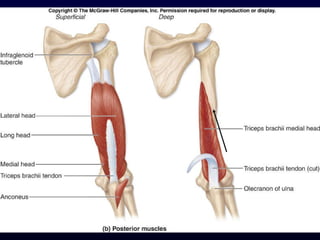
Move the Elbow/Antebrachium Name:  Triceps brachii Origin: Long head: Infraglenoid tubercle Lateral head: Posterior humerus superior to radial groove Medial head: Posterior humerus inferior to radial groove  Insertion: Olecranon process of ulna Action: Extend antebrachium Long head: steadies abducted humerus


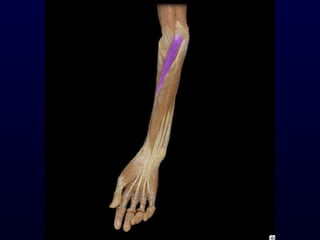
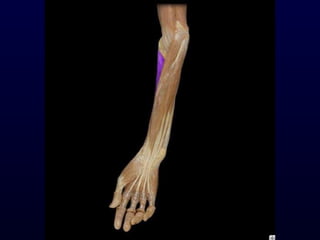
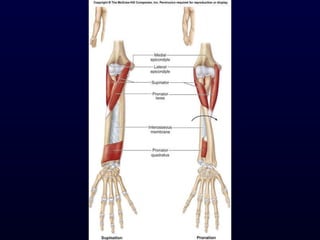
Pronate/Supinate Name:  Pronator teres Origin: Medial epicondyle of humerus. Coronoid process of ulna. Insertion: Lateral radius (middle) Action: Pronate antebrachium
 
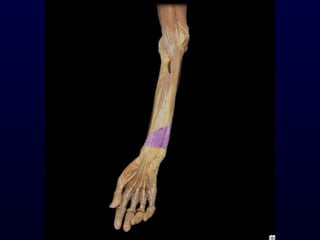
Pronate/Supinate Name:  Pronator quadratus Origin: Distal, anterior ulna Insertion: Distal, anterior radius Action: Pronate hand
 
Pronate/Supinate Name:  Supinator Origin: Lateral epicondyle of humerus. Crest of ulna. Insertion: Proximolateral radius (distal to tuberosity) Action: Supinate antebrachium
 
 
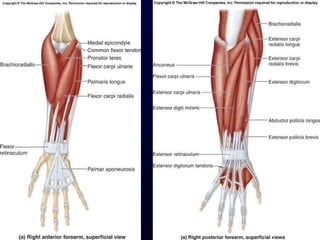
Move the Elbow/Antebrachium Name:  Flexor group Origin: Medial epicondyle Anterior, proximal ulna and radius, interosseus membrane Insertion: Carpals, metacarpals, phalanges Action: Flex wrist and digits
Move the Elbow/Antebrachium Name:  Extensor group Origin: Lateral epicondyle Posterior ulna and radius, interosseus membrane Insertion: Carpals, metacarpals, phalanges Action: Extend wrist and digits
 
 
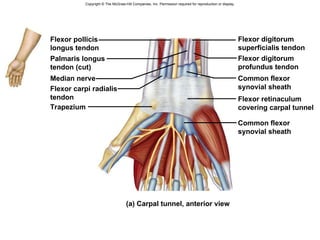
Move the Elbow/Antebrachium What is another name for the flexor retinaculum? Transverse carpal ligament
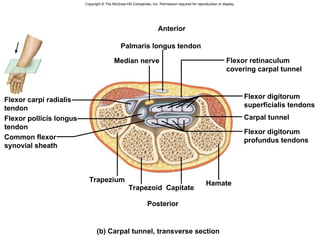
Move the Elbow/Antebrachium The flexor retinaculum of the wrist and the arch of the carpals form what structure? Carpal tunnel
Copyright © The McGraw-Hill Companies, Inc. Permission required for reproduction or display. Palmaris longus  tendon (cut) Common flexor  synovial sheath (a) Carpal tunnel, anterior view Flexor retinaculum  covering carpal tunnel Flexor pollicis  longus tendon Flexor carpi radialis  tendon Trapezium Median nerve Flexor digitorum  profundus tendon Flexor digitorum  superficialis tendon Common flexor  synovial sheath
Copyright © The McGraw-Hill Companies, Inc. Permission required for reproduction or display. (b) Carpal tunnel, transverse section Carpal tunnel Median nerve Palmaris longus tendon Anterior Common flexor synovial sheath Flexor carpi radialis  tendon Flexor pollicis longus  tendon Flexor digitorum profundus tendons Flexor retinaculum covering carpal tunnel Hamate Capitate Trapezoid Trapezium Posterior Flexor digitorum superficialis tendons
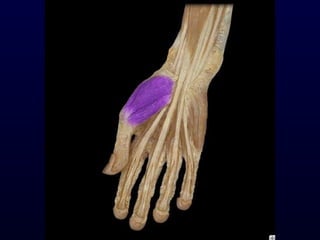
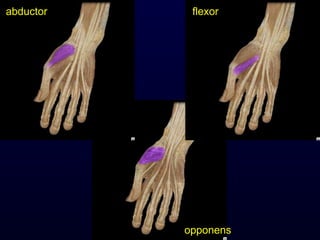
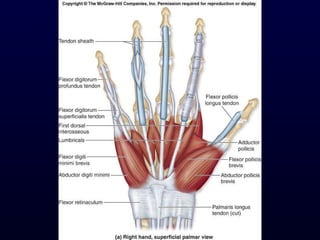
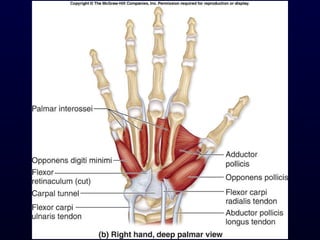
Intrinsic Muscles of the Hand What group of muscles forms the thick, fleshy mass at the base of the thumb and work to abduct, flex, and oppose the thumb? Thenar group
 
abductor flexor opponens
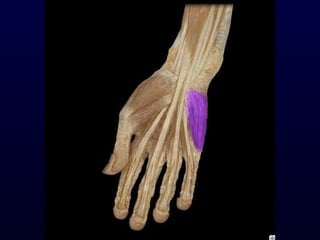
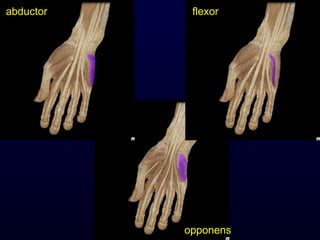
Intrinsic Muscles of the Hand What group of muscles forms the thick, fleshy mass at the base of the 5th digit of the hand and work to abduct, flex, and oppose the 5th digit? Hypothenar group
 
abductor flexor opponens
Intrinsic Muscles of the Hand Within the hand, what group of muscles lies between the 1st and 5th digits? Midpalmar group
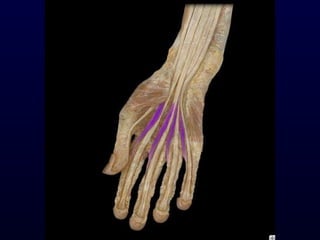
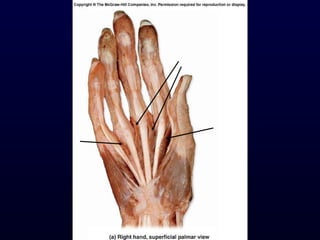
Intrinsic Muscles of the Hand Name:  Lumbricals Origin: Tendons of the flexor digitorum profundus Insertion: Extensor expansions (dorsal tendons) on digits 2-5 Action: Flex digits at metacarpophalangeal joints and extend at interphalangeal joints


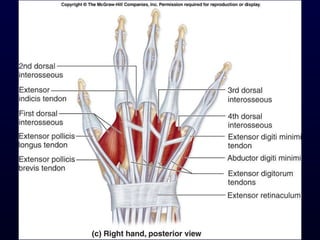
Intrinsic Muscles of the Hand Name:  Dorsal interossei Origin: Adjacent sides of metacarpals Insertion: Extensor expansions and bases of proximal phalanges of digits 2-4 Action: Abduct digits 2-4 (Extends interphalangeal joints)
 
Intrinsic Muscles of the Hand Name:  Palmar interossei Origin: Palmar surface metacarpals 2, 4, and 5 Insertion: Bases of proximal phalanges of digits 2, 4, and 5 Action: Adduct digits 2, 4, and 5 (Extends interphalangeal joints)
 

Muscles 2

  • 1.
    Muscles 2 McKinleyand O’Laughlin Chapter 12
  • 2.
    Introduction Muscles ofthe pectoral girdle and upper extremity may be classified into what 5 groups? Muscles that move the: Pectoral girdle Glenohumeral joint Elbow/forearm Wrist, hand, fingers Intrinsic muscles of the hand
  • 3.
    Move the PectoralGirdle Name: Pectoralis minor Origin: ribs 3-5 (sternal ends) Insertion: Coracoid process of scapula Action: Pulls scapula forward and down (protracts and depresses)
  • 4.
  • 5.
    Move the PectoralGirdle Name: Serratus anterior Origin: (External surfaces of) lateral parts of ribs 1-8/9 (upper and middle) Insertion: Anterior vertebral border of scapula Action: Pulls scapula forward and down (protracts and depresses)
  • 6.
  • 7.
  • 8.
  • 9.
    Move the PectoralGirdle Name: Levator scapulae Origin: (Posterior tubercle of) transverse process of C1-C4 Insertion: Superior vertebral border (near superior angle) of scapula Action: Elevates scapula. Rotates glenoid inferiorly.
  • 10.
  • 11.
    Move the PectoralGirdle Name: Rhomboid major Origin: Spinous process of T2-T5 Insertion: Vertebral border (from rhomboid minor to inferior angle) of scapula Action: Adducts (retracts) and elevates scapula. Rotates glenoid inferiorly.
  • 12.
  • 13.
    Move the PectoralGirdle Name: Rhomboid minor Origin: Spinous process of C7-T1 Insertion: Vertebral border (just below spine) of scapula Action: Adducts (retracts) and elevates scapula. Rotates glenoid inferiorly.
  • 14.
  • 15.
    Move the PectoralGirdle Name: Trapezius Origin: Medial superior nuchal line. External occipital protuberance. Nuchal ligament. Spines of C7-T12. Insertion: Acromial end of clavicle. Acromion. Spine of scapula.
  • 16.
  • 17.
    Move the PectoralGirdle Name: Trapezius Action: Superior fibers: Elevate scapula Middle fibers: Retract (adduct) scapula Inferior fibers: Depress scapula Sup and Inf: Rotate glenoid superiorly
  • 18.
  • 19.
  • 20.
  • 21.
    Move the Glenohumeraljoint Name: Latissimus dorsi Origin: Spines of sacral, lumbar and lower thoracic vertebrae (thoracolumbar fascia). Iliac crest. Lower 4 ribs. Insertion: Intertubercular groove Action: Extends, adducts, and rotates humerus medially. Retracts shoulder.
  • 22.
  • 23.
  • 24.
  • 25.
  • 26.
    Move the Glenohumeraljoint Name: Pectoralis major Origin: Clavicular head: Medial clavicle Sternocostal head: Anterior sternum. Superior 6 costal cartilages. Aponeurosis of external obliques. Insertion: Crest of greater tubercle
  • 27.
  • 28.
    Move the Glenohumeraljoint Name: Pectoralis major Action: Both heads: Adduct and medially rotate humerus. Draw shoulder anteriorly and inferiorly (protract and depress) Clavicular head: flex humerus Sternocostal head: extend humerus
  • 29.
    Move the Glenohumeraljoint Name: Deltoid Origin: Clavicle. Acromion. Spine of scapula. Insertion: Deltoid tuberosity Action: Anterior: Flex and medially rotate humerus Middle: Abduct humerus Posterior: Extend and laterally rotate humerus
  • 30.
  • 31.
    Move the Glenohumeraljoint Name: Coracobrachialis Origin: Coracoid process of scapula Insertion: Medial humerus (middle 1/3) Action: Flex and adduct humerus
  • 32.
  • 33.
  • 34.
  • 35.
    Move the Glenohumeraljoint Name: Teres major Origin: Inferior angle and lateral (axillary) border of scapula Insertion: Crest of lesser tubercle Action: Medially rotate, extend, and adduct humerus
  • 36.
  • 37.
  • 38.
  • 39.
    Move the Glenohumeraljoint Name: Subscapularis Origin: Subscapular fossa Insertion: Lesser tubercle Action: Medially rotate humerus (extend and adduct)
  • 40.
  • 41.
    Move the Glenohumeraljoint Name: Supraspinatus Origin: Supraspinous fossa Insertion: Greater tubercle Action: Abduct and laterally rotate humerus
  • 42.
  • 43.
    Move the Glenohumeraljoint Name: Infraspinatus Origin: Infraspinous fossa Insertion: Greater tubercle Action: Laterally rotate humerus
  • 44.
  • 45.
    Move the Glenohumeraljoint Name: Teres minor Origin: Lateral border of scapula (superior) Insertion: Greater tubercle Action: Laterally rotate humerus
  • 46.
  • 47.
  • 48.
  • 49.
  • 50.
    Move the Elbow/AntebrachiumWhat separates the limbs into compartments? Deep fascia
  • 51.
    Move the Elbow/AntebrachiumWhat 2 compartments occur in the brachium? Anterior - (Flexors) Posterior - (Extensors)
  • 52.
  • 53.
    Move the Elbow/AntebrachiumName: Biceps brachii Origin: Short head: Coracoid process Long head: Supraglenoid tubercle Insertion: Radial tuberosity. Bicipital aponeurosis. Action: Flex and supinate antebrachium
  • 54.
  • 55.
    Move the Elbow/AntebrachiumName: Brachialis Origin: Distal, anterior humerus Insertion: Coronoid process (ulna) Action: Flex antebrachium
  • 56.
  • 57.
    Move the Elbow/AntebrachiumName: Brachioradialis Origin: Lateral supracondylar ridge of humerus Insertion: Distolateral radius (styloid process) Action: Flex antebrachium
  • 58.
  • 59.
  • 60.
  • 61.
  • 62.
    Move the Elbow/AntebrachiumName: Triceps brachii Origin: Long head: Infraglenoid tubercle Lateral head: Posterior humerus superior to radial groove Medial head: Posterior humerus inferior to radial groove Insertion: Olecranon process of ulna Action: Extend antebrachium Long head: steadies abducted humerus
  • 63.
  • 64.
  • 65.
  • 66.
  • 67.
  • 68.
    Pronate/Supinate Name: Pronator teres Origin: Medial epicondyle of humerus. Coronoid process of ulna. Insertion: Lateral radius (middle) Action: Pronate antebrachium
  • 69.
  • 70.
    Pronate/Supinate Name: Pronator quadratus Origin: Distal, anterior ulna Insertion: Distal, anterior radius Action: Pronate hand
  • 71.
  • 72.
    Pronate/Supinate Name: Supinator Origin: Lateral epicondyle of humerus. Crest of ulna. Insertion: Proximolateral radius (distal to tuberosity) Action: Supinate antebrachium
  • 73.
  • 74.
  • 75.
    Move the Elbow/AntebrachiumName: Flexor group Origin: Medial epicondyle Anterior, proximal ulna and radius, interosseus membrane Insertion: Carpals, metacarpals, phalanges Action: Flex wrist and digits
  • 76.
    Move the Elbow/AntebrachiumName: Extensor group Origin: Lateral epicondyle Posterior ulna and radius, interosseus membrane Insertion: Carpals, metacarpals, phalanges Action: Extend wrist and digits
  • 77.
  • 78.
  • 79.
    Move the Elbow/AntebrachiumWhat is another name for the flexor retinaculum? Transverse carpal ligament
  • 80.
    Move the Elbow/AntebrachiumThe flexor retinaculum of the wrist and the arch of the carpals form what structure? Carpal tunnel
  • 81.
    Copyright © TheMcGraw-Hill Companies, Inc. Permission required for reproduction or display. Palmaris longus tendon (cut) Common flexor synovial sheath (a) Carpal tunnel, anterior view Flexor retinaculum covering carpal tunnel Flexor pollicis longus tendon Flexor carpi radialis tendon Trapezium Median nerve Flexor digitorum profundus tendon Flexor digitorum superficialis tendon Common flexor synovial sheath
  • 82.
    Copyright © TheMcGraw-Hill Companies, Inc. Permission required for reproduction or display. (b) Carpal tunnel, transverse section Carpal tunnel Median nerve Palmaris longus tendon Anterior Common flexor synovial sheath Flexor carpi radialis tendon Flexor pollicis longus tendon Flexor digitorum profundus tendons Flexor retinaculum covering carpal tunnel Hamate Capitate Trapezoid Trapezium Posterior Flexor digitorum superficialis tendons
  • 83.
    Intrinsic Muscles ofthe Hand What group of muscles forms the thick, fleshy mass at the base of the thumb and work to abduct, flex, and oppose the thumb? Thenar group
  • 84.
  • 85.
  • 86.
    Intrinsic Muscles ofthe Hand What group of muscles forms the thick, fleshy mass at the base of the 5th digit of the hand and work to abduct, flex, and oppose the 5th digit? Hypothenar group
  • 87.
  • 88.
  • 89.
    Intrinsic Muscles ofthe Hand Within the hand, what group of muscles lies between the 1st and 5th digits? Midpalmar group
  • 90.
    Intrinsic Muscles ofthe Hand Name: Lumbricals Origin: Tendons of the flexor digitorum profundus Insertion: Extensor expansions (dorsal tendons) on digits 2-5 Action: Flex digits at metacarpophalangeal joints and extend at interphalangeal joints
  • 91.
  • 92.
  • 93.
  • 94.
    Intrinsic Muscles ofthe Hand Name: Dorsal interossei Origin: Adjacent sides of metacarpals Insertion: Extensor expansions and bases of proximal phalanges of digits 2-4 Action: Abduct digits 2-4 (Extends interphalangeal joints)
  • 95.
  • 96.
    Intrinsic Muscles ofthe Hand Name: Palmar interossei Origin: Palmar surface metacarpals 2, 4, and 5 Insertion: Bases of proximal phalanges of digits 2, 4, and 5 Action: Adduct digits 2, 4, and 5 (Extends interphalangeal joints)
  • 97.