
Respiration
Process which involves taking in oxygen into the cells, using it
for releasing energy by burning food and then eliminating
the waste products like carbon dioxide and water from the
body
It is a catabolic process as the food
is broken down into simpler form. In short, respiration is a
biochemical activity taking place with in the protoplasm of
the cell and results in the liberation of energy
Breathing and Respiration
BREATHING
1. Mechanism by which
organisms obtain oxygen
from the air and release
carbon dioxide
2. It is a physical process
3. It involves lungs of the
organism
RESPIRATION
1. It includes breathing and
oxidation of food in the cells
of the organism to release
energy
2. It is a biochemical process
3. It involves the mitochondria
in the cells where food is
oxidized to release energy
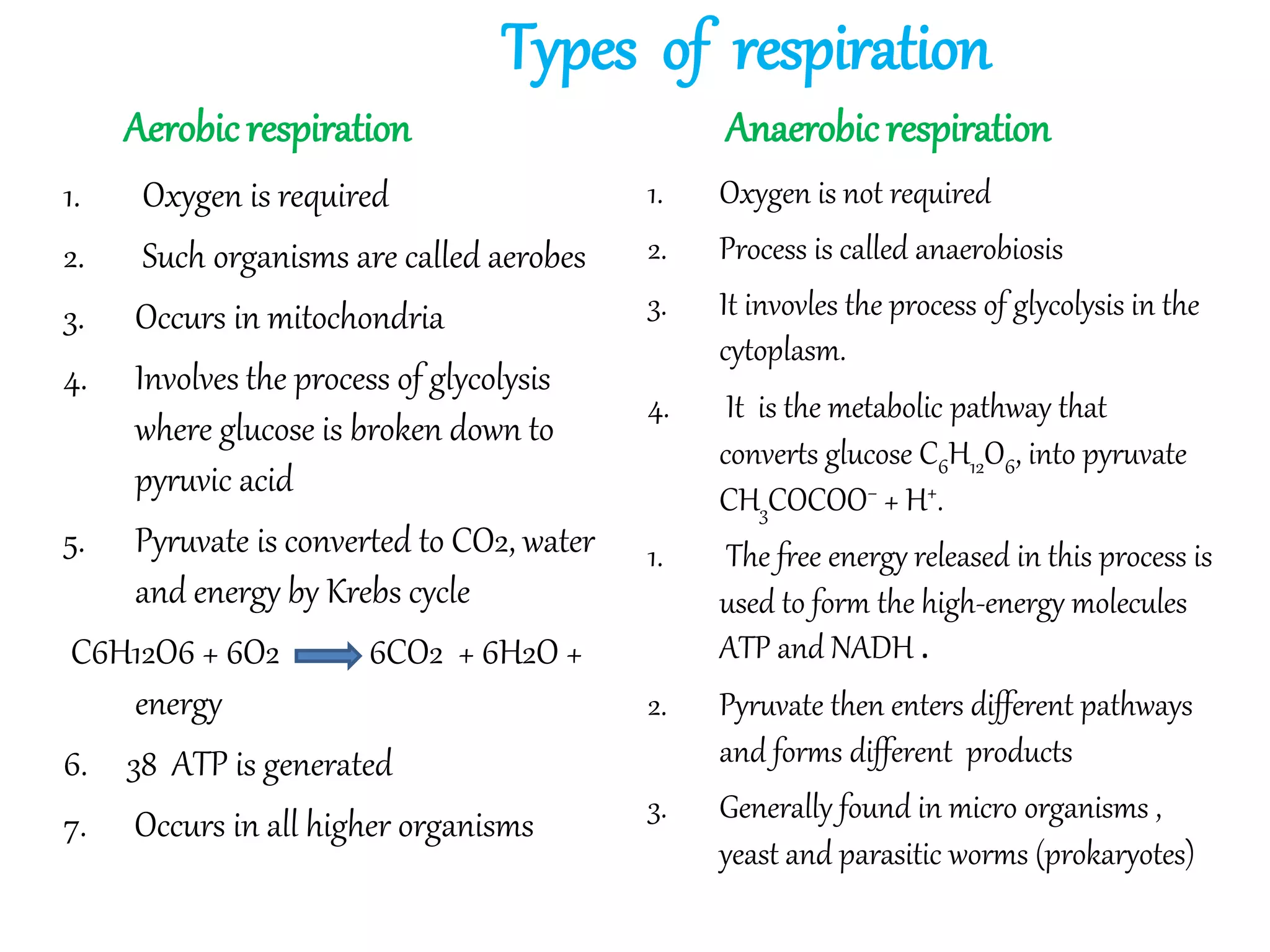
Types of respiration
Aerobicrespiration Anaerobicrespiration
1. Oxygen is required
2. Such organisms are called aerobes
3. Occurs in mitochondria
4. Involves the process of glycolysis
where glucose is broken down to
pyruvic acid
5. Pyruvate is converted to CO2, water
and energy by Krebs cycle
C6H12O6 + 6O2 6CO2 + 6H2O +
energy
6. 38 ATP is generated
7. Occurs in all higher organisms
1. Oxygen is not required
2. Process is called anaerobiosis
3. It invovles the process of glycolysis in the
cytoplasm.
4. It is the metabolic pathway that
converts glucose C6H12O6, into pyruvate
CH3COCOO− + H+.
1. The free energy released in this process is
used to form the high-energy molecules
ATP and NADH .
2. Pyruvate then enters different pathways
and forms different products
3. Generally found in micro organisms ,
yeast and parasitic worms (prokaryotes)
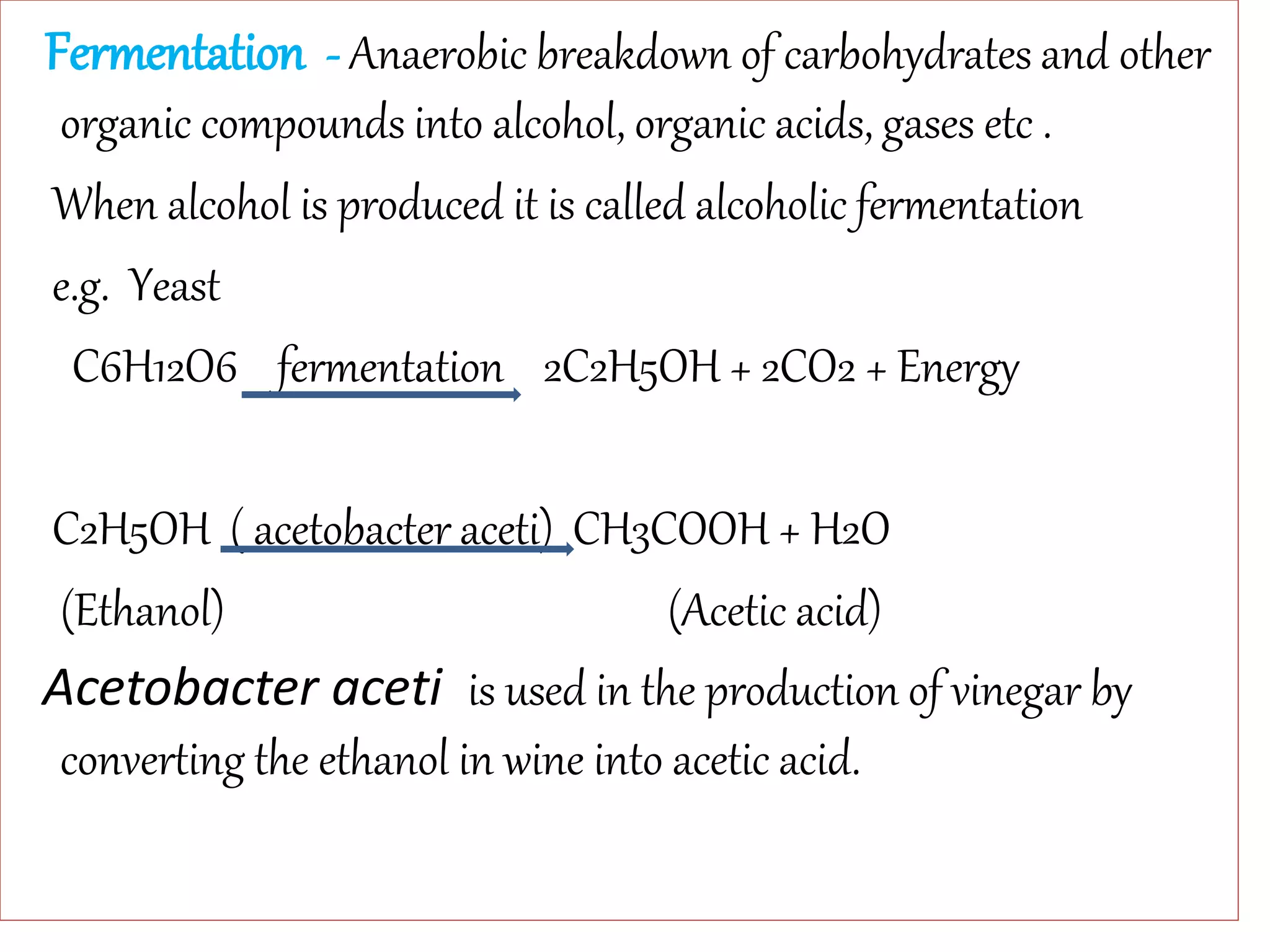
Fermentation - Anaerobic breakdown of carbohydrates and other
organic compounds into alcohol, organic acids, gases etc .
When alcohol is produced it is called alcoholic fermentation
e.g. Yeast
C6H12O6 fermentation 2C2H5OH + 2CO2 + Energy
C2H5OH ( acetobacter aceti) CH3COOH + H2O
(Ethanol) (Acetic acid)
Acetobacter aceti is used in the production of vinegar by
converting the ethanol in wine into acetic acid.
When lactic acid is produced as an end product then it is called
lactic acid fermentation e.g. Bacteria and parasitic worms
e.g. C6H12O6 2CH3CHOHCOOH + energy
(glucose) (lactic acid)
( The anaerobic respiration in human muscle tissue produces
lactic acid as an end product during vigorous physical exercise)
Types of aerobic respiration
Direct respiration
1. It is the exchange of oxygen
(of air) with CO2 of the body
cells
2. Without special respiratory
organs or blood e.g. aerobic
bacteria, plants, sponges
1. In this type special
respiratory organs like
skin, buccopharyngeal
lining, gills, and lungs
are used
2. It also involves the
blood
Indirect respiration
Cutaneous Respiration- Respiration in which skin is used
e.g. annelids, amphibians
Buccopharnygeal respiration- Respiration in which
buccopharyngeal lining is involved e.g. Frog, toad
Branchial respiration- It is exhibited by many annelids, most
crustaceans, molluscs and all fishes
Types of indirect respiration
External respiration
1. A physical process in which
an organism takes in oxygen
and gives out CO2
2. May involve respiratory
surface such as
integument,gills,trachea or
lungs
3. E.g. gas exchange between air
in the alveoli and blood in
pulmonary capillaries
Internal respiration
1. Also called tissue
respiration
2. Food is broken down into
simpler molecules within
the cells and energy is
produced
3. E.g. gas exchange between
tissue cells and the blood in
systemic capillaries
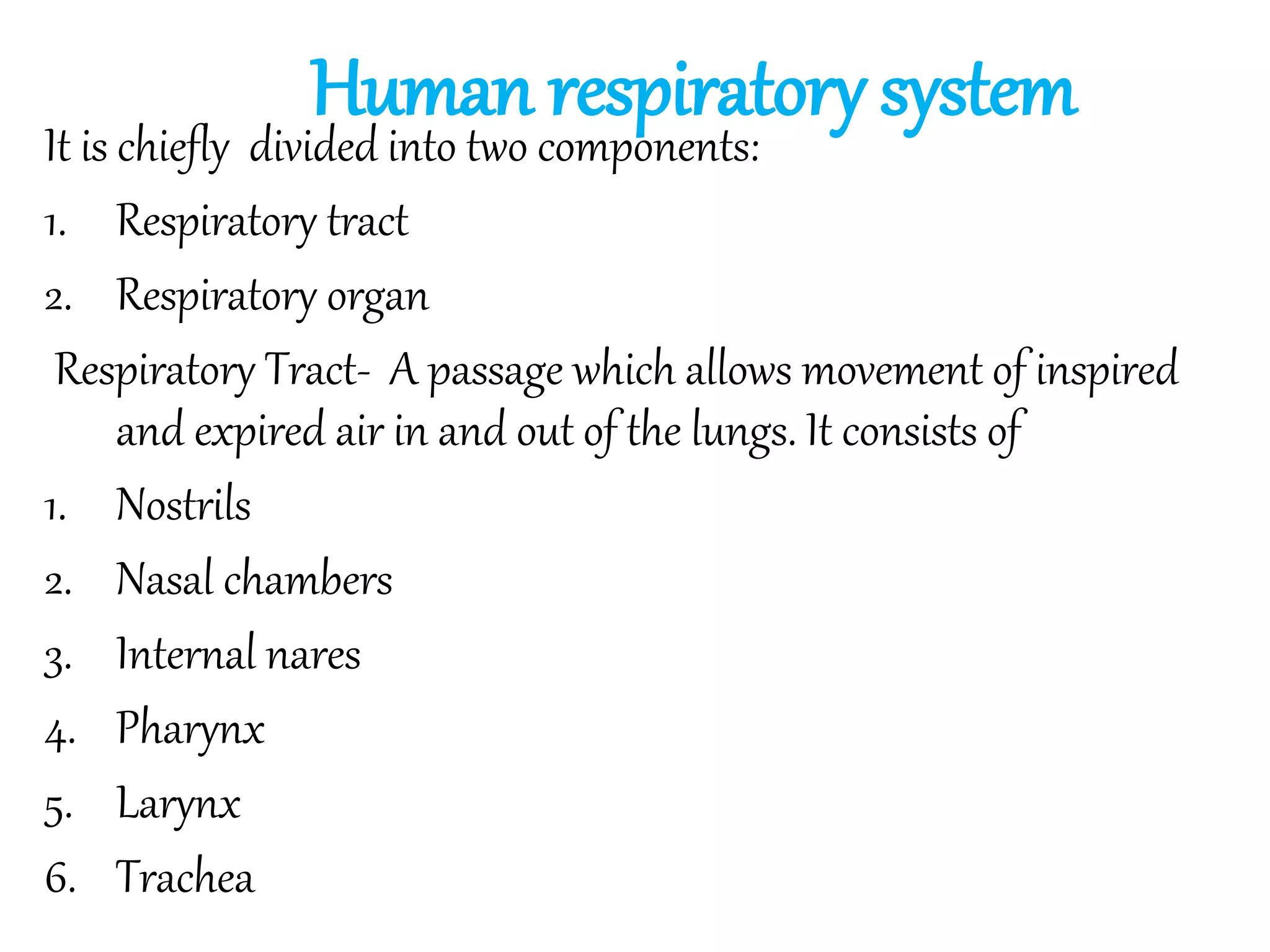
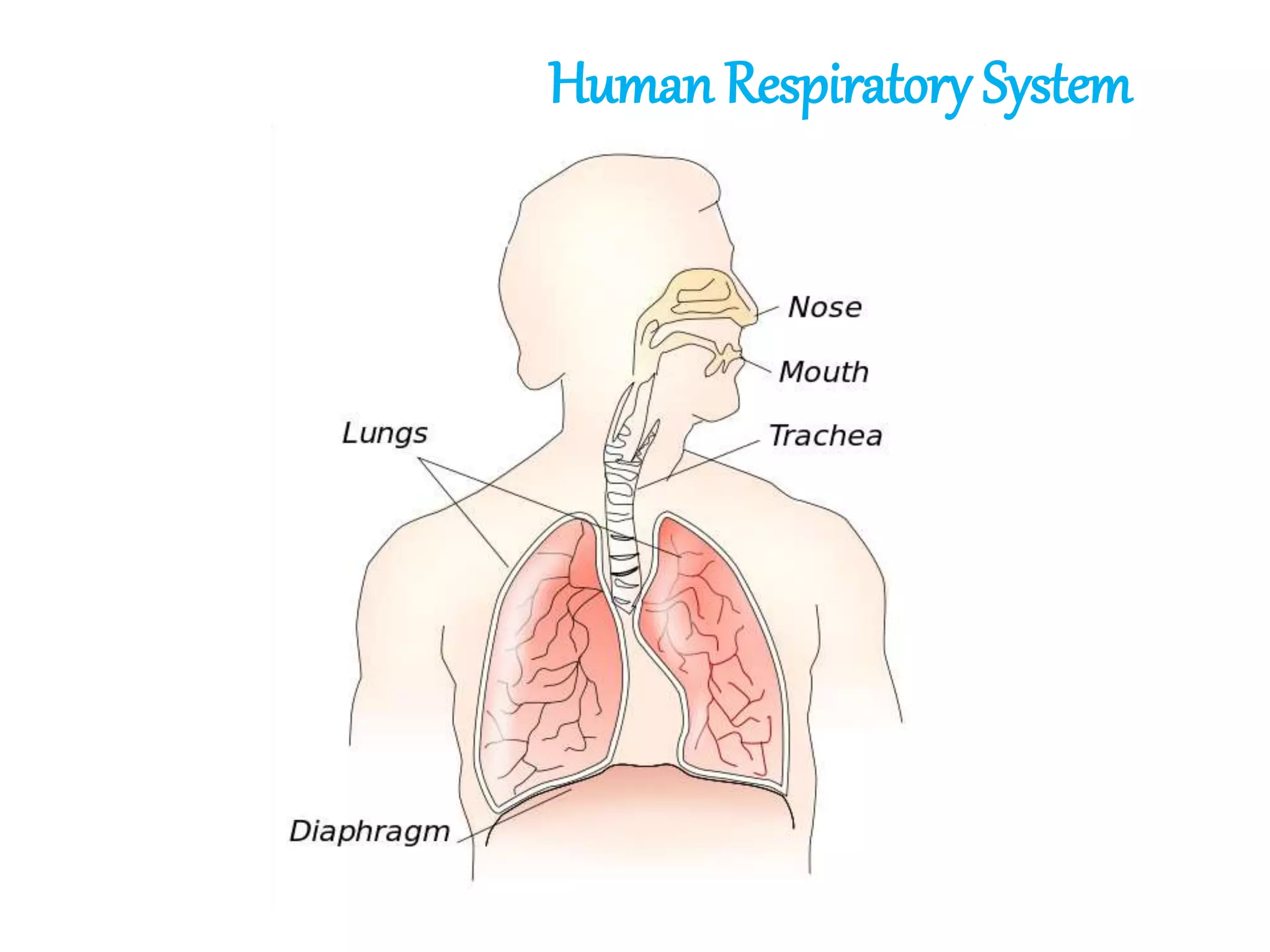
Human respiratory systemIt is chiefly divided into two components:
1. Respiratory tract
2. Respiratory organ
Respiratory Tract- A passage which allows movement of inspired
and expired air in and out of the lungs. It consists of
1. Nostrils
2. Nasal chambers
3. Internal nares
4. Pharynx
5. Larynx
6. Trachea
Human Respiratory System
1. Nostrils-The two nostrils are the openings of the nasal cavity
and lie above the mouth . They are separated by the septum
2. Nasal chambers- A pair of passages in the head above the
palate. They are separated from each other by a septum.
Each nasal chamber is divided into three regions:
1. Vestibular region
2. Respiratory region
3. Olfactory region
• Vestibular region- Lies within the external naris, short and lined by
hairy skin. Acts as a filter and prevents the entry of dust particles.
• Respiratory region- The middle region lined with respiratory
epithelium. Ciliated and rich in mucous glands.
• Olfactory region- The upper region of the nasal chamber, lined
with olfactory epithelium. Acts as an organ of smell.
3. Internal Nares-Openings of nasal chambers in the roof of
nasopharynx and are closed by uvula during swallowing.
4. Pharynx-. The pharynx (plural: pharynges) is the part of
the throat that is behind the mouth and nasal
cavity and above the esophagus and the larynx ( the
tubes going down to the stomach and the lungs)
A short vertical approx. 12cm long tube behind the buccal
cavity
It is divided into three parts:
1. Nasopharynx
2. Oropharynx
3. Larngyopharynx
Nasopharynx- Upper part of pharynx extends from the base of
the skull to the upper surface of the soft palate
Oropharynx- Middle part of pharynx in front of the buccal cavity
Laryngyopharynx- Lower part of pharynx, leads into two tubes the
trachea and the esophagus
5. Larynx- Often called Adam’s apple. More prominent in men than
in women
A cartilaginous box helps in sound production hence called sound
box . Enlarged upper end of the trachea situated in the neck on the
level of the 4th to the 6th cervical vertebrae.
Open into laryngopharynx by a slit like aperture called glottis
The glottis bears a leaf like cartilaginous flap called the epiglottis
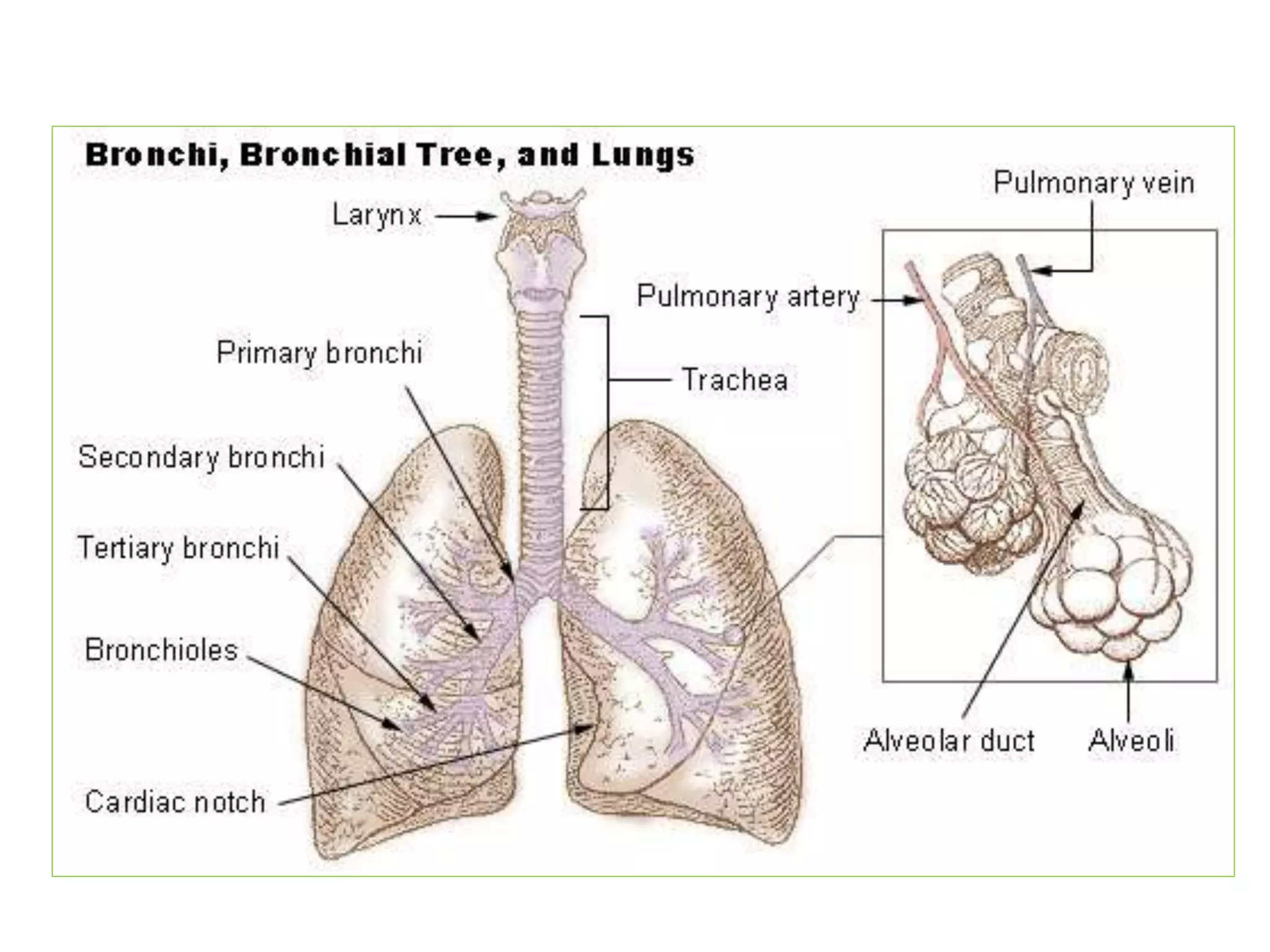
6. Trachea- or windpipe is approx 4 inches long, extends from
larynx to the middle of thoracic cavity where it divides into to
bronchi (the right and left primary bronchi)
• One major branch enters each lung. The right primary bronchus
divides into the secondary bronchi, which extends into two lobes of
the left lung.
• The secondary bronchi subdivides into smaller tertiary bronchi
and further into still smaller bronchioles.
• The small terminal bronchioles give off the respiratory bronchioles
which divide into alveolar ducts
This is called bronchial tree
The bronchial tree
The respiratory organs
• The main respiratory organs are a pair of lungs
• The branching network of bronchi, bronchioles and alveoli
comprise the lungs
• The lungs are two in number, fill the chest cavity lying one on each
side separated in the middle by heart
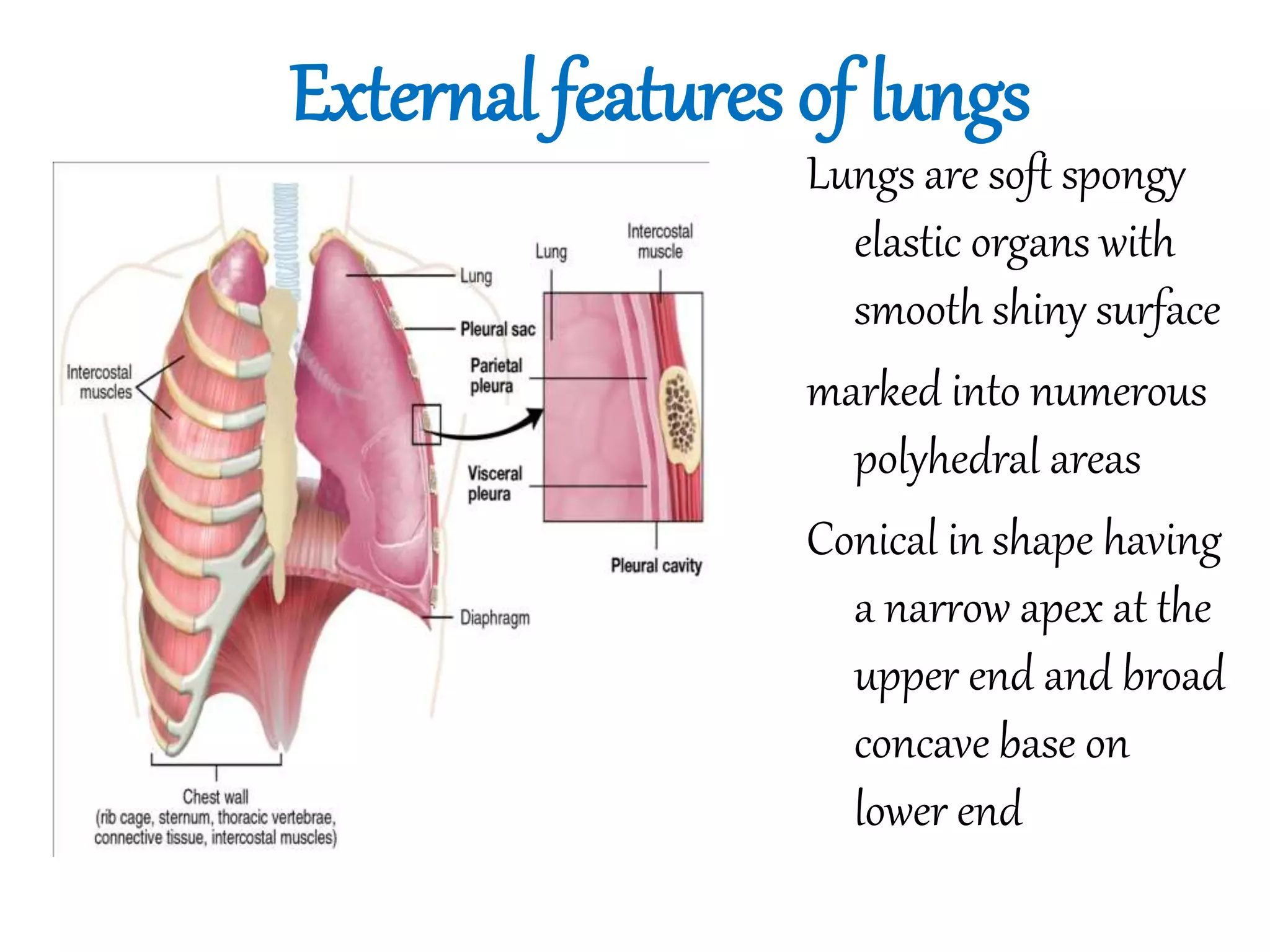
• Lungs are covered by a double layered pleura with pleural fluid in
between them
• This fluid acts as a lubricant permitting the lungs to move freely in
the thoracic cavity during breathing
Mediastinum- It is the space in the thoracic cavity between the two
lungs .It includes pleura of both the sides
The thoraciccavity- It is a hollow cavity and has two pleural
cavities each enclosing a lung
It is barrel shaped bounded at the back by backbone and
at the front by breast bone.
The sides are formed by the ribs
Diaphragm- A sheet of skeletal muscles, dome shaped muscular
partition separating thorax from abdomen anteriorly at rest and
attached to the lumber vertebrae and posteriorly to ribs performs
an important role in respiration
External features of lungs
Lungs are soft spongy
elastic organs with
smooth shiny surface
marked into numerous
polyhedral areas
Conical in shape having
a narrow apex at the
upper end and broad
concave base on
lower end
Lungs are divided into lobes by fissures
The right lung has three lobes while the left lung has two lobes
Each of these lobes is composed of a number of lobules
Lungs consist of bronchioles and alveoli and an extensive network of
blood vessels and the capillaries
The walls of the air sacs or alveoli are elastic and supplied with
capillaries from the pulmonary artery and are kept moist by
secretions to allow gases to diffuse.
It is done by the fluid produced by the walls of the alveoli
The surface tension of this fluid must be low else the alveoli may not
expand when air is inhaled
The fluid therefore contains a surfactant ( a detergent like substance)
to reduce surface tension
Pulmonary surfactants
Pulmonary surfactant is a mixture of lipids and proteins which is
secreted into the alveolar space by epithelial type II cells. The
main function of surfactant is to lower the surface tension at the
air/liquid boundary within the alveoli of the lung through
hydrophilic and hydrophobic forces.
Insufficient pulmonary surfactant in the alveoli can contribute to
collapse of part or all of the lung(atelectasis)
HUMAN LUNGS
In trachea and bronchi the goblet cells of the ciliated epithelium
produce the mucus.
It is a slimy solution containing glycoprotein's
glycoprotein's are able to trap inhaled particles e.g. pathogens
and dust
Chemical pollutants such as SO2 can dissolve in the mucus to
form an acidic solution that irritates the airways
The nasal passages have tiny hairs lining them as well
macrophages, phagocytic WBC’s patrol the surface of the air ways
remove particles such as bacteria
Mechanism of breathing
When we breathe in and out the chest goes up and down
This happens when
• We inhale the ribs move upward and outward
• Chest becomes bigger
• When we exhale , the ribs move downwards and inwards
• Chest becomes smaller
Lungs are present in the chest cavity
The ribs surround this cavity on the sides
A large muscle called diaphragm forms the floor of the chest cavity
During inhalation
• Ribs move out
• Diaphragm moves down
• Making the chest cavity bigger
• Air then rushes into the lungs and they inflate
During exhalation
• Ribs move downwards and inwards
• Diaphragm moves up
• Chest cavity is reduced
• Air rushes out of the lungs
• And the lungs grow smaller
THANK YOU
PREPARED BY
RITU.S

Human respiratory system

  • 2.
    Respiration Process which involvestaking in oxygen into the cells, using it for releasing energy by burning food and then eliminating the waste products like carbon dioxide and water from the body It is a catabolic process as the food is broken down into simpler form. In short, respiration is a biochemical activity taking place with in the protoplasm of the cell and results in the liberation of energy
  • 3.
    Breathing and Respiration BREATHING 1.Mechanism by which organisms obtain oxygen from the air and release carbon dioxide 2. It is a physical process 3. It involves lungs of the organism RESPIRATION 1. It includes breathing and oxidation of food in the cells of the organism to release energy 2. It is a biochemical process 3. It involves the mitochondria in the cells where food is oxidized to release energy
  • 4.
    Types of respiration AerobicrespirationAnaerobicrespiration 1. Oxygen is required 2. Such organisms are called aerobes 3. Occurs in mitochondria 4. Involves the process of glycolysis where glucose is broken down to pyruvic acid 5. Pyruvate is converted to CO2, water and energy by Krebs cycle C6H12O6 + 6O2 6CO2 + 6H2O + energy 6. 38 ATP is generated 7. Occurs in all higher organisms 1. Oxygen is not required 2. Process is called anaerobiosis 3. It invovles the process of glycolysis in the cytoplasm. 4. It is the metabolic pathway that converts glucose C6H12O6, into pyruvate CH3COCOO− + H+. 1. The free energy released in this process is used to form the high-energy molecules ATP and NADH . 2. Pyruvate then enters different pathways and forms different products 3. Generally found in micro organisms , yeast and parasitic worms (prokaryotes)
  • 6.
    Fermentation - Anaerobicbreakdown of carbohydrates and other organic compounds into alcohol, organic acids, gases etc . When alcohol is produced it is called alcoholic fermentation e.g. Yeast C6H12O6 fermentation 2C2H5OH + 2CO2 + Energy C2H5OH ( acetobacter aceti) CH3COOH + H2O (Ethanol) (Acetic acid) Acetobacter aceti is used in the production of vinegar by converting the ethanol in wine into acetic acid.
  • 7.
    When lactic acidis produced as an end product then it is called lactic acid fermentation e.g. Bacteria and parasitic worms e.g. C6H12O6 2CH3CHOHCOOH + energy (glucose) (lactic acid) ( The anaerobic respiration in human muscle tissue produces lactic acid as an end product during vigorous physical exercise)
  • 8.
    Types of aerobicrespiration Direct respiration 1. It is the exchange of oxygen (of air) with CO2 of the body cells 2. Without special respiratory organs or blood e.g. aerobic bacteria, plants, sponges 1. In this type special respiratory organs like skin, buccopharyngeal lining, gills, and lungs are used 2. It also involves the blood Indirect respiration
  • 9.
    Cutaneous Respiration- Respirationin which skin is used e.g. annelids, amphibians Buccopharnygeal respiration- Respiration in which buccopharyngeal lining is involved e.g. Frog, toad Branchial respiration- It is exhibited by many annelids, most crustaceans, molluscs and all fishes
  • 10.
    Types of indirectrespiration External respiration 1. A physical process in which an organism takes in oxygen and gives out CO2 2. May involve respiratory surface such as integument,gills,trachea or lungs 3. E.g. gas exchange between air in the alveoli and blood in pulmonary capillaries Internal respiration 1. Also called tissue respiration 2. Food is broken down into simpler molecules within the cells and energy is produced 3. E.g. gas exchange between tissue cells and the blood in systemic capillaries
  • 11.
    Human respiratory systemItis chiefly divided into two components: 1. Respiratory tract 2. Respiratory organ Respiratory Tract- A passage which allows movement of inspired and expired air in and out of the lungs. It consists of 1. Nostrils 2. Nasal chambers 3. Internal nares 4. Pharynx 5. Larynx 6. Trachea
  • 12.
  • 13.
    1. Nostrils-The twonostrils are the openings of the nasal cavity and lie above the mouth . They are separated by the septum 2. Nasal chambers- A pair of passages in the head above the palate. They are separated from each other by a septum. Each nasal chamber is divided into three regions: 1. Vestibular region 2. Respiratory region 3. Olfactory region
  • 14.
    • Vestibular region-Lies within the external naris, short and lined by hairy skin. Acts as a filter and prevents the entry of dust particles. • Respiratory region- The middle region lined with respiratory epithelium. Ciliated and rich in mucous glands. • Olfactory region- The upper region of the nasal chamber, lined with olfactory epithelium. Acts as an organ of smell.
  • 15.
    3. Internal Nares-Openingsof nasal chambers in the roof of nasopharynx and are closed by uvula during swallowing. 4. Pharynx-. The pharynx (plural: pharynges) is the part of the throat that is behind the mouth and nasal cavity and above the esophagus and the larynx ( the tubes going down to the stomach and the lungs) A short vertical approx. 12cm long tube behind the buccal cavity It is divided into three parts: 1. Nasopharynx 2. Oropharynx 3. Larngyopharynx
  • 17.
    Nasopharynx- Upper partof pharynx extends from the base of the skull to the upper surface of the soft palate Oropharynx- Middle part of pharynx in front of the buccal cavity Laryngyopharynx- Lower part of pharynx, leads into two tubes the trachea and the esophagus 5. Larynx- Often called Adam’s apple. More prominent in men than in women A cartilaginous box helps in sound production hence called sound box . Enlarged upper end of the trachea situated in the neck on the level of the 4th to the 6th cervical vertebrae. Open into laryngopharynx by a slit like aperture called glottis The glottis bears a leaf like cartilaginous flap called the epiglottis
  • 19.
    6. Trachea- orwindpipe is approx 4 inches long, extends from larynx to the middle of thoracic cavity where it divides into to bronchi (the right and left primary bronchi) • One major branch enters each lung. The right primary bronchus divides into the secondary bronchi, which extends into two lobes of the left lung. • The secondary bronchi subdivides into smaller tertiary bronchi and further into still smaller bronchioles. • The small terminal bronchioles give off the respiratory bronchioles which divide into alveolar ducts This is called bronchial tree The bronchial tree
  • 20.
    The respiratory organs •The main respiratory organs are a pair of lungs • The branching network of bronchi, bronchioles and alveoli comprise the lungs • The lungs are two in number, fill the chest cavity lying one on each side separated in the middle by heart • Lungs are covered by a double layered pleura with pleural fluid in between them • This fluid acts as a lubricant permitting the lungs to move freely in the thoracic cavity during breathing
  • 21.
    Mediastinum- It isthe space in the thoracic cavity between the two lungs .It includes pleura of both the sides The thoraciccavity- It is a hollow cavity and has two pleural cavities each enclosing a lung It is barrel shaped bounded at the back by backbone and at the front by breast bone. The sides are formed by the ribs Diaphragm- A sheet of skeletal muscles, dome shaped muscular partition separating thorax from abdomen anteriorly at rest and attached to the lumber vertebrae and posteriorly to ribs performs an important role in respiration
  • 22.
    External features oflungs Lungs are soft spongy elastic organs with smooth shiny surface marked into numerous polyhedral areas Conical in shape having a narrow apex at the upper end and broad concave base on lower end
  • 23.
    Lungs are dividedinto lobes by fissures The right lung has three lobes while the left lung has two lobes Each of these lobes is composed of a number of lobules Lungs consist of bronchioles and alveoli and an extensive network of blood vessels and the capillaries The walls of the air sacs or alveoli are elastic and supplied with capillaries from the pulmonary artery and are kept moist by secretions to allow gases to diffuse. It is done by the fluid produced by the walls of the alveoli The surface tension of this fluid must be low else the alveoli may not expand when air is inhaled The fluid therefore contains a surfactant ( a detergent like substance) to reduce surface tension
  • 24.
    Pulmonary surfactants Pulmonary surfactantis a mixture of lipids and proteins which is secreted into the alveolar space by epithelial type II cells. The main function of surfactant is to lower the surface tension at the air/liquid boundary within the alveoli of the lung through hydrophilic and hydrophobic forces. Insufficient pulmonary surfactant in the alveoli can contribute to collapse of part or all of the lung(atelectasis)
  • 25.
  • 26.
    In trachea andbronchi the goblet cells of the ciliated epithelium produce the mucus. It is a slimy solution containing glycoprotein's glycoprotein's are able to trap inhaled particles e.g. pathogens and dust Chemical pollutants such as SO2 can dissolve in the mucus to form an acidic solution that irritates the airways The nasal passages have tiny hairs lining them as well macrophages, phagocytic WBC’s patrol the surface of the air ways remove particles such as bacteria
  • 27.
    Mechanism of breathing Whenwe breathe in and out the chest goes up and down This happens when • We inhale the ribs move upward and outward • Chest becomes bigger • When we exhale , the ribs move downwards and inwards • Chest becomes smaller Lungs are present in the chest cavity The ribs surround this cavity on the sides A large muscle called diaphragm forms the floor of the chest cavity
  • 28.
    During inhalation • Ribsmove out • Diaphragm moves down • Making the chest cavity bigger • Air then rushes into the lungs and they inflate During exhalation • Ribs move downwards and inwards • Diaphragm moves up • Chest cavity is reduced • Air rushes out of the lungs • And the lungs grow smaller
  • 29.