Bones support and protect vital organs of the body and is dynamic (constantly changing)
Bones provide anchoring attachments for the skeletal muscles.   These muscles then move the bones to allow body movement.
Osteology  is the study of bones.
Orthopedics  deals with traumatic musculoskeletal injuries (not just broken bones). The name comes from its history—it was established as a means of correcting deformities in children.
 
Sesamoid bone
Sesamoid bones
Patella  is a sesamoid bone that develops over time
Locations where  cartilage  is found
 
Cartilage  helps support structures in the respiratory tract.
Cartilage  provides a gliding surface at articulations (joints) were two bones meet.
Cartilage  can serve as model for later bone development.
 
Hyaline cartilage  contributes to the structures of the respiratory tract, fetal skeleton, growth plates, and joints.
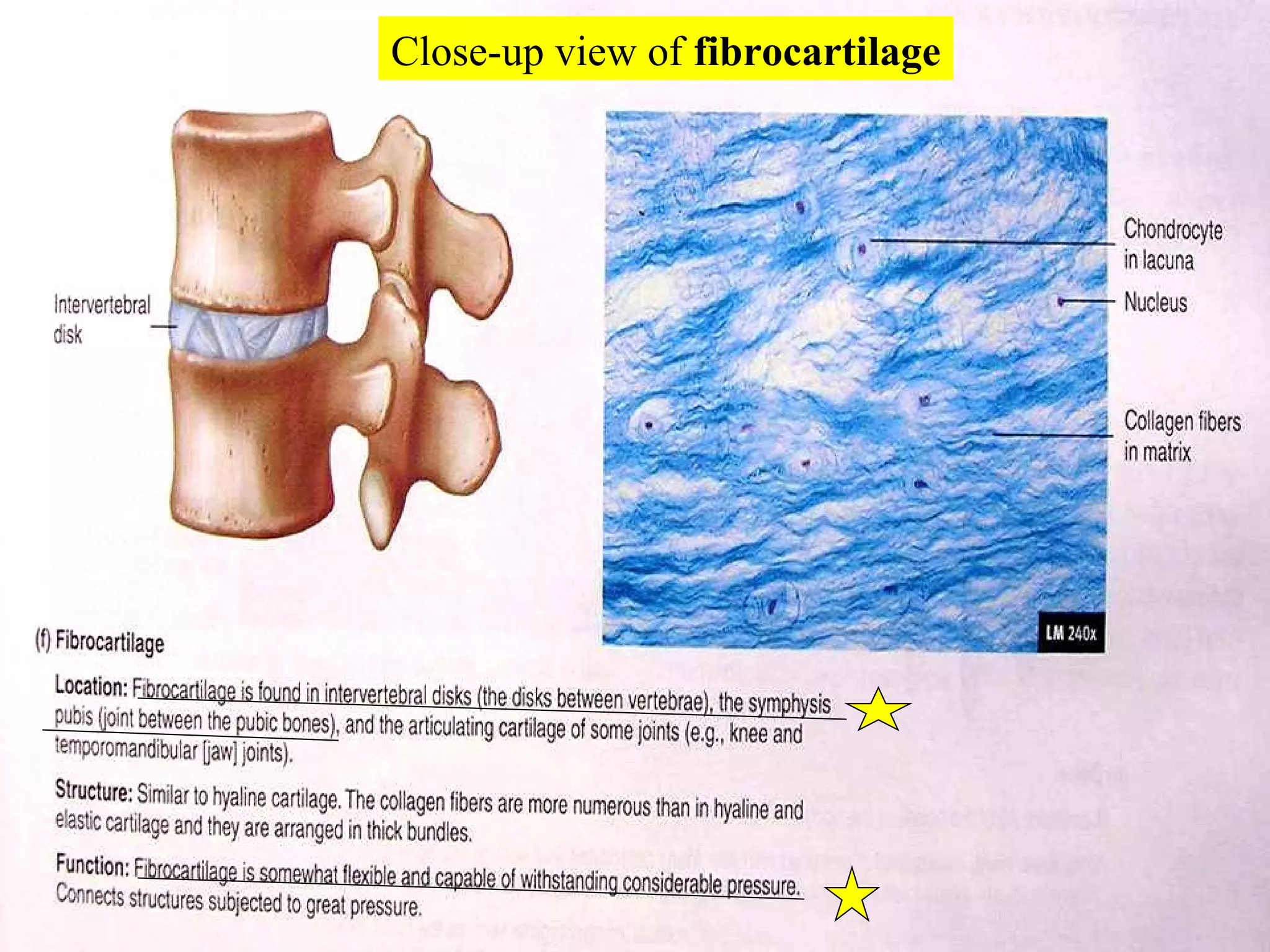
Close-up view of  fibrocartilage
Elastic cartilage
WHICH OF THE FOLLOWING  IS CORRECT  ABOUT CARTILAGE? A IS USED TO MAKE FINGERNAILS B IS FOUND IN THE PERITONEAL CAVITY C IS FOUND IN THE MEDIASTINUM D IS FOUND IN THE DORSAL BODY CAVITY E ALL OF THE ABOVE
Each bone is an organ  because it contains numerous types of tissue, including vascular, nervous, connective, muscular, cartilage, and osseous.
Bones allow movement by acting as levers
Hematopoiesis  (hemopoiesis) occurs within the active (red) marrow of the adult sternum, vertebrae, pelvis (ossa coxae), and proximal ends of bones of thigh and upper arm.
 
Hematopoiesis  in an adult occurs in the red marrow of the skull, sternum, vertebrae, pelvis (ossa coxae), and proximal epiphyses of the thigh bones and upper arm bones.
 
 
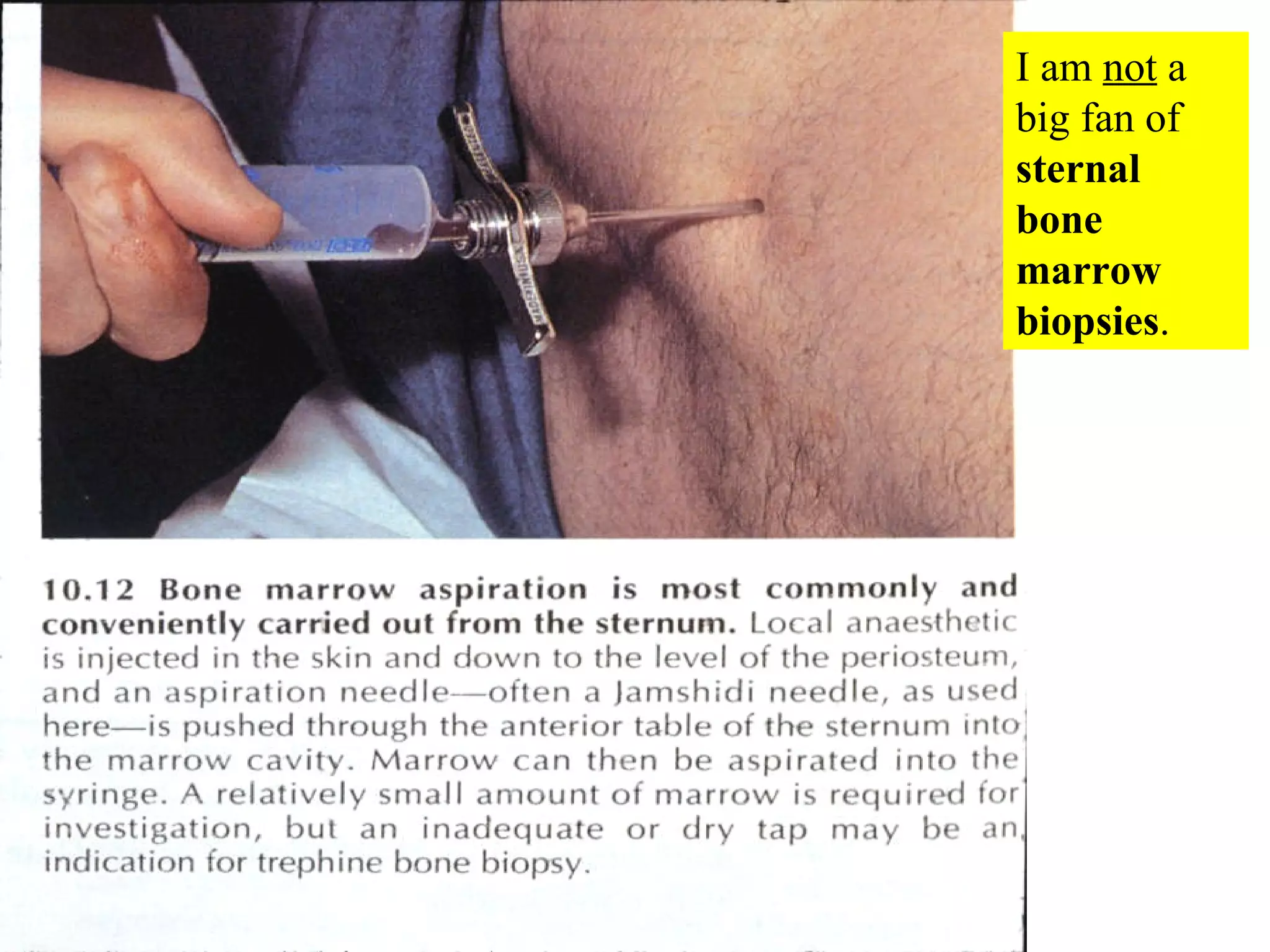
I am  not  a big fan of  sternal bone marrow biopsies .
Posterior portion of the ilium is better
Method of bone marrow biopsy  utilizing the posterior pelvis (ossa coxae)
 
 
Bones are mineral storage deposits  for calcium, phosphate, magnesium, and sodium salts. Withdrawals and deposits are constant.
90-95% of your calcium and phosphorous stored in bones, as well as magnesium and sodium salts Minerals give bone its strength Minerals are needed for blood clotting, muscle contraction, ATP synthesis, etc.
Yellow marrow  is inactive and is found in the central shaft.  Red marrow  is active and is found in the spongy bone at the proximal ends of long bones of arm and thigh, etc.
Osso bucco anyone?
Bones vary in shape and size
Shapes of Bones
The central shaft of a long bone is called the  diaphysis The ends of a long bone are called the  epiphyses
 
Each epiphysis is covered with smooth, slippery  hyaline cartilage . Note  nutrient foramen  that allows passage of blood vessels to keep bone alive.
 
 
Pulling stress on the  periosteum  causes and increase in bone  width.
The  epiphyseal growth plate  allows long bones to increase in  length .
Hyaline cartilage
Human growth hormone,  produced by the anterior portion of the pituitary, stimulates the mitotic activity of the epiphyseal growth plate.
Fracture through epiphyseal growth plate .  This can lead to premature ossification
Eventually the epiphyseal growth plate ossifies  and is replaced with an  epiphyseal line
Osteoblasts  secrete osteoid, which later becomes bone
Osteoclasts  break down bone
Osteoclast  in action breaking down bone osteocytes
Structurally unstable bones of the skull. Read about  Paget disease  of bone (osteitis deformans) in the  clinical view  in the text.
Ilizarov apparatus
WHICH OF THE FOLLOWING  IS FALSE  ABOUT LONG BONES? A THEY ARE FOUND IN THE CRURAL REGION B THE DIAPHYSIS IS SURROUNDED BY THE  EPIPHYSES C THEY MAY BE ELONGATED WITH AN  ILLIZAROV DEVICE D THEY ARE DERIVED FROM A CARTILAGE  MODEL E THEY ARE INVOLVED IN HEMOPOIESIS IN  INFANTS, BUT NOT IN ADULTS
Cross-section through long bone showing medullary cavity Bone consists of  organic components  (cells, collagen fibers, and ground substance) and  inorganic components  (calcium compounds, phosphorus, sodium, magnesium, sulfate, and fluoride).
Bone can be organized as either  spongy  (cancellous) bone or as  compact  (dense) bone. Compact bone Spongy bone
The spongy bone found between the layers of compact bone in the skull is called  diplo ë
If only the outer compact bone is broken, the inner layer of compact bone will still protect the brain.
Intramembranous ossification  (shown in gold) leads to formation of flat bones of skull, zygomatic (cheek) bone, maxilla (upper jaw), mandible (lower jaw),  collar bone (clavicle), and sesamoid bones.
Most bones develop by  endochondral ossification   (red areas).  The gray areas show bones developing by intramembranous ossification.
x Start of endochondral ossification
Continuation of endochondral ossification
A growing child
A growing adolescent
An adult
Finger bones of a juvenile bat
Finger bones of an adult bat
Read about forensic anthropology in the  clinical view  in your text
Read about  achondroplastic dwarfism  in the  clinical view  in your text.
Pulling stress on the periosteum stimulates osteoblasts which causes bones to increase in  width.
Remains of victims of Pompeii after overlying ash is removed
How could anthropologists distinguish Roman soldiers based solely on their arm bones?
Osteoclasts dissolve bone tissue adjacent to the medullary cavity so this cavity maintains an  appropriate size  for the increase in bone growth
Dental braces  can cause remodeling of the surrounding bone by increasing the activity of osteoclasts and osteoblasts.
 
Traction (Ilizarov method is shown)  can also stimulate osteoblasts to fill in gaps in long bones.
Blood vessels  bring oxygen and nutrients to the metabolically-active bone cells.  Nerves  also enter the bone and can signal injuries to the bone.
Hormones  produced by several glands can directly, or indirectly, influence bone growth.
Vitamin A  stimulates osteoblasts,  Vitamin C  is needed to synthesize collagen, and  Vitamin D  aides in the intestinal absorption of calcium and phosphate.
Read about  rickets  in the  clinical view  in your text.
Paralyzed persons, such as Christopher Reeve, suffer  loss of bone mass and weakened bones  because of lack of pulling stress on the periosteum.
Astronauts suffer loss of bone mass and weakened bones  because lack of pulling stress on the periosteum.
NASA just sent up a $5 million treadmill named the COLBERT (after the comedian Stephen Colbert)
 
 
Bears show very little bone loss during hibernation—if we could figure out how they do that it could really help astronauts and also bedridden patients.
Read about how  bone scans  can reveal the health of bones in the  clinical view  in your text.
A  fracture  is a cracking of the bone.  This is a view of a broken bone as viewed in an X-ray image.
The discoverer of X-rays.
X-rays  are used by radiologists to diagnose bone fractures and  many  other problems inside the body.
 
 
Most  bone fractures are the result of traumatic injury
Closed fracture of the tibia  after fall on trampoline
Open fracture of the femur .  Open fractures of the femur, or even closed fractures of the femur, can be associated with life-threatening blood loss.
 
 
Greenstick fractures  are almost exclusively limited to children since their bones are not completely ossified.
Greenstick fracture of the fibula.  Note also the epiphyseal growth plates.
Depressed skull fracture
Displaced fracture  of the head of the humerus
Nondisplaced spiral fracture of the tibia .  Note also the epiphyseal growth plates.  This child jumped off the kitchen counter while spinning and then planted her foot on the linoleum floor.
Fractures heal best when the bones are returned to proper anatomical position and then  immobilized  in place.
Immobilization may involve plates and screws in addition to a cast.
If you have a cast, be sure it matches your style!
Sequence of events in healing following a bone fracture
Distinctive bone markings or surface features
Surface features of bone
Crest
Epicondyle Condyle
Process
Spine
Tubercle & Tuberosity
Trochanter
 
Surface features of bone
Aging  causes bones to become more brittle and they tend to demineralize resulting in insufficient ossification (osteopenia).  Aging causes all persons to become slightly osteopenic.
Read about  osteoporosis  in the  clinical view  in your text
Next section: the Skull

03 Cartilage And Bone Connective Tissue

  • 1.
  • 2.
    Bones support andprotect vital organs of the body and is dynamic (constantly changing)
  • 3.
    Bones provide anchoringattachments for the skeletal muscles. These muscles then move the bones to allow body movement.
  • 4.
    Osteology isthe study of bones.
  • 5.
    Orthopedics dealswith traumatic musculoskeletal injuries (not just broken bones). The name comes from its history—it was established as a means of correcting deformities in children.
  • 6.
  • 7.
  • 8.
  • 9.
    Patella isa sesamoid bone that develops over time
  • 10.
    Locations where cartilage is found
  • 11.
  • 12.
    Cartilage helpssupport structures in the respiratory tract.
  • 13.
    Cartilage providesa gliding surface at articulations (joints) were two bones meet.
  • 14.
    Cartilage canserve as model for later bone development.
  • 15.
  • 16.
    Hyaline cartilage contributes to the structures of the respiratory tract, fetal skeleton, growth plates, and joints.
  • 17.
    Close-up view of fibrocartilage
  • 18.
  • 19.
    WHICH OF THEFOLLOWING IS CORRECT ABOUT CARTILAGE? A IS USED TO MAKE FINGERNAILS B IS FOUND IN THE PERITONEAL CAVITY C IS FOUND IN THE MEDIASTINUM D IS FOUND IN THE DORSAL BODY CAVITY E ALL OF THE ABOVE
  • 20.
    Each bone isan organ because it contains numerous types of tissue, including vascular, nervous, connective, muscular, cartilage, and osseous.
  • 21.
    Bones allow movementby acting as levers
  • 22.
    Hematopoiesis (hemopoiesis)occurs within the active (red) marrow of the adult sternum, vertebrae, pelvis (ossa coxae), and proximal ends of bones of thigh and upper arm.
  • 23.
  • 24.
    Hematopoiesis inan adult occurs in the red marrow of the skull, sternum, vertebrae, pelvis (ossa coxae), and proximal epiphyses of the thigh bones and upper arm bones.
  • 25.
  • 26.
  • 27.
    I am not a big fan of sternal bone marrow biopsies .
  • 28.
    Posterior portion ofthe ilium is better
  • 29.
    Method of bonemarrow biopsy utilizing the posterior pelvis (ossa coxae)
  • 30.
  • 31.
  • 32.
    Bones are mineralstorage deposits for calcium, phosphate, magnesium, and sodium salts. Withdrawals and deposits are constant.
  • 33.
    90-95% of yourcalcium and phosphorous stored in bones, as well as magnesium and sodium salts Minerals give bone its strength Minerals are needed for blood clotting, muscle contraction, ATP synthesis, etc.
  • 34.
    Yellow marrow is inactive and is found in the central shaft. Red marrow is active and is found in the spongy bone at the proximal ends of long bones of arm and thigh, etc.
  • 35.
  • 36.
    Bones vary inshape and size
  • 37.
  • 38.
    The central shaftof a long bone is called the diaphysis The ends of a long bone are called the epiphyses
  • 39.
  • 40.
    Each epiphysis iscovered with smooth, slippery hyaline cartilage . Note nutrient foramen that allows passage of blood vessels to keep bone alive.
  • 41.
  • 42.
  • 43.
    Pulling stress onthe periosteum causes and increase in bone width.
  • 44.
    The epiphysealgrowth plate allows long bones to increase in length .
  • 45.
  • 46.
    Human growth hormone, produced by the anterior portion of the pituitary, stimulates the mitotic activity of the epiphyseal growth plate.
  • 47.
    Fracture through epiphysealgrowth plate . This can lead to premature ossification
  • 48.
    Eventually the epiphysealgrowth plate ossifies and is replaced with an epiphyseal line
  • 49.
    Osteoblasts secreteosteoid, which later becomes bone
  • 50.
  • 51.
    Osteoclast inaction breaking down bone osteocytes
  • 52.
    Structurally unstable bonesof the skull. Read about Paget disease of bone (osteitis deformans) in the clinical view in the text.
  • 53.
  • 54.
    WHICH OF THEFOLLOWING IS FALSE ABOUT LONG BONES? A THEY ARE FOUND IN THE CRURAL REGION B THE DIAPHYSIS IS SURROUNDED BY THE EPIPHYSES C THEY MAY BE ELONGATED WITH AN ILLIZAROV DEVICE D THEY ARE DERIVED FROM A CARTILAGE MODEL E THEY ARE INVOLVED IN HEMOPOIESIS IN INFANTS, BUT NOT IN ADULTS
  • 55.
    Cross-section through longbone showing medullary cavity Bone consists of organic components (cells, collagen fibers, and ground substance) and inorganic components (calcium compounds, phosphorus, sodium, magnesium, sulfate, and fluoride).
  • 56.
    Bone can beorganized as either spongy (cancellous) bone or as compact (dense) bone. Compact bone Spongy bone
  • 57.
    The spongy bonefound between the layers of compact bone in the skull is called diplo ë
  • 58.
    If only theouter compact bone is broken, the inner layer of compact bone will still protect the brain.
  • 59.
    Intramembranous ossification (shown in gold) leads to formation of flat bones of skull, zygomatic (cheek) bone, maxilla (upper jaw), mandible (lower jaw), collar bone (clavicle), and sesamoid bones.
  • 60.
    Most bones developby endochondral ossification (red areas). The gray areas show bones developing by intramembranous ossification.
  • 61.
    x Start ofendochondral ossification
  • 62.
  • 63.
  • 64.
  • 65.
  • 66.
    Finger bones ofa juvenile bat
  • 67.
    Finger bones ofan adult bat
  • 68.
    Read about forensicanthropology in the clinical view in your text
  • 69.
    Read about achondroplastic dwarfism in the clinical view in your text.
  • 70.
    Pulling stress onthe periosteum stimulates osteoblasts which causes bones to increase in width.
  • 71.
    Remains of victimsof Pompeii after overlying ash is removed
  • 72.
    How could anthropologistsdistinguish Roman soldiers based solely on their arm bones?
  • 73.
    Osteoclasts dissolve bonetissue adjacent to the medullary cavity so this cavity maintains an appropriate size for the increase in bone growth
  • 74.
    Dental braces can cause remodeling of the surrounding bone by increasing the activity of osteoclasts and osteoblasts.
  • 75.
  • 76.
    Traction (Ilizarov methodis shown) can also stimulate osteoblasts to fill in gaps in long bones.
  • 77.
    Blood vessels bring oxygen and nutrients to the metabolically-active bone cells. Nerves also enter the bone and can signal injuries to the bone.
  • 78.
    Hormones producedby several glands can directly, or indirectly, influence bone growth.
  • 79.
    Vitamin A stimulates osteoblasts, Vitamin C is needed to synthesize collagen, and Vitamin D aides in the intestinal absorption of calcium and phosphate.
  • 80.
    Read about rickets in the clinical view in your text.
  • 81.
    Paralyzed persons, suchas Christopher Reeve, suffer loss of bone mass and weakened bones because of lack of pulling stress on the periosteum.
  • 82.
    Astronauts suffer lossof bone mass and weakened bones because lack of pulling stress on the periosteum.
  • 83.
    NASA just sentup a $5 million treadmill named the COLBERT (after the comedian Stephen Colbert)
  • 84.
  • 85.
  • 86.
    Bears show verylittle bone loss during hibernation—if we could figure out how they do that it could really help astronauts and also bedridden patients.
  • 87.
    Read about how bone scans can reveal the health of bones in the clinical view in your text.
  • 88.
    A fracture is a cracking of the bone. This is a view of a broken bone as viewed in an X-ray image.
  • 89.
  • 90.
    X-rays areused by radiologists to diagnose bone fractures and many other problems inside the body.
  • 91.
  • 92.
  • 93.
    Most bonefractures are the result of traumatic injury
  • 94.
    Closed fracture ofthe tibia after fall on trampoline
  • 95.
    Open fracture ofthe femur . Open fractures of the femur, or even closed fractures of the femur, can be associated with life-threatening blood loss.
  • 96.
  • 97.
  • 98.
    Greenstick fractures are almost exclusively limited to children since their bones are not completely ossified.
  • 99.
    Greenstick fracture ofthe fibula. Note also the epiphyseal growth plates.
  • 100.
  • 101.
    Displaced fracture of the head of the humerus
  • 102.
    Nondisplaced spiral fractureof the tibia . Note also the epiphyseal growth plates. This child jumped off the kitchen counter while spinning and then planted her foot on the linoleum floor.
  • 103.
    Fractures heal bestwhen the bones are returned to proper anatomical position and then immobilized in place.
  • 104.
    Immobilization may involveplates and screws in addition to a cast.
  • 105.
    If you havea cast, be sure it matches your style!
  • 106.
    Sequence of eventsin healing following a bone fracture
  • 107.
    Distinctive bone markingsor surface features
  • 108.
  • 109.
  • 110.
  • 111.
  • 112.
  • 113.
  • 114.
  • 115.
  • 116.
  • 117.
  • 118.
    Aging causesbones to become more brittle and they tend to demineralize resulting in insufficient ossification (osteopenia). Aging causes all persons to become slightly osteopenic.
  • 119.
    Read about osteoporosis in the clinical view in your text
  • 120.