CLASSIFICATION &
CHARACTERISTICS OF
HUMAN S
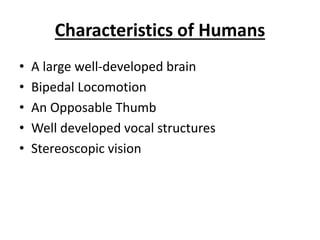
Characteristics of Humans
• A large well-developed brain
• Bipedal Locomotion
• An Opposable Thumb
• Well developed vocal structures
• Stereoscopic vision
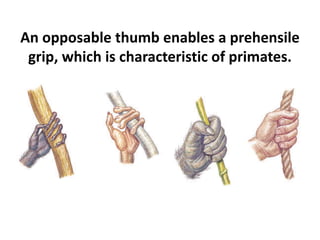
An opposable thumb enables a prehensile
grip, which is characteristic of primates.
BODY ORGANIZATION
•Cellular Level
•Tissue Level
•Organ Level
•System Level
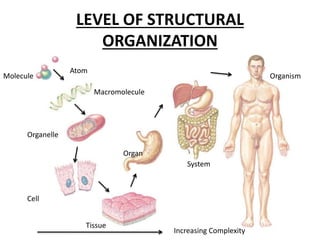
LEVEL OF STRUCTURAL
ORGANIZATION
Atom
Molecule
Macromolecule
Organelle
Cell
Tissue
Organ
System
Organism
Increasing Complexity
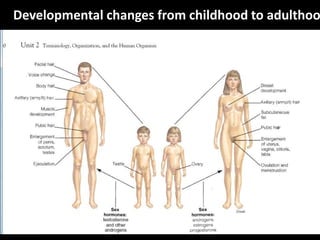
Developmental changes from childhood to adulthoo
Anatomical Nomenclature
Planes of Reference
Frontal
Sagittal
Transverse
Descriptive Terminology
Anatomical Position
Directional Terms
Clinical Procedures
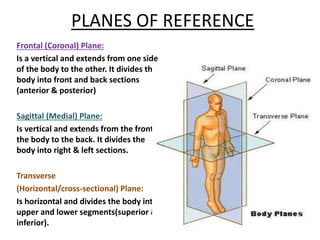
PLANES OF REFERENCE
Frontal (Coronal) Plane:
Is a vertical and extends from one side
of the body to the other. It divides the
body into front and back sections
(anterior & posterior)
Sagittal (Medial) Plane:
Is vertical and extends from the front of
the body to the back. It divides the
body into right & left sections.
Transverse
(Horizontal/cross-sectional) Plane:
Is horizontal and divides the body into
upper and lower segments(superior &
inferior).
Descriptive Terminology
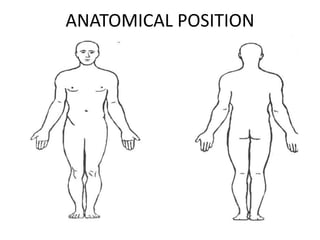
ANATOMICAL POSITION
• In anatomical position body is erect,
feets are parallel to each other & flat on
floor, the eyes are directed forward, and
the arms are at the side of body with the
palms of the hand turned forward and
fingers. pointed straight down
ANATOMICAL POSITION
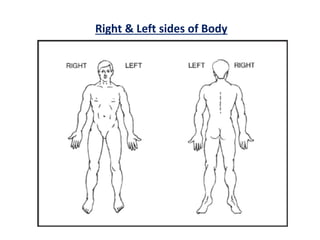
Right & Left sides of Body
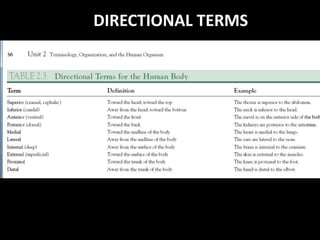
DIRECTIONAL TERMS
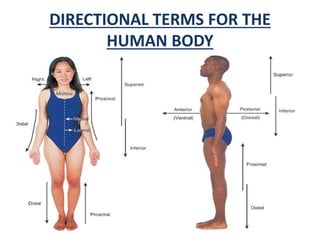
DIRECTIONAL TERMS FOR THE
HUMAN BODY
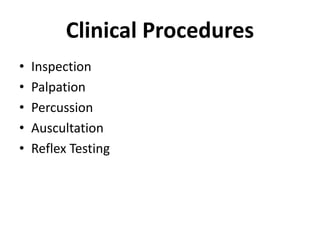
Clinical Procedures
• Inspection
• Palpation
• Percussion
• Auscultation
• Reflex Testing
SINGULAR & PLURAL FORMS OF BODY TERMINOLOG
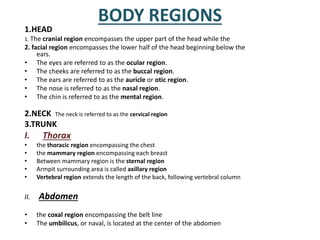
BODY REGIONS
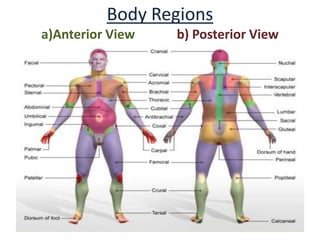
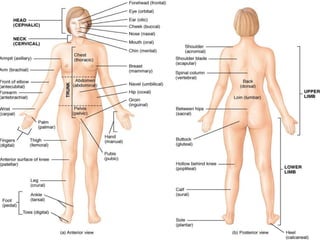
1.HEAD
1. The cranial region encompasses the upper part of the head while the
2. facial region encompasses the lower half of the head beginning below the
ears.
• The eyes are referred to as the ocular region.
• The cheeks are referred to as the buccal region.
• The ears are referred to as the auricle or otic region.
• The nose is referred to as the nasal region.
• The chin is referred to as the mental region.
2.NECK The neck is referred to as the cervical region
3.TRUNK
I. Thorax
• the thoracic region encompassing the chest
• the mammary region encompassing each breast
• Between mammary region is the sternal region
• Armpit surrounding area is called axillary region
• Vertebral region extends the length of the back, following vertebral column
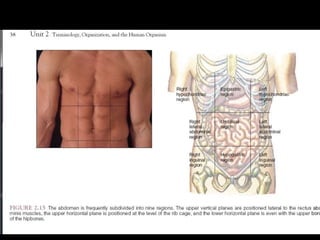
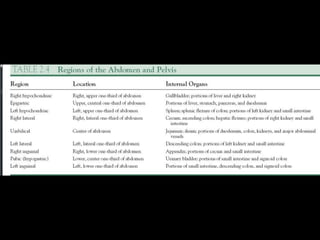
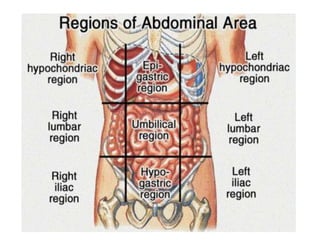
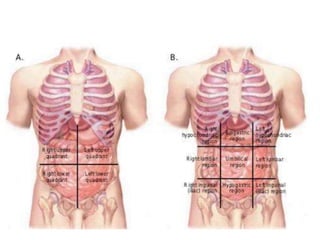
II. Abdomen
• the coxal region encompassing the belt line
• The umbilicus, or naval, is located at the center of the abdomen
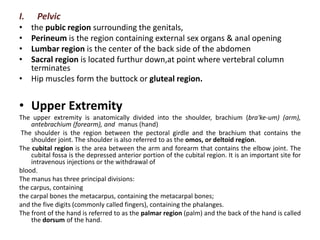
I. Pelvic
• the pubic region surrounding the genitals,
• Perineum is the region containing external sex organs & anal opening
• Lumbar region is the center of the back side of the abdomen
• Sacral region is located furthur down,at point where vertebral column
terminates
• Hip muscles form the buttock or gluteal region.
• Upper Extremity
The upper extremity is anatomically divided into the shoulder, brachium (bra'ke-um) (arm),
antebrachium (forearm), and manus (hand)
The shoulder is the region between the pectoral girdle and the brachium that contains the
shoulder joint. The shoulder is also referred to as the omos, or deltoid region.
The cubital region is the area between the arm and forearm that contains the elbow joint. The
cubital fossa is the depressed anterior portion of the cubital region. It is an important site for
intravenous injections or the withdrawal of
blood.
The manus has three principal divisions:
the carpus, containing
the carpal bones the metacarpus, containing the metacarpal bones;
and the five digits (commonly called fingers), containing the phalanges.
The front of the hand is referred to as the palmar region (palm) and the back of the hand is called
the dorsum of the hand.
• Lower Extremity
The lower extremity consists of the hip, thigh, knee, leg, and pes (foot).
The thigh is commonly called the upper leg, or femoral region.
The knee has two surfaces: the front surface is the patellar region, or kneecap;
the back of the knee is called the popliteal (pop''lı˘-te'al) fossa.
The leg has anterior and posterior crural regions
The shin is a prominent bony ridge extending longitudinally along the anterior
crural region, and the calf is the thickened muscular mass of the posterior
crural region.
The pes has three principal divisions:
I. the tarsus, containing the tarsal bones
II. the metatarsus, containing the metatarsal bones
III. and the five digits (commonly called toes), Containing the phalanges. The
ankle is the junction between the leg and the foot.
The heel is the back of the foot and the sole of the foot is referred to as the
plantar surface.
The dorsum of the foot is the top surface.
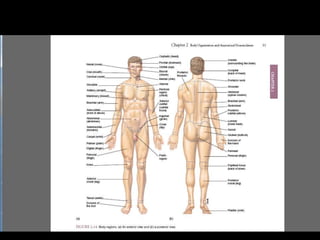
Body Regions
a)Anterior View b) Posterior View
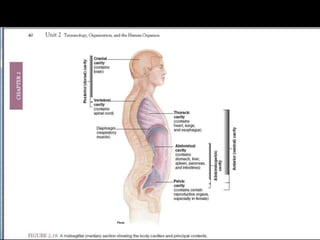
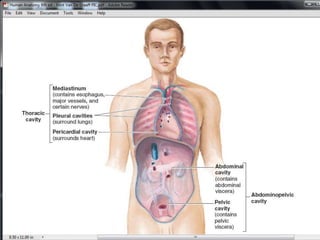
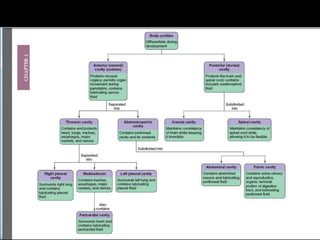
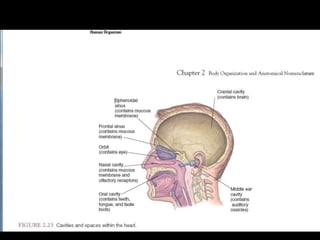
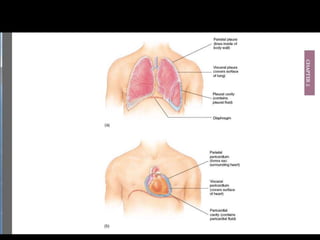
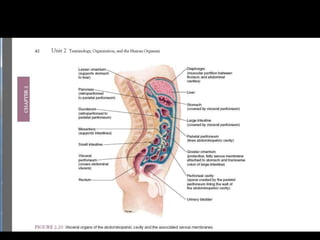
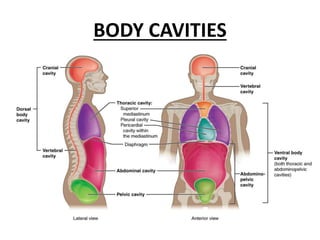
BODY CAVITIES
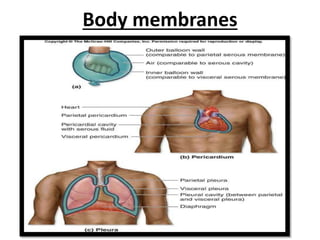
Body membranes

Anatomy

  • 1.
  • 4.
    Characteristics of Humans •A large well-developed brain • Bipedal Locomotion • An Opposable Thumb • Well developed vocal structures • Stereoscopic vision
  • 5.
    An opposable thumbenables a prehensile grip, which is characteristic of primates.
  • 6.
    BODY ORGANIZATION •Cellular Level •TissueLevel •Organ Level •System Level
  • 7.
  • 8.
    Developmental changes fromchildhood to adulthoo
  • 9.
    Anatomical Nomenclature Planes ofReference Frontal Sagittal Transverse Descriptive Terminology Anatomical Position Directional Terms Clinical Procedures
  • 10.
    PLANES OF REFERENCE Frontal(Coronal) Plane: Is a vertical and extends from one side of the body to the other. It divides the body into front and back sections (anterior & posterior) Sagittal (Medial) Plane: Is vertical and extends from the front of the body to the back. It divides the body into right & left sections. Transverse (Horizontal/cross-sectional) Plane: Is horizontal and divides the body into upper and lower segments(superior & inferior).
  • 11.
    Descriptive Terminology ANATOMICAL POSITION •In anatomical position body is erect, feets are parallel to each other & flat on floor, the eyes are directed forward, and the arms are at the side of body with the palms of the hand turned forward and fingers. pointed straight down
  • 12.
  • 13.
    Right & Leftsides of Body
  • 14.
  • 15.
    DIRECTIONAL TERMS FORTHE HUMAN BODY
  • 16.
    Clinical Procedures • Inspection •Palpation • Percussion • Auscultation • Reflex Testing
  • 17.
    SINGULAR & PLURALFORMS OF BODY TERMINOLOG
  • 18.
    BODY REGIONS 1.HEAD 1. Thecranial region encompasses the upper part of the head while the 2. facial region encompasses the lower half of the head beginning below the ears. • The eyes are referred to as the ocular region. • The cheeks are referred to as the buccal region. • The ears are referred to as the auricle or otic region. • The nose is referred to as the nasal region. • The chin is referred to as the mental region. 2.NECK The neck is referred to as the cervical region 3.TRUNK I. Thorax • the thoracic region encompassing the chest • the mammary region encompassing each breast • Between mammary region is the sternal region • Armpit surrounding area is called axillary region • Vertebral region extends the length of the back, following vertebral column II. Abdomen • the coxal region encompassing the belt line • The umbilicus, or naval, is located at the center of the abdomen
  • 19.
    I. Pelvic • thepubic region surrounding the genitals, • Perineum is the region containing external sex organs & anal opening • Lumbar region is the center of the back side of the abdomen • Sacral region is located furthur down,at point where vertebral column terminates • Hip muscles form the buttock or gluteal region. • Upper Extremity The upper extremity is anatomically divided into the shoulder, brachium (bra'ke-um) (arm), antebrachium (forearm), and manus (hand) The shoulder is the region between the pectoral girdle and the brachium that contains the shoulder joint. The shoulder is also referred to as the omos, or deltoid region. The cubital region is the area between the arm and forearm that contains the elbow joint. The cubital fossa is the depressed anterior portion of the cubital region. It is an important site for intravenous injections or the withdrawal of blood. The manus has three principal divisions: the carpus, containing the carpal bones the metacarpus, containing the metacarpal bones; and the five digits (commonly called fingers), containing the phalanges. The front of the hand is referred to as the palmar region (palm) and the back of the hand is called the dorsum of the hand.
  • 20.
    • Lower Extremity Thelower extremity consists of the hip, thigh, knee, leg, and pes (foot). The thigh is commonly called the upper leg, or femoral region. The knee has two surfaces: the front surface is the patellar region, or kneecap; the back of the knee is called the popliteal (pop''lı˘-te'al) fossa. The leg has anterior and posterior crural regions The shin is a prominent bony ridge extending longitudinally along the anterior crural region, and the calf is the thickened muscular mass of the posterior crural region. The pes has three principal divisions: I. the tarsus, containing the tarsal bones II. the metatarsus, containing the metatarsal bones III. and the five digits (commonly called toes), Containing the phalanges. The ankle is the junction between the leg and the foot. The heel is the back of the foot and the sole of the foot is referred to as the plantar surface. The dorsum of the foot is the top surface.
  • 23.
  • 36.
  • 37.