CONCEPT AND EVOLUTION OF
QUALITY CONTROL & QUALITY ASSURANCE
Presented by
G.Pavani
Y17mphpa426,
Dept of pharmaceutical
analysis
Chalapathi Institute of Pharmaceutical Sciences
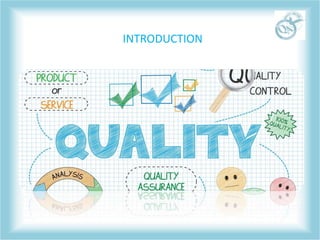
INTRODUCTION
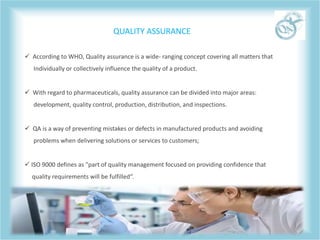
 According to WHO, Quality assurance is a wide- ranging concept covering all matters that
Individually or collectively influence the quality of a product.
 With regard to pharmaceuticals, quality assurance can be divided into major areas:
development, quality control, production, distribution, and inspections.
 QA is a way of preventing mistakes or defects in manufactured products and avoiding
problems when delivering solutions or services to customers;
 ISO 9000 defines as "part of quality management focused on providing confidence that
quality requirements will be fulfilled“.
QUALITY ASSURANCE
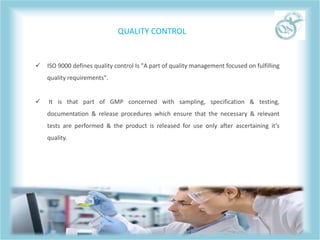
 ISO 9000 defines quality control Is "A part of quality management focused on fulfilling
quality requirements".
 It is that part of GMP concerned with sampling, specification & testing,
documentation & release procedures which ensure that the necessary & relevant
tests are performed & the product is released for use only after ascertaining it’s
quality.
QUALITY CONTROL
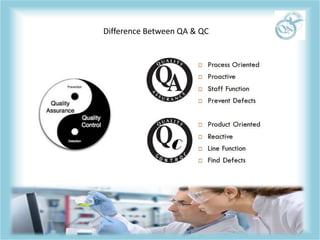
Difference Between QA & QC
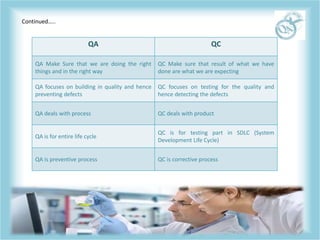
Continued…..
QA QC
QA Make Sure that we are doing the right
things and in the right way
QC Make sure that result of what we have
done are what we are expecting
QA focuses on building in quality and hence
preventing defects
QC focuses on testing for the quality and
hence detecting the defects
QA deals with process QC deals with product
QA is for entire life cycle
QC is for testing part in SDLC (System
Development Life Cycle)
QA is preventive process QC is corrective process
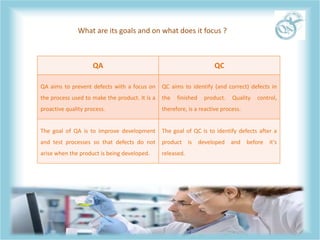
QA QC
QA aims to prevent defects with a focus on
the process used to make the product. It is a
proactive quality process.
QC aims to identify (and correct) defects in
the finished product. Quality control,
therefore, is a reactive process.
The goal of QA is to improve development
and test processes so that defects do not
arise when the product is being developed.
The goal of QC is to identify defects after a
product is developed and before it's
released.
What are its goals and on what does it focus ?
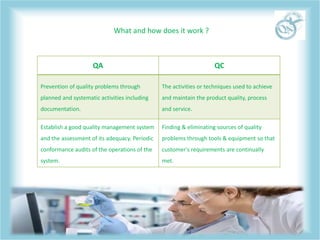
QA QC
Prevention of quality problems through
planned and systematic activities including
documentation.
The activities or techniques used to achieve
and maintain the product quality, process
and service.
Establish a good quality management system
and the assessment of its adequacy. Periodic
conformance audits of the operations of the
system.
Finding & eliminating sources of quality
problems through tools & equipment so that
customer's requirements are continually
met.
What and how does it work ?
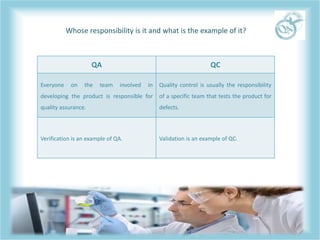
QA QC
Everyone on the team involved in
developing the product is responsible for
quality assurance.
Quality control is usually the responsibility
of a specific team that tests the product for
defects.
Verification is an example of QA. Validation is an example of QC.
Whose responsibility is it and what is the example of it?
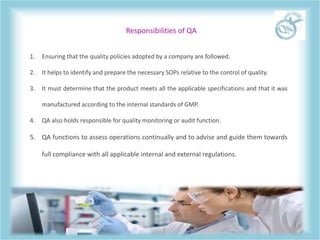
Responsibilities of QA
1. Ensuring that the quality policies adopted by a company are followed.
2. It helps to identify and prepare the necessary SOPs relative to the control of quality.
3. It must determine that the product meets all the applicable specifications and that it was
manufactured according to the internal standards of GMP.
4. QA also holds responsible for quality monitoring or audit function.
5. QA functions to assess operations continually and to advise and guide them towards
full compliance with all applicable internal and external regulations.
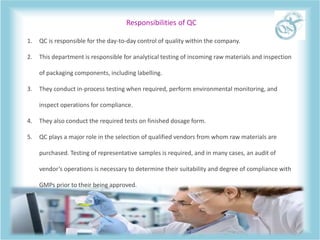
Responsibilities of QC
1. QC is responsible for the day-to-day control of quality within the company.
2. This department is responsible for analytical testing of incoming raw materials and inspection
of packaging components, including labelling.
3. They conduct in-process testing when required, perform environmental monitoring, and
inspect operations for compliance.
4. They also conduct the required tests on finished dosage form.
5. QC plays a major role in the selection of qualified vendors from whom raw materials are
purchased. Testing of representative samples is required, and in many cases, an audit of
vendor’s operations is necessary to determine their suitability and degree of compliance with
GMPs prior to their being approved.
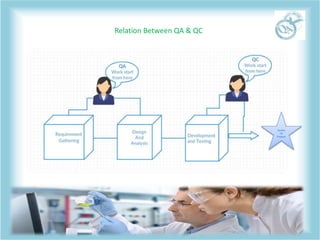
Relation Between QA & QC
Quality
Of
Product
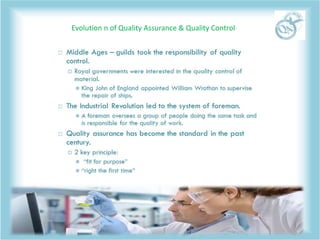
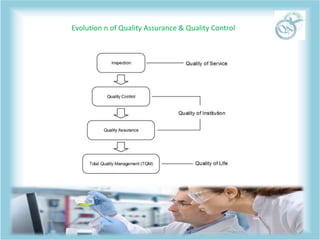
Evolution n of Quality Assurance & Quality Control
References :
1. https://en.wikipedia.org/wiki/Quality_assurance
2. https://www.iso.org
3. http://www.who.int/en/
4. Other Online Sources in Google Related to Subject topic.
PAVANI.GADUPUDI

Concept & evolution of qa & qc

  • 1.
    CONCEPT AND EVOLUTIONOF QUALITY CONTROL & QUALITY ASSURANCE Presented by G.Pavani Y17mphpa426, Dept of pharmaceutical analysis Chalapathi Institute of Pharmaceutical Sciences
  • 2.
  • 3.
     According toWHO, Quality assurance is a wide- ranging concept covering all matters that Individually or collectively influence the quality of a product.  With regard to pharmaceuticals, quality assurance can be divided into major areas: development, quality control, production, distribution, and inspections.  QA is a way of preventing mistakes or defects in manufactured products and avoiding problems when delivering solutions or services to customers;  ISO 9000 defines as "part of quality management focused on providing confidence that quality requirements will be fulfilled“. QUALITY ASSURANCE
  • 4.
     ISO 9000defines quality control Is "A part of quality management focused on fulfilling quality requirements".  It is that part of GMP concerned with sampling, specification & testing, documentation & release procedures which ensure that the necessary & relevant tests are performed & the product is released for use only after ascertaining it’s quality. QUALITY CONTROL
  • 5.
  • 6.
    Continued….. QA QC QA MakeSure that we are doing the right things and in the right way QC Make sure that result of what we have done are what we are expecting QA focuses on building in quality and hence preventing defects QC focuses on testing for the quality and hence detecting the defects QA deals with process QC deals with product QA is for entire life cycle QC is for testing part in SDLC (System Development Life Cycle) QA is preventive process QC is corrective process
  • 7.
    QA QC QA aimsto prevent defects with a focus on the process used to make the product. It is a proactive quality process. QC aims to identify (and correct) defects in the finished product. Quality control, therefore, is a reactive process. The goal of QA is to improve development and test processes so that defects do not arise when the product is being developed. The goal of QC is to identify defects after a product is developed and before it's released. What are its goals and on what does it focus ?
  • 8.
    QA QC Prevention ofquality problems through planned and systematic activities including documentation. The activities or techniques used to achieve and maintain the product quality, process and service. Establish a good quality management system and the assessment of its adequacy. Periodic conformance audits of the operations of the system. Finding & eliminating sources of quality problems through tools & equipment so that customer's requirements are continually met. What and how does it work ?
  • 9.
    QA QC Everyone onthe team involved in developing the product is responsible for quality assurance. Quality control is usually the responsibility of a specific team that tests the product for defects. Verification is an example of QA. Validation is an example of QC. Whose responsibility is it and what is the example of it?
  • 10.
    Responsibilities of QA 1.Ensuring that the quality policies adopted by a company are followed. 2. It helps to identify and prepare the necessary SOPs relative to the control of quality. 3. It must determine that the product meets all the applicable specifications and that it was manufactured according to the internal standards of GMP. 4. QA also holds responsible for quality monitoring or audit function. 5. QA functions to assess operations continually and to advise and guide them towards full compliance with all applicable internal and external regulations.
  • 11.
    Responsibilities of QC 1.QC is responsible for the day-to-day control of quality within the company. 2. This department is responsible for analytical testing of incoming raw materials and inspection of packaging components, including labelling. 3. They conduct in-process testing when required, perform environmental monitoring, and inspect operations for compliance. 4. They also conduct the required tests on finished dosage form. 5. QC plays a major role in the selection of qualified vendors from whom raw materials are purchased. Testing of representative samples is required, and in many cases, an audit of vendor’s operations is necessary to determine their suitability and degree of compliance with GMPs prior to their being approved.
  • 12.
    Relation Between QA& QC Quality Of Product
  • 13.
    Evolution n ofQuality Assurance & Quality Control
  • 14.
    Evolution n ofQuality Assurance & Quality Control
  • 15.
    References : 1. https://en.wikipedia.org/wiki/Quality_assurance 2.https://www.iso.org 3. http://www.who.int/en/ 4. Other Online Sources in Google Related to Subject topic.
  • 16.