CONTENTS
INTRODUCTION
ANALYTICALMETHOD DEVELOPMENT
METHOD VALIDATION
OBJECTIVES OF VALIDATION
HIGH PERFORMANCE LIQUID CHROMATOGRAPHY
UV SPECTROPHOTOMETRY
CONCLUSION
REFERENCES
3.
INTRODUCTION
Analytical chemistrydeals with
the separation, quantification and chemical components
identification of natural and artificial materials constituted with one or
more compounds or elements
Categories: Qualitative Analysis; Quantitative Analysis
The examination of pharmaceutical formulations and bulk drugs regarding
the quality control and assurance.
Rapid increase in pharmaceutical industries and production of drug in and
around the world cause increase in demand
to seek novel and systematic analytical techniques in the pharmaceutical
industries
Analytical method development has become the basic activity of analysis
4.
Development inscientific and concrete analytical methods has been
resulted from the advancements of analytical instruments
The improvements of the analytical method development and analytical
instruments have reduced the time and cost of analysis and enhanced
precision and accuracy
Techniques applicable to analysis are developed and validated for
active pharmaceutical ingredients,
excipients,
related substances,
drug products,
degradation products and, residual solvents, etc
5.
ANALYTICAL METHOD DEVELOPMENT
To test and ensure the Quality of Drug substances/ Drug products.
To analyze the existing either pharmacopoeial or non-pharmacopoeial
products, novel methods are developed to reduce the cost besides time
for better precision and ruggedness
These methods are optimized and validated through trial runs.
Purpose of analytical method development…
When there is no official drug or drug combination available in the pharmacopoeias
When there is no decorous analytical process for the existing drug in the literature
due to patent regulations
When there are no analytical methods for the formulation of the drug due to the
interference caused by the formulation excipients
Analytical methods for the quantitation of the analyte in biological fluids are found to
be unavailable
The existing analytical procedures may need costly reagents and solvents.
6.
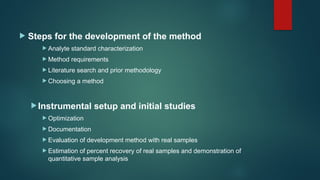
Steps forthe development of the method
Analyte standard characterization
Method requirements
Literature search and prior methodology
Choosing a method
Instrumental setup and initial studies
Optimization
Documentation
Evaluation of development method with real samples
Estimation of percent recovery of real samples and demonstration of
quantitative sample analysis
7.
Guidance for MethodValidation
CDER : “Analytical Procedures and Method Validation” Draft guidance August
2000
ICH: Validation Of Analytical Procedures: Text And Methodology Q2(R1) 2005.
USP 41: General Chapter Validation of Compendial Methods
8.
Types of AnalyticalProcedures to be
Validated
Identification tests; Eg. FTIR spectrum
Quantitative tests for impurities' content; Eg. 10ppm to 2%
Limit tests for the control of impurities; Eg. < 100ppm
Quantitative tests of the active moiety in samples of drug
substance or drug product or other selected component(s) in
the drug product. Eg. 99-101%
9.
VALIDATION
Validation isa documented evidence of the consistency of the any
process OR system.
The process of validation of analytical method is adopted to confirm that
the employed analytical procedure for a specific tests meet the intended
requirements.
Guidelines from the USP, ICH, FDA etc., can provide a framework for
validations of pharmaceutical methods.
Results from the method validation can be considered to judge its
quality, reliability as well consistency applicable to analytical results.
10.
METHOD VALIDATION
Parametersof Analytical Method Validation Analytical methods have
been validated in pursuance of ICH guidelines of Q2 (R1).
Accuracy
Precision
Repeatability
Intermediate Precision
Specificity
Detection Limit (LOD)
Quantitation Limit (LOQ)
Linearity
Range
System suitability
Robustness
Ruggedness
Furthermore, revalidation may be necessary in the
following circumstances:
changes in the synthesis of the drug substance;
changes in the composition of the finished product;
changes in the analytical procedure
11.
Analytical procedure
Characteristics
IDENTIFICATION TESTINGFOR IMPURITIES ASSAY
- dissolution
- content/potency
Quantitative Limit test
Accuracy No Yes No Yes
Precision-
Repeatability
No Yes No Yes
Intermediate precision No Yes No Yes
Interm.Precision No Yes No Yes
Specificity Yes Yes Yes Yes
Detection Limit No Yes Yes No
Quantitation Limit No Yes No No
Linearity No Yes No Yes
Range No Yes No Yes
12.
Specificity
Specificity isthe ability to assess unequivocally the analyte in the presence
of components which may be expected to be present.
Typically, these might include impurities, degradants, matrix, etc.
Lack of specificity of an individual analytical procedure may be compensated
by other supporting analytical procedure(s).
This definition has the following implications:
Identification: to ensure the identity of an analyte.
Purity Tests: to ensure that all the analytical procedures performed allow an
accurate statement of the content of impurities of an analyte, i.e. related
substances test, heavy metals, residual solvents content, etc.
Assay (content or potency): to provide an exact result which allows an accurate
statement on the content or potency of the analyte in a sample.
13.
ACCURACY: Trueness
The accuracy of an analytical procedure expresses the
closeness of agreement between the value which is accepted
either as a conventional true value or an accepted reference
value and the value found.
PRECISION:
The precision of an analytical procedure expresses the closeness of agreement
(degree of scatter) between a series of measurements obtained from multiple
sampling of the same homogeneous sample under the prescribed conditions.
Precision may be considered at three levels: repeatability, intermediate
precision and reproducibility. Precision should be investigated using
homogeneous, authentic samples. However, if it is not possible to obtain a
homogeneous sample it may be investigated using artificially prepared
samples or a sample solution.
The precision of an analytical procedure is usually expressed as the variance,
standard deviation or coefficient of variation of a series of measurements.
14.
Repeatability:
Repeatabilityexpresses the precision under the same operating
conditions over a short interval of time. Repeatability is also
termed intra-assay precision.
Intermediate precision:
Intermediate precision expresses within-laboratories variations:
different days, different analysts, different equipment, etc.
Reproducibility:
Reproducibility expresses the precision between laboratories
(collaborative studies, usually applied to standardization of
methodology).
15.
DETECTION LIMIT:
The detection limit of an individual analytical procedure is the
lowest amount of analyte in a sample which can be detected
but not necessarily quantitated as an exact value.
QUANTITATION LIMIT:
The quantitation limit of an individual analytical procedure is the
lowest amount of analyte in a sample which can be
quantitatively determined with suitable precision and accuracy.
The quantitation limit is a parameter of quantitative assays for
low levels of compounds in sample matrices, and is used
particularly for the determination of impurities and/or
degradation products.
16.
LINEARITY:
The linearityof an analytical procedure is its ability (within
a given range) to obtain test results which are directly proportional to
the concentration (amount) of analyte in the sample.
RANGE:
The range of an analytical procedure is the interval between the upper
and lower concentration (amounts) of analyte in the sample (including
these concentrations) for which it has been demonstrated that the
analytical procedure has a suitable level of precision, accuracy and
linearity.
ROBUSTNESS:
The robustness of an analytical procedure is a measure of its capacity
to remain unaffected by small, but deliberate variations in method
parameters and provides an indication of its reliability during normal
usage.
17.
Objectives of Validation
Chromatography is the most widely used laboratory technique for
separation, identification and quantification of components of liquid and
gaseous mixtures.
Solid mixtures are also analyzed by first converting them to a liquid or
gaseous state, using suitable sample preparation techniques.
Principle
High performance liquid chromatography (HPLC) is separation technique utilizing
differences in distribution of compounds to two phases; called stationary phase and
mobile phase.
The stationary phase designates a thin layer created on the surface of fine particles
a mobile phase designates the liquid flowing over particles.
Under a certain dynamic condition, each component in a sample has difference
distribution equilibrium depending on solubility in the phases and or molecular size.
As a result, the components move at different speed over the stationary phase and
thereby separated from each other.
18.
Calibration
“The demonstrationthat a particular instrument or device produces results within
specified limits by comparison with those produced by a reference or traceable
standard over an appropriate range of measurements”.
Calibration of HPLC:
Parameters are:
Flow rate accuracy
Injector accuracy
Wavelength accuracy
Injector linearity
System Precision
Detector linearity
Column oven temperature accuracy
19.
Types of detectors
A detector gives specific response for the components separated
by the column and also provides the required sensitivity.
It has to be independent of any changes in mobile phase
composition. Majority of the applications require UV-VIS detection
though detectors based on other detection technique are also
popular these days
• UV-VIS detector
• Photo diode array detector
• Fluorescence detector y detector
• Mass spectroscopic detector
• Refractive index detector
• Electrochemical detector
• Light scattering detectors
20.
CONCLUSION
When analyticalmethod is utilized to generate results about the
characteristics of drug related samples it is essential that the results are
trustworthy
They may be utilized as the basis for decisions relating to administering the drug
to patients
Analytical method validation required during drug development and
manufacturing and these analytical methods are fit for their intended purpose
To comply with the requirements of GMP pharmaceutical industries should
have an overall validation policy which documents how validation will be
performed
The purpose of this validation is to show that processes involved in the
development and manufacture of drug, production and analytical testing can
be performed in an effective and reproducible manner
Editor's Notes
#1 Method validation is the process to confirm that the analytical procedure employed for a specific test is suitable for its intended use. Methods need to be validated or revalidated as follows:
Before their introduction into routine use Whenever the conditions change for which the method has been validated
(e.g., instrument with different characteristics)
Whenever the method is changed, and the change is outside the original scope of the method
When quality control indicates an established method is changing with time
In order to demonstrate the equivalence between two methods (e.g., a new method and a standard)
Method validation has received considerable attention
#5 When no authoritative methods are available, new methods are being developed for analysis of novel products.