Process validation
Presented by
S.Saravanan
M.Pharm (Pharmaceutics)
Sri Ramachandra University
Definition
Process validation is establishing documented
evidence which provides a high degree of assurance that
a specific process (such as the manufacture of
pharmaceutical dosage forms) will consistently produce a
product meeting its predetermined specifications and
quality characteristics.
Scope of Validation
Pharmaceutical validation is a vast area of work & it
practically covers every aspect of pharmaceutical
processing activity. However it will point out at least the
following areas of for pharmaceutical validation.
Analytical, Instrument calibration, Process utility
services, Raw material & packaging material,
Equipment's, Manufacturing operation, Facilities,
Product design, Cleaning, Operator.
Introduction
12/18/2015
2
• Is to form a basis for written procedures for production and
process control.
• Which are designed to assure that the drug products have the
identity, strength, quality and purity they are represented to
possess.
• According to the FDA, the goal of validation is to:
“establish documented evidence which provides a high degree of
assurance that a specific process will consistently produce a
product meeting its predetermined specifications and quality
attributes.”
Objective of validation
12/18/2015
3
Enable scientist to communicate scientifically & effectively on
technical matter.
Cost saving, reducing testing, & elimination of product retesting.
Useful for comparison of results compliance to cGMP/GLP.
For addressing analytical problem to proper form.
Assurance of Quality
Safety
Reasons / purpose of validation
12/18/2015
4
The basic principle for validation may be stated as follows
Installation Qualification (IQ): Establishing by objective evidence
that all key aspects of the process equipment and ancillary system
installation adhere to the manufacturer’s approved Specification and
that the recommendation of the supplier of the equipment are suitably
considered.
Operational Qualification (OQ): Establishing by objective evidence
process control limits and action levels which result in product that all
predetermined requirements.
Performance Qualification (PQ): Establishing by objective evidence
that the process, under anticipated conditions, consistently produces a
product which meets all predetermined requirements.
Basic principle
12/18/2015
5
The following model may be useful in determining whether or not a
process should be validated:
Process Validation Decision
12/18/2015
Yes YesIs process
Output
Verifiable?
Is process
Sufficient and
Cost effective?
Verify and
control process
output
Validate Redesign
Product and/ or process
No No
Process Validation Decision Tree for change in
process controls of manufacturing process of
drug products
12/18/2015 7
Change in Manufacturing Process Controls (Specification)
Detection Relaxation/Testing
acceptance criteria
Risk Assessment
& justification Replacement/ Addition of test Risk Assessment
& justification
Impact analysis to be done
Major impact Revalidation on 3 batches Impact analysis to be done
Review previous validation data
No need of validation Complying to proposed Not complying
Acceptance criteria
Process Validation Decision Tree for Change in
Equipment
12/18/2015
8
Process Validation Decision Tree for Change in
Batch size of drug Product
12/18/2015
9
Process Validation Decision Tree for Change in
Source of Active Pharmaceutical Ingredients
12/18/2015
10
Process Validation Decision Tree for Change in
Source of Excipient
12/18/2015
11
Responsibility department and their
responsibility for Process Validation
12/18/2015
12
Department
/ Designee
Responsibility
3rd Level of
Process
Engineer
Prepare and review the validation protocol. Ensue regarding the Title, Market,
Batch Size, Report no, Batch details, Product details, Reference documents.
2nd Level of
Process
Engineer
Responsible for execution of process validation batch. Ensure that the
information regarding reason for validation, product specification & acceptance
criteria, measuring device used, batch fabrication details, in-process
characteristics, validation data, results & conclusion.
1st Level of
Process
Engineer
Review validation protocol and clarify validation report. Also ensure that
batches are executed as per the plan and approved protocol. Prepare periodic
revalidation calendar. Validation Review validation protocol and certify
validation report. Review periodic revalidation calendar.
Responsibility department and their
responsibility for Process Validation
12/18/2015
13
Department/
Designee
Responsibility
2nd level of
Quality
Assurance
Manager
Responsible for withdrawing sample as defined in the validation protocol.
Review the protocol with respect sampling plans and procedure, and
validation sample analysis results. Responsible for analyzing the samples as
per defined specification/procedure details in the protocol and responsible for
review and approval of validation protocol and certify validation report.
Manager
Operation
Review and ensure that the information regarding batch details, product
details, pack details of input material, equipment
used, batch fabrication details, in-process characteristics, yield monitoring,
result & conclusion.
Responsibility department and their
responsibility for Process Validation
12/18/2015
14
Department/
Designee
Responsibility
Authorized
Regulatory
Person
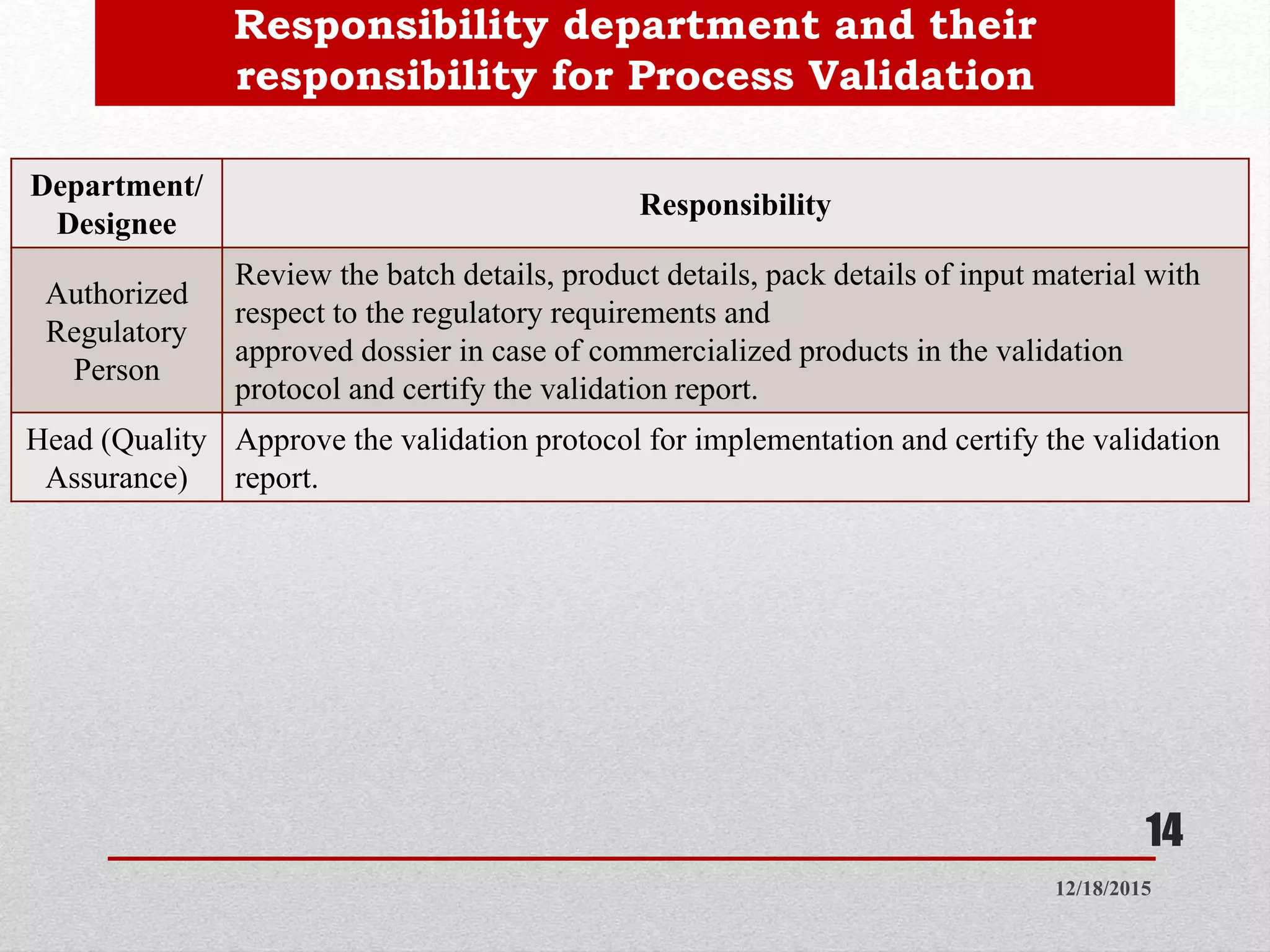
Review the batch details, product details, pack details of input material with
respect to the regulatory requirements and
approved dossier in case of commercialized products in the validation
protocol and certify the validation report.
Head (Quality
Assurance)
Approve the validation protocol for implementation and certify the validation
report.
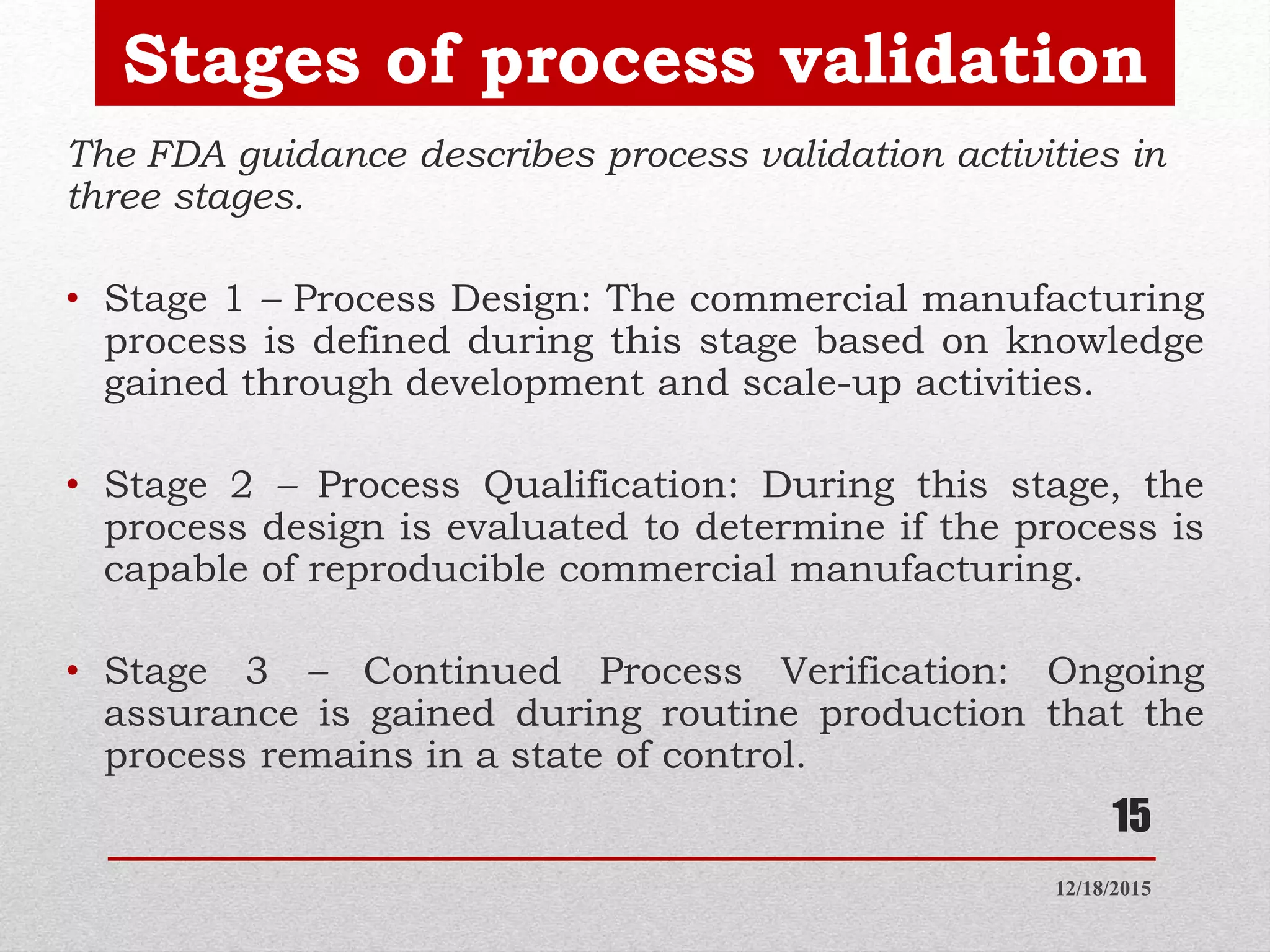
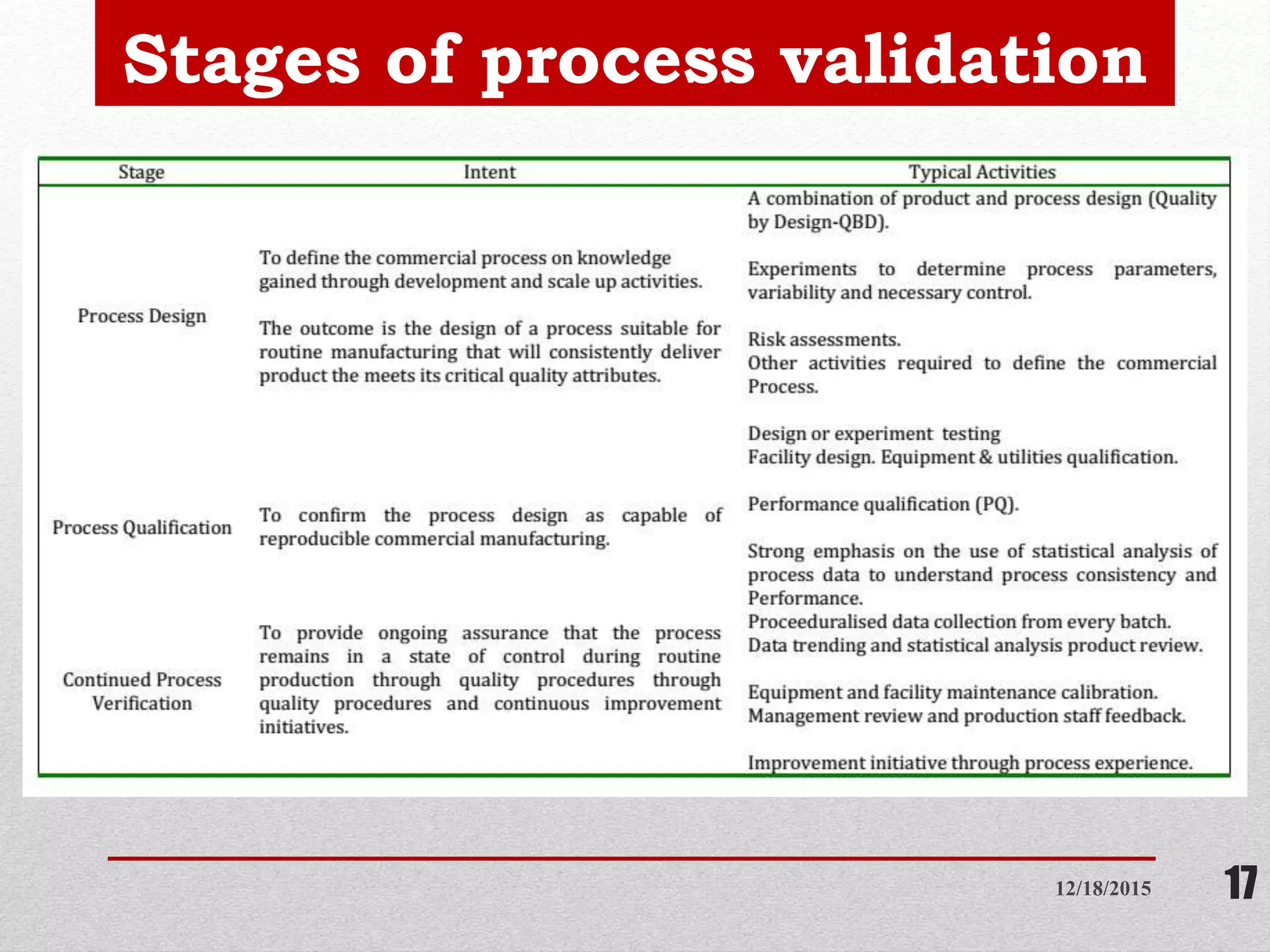
The FDA guidance describes process validation activities in
three stages.
• Stage 1 – Process Design: The commercial manufacturing
process is defined during this stage based on knowledge
gained through development and scale-up activities.
• Stage 2 – Process Qualification: During this stage, the
process design is evaluated to determine if the process is
capable of reproducible commercial manufacturing.
• Stage 3 – Continued Process Verification: Ongoing
assurance is gained during routine production that the
process remains in a state of control.
Stages of process validation
12/18/2015
15
Stages of process validation
12/18/2015 16
process validation according to FDA Guidance for Industry – Process Validation
Stages of process validation
12/18/2015 17
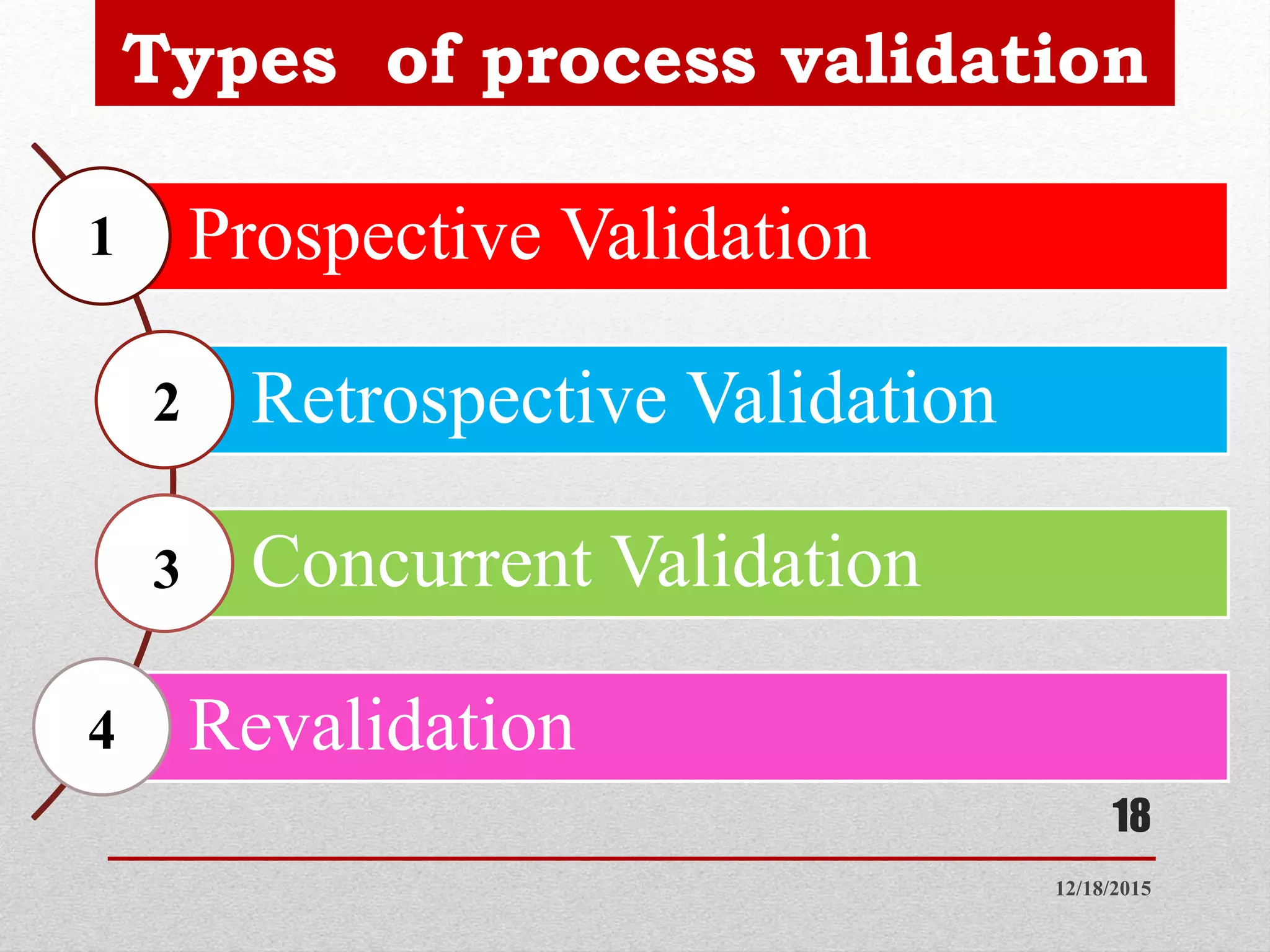
Types of process validation
12/18/2015
18
Prospective Validation
Retrospective Validation
Concurrent Validation
Revalidation
1
4
3
2
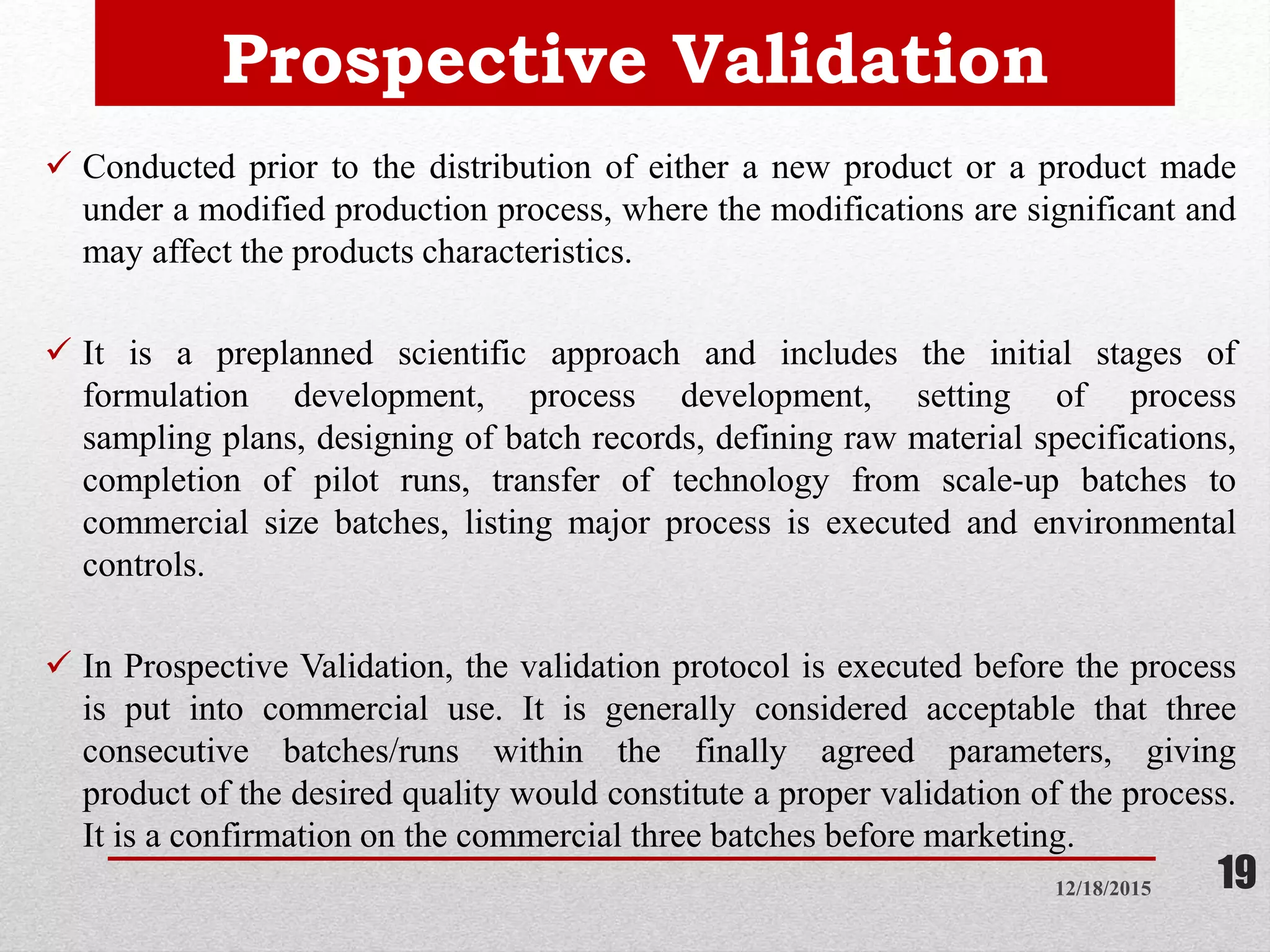
Prospective Validation
12/18/2015 19
 Conducted prior to the distribution of either a new product or a product made
under a modified production process, where the modifications are significant and
may affect the products characteristics.
 It is a preplanned scientific approach and includes the initial stages of
formulation development, process development, setting of process
sampling plans, designing of batch records, defining raw material specifications,
completion of pilot runs, transfer of technology from scale-up batches to
commercial size batches, listing major process is executed and environmental
controls.
 In Prospective Validation, the validation protocol is executed before the process
is put into commercial use. It is generally considered acceptable that three
consecutive batches/runs within the finally agreed parameters, giving
product of the desired quality would constitute a proper validation of the process.
It is a confirmation on the commercial three batches before marketing.
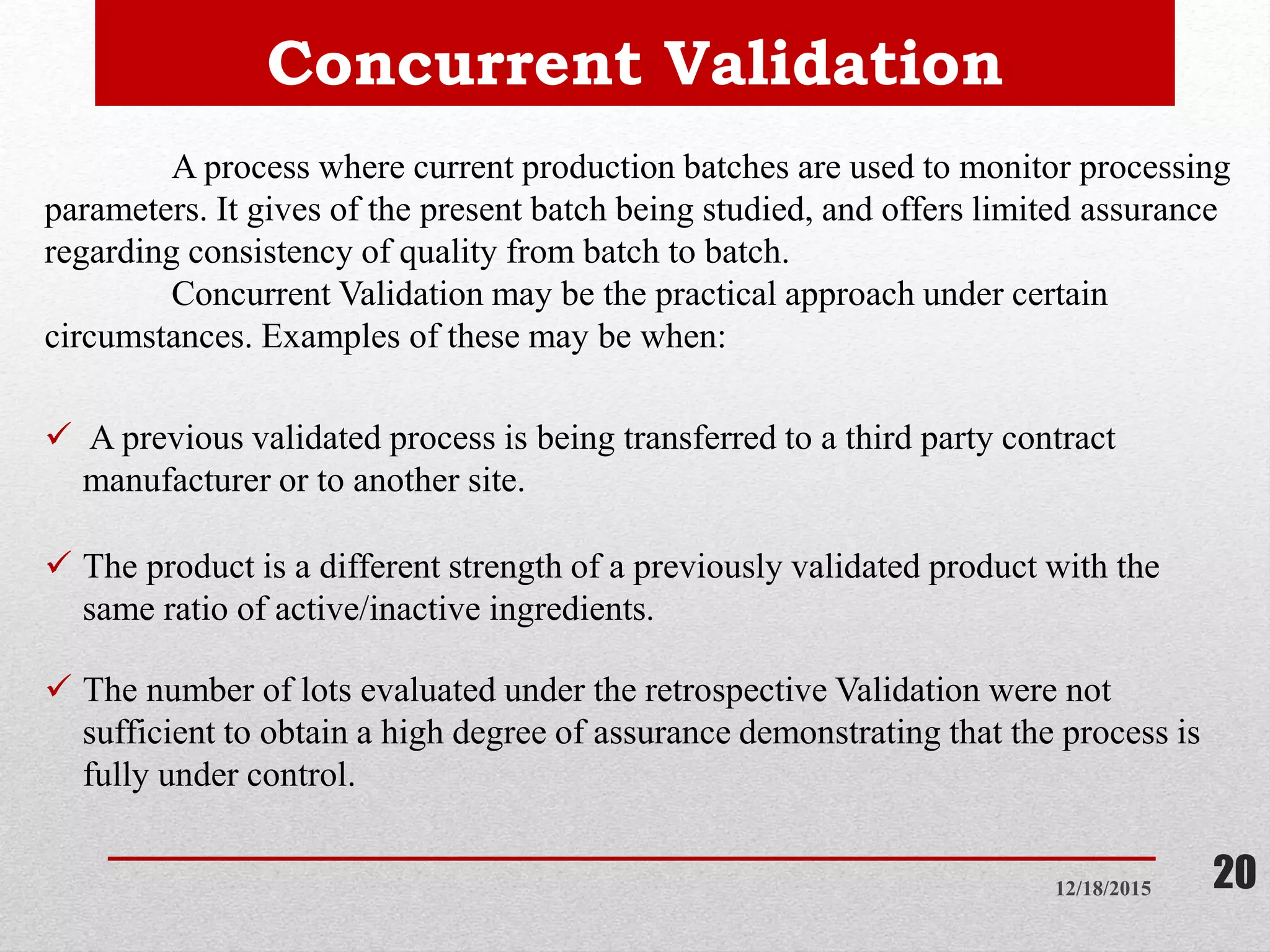
Concurrent Validation
12/18/2015 20
A process where current production batches are used to monitor processing
parameters. It gives of the present batch being studied, and offers limited assurance
regarding consistency of quality from batch to batch.
Concurrent Validation may be the practical approach under certain
circumstances. Examples of these may be when:
 A previous validated process is being transferred to a third party contract
manufacturer or to another site.
 The product is a different strength of a previously validated product with the
same ratio of active/inactive ingredients.
 The number of lots evaluated under the retrospective Validation were not
sufficient to obtain a high degree of assurance demonstrating that the process is
fully under control.
Concurrent Validation
12/18/2015 21
 The number of batches produced are limited.
 Process with low production volume per batch and market demand. drug due to
shortage or absence of supply.
 In all above cases concurrent validation is valid, provided following conditions
are appropriately.
 Pre-approved protocol for concurrent validation with rational
 A deviation shall be raised with justification and shall be approved by plant head
/head process owner/Head-QMS.
 Product behavior and history shall be reviewed based on developmental/scale up
/test batches.
 A detailed procedure shall be planned for handling of the marketed product if any
adverse reactions observed in concurrent validation process.
 Concurrent validation batches shall be compiled in interim report and shall be
approved all key disciplines.
Retrospective Validation
12/18/2015 22
Conducted fir a product already being marked, and is based on
extensive data accumulated over several lots and over time.
Retrospective Validation may be used for older products which
were not validated by the fabricator at the time that they were first
marketed, and which are now to be validated to confirm to the
requirements of division 2, Part C of the Regulation to be Food and
Drugs Act.
Retrospective Validation is only acceptable for well-established
detailed processes and will be Inappropriate where there have
recent changes in the formulation of the products, operating
procedures, equipment and facility
Some of the essential elements for
retrospective validation
12/18/2015 23
Batches manufactured for a defined period. (minimum of 10 last
consecutive batches). Number of lots released per year.
Batch size/strength/manufacturer/year/period.
Master manufacturing/packaging documents.
List of process deviations, corrective actions and changes to
manufacturing documents.
Data for stability testing for several batches.
Trend analysis including those for quality related complaints.
Process Re-Validation
12/18/2015 24
 Required when there is a change in any of the critical process
parameters, formulation, primary packaging components, raw material
fabricator, major equipment or premises. Failure to meet product and process
specifications in batches would also require process re-validation.
 Re-Validation becomes necessary in certain situations. The following are
examples of some of the planned or unplanned changes that may require re-
validation:
 Changes in raw materials (physical properties such as density, viscosity,
particle size distribution, and moisture, etc., that may
affect the process or product).
Process Re-Validation
12/18/2015 25
 Changes in the source of active raw material manufacturer.
 Changes in packaging material (primary container/closure system).
 Changes in the process (e.g. mixing time, drying temperatures and batch
size).
 Changes in the equipment (e.g. addition of automatic detection system).
 Changes of equipment which involve the replacement of equipment on a
“like for like” basis would not normally require a revalidation except that this
new equipment Must be qualified.
 Changes in the plant/facility.
 Variations revealed by trend analysis (e.g. process drifts).
PREREQUIST OF PROCESS VALIDATION
12/18/2015 26
VALIDATION PROTOCOL
12/18/2015 27
Detailed protocol for performing validations are
essential to ensure that the process is adequately validated.
Process validation protocols should include the following elements:
 Objectives, scope of coverage of the validation study.
 Validation team membership, their qualifications and
responsibilities.
 Type of validation: prospective, concurrent, retrospective, re-
validation.
 Number and selection of batches to be on the validation study.
 A list of all equipment to be used; their normal and worst case
operating parameters.
 Outcome of IQ, OQ for critical equipment.
 Requirements for calibration of all measuring devices.
 Critical process parameters and their respective tolerances.
VALIDATION PROTOCOL
12/18/2015 28
 Process variables and attributes with probable risk and prevention shall
be captured.
 Description of the processing steps: copy of the master documents for
the product.
 Sampling points, stages of sampling, methods of sampling, sampling
plans.
 Statistical tools to be used in the analysis of data.
 Training requirements for the processing operators.
 Validated test methods to be used in in process testing and for the
finished product.
 Specifications for raw and packaging materials and test methods.
 Forms and charts to be used for documenting results.
 Format for presentation of results, documenting conclusions and for
approval of study results.
VALIDATION SAMPLING PROCEDURE AND
ACCEPTANCE CRITERIA
12/18/2015 29
A validation plan shall be specific to be the requirement
of validation run of a particular product. A detailed plan of sampling
procedure of samples which shall be analyzed/ monitored during the
validation run shall be outlined systematically.
The sampling plan including sampling points, number of
samples and the frequency of sampling for each stage operation shall
be decided based on characteristics of the product and deed or
critical points of equipment's.
The number of samples should be adequate to provide
sufficient statistical confidence of quality both within a batch and
between batches.
Quality of sample to be drawn from each sampling point
shall be decided based on 1x – 3x formula in case of blend sample
on case to case basis.
VALIDATION SAMPLING PROCEDURE AND
ACCEPTANCE CRITERIA
12/18/2015 30
As per USFDA sampling size can be increased from 1x – 10x
provided on scientifically justified.
The acceptance criteria for each testing can be obtained from
a particular pharmacopoeia reference/ predetermined acceptance
criteria and wherever sampling is done for the academic interest for
future reference in product life cycle.
Sampling location are to be clearly indicated by diagram for
any equipment from which the sample are withdrawn (where ever
application). This shall be help process validation team.
FINAL PROCESS VALIDATION
REPORT
12/18/2015 31
At the conclusion of validation activities, a final report
should be prepared. This report should summarize and reference all
protocols and results. It should derive conclusions regarding the
validation status of the process and necessary recommendation for
routine process. The final report should be reviewed and approved
by the validation team and appropriate management.
 A validation report shall be prepared to assess the adherence to
the protocol after execution of batches.
 Data can be collected in pre design format during execution
wherever application but not limited to.
FINAL PROCESS VALIDATION
REPORT
12/18/2015 32
 Name of ingredients, batch numbers of the ingredients used,
quality of ingredients used and product batch number shall be
checked against the formulation order of the validation batch
processing records.
 Name of the equipments used at each processing stage,
equipments numbers and make/model/capacity of the equipments
shall be checked against the formulation order of the validation
batch processing records.
 The environmental condition during batch execution at each
processing stage shall be checked against the formulation order of
the validation batch processing records.
FINAL PROCESS VALIDATION
REPORT
12/18/2015 33
 Stage of process, details of process variables the respective
observations and recommendations shall be checked against
the formulation order of the validation batch processing records.
 Any work done in addition to that specific in the protocol or any
deviation from the protocol should be formally noted along
with an explanation.
 List of all sampling location and identification any differences to
the protocol.
 The actual yield obtained at different stages shall be checked
against the formulation order of the validation batch processing
records.
EXAMPLE
12/18/2015 34
Process Validation of Pantoprazole 40mg Tablets
Materials and Methods
12/18/2015 35
Drug Profile:
 Pantoprazole
Commonly used brand name (s): Zovanta 40, Pantoloc; Protonix.
 Category:
Gastric acid pump inhibitor Antiulcer agent
Materials and Methods
12/18/2015 36
Manufacturing Formula:
Core Materials:
Description of Work
12/18/2015 37
 Pantoprazole 40 tablets are validated to improve the
dissolution properties.
 It is proposed to reduce the quantity of Calcium stearate
from 3.20 mg per tablet to 1.60 mg per tablet and to
compensate the quantity with Crospovidone is increased
from 10.0 mg to 11.60 mg per tablet.
 Since this change is at blending stage, subsequent impact to
be studied further stages also, So the process needs to be
validated for blending, compression and coating stages.
 Dry mixing, granulation, drying stages remains same
Process Parameters for Validation
12/18/2015 38
 Blending
A) Water content
B) Bulk density
C) Sieve analysis
D) Compressibility index
E) Content uniformity & RSD
F) Angle of Repose
G) Assay
 Compression
A) Description
B) Weight variation (group and individual)
C) Hardness
D) Thickness
E) Friability
F) Disintegration time
G) Dissolution time
H) Content uniformity and
I) Impurities
Process Parameters for Validation
12/18/2015 39
 Coating
a) Pan RPM
b) Inlet/Exhaust temperature
c) Spray rate
d) Gun to bed distance
e) Air pressure
 Validation Procedure:
1. Three batches of 0.225 Million Tablets batch size to be
manufactured as described in the Batch manufacturing record.
2. Current version of standard operating procedures to be followed.
3. Record the yield after blending, Compression, Coating and
Inspection.
Sampling Procedure at Different Stages
12/18/2015 40
 Blending
Labels shall contain following details.
1) Date of sampling
2) Stages
3) Location No.
4) Sample no.
5) Sampled by
 Compression
 Hopper study
 Coating
Acceptance criteria for critical in process
controls and sampling plan
12/18/2015 41
REFERENCE’S
12/18/2015 42
1. Quality Management System – Process Validation, Guidance
GHTF/SG3/N99-10:2004 (Edition 2)
2. www.fda.gov/cdrh/qsr/04valid.html
3. http://www3.interscience.wilel.com/journal/118880168/abstract
4. Patel R. C, Bhuva C. K, singh R. P, Dadhich A, Sharma A., -
Pharmaceutical Process Validation, Pharmatutor – ART – 1053
5. FDA Guidance Update: process Validation: General Principles and
Practices; version 01;2009.
6. Validation Master Plan Installation and Operational Qualification –
Pharmaceutical Inspection Convention; Pharmaceutical
Inspection Co-Operation Scheme; PI 006 – 2; July,2004.
7. Md. Shoaib Alam, Pharmaceutical Process Validation: An
Overview, J. Adv. Pharm. Edu. & Res. 2012:; 4:185-200

Process validation

  • 1.
    Process validation Presented by S.Saravanan M.Pharm(Pharmaceutics) Sri Ramachandra University
  • 2.
    Definition Process validation isestablishing documented evidence which provides a high degree of assurance that a specific process (such as the manufacture of pharmaceutical dosage forms) will consistently produce a product meeting its predetermined specifications and quality characteristics. Scope of Validation Pharmaceutical validation is a vast area of work & it practically covers every aspect of pharmaceutical processing activity. However it will point out at least the following areas of for pharmaceutical validation. Analytical, Instrument calibration, Process utility services, Raw material & packaging material, Equipment's, Manufacturing operation, Facilities, Product design, Cleaning, Operator. Introduction 12/18/2015 2
  • 3.
    • Is toform a basis for written procedures for production and process control. • Which are designed to assure that the drug products have the identity, strength, quality and purity they are represented to possess. • According to the FDA, the goal of validation is to: “establish documented evidence which provides a high degree of assurance that a specific process will consistently produce a product meeting its predetermined specifications and quality attributes.” Objective of validation 12/18/2015 3
  • 4.
    Enable scientist tocommunicate scientifically & effectively on technical matter. Cost saving, reducing testing, & elimination of product retesting. Useful for comparison of results compliance to cGMP/GLP. For addressing analytical problem to proper form. Assurance of Quality Safety Reasons / purpose of validation 12/18/2015 4
  • 5.
    The basic principlefor validation may be stated as follows Installation Qualification (IQ): Establishing by objective evidence that all key aspects of the process equipment and ancillary system installation adhere to the manufacturer’s approved Specification and that the recommendation of the supplier of the equipment are suitably considered. Operational Qualification (OQ): Establishing by objective evidence process control limits and action levels which result in product that all predetermined requirements. Performance Qualification (PQ): Establishing by objective evidence that the process, under anticipated conditions, consistently produces a product which meets all predetermined requirements. Basic principle 12/18/2015 5
  • 6.
    The following modelmay be useful in determining whether or not a process should be validated: Process Validation Decision 12/18/2015 Yes YesIs process Output Verifiable? Is process Sufficient and Cost effective? Verify and control process output Validate Redesign Product and/ or process No No
  • 7.
    Process Validation DecisionTree for change in process controls of manufacturing process of drug products 12/18/2015 7 Change in Manufacturing Process Controls (Specification) Detection Relaxation/Testing acceptance criteria Risk Assessment & justification Replacement/ Addition of test Risk Assessment & justification Impact analysis to be done Major impact Revalidation on 3 batches Impact analysis to be done Review previous validation data No need of validation Complying to proposed Not complying Acceptance criteria
  • 8.
    Process Validation DecisionTree for Change in Equipment 12/18/2015 8
  • 9.
    Process Validation DecisionTree for Change in Batch size of drug Product 12/18/2015 9
  • 10.
    Process Validation DecisionTree for Change in Source of Active Pharmaceutical Ingredients 12/18/2015 10
  • 11.
    Process Validation DecisionTree for Change in Source of Excipient 12/18/2015 11
  • 12.
    Responsibility department andtheir responsibility for Process Validation 12/18/2015 12 Department / Designee Responsibility 3rd Level of Process Engineer Prepare and review the validation protocol. Ensue regarding the Title, Market, Batch Size, Report no, Batch details, Product details, Reference documents. 2nd Level of Process Engineer Responsible for execution of process validation batch. Ensure that the information regarding reason for validation, product specification & acceptance criteria, measuring device used, batch fabrication details, in-process characteristics, validation data, results & conclusion. 1st Level of Process Engineer Review validation protocol and clarify validation report. Also ensure that batches are executed as per the plan and approved protocol. Prepare periodic revalidation calendar. Validation Review validation protocol and certify validation report. Review periodic revalidation calendar.
  • 13.
    Responsibility department andtheir responsibility for Process Validation 12/18/2015 13 Department/ Designee Responsibility 2nd level of Quality Assurance Manager Responsible for withdrawing sample as defined in the validation protocol. Review the protocol with respect sampling plans and procedure, and validation sample analysis results. Responsible for analyzing the samples as per defined specification/procedure details in the protocol and responsible for review and approval of validation protocol and certify validation report. Manager Operation Review and ensure that the information regarding batch details, product details, pack details of input material, equipment used, batch fabrication details, in-process characteristics, yield monitoring, result & conclusion.
  • 14.
    Responsibility department andtheir responsibility for Process Validation 12/18/2015 14 Department/ Designee Responsibility Authorized Regulatory Person Review the batch details, product details, pack details of input material with respect to the regulatory requirements and approved dossier in case of commercialized products in the validation protocol and certify the validation report. Head (Quality Assurance) Approve the validation protocol for implementation and certify the validation report.
  • 15.
    The FDA guidancedescribes process validation activities in three stages. • Stage 1 – Process Design: The commercial manufacturing process is defined during this stage based on knowledge gained through development and scale-up activities. • Stage 2 – Process Qualification: During this stage, the process design is evaluated to determine if the process is capable of reproducible commercial manufacturing. • Stage 3 – Continued Process Verification: Ongoing assurance is gained during routine production that the process remains in a state of control. Stages of process validation 12/18/2015 15
  • 16.
    Stages of processvalidation 12/18/2015 16 process validation according to FDA Guidance for Industry – Process Validation
  • 17.
    Stages of processvalidation 12/18/2015 17
  • 18.
    Types of processvalidation 12/18/2015 18 Prospective Validation Retrospective Validation Concurrent Validation Revalidation 1 4 3 2
  • 19.
    Prospective Validation 12/18/2015 19 Conducted prior to the distribution of either a new product or a product made under a modified production process, where the modifications are significant and may affect the products characteristics.  It is a preplanned scientific approach and includes the initial stages of formulation development, process development, setting of process sampling plans, designing of batch records, defining raw material specifications, completion of pilot runs, transfer of technology from scale-up batches to commercial size batches, listing major process is executed and environmental controls.  In Prospective Validation, the validation protocol is executed before the process is put into commercial use. It is generally considered acceptable that three consecutive batches/runs within the finally agreed parameters, giving product of the desired quality would constitute a proper validation of the process. It is a confirmation on the commercial three batches before marketing.
  • 20.
    Concurrent Validation 12/18/2015 20 Aprocess where current production batches are used to monitor processing parameters. It gives of the present batch being studied, and offers limited assurance regarding consistency of quality from batch to batch. Concurrent Validation may be the practical approach under certain circumstances. Examples of these may be when:  A previous validated process is being transferred to a third party contract manufacturer or to another site.  The product is a different strength of a previously validated product with the same ratio of active/inactive ingredients.  The number of lots evaluated under the retrospective Validation were not sufficient to obtain a high degree of assurance demonstrating that the process is fully under control.
  • 21.
    Concurrent Validation 12/18/2015 21 The number of batches produced are limited.  Process with low production volume per batch and market demand. drug due to shortage or absence of supply.  In all above cases concurrent validation is valid, provided following conditions are appropriately.  Pre-approved protocol for concurrent validation with rational  A deviation shall be raised with justification and shall be approved by plant head /head process owner/Head-QMS.  Product behavior and history shall be reviewed based on developmental/scale up /test batches.  A detailed procedure shall be planned for handling of the marketed product if any adverse reactions observed in concurrent validation process.  Concurrent validation batches shall be compiled in interim report and shall be approved all key disciplines.
  • 22.
    Retrospective Validation 12/18/2015 22 Conductedfir a product already being marked, and is based on extensive data accumulated over several lots and over time. Retrospective Validation may be used for older products which were not validated by the fabricator at the time that they were first marketed, and which are now to be validated to confirm to the requirements of division 2, Part C of the Regulation to be Food and Drugs Act. Retrospective Validation is only acceptable for well-established detailed processes and will be Inappropriate where there have recent changes in the formulation of the products, operating procedures, equipment and facility
  • 23.
    Some of theessential elements for retrospective validation 12/18/2015 23 Batches manufactured for a defined period. (minimum of 10 last consecutive batches). Number of lots released per year. Batch size/strength/manufacturer/year/period. Master manufacturing/packaging documents. List of process deviations, corrective actions and changes to manufacturing documents. Data for stability testing for several batches. Trend analysis including those for quality related complaints.
  • 24.
    Process Re-Validation 12/18/2015 24 Required when there is a change in any of the critical process parameters, formulation, primary packaging components, raw material fabricator, major equipment or premises. Failure to meet product and process specifications in batches would also require process re-validation.  Re-Validation becomes necessary in certain situations. The following are examples of some of the planned or unplanned changes that may require re- validation:  Changes in raw materials (physical properties such as density, viscosity, particle size distribution, and moisture, etc., that may affect the process or product).
  • 25.
    Process Re-Validation 12/18/2015 25 Changes in the source of active raw material manufacturer.  Changes in packaging material (primary container/closure system).  Changes in the process (e.g. mixing time, drying temperatures and batch size).  Changes in the equipment (e.g. addition of automatic detection system).  Changes of equipment which involve the replacement of equipment on a “like for like” basis would not normally require a revalidation except that this new equipment Must be qualified.  Changes in the plant/facility.  Variations revealed by trend analysis (e.g. process drifts).
  • 26.
    PREREQUIST OF PROCESSVALIDATION 12/18/2015 26
  • 27.
    VALIDATION PROTOCOL 12/18/2015 27 Detailedprotocol for performing validations are essential to ensure that the process is adequately validated. Process validation protocols should include the following elements:  Objectives, scope of coverage of the validation study.  Validation team membership, their qualifications and responsibilities.  Type of validation: prospective, concurrent, retrospective, re- validation.  Number and selection of batches to be on the validation study.  A list of all equipment to be used; their normal and worst case operating parameters.  Outcome of IQ, OQ for critical equipment.  Requirements for calibration of all measuring devices.  Critical process parameters and their respective tolerances.
  • 28.
    VALIDATION PROTOCOL 12/18/2015 28 Process variables and attributes with probable risk and prevention shall be captured.  Description of the processing steps: copy of the master documents for the product.  Sampling points, stages of sampling, methods of sampling, sampling plans.  Statistical tools to be used in the analysis of data.  Training requirements for the processing operators.  Validated test methods to be used in in process testing and for the finished product.  Specifications for raw and packaging materials and test methods.  Forms and charts to be used for documenting results.  Format for presentation of results, documenting conclusions and for approval of study results.
  • 29.
    VALIDATION SAMPLING PROCEDUREAND ACCEPTANCE CRITERIA 12/18/2015 29 A validation plan shall be specific to be the requirement of validation run of a particular product. A detailed plan of sampling procedure of samples which shall be analyzed/ monitored during the validation run shall be outlined systematically. The sampling plan including sampling points, number of samples and the frequency of sampling for each stage operation shall be decided based on characteristics of the product and deed or critical points of equipment's. The number of samples should be adequate to provide sufficient statistical confidence of quality both within a batch and between batches. Quality of sample to be drawn from each sampling point shall be decided based on 1x – 3x formula in case of blend sample on case to case basis.
  • 30.
    VALIDATION SAMPLING PROCEDUREAND ACCEPTANCE CRITERIA 12/18/2015 30 As per USFDA sampling size can be increased from 1x – 10x provided on scientifically justified. The acceptance criteria for each testing can be obtained from a particular pharmacopoeia reference/ predetermined acceptance criteria and wherever sampling is done for the academic interest for future reference in product life cycle. Sampling location are to be clearly indicated by diagram for any equipment from which the sample are withdrawn (where ever application). This shall be help process validation team.
  • 31.
    FINAL PROCESS VALIDATION REPORT 12/18/201531 At the conclusion of validation activities, a final report should be prepared. This report should summarize and reference all protocols and results. It should derive conclusions regarding the validation status of the process and necessary recommendation for routine process. The final report should be reviewed and approved by the validation team and appropriate management.  A validation report shall be prepared to assess the adherence to the protocol after execution of batches.  Data can be collected in pre design format during execution wherever application but not limited to.
  • 32.
    FINAL PROCESS VALIDATION REPORT 12/18/201532  Name of ingredients, batch numbers of the ingredients used, quality of ingredients used and product batch number shall be checked against the formulation order of the validation batch processing records.  Name of the equipments used at each processing stage, equipments numbers and make/model/capacity of the equipments shall be checked against the formulation order of the validation batch processing records.  The environmental condition during batch execution at each processing stage shall be checked against the formulation order of the validation batch processing records.
  • 33.
    FINAL PROCESS VALIDATION REPORT 12/18/201533  Stage of process, details of process variables the respective observations and recommendations shall be checked against the formulation order of the validation batch processing records.  Any work done in addition to that specific in the protocol or any deviation from the protocol should be formally noted along with an explanation.  List of all sampling location and identification any differences to the protocol.  The actual yield obtained at different stages shall be checked against the formulation order of the validation batch processing records.
  • 34.
    EXAMPLE 12/18/2015 34 Process Validationof Pantoprazole 40mg Tablets
  • 35.
    Materials and Methods 12/18/201535 Drug Profile:  Pantoprazole Commonly used brand name (s): Zovanta 40, Pantoloc; Protonix.  Category: Gastric acid pump inhibitor Antiulcer agent
  • 36.
    Materials and Methods 12/18/201536 Manufacturing Formula: Core Materials:
  • 37.
    Description of Work 12/18/201537  Pantoprazole 40 tablets are validated to improve the dissolution properties.  It is proposed to reduce the quantity of Calcium stearate from 3.20 mg per tablet to 1.60 mg per tablet and to compensate the quantity with Crospovidone is increased from 10.0 mg to 11.60 mg per tablet.  Since this change is at blending stage, subsequent impact to be studied further stages also, So the process needs to be validated for blending, compression and coating stages.  Dry mixing, granulation, drying stages remains same
  • 38.
    Process Parameters forValidation 12/18/2015 38  Blending A) Water content B) Bulk density C) Sieve analysis D) Compressibility index E) Content uniformity & RSD F) Angle of Repose G) Assay  Compression A) Description B) Weight variation (group and individual) C) Hardness D) Thickness E) Friability F) Disintegration time G) Dissolution time H) Content uniformity and I) Impurities
  • 39.
    Process Parameters forValidation 12/18/2015 39  Coating a) Pan RPM b) Inlet/Exhaust temperature c) Spray rate d) Gun to bed distance e) Air pressure  Validation Procedure: 1. Three batches of 0.225 Million Tablets batch size to be manufactured as described in the Batch manufacturing record. 2. Current version of standard operating procedures to be followed. 3. Record the yield after blending, Compression, Coating and Inspection.
  • 40.
    Sampling Procedure atDifferent Stages 12/18/2015 40  Blending Labels shall contain following details. 1) Date of sampling 2) Stages 3) Location No. 4) Sample no. 5) Sampled by  Compression  Hopper study  Coating
  • 41.
    Acceptance criteria forcritical in process controls and sampling plan 12/18/2015 41
  • 42.
    REFERENCE’S 12/18/2015 42 1. QualityManagement System – Process Validation, Guidance GHTF/SG3/N99-10:2004 (Edition 2) 2. www.fda.gov/cdrh/qsr/04valid.html 3. http://www3.interscience.wilel.com/journal/118880168/abstract 4. Patel R. C, Bhuva C. K, singh R. P, Dadhich A, Sharma A., - Pharmaceutical Process Validation, Pharmatutor – ART – 1053 5. FDA Guidance Update: process Validation: General Principles and Practices; version 01;2009. 6. Validation Master Plan Installation and Operational Qualification – Pharmaceutical Inspection Convention; Pharmaceutical Inspection Co-Operation Scheme; PI 006 – 2; July,2004. 7. Md. Shoaib Alam, Pharmaceutical Process Validation: An Overview, J. Adv. Pharm. Edu. & Res. 2012:; 4:185-200