MODERN PHARMACEUTICS
Presented by-
ABDUL NAIM
M – Pharm – Pharmaceutics
1-st semester
Validation:- validation is confirmation by examination and the
provision of objective evidence that the particular
requirements for a specific intended use are fulfilled
TYPES OF VALIDATION
THE MAJOR TYPES OF VALIDATION
1. Process validation
2. Cleaning validation
3. Equipment validation (Qualification )
4. Validation of analytical method
Process validation
Definition
• As per FDA Nov,2008, ‘the collection of data from the process design
state throughout production, which establishes scientific evidence
that a process is capable of consistently delivering quality products.
Types of process validation:
Prospective validation
Retrospective validation
Concurrent validation
Revalidation
a. Prospective validation
• Carried out during the development stage by means of a risk analysis
of the production process, which is broken down into individual steps.
• These are then evaluated on the basis of past experience to
determine whether they might lead to critical situations.
b. Concurrent validation
Concurrent validation is validation which is carried out during normal
production.
It is appropriate when:-
• it is more appropriate to validate process during routine production
due to well understanding of process.
• Extensive testing and monitoring ensure the desired quality
characteristics of product with high degree of confidence
C. Retrospective validation
• Retrospective validation involves the examination of past experience
of production on the assumption that composition, procedures, and
equipment remain unchanged
• Such experience and the results of in-process and the final control
tests are then evaluated
• Recorded difficulties and failure in production are analysis to
determine the limit of process parameters
d. Revalidation
• Revalidation is needed to ensure that changes in the process and/or
in the process environment, do not adversely affect process
characteristics and product quality.
• Revalidation may be divided into two broad categories:
 Revalidation after any change having a bearing on product quality.
 Periodic revalidation carried out at scheduled intervals.
2. Cleaning validation
Definition
“A process of attaining and document in sufficient evidence to give
reasonable assurance, given the current state of science and
technology, that the cleaning process under consideration does, and/or
will do, what it purpose to do.”
Objective..
• To minimize cross contamination.
• To determine efficiency of cleaning process
• To do troubleshooting in case problem identified in the cleaning
process and give suggestions to improve the process
3. Equipment validation
Definition :-
• As per FDA, May 1987, ‘Action of proving of providing that any
equipment works correctly and leads to the expected results is
equipment qualification.
• It is not single step activity but instead result from many activities.
4. Validation of analytical method
Definition:-
• “the process by, which it is established, by laboratory studies, that the
performance characteristics of the method meet the requirements for
the intended analytical application.”
Accuracy :
“The closeness of test results obtained by that method to the true
value. This accuracy should be established across its range.”
Precision;
The degree of agreement among individual test results when the
method is applied repeatedly to multiple sampling of a homogenous
VALIDATION OF SOLID DOSAGE FORMS
• The objective of the design and manufacture of the solid dosage
form(tablet, capsule) is to deliver orally by correct amount of drug in
the proper from, over a period of time and in the desired location and
to have its chemical integrity protected to that point.
• The prime objective of any pharmaceutical plant is to manufacture
product of high quality consistently at the lowest possible cost.
• Through a careful design & validation of both the process and
controls, the manufacturer can establish a high degree of confidence
that all manufactured units from successive lots will be acceptable.
• The product quality can be ensured by,
1. Chemical and physical stability
2. Preservation against microbial contamination
3. Uniformity of dose of drug
4. Acceptability to users(prescriber & patient)
5. Suitable packaging and labelling
6. Validation
• Tablets as a dosage form comprises a mixture of active substances and
excipients, usually in powder form, pressed (or) compact in to solid
• The excipients include
1. Binder, glidants and lubricant- to ensure efficient tabletting
2. Disintegrant - to promote tablet break up in the GIT
3. Sweetener/flavour – to enhance taste
4. Pigment – to make the tablet visually attractive
• Polymer coating is often applied to make the tablet :-
1. Smoother
2. Easy to swallow
3. Control the release rate of active ingredients
4. More resistant to environment
5. Extending its shelf life
6. To enhance appearance of the tablet
• The manufacturing of tablet includes extensive powder handling
• The powder must blended for uniformity and converted in to the
dosage from through compression.
• The typical requirement include
1. Weight
2. Blending
3. Mixing/ granulation areas
4. Compression
5. Coating
GOVERNMENT REGULATION
• This emphasis on validation began in the late 1970 s, the requirement
has been set at 1963 as cGMP for finished pharmaceuticals.
• There shall be return procedures for production and process control
designed to assure that the drug products have the identity strength,
quality, purity.
• Validation is considered to be integral part of GMPs essentially
worldwide, compliances with validation requirements is necessary for
obtaining approval to manufacture and to introduce new products.
• The FDA’s cGMP refer to the concepts of the validation in both
sections.
• They state that such control procedure shall be established to
monitor output and to validate the performance of those
manufacturing process that may be responsible for causing variability
in the characteristics of in process materials and drug materials.
• The accuracy, sensitivity, specificity and reproducibility of test
methods employed by the firm shall be established and documented.
• A generally stated requirement for process validation is contained in
the medicinal device GMP regulations.
• Where deviations from device specification could occur as result of
manufacturing process itself.
• There shall be written procedures describing any process controls
necessary to assure conformance to specifications.
Manufacturing process model
Facilities
Facilities for URS(user requirement specification):-
• User requirement specifications may be define as the ,user
department will raise the indent for his requirement regarding
machine ,equipment or software. He will give his requirement in a
one format is called the URS which including the functional and
technical specification for the machine ,equipment or software ,these
specification written is called the URS.
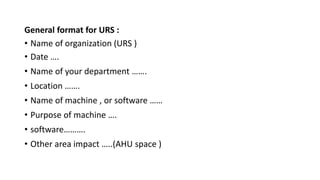
General format for URS :
• Name of organization (URS )
• Date ….
• Name of your department …….
• Location …….
• Name of machine , or software ……
• Purpose of machine ….
• software……….
• Other area impact …..(AHU space )
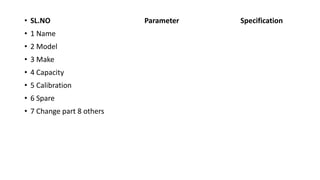
• SL.NO Parameter Specification
• 1 Name
• 2 Model
• 3 Make
• 4 Capacity
• 5 Calibration
• 6 Spare
• 7 Change part 8 others
• Facilities For Design qualification-(DQ)
• Once the URS is finalized the Engineering department, R&D ,user, QA
department will prepare the design qualification ,which including
drawing ,calculation ,sample & other design document .¨
Manufacturer will study the design ,if the design is ok from the
construction point of view manufacturer will quote to the user . if the
design is not ok from the construction ,national & international point
of view. machine manufacture will prepare new drawing from the
construction as well as legal & user point of view .than these drawing
is send to user for approval.
1 -General
2 -Document approval
3 -Version control
4 -Abbreviation
5 -Objective
6 -Responsibility
7 -URS 8 Equipment
9- DQ review and approval ,etc.
• Facilities Of Installation qualification (IQ)
•Installation qualification is the documented
verification that the system is installed
satisfactory & is compliance with other
appropriate engineering code, manufacturing
and approval specification and that instrument is
calibrated & all service are available & of
adequate .
• IQ protocol
• ¨ Validation file
• ¨ Security access
• ¨ Environment
• ¨ System diagnostics
• ¨ hardware component
• ¨ Instrument installation & calibration
• ¨ Electric power & circuit protection
• ¨ Instrument air supply
• ¨ Loop wiring
• ¨ Hardware configuration
• ¨ Software backup and restoration
• ¨ General system inspection
Facilities Of Operational qualification(OQ):
The computer must be power backup & check to ensure it functioning
correctly .This may be involve observing & recording system status lamp
& rerunning diagnostic check
OQ protocol
• Operator interface & screen display
• ¨ Input/ output signal
• ¨ Data storage ,backup & restore
• ¨ Electrical record &electrical signature
• ¨ System report printout
• ¨ Trend display
• ¨ Alarm event & massages
• ¨ Safety interlocks
• ¨ Control & Monitoring loop wiring
• ¨ Software process logic
• ¨ SOP preparation & approval
• ¨ Power failure & data recovery
Performance qualification(PQ)
Performance qualification is an documented verification that
computerized operation consistently perform as intended in the URS
throughout all the anticipated operating range . Performance
qualification are a collection of test cases used to verify that a system
perform as expected under simulated real world Condition The
performance and equipment for its routine analytical use is check to
ensure that complies with its specification .
types of validation

types of validation

  • 1.
    MODERN PHARMACEUTICS Presented by- ABDULNAIM M – Pharm – Pharmaceutics 1-st semester
  • 2.
    Validation:- validation isconfirmation by examination and the provision of objective evidence that the particular requirements for a specific intended use are fulfilled TYPES OF VALIDATION THE MAJOR TYPES OF VALIDATION 1. Process validation 2. Cleaning validation 3. Equipment validation (Qualification ) 4. Validation of analytical method
  • 3.
    Process validation Definition • Asper FDA Nov,2008, ‘the collection of data from the process design state throughout production, which establishes scientific evidence that a process is capable of consistently delivering quality products. Types of process validation: Prospective validation Retrospective validation Concurrent validation Revalidation
  • 4.
    a. Prospective validation •Carried out during the development stage by means of a risk analysis of the production process, which is broken down into individual steps. • These are then evaluated on the basis of past experience to determine whether they might lead to critical situations.
  • 5.
    b. Concurrent validation Concurrentvalidation is validation which is carried out during normal production. It is appropriate when:- • it is more appropriate to validate process during routine production due to well understanding of process. • Extensive testing and monitoring ensure the desired quality characteristics of product with high degree of confidence
  • 6.
    C. Retrospective validation •Retrospective validation involves the examination of past experience of production on the assumption that composition, procedures, and equipment remain unchanged • Such experience and the results of in-process and the final control tests are then evaluated • Recorded difficulties and failure in production are analysis to determine the limit of process parameters
  • 7.
    d. Revalidation • Revalidationis needed to ensure that changes in the process and/or in the process environment, do not adversely affect process characteristics and product quality. • Revalidation may be divided into two broad categories:  Revalidation after any change having a bearing on product quality.  Periodic revalidation carried out at scheduled intervals.
  • 8.
    2. Cleaning validation Definition “Aprocess of attaining and document in sufficient evidence to give reasonable assurance, given the current state of science and technology, that the cleaning process under consideration does, and/or will do, what it purpose to do.” Objective.. • To minimize cross contamination. • To determine efficiency of cleaning process • To do troubleshooting in case problem identified in the cleaning process and give suggestions to improve the process
  • 9.
    3. Equipment validation Definition:- • As per FDA, May 1987, ‘Action of proving of providing that any equipment works correctly and leads to the expected results is equipment qualification. • It is not single step activity but instead result from many activities.
  • 10.
    4. Validation ofanalytical method Definition:- • “the process by, which it is established, by laboratory studies, that the performance characteristics of the method meet the requirements for the intended analytical application.” Accuracy : “The closeness of test results obtained by that method to the true value. This accuracy should be established across its range.” Precision; The degree of agreement among individual test results when the method is applied repeatedly to multiple sampling of a homogenous
  • 11.
    VALIDATION OF SOLIDDOSAGE FORMS • The objective of the design and manufacture of the solid dosage form(tablet, capsule) is to deliver orally by correct amount of drug in the proper from, over a period of time and in the desired location and to have its chemical integrity protected to that point. • The prime objective of any pharmaceutical plant is to manufacture product of high quality consistently at the lowest possible cost. • Through a careful design & validation of both the process and controls, the manufacturer can establish a high degree of confidence that all manufactured units from successive lots will be acceptable.
  • 12.
    • The productquality can be ensured by, 1. Chemical and physical stability 2. Preservation against microbial contamination 3. Uniformity of dose of drug 4. Acceptability to users(prescriber & patient) 5. Suitable packaging and labelling 6. Validation • Tablets as a dosage form comprises a mixture of active substances and excipients, usually in powder form, pressed (or) compact in to solid • The excipients include 1. Binder, glidants and lubricant- to ensure efficient tabletting 2. Disintegrant - to promote tablet break up in the GIT
  • 13.
    3. Sweetener/flavour –to enhance taste 4. Pigment – to make the tablet visually attractive • Polymer coating is often applied to make the tablet :- 1. Smoother 2. Easy to swallow 3. Control the release rate of active ingredients 4. More resistant to environment 5. Extending its shelf life 6. To enhance appearance of the tablet
  • 14.
    • The manufacturingof tablet includes extensive powder handling • The powder must blended for uniformity and converted in to the dosage from through compression. • The typical requirement include 1. Weight 2. Blending 3. Mixing/ granulation areas 4. Compression 5. Coating
  • 15.
    GOVERNMENT REGULATION • Thisemphasis on validation began in the late 1970 s, the requirement has been set at 1963 as cGMP for finished pharmaceuticals. • There shall be return procedures for production and process control designed to assure that the drug products have the identity strength, quality, purity. • Validation is considered to be integral part of GMPs essentially worldwide, compliances with validation requirements is necessary for obtaining approval to manufacture and to introduce new products. • The FDA’s cGMP refer to the concepts of the validation in both sections.
  • 16.
    • They statethat such control procedure shall be established to monitor output and to validate the performance of those manufacturing process that may be responsible for causing variability in the characteristics of in process materials and drug materials. • The accuracy, sensitivity, specificity and reproducibility of test methods employed by the firm shall be established and documented. • A generally stated requirement for process validation is contained in the medicinal device GMP regulations. • Where deviations from device specification could occur as result of manufacturing process itself. • There shall be written procedures describing any process controls necessary to assure conformance to specifications.
  • 17.
  • 18.
    Facilities Facilities for URS(userrequirement specification):- • User requirement specifications may be define as the ,user department will raise the indent for his requirement regarding machine ,equipment or software. He will give his requirement in a one format is called the URS which including the functional and technical specification for the machine ,equipment or software ,these specification written is called the URS.
  • 19.
    General format forURS : • Name of organization (URS ) • Date …. • Name of your department ……. • Location ……. • Name of machine , or software …… • Purpose of machine …. • software………. • Other area impact …..(AHU space )
  • 20.
    • SL.NO ParameterSpecification • 1 Name • 2 Model • 3 Make • 4 Capacity • 5 Calibration • 6 Spare • 7 Change part 8 others
  • 21.
    • Facilities ForDesign qualification-(DQ) • Once the URS is finalized the Engineering department, R&D ,user, QA department will prepare the design qualification ,which including drawing ,calculation ,sample & other design document .¨ Manufacturer will study the design ,if the design is ok from the construction point of view manufacturer will quote to the user . if the design is not ok from the construction ,national & international point of view. machine manufacture will prepare new drawing from the construction as well as legal & user point of view .than these drawing is send to user for approval.
  • 22.
    1 -General 2 -Documentapproval 3 -Version control 4 -Abbreviation 5 -Objective 6 -Responsibility 7 -URS 8 Equipment 9- DQ review and approval ,etc.
  • 23.
    • Facilities OfInstallation qualification (IQ) •Installation qualification is the documented verification that the system is installed satisfactory & is compliance with other appropriate engineering code, manufacturing and approval specification and that instrument is calibrated & all service are available & of adequate .
  • 24.
    • IQ protocol •¨ Validation file • ¨ Security access • ¨ Environment • ¨ System diagnostics • ¨ hardware component • ¨ Instrument installation & calibration • ¨ Electric power & circuit protection • ¨ Instrument air supply • ¨ Loop wiring
  • 25.
    • ¨ Hardwareconfiguration • ¨ Software backup and restoration • ¨ General system inspection Facilities Of Operational qualification(OQ): The computer must be power backup & check to ensure it functioning correctly .This may be involve observing & recording system status lamp & rerunning diagnostic check
  • 26.
    OQ protocol • Operatorinterface & screen display • ¨ Input/ output signal • ¨ Data storage ,backup & restore • ¨ Electrical record &electrical signature • ¨ System report printout • ¨ Trend display • ¨ Alarm event & massages
  • 27.
    • ¨ Safetyinterlocks • ¨ Control & Monitoring loop wiring • ¨ Software process logic • ¨ SOP preparation & approval • ¨ Power failure & data recovery
  • 28.
    Performance qualification(PQ) Performance qualificationis an documented verification that computerized operation consistently perform as intended in the URS throughout all the anticipated operating range . Performance qualification are a collection of test cases used to verify that a system perform as expected under simulated real world Condition The performance and equipment for its routine analytical use is check to ensure that complies with its specification .