Course Title: Pharmaceutical Quality Control and Analytical Method
Validation
Course Code: BPH-415
Submitted To
Dr. Mohammed Shafikur Rahman
Designation: Associate Professor
Department of Pharmacy
Daffodil International University
Submitted By
MD. Riaz
ID: 181-29-1287
Bach: 19th (C)
Department of Pharmacy
Daffodil International University
Assignment Topic:
“Analytical Method Validation”
Introduction
Method validation is the process of documenting / proving that an analytical
method provides analytical data acceptable for the intended use. A
pharmaceutical drug productmust meet all its specifications throughoutits entire
shelf-life. The performanceof productcharacteristics throughoutthe shelf-life
must be tested by analytical method for the product’s chemical, physiochemical,
microbiological and biological characteristics. The method of analysis used must
be validated. This is required to ensurethe product’s safety and efficacy
throughoutall phases of its shelf-life. Validation is the process of establishing
documentary evidence demonstrating that a procedure, process, or activity
carried out in testing and then production maintains the desired level of
compliance at all stages.
Objective
The main objectiveof analytical validation is to ensurethat a selected analytical
procedurewill give reproducible and reliable results that are adequate for the
intended purpose. This is applicable to all the procedureeither pharmacopoeial or
non pharmacopoeial.
To discuss various aspects of analytical method validation.
Principles of analytical method validation.
Approaches to analytical method validation.
Steps of method development & validation
The steps of method development & validation depends upon the type of method
being developed, however the following steps are common to mosttypes of
projects:
 Method development plan definition
 Back ground information gathering
 Laboratory method development
 Generation of test procedure
 Methods validation protocoldefinition
 Laboratory method validation
 Validated test method generatio
 Validation report
Types of AnalyticalProceduresto beValidated
The required validation parameters also termed “analytical performance
characteristics”, depends upon the type of analytical method.
Pharmaceutical analytical methods are characterized into 5 general types
Identification tests
Potency assays
Limit tests for the control of impurities
Impurity tests- quantitative
Specific tests.
What is Analytical Method Validation?
 Method validation means establishing through documented evidence, a
high degree of assurancethatan analytical method will consistently yield
results that accurately reflect the quality characteristics of the products
tested.
 U.S. FDA-Establishing documented evidence which provides a high degree
of assurancethata specific process will consistently producea product
meeting its predetermined specifications and quality attributes.
 WHO- Documented act of providing that any procedure, process,
equipment material, activity or systemactually leads to the expected result.
PRINCIPLE
 Guideline presents information on the characteristics to be considered.
 Manufacturers to demonstrate -analytical procedureis suitable for its
intended purpose.
 Validate analytical methods - whether they indicate stability or not.
 Validated by R&D beforebeing transferred to the quality controlunit when
appropriate
ANALYTICAL PROCEDURES TO BE VALIDATED
Identification tests.
Quantitative tests for impurities’ content
Limit test for the control of impurities.
 Quantitative tests of the active moiety of drug substanceor drug productor
other selected component(s) in the drug product
 Dissolution testing and determination of particle size
 Analytical methods are used to test and ensure the Quality of Drug
substances /Drug products
 Analytical methods are followed fromOfficial Pharmacopeia or developed
by users.
 How can assurethe analytical methods are suitable for it purpose.
 Hence Analytical Method has to be validated or confirm its suitability?
WHY VALIDATION?
When should verification or revalidation bedone?
changes in the process for synthesis of the drug substance.
changes in the composition of the finished product.
changes in the analytical procedure
transfer of methods fromone laboratory to another.
changes in major pieces of equipment
instruments.
 Extent depends on the nature of the change(s)
 Evidence of “analystproficiency”.
VALIDATION CHARACTERISTICS
Characteristics that should be considered during
validation of analytical methods includes:
 Specificity
 Linearity
 Range
Accuracy
1. Repeatability
2. Intermediate Precision
 Detection Limit
 Quantitation Limit
 Robustness
ACCURACY
The accuracy of an analytical procedureexpresses the closeness of agreement
between the value which is accepted either as a conventional true value or an
accepted accepted reference referencevalue and the value found.
 The degree of agreement of test results with the true value or the closeness
of the results obtained by the procedureto the true value.
 Itis normally established on samples of the material to be examined that
have been prepared to quantitative accuracy.
 Accuracy should be established across the specified range of the analytical
procedure
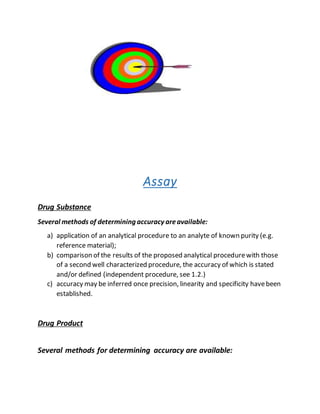
Assay
Drug Substance
Several methods of determining accuracy areavailable:
a) application of an analytical procedure to an analyte of known purity (e.g.
reference material);
b) comparison of the results of the proposed analytical procedurewith those
of a second well characterized procedure, the accuracy of which is stated
and/or defined (independent procedure, see 1.2.)
c) accuracy may be inferred once precision, linearity and specificity havebeen
established.
Drug Product
Several methods for determining accuracy are available:
a) application of the analytical procedureto synthetic mixtures of the drug
productcomponents to which known quantities of the drug substanceto be
analysed have been added;
b) in cases where it is impossible to obtain samples of all drug product
components, it may be acceptable either to add known quantities of the
analyte to the drug productor to compare the results obtained froma second,
well characterized procedure, the accuracy of which is stated and/or defined
(independent procedure, see 1.2.);
c) accuracy may be inferred once precision, linearity and specificity havebeen
established.
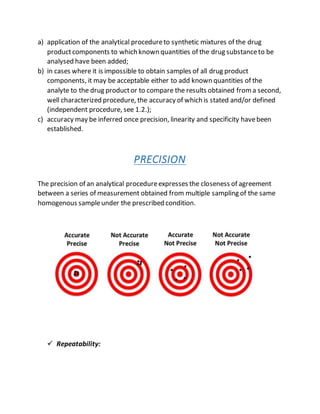
PRECISION
The precision of an analytical procedureexpresses the closeness of agreement
between a series of measurement obtained from multiple sampling of the same
homogenous sampleunder the prescribed condition.
 Repeatability:
A minimum of nine determinations covering the specified rangefor the procedure
e.g.- three concentrations/threereplicates each, or a minimum of six
determinations at 100% of the test concentration.
 Intermediateprecision:Within-laboratory variations
◦ usually on different days, differentanalysts and different equipment. (If
reproducibility is assessed, a measureof intermediate precision is not required.)
 Reproducibility: Precision between laboratories
Repeatability
Repeatability should be assessed using:
a) a minimum of 9 determinations covering the specified range for the procedure
(e.g., 3 concentrations/3 replicates each)
or
b) a minimum of 6 determinations at 100% of the test concentration.
Intermediate Precision The extent to which intermediate precision should be
established depends on the circumstances under which the procedureis intended
to be used. The applicant should establish the effects of randomevents on the
precision of the analytical procedure. Typical variations to be studied include
days, analysts, equipment, etc. Itis not considered necessary to study these
effects individually. The useof an experimental design (matrix) is encouraged.
Reproducibility
Reproducibility is assessed by means of an inter-laboratory trial. Reproducibility
should be considered in caseof the standardization of an analytical procedure, for
instance, for inclusion of procedures in pharmacopoeias. Thesedata are not part
of the marketing authorization dossier.
Recommended Data
The standard deviation, relative standard deviation (coefficient of variation) and
confidence interval should be reported for each type of precision investigated.
ROBUSTNESS
The ability of the procedureto provideanalytical results of acceptable accuracy
and precision under a variety of conditions. The results from separatesamples are
influenced by changes in the operational or environmental conditions. Robustness
should be considered during the development phase, and should show the
reliability of an analysis when deliberate variations are made in method
parameters.
Factorsthat can have an effect on robustness when performing
chromatographic analysis includes:
stability of test and standard samples and solutions
reagents (e.g. different suppliers)
different columns (e.g. different lots and/or suppliers)
extraction time
variations of pH of a mobile phase
variations in mobile phasecomposition
temperature
flow rate
stability of analytical solutions
extraction time
influence of variations of pH in a mobile phase
influence of variations in mobile phasecomposition
different columns (lots/suppliers)
The robustness of an analytical procedureis a measureof its capacity to remain
unaltered by small, but intentional variations in method parameters and provides
an indication of its reliability during normal usage.
LINEARITY
The linearity of an analytical procedureis its ability to show testresults which are
directly proportionalto the concentration.
Itindicates the ability to produceresults that are directly proportionalto the
concentration of the analyte in samples.
 A series of samples should be prepared in which the analyte concentrations
span the claimed range of the procedure. If there is a linear relationship,
test results should be evaluated by appropriatestatistical methods.
 A minimum of five concentrations should be used
RANGE
The range of an analytical procedureis the interval between the upper and lower
concentration of material under question in the sample for which it has shown
compliance with reference to precision, accuracy and linearity
 Itis an expression of the lowest and highest levels of analyte that have
been demonstrated to be determinable for the product.
 The specified range is normally derived fromlinearity studies
SPECIFICITY
 Itis the ability to measure unequivocally the desired analyte in the
presenceof components such as excipients and impurities that may also be
expected to be present.
 An investigation of specificity should be conducted during the validation of
identification tests, the determination of impurities and assay
Detection limit(LOD)
The detection limit is the lowest amountof analyte in a sample which can be
detected but not necessarily quantitated/measured as an exact value it means
some signalmust be detected by the process.
variousapproaches
Based on Visual Evaluation
Visualevaluation may be used for non-instrumentalmethods but may also
be used with instrumentalmethods.
The detection limit is determined by the analysis of samples with known
concentrations of analyte and by establishing the minimum level at which
the analyte can be reliably detected.
Based on Signal-to-Noise
This approach can only be applied to analytical procedures which exhibit
baseline noise.
Determination of the signal-to-noiseratio is performed by comparing
measured signals fromsamples with known low concentrations of analyte
with those of blank samples and establishing the minimum concentration at
which the analyte can be reliably detected. A signal-to
noise ratio between 3 or 2:1 is generally considered acceptable for
estimating the detection limit.
• Based on the Standard Deviation of theResponse and the SlopeBased on the
Standard Deviation of theBlank
Measurement of the magnitude of analytical background responseis performed
by analyzing an appropriate number of blank samples and calculating the
standard deviation of these responses.
Based on the Calibration Curve
A specific calibration curveshould be studied using samples containing an analyte
in the rangeof DL. The residualstandard deviation of a regression line or the
standard deviation of y-intercepts of regression lines may be used as the standard
deviation.
RecommendedData
The detection limit and the method used for determining the detection limit
should be presented. If DL is determined based on visualevaluation or based on
signal to noise ratio, the presentation of the relevant chromatograms is
considered acceptable for justification. 11 Validation of Analytical Procedures:
Methodology In cases where an estimated value for the detection limit is
obtained by calculation or extrapolation, this estimate may subsequently be
validated by the independent analysis of a suitable number of samples known to
be near or prepared at the detection limit.
 Itis the smallestquantity of an analyte that can be detected, and not
necessarily determined, in a quantitative fashion
Approaches (instrumental or non-instrumental):
 visualevaluation.
 signal to noise ratio.
 standard deviation of the responseand the slope.
 standard deviation of the blank.
 calibration curve.
Quantitation limit (limit of quantitation)
The quantitation limit of an individual analytical procedureis the least/lowest
amount of the analyte in a sample which can be quantitatively determined.
• Several approachesfor determining thequantitation limit
are possible, depending on whether the procedureis a non-instrumentalor
instrumental. Approaches other than thoselisted below may be acceptable.
• Based on Visual Evaluation
• Visualevaluation may be used for non-instrumentalmethods but may also be
used with instrumental
methods.
• The quantitation limitisgenerally determined by the analysisof samples with
known concentrationsof analyteand by establishing the minimumlevel at
which the analytic can be quantified with acceptableaccuracy
• Determinationof thesignal-to-noise ratiois performed by comparing measured
signals fromsamples with known low concentrations of analyte with those of
blank samples and by establishing the minimum concentration at which the
analyte can be reliably quantified. A typical signal-to-noiseratio is 10:1.
• Based on Standard Deviation of the Blank
Measurement of the magnitude of analytical background responseis performed
by analyzing an appropriate number of blank samples and calculating the
standard deviation of these responses.
• Basedon theCalibration Curve
A specific calibration curveshould be studied using samples, containing an analyte
in the rangeof QL. The residualstandard deviation of a regression line or the
standard deviation of
intercepts of regression lines may be used as the standard deviation.
• Recommended Data
The quantitation limit and the method used for determining the quantitation limit
should be presented. The limit should be subsequently validated by the analysis
of a suitable number of samples known to be near or prepared at the quantitation
limit
It is the lowest concentration of an analytic in a sample that may be determined
with acceptableaccuracy and precision.
Approaches (instrumentalor non-instrumental):
◦ visualevaluation.
◦ signalto noise ratio.
◦ standard deviation of the responseand the slope.
◦ standard deviation of the blank.
◦ calibration curve.

All you know About Analytical method validation

  • 1.
    Course Title: PharmaceuticalQuality Control and Analytical Method Validation Course Code: BPH-415 Submitted To Dr. Mohammed Shafikur Rahman Designation: Associate Professor Department of Pharmacy Daffodil International University Submitted By MD. Riaz ID: 181-29-1287 Bach: 19th (C) Department of Pharmacy Daffodil International University Assignment Topic: “Analytical Method Validation”
  • 2.
    Introduction Method validation isthe process of documenting / proving that an analytical method provides analytical data acceptable for the intended use. A pharmaceutical drug productmust meet all its specifications throughoutits entire shelf-life. The performanceof productcharacteristics throughoutthe shelf-life must be tested by analytical method for the product’s chemical, physiochemical, microbiological and biological characteristics. The method of analysis used must be validated. This is required to ensurethe product’s safety and efficacy throughoutall phases of its shelf-life. Validation is the process of establishing documentary evidence demonstrating that a procedure, process, or activity carried out in testing and then production maintains the desired level of compliance at all stages. Objective The main objectiveof analytical validation is to ensurethat a selected analytical procedurewill give reproducible and reliable results that are adequate for the intended purpose. This is applicable to all the procedureeither pharmacopoeial or non pharmacopoeial. To discuss various aspects of analytical method validation. Principles of analytical method validation. Approaches to analytical method validation.
  • 3.
    Steps of methoddevelopment & validation The steps of method development & validation depends upon the type of method being developed, however the following steps are common to mosttypes of projects:  Method development plan definition  Back ground information gathering  Laboratory method development  Generation of test procedure  Methods validation protocoldefinition  Laboratory method validation  Validated test method generatio  Validation report Types of AnalyticalProceduresto beValidated The required validation parameters also termed “analytical performance characteristics”, depends upon the type of analytical method. Pharmaceutical analytical methods are characterized into 5 general types Identification tests Potency assays Limit tests for the control of impurities Impurity tests- quantitative Specific tests.
  • 4.
    What is AnalyticalMethod Validation?  Method validation means establishing through documented evidence, a high degree of assurancethatan analytical method will consistently yield results that accurately reflect the quality characteristics of the products tested.  U.S. FDA-Establishing documented evidence which provides a high degree of assurancethata specific process will consistently producea product meeting its predetermined specifications and quality attributes.  WHO- Documented act of providing that any procedure, process, equipment material, activity or systemactually leads to the expected result. PRINCIPLE  Guideline presents information on the characteristics to be considered.  Manufacturers to demonstrate -analytical procedureis suitable for its intended purpose.  Validate analytical methods - whether they indicate stability or not.  Validated by R&D beforebeing transferred to the quality controlunit when appropriate ANALYTICAL PROCEDURES TO BE VALIDATED Identification tests. Quantitative tests for impurities’ content Limit test for the control of impurities.
  • 5.
     Quantitative testsof the active moiety of drug substanceor drug productor other selected component(s) in the drug product  Dissolution testing and determination of particle size  Analytical methods are used to test and ensure the Quality of Drug substances /Drug products  Analytical methods are followed fromOfficial Pharmacopeia or developed by users.  How can assurethe analytical methods are suitable for it purpose.  Hence Analytical Method has to be validated or confirm its suitability? WHY VALIDATION? When should verification or revalidation bedone? changes in the process for synthesis of the drug substance. changes in the composition of the finished product. changes in the analytical procedure transfer of methods fromone laboratory to another. changes in major pieces of equipment instruments.  Extent depends on the nature of the change(s)  Evidence of “analystproficiency”.
  • 6.
    VALIDATION CHARACTERISTICS Characteristics thatshould be considered during validation of analytical methods includes:  Specificity  Linearity  Range Accuracy 1. Repeatability 2. Intermediate Precision  Detection Limit  Quantitation Limit  Robustness ACCURACY The accuracy of an analytical procedureexpresses the closeness of agreement between the value which is accepted either as a conventional true value or an accepted accepted reference referencevalue and the value found.  The degree of agreement of test results with the true value or the closeness of the results obtained by the procedureto the true value.  Itis normally established on samples of the material to be examined that have been prepared to quantitative accuracy.  Accuracy should be established across the specified range of the analytical procedure
  • 7.
    Assay Drug Substance Several methodsof determining accuracy areavailable: a) application of an analytical procedure to an analyte of known purity (e.g. reference material); b) comparison of the results of the proposed analytical procedurewith those of a second well characterized procedure, the accuracy of which is stated and/or defined (independent procedure, see 1.2.) c) accuracy may be inferred once precision, linearity and specificity havebeen established. Drug Product Several methods for determining accuracy are available:
  • 8.
    a) application ofthe analytical procedureto synthetic mixtures of the drug productcomponents to which known quantities of the drug substanceto be analysed have been added; b) in cases where it is impossible to obtain samples of all drug product components, it may be acceptable either to add known quantities of the analyte to the drug productor to compare the results obtained froma second, well characterized procedure, the accuracy of which is stated and/or defined (independent procedure, see 1.2.); c) accuracy may be inferred once precision, linearity and specificity havebeen established. PRECISION The precision of an analytical procedureexpresses the closeness of agreement between a series of measurement obtained from multiple sampling of the same homogenous sampleunder the prescribed condition.  Repeatability:
  • 9.
    A minimum ofnine determinations covering the specified rangefor the procedure e.g.- three concentrations/threereplicates each, or a minimum of six determinations at 100% of the test concentration.  Intermediateprecision:Within-laboratory variations ◦ usually on different days, differentanalysts and different equipment. (If reproducibility is assessed, a measureof intermediate precision is not required.)  Reproducibility: Precision between laboratories Repeatability Repeatability should be assessed using: a) a minimum of 9 determinations covering the specified range for the procedure (e.g., 3 concentrations/3 replicates each) or b) a minimum of 6 determinations at 100% of the test concentration. Intermediate Precision The extent to which intermediate precision should be established depends on the circumstances under which the procedureis intended to be used. The applicant should establish the effects of randomevents on the precision of the analytical procedure. Typical variations to be studied include days, analysts, equipment, etc. Itis not considered necessary to study these effects individually. The useof an experimental design (matrix) is encouraged. Reproducibility
  • 10.
    Reproducibility is assessedby means of an inter-laboratory trial. Reproducibility should be considered in caseof the standardization of an analytical procedure, for instance, for inclusion of procedures in pharmacopoeias. Thesedata are not part of the marketing authorization dossier. Recommended Data The standard deviation, relative standard deviation (coefficient of variation) and confidence interval should be reported for each type of precision investigated. ROBUSTNESS The ability of the procedureto provideanalytical results of acceptable accuracy and precision under a variety of conditions. The results from separatesamples are influenced by changes in the operational or environmental conditions. Robustness should be considered during the development phase, and should show the reliability of an analysis when deliberate variations are made in method parameters. Factorsthat can have an effect on robustness when performing chromatographic analysis includes: stability of test and standard samples and solutions reagents (e.g. different suppliers) different columns (e.g. different lots and/or suppliers) extraction time
  • 11.
    variations of pHof a mobile phase variations in mobile phasecomposition temperature flow rate stability of analytical solutions extraction time influence of variations of pH in a mobile phase influence of variations in mobile phasecomposition different columns (lots/suppliers) The robustness of an analytical procedureis a measureof its capacity to remain unaltered by small, but intentional variations in method parameters and provides an indication of its reliability during normal usage. LINEARITY The linearity of an analytical procedureis its ability to show testresults which are directly proportionalto the concentration. Itindicates the ability to produceresults that are directly proportionalto the concentration of the analyte in samples.
  • 12.
     A seriesof samples should be prepared in which the analyte concentrations span the claimed range of the procedure. If there is a linear relationship, test results should be evaluated by appropriatestatistical methods.  A minimum of five concentrations should be used RANGE The range of an analytical procedureis the interval between the upper and lower concentration of material under question in the sample for which it has shown compliance with reference to precision, accuracy and linearity  Itis an expression of the lowest and highest levels of analyte that have been demonstrated to be determinable for the product.  The specified range is normally derived fromlinearity studies SPECIFICITY
  • 13.
     Itis theability to measure unequivocally the desired analyte in the presenceof components such as excipients and impurities that may also be expected to be present.  An investigation of specificity should be conducted during the validation of identification tests, the determination of impurities and assay Detection limit(LOD) The detection limit is the lowest amountof analyte in a sample which can be detected but not necessarily quantitated/measured as an exact value it means some signalmust be detected by the process. variousapproaches Based on Visual Evaluation Visualevaluation may be used for non-instrumentalmethods but may also be used with instrumentalmethods. The detection limit is determined by the analysis of samples with known concentrations of analyte and by establishing the minimum level at which the analyte can be reliably detected. Based on Signal-to-Noise This approach can only be applied to analytical procedures which exhibit baseline noise. Determination of the signal-to-noiseratio is performed by comparing
  • 14.
    measured signals fromsampleswith known low concentrations of analyte with those of blank samples and establishing the minimum concentration at which the analyte can be reliably detected. A signal-to noise ratio between 3 or 2:1 is generally considered acceptable for estimating the detection limit. • Based on the Standard Deviation of theResponse and the SlopeBased on the Standard Deviation of theBlank Measurement of the magnitude of analytical background responseis performed by analyzing an appropriate number of blank samples and calculating the standard deviation of these responses. Based on the Calibration Curve A specific calibration curveshould be studied using samples containing an analyte in the rangeof DL. The residualstandard deviation of a regression line or the standard deviation of y-intercepts of regression lines may be used as the standard deviation. RecommendedData The detection limit and the method used for determining the detection limit should be presented. If DL is determined based on visualevaluation or based on signal to noise ratio, the presentation of the relevant chromatograms is considered acceptable for justification. 11 Validation of Analytical Procedures: Methodology In cases where an estimated value for the detection limit is obtained by calculation or extrapolation, this estimate may subsequently be validated by the independent analysis of a suitable number of samples known to be near or prepared at the detection limit.
  • 15.
     Itis thesmallestquantity of an analyte that can be detected, and not necessarily determined, in a quantitative fashion Approaches (instrumental or non-instrumental):  visualevaluation.  signal to noise ratio.  standard deviation of the responseand the slope.  standard deviation of the blank.  calibration curve. Quantitation limit (limit of quantitation) The quantitation limit of an individual analytical procedureis the least/lowest amount of the analyte in a sample which can be quantitatively determined. • Several approachesfor determining thequantitation limit are possible, depending on whether the procedureis a non-instrumentalor instrumental. Approaches other than thoselisted below may be acceptable. • Based on Visual Evaluation • Visualevaluation may be used for non-instrumentalmethods but may also be used with instrumental
  • 16.
    methods. • The quantitationlimitisgenerally determined by the analysisof samples with known concentrationsof analyteand by establishing the minimumlevel at which the analytic can be quantified with acceptableaccuracy • Determinationof thesignal-to-noise ratiois performed by comparing measured signals fromsamples with known low concentrations of analyte with those of blank samples and by establishing the minimum concentration at which the analyte can be reliably quantified. A typical signal-to-noiseratio is 10:1. • Based on Standard Deviation of the Blank Measurement of the magnitude of analytical background responseis performed by analyzing an appropriate number of blank samples and calculating the standard deviation of these responses. • Basedon theCalibration Curve A specific calibration curveshould be studied using samples, containing an analyte in the rangeof QL. The residualstandard deviation of a regression line or the standard deviation of intercepts of regression lines may be used as the standard deviation. • Recommended Data The quantitation limit and the method used for determining the quantitation limit should be presented. The limit should be subsequently validated by the analysis of a suitable number of samples known to be near or prepared at the quantitation limit
  • 17.
    It is thelowest concentration of an analytic in a sample that may be determined with acceptableaccuracy and precision. Approaches (instrumentalor non-instrumental): ◦ visualevaluation. ◦ signalto noise ratio. ◦ standard deviation of the responseand the slope. ◦ standard deviation of the blank. ◦ calibration curve.