Research Articles
Science 1 January 2026 96
EXOPLANETS
A free-­floating-­planet
microlensing event caused
by a Saturn-­mass object
Subo Dong1,2,3
*, Zexuan Wu1,2
,Yoon-­Hyun Ryu4
,Andrzej Udalski5
*,
Przemek Mróz5
, Krzysztof A. Rybicki5,6
, Simon T. Hodgkin7
,
Łukasz Wyrzykowski5
, Laurent Eyer8
,Thomas Bensby9
,
Ping Chen10,11
, Sharon X. Wang12
,Andrew Gould13,14
,
Hongjing Yang15,12
, Michael D.Albrow16
, Sun-­
Ju Chung4
,
Cheongho Han17
, Kyu-­
Ha Hwang4
,Youn Kil Jung4,18
, In-­
Gu Shin19
,
Yossi Shvartzvald6
,Jennifer C.Yee19
, Weicheng Zang19
,
Dong-­Jin Kim4
, Chung-­
Uk Lee4
*, Byeong-­
Gon Park4
,
Radosław Poleski5
,Jan Skowron5
, Michał K. Szymański5
,
Igor Soszyński5
, Paweł Pietrukowicz5
, Szymon Kozłowski5
,
Dorota M. Skowron5
, Krzysztof Ulaczyk5,20
, Mariusz Gromadzki5
,
Milena Ratajczak5
, Patryk Iwanek5
, Marcin Wrona5,21
,
Mateusz J. Mróz5
, Guy Rixon7
, Diana L. Harrison7,22
, Elmé Breedt7
A population of free-­
floating planets is known from gravitational
microlensing surveys. None have a directly measured mass,
owing to a degeneracy with the distance, but the population
statistics indicate that many are less massive than Jupiter. We
report a microlensing event—KMT-­2024-­BLG-­0792/OGLE-­
2024-­
BLG-­
0516, which was observed from both ground-­and
space-­
based telescopes—that breaks the mass-­
distance
degeneracy. The event was caused by an object with 0.219+0.075
−0.046
Jupiter masses that is either gravitationally unbound or on a
very wide orbit. Through comparison with the statistical
properties of other observed microlensing events and
predictions from simulations, we infer that this object likely
formed in a protoplanetary disk (like a planet), not in isolation
(like a brown dwarf). Dynamical processes then ejected it from
its birthplace, producing a free-­
floating object.
Planets form in protoplanetary disks, which are gravitationally bound
to their host stars. Dynamical processes (1, 2) can later eject planets
from the system, becoming gravitationally unbound (3–5). Isolated
planetary-­
mass objects can alternatively form like stars and brown
dwarfs (BDs) through the gravitational collapse of gas in molecular
clouds (6). An unbound planetary-­
mass object can act as a gravita-
tional lens (7) if it passes between an observer and a background star
(known as the source). This causes an apparent change in brightness
of the source, which is observed as a microlensing event (8). Con­ven­
tionally, a free-­
floating-­
planet (FFP) microlensing event is defined as
one with a single lens, a single source, and an Einstein timescale (tE,
which quantifies the duration of a microlensing event) that is ≲1 day.
The requirements for a single lens and single source mean that there
is no evidence of the microlensing object being in a gravitationally
bound system, so it is either free floating or on a very wide orbit. The
short timescale indicates a low lens mass (M) because tE ∝
√
M. The
combination of these factors is conventionally interpreted as indicat-
ing a free-­
floating planet.
A population of microlensing FFP events (9) has been identified on
the basis of six short-­
tE events. This population was separated from
events caused by stars and BDs by a gap centered at tE ~ 0.5 days (9).
A high-­
cadence search identified an FFP event with finite-­
source ef-
fects (10), in which the finite angular size of the source star modifies
the time-­
varying magnification profile as the lens crosses the stellar
disk of the source. Such finite-­
source point-­
lens (FSPL) events provide
a measurement of the angular radius (θE) of the Einstein ring, the
apparently circular image formed when the lens and source are per-
fectly aligned. A systematic search for FSPL events (11) identified a
gap in the θE distribution at 9 ≲ θE ≲ 25 micro–arc sec, which was
referred to as the Einstein desert (12). All nine known FSPL FFP events
have θE below this desert, which implies that the lensing objects are
less than one Jupiter mass (MJ) (11, 13). These events have been inter-
preted as free-­
floating planets that were ejected from protoplanetary
disks. By contrast, all other detected FSPL events are above the
desert, which implies that they were produced by BDs and stars.
Ground-­
based observational data
The Korea Microlensing Telescope Network (KMTNet) (14) and Optical
Gravitational Lensing Experiment (OGLE) (15) surveys independently
identified a microlensing event on 3 May 2024, designating it KMT-­
2024-­BLG-­0792 and OGLE-­2024-­BLG-­0516, respectively (16). Both
surveys performed high-­
cadence photometric observations using their
telescopes in Chile, South Africa, and Australia. The source brightness
1
Department of Astronomy, School of Physics, Peking University, Beijing, China. 2
Kavli Institute of Astronomy and Astrophysics, Peking University, Beijing, China. 3
National Astronomical
Observatories, Chinese Academy of Sciences, Beijing, China. 4
Korea Astronomy and Space Science Institute, Daejeon, Republic of Korea. 5
Astronomical Observatory, University of Warsaw,
Warszawa, Poland. 6
Department of Particle Physics and Astrophysics,Weizmann Institute of Science, Rehovot, Israel. 7
Institute of Astronomy, University of Cambridge, Cambridge, UK.
8
Department of Astronomy, University of Geneva,Versoix, Switzerland. 9
Division of Astrophysics, Department of Physics, Lund University, Lund, Sweden. 10
Institute for Advanced Study in
Physics,Zhejiang University, Hangzhou, China. 11
Institute for Astronomy, School of Physics,Zhejiang University, Hangzhou, China. 12
Department of Astronomy,Tsinghua University, Beijing,
China. 13
Max ­Planck Institute for Astronomy, Heidelberg, Germany. 14
Department of Astronomy, Ohio State University, Columbus, OH, USA. 15
School of Science,Westlake University, Hangzhou,
China. 16
School of Physical and Chemical Sciences, University of Canterbury, Christchurch, New Zealand. 17
Department of Physics, Chungbuk National University, Cheongju, Republic of Korea.
18
National University of Science and Technology, Daejeon, Republic of Korea. 19
Center for Astrophysics, Harvard & Smithsonian, Cambridge, MA, USA. 20
Department of Physics, University of
Warwick, Coventry, UK. 21
Department of Astrophysics and Planetary Sciences,Villanova University,Villanova, PA, USA. 22
Kavli Institute for Cosmology, University of Cambridge, Cambridge, UK.
*Corresponding author. Email: dongsubo@​pku.​edu.​cn (S.D.); udalski@​astrouw.​edu.​pl (A.U.); leecu@​kasi.​re.​kr (C.-­U.L.)
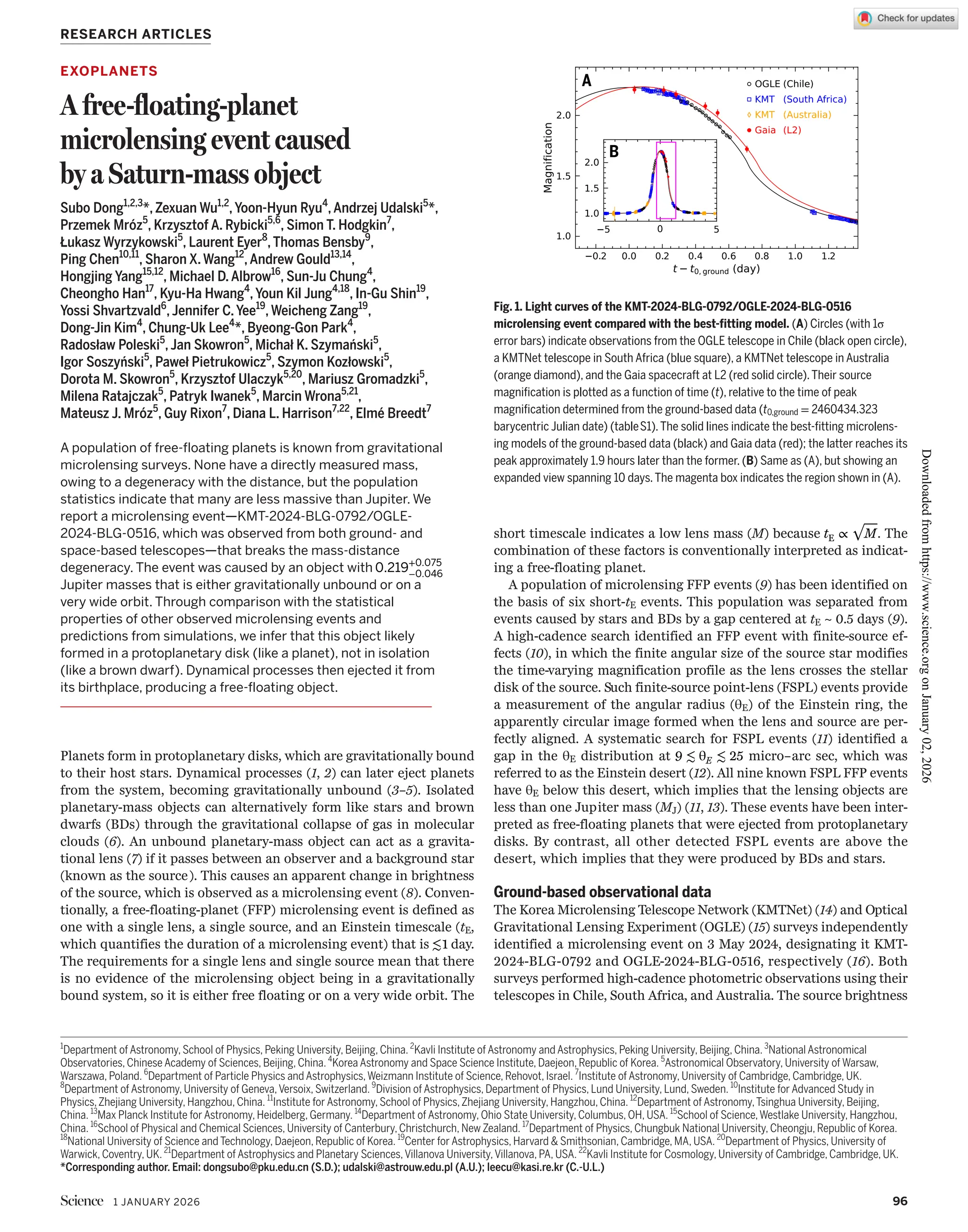
A
B
Fig. 1. Light curves of the KMT-­2024-­BLG-­0792/OGLE-­2024-­BLG-­0516
microlensing event compared with the best-­
fitting model. (A) Circles (with 1σ
error bars) indicate observations from the OGLE telescope in Chile (black open circle),
a KMTNet telescope in South Africa (blue square), a KMTNet telescope in Australia
(orange diamond), and the Gaia spacecraft at L2 (red solid circle).Their source
magnification is plotted as a function of time (t), relative to the time of peak
magnification determined from the ground-­based data (t0,ground = 2460434.323
barycentric Julian date) (tableS1).The solid lines indicate the best-­fitting microlens-
ing models of the ground-­based data (black) and Gaia data (red); the latter reaches its
peak approximately 1.9 hours later than the former. (B) Same as (A), but showing an
expanded view spanning 10 days.The magenta box indicates the region shown in (A).
Downloaded
from
https://www.science.org
on
January
02,
2026
Research Articles
Science 1 January 2026 97
as a function of time (Fig. 1, light curve) exhibits a rounded peak,
indicating finite-­
source effects.
Spectroscopic observations were performed by using the Magellan
Inamori Kyocera Echelle (MIKE) spectrograph on 4 May 2024, when
the source was magnified by a factor of ≈1.9. The MIKE spectrum is
shown in fig. S3, from which we determined the source star’s atmo-
spheric parameters (16), which indicate that it is a red giant star with
low metallicity (abundance of elements heavier than helium).
Finite-­source point-­lens modeling
We fitted an FSPL model to the light curve to compute the magnifica-
tion as a function of time (16). This model has four free parameters: tE,
the Einstein timescale; t0, the time of the peak magnification; u0, the
impactparameter,definedastheminimumangularseparationbetween the
source and lens, normalized by θE, with smaller u0 values correspond-
ing to larger peak magnifications; and ρ ≡ θ∗ ∕θE, the angular source
radius θ* normalized by θE. We adopted fixed linear limb-­
darkening
parameters determined from the observed spectrum and stellar atmo-
sphere models (16). We considered microlensing models with blended
flux but found that they are not required by the data, so we do not
include any blended flux in our fiducial model (16).
The best-­
fitting FSPL model is shown in Fig. 1, and its parameters are
listed in table S1. We measured the angular radius of the source star θ* =
18.4 ± 0.9 micro–arc sec (all uncertainties are 1σ); its flux and color
indicate that it is a red giant (16), which is consistent with the spectros-
copy. The best-­
fitting FSPL model has ρ = 0.991 ± 0.002 and tE = 0.842 ±
0.002 days, from which we derived the angular Einstein radius θE = θ*/ρ =
18.6 ± 0.9 micro–arc sec and lens-­
source relative proper motion μrel =
θE/tE = 8.05 ± 0.38 milli–arc sec year–1
.
Space-­
based microlens parallax measurement
Direct determination of the lens mass requires two observables (17):
θE and the microlens parallax, πE (16). πE can be directly measured
from simultaneous time-­
series observations from sufficiently widely
separated observers, such as Earth and a distant spacecraft (18, 19)
(Fig. 2A). The light curves seen from the spacecraft and from Earth
are offset in time and impact parameter by (Δt0, Δu0), which can be
measured from the photometric data. Using those values, πE = au/D⊥ ×
(Δτ, Δu0), where Δτ = Δt0/tE, au is the astronomical unit (approxi-
mately the average orbital distance between Earth and the Sun), and
D⊥ is the spacecraft-­
Earth projected separation on the sky. Different
values of D⊥ set the range of M and πrel that can be investigated by
A B
C
D
Fig. 2. Illustration of the space-­
based microlens parallax effect. (A) Three-­dimensional schematic diagram (not to scale) illustrating the geometric configuration of the source,
lens, and observers.The lens (blue dot) and its Einstein ring (blue circle) are located on the lens plane (gray surface), which we treat as fixed in space.The source (orange dot)
moves relative to the lens, in the direction of the orange arrow. Observers located at Earth (black dot) and Gaia (red dot) see different apparent source trajectories (black and red
solid lines) projected on the lens plane, with dashed lines indicating their sightlines at two illustrative epochs.The Earth-­Gaia vector (magenta arrow) projected on the observer
plane (beige surface) causes a corresponding shift (cyan arrow) between the apparent source trajectories on the lens plane. (B) The corresponding model light curves for Earth
(black line) and Gaia (red line), as inFig.1. Numbered dots on both curves indicate the Gaia observation epochs. (C) Model source trajectory with respect to the lens (blue dot)
projected onto the lens plane as seen from Earth (black line) and Gaia (red line) for this event.The source angular position vectors u are normalized to the radius of the Einstein ring
(blue circle), θE.The axes u‖ and u⊥ are defined as parallel and perpendicular, respectively, to the source motion’s direction (orange arrow).The compass indicates the north and
east directions.The numbered positions (solid dots) correspond to the Gaia observation epochs. (D) Zoomed view of the region in the black box in (C), with cyan arrows indicating
the shift attributable to the microlens parallax effect.
Downloaded
from
https://www.science.org
on
January
02,
2026
Research Articles
Science 1 January 2026 98
using this method. A spacecraft at the Sun-­
Earth second Lagrange
point (L2) provides an appropriate distance to determine microlens
parallaxes for Earth-­to Jupiter-­
mass lenses (20).
At the time of this event, the Gaia spacecraft (21) was in L2 orbit,
but it performed survey observations that could not be redirected and
normally had a low cadence. Gaia made pairs of observations sepa-
rated by 106.5 min, owing to its twin fields of view and 6-­
hour spin period.
The spacecraft’s 63-­
day orbital precession meant it typically would
not revisit the same target until about 1 month later, which would
not be sufficient to temporally resolve a microlensing FFP event.
Serendipitously, the KMT-­2024-­BLG-­0792/OGLE-­2024-­BLG-­0516 mi-
crolensing event was located nearly perpendicular to the direction of
Gaia’s precession axis. This rare geometry caused the event to be observed
by Gaia six times over a 16-­
hour period, beginning close to peak magni-
fication. The source was identified as transient and announced by Gaia
Science Alerts (22), designated as Gaia24cdn (23).
The overall shape of the Gaia light curve (Fig. 1) closely resembles
that observed from the ground. The Gaia and ground-­based data show
nearly identical maximum magnifications, indicating similar impact
parameters, whereas the Gaia light curve peaks ~1.9 hours later than
the one observed from the ground. We jointly modeled both light
curves (16), which detects the microlensing parallax at a significance
of ≈7σ, with the best-­
fitting amplitude of the microlens parallax
vector 𝛑E measured to be 10.9+2.9
−2.7
.
Combining this value with the other parameters determined from
the FSPL model, we derived the lens mass M = 0.219+0.075
−0.046
MJ, which
is slightly lower than the mass of Saturn (0.30MJ). We also inferred
the relative lens-­
source trigonometric parallax, πrel = 0.202+0.054
−0.052
milli–
arc sec. The direction, spectral type, and flux of the source star indicate
that it is located in the Milky Way’s central bulge. Adopting a bulge dis­
tance of Ds = 7.93+0.54
−0.51 kpc for the line of sight toward this event (24),
the lens distance is Dl = 3.05+0.58
−0.43
kpc.
An object in the Einstein desert
With θE ≈ 18.6 micro–arc sec, KMT-­2024-­BLG-­0792/OGLE-­2024-­
BLG-­
0516 falls within the Einstein desert identified by previous studies
(Fig. 3) (11, 12). In principle, without the lens mass measurement, this
event could have been classified as either an FFP event (like previous
events below the desert, θE ≲ 9 micro–arc sec) or a BD event (like
previous events above the desert, θE ≳ 25 micro–arc sec).
Various scenarios could explain the paucity of objects in the Einstein
desert, which have masses statistically inferred to be on the order of
~1MJ. For objects that form like planets, higher-­
mass objects are less
likely to be ejected from their host planetary system through dynami-
cal processes. This is qualitatively consistent with the mass function
that was estimated from the θE distribution of previous FFP events:
The occurrence rate declines with increasing planet mass, following
a power-­
law distribution dN/dlogM ∝ Mα
, where dN is the number of
planets within a logarithmic mass interval, and α is the power-­
law
index. The inferred value, α ~ –1, is steeper than that of the mass func-
tion of observed exoplanets bound to their host stars (11, 13). For ob-
jects that form like BDs, the theoretical minimum mass is uncertain,
with estimates ranging from ~1 to ~10MJ (6). Deep imaging observa-
tions of several star-­
forming regions have found a BD mass function
that cuts off at ≳3MJ (25–27). The Einstein desert has alternatively
been attributed to this low-­
mass cutoff of the BD mass function (11).
We compared our mass measurement with these expectations. The
nine previously published FFP events with measured θE below the
Einstein desert are statistically consistent with having masses substan-
tially ≲1MJ. Nevertheless, the aforementioned empirical power-­
law
planet mass function could extend up to ~1MJ, as predicted by popula-
tion synthesis simulations for unbound objects (28), which would pro-
duce events with θE values within the desert. For the sample of now
10 FFP events, the empirical planet mass function ∝M–1
predicts
≈2.0 events with θE in the desert (11, 13), corresponding to objects
with masses on the order of ~1MJ and encompassing the Saturn-­
mass
regime of the KMT-­2024-­BLG-­0792/OGLE-­2024-­BLG-­0516 event.
Assuming Poisson statistics and the expected 2.0 events, the probabil-
ity of observing exactly one event is ≈27%, which is statistically con-
sistent with our detection rate (1 out of 10). At the low-­
mass end, this
empirical planet mass function extends down to terrestrial masses
(~0.003MJ). For planets with masses ≳0.03MJ, the theoretically pre-
dicted mass function (28) agrees with the empirical distribution. At
lower masses, in the terrestrial regime, the theoretical prediction deviates
from a power law, but there are only weak observational constraints.
Given its measured Saturn-­
like mass and location in the Einstein
desert, we interpret the lens object as part of the high-­
mass tail of the
planet mass function inferred from previous FFP events. Our measured
mass is below the low-­
mass limit for the BD formation mechanism at
>1MJ, which has also been invoked to explain the deficit of events in
the Einstein desert.
Implications for the planetary-­
mass population
The measured mass of KMT-­2024-­BLG-­0792/OGLE-­2024-­BLG-­0516
provides direct evidence that the FFP events observed by microlensing
surveys are caused by extrasolar planetary-­
mass objects (9, 11, 13).
Although previous FFP events did not have directly measured masses,
statistical estimates indicate that they are predominantly sub-­
Neptune-­
mass objects (13), either gravitationally unbound or on very wide or-
bits. Such objects can be produced by strong gravitational interactions
within their birth planetary systems (3, 28). We conclude that violent
dynamical processes shape the demographics of planetary-­
mass ob-
jects, both those that remain bound to their host stars and those that
are expelled to become free floating.
A
B
Fig. 3. Cumulative distribution of Einstein radius (θE) and the Einstein desert.
(A) Histogram (dark green) of the cumulative distribution of θE from previous
microlensing observations [the KMTNet FSPL sample (11)].The apparent lack of
events between 9 and 25 micro–arc sec is the Einstein desert (blue shaded region).
(B) The distribution of all published microlensing FFP events with measured θE
(10,12,29–34), which are all located below the desert. KMT-­2024-­BLG-­0792/
OGLE-­2024-­BLG-­0516 has θE = 18.6 ± 0.9 micro–arc sec (red vertical line in both
panels, with red-­shaded 1σ uncertainty region), within the desert.
Downloaded
from
https://www.science.org
on
January
02,
2026
Research Articles
Science 1 January 2026 99
REFERENCES AND NOTES
1. F.A. Rasio, E. B. Ford, Science 274, 954–956 (1996).
2. M.Jurić, S.Tremaine, Astrophys.J. 686, 603–620 (2008).
3. S. Ma, S. Mao, S. Ida, W. Zhu, D. N. C. Lin, Mon. Not. R. Astron. Soc. 461, L107–L111
(2016).
4. F.Yu, D. Lai, Astrophys.J. 970, 97 (2024).
5. G.A. L. Coleman, Mon. Not. R.Astron. Soc. 530, 630–644 (2024).
6. K. L. Luhman, Annu. Rev.Astron.Astrophys. 50, 65–106 (2012).
7. A. Einstein, Science 84, 506–507 (1936).
8. B. Paczynski, Astrophys.J. 304, 1 (1986).
9. P. Mróz et al., Nature 548, 183–186 (2017).
10. P. Mróz et al., Astron.J. 155, 121 (2018).
11. A. Gould et al., J. Korean Astron. Soc. 55, 173–194 (2022).
12. Y.-­H. Ryu et al., Astron.J. 161, 126 (2021).
13. T. Sumi et al., Astron.J. 166, 108 (2023).
14. S.-­L. Kim et al., J. Korean Astron. Soc. 49, 37–44 (2016).
15. A. Udalski, M. K. Szymański, G. Szymański, Acta Astron. 65, 1–38 (2015).
16. Materials and methods are available as supplementary materials.
17. A. Gould, Astrophys.J. 392, 442 (1992).
18. S. Refsdal, Mon. Not. R.Astron. Soc. 134, 315–319 (1966).
19. A. Gould, Astrophys.J. 421, L75 (1994).
20. A. Gould,W.-­C.Zang, S. Mao, S.-­B. Dong, Res.Astron.Astrophys. 21, 133 (2021).
21. Gaia Collaboration, Astron.Astrophys. 595,A1 (2016).
22. S.T. Hodgkin et al., Astron.Astrophys. 652,A76 (2021).
23. Gaia24cdn,Gaia ScienceAlerts (2024); http://gsaweb.ast.cam.ac.uk/alerts/alert/Gaia24cdn.
24. D. M. Nataf et al., Astrophys.J. 769, 88 (2013).
25. K. L. Luhman et al., Astron.J. 167, 19 (2024).
26. A. B. Langeveld et al., Astron.J. 168, 179 (2024).
27. M. De Furio et al., Astrophys.J. Lett. 981, L34 (2025).
28. G.A. L. Coleman,W. DeRocco, Mon. Not. R.Astron. Soc. 537, 2303–2312 (2025).
29. P. Mróz et al., Astron.Astrophys. 622,A201 (2019).
30. P. Mróz et al., Astron.J. 159, 262 (2020).
31. P. Mróz et al., Astrophys.J. Lett. 903, L11 (2020).
32. H.-­W. Kim et al., Astron.J. 162, 15 (2021).
33. N. Koshimoto et al., Astron.J. 166, 107 (2023).
34. Y. K.Jung et al., Astron.J. 168, 152 (2024).
35. S. Dong et al.,A free-­floating-­planet microlensing event caused by a Saturn-­mass object.
Dryad (2025); https://doi.org/10.5061/dryad.g79cnp622.
ACKNOWLEDGMENTS
This research has made use of the KMTNet system operated by the Korea Astronomy and
Space Science Institute (KASI) at three host sites of CTIO in Chile, SAAO in South Africa, and
SSO in Australia. Data transfer from the host site to KASI was supported by the Korea
Research Environment Open NETwork (KREONET).This work has made use of data from the
European Space Agency (ESA) mission Gaia, processed by the Gaia Data Processing and
Analysis Consortium (DPAC). Funding for the DPAC has been provided by national institutions,
in particular the institutions participating in the Gaia Multilateral Agreement. Funding: This
work was supported by the National Natural Science Foundation of China grant 12133005
(S.D.,Z.W., H.Y., and W.Z.); science research grant from the China Manned Space Project grant
CMS-­CSST-­2025-­A16 (S.D. and Z.W.); the XPLORER PRIZE (S.D.); KASI under the R&D
program (project 2024-­1-­832-­01), supervised by the Korean Ministry of Science and ICT;
“Copernicus 2024 Award”of the Polish FNP and German DFG agencies (A.U.); National
Science Center (NCN), Poland, grant SONATA 2023/51/D/ST9/00187 (P.M.); European
Union’s 101004719 (ORP) and 101131928 (ACME) as well as grant 2024/52/L/ST9/00210
(DAINA) from NCN (Ł.W.); the China Postdoctoral Science Foundation 2024M762938
(H.Y.); the CfA Fellowship (W.Z.); US NSF grant AST-­2108414 (J.C.Y. and I.-­G.S.); BSF Grant
2020740 (Y.S.); National Research Foundation of Korea grants 2019R1A2C2085965 and
2020R1A4A2002885 (C.H.); Polish National Agency for Academic Exchange grant“Polish
Returns 2019”(R.P.); the United Kingdom Particle Physics and Astronomy Research Council
(PPARC), the United Kingdom Science and Technology Facilities Council (STFC), and the
United Kingdom Space Agency (UKSA) through the following grants: PP/D006511/1, PP/
D006546/1, PP/D006570/1, ST/I000852/1, ST/J005045/1, ST/K00056X/1, ST/
K000209/1, ST/K000756/1, ST/L006561/1, ST/N000595/1, ST/S000623/1, ST/
N000641/1, ST/N000978/1, ST/N001117/1, ST/S000089/1, ST/S000976/1, ST/S001123/1,
ST/S001948/1, ST/S002103/1, and ST/V000969/1 (S.T.H., G.R., D.L.H., and E.B.). Author
contributions: S.D. led the analysis and manuscript preparation.Z.W.,A.U., P.M.,T.B., P.C..
and A.G. contributed to manuscript preparation.Z.W.,A.U., P.M., K.A.R., and A.G. contributed
to the analysis of microlensing data. C.-­U.L.,A.G.,Y.-­H.R., and J.C.Y. are the principal
investigator, scientific principal investigator, KASI deputy scientific principal investigator, and
SAO deputy scientific principal investigator of the KMTNet project, respectively.A.G. issued
the KMTNet alert of the event. H.Y. provided the KMTNet photometry.Y.-­H. R.,A.G., H.Y.,
M.D.A., S.-­J.C., C.H., K.-­H.H.,Y.K.J., I.-­G.S.,Y.S.,J.C.Y.,W.Z., D.-­J.K., C.-­U.L., and B.-­G.P.
contributed to the operation of KMTNet and are members of the KMTNet collaboration.A.U. is
the principal investigator of the OGLE project, issued the OGLE alert of the event, and
provided the OGLE photometry and astrometry.A.U., P.M., K.A.R., R.P.,J.S., M.K.S., I.S., P.P.,
S.K., D.M.S., K.U., M.G., M.R., P.I., M.W., and M.J.M. collected the OGLE photometric
observations and are members of the OGLE collaboration. S.T.H., Ł.W., G.R., D.L.H., and E.B.
issued the Gaia alert of the event and are members of the Gaia Science Alerts team. L.E.
provided technical guidance on the analysis and interpretation of the Gaia data.T.B. extracted
the spectroscopic stellar parameters, P.C. reduced the spectroscopic data, and S.X.W.
performed the spectroscopic observation.All authors revised the manuscript. Competing
interests: Ł.W. is also affiliated with the Astrophysics Division, National Centre for Nuclear
Research,Warsaw, Poland. Data, code, and materials availability: The photometric time
series (KMTNet, OGLE, and Gaia), reduced MIKE spectrum, and the gett 1.0 code we used to
model terrestrial and diurnal microlens parallax effects are all archived at Dryad (35).The
best-­fitting parameters of our FSPL models are provided in tableS1. No physical materials
were generated in this work. License information: Copyright © 2026 the authors, some
rights reserved; exclusive licensee American Association for the Advancement of Science. No
claim to original US government works. https://www.science.org/about/science-­licenses-­
journal-­article-­reuse
SUPPLEMENTARY MATERIALS
science.org/doi/10.1126/science.adv9266
Materials and Methods; Figs.S1 to S7; TablesS1 and S2; References (36–88)
Submitted 14 January 2025; accepted 28 October 2025
10.1126/science.adv9266
Downloaded
from
https://www.science.org
on
January
02,
2026

A free- floating- planet microlensing event caused by a Saturn- mass object

  • 1.
    Research Articles Science 1January 2026 96 EXOPLANETS A free-­floating-­planet microlensing event caused by a Saturn-­mass object Subo Dong1,2,3 *, Zexuan Wu1,2 ,Yoon-­Hyun Ryu4 ,Andrzej Udalski5 *, Przemek Mróz5 , Krzysztof A. Rybicki5,6 , Simon T. Hodgkin7 , Łukasz Wyrzykowski5 , Laurent Eyer8 ,Thomas Bensby9 , Ping Chen10,11 , Sharon X. Wang12 ,Andrew Gould13,14 , Hongjing Yang15,12 , Michael D.Albrow16 , Sun-­ Ju Chung4 , Cheongho Han17 , Kyu-­ Ha Hwang4 ,Youn Kil Jung4,18 , In-­ Gu Shin19 , Yossi Shvartzvald6 ,Jennifer C.Yee19 , Weicheng Zang19 , Dong-­Jin Kim4 , Chung-­ Uk Lee4 *, Byeong-­ Gon Park4 , Radosław Poleski5 ,Jan Skowron5 , Michał K. Szymański5 , Igor Soszyński5 , Paweł Pietrukowicz5 , Szymon Kozłowski5 , Dorota M. Skowron5 , Krzysztof Ulaczyk5,20 , Mariusz Gromadzki5 , Milena Ratajczak5 , Patryk Iwanek5 , Marcin Wrona5,21 , Mateusz J. Mróz5 , Guy Rixon7 , Diana L. Harrison7,22 , Elmé Breedt7 A population of free-­ floating planets is known from gravitational microlensing surveys. None have a directly measured mass, owing to a degeneracy with the distance, but the population statistics indicate that many are less massive than Jupiter. We report a microlensing event—KMT-­2024-­BLG-­0792/OGLE-­ 2024-­ BLG-­ 0516, which was observed from both ground-­and space-­ based telescopes—that breaks the mass-­ distance degeneracy. The event was caused by an object with 0.219+0.075 −0.046 Jupiter masses that is either gravitationally unbound or on a very wide orbit. Through comparison with the statistical properties of other observed microlensing events and predictions from simulations, we infer that this object likely formed in a protoplanetary disk (like a planet), not in isolation (like a brown dwarf). Dynamical processes then ejected it from its birthplace, producing a free-­ floating object. Planets form in protoplanetary disks, which are gravitationally bound to their host stars. Dynamical processes (1, 2) can later eject planets from the system, becoming gravitationally unbound (3–5). Isolated planetary-­ mass objects can alternatively form like stars and brown dwarfs (BDs) through the gravitational collapse of gas in molecular clouds (6). An unbound planetary-­ mass object can act as a gravita- tional lens (7) if it passes between an observer and a background star (known as the source). This causes an apparent change in brightness of the source, which is observed as a microlensing event (8). Con­ven­ tionally, a free-­ floating-­ planet (FFP) microlensing event is defined as one with a single lens, a single source, and an Einstein timescale (tE, which quantifies the duration of a microlensing event) that is ≲1 day. The requirements for a single lens and single source mean that there is no evidence of the microlensing object being in a gravitationally bound system, so it is either free floating or on a very wide orbit. The short timescale indicates a low lens mass (M) because tE ∝ √ M. The combination of these factors is conventionally interpreted as indicat- ing a free-­ floating planet. A population of microlensing FFP events (9) has been identified on the basis of six short-­ tE events. This population was separated from events caused by stars and BDs by a gap centered at tE ~ 0.5 days (9). A high-­ cadence search identified an FFP event with finite-­ source ef- fects (10), in which the finite angular size of the source star modifies the time-­ varying magnification profile as the lens crosses the stellar disk of the source. Such finite-­ source point-­ lens (FSPL) events provide a measurement of the angular radius (θE) of the Einstein ring, the apparently circular image formed when the lens and source are per- fectly aligned. A systematic search for FSPL events (11) identified a gap in the θE distribution at 9 ≲ θE ≲ 25 micro–arc sec, which was referred to as the Einstein desert (12). All nine known FSPL FFP events have θE below this desert, which implies that the lensing objects are less than one Jupiter mass (MJ) (11, 13). These events have been inter- preted as free-­ floating planets that were ejected from protoplanetary disks. By contrast, all other detected FSPL events are above the desert, which implies that they were produced by BDs and stars. Ground-­ based observational data The Korea Microlensing Telescope Network (KMTNet) (14) and Optical Gravitational Lensing Experiment (OGLE) (15) surveys independently identified a microlensing event on 3 May 2024, designating it KMT-­ 2024-­BLG-­0792 and OGLE-­2024-­BLG-­0516, respectively (16). Both surveys performed high-­ cadence photometric observations using their telescopes in Chile, South Africa, and Australia. The source brightness 1 Department of Astronomy, School of Physics, Peking University, Beijing, China. 2 Kavli Institute of Astronomy and Astrophysics, Peking University, Beijing, China. 3 National Astronomical Observatories, Chinese Academy of Sciences, Beijing, China. 4 Korea Astronomy and Space Science Institute, Daejeon, Republic of Korea. 5 Astronomical Observatory, University of Warsaw, Warszawa, Poland. 6 Department of Particle Physics and Astrophysics,Weizmann Institute of Science, Rehovot, Israel. 7 Institute of Astronomy, University of Cambridge, Cambridge, UK. 8 Department of Astronomy, University of Geneva,Versoix, Switzerland. 9 Division of Astrophysics, Department of Physics, Lund University, Lund, Sweden. 10 Institute for Advanced Study in Physics,Zhejiang University, Hangzhou, China. 11 Institute for Astronomy, School of Physics,Zhejiang University, Hangzhou, China. 12 Department of Astronomy,Tsinghua University, Beijing, China. 13 Max ­Planck Institute for Astronomy, Heidelberg, Germany. 14 Department of Astronomy, Ohio State University, Columbus, OH, USA. 15 School of Science,Westlake University, Hangzhou, China. 16 School of Physical and Chemical Sciences, University of Canterbury, Christchurch, New Zealand. 17 Department of Physics, Chungbuk National University, Cheongju, Republic of Korea. 18 National University of Science and Technology, Daejeon, Republic of Korea. 19 Center for Astrophysics, Harvard & Smithsonian, Cambridge, MA, USA. 20 Department of Physics, University of Warwick, Coventry, UK. 21 Department of Astrophysics and Planetary Sciences,Villanova University,Villanova, PA, USA. 22 Kavli Institute for Cosmology, University of Cambridge, Cambridge, UK. *Corresponding author. Email: dongsubo@​pku.​edu.​cn (S.D.); udalski@​astrouw.​edu.​pl (A.U.); leecu@​kasi.​re.​kr (C.-­U.L.) A B Fig. 1. Light curves of the KMT-­2024-­BLG-­0792/OGLE-­2024-­BLG-­0516 microlensing event compared with the best-­ fitting model. (A) Circles (with 1σ error bars) indicate observations from the OGLE telescope in Chile (black open circle), a KMTNet telescope in South Africa (blue square), a KMTNet telescope in Australia (orange diamond), and the Gaia spacecraft at L2 (red solid circle).Their source magnification is plotted as a function of time (t), relative to the time of peak magnification determined from the ground-­based data (t0,ground = 2460434.323 barycentric Julian date) (tableS1).The solid lines indicate the best-­fitting microlens- ing models of the ground-­based data (black) and Gaia data (red); the latter reaches its peak approximately 1.9 hours later than the former. (B) Same as (A), but showing an expanded view spanning 10 days.The magenta box indicates the region shown in (A). Downloaded from https://www.science.org on January 02, 2026
  • 2.
    Research Articles Science 1January 2026 97 as a function of time (Fig. 1, light curve) exhibits a rounded peak, indicating finite-­ source effects. Spectroscopic observations were performed by using the Magellan Inamori Kyocera Echelle (MIKE) spectrograph on 4 May 2024, when the source was magnified by a factor of ≈1.9. The MIKE spectrum is shown in fig. S3, from which we determined the source star’s atmo- spheric parameters (16), which indicate that it is a red giant star with low metallicity (abundance of elements heavier than helium). Finite-­source point-­lens modeling We fitted an FSPL model to the light curve to compute the magnifica- tion as a function of time (16). This model has four free parameters: tE, the Einstein timescale; t0, the time of the peak magnification; u0, the impactparameter,definedastheminimumangularseparationbetween the source and lens, normalized by θE, with smaller u0 values correspond- ing to larger peak magnifications; and ρ ≡ θ∗ ∕θE, the angular source radius θ* normalized by θE. We adopted fixed linear limb-­ darkening parameters determined from the observed spectrum and stellar atmo- sphere models (16). We considered microlensing models with blended flux but found that they are not required by the data, so we do not include any blended flux in our fiducial model (16). The best-­ fitting FSPL model is shown in Fig. 1, and its parameters are listed in table S1. We measured the angular radius of the source star θ* = 18.4 ± 0.9 micro–arc sec (all uncertainties are 1σ); its flux and color indicate that it is a red giant (16), which is consistent with the spectros- copy. The best-­ fitting FSPL model has ρ = 0.991 ± 0.002 and tE = 0.842 ± 0.002 days, from which we derived the angular Einstein radius θE = θ*/ρ = 18.6 ± 0.9 micro–arc sec and lens-­ source relative proper motion μrel = θE/tE = 8.05 ± 0.38 milli–arc sec year–1 . Space-­ based microlens parallax measurement Direct determination of the lens mass requires two observables (17): θE and the microlens parallax, πE (16). πE can be directly measured from simultaneous time-­ series observations from sufficiently widely separated observers, such as Earth and a distant spacecraft (18, 19) (Fig. 2A). The light curves seen from the spacecraft and from Earth are offset in time and impact parameter by (Δt0, Δu0), which can be measured from the photometric data. Using those values, πE = au/D⊥ × (Δτ, Δu0), where Δτ = Δt0/tE, au is the astronomical unit (approxi- mately the average orbital distance between Earth and the Sun), and D⊥ is the spacecraft-­ Earth projected separation on the sky. Different values of D⊥ set the range of M and πrel that can be investigated by A B C D Fig. 2. Illustration of the space-­ based microlens parallax effect. (A) Three-­dimensional schematic diagram (not to scale) illustrating the geometric configuration of the source, lens, and observers.The lens (blue dot) and its Einstein ring (blue circle) are located on the lens plane (gray surface), which we treat as fixed in space.The source (orange dot) moves relative to the lens, in the direction of the orange arrow. Observers located at Earth (black dot) and Gaia (red dot) see different apparent source trajectories (black and red solid lines) projected on the lens plane, with dashed lines indicating their sightlines at two illustrative epochs.The Earth-­Gaia vector (magenta arrow) projected on the observer plane (beige surface) causes a corresponding shift (cyan arrow) between the apparent source trajectories on the lens plane. (B) The corresponding model light curves for Earth (black line) and Gaia (red line), as inFig.1. Numbered dots on both curves indicate the Gaia observation epochs. (C) Model source trajectory with respect to the lens (blue dot) projected onto the lens plane as seen from Earth (black line) and Gaia (red line) for this event.The source angular position vectors u are normalized to the radius of the Einstein ring (blue circle), θE.The axes u‖ and u⊥ are defined as parallel and perpendicular, respectively, to the source motion’s direction (orange arrow).The compass indicates the north and east directions.The numbered positions (solid dots) correspond to the Gaia observation epochs. (D) Zoomed view of the region in the black box in (C), with cyan arrows indicating the shift attributable to the microlens parallax effect. Downloaded from https://www.science.org on January 02, 2026
  • 3.
    Research Articles Science 1January 2026 98 using this method. A spacecraft at the Sun-­ Earth second Lagrange point (L2) provides an appropriate distance to determine microlens parallaxes for Earth-­to Jupiter-­ mass lenses (20). At the time of this event, the Gaia spacecraft (21) was in L2 orbit, but it performed survey observations that could not be redirected and normally had a low cadence. Gaia made pairs of observations sepa- rated by 106.5 min, owing to its twin fields of view and 6-­ hour spin period. The spacecraft’s 63-­ day orbital precession meant it typically would not revisit the same target until about 1 month later, which would not be sufficient to temporally resolve a microlensing FFP event. Serendipitously, the KMT-­2024-­BLG-­0792/OGLE-­2024-­BLG-­0516 mi- crolensing event was located nearly perpendicular to the direction of Gaia’s precession axis. This rare geometry caused the event to be observed by Gaia six times over a 16-­ hour period, beginning close to peak magni- fication. The source was identified as transient and announced by Gaia Science Alerts (22), designated as Gaia24cdn (23). The overall shape of the Gaia light curve (Fig. 1) closely resembles that observed from the ground. The Gaia and ground-­based data show nearly identical maximum magnifications, indicating similar impact parameters, whereas the Gaia light curve peaks ~1.9 hours later than the one observed from the ground. We jointly modeled both light curves (16), which detects the microlensing parallax at a significance of ≈7σ, with the best-­ fitting amplitude of the microlens parallax vector 𝛑E measured to be 10.9+2.9 −2.7 . Combining this value with the other parameters determined from the FSPL model, we derived the lens mass M = 0.219+0.075 −0.046 MJ, which is slightly lower than the mass of Saturn (0.30MJ). We also inferred the relative lens-­ source trigonometric parallax, πrel = 0.202+0.054 −0.052 milli– arc sec. The direction, spectral type, and flux of the source star indicate that it is located in the Milky Way’s central bulge. Adopting a bulge dis­ tance of Ds = 7.93+0.54 −0.51 kpc for the line of sight toward this event (24), the lens distance is Dl = 3.05+0.58 −0.43 kpc. An object in the Einstein desert With θE ≈ 18.6 micro–arc sec, KMT-­2024-­BLG-­0792/OGLE-­2024-­ BLG-­ 0516 falls within the Einstein desert identified by previous studies (Fig. 3) (11, 12). In principle, without the lens mass measurement, this event could have been classified as either an FFP event (like previous events below the desert, θE ≲ 9 micro–arc sec) or a BD event (like previous events above the desert, θE ≳ 25 micro–arc sec). Various scenarios could explain the paucity of objects in the Einstein desert, which have masses statistically inferred to be on the order of ~1MJ. For objects that form like planets, higher-­ mass objects are less likely to be ejected from their host planetary system through dynami- cal processes. This is qualitatively consistent with the mass function that was estimated from the θE distribution of previous FFP events: The occurrence rate declines with increasing planet mass, following a power-­ law distribution dN/dlogM ∝ Mα , where dN is the number of planets within a logarithmic mass interval, and α is the power-­ law index. The inferred value, α ~ –1, is steeper than that of the mass func- tion of observed exoplanets bound to their host stars (11, 13). For ob- jects that form like BDs, the theoretical minimum mass is uncertain, with estimates ranging from ~1 to ~10MJ (6). Deep imaging observa- tions of several star-­ forming regions have found a BD mass function that cuts off at ≳3MJ (25–27). The Einstein desert has alternatively been attributed to this low-­ mass cutoff of the BD mass function (11). We compared our mass measurement with these expectations. The nine previously published FFP events with measured θE below the Einstein desert are statistically consistent with having masses substan- tially ≲1MJ. Nevertheless, the aforementioned empirical power-­ law planet mass function could extend up to ~1MJ, as predicted by popula- tion synthesis simulations for unbound objects (28), which would pro- duce events with θE values within the desert. For the sample of now 10 FFP events, the empirical planet mass function ∝M–1 predicts ≈2.0 events with θE in the desert (11, 13), corresponding to objects with masses on the order of ~1MJ and encompassing the Saturn-­ mass regime of the KMT-­2024-­BLG-­0792/OGLE-­2024-­BLG-­0516 event. Assuming Poisson statistics and the expected 2.0 events, the probabil- ity of observing exactly one event is ≈27%, which is statistically con- sistent with our detection rate (1 out of 10). At the low-­ mass end, this empirical planet mass function extends down to terrestrial masses (~0.003MJ). For planets with masses ≳0.03MJ, the theoretically pre- dicted mass function (28) agrees with the empirical distribution. At lower masses, in the terrestrial regime, the theoretical prediction deviates from a power law, but there are only weak observational constraints. Given its measured Saturn-­ like mass and location in the Einstein desert, we interpret the lens object as part of the high-­ mass tail of the planet mass function inferred from previous FFP events. Our measured mass is below the low-­ mass limit for the BD formation mechanism at >1MJ, which has also been invoked to explain the deficit of events in the Einstein desert. Implications for the planetary-­ mass population The measured mass of KMT-­2024-­BLG-­0792/OGLE-­2024-­BLG-­0516 provides direct evidence that the FFP events observed by microlensing surveys are caused by extrasolar planetary-­ mass objects (9, 11, 13). Although previous FFP events did not have directly measured masses, statistical estimates indicate that they are predominantly sub-­ Neptune-­ mass objects (13), either gravitationally unbound or on very wide or- bits. Such objects can be produced by strong gravitational interactions within their birth planetary systems (3, 28). We conclude that violent dynamical processes shape the demographics of planetary-­ mass ob- jects, both those that remain bound to their host stars and those that are expelled to become free floating. A B Fig. 3. Cumulative distribution of Einstein radius (θE) and the Einstein desert. (A) Histogram (dark green) of the cumulative distribution of θE from previous microlensing observations [the KMTNet FSPL sample (11)].The apparent lack of events between 9 and 25 micro–arc sec is the Einstein desert (blue shaded region). (B) The distribution of all published microlensing FFP events with measured θE (10,12,29–34), which are all located below the desert. KMT-­2024-­BLG-­0792/ OGLE-­2024-­BLG-­0516 has θE = 18.6 ± 0.9 micro–arc sec (red vertical line in both panels, with red-­shaded 1σ uncertainty region), within the desert. Downloaded from https://www.science.org on January 02, 2026
  • 4.
    Research Articles Science 1January 2026 99 REFERENCES AND NOTES 1. F.A. Rasio, E. B. Ford, Science 274, 954–956 (1996). 2. M.Jurić, S.Tremaine, Astrophys.J. 686, 603–620 (2008). 3. S. Ma, S. Mao, S. Ida, W. Zhu, D. N. C. Lin, Mon. Not. R. Astron. Soc. 461, L107–L111 (2016). 4. F.Yu, D. Lai, Astrophys.J. 970, 97 (2024). 5. G.A. L. Coleman, Mon. Not. R.Astron. Soc. 530, 630–644 (2024). 6. K. L. Luhman, Annu. Rev.Astron.Astrophys. 50, 65–106 (2012). 7. A. Einstein, Science 84, 506–507 (1936). 8. B. Paczynski, Astrophys.J. 304, 1 (1986). 9. P. Mróz et al., Nature 548, 183–186 (2017). 10. P. Mróz et al., Astron.J. 155, 121 (2018). 11. A. Gould et al., J. Korean Astron. Soc. 55, 173–194 (2022). 12. Y.-­H. Ryu et al., Astron.J. 161, 126 (2021). 13. T. Sumi et al., Astron.J. 166, 108 (2023). 14. S.-­L. Kim et al., J. Korean Astron. Soc. 49, 37–44 (2016). 15. A. Udalski, M. K. Szymański, G. Szymański, Acta Astron. 65, 1–38 (2015). 16. Materials and methods are available as supplementary materials. 17. A. Gould, Astrophys.J. 392, 442 (1992). 18. S. Refsdal, Mon. Not. R.Astron. Soc. 134, 315–319 (1966). 19. A. Gould, Astrophys.J. 421, L75 (1994). 20. A. Gould,W.-­C.Zang, S. Mao, S.-­B. Dong, Res.Astron.Astrophys. 21, 133 (2021). 21. Gaia Collaboration, Astron.Astrophys. 595,A1 (2016). 22. S.T. Hodgkin et al., Astron.Astrophys. 652,A76 (2021). 23. Gaia24cdn,Gaia ScienceAlerts (2024); http://gsaweb.ast.cam.ac.uk/alerts/alert/Gaia24cdn. 24. D. M. Nataf et al., Astrophys.J. 769, 88 (2013). 25. K. L. Luhman et al., Astron.J. 167, 19 (2024). 26. A. B. Langeveld et al., Astron.J. 168, 179 (2024). 27. M. De Furio et al., Astrophys.J. Lett. 981, L34 (2025). 28. G.A. L. Coleman,W. DeRocco, Mon. Not. R.Astron. Soc. 537, 2303–2312 (2025). 29. P. Mróz et al., Astron.Astrophys. 622,A201 (2019). 30. P. Mróz et al., Astron.J. 159, 262 (2020). 31. P. Mróz et al., Astrophys.J. Lett. 903, L11 (2020). 32. H.-­W. Kim et al., Astron.J. 162, 15 (2021). 33. N. Koshimoto et al., Astron.J. 166, 107 (2023). 34. Y. K.Jung et al., Astron.J. 168, 152 (2024). 35. S. Dong et al.,A free-­floating-­planet microlensing event caused by a Saturn-­mass object. Dryad (2025); https://doi.org/10.5061/dryad.g79cnp622. ACKNOWLEDGMENTS This research has made use of the KMTNet system operated by the Korea Astronomy and Space Science Institute (KASI) at three host sites of CTIO in Chile, SAAO in South Africa, and SSO in Australia. Data transfer from the host site to KASI was supported by the Korea Research Environment Open NETwork (KREONET).This work has made use of data from the European Space Agency (ESA) mission Gaia, processed by the Gaia Data Processing and Analysis Consortium (DPAC). Funding for the DPAC has been provided by national institutions, in particular the institutions participating in the Gaia Multilateral Agreement. Funding: This work was supported by the National Natural Science Foundation of China grant 12133005 (S.D.,Z.W., H.Y., and W.Z.); science research grant from the China Manned Space Project grant CMS-­CSST-­2025-­A16 (S.D. and Z.W.); the XPLORER PRIZE (S.D.); KASI under the R&D program (project 2024-­1-­832-­01), supervised by the Korean Ministry of Science and ICT; “Copernicus 2024 Award”of the Polish FNP and German DFG agencies (A.U.); National Science Center (NCN), Poland, grant SONATA 2023/51/D/ST9/00187 (P.M.); European Union’s 101004719 (ORP) and 101131928 (ACME) as well as grant 2024/52/L/ST9/00210 (DAINA) from NCN (Ł.W.); the China Postdoctoral Science Foundation 2024M762938 (H.Y.); the CfA Fellowship (W.Z.); US NSF grant AST-­2108414 (J.C.Y. and I.-­G.S.); BSF Grant 2020740 (Y.S.); National Research Foundation of Korea grants 2019R1A2C2085965 and 2020R1A4A2002885 (C.H.); Polish National Agency for Academic Exchange grant“Polish Returns 2019”(R.P.); the United Kingdom Particle Physics and Astronomy Research Council (PPARC), the United Kingdom Science and Technology Facilities Council (STFC), and the United Kingdom Space Agency (UKSA) through the following grants: PP/D006511/1, PP/ D006546/1, PP/D006570/1, ST/I000852/1, ST/J005045/1, ST/K00056X/1, ST/ K000209/1, ST/K000756/1, ST/L006561/1, ST/N000595/1, ST/S000623/1, ST/ N000641/1, ST/N000978/1, ST/N001117/1, ST/S000089/1, ST/S000976/1, ST/S001123/1, ST/S001948/1, ST/S002103/1, and ST/V000969/1 (S.T.H., G.R., D.L.H., and E.B.). Author contributions: S.D. led the analysis and manuscript preparation.Z.W.,A.U., P.M.,T.B., P.C.. and A.G. contributed to manuscript preparation.Z.W.,A.U., P.M., K.A.R., and A.G. contributed to the analysis of microlensing data. C.-­U.L.,A.G.,Y.-­H.R., and J.C.Y. are the principal investigator, scientific principal investigator, KASI deputy scientific principal investigator, and SAO deputy scientific principal investigator of the KMTNet project, respectively.A.G. issued the KMTNet alert of the event. H.Y. provided the KMTNet photometry.Y.-­H. R.,A.G., H.Y., M.D.A., S.-­J.C., C.H., K.-­H.H.,Y.K.J., I.-­G.S.,Y.S.,J.C.Y.,W.Z., D.-­J.K., C.-­U.L., and B.-­G.P. contributed to the operation of KMTNet and are members of the KMTNet collaboration.A.U. is the principal investigator of the OGLE project, issued the OGLE alert of the event, and provided the OGLE photometry and astrometry.A.U., P.M., K.A.R., R.P.,J.S., M.K.S., I.S., P.P., S.K., D.M.S., K.U., M.G., M.R., P.I., M.W., and M.J.M. collected the OGLE photometric observations and are members of the OGLE collaboration. S.T.H., Ł.W., G.R., D.L.H., and E.B. issued the Gaia alert of the event and are members of the Gaia Science Alerts team. L.E. provided technical guidance on the analysis and interpretation of the Gaia data.T.B. extracted the spectroscopic stellar parameters, P.C. reduced the spectroscopic data, and S.X.W. performed the spectroscopic observation.All authors revised the manuscript. Competing interests: Ł.W. is also affiliated with the Astrophysics Division, National Centre for Nuclear Research,Warsaw, Poland. Data, code, and materials availability: The photometric time series (KMTNet, OGLE, and Gaia), reduced MIKE spectrum, and the gett 1.0 code we used to model terrestrial and diurnal microlens parallax effects are all archived at Dryad (35).The best-­fitting parameters of our FSPL models are provided in tableS1. No physical materials were generated in this work. License information: Copyright © 2026 the authors, some rights reserved; exclusive licensee American Association for the Advancement of Science. No claim to original US government works. https://www.science.org/about/science-­licenses-­ journal-­article-­reuse SUPPLEMENTARY MATERIALS science.org/doi/10.1126/science.adv9266 Materials and Methods; Figs.S1 to S7; TablesS1 and S2; References (36–88) Submitted 14 January 2025; accepted 28 October 2025 10.1126/science.adv9266 Downloaded from https://www.science.org on January 02, 2026