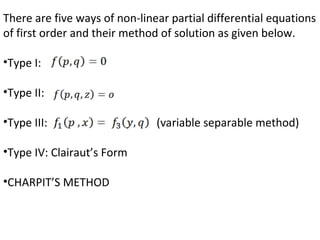
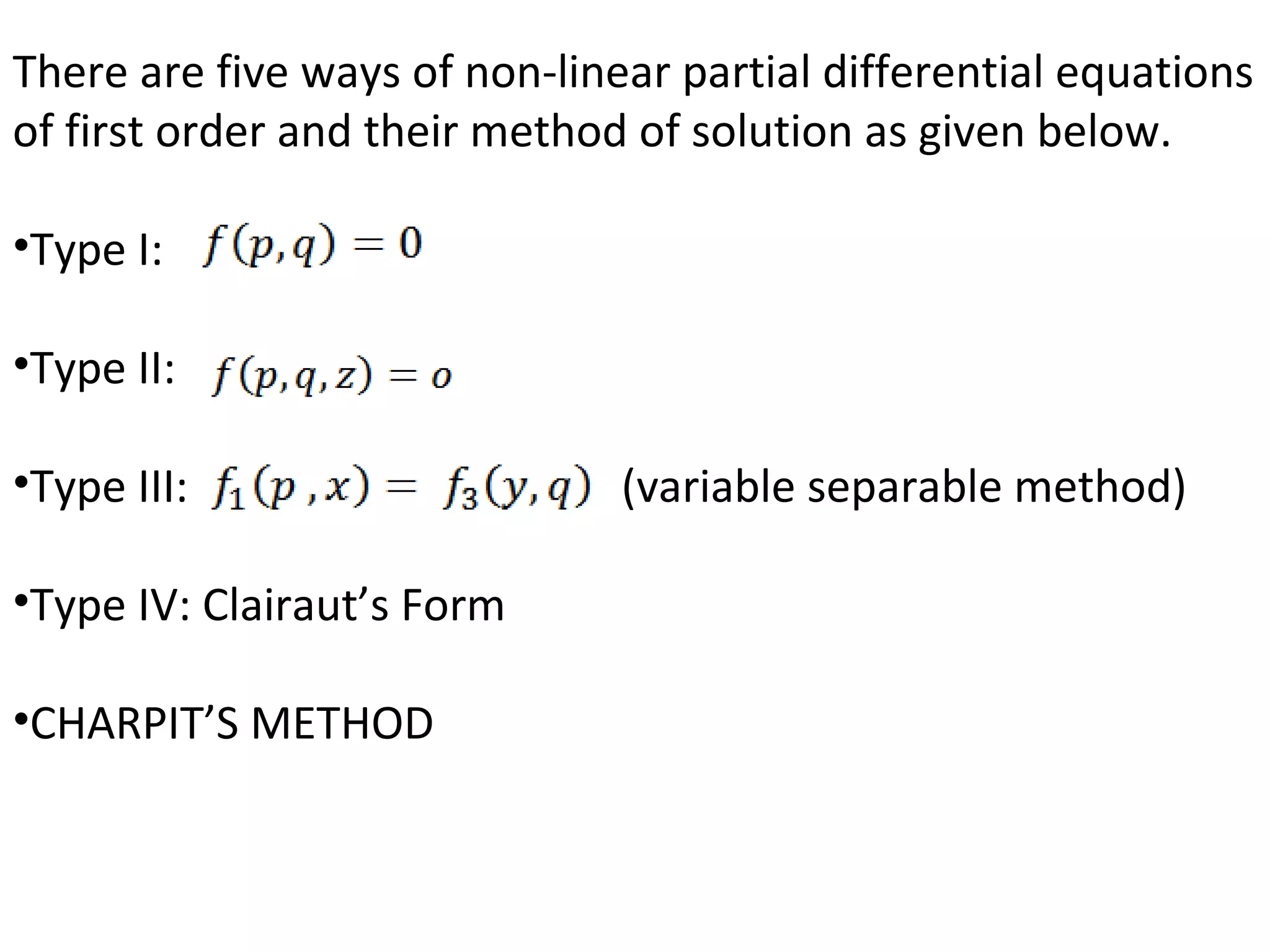
There are five ways of non-linear partial differential equations
of first order and their method of solution as given below.
•Type I:
•Type II:
•Type III: (variable separable method)
•Type IV: Clairaut’s Form
•CHARPIT’S METHOD
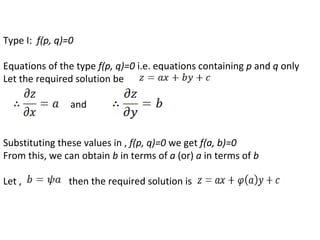
Type I: f(p, q)=0
Equations of the type f(p, q)=0 i.e. equations containing p and q only
Let the required solution be
and
Substituting these values in , f(p, q)=0 we get f(a, b)=0
From this, we can obtain b in terms of a (or) a in terms of b
Let , then the required solution is
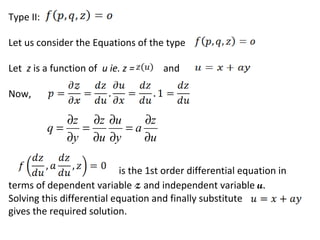
Type II:
Let us consider the Equations of the type
Let z is a function of u ie. z = and
Now,
is the 1st order differential equation in
terms of dependent variable z and independent variable u.
Solving this differential equation and finally substitute
gives the required solution.
u
z
a
y
u
u
z
y
z
q
∂
∂
=
∂
∂
∂
∂
=
∂
∂
=
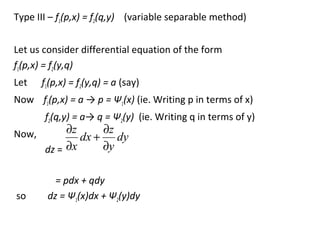
Type III – f1(p,x) = f2(q,y) (variable separable method)
Let us consider differential equation of the form
f1(p,x) = f2(y,q)
Let f1(p,x) = f2(y,q) = a (say)
Now f1(p,x) = a → p = Ψ1(x) (ie. Writing p in terms of x)
f2(q,y) = a→ q = Ψ2(y) (ie. Writing q in terms of y)
Now,
dz =
= pdx + qdy
so dz = Ψ1(x)dx + Ψ2(y)dy
dy
y
z
dx
x
z
∂
∂
+
∂
∂
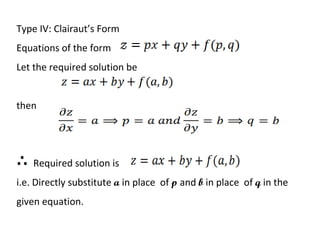
Type IV: Clairaut’s Form
Equations of the form
Let the required solution be
then
Required solution is
i.e. Directly substitute a in place of p and b in place of q in the
given equation.
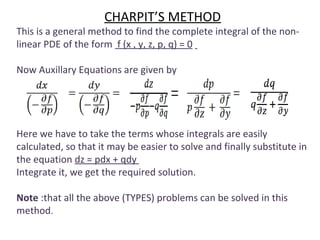
CHARPIT’S METHOD
This is a general method to find the complete integral of the non-
linear PDE of the form f (x , y, z, p, q) = 0
Now Auxillary Equations are given by
Here we have to take the terms whose integrals are easily
calculated, so that it may be easier to solve and finally substitute in
the equation dz = pdx + qdy
Integrate it, we get the required solution.
Note :that all the above (TYPES) problems can be solved in this
method.
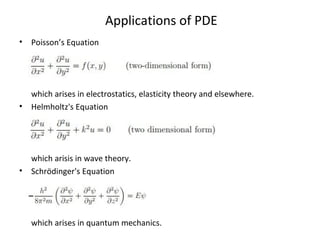
Applications of PDE
• Poisson’s Equation
which arises in electrostatics, elasticity theory and elsewhere.
• Helmholtz's Equation
which arisis in wave theory.
• Schrödinger's Equation
which arises in quantum mechanics.
THANK YOU

First order non-linear partial differential equation & its applications

  • 1.
    There are fiveways of non-linear partial differential equations of first order and their method of solution as given below. •Type I: •Type II: •Type III: (variable separable method) •Type IV: Clairaut’s Form •CHARPIT’S METHOD
  • 2.
    Type I: f(p,q)=0 Equations of the type f(p, q)=0 i.e. equations containing p and q only Let the required solution be and Substituting these values in , f(p, q)=0 we get f(a, b)=0 From this, we can obtain b in terms of a (or) a in terms of b Let , then the required solution is
  • 3.
    Type II: Let usconsider the Equations of the type Let z is a function of u ie. z = and Now, is the 1st order differential equation in terms of dependent variable z and independent variable u. Solving this differential equation and finally substitute gives the required solution. u z a y u u z y z q ∂ ∂ = ∂ ∂ ∂ ∂ = ∂ ∂ =
  • 4.
    Type III –f1(p,x) = f2(q,y) (variable separable method) Let us consider differential equation of the form f1(p,x) = f2(y,q) Let f1(p,x) = f2(y,q) = a (say) Now f1(p,x) = a → p = Ψ1(x) (ie. Writing p in terms of x) f2(q,y) = a→ q = Ψ2(y) (ie. Writing q in terms of y) Now, dz = = pdx + qdy so dz = Ψ1(x)dx + Ψ2(y)dy dy y z dx x z ∂ ∂ + ∂ ∂
  • 5.
    Type IV: Clairaut’sForm Equations of the form Let the required solution be then Required solution is i.e. Directly substitute a in place of p and b in place of q in the given equation.
  • 6.
    CHARPIT’S METHOD This isa general method to find the complete integral of the non- linear PDE of the form f (x , y, z, p, q) = 0 Now Auxillary Equations are given by Here we have to take the terms whose integrals are easily calculated, so that it may be easier to solve and finally substitute in the equation dz = pdx + qdy Integrate it, we get the required solution. Note :that all the above (TYPES) problems can be solved in this method.
  • 7.
    Applications of PDE •Poisson’s Equation which arises in electrostatics, elasticity theory and elsewhere. • Helmholtz's Equation which arisis in wave theory. • Schrödinger's Equation which arises in quantum mechanics.
  • 8.