MATHEMATICS
E-Content
On
Differential Equation
Vinay M. Raut
Associate Professor
Shri Shivaji Science College, Amravati
2
Differential Equation (D.E.)
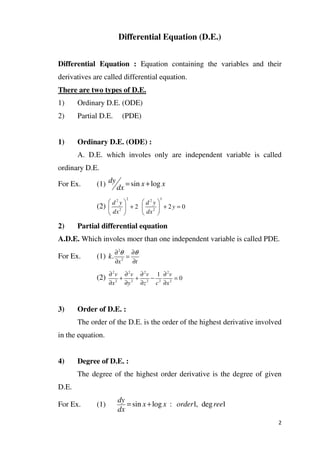
Differential Equation : Equation containing the variables and their
derivatives are called differential equation.
There are two types of D.E.
1) Ordinary D.E. (ODE)
2) Partial D.E. (PDE)
1) Ordinary D.E. (ODE) :
A. D.E. which involes only are independent variable is called
ordinary D.E.
For Ex. (1) sin log
dy x x
dx = +
(2)
2
2
2
2
d y
dx
 
+
 
 
3
2
2
2 0
d y
y
dx
 
+ =
 
 
2) Partial differential equation
A.D.E. Which involes moer than one independent variable is called PDE.
For Ex. (1)
2
2
.
x t
k
θ θ
∂ ∂
=
∂ ∂
(2)
2 2 2 2
2 2 2 2 2
1
0
v v v v
x y z c x
∂ ∂ ∂ ∂
+ + − =
∂ ∂ ∂ ∂
3) Order of D.E. :
The order of the D.E. is the order of the highest derivative involved
in the equation.
4) Degree of D.E. :
The degree of the highest order derivative is the degree of given
D.E.
For Ex. (1) sin log : 1, deg 1
dy
x x order ree
dx
= +
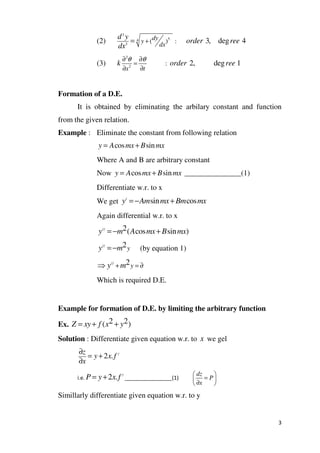
3
(2)
3
5
4
3
( ) : 3, deg 4
dy
y
dx
d y
order ree
dx
+
=
(3)
2
2
: 2, deg 1
x t
k order ree
θ θ
∂ ∂
=
∂ ∂
Formation of a D.E.
It is obtained by eliminating the arbilary constant and function
from the given relation.
Example : Eliminate the constant from following relation
cos sin
y A mx B mx
= +
Where A and B are arbitrary constant
Now cos sin
y A mx B mx
= + _______________(1)
Differentiate w.r. to x
We get /
sin cos
y Am mx Bm mx
= − +
Again differential w.r. to x
// 2( cos sin )
y m A mx B mx
= − +
// 2y
y m
=− (by equation 1)
// 2y
y m
+ = ∂
⇒
Which is required D.E.
Example for formation of D.E. by limiting the arbitrary function
Ex. 2 2
( )
Z xy f x y
= + +
Solution : Differentiate given equation w.r. to x we gel
/
2 .
z
y x f
x
∂
= +
∂
i.e.
/
2 .
P y x f
= + ________________(1)
dz
P
x
 
=
 
∂
 
Simillarly differentiate given equation w.r. to y
4
We /
2
z
x yf
y
∂
= +
∂
i.e. /
2
q x yf
= + _____________(2)
dz
q
dy
 
 
 
=
multiply equation (1) by y and equation (2) by x and subtract we get.
2 2
x
YP xq y −
− = is the required D.E.
First order ordinary differential equation :
In general an ODE of the first order and first degree is expressed in
the form / /
( ) 0, y , [ ]
dy
f x y y x a b
dx ε
= =
Method for solving first order O.D.E.
Method First :
Working Rule : Seprate the coefficient of dx and dy so that the
coefficient of dx is function x- only and coefficient of dy is function of
y-only. Further on integration we get the required solution.
For ex. (1) Solve 2
3
dy x y y
e x e
dx
− −
= +
Solution 2
( 3 )
x
e x
dy y
e
dx
+
−
=
2
( 3 )
y x
dy e e x dx
−
⇒ = +
2
( 3 )
dy
y x
e e x dx
=
⇒ +
Thus the variable are separable
∴ On integration we get
3
y x
e e x C
= + + Where C = integration constant is the required solution
of given D.E.
5
Method Second : Exact differential equation
Theorem :
A necessary condition for ( ) ( ) 0
M xy dx N xy dy
+ = to be exact is
My Nx
= where M and N are continuously differential function.
Proof :
Let ( ) ( ) 0
M x y dx N x y dy
+ = to be exact differential equation
then by definition df Mdx Ndy
= + ____________ (1)
(df = total differential function of ( )
f xy )
But . .
df fx dx fy dy
= + ______________(2)
Equation (1) and (2) ⇒
M fx
= and fy N
=
differentiate partially
⇒ My Fxy
= fyx Nx
=
But mixed partial derivative are equation
∴ [ ]
My Nx Fyx Fxy
= =
∵
Working Method to solve
1) Find the values of M and N then verify My Nx
=
2) Then solution is written as
( form N not containing )
Mdx term x dy C
+ =
∫ ∫
Ex. Test the following D.E. for exactness and solve them if they are
exact. 2 2 2 2
( 4 2 ) ( 4 2 ) 0
x xy y dx y xy x dy
− − + − − =
Solution : This is of the form
0
Mdx Ndy
+ =
Here 2 2
4 2
M x xy y
= − − 2 2
4 2
N y xy x
= − −
⇒ diff. partially w.r. to y diff. partially w.r. to x
∴ 4 4
My x y
= − − 4 4
Nx y x
= − −
6
∴ We have My Nx
=
⇒ Give D.E. is exact
∴ Required solution is
. ( form N not containing )
M dx term x dy c
+ =
∫ ∫
y-constant (x)
⇒ ( )
tan
2 2 2
4 2
y cons t
x xy y dx y dy C
−
− − + =
∫
∫
⇒
3
3 2 2
2 2
3 3
y
x x y xy C
− − + =
Or
3 3 6 ( )
x y xy x y c
+ − + =
is required solution
Method Third :
Lineal Equation
A linear equation of the first order is of the form
/
Y PY Q
+ =
Where P, Q are function of x
Working Rule
1) Find out integrating factor
e
Pdx
∫
2) Then Solution may be written as
.( ) .( ).
y If Q If dx C
= +
∫
⇒ y.e
Pdx
=
∫ . .
Pdx
Q e dx C
∫ +
∫
Ex. Solve | 1
2
1
y y
x
e
+ =
+
Solution : The given D.E. is linear because it is of the form
7
dy
dx
py Q
+ = Where 2
1
1,
1 x
P Q
e
= =
+
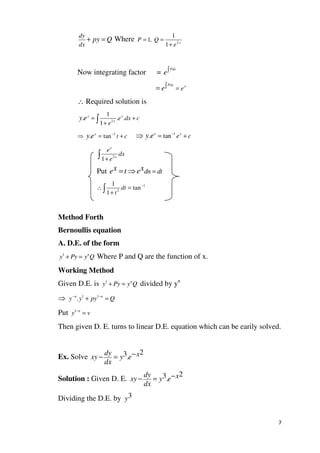
Now integrating factor =
Pdx
e∫
Pdx x
e
e∫ =
=
∴ Required solution is
2
1
. .
1
. x x
x
e dx c
e
y e = +
+
∫
⇒ 1
tan
. x
t c
y e −
= + 1
tan
. x x
e c
y e −
= +
⇒
2
1
x
x
e
dx
e
+
∫
Put dn dt
x x
e t e =
= ⇒
1
2
1
tan
1
dt
t
−
∴ =
+
∫
Method Forth
Bernoullis equation
A. D.E. of the form
1 n
y Py y Q
+ = Where P and Q are the function of x.
Working Method
Given D.E. is 1 n
y Py y Q
+ = divided by yn
⇒ 1 1
.
n n
y y py Q
− −
+ =
Put 1 n
y v
−
=
Then given D. E. turns to linear D.E. equation which can be earily solved.
Ex. Solve
2
3.
dy x
xy y e
dx
−
− =
Solution : Given D. E.
2
3.
dy x
xy y e
dx
−
− =
Dividing the D.E. by 3
y
8
⇒ 2 3 2
.
dy x
xy y e
dx
− − −
− = ____________________(1)
Taking 2
y V
− =
⇒
3
2 .
dv
dy
y dx dx
−
− =
⇒
1
3.
2
dy dv
y dx dx
−
− =
∴ Equation (1) ⇒
2
1
2
x
dv
xv e
dx
−
+ =
⇒ 2
2 2 x
dv xv e
dx
−
+ = ____________________(2)
This is linear (1) equation in v
∴ Solution of equation (2) is
⇒
2 2 2
. 2. .
x x x
v e e e dx c
−
= +
∫
Put the value of v
⇒ 2 2(2 )
ex y x c
= +
Method fifth
Clairaut’s Equation
The form of the equation is ( )
y px f p
= +
It’s solution is obtained just replacing P by C.
Ex. Solve log( )
P Px y
= −
Solution : Given D. Equation is
p
Px y e
− =
Or p
y Px e
= +
This is of clairants form
∴ It’s solution is y = cx+eP
2
2
.
xdx x
I f e e
∫
= =
9
Objective Question
1) The D.E. // /
4 4 0
Y y y
− + = has roots ______________.
2) The D.E. Which involes only one independent variable is called an
____________.
3) The D.E. which involes more than one independent variable is called
_________.
4) The order of D.E. is the order of ________ derivative in the D.E.
5) A necessary condition for 0
Mdx Ndy
+ = to be exact is __________.
6) The form of the equation ( )
y px f p
= + is called _________.
7) The order and degree of D. E. is
2
2
2
sin 0
d y dy
x y x
dx dx
+ − − = _________.
8) A linear equation of the first order is of the form ________.
9) The D.E. of the form | n
y py y Q
+ = is called as ________.
10) Integrating factor is ___________.
11) Ordinary D.E. involves only ________ independent variable.
12) PDE which involves ________ independent variables.
------------------------------- * * * * * * -----------------------------

Differential Equation

  • 1.
    MATHEMATICS E-Content On Differential Equation Vinay M.Raut Associate Professor Shri Shivaji Science College, Amravati
  • 2.
    2 Differential Equation (D.E.) DifferentialEquation : Equation containing the variables and their derivatives are called differential equation. There are two types of D.E. 1) Ordinary D.E. (ODE) 2) Partial D.E. (PDE) 1) Ordinary D.E. (ODE) : A. D.E. which involes only are independent variable is called ordinary D.E. For Ex. (1) sin log dy x x dx = + (2) 2 2 2 2 d y dx   +     3 2 2 2 0 d y y dx   + =     2) Partial differential equation A.D.E. Which involes moer than one independent variable is called PDE. For Ex. (1) 2 2 . x t k θ θ ∂ ∂ = ∂ ∂ (2) 2 2 2 2 2 2 2 2 2 1 0 v v v v x y z c x ∂ ∂ ∂ ∂ + + − = ∂ ∂ ∂ ∂ 3) Order of D.E. : The order of the D.E. is the order of the highest derivative involved in the equation. 4) Degree of D.E. : The degree of the highest order derivative is the degree of given D.E. For Ex. (1) sin log : 1, deg 1 dy x x order ree dx = +
  • 3.
    3 (2) 3 5 4 3 ( ) :3, deg 4 dy y dx d y order ree dx + = (3) 2 2 : 2, deg 1 x t k order ree θ θ ∂ ∂ = ∂ ∂ Formation of a D.E. It is obtained by eliminating the arbilary constant and function from the given relation. Example : Eliminate the constant from following relation cos sin y A mx B mx = + Where A and B are arbitrary constant Now cos sin y A mx B mx = + _______________(1) Differentiate w.r. to x We get / sin cos y Am mx Bm mx = − + Again differential w.r. to x // 2( cos sin ) y m A mx B mx = − + // 2y y m =− (by equation 1) // 2y y m + = ∂ ⇒ Which is required D.E. Example for formation of D.E. by limiting the arbitrary function Ex. 2 2 ( ) Z xy f x y = + + Solution : Differentiate given equation w.r. to x we gel / 2 . z y x f x ∂ = + ∂ i.e. / 2 . P y x f = + ________________(1) dz P x   =   ∂   Simillarly differentiate given equation w.r. to y
  • 4.
    4 We / 2 z x yf y ∂ =+ ∂ i.e. / 2 q x yf = + _____________(2) dz q dy       = multiply equation (1) by y and equation (2) by x and subtract we get. 2 2 x YP xq y − − = is the required D.E. First order ordinary differential equation : In general an ODE of the first order and first degree is expressed in the form / / ( ) 0, y , [ ] dy f x y y x a b dx ε = = Method for solving first order O.D.E. Method First : Working Rule : Seprate the coefficient of dx and dy so that the coefficient of dx is function x- only and coefficient of dy is function of y-only. Further on integration we get the required solution. For ex. (1) Solve 2 3 dy x y y e x e dx − − = + Solution 2 ( 3 ) x e x dy y e dx + − = 2 ( 3 ) y x dy e e x dx − ⇒ = + 2 ( 3 ) dy y x e e x dx = ⇒ + Thus the variable are separable ∴ On integration we get 3 y x e e x C = + + Where C = integration constant is the required solution of given D.E.
  • 5.
    5 Method Second :Exact differential equation Theorem : A necessary condition for ( ) ( ) 0 M xy dx N xy dy + = to be exact is My Nx = where M and N are continuously differential function. Proof : Let ( ) ( ) 0 M x y dx N x y dy + = to be exact differential equation then by definition df Mdx Ndy = + ____________ (1) (df = total differential function of ( ) f xy ) But . . df fx dx fy dy = + ______________(2) Equation (1) and (2) ⇒ M fx = and fy N = differentiate partially ⇒ My Fxy = fyx Nx = But mixed partial derivative are equation ∴ [ ] My Nx Fyx Fxy = = ∵ Working Method to solve 1) Find the values of M and N then verify My Nx = 2) Then solution is written as ( form N not containing ) Mdx term x dy C + = ∫ ∫ Ex. Test the following D.E. for exactness and solve them if they are exact. 2 2 2 2 ( 4 2 ) ( 4 2 ) 0 x xy y dx y xy x dy − − + − − = Solution : This is of the form 0 Mdx Ndy + = Here 2 2 4 2 M x xy y = − − 2 2 4 2 N y xy x = − − ⇒ diff. partially w.r. to y diff. partially w.r. to x ∴ 4 4 My x y = − − 4 4 Nx y x = − −
  • 6.
    6 ∴ We haveMy Nx = ⇒ Give D.E. is exact ∴ Required solution is . ( form N not containing ) M dx term x dy c + = ∫ ∫ y-constant (x) ⇒ ( ) tan 2 2 2 4 2 y cons t x xy y dx y dy C − − − + = ∫ ∫ ⇒ 3 3 2 2 2 2 3 3 y x x y xy C − − + = Or 3 3 6 ( ) x y xy x y c + − + = is required solution Method Third : Lineal Equation A linear equation of the first order is of the form / Y PY Q + = Where P, Q are function of x Working Rule 1) Find out integrating factor e Pdx ∫ 2) Then Solution may be written as .( ) .( ). y If Q If dx C = + ∫ ⇒ y.e Pdx = ∫ . . Pdx Q e dx C ∫ + ∫ Ex. Solve | 1 2 1 y y x e + = + Solution : The given D.E. is linear because it is of the form
  • 7.
    7 dy dx py Q + =Where 2 1 1, 1 x P Q e = = + Now integrating factor = Pdx e∫ Pdx x e e∫ = = ∴ Required solution is 2 1 . . 1 . x x x e dx c e y e = + + ∫ ⇒ 1 tan . x t c y e − = + 1 tan . x x e c y e − = + ⇒ 2 1 x x e dx e + ∫ Put dn dt x x e t e = = ⇒ 1 2 1 tan 1 dt t − ∴ = + ∫ Method Forth Bernoullis equation A. D.E. of the form 1 n y Py y Q + = Where P and Q are the function of x. Working Method Given D.E. is 1 n y Py y Q + = divided by yn ⇒ 1 1 . n n y y py Q − − + = Put 1 n y v − = Then given D. E. turns to linear D.E. equation which can be earily solved. Ex. Solve 2 3. dy x xy y e dx − − = Solution : Given D. E. 2 3. dy x xy y e dx − − = Dividing the D.E. by 3 y
  • 8.
    8 ⇒ 2 32 . dy x xy y e dx − − − − = ____________________(1) Taking 2 y V − = ⇒ 3 2 . dv dy y dx dx − − = ⇒ 1 3. 2 dy dv y dx dx − − = ∴ Equation (1) ⇒ 2 1 2 x dv xv e dx − + = ⇒ 2 2 2 x dv xv e dx − + = ____________________(2) This is linear (1) equation in v ∴ Solution of equation (2) is ⇒ 2 2 2 . 2. . x x x v e e e dx c − = + ∫ Put the value of v ⇒ 2 2(2 ) ex y x c = + Method fifth Clairaut’s Equation The form of the equation is ( ) y px f p = + It’s solution is obtained just replacing P by C. Ex. Solve log( ) P Px y = − Solution : Given D. Equation is p Px y e − = Or p y Px e = + This is of clairants form ∴ It’s solution is y = cx+eP 2 2 . xdx x I f e e ∫ = =
  • 9.
    9 Objective Question 1) TheD.E. // / 4 4 0 Y y y − + = has roots ______________. 2) The D.E. Which involes only one independent variable is called an ____________. 3) The D.E. which involes more than one independent variable is called _________. 4) The order of D.E. is the order of ________ derivative in the D.E. 5) A necessary condition for 0 Mdx Ndy + = to be exact is __________. 6) The form of the equation ( ) y px f p = + is called _________. 7) The order and degree of D. E. is 2 2 2 sin 0 d y dy x y x dx dx + − − = _________. 8) A linear equation of the first order is of the form ________. 9) The D.E. of the form | n y py y Q + = is called as ________. 10) Integrating factor is ___________. 11) Ordinary D.E. involves only ________ independent variable. 12) PDE which involves ________ independent variables. ------------------------------- * * * * * * -----------------------------