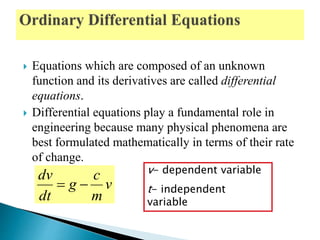
 Equations which are composed of an unknown
function and its derivatives are called differential
equations.
 Differential equations play a fundamental role in
engineering because many physical phenomena are
best formulated mathematically in terms of their rate
of change.
v- dependent variable
t- independent
variable
v
m
c
g
dt
dv

 When a function involves one dependent variable, the
equation is called an ordinary differential equation
(or ODE). A partial differential equation (or PDE)
involves two or more independent variables.
 Differential equations are also classified as to their
order.
 A first order equation includes a first derivative as its
highest derivative.
 A second order equation includes a second derivative.
 Higher order equations can be reduced to a system of
first order equations, by redefining a variable.
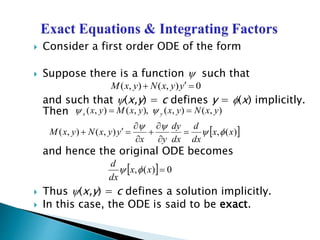
 Consider a first order ODE of the form
 Suppose there is a function  such that
and such that (x,y) = c defines y = (x) implicitly.
Then
and hence the original ODE becomes
 Thus (x,y) = c defines a solution implicitly.
 In this case, the ODE is said to be exact.
0),(),(  yyxNyxM
),(),(),,(),( yxNyxyxMyx yx  
 )(,),(),( xx
dx
d
dx
dy
yx
yyxNyxM 








  0)(, xx
dx
d

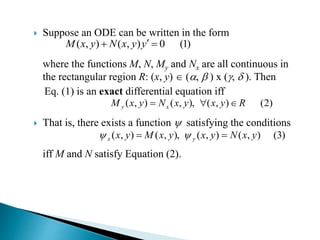
 Suppose an ODE can be written in the form
where the functions M, N, My and Nx are all continuous in
the rectangular region R: (x, y)  (,  ) x (,  ). Then
Eq. (1) is an exact differential equation iff
 That is, there exists a function  satisfying the conditions
iff M and N satisfy Equation (2).
)1(0),(),(  yyxNyxM
)2(),(),,(),( RyxyxNyxM xy 
)3(),(),(),,(),( yxNyxyxMyx yx  
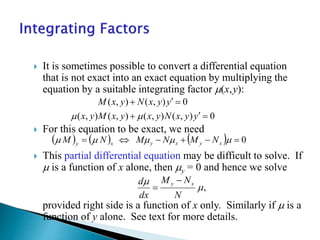
 It is sometimes possible to convert a differential equation
that is not exact into an exact equation by multiplying the
equation by a suitable integrating factor (x,y):
 For this equation to be exact, we need
 This partial differential equation may be difficult to solve. If
 is a function of x alone, then y = 0 and hence we solve
provided right side is a function of x only. Similarly if  is a
function of y alone. See text for more details.
0),(),(),(),(
0),(),(


yyxNyxyxMyx
yyxNyxM

      0  xyxyxy NMNMNM
,

N
NM
dx
d xy 

 
2
2
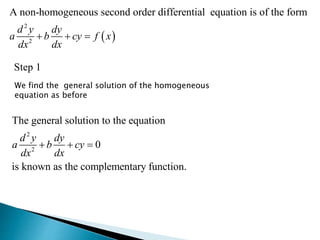
A non-homogeneous second order differential equation is of the form
d y dy
a b cy f x
dx dx
  
We find the general solution of the homogeneous
equation as before
2
2
The general solution to the equation
0
is known as the complementary function.
d y dy
a b cy
dx dx
  
Step 1
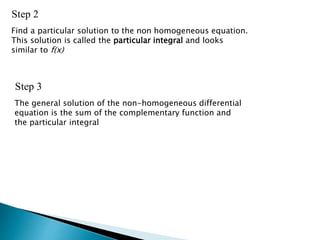
Step 2
Find a particular solution to the non homogeneous equation.
This solution is called the particular integral and looks
similar to f(x)
Step 3
The general solution of the non-homogeneous differential
equation is the sum of the complementary function and
the particular integral
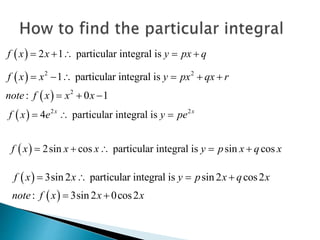
  2 1 particular integral isf x x y px q    
 
 
2 2
2
1 particular integral is
: 0 1
f x x y px qx r
note f x x x
     
  
  2 2
4 particular integral isx x
f x e y pe  
  2sin cos particular integral is sin cosf x x x y p x q x    
 
 
3sin 2 particular integral is sin 2 cos2
: 3sin 2 0cos2
f x x y p x q x
note f x x x
   
 
2
2
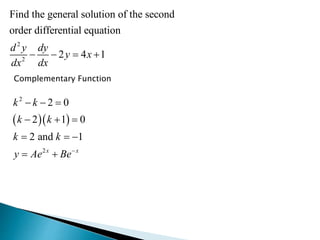
Find the general solution of the second
order differential equation
2 4 1
d y dy
y x
dx dx
   
  
2
2
2 0
2 1 0
2 and 1
x x
k k
k k
k k
y Ae Be
  
  
  
 
Complementary Function
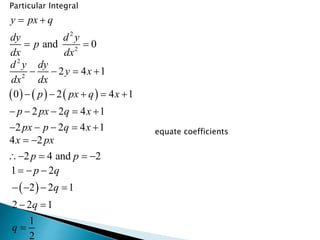
Particular Integral
2
2
and 0
y px q
dy d y
p
dx dx
 
 
     
2
2
2 4 1
0 2 4 1
2 2 4 1
2 2 4 1
d y dy
y x
dx dx
p px q x
p px q x
px p q x
   
    
    
     equate coefficients
4 2
2 4 and 2
x px
p p
 
   
 
1 2
2 2 1
2 2 1
1
2
p q
q
q
q
  
   
 

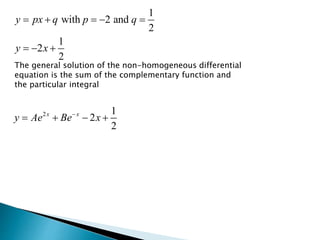
The general solution of the non-homogeneous differential
equation is the sum of the complementary function and
the particular integral
2 1
2
2
x x
y Ae Be x
   
1
with 2 and
2
1
2
2
y px q p q
y x
    
  

Differential equation and Laplace transform

  • 2.
     Equations whichare composed of an unknown function and its derivatives are called differential equations.  Differential equations play a fundamental role in engineering because many physical phenomena are best formulated mathematically in terms of their rate of change. v- dependent variable t- independent variable v m c g dt dv 
  • 3.
     When afunction involves one dependent variable, the equation is called an ordinary differential equation (or ODE). A partial differential equation (or PDE) involves two or more independent variables.  Differential equations are also classified as to their order.  A first order equation includes a first derivative as its highest derivative.  A second order equation includes a second derivative.  Higher order equations can be reduced to a system of first order equations, by redefining a variable.
  • 4.
     Consider afirst order ODE of the form  Suppose there is a function  such that and such that (x,y) = c defines y = (x) implicitly. Then and hence the original ODE becomes  Thus (x,y) = c defines a solution implicitly.  In this case, the ODE is said to be exact. 0),(),(  yyxNyxM ),(),(),,(),( yxNyxyxMyx yx    )(,),(),( xx dx d dx dy yx yyxNyxM            0)(, xx dx d 
  • 5.
     Suppose anODE can be written in the form where the functions M, N, My and Nx are all continuous in the rectangular region R: (x, y)  (,  ) x (,  ). Then Eq. (1) is an exact differential equation iff  That is, there exists a function  satisfying the conditions iff M and N satisfy Equation (2). )1(0),(),(  yyxNyxM )2(),(),,(),( RyxyxNyxM xy  )3(),(),(),,(),( yxNyxyxMyx yx  
  • 6.
     It issometimes possible to convert a differential equation that is not exact into an exact equation by multiplying the equation by a suitable integrating factor (x,y):  For this equation to be exact, we need  This partial differential equation may be difficult to solve. If  is a function of x alone, then y = 0 and hence we solve provided right side is a function of x only. Similarly if  is a function of y alone. See text for more details. 0),(),(),(),( 0),(),(   yyxNyxyxMyx yyxNyxM        0  xyxyxy NMNMNM ,  N NM dx d xy  
  • 8.
      2 2 A non-homogeneoussecond order differential equation is of the form d y dy a b cy f x dx dx    We find the general solution of the homogeneous equation as before 2 2 The general solution to the equation 0 is known as the complementary function. d y dy a b cy dx dx    Step 1
  • 9.
    Step 2 Find aparticular solution to the non homogeneous equation. This solution is called the particular integral and looks similar to f(x) Step 3 The general solution of the non-homogeneous differential equation is the sum of the complementary function and the particular integral
  • 11.
      21 particular integral isf x x y px q         2 2 2 1 particular integral is : 0 1 f x x y px qx r note f x x x            2 2 4 particular integral isx x f x e y pe     2sin cos particular integral is sin cosf x x x y p x q x         3sin 2 particular integral is sin 2 cos2 : 3sin 2 0cos2 f x x y p x q x note f x x x      
  • 12.
    2 2 Find the generalsolution of the second order differential equation 2 4 1 d y dy y x dx dx        2 2 2 0 2 1 0 2 and 1 x x k k k k k k y Ae Be            Complementary Function
  • 13.
    Particular Integral 2 2 and 0 ypx q dy d y p dx dx           2 2 2 4 1 0 2 4 1 2 2 4 1 2 2 4 1 d y dy y x dx dx p px q x p px q x px p q x                    equate coefficients 4 2 2 4 and 2 x px p p         1 2 2 2 1 2 2 1 1 2 p q q q q          
  • 14.
    The general solutionof the non-homogeneous differential equation is the sum of the complementary function and the particular integral 2 1 2 2 x x y Ae Be x     1 with 2 and 2 1 2 2 y px q p q y x        